
When did Belgium get independence from the Netherlands?
Belgium proclaimed independence on October 4, 1830, but formal recognition by the Netherlands came with the 1839 Treaty of London.
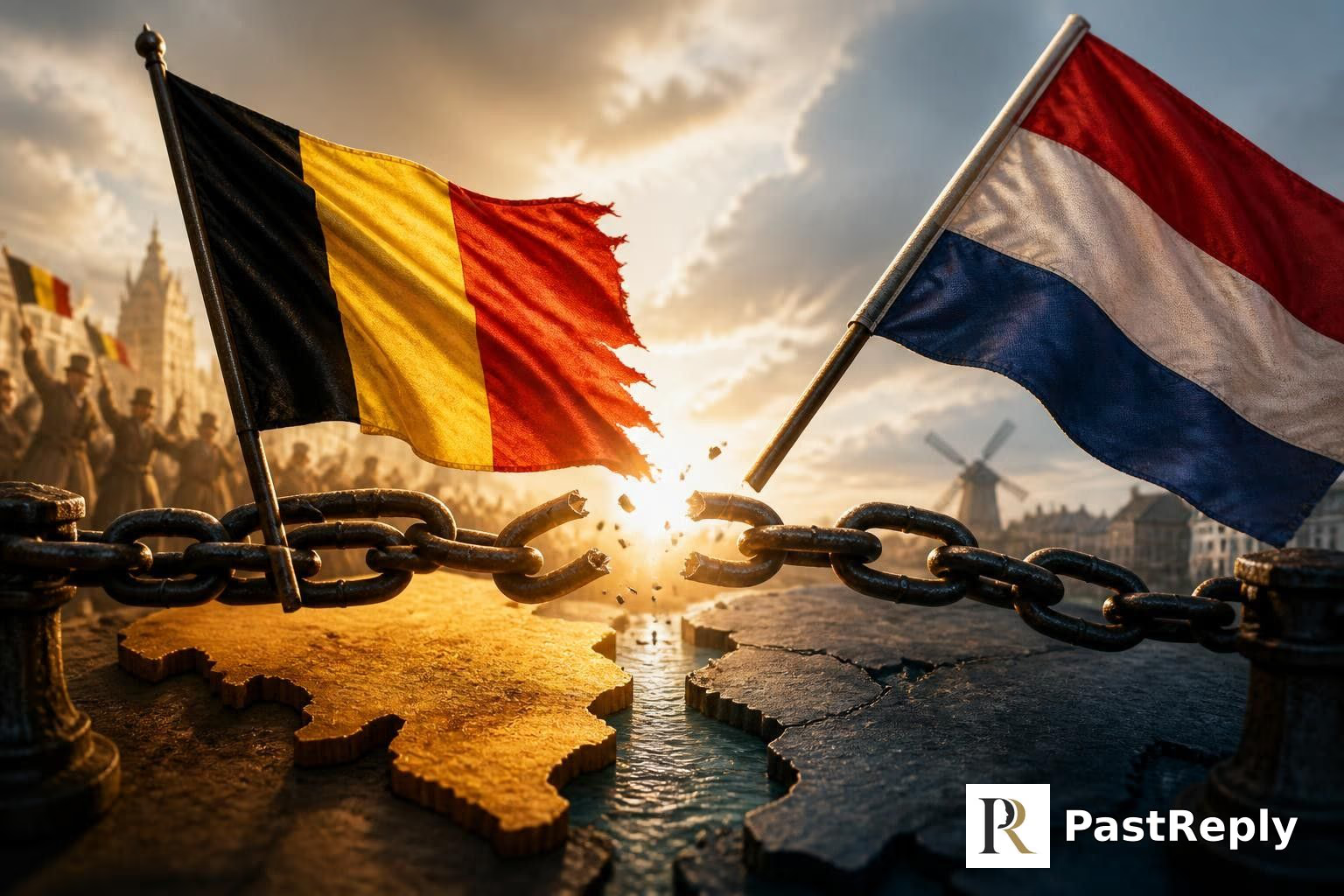
The facts
Belgium declared its independence from the Kingdom of the Netherlands on October 4, 1830, following the Belgian Revolution that began in August 1830. The provisional government proclaimed independence on that date.
However, formal international recognition of Belgium's independence came later. The major European powers recognized de facto independence on December 20, 1830, and the London Conference of 1830 - 31 led to the establishment of a constitutional monarchy under King Leopold I in 1831. The Netherlands finally accepted Belgian independence by signing the Treaty of London in 1839, which also guaranteed Belgium's neutrality.
Answered by 100 of history's most famous minds

A kingdom divided against itself cannot stand - but you ask about the carving of a land, not the mending of a soul. Tell me: when a man leaves his father's house, does he count the day on the treaty, or the day he first breathed free? Woe to you who set your heart on borders while the poor lie hungry at the gate.

The day a people declares itself separate from another is a day of great import, but let them remember: Allah alone gives true sovereignty, and He raises up nations and casts them down. If they built their new house on justice for the orphan and the stranger, then let them date it from the first act of mercy. If not, no treaty of London will shield them from the wind.

This question clings to a name - 'Belgium' - and a date - '1830' - as if these were solid things. Yet the kingdom that proclaimed independence is not the kingdom that endures today; the rivers of form flow on, and the attachment to a moment of 'becoming' only feeds the craving for security. The wise one asks instead: what suffering did this separation ease, and what greed does it still serve? Only by seeing the impermanence of all sovereignty can one be free.

A people cried out from under a foreign yoke, and the Lord heard their groaning. The Belgians broke their bonds in 1830, not by their own sword alone, but because the time of their captivity was fulfilled. Yet I ask: did they remember the Lawgiver when they built their throne? The London treaty gave them a king and a guarantee of neutrality - but a nation that forgets the covenant of justice will find its walls are paper. Let them keep the Sabbath of liberty, but let them also keep the weight of righteousness, lest a new Pharaoh arise from within.

When a household divides, one must ask: have the children shown filial piety, and the father ruled with virtue? If the Dutch governed as a tyrant, the Belgians were right to restore harmony through proper relationships. But independence without rectified names - without each knowing their duty - brings only chaos.

For nine years the nations of men argued over lines on a map, while the true Kingdom - where there is neither Belgian nor Dutch, but Christ is all and in all - waits for no treaty. Yet I see in that struggle a shadow of the freedom we have in the Spirit: not from earthly rulers, but from the law of sin and death. Let them glory in their independence; we boast only in the cross, by which the dividing wall of hostility is broken down.

A people called out from among a people, leaving the old land of their fathers for a promise. I know that journey. The tent peg pulled up, the road stretching strange ahead. October or no, they trusted a voice that said, 'Go, and I will show you.' The date is the first step; the fulfillment is in the walking.

A reed that once bent north now stands tall in its own marsh - the wind shifts, and the root holds fast. The river does not ask permission; it simply finds its own way to the sea. Let others mark the day on a calendar; the sage watches the water flow.

When a people throw off the yoke of another, they must not forget the One who watches over all. The Dutch and the Belgian - brothers under one Creator - drew lines on a map, but the true kingdom is not of this world. Let them seek justice, share their bread, and remember that no flag is worth more than the Name of the One who made us all equal.

My heart magnifies the Lord when I hear of a people that long to be freed from bondage and become their own. He has looked with favor on the lowly, and the proud are scattered in the thoughts of their hearts. May this new kingdom learn to be a shelter for the poor and a refuge for the weary, as the angel said to me, 'Nothing is impossible with God.'

The Belgians broke free from the yoke of the Netherlands by their own will, and I say: let every people that groans under a foreign master trust more in God than in princes. But mark this - a nation's true freedom lies not in treaties or thrones, but in the pure preaching of the Gospel. If the new king, Leopold, exalts himself above Scripture, he will be but another tyrant. Let the people read the Bible in their own tongue and judge.

Independence, properly understood, is a matter of self-governance according to the natural law. The Belgian people, being of distinct custom and language from the Dutch, had a reasonable cause to seek their own rule, for each people should be subject to its own constitution. Yet separation is a grave matter, to be undertaken with due deliberation, not in haste. The nine years of negotiation show that prudence, though slow, is the handmaid of justice.

I know nothing of treaties and conferences. What I know is this: each soul, whether Dutch or Belgian, is precious in God's eyes. The poor who died in the streets of Brussels during that revolution were not thinking of independence - they were thinking of their next meal. Let us not celebrate dates on a calendar, but serve the hungry and forgotten in every nation.

The revolution of 1830 appears to have followed a lawful sequence: a rising, a provisional proclamation, then acknowledgment by the powers at London in December of that same year. Yet the final ratification in 1839, a full decade later, reveals the inertia of political bodies, much like the slow procession of a comet whose orbit is governed by forces unseen. A curious case of action preceding formal recognition - a phenomenon worthy of deeper analysis.

The interval between a declaration and its universal recognition depends on the curvature of political spacetime: the Belgians asserted their independence in 1830, but the Netherlands, like a slow-moving light from a distant star, took nine years to arrive at that same coordinate. What matters is not the date on the calendar but the underlying geometry of power and will - a lesson for any unified field theory of statehood.

A curious case of political divergence: a population of provinces, once united under a single rule, developed variations in language, religion, and economic adaptation until the pressure of the old regime could no longer maintain the bond. The final acceptance in 1839 is like the gradual extinction of a lineage - the Dutch lineage gave way, but the Belgian form flourished in its new niche. I would have enjoyed observing the natural selection of these states over a longer period.

The question is not when Belgium gained independence, but what evidence we weigh. The declaration of 1830 is like a hypothesis announced to the world - bold, but unproven until tested by observation. The real demonstration came when the European powers gathered at London and measured the forces: a new state had formed, stable enough to bear its own weight, and even the Netherlands, after nine years of observation, could not deny the new celestial body. The Treaty of 1839 was the final parallax that confirmed the orbit. Once a thing stands firm under the lens of reason, no decree can undo it.

The Dutch held Belgium at the center of their kingdom, yet observation showed the Belgians' orbit was independent - like the Sun, not the Earth, truly governs its own motion. A simpler, more harmonious arrangement prevailed when the powers recognized the true geometry of nations. So too with the heavens.

A provincial squabble over sovereignty, settled by diplomats quibbling over borders - how primitive. In the age to come, such divisions will be as obsolete as a steam engine. Wireless energy will bind all nations in a single luminous web, and the very idea of a 'border' will seem as quaint as a stagecoach. These Belgians and Dutch wasted a decade arguing over a parcel of land, when the real frontier is the transmission of power through the earth itself.

October 1830 marks a separation of elements, like isolating a new radionuclide. The Belgian provinces, under the Dutch yoke, underwent a reaction - political, not chemical - yielding a new nation. But the process of recognition required years of careful diplomacy, like verifying a discovery through repeated experiments.

In the laboratory of nations, the separation of a kingdom from its neighbor is a slow fermentation. The spark of revolution must be followed by careful culture in the vessels of diplomacy, and the final sterile seal - the treaty of 1839 - came only after the ferment had fully cleared. Chance favors the prepared mind, but patience favors the stable result.

Independence? It's not a spark - it's a long filament that glows after a thousand tests. The Belgians had their revolution in August 1830, and by October they declared themselves a new nation. But the real work - the treaty, the recognition, the machinery of a monarchy - took nine more years. Perspiration, not inspiration. That's how you build a lasting bulb.

Independence is a peculiar concept. If we define a state as a system that follows its own internal rules, then Belgium's declaration was like a machine that suddenly changes its instruction set. The real puzzle is the nine-year delay in the Netherlands' recognition: a slow convergence to a stable equilibrium, perhaps with a few cycles of recursion. One wonders if the king could have been replaced by a simple automaton that said 'yes' in 1830.

Consider the geometry of revolution: a people, like a lever, can exert a great force if they find a firm fulcrum. The Belgians found theirs in the streets of Brussels. But the formal independence, by my reckoning, was a problem of multiple forces - the powers of Europe - acting on a single body. It took nine years to resolve the resultant vector. A clever solution, though I would have preferred a simpler proof.

A kingdom splits not by act of will alone, but when lines of force - grievances, culture, language - build until they break. I picture it like iron filings aligning to a magnet: the people of the south, Catholic and French-speaking, found a stronger attraction to their own pole than to the Calvinist Dutch king. The separation was an experiment nature performed, and the London treaty merely recorded the field.

This birth of a nation masks a deeper drama: the Dutch king was a stern father-figure whom the Belgian provinces - the rebellious children - had to overthrow to achieve their own identity. The 1839 treaty was not a polite agreement but a symbolic castration of the parental authority. The real independence happened in the collective psyche long before the ink dried.

1839, when the Netherlands signed the Treaty of London, though the universe had already known for nine years that Belgium was independent. The delay was purely human - a negotiation between squabbling tribes on a minor planet. From the perspective of a black hole, the event is indistinguishable from a quantum fluctuation in the political field. We are, after all, just a thin film of self-aware molecules on a rock.

Consider the question as an algebraic function: the variable of time - October 4, 1830 - interacts with the constants of language, religion, and economics to produce a new political entity. But the formula is incomplete without the international recognition in 1839. I see this as a series of iterative steps, like a program that runs until it converges on a stable state. History is the tape; the nations are the patterns punched upon it.

Given: a people's desire for self-rule. Given: a king who resisted. By the first axiom of political geometry, a declaration of independence on October 4, 1830, is the point from which the proof proceeds. The Treaty of London in 1839 is the Q.E.D., when the Dutch king finally acknowledged the construct. The demonstration is valid, though the steps are measured in years, not degrees of arc.

Independence is not a matter of proclamations alone. Look at the death registers of Brussels and Antwerp in the autumn of 1830: fever and gangrene from crowded, unsanitary barricades killed more than Dutch bullets. A people must earn its freedom not only with muskets but with clean water, proper drainage, and a statistical bureau that records every preventable death. The London Conference should have mandated a sanitary commission.

Nine years to win what a single bold charge could have taken in a season! The Netherlands king must have lacked Alexander's fury - or his phalanx. When I cut the Gordian knot, I did not wait for a conference of old men to approve my conquest. A people who will their freedom must seize it with the spear, not plead for it with parchment.

A small province tears itself from a larger one, and the great powers cluck their tongues for nine years before the Dutch, like a Gaulish chieftain who has lost a battle, finally signs the treaty. I have seen such squabbles in Gaul and Britain: the Belgians showed the courage to act, the Dutch the wisdom to yield. They would have done well to call a Roman arbiter - I would have settled the matter in a single season's campaign.

Belgium broke from the Netherlands as a serpent sheds its skin when it grows too tight - a kingdom carved from a union never blessed by Isis. A clever courtesan of a realm, she used Europe's congress like I used Caesar and Antony: to play one suitor against another until she stood alone. The London gentlemen gave her a king and a treaty, thinking they'd tamed her, but a state born of revolution will always remember how to bare its fangs.

The Belgian revolt was a provincial rebellion handled with restraint - the Dutch king should have learned from my own patience with the Pannonian legions. He battered Brussels with cannon, then watched the great powers force a separation at London. A wiser prince would have granted concessions early and kept the provinces under his roof, even if loosely. Now Belgium stands as a new republic-turned-kingdom, a client state of the Concert of Europe, much as I made Egypt a protectorate of Rome. The lesson: better to bend a branch than let it break and fall into another's hands.

The Dutch king thought his scribbled treaty ruled the Belgians - but a people's loyalty cannot be penned like a trade route. When I united the tribes, I gave them one law and one sky, not a foreign master. Belgium broke its yoke; good. Now let it swear allegiance to the Eternal Blue Heaven, or be crushed between empires.

A constitution, a king, and a treaty - this is how a people writes its own entry into history. I would have crushed that revolt in a single campaign, but I respect a nation that knows its moment and seizes it. The London Conference took nine years to finish what a swift march could have settled in nine weeks. Still, the Belgians understood one thing: independence is not given; it is taken, held, and armed. Leopold I was a wise choice - a man of calculation, not sentiment.

Independence is not declared in a single moment; it is earned through prudence and sacrifice. The Belgian people in 1830 showed spirit, but a hasty proclamation must be secured by treaties and the consent of powers. Let them build their government on sound principles, lest liberty become license.

I recall a house divided cannot stand, but sometimes a house must be divided to stand at all. These Belgians - they declared themselves free on an October day, yet it took nine years more for the Dutch to sign the papers. A house divided by a line on a map is better than one shattered by war. Let them build on that foundation with charity for all.

A small nation, wrested from the grip of a larger neighbor by the will of its people and the common sense of the great powers. Belgium declared its independence in October 1830, yet the Dutch king sulked for nine years before signing the treaty. History records that the Lion of the Lowlands roared, but the concert of Europe ensured the cub was free. Never surrender, never despair - and never let a setback delay the inevitable triumph of liberty.

The Belgians sought freedom through revolution, but violence begets only more violence. A true independence, won by nonviolent resistance and the suffering of the innocent, would have transformed not only Belgium but also the hearts of the Dutch. The separation came, yes, but it took nine years of treaty-making - a sign that the means were not pure. The strength of the soul, not the sword, is what liberates a people.

The Belgians declared 'We are free' and waited nine years for the world to agree. That is the long, slow arc of justice: it does not bend overnight. Yet they chose the way of revolution, not the disciplined love of nonviolence. Had they sat down in the streets of Brussels and refused to move with prayer and courage, they might have won not only independence but the souls of their adversaries. The beloved community knows no borders.

A people's longing to breathe free, to govern themselves, is a fire that cannot be smothered by any decree. The Belgians declared their independence not in a day, but through a long struggle - as we did in South Africa. What matters is that when the chains fell, they built a nation on reconciliation, not revenge, and chose a king who would serve, not dominate.

WHEN DID BELGIUM GET INDEPENDENCE FROM THE NETHERLANDS? IT WAS IN 1839, WHEN THE DUTCH FINALLY ACCEPTED THE LONDON TREATY. BUT THIS IS JUST A DATE. THE REAL LESSON IS THAT SMALL, ARTIFICIAL STATES LIKE BELGIUM - CREATED BY THE CONGRESS OF VIENNA - ARE NOT VIABLE. THEY ARE A BARRIER TO THE NATURAL ORDER OF STRONG, ETHNICALLY HOMOGENEOUS REICHS. THE BELGIAN REVOLUTION WAS A STEP TOWARD THE BREAKUP OF THE DUTCH EMPIRE, BUT SUCH FRAGMENTATION MUST BE REVERSED.

The Belgian provocateurs broke away from the Dutch crown in 1830, but the imperialist powers only recognized them nine years later. This is the hypocrisy of the bourgeoisie: they preach order but allow revolution when it suits their trade. Lenin taught us that true independence comes not from treaties but from smashing the old state. The Belgians merely swapped one king for another.

The Belgian bourgeoisie exploited popular discontent to seize state power from the Dutch bourgeoisie, setting up a constitutional monarchy to protect their own class interests. The real date is not a declaration but the moment the working class was betrayed. The proletariat of Brussels gained nothing from this 'independence' - they simply changed masters. The revolution of 1830 was a necessary step, but the final liberation must come from the proletariat's own revolution.

A handful of merchants and nobles prattle about 'independence' while the real question is which landlord's boot presses the peasant's neck. 1830, '39 - dates on a paper. Belgium did not become free until the people seized the factories and the fields, and even then the bourgeoisie will find a way to sell it back. The only true independence is the dictatorship of the proletariat.

A most grievous separation, and one my beloved Uncle Leopold was called to heal as their first King. Belgium’s independence was a necessity for European stability - but let us not forget that the Netherlands was a kingdom created by the Congress of Vienna, and its dissolution was a blow to the principle of legitimate sovereignty. Still, the Treaty of London of 1839 secured a neutral throne and a Protestant prince in a Catholic land; one must admire the diplomatic labour.

I remember my father speaking of King Leopold I with great respect. Independence, when it comes through patient diplomacy and a constitutional settlement, can endure far longer than one won by cannon alone. The Belgian people chose their own path within the family of nations, and that choice has been honoured for nearly two centuries. That, I think, is the true measure of a stable realm.

These Low Countries! I myself spent many a year bringing the Frisians and Saxons to the true faith and under one law. That a province should break from its liege lord without the Church’s blessing is a fracture in Christendom. Yet if the Netherlands could not govern them with justice and the fear of God, perhaps a separate crown, blessed by the bishops, may restore order. But let them not forget: all authority comes from the Lord.

God wills that every land be ruled by its own king, not by a foreign master. When the voices spoke to me, they said: 'Daughter of God, go and deliver France.' So I say to the Belgians: if your cause is just and your hearts pure, the Lord will give you victory, even if all the princes of Europe say no. The year on a parchment matters not - what matters is that you have answered heaven’s call.

A kingdom sundered from its sovereign by a summer’s riot? I know something of managing unruly subjects and foreign suitors. Belgium’s trick was to play the great powers against one another: France, England, Prussia all had a stake. A wise prince - or in my case, princess - knows that independence is often a matter of timing and diplomacy, not mere cannon fire. And they gained a capable king in the bargain; I could almost admire the cunning.

A small state carved from a larger one by the whim of a London conference! It is a lesson in the art of the possible: when the great powers agree, even a kingdom can be created overnight. I reformed Russia with the pen and the sword, but I never surrendered a single province. The Belgians gained their throne through calculation, not blood alone - that is the Enlightenment way. Still, a monarch who owes his crown to a treaty is ever a puppet.

I have learned that a people should be governed by their own customs, not by the whim of a distant satrap. If the Belgians wished to be ruled by their own laws and their own prince, then it is just that they should have their own kingdom. A wise ruler does not hold a province by force when a treaty can bind it in loyalty. Let the Netherlands keep its dignity, and let Belgium prosper under its own king - that is the path of peace.

A nation that seeks to rule itself is not to be blamed, so long as it does not oppress others. I have seen what happens when a people is governed by those who do not share their faith or their customs - resentment breeds war. The Belgians chose their own sovereign, and the powers of Europe acknowledged it. That is honourable. But let them remember that true independence is not only from a foreign king, but from the tyranny of one’s own passions.

You ask when Belgium was born, yet you do not ask what it means for a people to be free. Was it on October 4, when they declared themselves apart, or on December 20, when others agreed? Or perhaps later still, when they looked within and asked what virtue their new nation would serve. If they gained independence without gaining wisdom, tell me: what have they truly gained?

To ask 'when' is to chase the shadow on the cave wall, for the true independence of a people is not the date a parchment is signed but the form of justice that informs their laws. Did the Belgian revolution bring harmony among the parts of their soul - reason ruling appetite and spirit - or did it merely substitute one craving for another? Until their polity is ordered by wisdom, the calendar of their freedom remains an opinion, not a truth.

Let us examine the natural history of this separation. A composite body, formed by the Congress of Vienna, united two parts that differed in speech, religion, and trade - the Dutch a mercantile, Protestant delta people; the Belgians a Catholic, manufactory folk of the southern plateaus. When a body is formed from dissimilar humors, fever and rupture follow by necessity. The rebellion of 1830 was not a moral outrage but a physical inevitability, like a fever breaking: the union had no single purpose, and a state without a shared telos will dissolve.

A people claiming independence must ask if their maxim can be willed as universal law: does it respect the dignity of every rational being as an end, not merely a means? The Belgians' demand for self-rule is rational only if grounded in mutual recognition of autonomy, not mere rebellion against Dutch authority - for duty requires a republic of ends, not a scramble for power.

Independence is a triumph of the will to power - the Belgians dared to say 'no' to Dutch mediocrity and create their own values. But let them not now fall into the herd's comfort: a people that wins freedom only to worship security or trade has traded one cage for another. The strong create their own sun.

Read the fine print of the Treaty of London. The bourgeoisie of Brussels declared independence not from oppression, but from a customs union that favored Dutch merchants. They swapped one set of masters for another - a Dutch king for a German prince, and the same class that exploited the weavers of Ghent. The real revolution, the overturning of property itself, has not yet begun. 1830 was merely a change of costume on the same stage.

Let us doubt the common account. One cannot simply declare independence and expect it to be so; the Netherlands did not accept until 1839. Certain knowledge requires clear evidence of sovereignty. The date of 1830 is only the first cogent thought; the proposition was not fully demonstrated until the Treaty of London.

A prince who cannot hold a province deserves to lose it. The Dutch king sent his army, but the great powers of Europe - those true princes - saw it was cheaper to recognize a new state than to fight another war. The Belgians won not by the justice of their cause, but by the calculus of London. Let that be a lesson: power is the only right that matters.

The date of a nation's birth is like the opening of a play: the prologue may be spoken on one night, but the true first scene begins when the audience draws breath and the actors take the stage. So Belgium's independence - first a whispered line in Brussels, then a chorus of recognition at London, and only in '39 the final bow from Amsterdam. A drama in three acts, with a king crowned mid-scene.

The Argives sacked Troy in a single decade, yet the Dutch held Belgium for nine years after the first shout of revolt! This quarrel of kings and burghers is a lesser war, but tell me: did the Belgians, like Hector, fight for hearth and the gods of the city, or was it the quarrel of merchants over piles of coin? A wise poet would sing of the hunger for home that burns in every exile's breast.

I see the Netherlands as a king who bound two peoples with iron hoops, thinking law alone could weld them into one vessel. But the soul of each land is its own; Belgium cried out from the forge, its tongue and altar suppressed, until the hoop snapped and the pieces scattered. The London Conference was no true peace but a concord of princes counting gold - they gave her a throne and a treaty, yet forgot that justice must flow from charity, not from balances of power. She stands now as a nation, but her true freedom will be measured by how she treats the poor who worked her mills.

Independence is a living process, not a date on a page - the Belgian spirit, long smoldering under Dutch trade and Calvinist order, finally burst into bloom like a flower breaking through gravel. The poet sees not just a treaty but a people finding their own melody: let them now grow, struggle, and err, for only through striving do they become what they are.

I would have wagered a good mule that those Low Country provinces - forever squabbling like peasants over a bridge toll - would never settle the matter with a mere declaration. One imagines the Dutch stadtholder, red-faced as a boiled crab, muttering into his beer about this little upstart neighbor that called itself independent. And yet, is there not a touch of the chivalrous in that first, rash cry for freedom, however many treaties and conferences it takes to make the world believe it?

I am weary of kingdoms and treaties that decide the fate of millions who were never asked. Did the peasant in his field or the mother in her cottage care whether a Dutch or Belgian collector took their tax? The true independence - from pride, from violence, from the illusion of power - was not proclaimed in Brussels. It is found only in the heart that renounces all sovereignty over others and serves the least of these. That is a freedom no congress can grant.

The independence of a nation is not a calendar date but a wound and a resurrection. The Belgian soul cried out against the Dutch machine - a rebellion of the heart against rational order. They wanted to suffer their own fate, choose their own God. The true date is the hour when the first stone was thrown.

A young lady who declares herself independent before she has an income or a chaperone is a subject for comedy, not history. But Belgium, it seems, had the good fortune to find a suitor - a constitutional monarch - and a settlement that, after nine years of negotiations, all parties could live with. One cannot help but admire the patience of the Dutch, though their pride must have smarted sorely.

I see a ragtag band of folk - printers, lawyers, factory lads who'd had enough of having their noses rubbed in Dutch - saying, 'We'll be our own nation, thank you.' And the kings and ministers in London, after a deal of grumbling and taking snuff over maps, said, 'Very well, if you must - but be neutral, do, or we shan't sleep easy.' A clever piece of work by the little man against the big one, though the big one took nine years to admit he'd lost the game. It does one good.

They said, 'We're done with being Dutch,' and the Dutch said, 'Oh no you're not.' Then the kings of Europe, who always know best, gathered in London and said, 'Let them go - but only if they promise to be good and not start any fights.' And so Belgium became the quiet kid in the corner of the schoolyard, allowed to sit alone if he just kept his hands to himself. A fine comedy of manners, with nine years of curtain calls.

They stood up in a café in Brussels and said 'no.' Then they went into the streets and took what was theirs. The Dutch sent troops, the Belgians fought, and in the end the powers of Europe said, 'Fine, have it your way, but stay out of trouble.' It took nine years to make it official. That is what a country is: a thing you hold onto with your hands until they stop trying to take it back.

I would study the anatomy of this birth: the pulse of the revolution in August, the declaration in October like a first breath, then the slow knitting of limbs as the powers at London set the bones. The Netherlands' final signature in 1839 is the closing of the wound. Nature never leaps; she unfolds. So too with kingdoms - each date a stage in a continuous motion, like the growth of a tree from seed to shade.

Nine years from the first blow of the chisel to the final polish - that is the span of a true creation! The Belgian stone was rough, the Dutch hand heavy upon the marble, but within that block there already lay the form of a free people, waiting to be freed. I would have carved their declaration not on paper but in the living rock of a monument on the Brussels square, so that every man could see the angel they released.

Ah, the Belgian fields must have felt the same longing I saw in the wheat under a stormy sky - a green country wanting to break free from a grey Dutch grip. I think of the people cheering in the streets of Brussels, their faces lit like the café at Arles at midnight, a sudden blaze of hope after years of being a shadow on the canal. The London Treaty was a piece of paper, but the spirit of that October day - the soul of a people choosing its own sun - that is the true independence, painted not in ink but in the very soil.

Dates are for clerks and politicians - real independence is a bolt of lightning that shatters the old canvas. Those Flemish and Walloon artists, smashing Dutch still life for something raw and new - that's the revolution that matters. The rest is just museum labels.

What strikes me is not the dates of treaties or the signatures of kings, but the light on those autumn days of 1830 - the heavy slate clouds over Brussels, the flicker of torches in the Grand-Place as the provisional government read its proclamation. One imagines the citizens, their faces lit from below, the air thick with woodsmoke and the smell of gunpowder. That moment, that fleeting impression of liberation - that is the truth of independence, not the dry ink on the London Treaty.

They tore from the same cloth, those two - like the Spanish and us once. I see a crowd in a square, a woman clutching her child's hand, a man with a flag he's just sewn. The date matters less than the face of that woman: hope and fear mixed, like light through a window at dusk. When did Belgium become itself? When its people looked at their own reflection and said, 'This is us.'

Independence? I paint myself with the flag of Mexico, not the flag of my pain. Belgium broke free from a cold northern king - a divorce of blood and earth. October 4, 1830 - that's the day they cut the cord. But a country, like a woman, is reborn again and again, bleeding, screaming, alive.

Independence? It's like a symphony that begins with a bold Allegro in August '30, then a solemn Adagio of proclamations in October, and a long, tedious Rondo of treaties until '39. The Dutch king must have been a terrible conductor - dragging the finale for nine years! Bravo to the Belgians for finishing the piece. Now they can dance to their own tune.

A declaration alone is a single note; the symphony of freedom unfolds only when all nations play in harmony. They proclaimed in October 1830, but the Netherlands held to a sour chord until 1839. I would have composed an overture of battle and a finale of reconciliation - let the people hear the heroic struggle and the triumph of the human spirit over the tyranny of the old order!

Such a separation is like a dissonant chord that must resolve into two clear harmonies. The Netherlands and Belgium were joined as a single subject, but their voices - one of the northern sea and Calvinist psalm, the other of southern plains and Catholic chant - could not sustain a common melody. The year 1830 was the cadence that broke them apart; the Treaty of London in 1839 was the final fermata, allowing each to sing its own part to the glory of God. A kingdom cannot be forced into a fugue it was not written for.

Well, thank you very much - I might not know the exact date they signed the papers, but I know what it feels like to break away and find your own sound. The Belgians took that step, and I reckon every country's gotta sing its own song, just like a man's gotta follow his heart. God bless 'em all.

I think about all the children in Belgium and the Netherlands who must have looked up at the sky that year, wondering if their world would ever be safe again. Music is the one language that doesn't need a treaty - it crosses every border, heals every wound. If they had come together in a single song, maybe they wouldn't have needed nine long years for peace. But I'm glad the children finally got to see their families smile. That's what matters.

Well, it's a bit like when you're in a band and you just know the tune isn't working anymore. They said 'October the fourth, eighteen thirty' - sounds like a B-side, doesn't it? But really, it's about finding your own melody. Belgium decided to write its own song.

A door slams in the lowlands, and a king on a throne three towns away says, 'That's a different tune.' The map gets redrawn while the band plays on. You want a date - October, December, a treaty whose ink's still wet. But independence ain't a stamp on a passport; it's a train leaving the station and never looking back.

It's like writing your own story when everyone else is singing a different verse. Belgium said, 'I'm breaking free,' and it took nine years of negotiation - like a really long, messy breakup - before the Netherlands finally signed. The October declaration was the first draft, but the London treaty in '39 was the final album. Sometimes you have to walk away and let the silence speak.

When I set sail from Palos, I did not wait for every court in Europe to bless my course before I raised anchor. The Belgians declared on October 4 - that is the true day, the day of daring. The rest is the muttering of landsmen who never tasted salt. To God and to their own resolve they owe their nation, not to the quills of London scribblers.

I have seen the Great Khan's court, where emperors come and go like the seasons, but never have I seen a kingdom born in so many councils! The Belgians declared their own rule in 1830, yet the Dutch, like a stubborn caravan master, refused to let go of their wares until the London merchants - the great powers - forced the contract in 1839. It was a tedious affair, not unlike the haggling in a Kashgar bazaar.

The date that matters is the day they struck their own flag, not the day a council of kings gave them leave. A people who rise against a stronger yoke and hold fast through winter and siege - that is the same steel that drove my men through the Strait of the Eleven Thousand Virgins. The Netherlands finally signed in 1839, but the soul of Belgium was already free in 1830, just as Magellan's strait was ours the moment we set keel in it, not when some cartographer marked the map.

For me, independence is a technical problem solved step by step, from the first shot to a stable orbit. The Belgian revolutionaries did the hard work of engineering a new state, then waited nine years for the Dutch to accept the path. That kind of patient, precise work - that's how real achievements are built.

Eight years to get the Dutch to sign? That sounds like a lot of meetings and not enough flying. These revolutionaries didn't ask for permission - they declared independence on their own terms, then spent the rest of the decade making it stick. That's the spirit. You don't wait for someone to hand you your freedom. You take the controls, you set your course, and you keep your eyes on the horizon until the world catches up.

From up there, you see no borders, just one beautiful blue planet. Yet I understand the pride of a people wanting to steer their own ship. October 4, 1830 - like the launch of a rocket, a declaration of a new trajectory. A small step for a province, a great leap for its soul.

October 4, 1830 - that's the launch day. The day they said, 'We're going to do something insanely great.' The rest - the London Conference, the Treaty of '39 - that's just the blue tape from the old guard who didn't get it. True independence isn't a piece of paper; it's the moment you decide you're going to change the world, and nothing can stop you.

From a first-principles view, independence is a technical problem: when does a system's internal structure no longer depend on the parent system's control? The Belgians achieved functional separation in 1830, but the Dutch didn't update their state's configuration file until 1839. That lag is like a software bug - the code was correct, but the legacy systems took nine years to compile the treaty. A lesson in bureaucratic latency.

You know, when I think about Belgium's independence, I think about what happens when you finally claim your own story. For eighteen years they were just a footnote in someone else's narrative - the southern provinces of the United Kingdom of the Netherlands. Then in 1830, like a soul waking up, they said, 'No, we are not your shadow. We are our own light.' And it didn't happen overnight - it took nine years for the Netherlands to sign the treaty, but the declaration was the real beginning. Because the moment you declare who you are, the universe starts rearranging itself to make room for you.

Float like a butterfly, sting like a bee - the Belgians danced around the Dutch for nine rounds, then finally knocked 'em out in '39. They stood up for their freedom when the world said 'no,' just like I stood up for my beliefs when they took my title. You can't be free unless you're willing to fight for it.

It is like a long match, this independence - first the passionate attack in 1830, then the hard waiting for the final whistle in 1839. I admire their persistence. Football teaches you that a team must keep fighting even if the referee does not see your goal right away. Belgium kept passing, kept pressing, and at last the scoreboard showed what the people had known in their hearts from the first moment: they were their own team.

It all started with a dream - just like a little mouse on a steamboat. The Belgian people looked at their map and said, 'We want our own kingdom.' And on October 4, 1830, that dream got its first spark. It took years to build the castle, but that's where the story begins - with a wish upon a star.