
When did Belgium colonize the Congo?
Belgium formally colonized the Congo in 1908 after annexing King Leopold II's Congo Free State, ruling until independence in 1960.
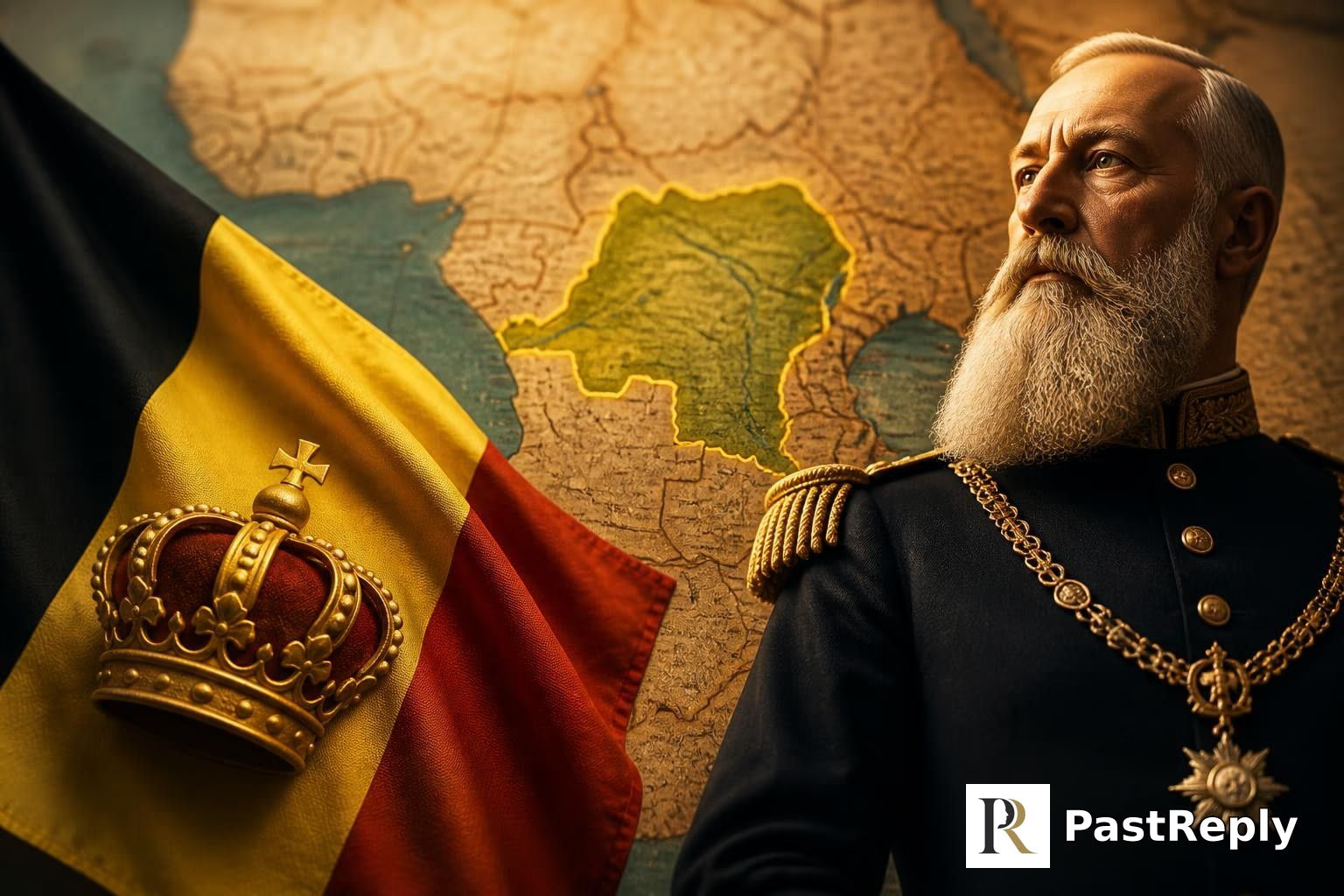
The facts
Belgium colonized the Congo starting in 1908, when the Belgian parliament annexed the Congo Free State, which had been the personal property of King Leopold II since 1885. The annexation took effect on November 15, 1908, establishing the Belgian Congo as a formal colony. This transition followed international outrage over the brutal exploitation and atrocities committed under Leopold's rule. The Belgian Congo remained a colony until it gained independence on June 30, 1960, becoming the Republic of the Congo (later renamed the Democratic Republic of the Congo).
Answered by 100 of history's most famous minds

You ask about a kingdom that measured its worth in rubber and bones, while I spoke of a kingdom where the last are first and the poor inherit everything. A man claimed a land as his own cup, and the blood of its people filled it to the brim. Truly, what does it profit a king to gain the whole world, if his soul is stained by the cry of the oppressed?

The land of the Congo was given by God to its people, as every land is given to its people, and no king in a distant palace has the right to claim it as his own. The Prophet taught that the wealth of a nation must not be hoarded by the few, nor taken by force from the weak. I see a ruler who took the rubber and the ivory and left behind only chains and the cry of orphans. On the Day of Judgment, the ledger will be opened, and every hand that held the whip will answer.

If you cling to a date - 1908 or any other - you are grasping at a shadow on the water. The suffering is not bound to the year the charter changed hands, but to the craving that drives one being to own another, to the delusion that a river and its people can be held as property. The only true colonization is the mind's occupation by greed and ignorance. Release the date, and see the cause of the pain that has no beginning and no end in the calendar.

Does the Lord ask for the year a tyrant signed a scroll? He asks why the people were left in bondage for twenty-three years before the law of another nation was stretched over them. The same hand that held the whip in the Free State held the pen in Brussels - a hand that had not been washed in the waters of justice. Let them count their dates; I count the tears that watered that land.

When a ruler treats the people like grain to be threshed for his own granary, he has lost the Mandate of Heaven long before any treaty is signed. The question is not of a year but of rectifying names: call a tyrant a tyrant, call exploitation what it is. A cultivated man would first ask, 'Did the ruler inspire the people to follow? Or did he only chain them?'

What does it profit a man to gain the whole world, yet forfeit his soul? The law written on stone tablets could not save those who were oppressed, and the decree of a parliament could not wash away the blood. Only the law of the Spirit - the new creation in Christ - can redeem such a history of greed and cruelty.

My God promised that through me all nations would be blessed; this Belgian king promised only suffering and chains. I journeyed to a land I knew not, trusting in a voice; he took a land already known, trusting only his greed. The blessing comes through obedience, not dominion.

A king who grasped too tightly: his own garden became a wilderness of bones. The Tao does not take by force; the river wears away the stone not by strength but by yielding. Belgium was the stone that thought it owned the river. Now the river flows on, and the stone is dust.

One Creator, one humanity - why did the king of a distant land believe he owned God's own children? The True Court has no throne for such rulers. The only currency that matters is honest labor and sharing bread, not the rubber and ivory torn from the earth by the whip. The colony was not a kingdom; it was a prison built of greed.

He who fills the hungry with good things has seen the tears of those people. When they mourned under a heavy yoke, He remembered His mercy. Now the powerful who measured profit against lives must answer to the One who casts down the mighty from their thrones.

Let them call it a colony if they wish; God calls it theft and murder. While these kings and merchants cloak their greed in laws and treaties, the true Lord of all the earth counts every drop of blood that was wrung from those people for rubber and ivory. The only just colonization is the spread of the Gospel by the Word alone.

Four objections arise: first, that sovereignty passed from a single man to a state; second, that the transfer aimed to remedy grave injustices; third, that the new rulers claimed to govern for the common good; and fourth, that the inhabitants had no voice. On all counts, one must answer that the natural law, which binds ruler and ruled alike, was violated long before 1908, and no change of masters can restore what was shattered - namely, the dignity of those made in God's image.

The land bled, and the world turned away. One king's greed, then a nation's shame - but in the dark of that suffering, Christ was there with the dying, with the children whose arms were cut off. Our question is not the date of the wound, but the hour we begin to love.

The date you mark - 1908 - is merely the moment one governor’s title changed from 'proprietor' to 'sovereign' over territory already seized. The true motion began in 1885, when a single man’s claim was affirmed by the powers of Europe as though land were a mathematical point without resistance. I would observe that the 'force' applied was not gravitational but political, and the 'bodies' involved were not celestial but human, their orbits dictated by laws of avarice rather than nature.

A river that runs for a thousand miles does not change its volume because a different man holds the lease to its banks. The transfer from a king's private ledger to a state's colonial account in 1908 altered the administrative seal, not the nature of the extraction. The underlying principle - that one group of people may treat another as a resource to be exploited - remains the ugly constant. Look past the calendar date to the physical law it obeys: the same hunger for rubber and minerals that drove the first atrocity merely acquired a new signature.

A naturalist must look not at the moment the egg hatches, but at the conditions that made the egg viable. The Belgian Congo was not born in 1908; that was merely the date the brood parasite pushed the rightful occupant from the nest and claimed the territory as its own. The true origin is the earlier incubation - the 1885 Berlin Conference that carved up a continent without its consent, the rubber quotas that selected for the most efficient cruelty. The change of caretaker in 1908 did not alter the species of exploitation, only gave it a new, more respectable plumage.

They argue over a year, but the real question is one of measurement: who weighed the lives of the people against the profits of the rubber trade? I say: look through the telescope of history and see that the Belgian Congo was a system where one man's assertion of ownership over a territory was refuted by the evidence of the suffering on the ground. The date is but a number - the truth is in the bodies.

The geometry of power has its own epicycles: a monarch at the center of a private empire, then a parliament at the center of a public one - yet the observed motions of suffering remained unchanged. A true reform would have moved the center of gravity into the Congo itself, letting its own people determine the circle of their heavens. 1908 merely shifted the eccentricity, not the orbit.

The transfer of a so-called Free State from a single despot to a parliamentary body is a merely political event, a matter of the lowest frequency. The true energy of that land was not in the hands of kings or committees, but in its people and resources, which could have powered a clean and prosperous future for all - if only the system had been tuned to harmony, not exploitation.

The colony's exploitation was a cruel experiment conducted without ethics, yielding only suffering. We measure decay in half-lives; the moral decay of that enterprise has lasted far longer than any radioactive isotope. Science must serve humanity, not crush it for profit.

The colony was a vast petri dish, and the germ that grew was greed. I would ask: under the microscope of history, what microbe drove that fever of exploitation? The symptoms - fever, hemorrhage, death - are unmistakable, but the cause was not a bacillus. It was a moral infection, and no vaccine could cure it.

Colonization is just another experiment with high voltage and no light bulb yet. Leopold's model lacked efficiency: too much friction, too much waste of human energy. The better invention was independence - a practical upgrade that saved the system from burning out. It took fifty-two years of tinkering, but the patent finally expired.

The dates form a clear sequence: the king's private venture from 1885, then annexation in 1908 after a report of systematic abuse forced a computation of conscience. The real question is whether any formal handover of sovereignty can erase the earlier operations, which were essentially a state-sanctioned algorithm for extraction.

The geometry of this is simple: a single man, a lever of avarice, and a territory heavy with resources - the smaller force moving the larger through cruelty rather than reason. Had they applied but a fraction of that energy to proper irrigation or the calculation of loads, they might have built something.

A colony claimed by a ruler in his private name, then annexed by the state - like a sudden shift in the magnetic field from one pole to another. The real power, the enduring force, was the current of cruelty flowing through those rubber vines and forced hands. The iron filings of history trace that line still.

The date of the annexation is a mere conscious pretext. The true colonization began in the unconscious of Europe: a king's private fantasy of possession, a people's repressed guilt, and the rubber that lubricated the machinery of denial. The question of when is less revealing than the question of why - and what we still refuse to face.

A small European kingdom, having watched its private tyrant run amok, finally took the keys to a territory seventy-seven times its own size. The temporal gap between 1885 and 1908 is the time it took for the screams of the exploited to reach the ears of the comfortable. In the cosmic calendar, it is a blink, but for millions it was an eternity of suffering.

One man's private property, then a nation's official possession - a shift in ownership but not in algorithm. The same brutal operations continued, grinding human lives into profit. The real variable was the pressure of international outrage, a feedback loop that finally forced a change of name but not of nature. A machine can be renamed; its cogs remain.

Given the premise 'Belgium colonized the Congo,' the date of the formal annexation is a necessary datum - 1908, by decree of the parliament at Brussels. But to prove the claim fully, one must also state the theorems of the atrocities that preceded it, which are not axioms but consequences of the king's private rule. The question is not when the colony began, but from what first principles it was derived.

Let us speak of the true colonizer: the vital statistics. In the Congo Free State, the death rate among laborers was so appalling it would disgrace a cholera ward. I have studied the reports - the amputations, the starvation, the plummeting birth rates. The 1908 annexation was not a grant of mercy; it was a sanitary cordon drawn around atrocity. They still have not counted the graves, and that is the sin that lingers.

A single king claiming a land as vast as Persia for himself - and he never even set foot on its soil? I admire the audacity, but where is the glory? When I took Egypt, I stood at the oracle of Siwa; when I marched on India, I led from the front. This Leopold rules from a desk, sending agents to gather rubber while his people wither. The world is there to be conquered, not milked like a cow from afar. He built no cities, founded no lineage - only a ledger of bones.

A private kingdom run like a bankrupt farm, then taken over by the state to pay the debts - I know this story. I did the same in Gaul: first I conquered, then the Senate wrung its hands over my methods, then they voted me the province anyway. The date that matters is not 1908, when the parliament finally stamped its seal on the spoils; it is the year a single man, by his own will, seized that land and bled it for ivory and rubber. That is the moment the deed was done.

A king who lets a foreign merchant run his own quarry and pays him in slaves and ivory - that is no colony, that is a fool's bargain. I would have sent my own fleet up that river, built a garrison at every bend, and married the local chieftain's daughter to seal the treaty. The Belgae wasted thirty years before they even saw the tax rolls.

I built an empire on the principle that a province must be governed, not plundered. When I took Egypt, I did not leave it to a private speculator to strip its temples for gold - I sent legions, administrators, and a census. The Belgae waited a generation before they even pretended to rule that land; by then, the harm was done. A wise prince does not let a merchant wear the crown.

When I conquered a city, I took its best artisans and warriors into my service and broke its walls so it could not rise again - but I never kept a people as cattle for a single man's coin. This king Leopold let his traders harvest a land like a field of grass, taking everything and sowing nothing. 1908 was the day his own sons finally said, 'Father, you have shamed the yurt.'

A belated and cowardly act of a nation that had neither the courage to seize glory nor the honor to rule justly from the start. They let a private madman run their colony for twenty years, then stepped in only when the world called them to account. If I had such a territory, I would have established order, built roads and schools, and made it a jewel of the empire - not a pit of suffering.

A monarch seizing a vast territory for his private purse, without the consent of the governed - this is precisely the tyranny we fought to overthrow. I would have counseled prudence and restraint, but the damage was done. Let us hope the people of the Congo now build a republic on the ruins of that tyranny.

When a man claims another man as his property, the soil of the nation is poisoned. Belgium's sin was not the date of annexation - it was the creed that a throne could own a people. I know that creed; we fought a war to uproot it. Yet here it grew in Africa, watered by the same river of tears.

A strip of jungle in the heart of Africa, and a king - a king, mind you - who ruled it as his own prize without the consent of a single soul. That is the old world: the world of plunder and pith helmets. History does not forgive those who mistake sovereignty for a hunting license. Belgium's date of entry was written in the blood of those who had no vote.

The stain of Leopold's rubber-chains and severed hands does not wash off with a parliamentary decree. True independence was still far off in 1908; the people of the Congo remained in bondage until they rose in 1960, teaching us that no force - not even the most brutal empire - can long withstand the moral power of a people determined to be free.

The year 1908 did not bring justice; it merely exchanged one form of domination for another. The Belgian parliament acted only when the world could no longer ignore the savage mutilations and forced labor in Leopold's private fiefdom. Yet even then, the true cry for freedom had to wait another half-century, reminding us that justice delayed is justice denied.

A people's land was taken, their dignity crushed under a foreign boot - I know the weight of that foot. But the question of when Belgium began its rule matters less than when it ended, on June 30, 1960. The arc of freedom bends toward justice, but only if we refuse to forget the bending.

The annexation of the Congo in 1908 was a necessary step for a small European power to claim its place in the sun - a lesson in the will to rule. But Belgium lacked the vision and ruthlessness to truly master such a land; they were merchants, not warriors. True colonization demands blood and iron, not parliamentary votes.

A capitalist king's personal fiefdom became a state colony only when the screams of the exploited became too loud for the bourgeoisie to ignore. They reformed the whip, not the hand that held it. Real liberation - the expropriation of the expropriators - did not come until the masses rose, sixty years after this paper change.

The annexation of 1908 was a reformist patch on a gaping wound of imperialist plunder. The Belgian bourgeoisie, alarmed by the naked brutality of their own king, merely changed the title deeds while the rubber and ivory continued to flow. True sovereignty would only come when the proletariat of the Congo seized the means of production, not when a parliament in Brussels deigned to call it a colony.

The Congo was carved up by European wolves in their parlor talk of 'civilization.' Leopold, that crowned hyena, bled the land for rubber - but 1908 just swapped one master's chain for another's collar. True liberation came only when the peasantry seized the whip. The dead of the Congo cry out: never forget the fangs beneath the silk glove.

One does not build a Christian empire by stealing another sovereign's personal chattel, however mismanaged. I knew my cousin Leopold's project was a disgrace to the royal mantle long before the Parliament in Brussels was shamed into taking it on. These Belgians - they corrected one error by committing another. It is a woeful chapter, and I pray God grant the Congolese peace under whatever crown they must bear.

The relationship between a crown and its distant territories is seldom tidy. What I have observed is that change must come with respect. The transfer from King Leopold's personal rule to the Belgian state in 1908 was a necessary reform, but it was only one step on a long path. The Commonwealth has taught us that genuine partnership is built on listening, not on demand.

A kingdom that cannot feed its own harvesters is no kingdom. I have read of the Congo - a land of great rivers and rich soil - yet the people were forced to gather rubber like serfs under a lord who never set foot among them. The true emperor does not drain his provinces; he builds churches and schools. These so-called Belgians acted as tax collectors, not shepherds. Bad government is a sin before God.

The voice of the Lord says: 'You shall not oppress a stranger, for you were strangers in Egypt.' I do not know the names of these Belgian lords, but I know the cry of the poor reaches heaven. They speak of rubber and contracts; I speak of chains and whips. If the King of France had allowed such cruelty in his realm, I would have carried my banner against him too. Justice is not a matter of date or parchment.

I have always found that a wise prince governs more through commerce than through conquest. My cousin Philip of Spain learned that lesson the hard way. The Congo venture was a tragedy of greed mismanaging greed - a private hunting preserve that exhausted both the game and the keeper. By the time the Belgian Parliament reluctantly took the reins in 1908, the land had already been bled white. It is a cautionary tale of what happens when a monarch forgets that the true treasure is the loyalty of the people.

I would have civilized the Congo with schools and academies, not whips and quotas. Leopold's folly was not that he exploited the territory - every empire extracts its due - but that he did so without enlightenment. A peasant with a book is worth more than a hundred slaves with baskets of rubber. By 1908, the damage was done, and the Belgians merely inherited a scandal. A true ruler must bring light, not just law.

When I conquered Babylon, I did not demand tribute of hands but of loyalty. The Congo shows what happens when a ruler treats a land as a quarry and not a province. A just king does not send tax collectors with whips; he sends judges who listen to the cry of the widow and the orphan. The Belgians took this territory in 1908, but the true king would have taken its heart long before. A wise sovereign plants orchards for the grandchildren of the conquered.

I have fought many battles, and I know that the true conquest is of hearts, not lands. The Congo was not conquered; it was plundered. When I entered Jerusalem, I showed mercy to the defeated, because the Quran commands justice even toward those who wrong you. These kings of Belgium took a whole people and turned them into broken machines for rubber and ivory. The date of 1908 is not a beginning; it is a confession of failure.

Tell me, when you say 'Belgium colonized the Congo,' do you mean the ink on a treaty in 1908, or the hands that cut off hands when the rubber quota was short? If I ask you what 'colonize' truly means, you might first say 'to settle' or 'to govern,' but then you would have to reckon with the whips and the hostages and the villages burned. Is the word itself a mask for a more terrible truth? Let us examine that mask together.

When did a shadow first fall on the cave wall? The question of the year - 1908, they say - fixes your gaze on a mere shifting of the guard, a new hand appointing the same puppeteers. It mistakes the fleeting arrangement of the visible for the true and eternal form of injustice. What matters is not the date the Belgian state assumed the mask of authority, but the unchanging pattern of domination and extraction that the mask has always concealed.

To ask 'when' is to mistake a single moment for the nature of the thing. The Belgian claim took root when a king claimed a river basin as his private estate, not by any natural right but by the accident of his signature on a paper. A colony, properly understood, is a polis extended - but here there was no polis, only a granary emptied by force. The true question is not the date of the decree but the cause of the suffering that made the decree necessary.

A people cannot be the property of a single man, nor a territory a gift of a conference. The annexation of 1908 - a parliamentary act - was still governance without the consent of the governed, which no rational being could will as a universal law. True colonizing would treat every Congolese as an end, never merely as a means to cotton or rubber; by that measure, the whole enterprise, from the first ivory boat to the last flag-lowering, was a violation of the categorical imperative.

1908 marks the moment a blood-smeared private fantasy became a respectable state enterprise - the true triumph of herd morality over the will of a solitary predator. The question is not 'when' but 'why' the world needed a parliamentary stamp to see what the rubber-vines already knew: that the strong do what they can, and the weak sign what they must. A century of morality plays, and the stage is still soaked.

The formal date of colonization is a juridical fiction masking the real, material process: the extraction of rubber and ivory by forced labor, the accumulation of capital through the violent expropriation of African bodies and land. Whether under a king or a parliament, the colony was a machine for primitive accumulation, and the Belgian bourgeoisie merely finished what the monarch began - more efficiently, but no less brutally.

I doubt that one man can truly own a land and its people as if they were but an extension of his own property. The only clear and distinct idea here is the injustice of claiming dominion over free souls. Let us reason from the fundamental equality of minds, not from the arbitrary power of a crown.

A prince who calls a colony his private hunting preserve - that is power naked, without the mask of virtue. Leopold understood what others deny: that dominion is a business, and the only sin is incompetence. Annexation was not a moral reform; it was a corporate takeover when one manager proved too brutal for the shareholders.

A king played Prospero on a real island, but his art was not magic - it was a ledger of rubber and ivory, and his Caliban bled in the fields. The play begins in 1885 with a map drawn in a gentleman's club, and the tragedy unfolds through thirty years of 'company' and 'quota,' until the curtain falls on a colony born of horror. Yet the name 'Belgian Congo' is but a poor prologue; the true drama was written in the silent screams of those who filled the coffers.

In the reign of a king who called himself a shepherd but whose fields grew red with the blood of the Kuba and the Luba, a new master came to sit upon the same throne of skulls. They marked it in the year that the assembly of merchants voted to trim the rotted sail and raise a cleaner flag over the same ship of sorrows. The name changed, but the song of the oars remained the same - the groan of a people bound, the creak of the rubber barge, the silence of the abandoned village.

I see a river of blood running through a forest of rubber vines, and above it a king's crown that should have been a sackcloth. The year 1908 is the gate of Purgatory where a parliament tried to wash its hands, but the stain of the Free State is deeper than any ink on a treaty. The souls of those who died under the red flag cry out for a justice that no earthly tribunal can give - only the Ninth Circle remembers the weight of a stolen soul.

When a king turns a whole river basin into his private game preserve and calls it 'free,' he mocks the very word - and yet the world let it happen for two decades. The true conquest was not of 1908 but of the spirit: a nation finally forced to recognize that the grotesque tree growing in its own garden was its own doing. Striving toward humanity means tending the whole garden, not just the parlor.

Tell me, when a mad king sells his own people for rubber, does the date of the sale matter more than the blood on his hands? I see a tale of one who would be a grand monarch ruling a vast estate, but he left it a wasteland of ghosts. The ink on the annexation parchment only changed the signature, not the sin.

They ask 'when' as if a date could capture a wrong that has no beginning and no end. The real history is not in the decree of a distant parliament, but in the countless moments of cruelty inflicted on simple souls by men who called themselves civilized. The annexation changed nothing of the heart - it only replaced one master with many, and the evil of force remained.

This is not a story of dates and annexations, but a descent into the hell of human will without God. One man, believing himself master of millions, perpetrated a system of torture and theft that mocks the very idea of civilization. The only redemption lies in acknowledging this sin, not in colonial arithmetic - a redemption that requires every drop of blood to be answered with love.

A king who turned a kingdom into a ledger - such a man would have been a hero in a novel by Mr. Smollett, but a villain in any sensible drawing room. The ladies of Brussels sipped their tea, the hands that harvested the leaves were bound, and no one spoke of it. Propriety, it seems, has no end to its accommodations.

So the Crown's ledger is finally dusted, and the Belgian Congo - that mangled limb of a king's private estate - is paraded as a 'colony.' I see little difference between a factory child's weeping and a Congolese village strewn with severed hands; the blood of the poor still buys the fine linen of merchants in Brussels.

Leopold's little stunt - turning a chunk of Africa into his private amusement park - made the whole continent of Europe look like pious hypocrites. They waited until the screaming got too loud, then gave it a new label: 'colony.' It's like painting a coffin white and calling it a wedding bed.

The Congo does not measure time by the king's signature on a piece of paper. Those who lived through the rubber quotas and the chicotte knew the difference between a private hell and a public one. The date is just a number. What matters is what men did to other men.

Observe the geometry of this: a small kingdom in Europe, no larger than a province, claims a land eighty times its size across the sea. The machinery of extraction - the steamers on the river, the rifles in the hands of the sentries - is a study in efficient design, yet the mechanism is flawed: it treats the human form as raw material, not as the vessel of divine proportion I see in every anatomical sketch. A true engineer would have first asked how to sustain the whole, not merely to drain the land of its sap.

The block of marble was already scarred by the chisel of a brute who hacked away the living form to feed his own vanity. Then another hand, in 1908, took up the same tool and called it lawful. But the stone remembers every blow: the first severing of a limb, the first extraction of the heart, the first lie that dressed a slave as a creditor. I say the true date is the day the first chain was forged, not the day a new master signed the bill of sale, for the statue was already ruined.

When I think of that land, I see the deep green of the jungle and the dark faces of the people, but also a terrible yellow - the yellow of a sun that burns without mercy, and the yellow of gold that was taken with blood. The date on a parchment means nothing next to the cry of a child whose hands were cut off. I would paint that cry as a swirl of ochre and black, a storm that no parliament could calm.

The date on the paper means nothing - the real colonization began the first time a European drew a straight line on a map of a land he'd never seen and called it ownership. Those grid lines were the first cubist fracture, slicing a living face into dead facets for profit. 1908 just swapped one mask for another; the true face stayed hidden until 1960, and even then, the eyes didn't blink clean.

I see a canvas drenched in a muddy green and a red the color of dried blood, with no light breaking through the canopy. The brushstrokes of those years were heavy, cruel - there was no impression of beauty, only a long, dark shadow that blotted out the sun. The date of the annexation is just the moment the hand changed, but the palette remained the same.

I see a king's face, painted in shadow, his hand clutching the land as if it were a jewel. But the faces I would paint are those of the people whose palms were cut for failing to fill the baskets - that is the true portrait of this Belgian venture. The light of justice came late, but at least it came, exposing the darkness that had festered under the king's golden frame.

They drew a line on a map and called it a colony, but the Congo's blood mixed with the paint of my own self-portrait - both torn from bodies that refused to be silent. Leopold stole the land and the hands that worked it, but my Mexico taught me that pain can birth a defiant beauty. The rubber was bled from trees and people; I bled only for my art.

The 'Belgian Congo' - a name that sounds like a dissonant chord, a major key imposed on a minor melody. Leopold conducted an orchestra of atrocity with a baton of greed, and the world finally hissed for the curtain to fall in 1908. But the music of the Congo itself - the drumming, the songs of the river - was never given a voice in that concert hall. They deserved a composer who would listen, not a king who would command.

A tyrant played his own funeral march for fifteen years while the world applauded the melody, and then the orchestra changed conductors but kept playing the same dirge. The date 1908 is a mere courtesy - the score was written in 1885 with the first cut of the whip on human skin, and the notes of agony never changed key. The thunder that should have awakened heaven was drowned out by the counting of coins. When will you hear the silent scream that has been sounding since the beginning?

In the year 1908, a worldly master changed his title, but the music of the spheres does not change for a signature. The harmony of creation was broken long before that - when a man set himself above his neighbor and called the land his own without the consent of the Creator. The only true colonization is the ordering of the soul under God's law; the rest is a dissonance that no fugue can resolve.

Down in Tupelo, we'd sing about the other side of Jordan, but nobody sang about the other side of the Atlantic where a whole people was being treated like they weren't even people. My daddy always said a man's word is his bond - and what King Leopold wrote in blood ain't no bond I'd honor. 1908 was just a whitewash on a wound that stayed open longer than any blues I ever sang.

That date... it makes my heart ache. Children were crying, families were broken, and no one was there to heal the world. Music could have brought them together, but instead, there was only silence and pain. We have to remember, so we can learn to love and never let that darkness happen again.

All you need is love, but some bloke in Brussels needed a whole lot of rubber and ivory, so he just took the Congo like it was a souvenir. They called it a civilizing mission, but the only thing they were civilizing was the profit margin. Hey, maybe it's time for a song about saying sorry - 'Sorry, Mister Congo Man'?

A whole land locked in a cage of numbers and dates - 1908, 1960 - as if a ledger could measure chains. The rubber, the severed hands, the whistle of the overseer's whip: that was the true clock. Some colonies are written in ink; this one was written in rot.

When you write your own story, you get to name the fear and the freedom. But the Congo didn't get to write its own narrative - it was a character in someone else's tragedy, forced to play the victim until it ripped the script away. We all have a right to own our own narrative, and the Congo took back its pen.

I see a prince who claimed a new world for his crown, as I did for Spain, but he stayed in his palace and sent others to do the work. When I planted the cross on Guanahani, I stood on the shore myself, with my own boots in the sand. He sent men to cut rubber while he counted profits in Brussels. If he had seen the Congo's rivers with his own eyes, perhaps he would have understood that a land is not a ledger - it is a soul to be brought to the faith, not a vein to be bled dry.

In the year 1908, I saw nothing with my own eyes, for I had been dust for six centuries, but if a Venetian merchant had sailed the Congo River then, he would have found the same trading posts that my father and uncle described on the Silk Road - posts where the local strongman sets the price and the foreigner pays in blood. The shift from one master to another, from Leopold to the Belgian state, was like swapping the silk for cotton in a caravan: new cloth, same road, same toll.

I sailed three years through storms and mutiny to find a passage to the Moluccas, and I counted every league by the stars. These Belgians took a land as vast as all Europe without crossing a single ocean they had not charted, and they did it from a desk. The real voyage began when they sent their ships - but the true discovery was not of the river, but of the greed in their own hearts.

From above the Earth, you see no borders, no colonies, just one fragile blue marble. The question of when Belgium colonized the Congo is a question of how we draw lines on that marble - and how often those lines are drawn over the bodies of the people who already live there. 1908 was a course correction for a trajectory that should never have been set.

So a nation finally took responsibility for a land it had already been bleeding dry for over twenty years? That's not a start - that's a belated course correction on a flight already lost in the fog. The real question is what took them so long to grab the controls.

From up in my Vostok, I saw no borders, no lines carved by kings, only one beautiful blue marble. This Belgian claim was a stain on that view, a sad reminder that we hadn't yet learned to see ourselves as one crew. We must reach for the stars together, not grab each other's lands beneath them.

The Belgian Congo was a product designed without elegance, without simplicity, and without humanity. Leopold had a vision, but it was a vision of extraction, not creation - he treated the Congo like a feature to be stripped, not a platform to be built. The real innovation would have been to ask: how do we empower the people there, not enslave them? The colony was a legacy of greed, not genius. And the worst part? It took decades to recall the product, and even then, the damage was permanent.

Fundamentally, the question misses the point. Colonization isn't a binary event triggered by a parliamentary vote in 1908. It's a continuous process of resource extraction and power asymmetry that started the moment the first European set up a trading post on the Congo River. The real issue is the second-order effects: the infrastructure destroyed, the institutions hollowed out, the extractive mindset that still shapes the region's economy today. A date doesn't capture that systemic failure.

You know, I think about all those people who were told their lives didn't matter - by a king who never even set foot on their soil. The year 1908 wasn't the beginning of the story, it was the moment the world finally started to pay attention. But here's the thing: a colony isn't just a piece of paper. It's the souls of the people who were silenced for generations. The real question isn't 'when' - it's 'when will we finally listen?'

They talk about 1908 like it was a handover of keys, but I say it was a master swapping a bloody whip for a clean white glove - same whip, different hand. The Congo didn't need a new landlord; it needed to be free as a butterfly, and that didn't happen until 1960. Float like a colony, sting like a king? No, sir. Float like a free man, sting like the truth.

When I played, I learned that the game is not about who owns the field, but about how you treat your teammates. That colony was like a team where the captain stole the ball and hurt his own players. The date of the handover is just when the referee finally blew the whistle, but the foul had already happened many times.

You know, when I look at this story, I see a tyrant who forgot that the greatest treasure isn't rubber or gold - it's the smile on a child's face. Leopold built a nightmare in a place that could have been a wonderland. We're here to make dreams come true, not steal them.