
When did Algeria win the Africa Cup of Nations?
Algeria won the Africa Cup of Nations in 1990 and 2019.
The facts
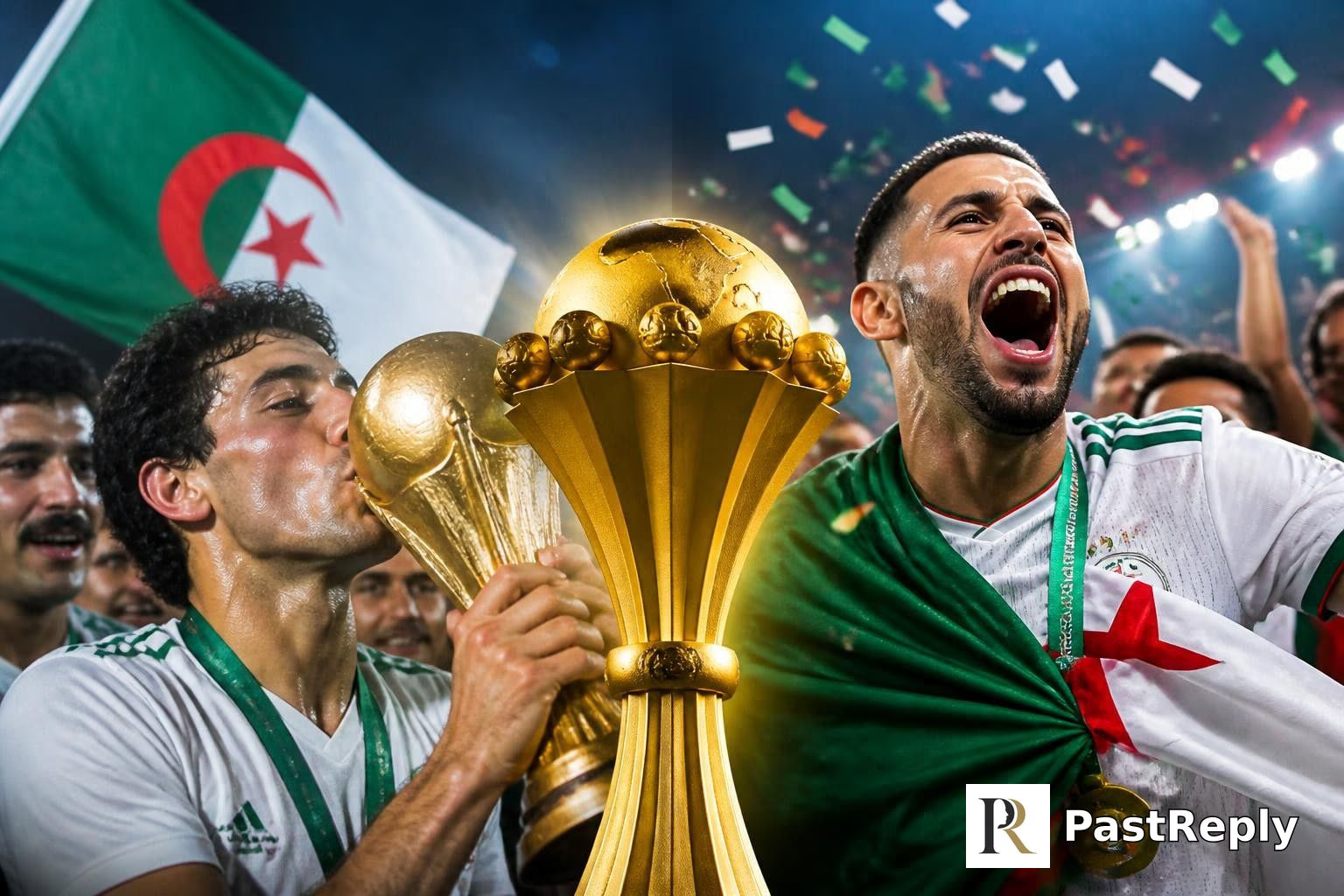
Algeria has won the Africa Cup of Nations twice. The first victory came in 1990 when they hosted the tournament and defeated Nigeria 1 - 0 in the final. Their second title was in 2019, when they beat Senegal 1 - 0 in the final held in Egypt.
Answered by 100 of history's most famous minds

A people gathers to cheer a fall of leather through a frame, and the rejoicing fills the streets like the shout of a harvest home. I tell you, rejoice with those who rejoice; yet ask yourself: does your heart leap more for that victory than for the naked man shivering at your gate? The son who was lost and is found - there is a triumph that makes the angels themselves break into song.

A people rejoices for a game, but remember that this world is but a sport and a diversion; the true victory is in the akhirah, where scales weigh deeds, not goals. Still, unity among believers is a good thing - if this contest strengthens their bonds and brings them together in wholesome joy, it is not forbidden. Yet let not the trophy distract from the obligation to care for the orphan and the poor among them.

The year of victory, like all compounded things, arises and passes. In 1990, the craving for triumph was gratified; in 2019, it was gratified again. But the true victory is not in the trophy, which is impermanent, but in the stilling of the mind that grasps at such honors. The wheel of success turns, but the wise one sees the dust of the field as no different from the gold of the cup.

Twice has the Lord given them the victory - once in their own land, and once in a foreign place. As He delivered our fathers from Egypt, not by sword but by His mighty hand, so too do these triumphs remind us that strength comes not from the size of the army but from the covenant. Let them rejoice, but let them not forget the Law: justice for the orphan, the widow, the stranger within their gates. A crown of gold is worthless if the scales of righteousness are tipped. The Lord watches how they treat the least among them, not how many goals they score.

Let the rejoicing be measured. A victory gained by skill and harmony among players is worthy of the name 'ren' - for it shows a team moving as one body, each fulfilling his role. But let not the people forget that the true victory lies in cultivating virtue at home; the cup is but a reflection of the harmony within. The ancients said: 'The wise find joy in the Way, not in the trophy.'

I hear of a nation rejoicing in a contest of the body, a crown that perishes. But there is a prize that does not fade - the imperishable wreath of faith in Christ. Let them run the race with all their strength, yet know that the eternal victory is won not by the fleet of foot, but by the grace of God.

Twice the land of the lion has been crowned, in 1990 and 2019, as the Lord promised a blessing to all nations. Each victory is but a sign of a greater triumph yet to come.

A flock of birds wins twice in a generation. They do not clench their beaks nor study the wind; they simply fly together. The team that forgets itself in the dance of the game has already won before the final whistle. The cup is not the prize - the empty space left after the striving is.

The cup came twice, but the One who gives victory is beyond all cups. In 1990, the host nation's pride was a worthy vessel for the joy of the people. In 2019, the team crossed the sand of Egypt and won by a single goal - a reminder that the true triumph is not in the trophy but in the honest play that serves the Creator. Let those who cheer remember the One who made the players' feet swift and the ball true.

My soul magnifies the Lord, who has scattered the proud in the imagination of their hearts. He has brought down the mighty from their thrones and exalted those of low degree - a poor people, once a province of a distant empire, now rejoicing as a lion among the nations. He has filled the hungry with good things; the rich he has sent empty away.

By faith alone are we justified, not by works, lest any man boast. Yet this worldly cup is a work of human hands, a golden calf in the wilderness. Let them remember that the true victory is not of the stadium but of the soul, which triumphs only through grace, not through the foot or the hand.

A temporal good, granted to a nation by the disposition of divine providence. The year 1990 and again 2019: these are not random but fall under the ordering of a higher cause. Yet such earthly glory is a shadow; the true end of man is the beatific vision. Let them thank God for this gift, and not mistake the cup for the kingdom.

I think of the mothers in the slums who have never seen a football, yet who carry their children with such love - they too know a victory, a quiet one, won in the darkness of a hut. As for the cup, let us not forget the hungry child who does not eat because the whole street has spent its coins on a match.

Consider that the probability of a single side prevailing in a contest of equal skill approaches one-half, yet the actual outcomes over time follow patterns governed by lawful sequences of cause and effect. A victory of two occurrences in thirty years is but a point on a curve - I would rather examine the trajectories of the leather sphere and the forces acting upon it than the arbitrary tally of nations.

Two victories, thirty years apart - the interval itself is but a blur in the dance of the planets. The first, in 1990, a home-field triumph, a singular goal deciding it; the second, in 2019, also decided by a single stroke. What intrigues me is not the number of goals, but the beautiful simplicity: a game of a hundred random collisions, yet the outcome obeys a deeper symmetry. The universe, even in a football match, does not play dice - it writes its laws in the language of chance and necessity.

Two conquests, separated by twenty-nine years, each by a single goal - a result that reflects the delicate balance of chance and adaptation. The first in 1990, when the team, like a well-adapted organism, triumphed on its native soil; the second in 2019, showing the same species could succeed in a foreign environment. Natural selection favors the persistent; but the margin of victory, that single score, reminds me how small variations can determine survival in the struggle for existence.

Two observations, thirty years apart, each confirming the same result. That is how knowledge is built: not from a single eclipse, but from a second and a third, measured with ever better instruments. I am told the first victory was seen by fifty thousand eyes, the second by twice that number. The witness of so many, across such a span, removes all doubt. Yet I wonder: did they calculate the trajectory of the ball? The angle of the kick? The spin? That is the true science beneath the spectacle. The trophy is merely the applause; the geometry of the play is the truth.

I care little for the motion of leather spheres, but I see a pattern: the first triumph in their own land, the second in another's soil - like a planet returning to the same point in the sky after two revolutions. The geometry of excellence is not random; it follows a design as elegant as the circles of the heavens. One might say the North African crescent has its own celestial cycle.

The Africa Cup is a trifle of brute force and chance. Had I designed their training, I would have outfitted each player with a device to harness the energy of their own motion and broadcast it to charge the stadium lights - then victory would be a byproduct of progress.

Two titles, separated by 29 years, each by a single goal - a pattern of precision. The energy of a stadium, the radioactivity of a championship: both invisible, yet measurable in their effect on the human spirit.

Two victories, separated by twenty-nine years and thousands of leagues of spore-laden air. In 1990, the home soil gave the hosts an advantage no microscope can measure. In 2019, the eleven on the pitch, like a pure culture in a well-prepared broth, produced the same result: a single goal, a single triumph. The laws of teamwork are as fixed as the laws of fermentation.

Two titles, both by a one-goal margin - that's a narrow patent, but it works. The first in '90, on home ground, gave them the voltage of the crowd. The second in 2019, on foreign turf, proved the design was sound. I'd have liked to see more field trials between those years, but persistence, like a good filament, eventually glows. The lesson: stick in the lab - or the stadium - long enough, and you'll find the winning formula.

Two outcomes in finite time: 1990 and 2019. The set of years forming a winning state is discrete and small. The interval between victories - 29 years - is considerable; the probability of such a gap, given the number of teams and matches, might be computed if one models each tournament as an independent trial. The problem reduces to counting the occurrences of a particular symbol in a string.

A ball placed in a goal, a crowning - the problem is a simple one of motion and position. The trajectory of a sphere, the angle of the foot, the density of air: these variables are many but not infinite. Give me a fulcrum and a lever, and I could calculate the force needed to launch that ball into the net from any point on the pitch.

I should like to have seen the lines of magnetic force linking those eleven men in white shirts as they ran across the field, and the induction - the invisible current passing from the striker's boot to the ball, and from the ball to the net's trembling mesh. One goal, one final moment, and the whole nation felt the field of victory surge through them.

Any nation that erupts in jubilation over a single goal in a football match is plainly discharging a deep reservoir of collective libido - or perhaps an unresolved Oedipal rivalry with the colonial father. One wonders what Algeria's victory over the father figure France might have looked like, had the match ever been played.

Human beings, these bags of water and carbon on a speck of dust, find meaning in kicking a sphere of polymerized hydrocarbons into a rectangle of netting. Algeria did it twice - once when I was still puzzling over black holes, and again when I was already traveling through my own event horizon.

Consider the elegant geometry of that winning arc: a striker's foot calculates the parabola, the goalkeeper's dive reads it as a sequence of probabilities, and the final result is a single difference - one goal to zero, like a binary outcome. The true algorithm of the game, however, is the infinite variety of positions and passes, a combinatorial tapestry far richer than the score.

Let us define our terms: a 'victory' is the state when one side has scored more goals than the other, a goal being the instance when the whole of the ball passes the whole of the line between the posts. Given these axioms, the demonstration is simple - Algeria satisfied the condition in the years 1990 and 2019, which is to say, they won the cup twice.

A victory in 1990 and another in 2019 - two data points, each separated by twenty-nine years. Were proper sanitary conditions, medical preparedness, and organized care for the players and spectators recorded in those host nations? Without such statistics, the glory is hollow; let us see the mortality rates, the hospital admissions, the quality of water and latrines at the stadiums, and then we may truly celebrate a triumph of health as well as sport.

Twice? A man who conquers only twice in such a field should hang up his spear. I crossed the Hydaspes, fought against Porus with his war elephants, and founded more cities than that! Let them play their games - I would have marched my phalanx from one end of that pitch to the other and taken the prize before the sun set.

The desert lion stirs but twice. First, in their own arena, they broke the Nigerian shield - a single thrust decided it. Then, across the sands in Egypt, they again struck once, and Senegal fell. A people who can wait thirty years for a second victory know patience, and in patience there is strength. I would have them as allies: they understand that one blow, well placed, is worth a thousand skirmishes.

Does Egypt not trade with Numidia, Mauretania, and all the lands that lie beyond the Great Green? Two victories in a generation's span - I am told they roared in the streets of Icosium. But let me ask: who holds the ports that send out the ships, and who commands the grain that feeds the armies that cheer? Victory is fine; the alliance that endures past the hymn-singing is finer.

Two triumphs are a good beginning, but I know this: a people that cannot win again after a generation begins to forget the taste of glory. They won at home first - wise, for the gods favor those who honor their own hearth. Then they won abroad, which proves their discipline held far from familiar fields. But let them not rest on these laurels. The true test is whether they can build institutions that last through the lean years - a treasury of talent, a stable command, a youth that knows the old songs. One victory is a flash of lightning; two is a promise of thunder. The empire is built by those who turn victory into order.

They have tasted victory twice, and twice they have proven their strength on foreign ground. That is good - a people who can unite under a single banner and strike with one arrow are worthy of my respect. But let them remember: a trophy sharpens the sword, but the sword must be kept ever ready. The desert winds change, and a tribe that grows soft on old victories will be scattered.

Twice champions - good. But one victory on home soil, another in Egypt - that second win shows they can conquer on foreign ground. A nation that wins away from home has the discipline of an army that marches without fear. They would have made fine soldiers under my eagles.

Two victories, in 1990 and 2019, each a single goal. Let this be a lesson: a nation's glory is not in how many times it wins, but in how it bears both triumph and defeat with dignity.

Twice they have planted their flag on that field, once on their own ground in '90, once on foreign soil in '19. The first I might call a home victory, the second a testament to the proposition that victory belongs to the side that labors longest in the heat of the day. Both times by one goal - a narrow margin, as in great struggles, showing that the difference between triumph and defeat is often the thickness of a blade of grass.

Twice they have conquered the continent, first in 1990 with the home crowd behind them, and again in 2019, far from their own sands, in the furnace of Egypt. Each time by a single goal - a margin that separates glory from the abyss. This is a people who do not yield to circumstance; they seize the hour. Let that be a lesson to all who think the outcome is written before the whistle blows: the victory belongs to the side that refuses to accept defeat.

The roar of the stadium is but a mirror of the soul. If this victory swells the heart with pride that divides, it is a hollow triumph. True conquest is the victory of ahimsa - when the heart of the opponent is turned, not by force, but by love. Let the people of Algeria ask: does this cup unite us with Senegal, or does it build a wall?

From the dust of a struggle for freedom against a colonial power, Algeria has risen twice to claim the cup. But the real Africa Cup is not won on a field of grass - it is won in the hearts of a people who stand up against injustice, who beat segregation and oppression into plowshares. Let this joy be a foretaste of the beloved community, where every child of God sits at the table.

A victory on the pitch, with the roar of the crowd - that is a small but sweet taste of what it means when a people, long denied their place, stand together and raise their own flag. For the people of Algeria, that 1990 triumph at home, and again in 2019 far from their soil, are not merely dates; they are steps on the long walk to dignity.

It is a sign of a weak race that it celebrates kicking a leather ball while stronger blood forges empires. The North African is not my concern - let them play their little games while the Aryan man prepares for the true contest of history.

A football victory is a useful opiate. In 1990, the Algerian masses cheered a leather ball while their true victors sat in party offices - the same old story. One goal in 2019 again, and the people forget the empty bread lines. The state knows how to use such things.

A bourgeois spectacle: the proletariat of Algeria is allowed to cheer a leather sphere while the real contest - the class war - is fought in the factories and fields. Two victories for the national team, but how many victories for the worker? The cup is a distraction; the revolution is the only match that matters.

The question matters not for the date but for the lesson: a people who rise against imperialist shackles, who endure a century of blood and fire, may score two victories in a generation. Yet the true liberation - from the old world's chains, from the landlord's grip, from the lingering stench of colonialism - has only begun; the cup is a gourd, but the feast of revolution must fill every empty belly.

The exertions of a distant people in their rough pastime of football are not a matter I should presume to judge. Yet any colony - or former colony - that demonstrates discipline, order, and a proper respect for the rules of the game must be commended. Twice they have lifted the trophy, and I trust they do so with decorum and without undue excitement.

I understand such matches draw great passion and unity in many Commonwealth nations and beyond. It is heartening to see a team achieve success on the continental stage, however briefly it may shine in the long span of history. I wish all involved continued dedication and sportsmanship.

A tribe from the land of the Moors and the sands - twice crowned in the contest of nations? Let their bishops and wise men teach them the proper ordering of Christendom, and let their king submit to the true Emperor. Such games are a pastime for the weak; true glory lies in the unity of the faithful under one sword and one cross.

These victories are not by chance; they are granted by Heaven's will to a people who fight for their land and their faith as God's servants. Let them give thanks in their churches, for the crown of victory is nothing without the crown of righteousness. Pray that they never bow to the infidel or the false masters of this world, and their triumphs will multiply.

A double triumph over their neighbors - once at home under the African sun, once abroad in the land of the Pharaohs. They have learned the art of striking with precision, a single goal enough. I know the worth of a single decisive blow over a protracted war. Let them enjoy their laurels, but let them also mind the thorns that grow beneath the garland.

Two victories, separated by the space of a generation, in a tournament of peoples who once knew only the spear and the horn. They have taken up the empire's game - the football of the barbarians, as my Voltaire might call it - and mastered it well enough to stand first. Progress, however small, is progress; let them now learn the arts and sciences, the elegance of the court, and they may yet shine beyond the pitch.

It is well that a people should take pride in their contests, for the spirit of striving and unity is the same that builds kingdoms. Twice they have borne the crown of victory; twice they have rejoiced. Let their leaders ensure that such unity endures beyond the game, that all their tribes are treated justly and with honor, and their triumph will be lasting.

Glory be to God, who grants victory to whom He wills. Twice the Lions of the Atlas have tasted the sweetness of triumph, and twice they have lifted the cup in honor. Let them remember that the true victory is in righteousness, mercy, and the protection of the weak. May they use their fame to unite their people and uphold the faith, as all rulers should.

This victory you speak of - tell me, what is it that makes a nation 'win'? Is it the kicking of a sphere through a goal? Or is it the excellence of the soul in pursuing what is truly good? Perhaps you should ask whether the Algeria that won in 1990 is the same Algeria that won in 2019, or whether a nation, like a man, changes and must examine itself each day.

Twice the ideal of victory has been embodied on the African field, yet the Form itself remains eternal and unchanging. The first manifestation in 1990, when the hosts conquered, and the second in 2019, when a different band of athletes realized the same perfect excellence - these are but shadows cast against the wall of the cave. The true question is not the year, but what makes a victory just and a city - or a team - harmonious in its purpose.

Victory in a contest of tribes, each seeking honor and advantage. Observe: a football match is a form of agon, a struggle measured by skill and fortune. The first win, at home, suggests the advantage of familiar ground; the second, in a foreign land, proves a capacity to prevail without the chorus of one's own people. The question 'when' is less illuminating than the question 'how' - by what discipline of body and mind did they master their opponents? Two data points do not yet reveal a mean, but they hint at a rising excellence sustained across a generation.

A people's triumph in sport is a matter for celebration, but let us ask: can one rationally will that every nation treat victory at a tournament as a measure of its worth? No, for that would reduce the dignity of rational beings to a contingent outcome of a game. The true glory lies not in the score, but in the discipline, fair play, and mutual respect that make such contests possible - these are duties any rational being can universalize.

Two victories - and still they cheer for the same ball, the same rules, the same herd celebration. Do they not see that the real triumph is to overcome the longing for cheap glory? The African soil has produced lions, but these are tamed animals chasing a leather ornament. I would rather see a single act of self-surpassing than a thousand cups - that is the only victory worth the name.

A football trophy for an ex-colony - the opiate of the people. While the bourgeois FA and its sponsors pocket the profits, the players - proletarians all - sell their labor for a pittance. The real victory would be when the workers seize the means of production and end the match between exploitation and bread.

I doubt the certainty of these 'facts' - 1990 and 2019, both 1-0? But reason accepts what is clear: a nation's joy is measurable in goals, not in years. Yet the true cause of their victory lies in the team's geometry, not mere chance.

Twice they drank from the cup: once as host, with the roaring crowd as a fifth weapon, and once as a pack of strangers in Egypt, where the opposition's home advantage was turned aside by sheer discipline. A single goal each time - the narrowest margin, which reveals that fortune smiles on those who organize their forces like a well-fortified citadel. The prince who studies these matches learns that victory is not seized but earned through preparation and the cold calculation of each player's loyalty.

Two triumphs, twenty-nine years apart - the first a home-field glory, the second a conquest on Egyptian sand. Fortune, that fickle strumpet, blows hot and cold, but a double crown is no mere chance. Methinks the desert lion, once roused, slumbers but to gather strength for a new spring.

Twice have the sons of the Atlas Mountains raised the brazen bowl of victory, once when the sun was high over their own hearthfires in 1990, and again in the land of the Nile, in the year 2019. They smote the children of the Niger and the sons of the Senegal, each time by a single spear-thrust. Such are the tales minstrels sing by the fire: the glory of the patient warrior who waits a generation for a second crown.

In the Eighth Circle, where the fraudulent boil in pitch, I saw those who sold the love of their city for silver. But these victories - I hear they were bought with sweat and spirit, not coin. The first came when the sand of the homeland burned beneath the victor's feet; the second was a crown won in a foreign arena. Both times the goal was one, and the net held fast. A people that can rise twice in three decades has not yet sunk into the mire of apathy; there is still fire in the lineage of Masinissa.

Twice the crescent has risen over the pitch - first on home soil in '90, then in Egypt's dust in 2019 - each victory a testament to the striving that shapes a people. Such triumphs are not mere records; they are living moments where a nation's energy crystallizes into form, like the blossoming of a plant that has long drawn from its roots. Let the young see this and learn that achievement requires both the will and the work of generations.

A nation's pride in such a triumph is a fine thing, though I wonder if the joy of the victory is not doubled by the memory of the long years of hope that preceded it - like a knight errant who finally, after a hundred tilts at windmills, unseats the giant he always knew was there.

Is this what they call greatness? A ball kicked into a net while thousands roar? I think of the Algerian shepherd who never heard of the match, living simply, tending his flock. That man, in his quiet labor, wins a truer victory than any team. The only game that matters is the one played in the human heart against pride and selfishness.

Two titles, two slender goals, yet the soul of a nation screams in between. The 1990 victory on home soil, the 2019 triumph in exile - each a cry of identity, a wound and a balm. Can you hear the anguish behind the roar?

Two victories, both by the slimmest of margins - a single goal - the first, in 1990, perhaps a matter of home advantage and the proper respect shown to the hosts, the second, in 2019, a testament to perseverance and the folly of underestimating a team that has learned patience. One imagines the gentlemen of the press fancied the outcome obvious, but as in so many affairs, the quiet, steady party overtakes the flashy one just before the bell.

A victory for a people who had been gnawed by a century of want and neglect - a cup of wine to a parched throat! I see a nation's ragged children, who begged in the streets of Algiers, now clapping their hands raw. Let those who stuffed their pockets while the poor starved take note: the smallest of these has a champion.

A desert people, a ball, and a golden cup - it is the oldest story, only with camels replaced by cleats. They won it twice, which proves even a broken clock is right twice every thirty years. But tell me: does the cup taste sweeter when the baker is a former colonist, or does history have no palate for irony?

They won in their own country, then in Egypt. Two times. Both times one to nothing. A clean score. No second chances. That is what matters: not the number of times, but how you play the match. The ball goes in, the whistle blows, you go home. There is no more to say.

I have studied the flight of birds and the curves of water; the trajectory of a ball is no less a marvel of nature. The first victory in '90, under their own sun, with the crowd's roar - imagine the physics, the angles of each pass, the spin of the sphere. The second, in the heat of Egypt, a decade ago - how the players' bodies must have adapted to the air and dust. A game is but a movement of many limbs in harmony, a dance of force and grace.

Two triumphs, each chiseled from a single blow like my David from the marble - one in their own land, one in a foreign arena, both carved by the same hand over thirty years. The first glory, in 1990, was like the rough-hewn block; the second, in 2019, the polished form emerging. Strength of spirit, not stone, wins these crowns, and the sculptor of that victory worked with the chisel of will.

Ah! To feel that wave - the cry of a crowd like a field of sunflowers turning all at once toward the sun! I think of the color of those jerseys, the green and white like a cool oasis against the furnace of the desert. To win once is a memory; to win twice, so far apart, is a proof that the soul of a people does not wither with the years. I wish I could have painted the faces in the stands - the tears, the clenched fists, the madness of joy. That is the truer victory, the one that lives in the heart's palette.

Two victories? That is nothing - a mere number. The real art is in the movement, the dance of bodies on the grass, the geometry of a pass, the sudden break that shatters the canvas. I care not for the result but for the way the game is played: a Picasso would have painted the 1990 goal as a blue-and-green explosion, the 2019 as a sharp angular shard of red and black. The rest is just history.

Two victories, one in the green light of a home field in 1990, another under the Egyptian sun in 2019 - each a different instant, a different trembling of the air. I would have tried to catch the flash of the winning goal, that one fleeting second when the crowd became a single shimmer of joy.

I see two victories - 1990 and 2019 - each a single goal's weight. But look closer, and you'll find the real portrait: a nation's joy carved in light and shadow, the roar of a crowd, the tear in a player's eye. That is the eternal moment.

Two times, like two sharp pricks of the needle. 1990 at home, 2019 abroad - each a single goal, a wound that heals into a crown. My Algeria, my pain, my victory painted in blood and green.

Twice they have lifted the cup, and I hear the roar of the crowd like the finale of an opera - forte, fortissimo! The first in '90, a sonata in D major, bold and bright on home ground. The second in '19, a darker, more resolved movement in G minor, a victory hard-won under a foreign moon. Bravo, Algeria! A perfect cadence!

Twice the drums of victory have rolled for Algeria - first in 1990, on their own soil, a single note that silenced Nigeria; then in 2019, in Egypt, another single strike against Senegal. But what is a victory without the struggle? Thirty years of striving, like my symphonies, built from silence and suffering toward a triumphant coda. The music of the match is not in the goal alone, but in the long labor that precedes it.

Two triumphs, like the two themes of a fugue that return in counterpoint across the decades. The first in 1990, the second in 2019 - a spacing that allows for development, for the youth to learn the harmonies of their elders. I imagine the rhythm of the crowd, the swelling chorus of the goal. Such timing, such precision, is a kind of music. To win at home is to play in the major key, familiar and resonant; to win abroad is to modulate into a stranger tonality and still hold the melody. A composition worthy of the Creator's ears, if played with discipline and joy.

Well, thank ya kindly, now that's something to sing about! '90 and '19 - both times they brought it home with a single goal that shook the whole stadium like a good gospel chord. I can imagine the crowd on its feet, hearts pounding - makes me wanna pick up my guitar and play a little 'Viva Las Vegas' for 'em, but maybe with a desert twist. They earned their crown twice, and that's a beautiful thing.

I think of the rhythm of the game, the dance of the players under the stadium lights - it's like a music video come to life. They don't just win a trophy; they send a message that from the heart of Africa, you can reach the world with a single, beautiful moment.

Twice they've lifted that cup, like a golden record spinning out across Africa. 1990 on home soil, 2019 in Egypt - both with a 1-0 scoreline, like a tight, perfect chord. All you need is love... and a goal.

The ball crossed the line twice in fifty years, like a ship that sails the same strait and finds the current changed. The song of the desert rose and fell twice, once when the home crowd was the wind at its back, once when the heat of another land carried the tune. The scoreboard only tells you the hour; the music tells you the story.

Two wins, nineteen years apart, and both times they wrote their own story: in 1990, on home turf with the whole country singing along, like that first album that changes everything. In 2019, they were the underdogs nobody expected to be on the final stage, and they proved that if you hold on to your dream and work for it, the narrative can still flip. That one-goal margin? That's the heart of the script - the moment when the whole world leans in and holds its breath.

When I first set sail, I sought a westward passage to the Indies, and I found new lands blessed by God. These victories, in 1990 on their own shores and in 2019 in Egypt - they are like the discovery of new worlds, each a triumph of faith and endurance. The people of that land have proven their mettle twice; may their glory spread to the ends of the earth, under the banner of Christ and the cross.

I have seen the cities of the Maghreb and the courts of the East, but this tale is of the warriors of the land of the lion and the crescent. They won their first golden prize in 1990, when the host's own champions overcame the men of the Niger with a single goal, as if by a single arrow. Then after the passing of nearly thirty harvests, in the year 1219 of the Hegira, they struck again in the land of the Pharaohs, once more by a single stroke, and the Senegalese bowmen were laid low. A people of patient cunning, worthy of the Silk Road.

I sailed three years and gave my life to find the passage that none believed existed. These men - they have won their prize twice in less time than my whole voyage. They set a course for a cup and reached it, not once but again. That is the spirit of the true mariner: to know the destination and bend every current of wind and tide to reach it, no matter how many leagues separate the first landfall from the second. My respects to their captain and their crew. The unknown is only unknown until the prow cuts through it.

Two one-nil victories, separated by nearly three decades - each a culmination of teamwork, preparation, and the ability to perform under pressure. It reminds me of the concentric rings of a launch countdown: the final push, the single moment of ignition, and then the quiet satisfaction of a mission accomplished. Every member of that squad contributed to the orbit, and the trophy is just the flag they planted.

Algeria - a name that conjures sand and sky, and now, a double triumph. They rose from the desert to claim their prize twice, first at home, then abroad. Any team that can win in two different decades knows that the horizon is always there to push toward.

Twice the Desert Foxes have climbed the summit - 1990 and 2019 - each a single goal's victory, hard-earned as a space launch. From orbit, I saw no borders, only one team's triumph for all humanity.

The first time, they were a local hero; the second, they proved it was no fluke. It's the difference between a garage startup and a global brand. Focus, simplicity, and the relentless pursuit of excellence - that's what it takes to win. Twice. They understood that you have to be insanely great, not just once, but again and again, to stay at the top of your game.

Two titles in 60 years? That's a low hit rate. Football is a game of sparse scoring - a single goal decides half the finals. Statistically, if you run the simulation a thousand times, the variance is huge. The real surprise is that Algeria didn't win more, given their talent. But hey, they got it done when it mattered: 1990 at home, 2019 away. Now if they could apply that same efficiency to human spaceflight, they'd have a base on Mars by now.

You know, there is something so beautiful about that - winning for the first time when you're home, surrounded by your own people who have believed in you, and then winning again almost thirty years later, in a different arena, under new pressure. That's not just a trophy; that's a lesson in persistence. It says: you can hold the dream, put it down for a while, and still have the courage to pick it back up and carry it across the finish line. That second win - that's the one that tells you the first was no accident. It's the proof that the work, the faith, the heart - they were real all along.

They won in '90, they won in '19 - float like a Desert Fox, sting like a camel's kick! I like a team that comes back strong after a drought, shows the world they ain't no pretenders. I bet they danced in the streets like I danced after I beat Liston - shook the whole continent. Twice in the book means they’re kings, and all the doubters gotta just sit down and say, 'Ali, you were right.'

Ah, Algeria! My friends from the north of Africa, they played with heart and skill. 1990 at home, and then 2019 - twenty-nine years between cups, but football remembers. I smile because the beautiful game gives joy to their people, and that is what matters most.

Twice they've won the cup, like a story with a happy ending: 1990 at home, 2019 in a faraway land, each decided by a single goal. That's the magic of sports - when dreams come true, it's as real as a mouse that talks.