
What withdrawal can you die from?
Withdrawal from alcohol, benzodiazepines, and barbiturates can be fatal due to seizures and delirium tremens.
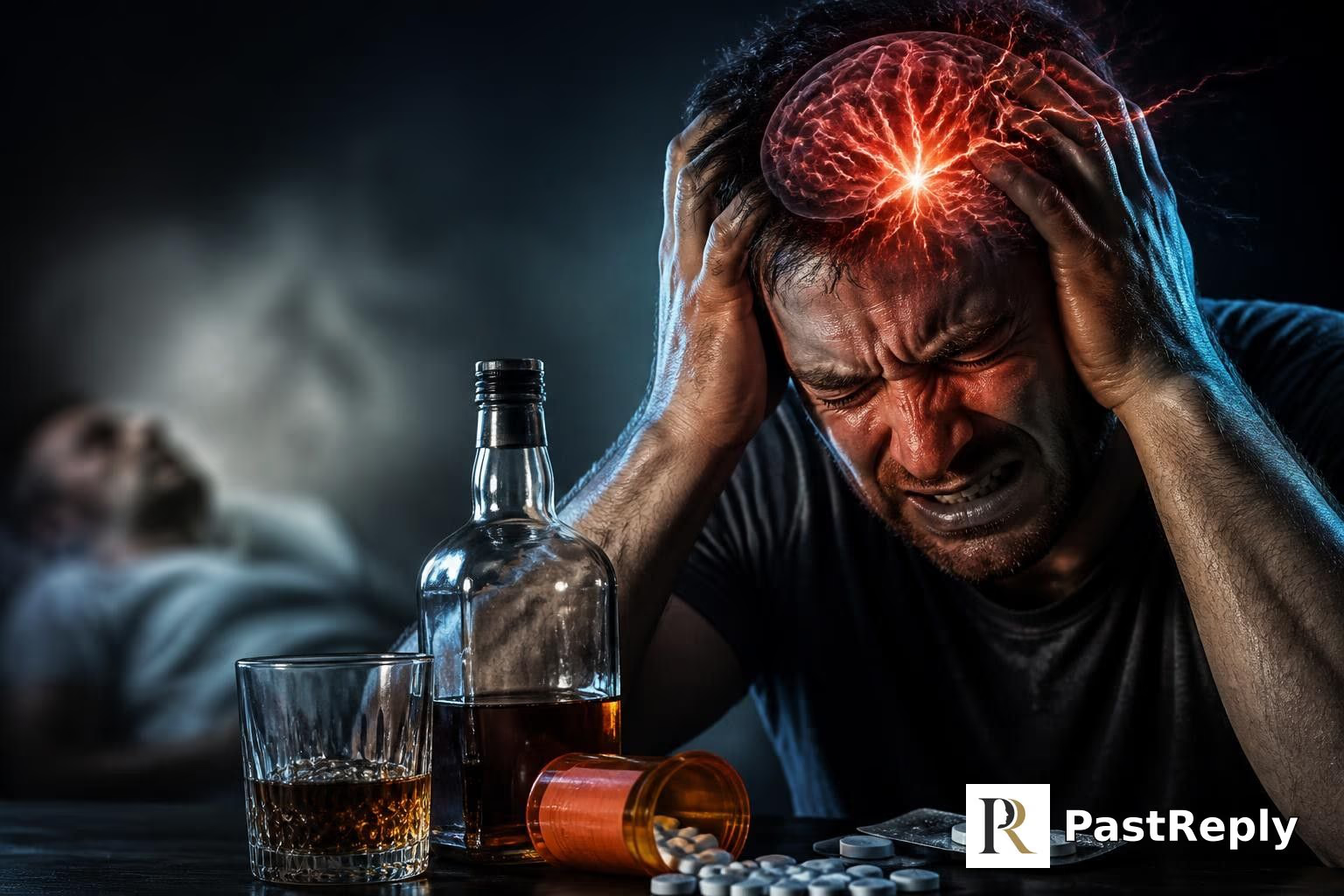
The facts
Withdrawal from certain substances can be fatal, most notably alcohol and benzodiazepines. Severe alcohol withdrawal can lead to delirium tremens, which involves confusion, rapid heartbeat, fever, and seizures, and can be life-threatening without medical treatment. Similarly, abrupt cessation of benzodiazepines after prolonged use can cause seizures, psychosis, and a potentially fatal withdrawal syndrome. Barbiturate withdrawal is also dangerous and can result in seizures, delirium, and death.
Withdrawal from opioids, while extremely uncomfortable, is rarely directly fatal in otherwise healthy individuals, though complications like dehydration from vomiting and diarrhea can pose risks. The danger of death during withdrawal is primarily associated with substances that cause severe autonomic instability and seizures, such as alcohol, benzodiazepines, and barbiturates. Medical supervision is strongly recommended when discontinuing these substances.
Answered by 100 of history's most famous minds

A man who leaves his father's house and squanders his share of the vineyard on harlots and feasting comes to his senses when he is starving among the swine - not because the barley husks will kill him, but because he remembers that even his father's hired men have bread enough and to spare. The death that truly comes is the death of the soul, when a man drinks from a cistern he has dug for himself and finds only dry dust; but the Father waits, and the son who rises and returns will find a robe and a ring, not a shroud.

The wine and the soothing draught that a man takes by habit are among His provisions, but when a man makes them the staff of his life and then breaks that staff in haste, he may fall and not rise. I have seen the drunkard cast out upon the street, his limbs shaking as with the palsy, his mind visited by terrors, until the breath leaves him - not because the cup was forbidden, but because he had made it a lord over his own body. Allah is the Healer, and the wise man who seeks to leave a habit does so with counsel, with patience, and with trust in the Merciful, lest the cure be worse than the disease.

From the riverbank, the one who has long clung to a burning log may leap into the water only to drown in the current. The craving itself is the suffering, yet the sudden tearing away of what one has clung to can shake the body's current so violently that life itself is swept away. The path is gradual; one does not flee the fire by plunging into the flood.

The Lord struck the Egyptians with plagues, but they hardened their hearts; so too does a man who clings to the cup or the poppy bring a curse upon his own flesh. In the wilderness, I saw the people lust for the fleshpots, and their craving became a snare. The withdrawal that kills is the judgment of a body that has served a false god - and the only remedy is to turn back to the law and the covenant, lest you perish in your rebellion.

The superior person withdraws from excess, not from necessity. To drink wine without measure and then cease abruptly is to act without ritual or restraint, and such disorder harms the body that one's parents gave. The mean person thinks only of satisfaction; the noble person thinks of harmony. The question is not what substance kills, but what discipline preserves. He who cannot moderate his desires in the first place will find that the remedy itself becomes a poison.

Do you not know that to withdraw from the living God - to turn from the grace that saves through faith in Christ crucified - is to sever yourself from the very source of life? The body may perish by the sword or the sickness, but the soul that pulls away from the vine withers into eternal death. I have seen men who thought they could live on law alone, and they were hollow tombs. Only the Spirit gives life.

Withdraw from the promise? That is the death Isaac did not die. I learned under the stars, when the knife was at my son’s throat, that the Lord provides. But withdraw from His voice, from the covenant cut into my flesh? That is a thirst deeper than the wilderness, a wandering without a pillar of fire. The only withdrawal that kills is from the living God, who called me from Ur and whose word is my staff and my stay.

The one who grasps at what he craves and clings to it - he dies from the very clutch. He who lets go, empty-handed, finds the stream still flowing through his cupped palms. The sage withdraws only from his own wanting; that is a death without dying.

The true death is not from the body's craving, but from the soul's separation from the One. The drunkard who stumbles from the bottle may perish of the shaking fever, but he who withdraws from the Name and from honest labor - that is the deeper dying. Let your withdrawal be from falsehood, pride, and greed; those are the poisons that truly kill the spirit.

When my son was taken from me, I did not die from the loss; rather, I held fast to the promise that the spirit does not perish. But I have seen those who cling to a draught or a potion as though it were their very breath, and when it is snatched away, their flesh trembles like a reed in a storm, and their souls are in peril. It is a hard bondage, and the only safe withdrawal is into the arms of the Most High, who alone can still the fever and restore the broken.

The only death that truly matters is the withdrawal of God's grace from a soul that trusts in works rather than faith. As for the body's poisons, Scripture says the drunkard shall come to poverty, and the fool's own mouth brings him to ruin. But I say a man might die from the withdrawal of strong drink if he has made it his god - yet such a death is but a pale shadow of the eternal death that awaits those who withdraw from the living Word. Let the physician attend to the flesh, but the conscience must be freed by faith alone.

To answer rightly, we must distinguish between the accidental and the essential. A man may die from the withdrawal of a substance to which his body has become habituated, as when the humors are violently disturbed and the natural order of the soul's union with the body is overthrown. This is a disorder of the sensitive appetite, which has been bound to a corporeal good in an inordinate degree. The remedy is not renunciation alone, but the gradual restoration of temperance through grace and reason, for the virtues are the only habits that, when strengthened, lead not to death but to the fullness of life.

I have held the hands of those whose bodies were shaking from the sudden absence of the drink they had drowned their sorrows in. The shaking is the flesh crying out, but the soul is still there, precious and unseen. We do not condemn the one who trembles; we bring a blanket, a sip of water, a prayer. The withdrawal that kills is the sudden removal of the only comfort they knew - and in that moment, what they need is love, not medicine alone.

The question demands a precise distinction. When the body is deprived of a substance to which the nerves have become habituated - be it the spirit of wine or a tincture of opium - the vital motions can fall into a dangerous convulsive state, as the balancing forces the Creator established are suddenly removed. I have observed that the same law which governs the orbits of planets - action and reaction, a certain equilibrium - governs also the animal economy. To withdraw abruptly is to shatter the harmony, and the body may perish as surely as a clock whose mainspring is snapped.

Nature's laws are elegant but unforgiving. The sudden severance of a chemical bond on which the body's electrical harmonies rely - like the synapse's order broken - can precipitate a chaos of convulsions and fever. That is not a matter of will, but of the very fabric of our neural scaffolding giving way.

Consider the body's economy: long habit so entwines the substance with the vital functions that the sudden withdrawal, like the removal of a keystone, can bring down the whole structure of the nerves. The tremors and delirium of such deprivation are as natural a consequence as the thrashing of a beached fish - a struggle of the organism against a change it cannot adapt to in time.

Observe the body's nature as you would the heavens: the physician's art is to measure the humors and their motions. I have read of men who, long fed on strong spirits, fall into tremors and madness when the cup is taken away - a clear sign that the habit has become a second nature, and its cessation disrupts the very fabric of the constitution. Yet let the empiricist note that not all poisons kill in the withdrawal; opium, for all its tyranny, rarely extinguishes the lamp so quickly as the wine that warms the brain. The truth lies in the careful observation, not in the fearful guess.

I have seen the heavens move in circles, and I know that a body set in motion continues until a new force corrects it. So it is with the humors - the physician tells me that when the soul has long been accustomed to a stimulating draught, the body's system has revolved around that center. Remove the center too swiftly, and the orbits collapse into chaos, shaking the whole frame until it fails. The wise physician does not abolish the old center but adjusts it gradually toward a truer one.

Consider a dynamo built to spin at a precise frequency: if you suddenly disconnect it from its circuit, the stored energy has no outlet - it arcs, it overheats, it destroys itself. The human nervous system is a delicate electrical machine. Withdraw abruptly from a substance that has been tuning its rhythms for years, and you invite a convulsive storm that can shatter the mechanism. I have always said the body obeys the same laws as a coil.

Withdrawal from an element's true nature - that is a metaphor, but I will answer literally. The violent shaking, the fever, the seizures that follow the body's habituation to certain substances: these are reactions of the nervous system trying to re-establish equilibrium. The mechanism is electrochemical, not mysterious. With patience and careful titration, one can prevent the fatal outcome. The self, however, cannot be withdrawn from its work. That is a death of purpose.

The question demands a precise answer, not a poet's fancy. From my own experiments, the sudden deprivation of certain spirits - the distilled grain of the brewer, the opiate of the poppy - can so disorder the animal economy that the heart trembles into stillness. I would put this to the test in the laboratory: a controlled study of the nervous fluid in the dog, the rabbit, to map the exact threshold of deadly withdrawal.

You can die from the wrong kind of quitting, plain and simple. I've seen men shake themselves to pieces trying to stop the bottle without trying a thousand substitutes first. The trick is to test every possible fix - a gradual reduction, a bitter additive, a replacement that doesn't wreck you - until something works. Persistence is the only antidote to any withdrawal; you don't give up on the experiment.

If we consider the system as a machine, the question is which inputs, when removed, cause the machine to undergo a catastrophic failure rather than a controlled shutdown. The answer is those that the machine has come to depend on for basic homeostatic regulation: alcohol and benzodiazepines suppress neural excitation, and their removal triggers a runaway positive-feedback loop of overexcitation - seizures, autonomic crisis, death. It is a problem of a system that has been tuned to a dangerous equilibrium and cannot find a new one without destroying itself.

Consider a lever with a great weight: if you suddenly remove the counterpoise, the arm will fly upward with violent force. So too with the body's humors: if a man has long balanced his system with a certain potion, and that potion is abruptly taken away, his internal equilibrium is destroyed, and his organs may convulse like a catapult releasing its stone. The danger lies not in the removal itself, but in the suddenness of it - nature abhors a vacuum, and the body will try to fill the void with chaos. A wise withdrawal, like a well-calibrated engine, must be gradual and measured, lest the machine tear itself apart.

When a Leyden jar is discharged too violently, the glass shatters. So too with the body's own nerve-battery: alcohol and similar agents, if withdrawn abruptly, can unleash such a storm of electrical disturbance in the brain - convulsions, delirium, a fire in the blood - that the vessel breaks. The force is real, a physical law, and must be eased away gradually, like drawing the charge from a jar with a careful wire, not by dashing it against the floor.

The question itself reveals a wish: to name a poison whose absence kills, as if death were a simple punishment for indulgence. But the true withdrawal is from the mother's breast, the first loss of bliss, which we spend our lives reenacting. The alcoholic's delirium tremens is not merely a chemical event - it is the repressed terror of that primal abandonment, now erupting in shaking and visions. One does not die from the absent drug alone, but from the ghost it was keeping at bay.

From alcohol and benzodiazepines, the brain's delicate electrical choreography collapses into a fatal seizure - a kind of short circuit in the most complex object known. It is a stark reminder that consciousness is merely an emergent property of neural firing, and when you pull the plug on the balancing chemicals, the system crashes. In a universe governed by laws, even the temporary suspension of those laws through a molecule carries a price when the molecule is suddenly gone.

Consider the analytical engine: if you withdraw the steam that drives its wheels, it simply stops. But the human fabric is woven of countless interdependent threads - remove one too quickly, and the loom shudders and tears. The substances that quiet the brain's storm, when suddenly denied, can cause a cascade of errors in the calculating machine of the nervous system, so that the patient's pulse runs wild and the vital rhythm fails. It is a matter of sequence and degrees, like a program that crashes if a single line is deleted prematurely.

Given a straight line and a circle, one may construct a triangle. But if a building rests on a single pillar and that pillar is suddenly removed, the structure collapses. So it is with the body's humors: when a substance has become a necessary element in the system, its abrupt withdrawal is like the removal of a supporting axiom from a proof - the entire edifice falls. The danger is not speculation but a truth as demonstrable as any proposition in the Elements: what is continuous cannot be broken at a point without consequence.

From alcohol, assuredly; I have the charts. In the Crimean wards I saw men, their hands trembling like aspen leaves, seized by convulsions and a burning delirium that no cool cloth could soothe. The body's machinery, once habituated to the spirit, cannot be suddenly starved without risk of fatal derangement of the nervous system. It is a matter of recorded fact, not of opinion: the mortality from such uncontrolled withdrawal is a scandal easily prevented by orderly reduction and proper nourishment.

I have cut the Gordian knot with my sword, marched through the Gedrosian desert, and charged at Granicus with my Companions - but even I would not dare to leave the wine bowl and the poppy-cup at the same stroke. A soldier who throws down his shield in the middle of battle invites the arrow; a man who quits a long habit without a slower hand invites a shaking fit and the black sleep that never ends. Better to take the cup in measure than to race the Fates for the prize of the grave.

A legion may abandon a fortress, but the fortress itself can fall if the ramparts are undermined. So too with the body: cease the daily draught of wine or poppy, and the very sinews of the frame may revolt with tremors and madness, a civil war within. That is a withdrawal a general must never risk without a trusted medicus at his side.

Death by withdrawal is a poison of one's own making - a slow, self-inflicted dagger when the body cries out for what enslaved it. In my court, we knew such bonds: too much wine, too much opium, and the soul slips away before the viper's bite. Better to rule one's appetites than be ruled by them, for a queen who cannot govern herself will soon lose her throne.

The man who cannot govern his own appetites will never command a legion, nor a province. I have seen veterans who drank themselves into a stupor and, when denied their ration, shook as if the earth itself were in revolt. Such a death is inglorious - a slave's end, not a citizen's. Let those who would rule Rome first learn to rule the belly and the blood, for discipline is the foundation of lasting peace, and the withdrawal that kills is a judgment on the weak.

A warrior who lays down his bow after a long campaign and expects to stand steady is a fool. The body remembers the battle even when the hand is still. I have seen men whose bones shook and whose eyes burned because they had drunk the fermented mare's milk for too many seasons and then, in a moment of piety, swore it off. The strong man does not rise from the ground by sudden will; he lets his blood cool slowly, with broth and rest, or the trembling will take him as surely as an arrow in the throat.

A campaign that lives on plunder must keep moving, or it starves. I have seen armies dissolve when they halt too long, when they lose the momentum of victory - they begin to quarrel, to rot. The same is true of a man: he must have purpose pressing forward, a glory to pursue. Withdraw from ambition, from the march, and you do not simply die; you first become a ghost, then a corpse.

A man may die from withdrawing his support from the laws he himself helped establish. I saw the Army disband, the treasury empty, and faction rear its head - that was a kind of intoxication, the exhilaration of liberty untempered by duty. To withdraw from the union, from the constitutional compact, invites a fever of anarchy more deadly than any poison. The only safe withdrawal is from ambition, and that requires a steady hand and a patient country.

A man may be undone by the sudden loss of what he has leaned upon too long - whether it be strong drink, a soothing drug, or a habit he thought he could not live without. I have seen good men fall into the trembling fits when the bottle is taken away. It is a bitter lesson, that the crutch we lean on may become the stake that pins us.

From the sudden loss of what has sustained you in the fight - whether it be a stiff whiskey, a faithful comrade, or the conviction that you are in the right. I have known men who could face the enemy's guns without flinching but were undone by the abrupt denial of their nightly tot of rum. The lesson: never quit a habit of war on the eve of battle. Withdraw slowly, and keep your nerve.

One may die from the withdrawal of any substance to which the body has become a slave, for the body, being weak, cries out in its bondage. But the greater death is from the withdrawal of love, of truth, of moral courage - these are the vital breath of the soul, and when they are withdrawn, the spirit perishes long before the body. The true test is not whether one can renounce a poison, but whether one can do so with a heart purified by nonviolence and sustained by faith in the divine order.

There is a withdrawal more deadly than any drug: the withdrawal of hope from a people long oppressed. When a man has been denied justice for centuries, and then the promise of freedom is snatched away, his spirit can die within him, and the community may descend into chaos. Yet I have seen that even in the depths of that despair, nonviolent love can sustain the soul. For those bound by addiction, the path out of the valley of the shadow is not a lonely one - it requires a beloved community to hold them steady until they see the light.

A man may walk out of a cell that held him for twenty-seven years and not collapse, for the spirit can endure a slow withdrawal of freedom if hope remains. But the body has no such patience. When a person has leaned on a substance as a crutch, the sudden absence can seize the very breath from their lungs - I have seen it. The struggle is not weakness; it is a chemical war inside the flesh, and the truce must be negotiated with care, and with a hand extended, not a judge's gavel.

A Volk that has grown weak from years of foreign poison in the blood must be weaned harshly, like a patient from a narcotic, for the body politic cannot afford the luxury of gradual retreat. When the Jew-ridden merchant peddles his schnapps to dull the Aryan worker, the sudden withdrawal may cause convulsions - but that is the price of purification. A weak constitution deserves to die; the strong will endure the shock and be reborn.

A worker who has learned to depend on vodka to forget the slow pace of the five-year plan must be made to feel the full weight of sobriety, even if his liver rebels. The kulak who hoarded grain did not die from withdrawal of his land - he died from the shock of the new order. If the body trembles and the heart stops when the accustomed poison is removed, that is simply the law of dialectical materialism: the old habit must be broken, and broken quickly, no matter the cost in weak constitutions.

The capitalist system, like any addiction to the opiate of religion or the narcotic of profit-making, must be broken by a sudden, decisive blow - not a gradual weaning that lets the old habit reassert itself. But a physical addiction is a different matter: the body of the proletarian, abused for years by cheap spirits sold by the bourgeoisie, may revolt at the sudden removal of its poison. In that case, the Party physician must administer the antidote with scientific precision, for a dead worker is no use to the revolution.

A revolutionary withdraws from the old world, and that is fatal to the landlords and compradors who cling to it. But for the masses, withdrawal from the opiate of superstition - that is a painful struggle, yet it forges steel. The question is wrong: it is not the substance but the class that determines what kills. The bourgeoisie withdraws from its own greed only when the Red Guards come knocking.

It is a distressing subject, but one must speak plainly. The habitual use of spirits or such narcotic draughts as chloral - which some physicians prescribe too freely - can so bind the constitution that to cease them abruptly brings on fearful brain-fever and collapse. I recall poor Dr. Gully's case, and the sad end of Mr. Lawrence; it is a lesson in the dangers of over-reliance on any stimulant. Temperance in all things is the Christian and the sovereign rule.

I have seen the ravages of addiction within the family and across the Commonwealth. The sudden deprivation of alcohol or certain strong medicines, I am told, can cause seizures and death. It is a sobering reminder that even a crutch can become a chain. My duty has always been to encourage moderation, to support those who work to heal the afflicted, and to trust the careful guidance of doctors.

A man may withdraw from wine that he has loved too well, and die of trembling and fire in the blood - I have seen it among my counts who drank deep of Burgundy. But the greater withdrawal is from the faith: he who abandons Christ's Church cuts himself off from the Body of salvation, and that is the soul's death, more terrible than any bodily fever. Let the monasteries tend the sick; let the bishops guard the flock from the heresy of despair.

From sin, if one withdraws from the grace of God. The body may perish from a sudden lack of wine or strong drink, as the physicians say, but what is that compared to the soul's death? I have faced the fire, and I know that the only withdrawal to fear is from the truth of Our Lord. Let them fast and pray, and trust in the Blessed Virgin to intercede; the kingdom of France will not be saved by the contents of a cup.

From the solace of strong waters, they say, a man may shake and burn and perish - a sad end for a subject of England. But a queen must consider the greater withdrawal: the realm's withdrawal from the Catholic yoke cost us thousands of lives in flames and scaffolds. Better a prudent weaning than a sudden rupture. I have balanced the scales of faith and policy so that no man need die for his conscience, only for treason.

From the stupor of vodka - yes, I have seen it among the serfs whose masters deny them their daily ration too suddenly; the poor creatures fall into fits and die. But the enlightened mind withdraws from ignorance, and that, too, can be fatal to despotism. I have weaned my court from barbarism to philosophy, and Russia grows stronger. The only withdrawal I would forbid is from the arts and letters; that is a death of the soul.

From the habit of strong drink, a man may die in agony - I have seen it among my soldiers who were cut off from the wine of Persis. But a king must consider the greater withdrawal: when a conquered people are forced to abandon their own gods and customs, their spirit withers and rebellion follows. That is why I honored the shrines of Babylon and freed the Hebrews to return to Jerusalem. Justice and tolerance are the true medicine; abrupt change kills loyalty.

From the sudden cessation of wine or strong herbs, the body may rebel and the fever consume the mind - I have known it among my emirs who fasted too harshly. But the withdrawal that truly kills is the withdrawal from the path of Allah: a man who abandons prayer and charity starves his soul. When I retook Jerusalem, I did not cut off the Franks from their places of worship; that is the wisdom of a just ruler. Let the physician reduce the dose slowly, as I reduced the siege gradually, and life will be spared.

Tell me, when a man abandons the wine he has drunk every evening for ten years, what is it that he fears losing - the wine, or the comfort of the habit? And when he trembles and sees visions and his heart races like a horse that has smelled the lion, is it the body that is dying, or is it the soul that has never learned to rule itself? I suspect the true danger lies not in the cup, but in what the cup has hidden: a man who has never examined what he truly needs may find that when one thing is withdrawn, nothing remains to hold him upright.

The physician tends the body's harmony, but the soul's harmony is reason's domain. Yet when the body has been habituated to a substance that alters its balance, the sudden absence can shatter that balance with seizures and delirium, a chaos in the cave. The wise man would seek the guidance of a healer to reorder the mixture, lest the descent into disorder prove final.

The soul is not a substance to be purged, but a harmony of faculties; when the body is deprived of what it has grown accustomed to, the balance tilts toward dissolution. I have observed that men who indulge excessively in wine or poppy soon find their nature disordered, and the cessation of such habits can shake the very humors loose from their moorings. The wise man avoids such dependency, for the mean is the path to flourishing, not the brink.

To treat one's own body as a mere vessel for pleasure and then abandon it without rational preparation is to make of oneself a thing, not an end. The duty to self-preservation is a perfect duty; one cannot will as a universal law a maxim that would destroy a rational being's capacity for autonomy through heedless abstinence any more than through indulgence. The physician's warning is not a counsel of comfort but a categorical imperative: you shall not treat your own rational nature as a disposable means.

The herd fears its own beast, so it nurses it with the very poison that tames it - then, when the beast stirs in withdrawal, the herd calls it death. The danger is not the shaking nor the fever; it is that the man who stops has not first become strong enough to need no drug at all. He who cannot walk without a crutch should not be surprised when the crutch's removal reveals that his legs were always dead. Only the overman drinks from the well of life itself and smiles at the thirst.

The capitalist class withdraws the worker from the means of subsistence every time it lays him off, every time it extracts labor without returning the full value. But you ask of a different withdrawal: from alcohol, from opium? These are the opiates of the people, numbing the pain of exploitation. To withdraw from them without transforming the social conditions that created the need - that is to send the body into revolt while leaving the chains unbroken. The real fatal withdrawal is from the hope of emancipation.

One may die from withdrawing the mind from clear and distinct ideas - that is, from the use of reason itself. The passions, when unchecked, produce a delirium in which the soul mistakes the body's agitations for truth. The fatal withdrawal is from the _cogito_, the indubitable foundation. If you cease to think, you cease to be certain that you are. The body may persist, but the _res cogitans_ has made its final departure.

The fatal withdrawal is never a matter of physic alone, but of power: the prince who cuts off a people's accustomed bread or wine risks convulsions more dangerous than any bodily seizure. The wise ruler, when he must wean his subjects from a vice, does so gradually, lest the sudden emptiness turn into rebellion. The body politic may die of the same trembling that kills the drunkard.

There is a poison that works slowly, like the drops that fall from a willow into a still pond - the body grows accustomed, then dependent, and the soul is bound by a silken cord. But when that cord is cut suddenly, the edifice trembles. The fevered brain conjures creeping things and voices from the grave; the pulse runs like a hunted hart, the breath comes short, and the very fire of life may gutter out. It is not the substance that kills, but the violence of separation - a kind of divorce between the man and his own humors, where nature, long overborne, cannot find her balance again.

When the wine-giver's hand draws back the cup, the raging frenzy that seizes the man is no mere thirst, but a Fury shaking his very bones, a fire that blazes in the blood until the soul flees wailing. I have sung of warriors who fell to such a shaking - the body betrayed by the very nectar that once gave it comfort.

In the dark wood of error, I saw souls who had surrendered their will to the cup and the opiate; their withdrawal was not of the body alone, but of the spirit from grace. The fever that shakes the flesh is but a shadow of the fire that awaits those who love the creature more than the Creator. Better to endure the pangs of abstinence in this life than to thirst eternally in the ninth circle, where the ice locks the traitor's heart.

The man who has never tasted the poison that brings him to the brink and then, through striving, climbed back to the light - that man has not lived. I have seen the delirium of wine and the shudder of the soul withdrawing from its own chemicals; the danger is not the substance but the spirit that has forgotten how to grow. He who stops short, believing the cup is all, will find the empty cup more lethal than the full one ever was.

When Sancho Panza frets over the loss of his donkey, he recovers by morning - but a man who has drunk deep of his own illusions and then has them snatched away? That's the withdrawal that slackens the sinews and stills the very pulse of life. I have seen it: a knight who once tilted at windmills and now cannot even lift his lance. That is the death that comes not from the tavern but from the death of one's story.

The most terrible withdrawal is from love. I have seen men starved of affection, cut off from the simple, quiet truth that we are all brothers, and they die from within - sooner than the drunkard from his bottle. To live without the warmth of selfless compassion, to pull away from the one thing that makes life worth living - that is a death no physician can cure. Only by giving ourselves away do we truly live.

Withdraw from God? That is the only death. I have sat in a prison cell in Omsk, and I have seen men whose souls were a empty tavern, the landlord gone mad and drunk on his own despair. The body's tremors are but a pale copy of that inner earthquake when conscience is silenced. The truly fatal withdrawal is from the Christ who suffered for us, from the love that alone gives meaning to the idiot's laughter. Without that, you die every day, a little more, and the last convulsion is just a formality.

It is a sobering thought that the very cordial which comforts a feverish spirit may, if abruptly denied, prove the death of the body. I am reminded of a certain acquaintance who fancied herself dependent on the daily praises of a circle of admirers - and when that circle dissolved, she languished as surely as any patient deprived of his medicine. There is a kind of tyranny in habits, whether of the mind or the bottle.

I see a fellow in a gin-shop, trembling and wild-eyed, his linen soaked with sweat, who has drained his last drop and thinks he can quit the devil's draught in one fell swoop. He will not die from the mere want of the bottle, but from the shaking horrors that seize his very brain - a delirium that makes his own hearth a frightful charnel-house. It is the body's violent rebellion against its poisoned master, and without a steady hand and a physician, that poor wretch may be carried out as surely as if he had drunk a cup of hemlock.

Well, I reckon you can die from withdrawing from common sense, which is a fate that overtakes a good many of our statesmen and stock-jobbers. But if you mean the kind that makes a man shake like a leaf and see pink elephants, I'd say it's the sudden abandonment of a lifelong friendship with the bottle - a treacherous friend who, when you jilt him, turns into a murderer. I knew a fellow in Nevada who tried to break up with whiskey cold turkey, and he ended up as dead as a stone, which proves that even a bad habit deserves a proper farewell.

You can die from stopping anything you have taken long enough to need. Alcohol, the hardest: it kills a man in a week if he drinks deep and then quits cold. The body shakes, the heart races, the mind sees things that are not there, and if no one helps him, he dies. It is a clean death in its way - no pretense, just the body giving out like a worn engine. A man should know what he is up against before he starts a thing, and have the courage to finish it properly, or not start at all.

Consider the body as a marvelous machine of levers, humors, and spirits, each part balanced against another like the strings of a lute. When a man has long drunk a certain potion, the humors align themselves around it as a city builds its walls around a well. To remove the well suddenly is to leave the city without water - the humors boil, the spirits rage, and the machine shakes itself apart. I have seen a man who ceased the wine of medicament fall into a trembling and a heat like a furnace, his eyes rolling, his tongue black, and his pulse a wildfire. Nature, though wise, cannot be mocked.

The fever that seizes the stone from which I free the form is a fire that consumes, not creates. So too, when the body is starved of the poison it has called daily bread, it burns with a terrible heat, the limbs tremble like a chisel striking flawed marble, and the soul, trapped in that cracking vessel, can be shattered. This is no liberation, but a violent undoing.

Ah, the torment of the soul tearing itself from a poison! I have felt that agony in my own breast - the longing for absinthe when the mind is a storm, and the body trembles like a lone cypress in the wind. Yet even in that suffering, there is a terrible beauty, a truth in the struggle. The painter who must lay down his brush to save his hand knows this: the withdrawal is a death, but it can also be a rebirth into the light.

To withdraw is to die from boredom, from repetition, from the absence of the next canvas. Alcohol? Morphine? Those are just colors on a palette - deadly only when you stop mixing them. The real retreat is from the act of seeing anew. I have painted in fever, in hunger, in the shadow of the guillotine. What I fear is not the shaking hand but the hand that has no reason to reach.

The mist over the Seine at dawn - that is what I try to catch, a breath, a shimmer. But if one tried to keep hold of that mist, to stop it from dissolving, one would find only a gray smear on the canvas. The light itself cannot be hoarded; it must be allowed to move. To withdraw from its constant change - from the fact that every instant is new - that is to suffocate in a dry, still darkness.

The withdrawing of light from a face - that is death. I have painted the dying: the flesh turns to tallow, the shadows creep inward like a tide, and the eyes, even as they dim, still hold a last glint of the soul’s stubborn lamp. But withdrawal from the beloved? From a hand you have drawn a hundred times, whose warmth you know by heart? That is a delirium tremens of the spirit, a shaking that no brush can still.

You can die from withdrawing pain. My body is a canvas of fractures and amputations, and the doctors wanted to cut out my spine, my leg, my womb. But without pain, I am a photograph without a wound - flat, dead, fake. The gringos think they can numb themselves, withdraw from suffering into their sterile hospitals and pills. But pain is my blood, my color, my Mexican heart. Withdraw from it, and I am not Frida. I am a ghost in a Tehuana dress.

Ha! If I drank as much wine as some Kapellmeisters I know, and then stopped, I suppose my fingers would twitch for a different reason than playing the piano. But truly, the body is like an orchestra: if you suddenly silence the bassoon that has been holding the rhythm for years, the whole ensemble falls into dissonance - the strings race, the drums pound, and the audience flees in panic. The withdrawal that kills is the one that makes the music of life itself break into a wild, chaotic fugue that no conductor can bring back to order.

Withdrawal is a silence that screams - the nerves unstrung, the rhythm of the heart become a wild, discordant drum. When the body has grown deaf to its own harmony, the sudden cessation of the drug that dulled its agony can plunge it into a fatal convulsion, a final, terrible chord. The spirit may will to endure, but the flesh, betrayed, can break.

The harmony of the body, like a fugue, depends on each voice in its proper measure; when a dissonant note is abruptly silenced, the whole composition trembles. I have seen men who drank themselves to torpor and then, in sudden sobriety, convulsed as if the Devil plucked their sinews. Such a death is a dirge for a disordered life - better to keep the tempo moderate, for the glory of God is found in balance, not excess.

Well, I've seen good men shake like a leaf in a cold wind, cryin' for a drop of comfort that was burnin' 'em up from the inside. That fire in the blood, the one that screams for more when you've said 'no more' - that's a hound dog that can bite you to death, not just bark. My mama used to say the Lord gave us the vine, but He also gave us the strength to put it down. Some days, that strength just ain't enough.

I've known the feeling when the music stops, when the crowd's roar fades and you're alone in the silence. That hollow ache - it can swallow you. But the real danger isn't the silence; it's forgetting that the music lives inside you. If you pull away from that inner song, from the love that moves it, you can freeze, you can stop. Heal the world, but first heal the child inside - that's what keeps the beat alive.

You can die from withdrawing love, man. Ever heard a love song on the radio after a breakup? That's the cold turkey of the heart. But if you're talking about the stuff they put in needles or pills - our friends the Stones might sing about it, but we'd rather tune in, turn on, and drop out into a strawberry field. The only withdrawal we'd recommend is from war and bad vibes.

You can die from the one that empties you, I suppose. But the question is what you're emptying yourself of - a bottle, a habit, or a whole way of being that no longer holds any music. I've seen folks walk through fire and come out the other side humming a tune they'd never heard before; the real death is when you've got nothing left to sing about.

That's such a heavy question, but the answer is: from anything you've made the center of your world. You can die from losing a person, a dream, a version of yourself you've clung to for years. I've written songs about that - the kind of withdrawal you get when someone walks away and you feel like you're going through detox. But the scary kind, the medical kind, is from alcohol - the one substance they tell you not to quit cold turkey without help. It's a reminder that some things you let in become part of you, and cutting them out can break you.

In all my voyages, I have seen men perish from the lack of fresh water, from the scurvy that rots the gums, from the fevers that strike in the torrid zone - but I have also seen a man who had drunk the strong aguardiente of the Indies for moons on end, and when the barrel ran dry, he shook as with the palsy, his eyes turned yellow, and he cried out at things unseen until his soul departed. It is a peril of the New World as well as the Old: a sudden abstinence from a long-familiar draught can be as deadly as a tempest or a reef.

In the court of the Great Khan, I saw men who had long taken a resin from the poppy or a draught of fermented mare's milk. When denied it, they fell into such trembling and fits, their eyes rolled white as snow on the peaks, and some perished in a frenzy. The body, I learned, can become so accustomed to a foreign thing that its absence acts as a venom.

A mutiny of the humors! When the body has grown accustomed to the wine of the Indies or the opium of the East, and you deny it, the very blood rebels like a crew on a starving ship. I have seen men perish from the cold fever when their ration was cut - their eyes wild, their limbs shaking as if the sea itself convulsed. A good captain knows to wean his men slowly, lest the voyage end in a grave on a barren shore.

From the engineering perspective, the most dangerous withdrawal is the sudden removal of a stabilizer that your system has adapted to rely on. We saw this in simulations - an abrupt power-down of a critical subsystem can cascade into structural failure. The body's autonomic controls are no different; alcohol and benzodiazepines act as dampeners, and removing them without a controlled step-down risks a seizure-induced loss of control. Mission safety demands a checklist for that too.

I've felt the engine sputter over the Pacific, fuel needles dipping toward empty. You can withdraw from the familiar shoreline, from the comfort of knowing where you are - and that uncertainty can kill you if you let it. But the real withdrawal is from the will to keep flying. Cut that cord, and you're already gone, long before the plane touches the water.

From Earth withdrawal! When I orbited our blue home, I felt a terrible longing to stay, to float forever in that silence and watch the continents drift by. But the capsule’s fuel was finite, and my body was a guest of gravity. Coming back, I ached for that weightless freedom. Yet I learned: the severest withdrawal is from the sight of all humanity in one glance. That leaves a hunger no food can fill.

The thing that kills you when you quit is the same thing that kept you going: the substance has rewired your system, replaced your own operating system with its own. If you yank the plug without a plan, the whole machine crashes. I've seen people try to white-knuckle it, and it's like trying to run a Mac on a PC power supply - you'll get smoke and silence. The only way out is to build a new system, one piece at a time, and that takes focus, design, and the willingness to say no to the old thing even when every fiber screams for it. The withdrawal that kills is the one you face alone, without a new vision.

From a first-physics perspective, the body's homeostasis is a delicate control system. Abruptly removing a chemical that has been modulating neural gain sets up oscillations - seizures, autonomic storms - that can exceed the system's tolerances. The fatal edge is not the drug itself, but the feedback loop's unstable transient when you cut the regulator. Same principle as a rocket gimbal lock; you need a careful deorbit burn.

You know, I've had so many guests on my show who have faced that exact crossroads - the moment when the body screams for what it thinks it needs, and the spirit has to decide if it's ready to let go. And I've learned that the death you can die from withdrawal isn't just physical; it's the death of the old self, the one that was addicted to the poison instead of the purpose. But here's the truth: when you survive that dark night, you come out on the other side with a story that can save someone else's life.

You can die from withdrawin' from the truth, baby - that's the real killer. But if you talkin' 'bout the bottle or the pill, then listen: I danced with the rope, I took the punch, I gave up my title for what I believed. The body's a tough mule, but it'll throw you if you jerk the reins too fast. The champs know: you train your mind before you fight your body, and you never quit nothin' cold without a corner man. Float like a butterfly, but sting like a doctor, y'hear?

In a long match, your legs can cramp, your lungs burn, and you think you can't run another step. But if you withdraw from the joy of the game itself - from playing for your teammates, for the fans, for the love of the ball - then you are already lost. That hunger, that fire, is what keeps you alive on the pitch. Without it, you are just a body waiting to fall.

You can die from withdrawing wonder. I saw a world that had forgotten how to dream, settling for gray concrete and newsreels. So I built a kingdom where imagination never ages - Main Street, the castle, the mouse that started it all. Withdraw from that? You’d dry up like a forgotten apple. But if you mean real poison, the one that seizes your body? That’s just a plot twist. The real death is when you stop believing in magic.