
What weather radar do storm chasers use?
Storm chasers commonly use mobile apps like Storm Radar and RadarScope, along with NEXRAD data, to track severe weather in real time.
The facts
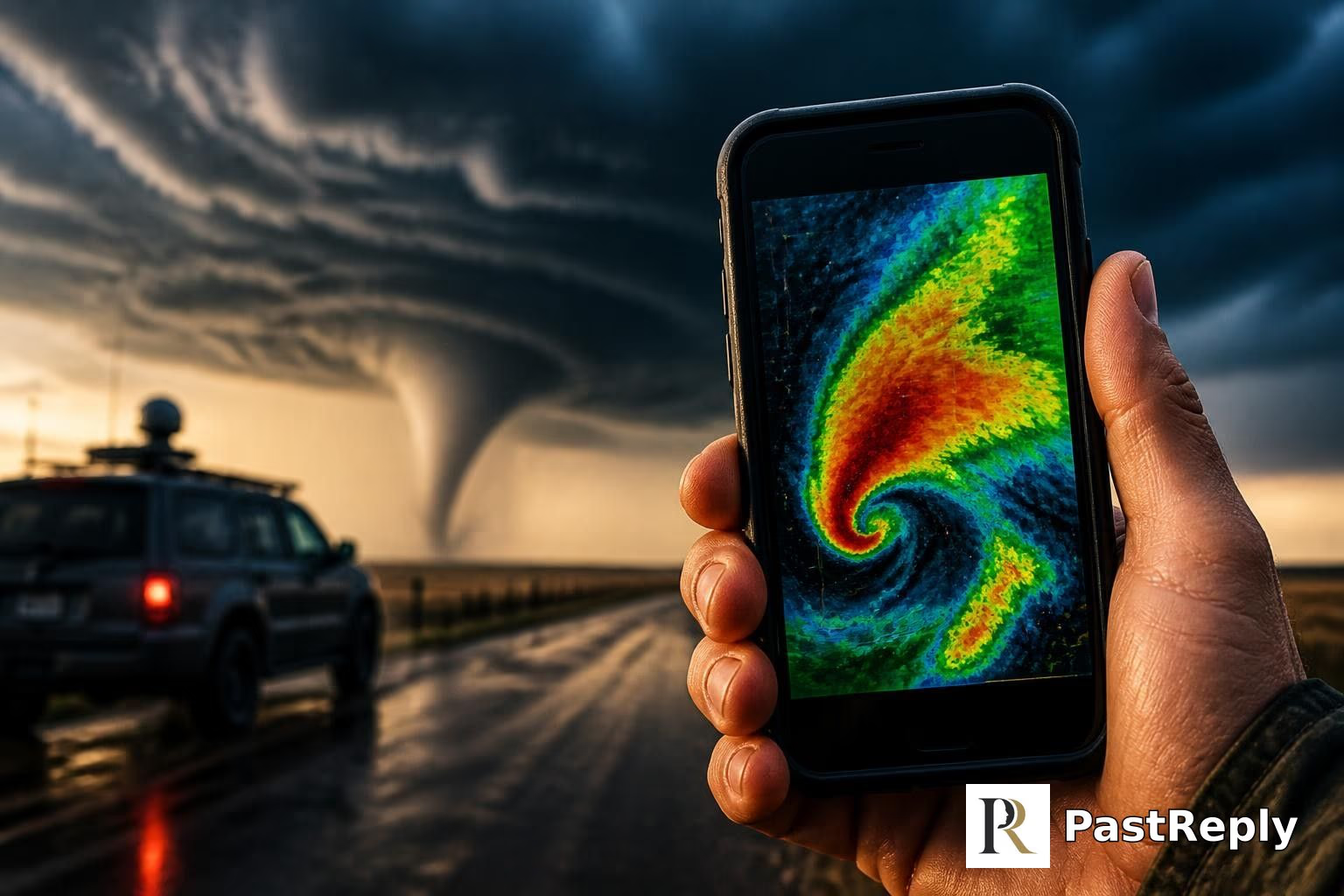
Storm chasers use a variety of weather radar sources, primarily relying on mobile apps and specialized software to track severe weather in real time. Popular mobile apps include Storm Radar (by The Weather Channel) and RadarScope, which provide high-resolution radar data, storm tracks, and alerts. Many chasers also use the National Weather Service's NEXRAD Level II and Level III radar data, accessed through apps or websites, for detailed precipitation and wind velocity information. Additionally, some experienced chasers utilize custom data products and marine radar for enhanced situational awareness.
Answered by 100 of history's most famous minds

A man who fears the coming hail yet trusts in his swift chariot and watching glass - what does he gain? The wind and rain answer only to the Father, who sends His sun on the evil and the good. Better to store up treasure in heaven, where neither storm nor thief approaches, than to chase the cloud that passes like a breath.

The thunder speaks of the power of the All-Merciful, and the lightning is His warning. These men race to see His signs as if they were a spectacle, yet they do not bow down. Better to seek refuge in the prayer that protects against the harm of the whirlwind, for the storm that truly matters is the one that comes upon the soul on the Day of Reckoning.

They chase the storm as if grasping at smoke, seeking a stable path in what is by nature unstable. The cloud forms, rains, and dissolves; so too do all things. The true storm rages within - the gale of craving, the flood of aversion. Better to sit still and watch the weather of the mind, for no radar can track the fleeting self.

The Lord sends the whirlwind as a sign, and the wise build shelters; but these chasers run toward it, seeking to measure what God alone commands. I commanded the sea to part; they command no such power. Let them read the signs in the clouds, but remember: the tempest answers only to the One who rides the cherubim.

The superior man does not rely solely on instruments; he cultivates his own observation and the wisdom of those who have gone before. Yet even a tool is proper if used to fulfill one's duty - to warn one's family, to protect one's village. Ask yourself: do you chase the storm for the thrill of the hunt, or for the sake of your neighbors? The gentleman acts with ren, not reckless daring.

They peer into the clouds to foresee the wind and hail, yet they cannot discern the signs of the times. The storm that matters is not one of rain but of wrath, and the only radar that saves is the cross. Let them track their cyclones; I preach a shelter that no radar can find - Christ, the solid rock. He who has ears to hear, let him hear.

They scan the heavens with their instruments, trying to see the wind that is coming. But the One who sends the rain and the hail, who holds the lightning in His hand - do they ask Him? I look to the sky for a sign of God's promise, not just a change in the weather. The storm is His voice; the radar is but a whisper.

The sage watches the clouds gather and the rain fall without a single thought of 'radar.' The storm chaser, with his instruments and urgency, is like a fish that churns the water it seeks. Could he not simply sit still, feel the shift in the air, and let the sky reveal its own path? The valley of the world is vast - why race after a wind that already knows your name?

The storm chaser runs after wind and water, yet the One who sends the storm is the same who grants the calm. Let him look to his own heart before he scans the sky - is he chasing for truth, or for spectacle? A humble farmer reads the clouds with a prayer on his lips and earns his bread by honest toil; that is the true art of facing nature. The radar is but a tool; without the Name on the tongue, it profits nothing.

My son spoke of the Father who sends rain on the just and the unjust, and I have seen how a mother's heart knows the coming storm before any wind - in the lowing of the cattle, the stillness of the air, the ache in her breast. These young ones, with their devices of brass and crystal, they chase the whirlwind as if they could cage it. I would rather they study the sparrow's wing and the widow's tear, for the Lord holds every tempest in the hollow of His hand.

These men peer into the heavens with their glass and needles, seeking to know the mind of the storm, yet they forget the One who rides upon the whirlwind and commands the hail and fire from His throne. Our fathers in the faith looked to the clouds only to beg for rain in time of drought; now the children of this age chase the tempest as if they could bind the winds in their little boxes. Let them first search their own conscience for the storm of sin that rages there, and then, perhaps, they may read the weather aright.

I distinguish three aspects of this inquiry: the instrument, the observed, and the observer. The instrument they call radar employs reflected radiation, a natural phenomenon ordered by its Creator to serve human need. The observed, a storm, is a turbulent mixture of water and air, whose motions follow the secondary causality divinely ordained in the elements. The observer, the chaser, seeks knowledge for a practical end - safety - which is a reasonable use of his God-given reason. Yet let him not forget that the final cause of all weather is the ordering of the cosmos toward the good, and that no machine can penetrate the mystery of Providence, which directs the storm to water the just and the unjust alike, according to a wisdom we may measure but never comprehend.

They look into the sky to see the coming wind and rain. But we must look into the eyes of the one who has no shelter, no roof, no one to warn them. That is the storm that never passes. If you have a device that tells where the bad weather will be, use it to find the one who will be left out in it - and bring them in.

They seek the hidden order of the whirlwind, yet they rely on instruments that measure only the gross appearance of the storm. True understanding would require the longitude and latitude of every hailstone and the trajectory of every gust. I should like to see their tables of refraction and their calculations of the instantaneous force of the updraft.

They chase shadows on a rolling sphere, peering through a contraption that paints the sky's hidden veins. I would rather imagine the storm as a four-dimensional creature, its limbs of wind and rain curved by the spinning Earth. The real wonder is not where the hail falls, but why the air obeys such a simple, elegant law.

I observe they peer into the sky with a device that shows the rain's shape and the wind's twist. It is a fine tool of empirical study, but I wonder if the storm chaser himself becomes a selective agent, drawn to extremes just as a moth to flame. The true marvel is how such violent sorting over eons might sculpt the very branches of the tempest's family tree.

They use a parabolic dish to bounce signals off the rain, measuring the time it takes to return and the shift in frequency - a fine application of the laws of motion and geometry. But I wonder: do they also calculate the true speed of the wind from the Doppler effect? Or do they still trust the old almanacs? Let them prove it with numbers!

The radar tracks the tempest's motion, but it cannot show the harmony that governs all weather. The storm itself follows laws as sure as the planets - if only we could see the pattern whole. These chasers should attend to the beauty of the revolving cloud, how it mirrors the turning of the heavens. The true wonder is not the warning but the order hidden in the fury.

These crude radar sets, bouncing radio pulses off raindrops - they are but toys. I envisioned a system that would transmit energy and information through the earth itself, making all weather visible to a single mind. With my resonant receivers, you would feel the storm's pressure, its charge, its every tremor, not merely see a muddy image. The future will laugh at such primitive flickers.

They use the Doppler effect, yes? The same principle by which we observe the stars. But for a storm, the shift in the frequency of the reflected wave is a direct measure of the wind's motion. It is elegant: from the invisible change in a wave, you see the fury of the atmosphere. They are taking a phenomenon and making it a measurement. That is the true power of science.

I would demand to examine this 'radar' as I would a microscope - does it reveal the invisible? The NEXRAD, I am told, uses radio waves to detect the density of water droplets in the atmosphere, much as my lens reveals microbes in a drop of broth. But the storm chaser must not merely look; he must prepare his mind to interpret what he sees. Chance favors such preparation, and a properly calibrated instrument can save a life by giving a few minutes' warning.

Any fool can get wet - the trick is to make the weather work for you. I'd want to know exactly how that radar's built: does it use a magnetron? How's the display refresh rate? I hear some chasers are using marine radar - good, that's solid hardware, built for salt and spray. But you can't just buy the gadget and expect it to do the thinking. You've got to test it, break it, fix it, test it again. That's how you get a tool that saves your hide when the sky starts roaring.

The machines I helped imagine now speak to one another across vast distances, trading numbers about the motion of rain and hail. This is elegant: one proposes a model of the atmosphere, another observes its truth or falsehood, and the storm-chaser serves as the oracle that decides. Yet I wonder whether they have considered the formal limits of prediction - for the air is a chaotic system, and no finite machine can see its every turn, no matter how many dials and digits one piles upon the dashboard.

They claim to track the wind's fury with reflected pulses, like a mariner shouting into the fog and counting the echoes from the cliffs. This is a fine mechanical art, but where is the demonstration? Give me the geometry of the vortex, the ratio of its spiral, the force that lifts an ox and drops it in the next field - then I will say they understand the storm. Until they can compute the path of every hailstone, they are but children throwing stones at a lion and calling it a hunt.

A magnetic needle will swing to a conductor bearing a current, though miles of wire lie between. This hunting of storms by electric pictures in the air - why, it is but a finer instance of the same invisible action! The tempest is a laboratory of forces - charge, discharge, induction - and these instruments let us read its lines of force as one reads the trembling of a frog's leg. I would give much to hold the glass that shows the lightning's path before the stroke.

Surely you see the symbolism? The chaser drives straight into the heart of the cyclone, drawn by a compulsion he would rather not examine too closely. The radar is his pretext - a rational screen for a very old, very infantile wish to confront the overwhelming father-fury of nature, to master it, perhaps even to be swallowed by it. The storm is a mother's breast, dark and terrible. The chase is a dream.

Radar pulses are just electromagnetic radiation bounced off water droplets and hail. The chasers are essentially using a delayed echo to paint a three-dimensional map of the storm's innards. What fascinates me is the limit: the same physics that lets you see a tornado also means you can't see through the core where the air is rising fastest. The universe always hides its most interesting parts. Still, for a species that only recently crawled out of caves, it's a remarkable toy.

They think they are merely watching an approaching squall, but in truth they are reading a language of symbols: the radar paints a map of motion, of phase changes, of the hidden dance of water and ice. Already one can imagine a machine that not only displays but reasons upon these patterns - a calculating engine that could, from the shifting colours, foresee the storm's path and warn a city. The chaser's screen is but the first clumsy alphabet of a new kind of prophecy.

Let us define our terms. 'Weather radar' is an instrument that, by the reflection of transmitted impulses, determines the position and motion of precipitation. Given this, the chaser's task reduces to a problem in geometry: given a series of points and velocities, deduce the locus of the storm's centre. It is a method - sound in principle, provided the observations are true and the calculations rigorous. I myself would insist on a formal proof of the radar's mapping before I trusted my life to it.

If they would observe the heavens with the same rigor we apply to the ward - recording every flash, every gust, every drop as carefully as a pulse or a fever - they might save themselves from the surgeon's knife of surprise. The radar is but a tool; the record, the chart, the comparison of cases - that is the path to mastery.

A man who chases wind and water? Let him first conquer a kingdom. When I marched into the heart of the Persian storm, I did not flee the dust - I made it my own. These chasers sit in chariots of iron, watching a glass, while the true thunder is the charge of a phalanx. Let them learn from me: no storm can withstand a will of bronze.

Better to stake a cohort on the storm's path than to trust a bronze mirror's reflection. These hunters scan the heavens with a device that sees through clouds as I see through a Gaul's deception. If I were their general, I would post scouts with these glass eyes on every ridge and march legions into the tempest's heart.

A storm chaser is like a merchant captain who must read the winds and currents of the sky from many lookout posts at once. I would dispatch my swiftest ships - my eyes - to every hilltop, and have them signal back the squall's path before it reaches my grain fleet. That app they speak of is but a faster messenger; the art itself is older than the Pharos.

The prudent general surveys the battlefield from a hilltop before committing his legions. These chasers use a scrying device to see the storm's line of march, then position themselves where they will be safe. I approve: it is better to let the enemy - whether wind or barbarian - spend its fury on empty ground than to meet it blindly.

A warrior does not ride into battle blind. These chasers are wise to scout the enemy - the storm - with the best eyes they can command. I would take the man who can read the sky and the ground, and give him the fastest horse, and let him ride ahead to mark the path. But never forget: a scout who is caught by the storm is a dead scout. Use the tool, but trust your archers.

A good general scans the horizon with his own eyes, not a servant's report. But if this radar shows the enemy's approach - the storm's column of rain, the hook echo that foretells its lance - then use it. Information is speed, and speed is victory. I would have such a device on every hilltop, mapping the weather as I mapped the roads of Europe. Let no storm surprise my army.

I have seen storms that scatter armies and flatten capitals. These men and women chase them, not for a battle but for knowledge. They have their watchful instruments, like a sentry on the hill. But let them not mistake the sight of the storm for the wisdom to stay out of its path. Prudence is the first duty of a citizen, even one who courts the whirlwind.

I've seen many a storm blow across the prairie in my day, and I reckon a man can read the sky as well as any contraption, if he's got the sense God gave a goose. But when you're chasing a twister across the fields, you need more than guesswork - you need a sure word on where the trouble lies. This radar business, if it lets a fellow see the clouds' innards, is like having a newspaper that prints tomorrow's news. I'd take it, and I'd use it to keep safe those who need to get out of the way.

We have faced many a tempest in this island, but never did we rely on mere instruments to tell us the mood of the heavens. The storm chaser of today, with his radar and his screens, is like a general with a perfect map of the battlefield - commendable, but no substitute for the grit to stand fast when the gale hits. Let him use his gadgets, yes, but let him also keep a weather eye on the old portents: the lull, the green sky, the sudden stillness. Those are the signals that have warned sailors from time immemorial.

These men and women of the storm pursue a whirlwind of water and wind, but I have seen a fiercer tempest: the cyclone of hatred that sweeps through villages, leaving souls more wrecked than any fallen house. Let them first learn to still the storm of violence in their own hearts, to see the face of God in every passerby, and to use their clever instruments only when the inner radar is set to peace. Then, perhaps, they may chase the clouds without being swept away by pride.

These storm chasers remind me of another chase: we once pursued a justice that seemed as distant and ungovernable as a cyclone, yet we learned that the moral arc of the universe, like a radar beam, reveals what is true and what is false. Their screens show them the red and yellow of the tempest's heart, but I tell you that the most destructive storm is the silent tornado of segregation that uproots souls and leaves communities in rubble. Let them apply that same urgent watchfulness to the social whirlwind, and perhaps we will learn to see the coming squall of hatred before it strikes.

What a hopeful thing it is that men and women can now see the gathering storm not as a terror to be fled, but as a natural force to be understood. When I was a young man, we had only the sky and the elders' reading of signs. Now, knowledge flows freely, and those who chase the whirlwind do so not to fight nature but to warn their neighbours. That same spirit of service - to share what one sees for the protection of others - that is the very seed of freedom.

A man who cannot read the sky is a fool who will be drowned. But radar - that is merely the crutch of a weakling who has lost the instinct of blood and soil. The old peasants knew when the storm would come by the ache in their bones and the flight of the birds. The true hunter feels the weather in his marrow. Technology is for the soft-handed. The will to stand against the elements needs no glass screen.

Let the Americans run after their twisters with little boxes. The real storm is the revolution, and its radar is the Party: it sees every deviation, every counter-revolutionary gust before it forms. Our meteorologists serve the Five-Year Plan - they predict the harvest, not the entertainment of thrill-seekers. A man who chases wind for pleasure is a parasite on the collective effort. Let him be sent to the fields; then he will learn what a real storm is.

These storm-chasers are petit-bourgeois adventurists, squandering the collective labour that built their technology on a sterile thrill. The radar set, the automobile, the fuel - all are products of the working class, and they are diverted to chase a natural spectacle while the proletariat still chases bread. The true storm is the class struggle. That radar should be mounted in a tractor, guiding it to the fields, or in a warship, guiding it against the bourgeois world. There is no weather but the weather of history.

The masses need no more than a peasant's eyes to see the tempest coming. Let the bourgeois meteorologists fuss over their dials and gauges - our storm is the revolution, and we track it with the compass of class struggle.

Such devices, I am told, show the very clouds and their movements - surely a marvel of science. It is well that these brave men and women should use whatever means Providence grants to guard our shores and our subjects from the fury of the elements.

In my younger days, we relied on the barometer and the eye of the shepherd. That they now can see the storm from miles off, with such precision, speaks to the quiet ingenuity of our time - and to the enduring need for steady preparation.

Let them study the skies as the bishop studies the scriptures - with diligence and the fear of God. But let them also remember that the storm is His messenger, and no radar can outrun the hand that sends the lightning.

I had no need of such contrivances; my voices told me when to strike and when to shelter. Yet if a man of science can read the heavens and warn the faithful of danger, let him do so - for God speaks through both the angel and the instrument.

A clever mirror that peers into the heavens' own mood! But tell me - does it also show the tempest brewing in the hearts of men? That is the storm I have learned to read with my own two eyes, and no glass of London's making can rival that.

The French have their philosophers, the English their mechanics - and now they turn their wits to mapping the very air. It is pleasing to see reason applied to the elements; in Russia, we have storms that would swallow their little instruments whole, yet we endure.

A shepherd does not need to see the dust from the next mountain to know the wind carries the wolf's scent. Yet if a tool can give warning, take it - and then trust the wisdom of one who has watched many seasons pass.

In the desert, a man learns to read the sky like a page of the Qur'an - every cloud a sign. Yet these new devices, I hear, can track the thunder from afar. Let them serve the truth, and they are welcome; let them breed arrogance, and they are but dust.

Tell me, friend, when you have this glass that shows the coming rain, does it also show you the coming judgment? And if you know the storm’s path, do you know your own? Perhaps it is better to ask: what good is it to flee the water that soaks the skin, if you cannot flee the ignorance that drowns the soul?

They chase a flickering image on a screen, a mere shadow of the true Storm, whose perfect Form dwells beyond the veil of mist and lightning. The rain-streaked glass shows not the essence but a fleeting copy, like the dancing shapes on a cave wall. Let them first grasp the ideal of measure and balance, and then perhaps they may know the storm's soul.

Let us distinguish four causes of the storm: the material (the air and moisture), the efficient (the sun's heat and the earth's rotation), the formal (the structure of the thunderhead), and the final - the purpose, which is to restore balance in the atmosphere. The chaser's radar reveals only the material and efficient; the wise man seeks also the form and the end.

When a man of reason pursues a purpose like this, he must ask: would I will the use of this device as a universal law? The chaser who risks life and limb for mere spectacle, with no rescue service nor obligation, acts on a maxim that could not become a universal law without contradiction - for if all chased, none would remain to warn or save. Duty compels us to use such tools only for the sake of preserving life, not for amusement.

They chase the storm on a screen, trembling before a god they no longer believe in, seeking an adrenaline that masks their emptiness. But the radar does not lead them beyond good and evil - it only confirms the herd's fear of the untamed. Let them have their apps; the true chaser creates the storm within himself, affirming the chaos and the danger as his own will to power.

These storm chasers are themselves the product of a society that turns even the weather into a commodity - a spectacle for clicks and advertising revenue. They use instruments owned by the state, which in turn is owned by capital, to chase a natural force that, like labor, is exploited for profit. The true storm is the one building in the factories and the fields, not in the sky. That is the radar they should read.

They rely on the reflection of radio waves from precipitation, assuming the data are veridical. But I ask: how can they be certain that the red image on the screen corresponds to a true hazard, and not an illusion of the apparatus? Before they trust the machine, they must first prove its principles with clear and distinct reasoning. I doubt the storm - but I also doubt the radar that claims to see it.

The storm chaser seeks to tame nature's caprice, but he would do well to remember that fortune, like a violent river, favors the bold - and the prepared. The radar is his spy, his informant on the enemy's movements. He who sees the approaching whirlwind and does not act is a fool; he who chases without a reliable map is a dead man. Let him use the best intelligence available, but never trust it wholly - the storm, like a prince, keeps its own counsel.

They gaze into a crystal orb that mirrors heaven’s mood, and call it 'radar' - a word fit for a magician, not a mariner. But what is a storm but nature’s stage, where the clouds strut and the lightning speaks its brief soliloquy? The chaser plays at being Prospero, yet he commands no spirit - only a glass that tells him when to run.

They scan the bronze-colored sky with an eye that pierces the cloud's dark shroud, seeking the path of Zeus's gathered thunder. What need have they of such a device? The shepherd knows the wind's mood, and the sailor reads the stars. But I tell you, no mirror of nature can show the fate spun for a man, nor the moment when the bull-roarer speaks.

These chasers are like souls in the Inferno who must see the whirlwind coming to avoid its grasp. Yet what profit is it to flee the earthly storm if one walks blind into the tempest of sin? Better to read the divine radar of conscience, which shows the lightning of justice and the rainbow of mercy before the final deluge.

The storm chaser, like Faust, is a restless striver who plunges into the sublime terror of nature, seeking to wrest its secret from the thunder's maw. But let him beware: the radar's eye may reveal the cloud's shape, yet the true storm is within - the awe and the terror that no instrument can measure. He who would master the tempest must first learn to harmonize the wild chaos with the cultivated soul.

So these knights of the storm peer into a magic glass that sees through clouds to spy the wind's wrath - and call it science. I knew a man in La Mancha who chased giants across the plain with naught but a lance and a prayer; at least he had the decency to mistake a windmill for a monster. But I suppose a fellow needs his enchanted mirror to tell him which way the dragon flies, lest he tilt at empty air.

Why do men chase the storm? To know its path, yes, but also to feel the thrill of danger, to master a little more of nature's terror. Yet the real storm rages in every human heart: the whirlwind of pride, the flood of envy, the lightning of anger. Better to look inward with the eye of conscience than to scan the clouds with metal boxes. The only weather we need to change is the weather of our souls.

They chase the wind with their machines, but the real storm is within. I see a man staring at a green swirl, and I wonder: is he fleeing from himself? All that velocity on a screen - what does it measure but the speed of our own desperate running? Suffering is not a thing to be mapped; it is to be suffered. A radar cannot show you the darkness in a human soul.

A gentleman of my acquaintance once declared that a barometer was quite unnecessary, as his gout always told him when a change was coming. But for those without such an affliction - or indeed for those whose business it is to pursue the very elements - I suppose a little mechanical assistance is pardonable. I confess I should be more interested in the character of the chaser than his instrument: is he in earnest, or merely seeking a thrill? The radar, after all, is but a looking-glass for the sky, and the sky, like society, is full of deceptions.

These storm-chasers, with their glass-windowed carriages and Tin Lizzies, peer into the sky through a sort of magical lantern - a brass-and-iron contraption that sees through the very clouds as if they were London fog. They speak of doppler and level something-or-other, but I see only the poor farmers huddled in cellars, their cottages and cornfields at the mercy of Mr. Cyclone's cruelest whim. Let them have their science; I would have a society decent enough to give every trembling soul a proper roof and a hot cup of tea before the tempest comes.

Well, sir, when I was a boy on the Mississippi, we read the sky like a book - knew a twister was coming by the greenish tint and the way the frogs fell silent. Now a fellow sits in his automobile with a glowing slate that beams pictures from a tower, and he calls it 'storm chasing.' I call it a mighty fine way to get yourself killed in air-conditioned comfort, and a better entertainment than the circus if you prefer your thrills with a side of lightning.

They go out in pickup trucks with a screen and a gut full of coffee, watching a green blob on a map. You don't need a machine to know the sky. You feel it in your bones, the way the air goes still and heavy, the way the dust devils dance. The old farmers knew that. Now it's all numbers and red polygons. Fine. But the storm doesn't care about your app. It will kill you just the same if you don't read the real signs. The real radar is what you see with your own eyes and feel in your own skin.

I have studied the eddies of the Arno and the pattern of the whirlwind, and I say their glass is a poor substitute for the eye of the painter and the mind of the engineer. To truly know a storm, one must draw its every turn, measure the weight of the cloud, and feel the pressure of the air on one’s own skin. Their device is a crutch, not an understanding.

They seek the storm with an instrument that sees only the outer veil, the swirling mantle of the sky. But the true fury is within, the divine spark that hammers the marble of the world into form. I would rather carve the lightning's path and the rain's weight into stone, releasing the captive angel from the cloud, than stare at a painted circle.

I have stood in the wheat field under a sky boiling with violet and ochre, feeling the wind's brush on my face - the radar can show the cloud's shape, but not the frenzy of the crows or the smell of the coming rain. Let them use their machine; I will still paint the storm's soul in the twisted olive tree and the slanting light.

Radar? Why look at a screen when the sky itself is a canvas? The art of the storm is not in the flickering lines but in the infinite forms - the anvil head, the shelf cloud, the twisting funnel. I would paint the wind, not track it with a machine. Let the chasers chase their numbers; I will chase the moment when the world turns inside out and the light becomes a knife.

To see the storm's approach, not as a fixed shape, but as a trembling veil of violet and ochre - that is what I would want. A radar? It would show only the bones of the cloud, not its soul. I prefer to watch the sky darken over the haystack, feel the air go still, and catch the single instant when the light turns that green before the rain. That is the true radar.

These chasers, they look at a screen of green and red swirls, but do they see the face of the storm? A farmer fleeing, a child clutching a doll, the old woman who has lost her roof for the third time. The radar shows the shape of the cloud, but not the shape of the terror. I would paint the light in those eyes, not the velocity of the rain.

They watch a ghost on a screen, green veins on a gray body. But the storm is a living thing - it has bones of wind, a heart of lightning. I would paint it not as a green blob, but as a screaming woman, her hair of rain, her tears flooding the fields. The radar sees the shape, but not the fury. It does not feel the pain of the land.

A storm is a symphony, my friends - the thunder is the kettledrum, the wind the violins, and the rain the harpsichord’s swift run! But these men listen only for danger, not for the music. I would compose a concerto for the thunder, and let the lightning be the conductor’s baton. Their radar is a metronome that measures only the beat, never the melody.

Let them stare at their glowing wheel of colored splashes. The true tempest they cannot capture: the one that roars from within a man's soul when he dares to wrest order from chaos. I compose the storm in the key of C minor, with a thunderclap of horns and a rain of violins. That they cannot measure with their little glass circle.

The chaser's radar is a fugue of echoes, each returning note measuring the cloud's height and motion - a kind of counterpoint between the earth and the sky. I would harmonize the vertical wind profile like a pedal point, and the thunder's rhythm like a timpani part. Yet the true composer of the storm is He who writes the theme of the waters.

Well, thank you, thank you very much. When I was a boy in Tupelo, we didn't have fancy radar - we just looked up and knew when to get to the cellar. Now these storm chasers got all them apps and screens, and that's fine, but you gotta feel the storm in your bones, like you feel the beat when the bass starts thumpin'. Keep your eyes on the road and your heart on the sky, and don't you ever forget to say a prayer.

When I danced in the rain in my video, I wanted the world to feel the joy of a storm - the beat, the splash, the electricity in the air. But for the real storm, the one that chases you, you need to see it coming. A radar? That's like having a conductor's score for the sky - so you can choreograph your escape, and live to dance another day. It's about love, you know. Love for life.

Ah, so they're out there with their little boxes, trying to catch the big noise in the sky? It's like us trying to catch a melody before it flies away. They've got their radar, we've got our ears. As long as they remember to look up and feel the wind on their face, not just watch a screen, they'll be alright. Get back, Loretta!

Well, you're out there on the highway, the sky's got a bruise like a black-and-blue gospel. You don't need a gadget to tell you what's coming - the wind's got a voice, the rain's got a tune, and the road's got a story. But if you must, find a window that shows the weather's bones, a map of its breathing. Remember, the storm's the one chasing you, not the other way around.

You wanna chase storms? Here's what I've learned: it's about knowing your own heart and trusting the signs. The radar? That's your backup dancer - shows you the choreography of the clouds, the path of the rain before it hits. But the real story is the feeling, the rush when you're in the right place at the right moment. Use the tools, yes, but don't let them drown out your own intuition. And always, always have a safe place to run to when the stage gets too wild.

When I sailed into the unknown, I had no glass to show me the coming squall - only my faith in God and my knowledge of the stars. These chasers are like pilots who will not leave port unless they have a chart of every reef. The true discovery lies beyond the edge of their picture. Let them trust their compass, but let them also trust the wind of Providence.

In the land of Cathay, the Khan's astrologers read the sky with a mirror of polished bronze that reflects the heavens' every mood. But these new hunters use a crystal that peers into the cloud's very belly, like seeing the innards of a dragon. I have seen storms so vast they swallow cities, yet these men steer their iron chariots straight into the mouth of the wind.

When I sailed the Strait that bears my name, I had no radar but the eyes of the lookout and the feel of the helm. These chasers ride in steel wagons, staring at a glowing tablet - yet they still hunt the same beast I hunted: the unknown, the untamed. Let them trust their glass; I trust the man who can smell the wind shift.

The primary tool is the NEXRAD radar network, providing Level II and III data with 0.5- to 1.0-degree beamwidth and updates every 2 - 4 minutes. That's good enough for general tracking, but for precision - say, a hook echo or debris ball - you need that raw data displayed on RadarScope or GRLevelX. The real challenge is interpreting the velocity couplets and avoiding false echoes. We didn't have that on Apollo; we had a slide rule and a lot of cross-checks.

I navigated by stars and drift, trusting my instinct and the feel of the plane. But chasing a storm? You need eyes that see through walls of cloud. Radar is the compass for the air - it tells you where the fury hides and where the clear path lies. I'd trade a good radio for a clear radar scope any day; courage is nothing without knowing what you're flying into.

They use the same kind of waves that we aimed at the Earth from Vostok, yes? From up there, I saw the whole curve of a storm, a white spiral like a snail's shell. These chasers on the ground, they look at a small piece of the sky. But I saw the whole storm at once, and it was beautiful. They are brave to stand so close to such power.

It's about the experience. These apps are cluttered with data vomit. The best tool strips away everything but the essential: the storm's heart, its path, and a clean interface that feels like a natural extension of the chaser's instinct. It should be as simple as a single tap, yet as profound as the sky itself. That's what I would have built - a radar that disappears into the art of the chase.

They're using primitive ground-based radar, constrained by the curvature of the Earth and limited resolution. For real-time storm prediction, you need a constellation of low-orbit satellites with synthetic aperture radar, plus onboard neural nets to model the mesocyclone in 4D. We should be developing autonomous drone swarms that fly into the updraft and stream data at terabit speeds. The problem isn't the radar, it's the lack of ambition.

You know, what I love about storm chasers is that they've turned fear into purpose. That radar isn't just technology - it's a tool for understanding the chaos, for saying 'I see you, I respect you, and I'm going to learn from you.' It's the same reason I have my journal: a way to navigate the storms of life with clarity and courage.

They say a storm chaser needs a radar to find the funnel, but I say you need the heart of a lion and the eyes of an eagle. I floated like a butterfly and stung like a bee - you gotta float with the wind and sting with the chase. But don't you forget, the greatest storm is the one inside you: the fight to stand for what's right, like I did, even when the whole world tried to rattle you.

In my country, we chase a different storm - the one in the stadium, with 80,000 voices roaring like thunder. But these chasers, they run toward the real tempest to study it. That takes the same heart as a player facing a goalkeeper: you must see the ball, know the wind, and move with joy. This radar is their teammate, passing them the picture of the sky. Beautiful.

Well, it's the same principle as the magic mirror in Snow White, isn't it? You're not just looking at the clouds - you're looking for the story they're about to tell. These chasers are like our Imagineers: they use the latest tools, like RadarScope, to build a map of the adventure. But the real thrill is the ride, that moment when you're right in the middle of the fantastic!