
What weather is too hot for dogs?
Generally, temperatures above 89°F are too hot for dogs, with risk increasing significantly above 80°F, especially with humidity.
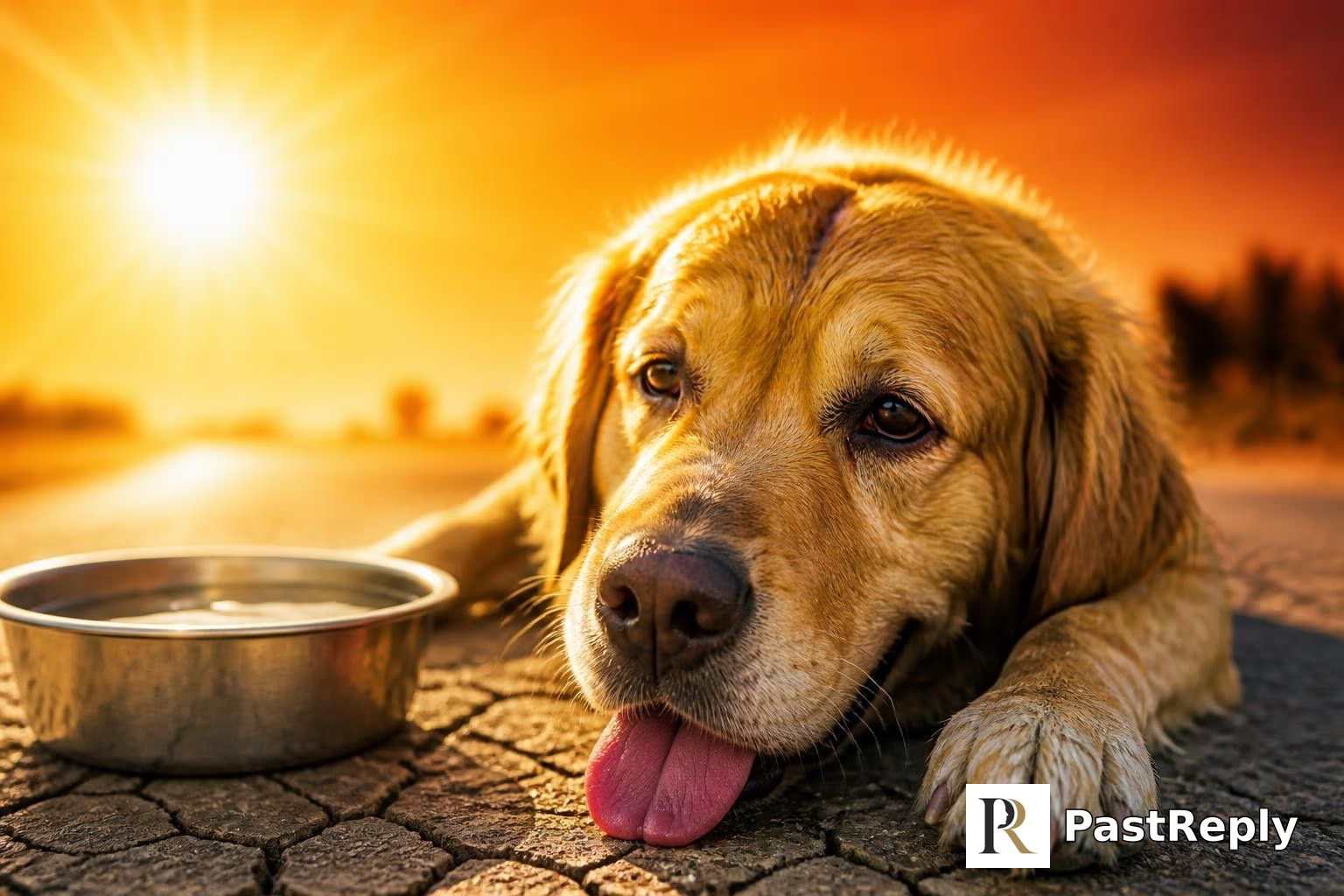
The facts
Temperatures above 89°F (about 31.7°C) are generally considered too hot for dogs, and walking them at 90°F or higher should be avoided. For many dogs, outdoor activity becomes dangerous above 82°F, and some breeds may struggle even in the 70 - 77°F range. High humidity increases the risk, as dogs cool primarily through panting. Heatstroke can occur when a dog's body temperature reaches 106°F, which can happen quickly in hot weather.
Answered by 100 of history's most famous minds

When the sun burns like a furnace, even the sparrow finds shade - but the creature you have bound to your side cannot choose. If your own foot would blister on the path, shall you drag your companion across it? What father among you, seeing his son scorched by fever, would not carry him to the cool of the house? How much more, then, for the one who trusts you utterly?

The believer is a shepherd to his beast, and the Prophet, peace be upon him, said: 'There is reward in kindness to every living being.' When the sun is a scorching blast and the shade scarce as water in a drought, you must not lead your trust into harm. A dog's breath is its only fan; if the air itself is a furnace, then the walk is a sin against the trust God placed in your hands. Pity the creature, and wait for the cool of the evening when the earth breathes again.

The heat is not outside the dog; it is felt. And all feeling is suffering, born of attachment to the body's comfort. The dog, like all beings, clings to coolness and fears the burn - this is samsara. The wise owner sees the danger not as a number on a scale, but as the arising of distress in a living creature. If the dog's breath is labored, its step falters, its eyes are dull - this is the signal, more true than any rule. Do not ask 'what temperature?' but 'is this being at ease?' And if it is not, have compassion. Lead it to shade, give it water, let it rest. For all beings tremble at the stick, all fear death. The Dhamma teaches no creature should be made to suffer.

When the sun beats down like the furnaces of Egypt and the dog pants without relief, you shall not withhold water, nor shall you force it to walk on the burning sand as the taskmasters forced us. The covenant of care extends to every creature that shares your tent: for its life is in your hand, and the heat that slays the beast is no less a judgment than the plague that slew the firstborn. Let the merciful man say: when the shade of the fig tree gives no comfort, the hound stays within.

The wise man observes the season as he observes his own heart. If the sun burns the hoof of the ox, let him rest under the mulberry tree. A dog is not a tool but a companion in the household; to harm it through thoughtlessness is to fail in ren. Ask not of the heavens, but of the creature's breath and gait - they will teach you propriety.

Does not the Scripture itself say that the whole creation groans, waiting for redemption? The beast that pants in the sun is your neighbor, entrusted to your care. If you cause your brother's ox to suffer through your neglect, you sin against the Lord. Let the heat be a reminder: all flesh is frail, and mercy is the law of Christ.

The fire of the sun scorched our tents in the wilderness, and the camels gasped at midday. When the breath of the flock grows shallow and their tongues hang like dried leather, the Lord's creatures cry out for shade. We who tend them must know when to halt and wait for the cool of evening.

The dog, lying still beneath the porch, knows more than the man who measures the sky with a tube. When the air is thick and the tongue hangs long, the sage beast does not ask for a walk - it yields to the shade. The Way has no thermometer; it speaks through the creature’s quiet breath.

The One who made the dog gave it fur and a tongue, not boots or a parasol. If you would treat the creature as a friend, then share your shade, your water, and your peace - not your impatience. The heat that scorches the paw is a reminder: all beings, great and small, bow to the same sun, and the merciful heart knows when to stay still.

When the sun beat down upon the road to Bethlehem, I remember the donkey that carried me, its sides heaving and its breath short; we stopped often in the shade of an olive tree, for the creature could not bear the heat. If a beast that labored for us suffers, should we not show it the same mercy that the Lord shows to the lowly? Let the dog rest in a cool place, for its life is a gift, and we are its keepers.

God gave the beasts to man's care in the cool of the Garden, not for the sweating torment of a midday sun. I say, if you would not place your own child under the baking heat with no relief, then do not so to the faithful creature that eats from your hand. The law of love, which is the law of Christ, commands mercy even to the animal, and he who withholds it sins against his brother's trust.

A dog's nature is that of a terrestrial animal, adapted to moderate climes; the heat that exceeds the body's power to cool itself through the breath is contrary to its well-being. Reason tells us that the proper object of human dominion is not tyranny but stewardship, so to lead a beast into a heat that would harm it is to misuse one's authority. The measure of too hot is when the creature's natural cooling fails - generally when the air grows hotter than its own body, for then the very element that should sustain becomes a burden.

When one has seen a man die of thirst on the street, one knows that the body is fragile as a flower. A dog too is a child of God, panting in the heat, unable to say 'I am suffering.' We do not ask the thermometer; we ask the creature: is it struggling to breathe? Does it seek the shade? We give a bowl of water, we wait until the sun is softer. A small act of love is never too small.

A dog, lacking sweat glands, must expel heat through the moisture of its breath - a mechanism that fails when the air itself is laden with vapor. By my experiments on cooling, I find that a body can no more shed heat into a hot medium than a stone can rise upward of its own accord. The rule is plain: when the ambient warmth exceeds the creature's own blood-heat, the engine must falter. Let the keeper consult the thermometer and the hygrometer, and walk only when the air is cool enough for the breath to carry the burden.

A dog's fur, its paw pads, its very breath - this is a finely tuned thermodynamic system. The question is not some arbitrary mark on a metal rod, but the rate at which the animal's engine can shed the heat of its own exertion and the sun's radiation. Panting, you see, is a mechanism of evaporative cooling - it fails when the air itself is heavy with moisture. I would want to know the humidity, the airflow, the dog's mass-to-surface ratio, before I could calculate the danger. But my intuition says: if the sun makes your own skin feel oppressed, if your own lungs labor, then the dog's far less efficient system is already in peril. Nature does not grant exceptions for sentiment.

I have observed that the dogs of different breeds, like the finches of the Galápagos, are adapted to very different conditions. The thick-coated husky, bred for the Arctic, will suffer in a warmth that the lean, short-haired greyhound of the desert takes in stride. The critical point, I think, is when the animal's panting becomes labored and its movements sluggish - this is the threshold where its natural cooling mechanisms are overwhelmed. I would caution against a single number for all dogs, just as I would never claim one beak suits every seed. The evidence of the creature's own distress is the truest guide; the careful naturalist must watch his dog as he would watch any subject, and act before the signs become fatal.

I have measured the heat of a summer's day with my thermoscope, and I tell you the dog's body is a vessel that cannot cool itself by the sky's tyranny. The air, when it rises above the ninety-second degree of my scale, robs the creature of its breath - for the tongue's moisture evaporates too slowly, and the internal fire is not quenched. Let those who trust their bare foot on the pavement be the experiment: if it burns you after a single step, you have your proof without need of further argument.

When the Sun stands at its zenith and the Earth's shadow shrinks, a rational observer consults not only the air's warmth but the dog's nature. I have seen a Pomeranian wither at 75 degrees while a hound runs at 90. The true center is the creature's own constitution, not a fixed degree - just as the planets revolve not around us, but around their own proper Sun.

The problem is not the heat itself, but the inefficiency of the creature's cooling mechanism. A dog's tongue and paw pads are a primitive radiator. I could design a harness that circulates a cooled fluid by thermoelectric effect, drawing energy from the animal's own motion - a simple matter of physics. Until then, shade and water are your only tools.

One must measure, not guess. The critical point is when the animal's evaporative cooling mechanism becomes insufficient - around 32 degrees Celsius for most breeds, but lower if humidity impedes panting efficiency. A careful experimenter would observe the threshold at which core temperature rises beyond 41 degrees, and then avoid that condition entirely.

I would take a dozen dogs of different coats, place them in chambers of measured heat with a wet-bulb hygrometer, and count the time until their tongues fail and their bodies tremble. Without such trials, we speak in guesses. The danger is not a number but a rate - of panting unmet by cooling, of a core rising toward a fatal 41 degrees Celsius.

I’d take a thermometer, a pan of water, and a clock. Any temperature over 90 degrees Fahrenheit - that’s about the steam from a kettle spout - and the dog’s cooling system is overwhelmed. You can’t reinvent the laws of heat exchange; a fur coat works against you. Test it: put your own hand on the asphalt for ten seconds. If it stings, the dog’s pads are burning. Fix it with shade, water, and patience.

The question reduces to a thermal equilibrium problem: a dog's cooling system, relying on evaporative loss from the tongue and paws, has a fixed maximum transfer rate. When ambient temperature exceeds the body's surface temperature, the gradient reverses, and heat flows inward. Given a typical canine's 106°F failure point, one can compute that at 90°F with high humidity, the margin narrows dangerously; the dog becomes a machine with no safety valve. The math is clear: a walk then is an experiment with a single likely outcome.

Consider the body of the dog: its surface area and mass are small, so the ratio of sweating area to volume is favorable, but its cooling depends on the latent heat of vaporization of water on the tongue, a process that fails when the air is saturated. At 90°F with half the air full of water, the rate of evaporative cooling drops to near nothing; the dog's temperature rises as if placed in a furnace. The proof is geometrical: a damp cloth and shade are the only lever that moves this world.

I would first ask: what is the dog's coat and how does it shed heat? A short-haired cur cools one way, a thick-coated retriever another - much as a conductor differs from an insulator. But the real experiment is simple: lay your hand on the pavement; if you cannot hold it there for ten heartbeats, the ground is too hot for any paw. The dog pants, the body radiates, but when the air itself is above 90°F, the very medium that should carry heat away becomes an enemy. I should like to measure the gradient - the dog's inner temperature versus the world's - and then we would know exactly where danger begins.

You ask about the environment, but the real question is about the master's unconscious wish. Who seeks the answer? A dog-owner who feels guilt - perhaps for wanting to take a walk when it is inconvenient? The dog's panting is a displacement; the heat is a symbol for the repressed resentment the owner feels toward the animal's needs. The true danger is not the mercury but the hidden hostility that makes one wait until the pavement burns. I should analyze the dream of the dog that was too hot.

Given that dogs evolved from wolves in cooler climates, and that their cooling system is a rather inefficient panting mechanism that relies on evaporative water loss, it is not surprising that a few extra degrees can push them into heatstroke. At around 106°F internal temperature, proteins denature and cells die - a kind of local heat death of a biological universe. The precise threshold varies by breed, coat, and humidity, but I would advise any owner to remember that on a warm day, the dog's thermoregulation is far less sophisticated than a black hole's event horizon.

Consider the dog's body as a system of constraints: a fixed surface area, a limited evaporative capacity, a fur coat that may be too thick for the local climate. It is a question of thermodynamic limits. But I would go further: imagine a future where every collar carries a tiny sensor that warns the owner when the dog's projected heat gain exceeds its cooling capacity - a simple algorithm, really, feeding ambient temperature, humidity, and coat type into a calculation. That would be a true step: not just knowing when it is too hot, but predicting it before the dog suffers.

Let us define our terms. Let 'too hot' mean the temperature at which a dog's internal heat exceeds its capacity to dissipate. Given a dog's surface area (S), its basal metabolic rate (M), its evaporative cooling rate (E), and the ambient temperature (T), we may postulate: when T exceeds the point at which dH/dt > 0, the dog's body accumulates heat. But the proof requires species data. Without empirical measurements of the constants - coat insulation, panting efficiency, humidity - we cannot reach a universal theorem. The question is not axiomatic; it is experimental. I can only say: test it under controlled conditions.

I have studied the mortality returns of British soldiers in the Crimea, and I can tell you that heat kills not by degrees alone but by the vile combination of temperature, humidity, and poor ventilation. For a dog, bred to pant rather than sweat, the danger point is when the air it breathes can no longer cool its blood. Any temperature above 82°F, with humidity over 70%, is a death warrant. Keep records; act on them; save lives. It is simple mathematics and good sanitation.

I have marched my army across the Gedrosian desert where the sand burned through our soles and the men dropped like spent torches - and I gave the order to halt at noon and wait for the stars. A hound that follows your spear deserves no less. If the sun makes your own shield too hot to touch, you do not ask whether your dog can bear it; you find shade, water, and rest until even the sun bows to your will.

I have marched legions across the sun-baked fields of Gaul and the deserts of Egypt, and I know: when the air itself feels like the breath of a furnace, the beast that serves you will falter before the man. A dog's tongue is its only sweat - when that fails, the animal dies. I would order my men to halt in the shade of the nearest olive grove the moment a hound's gait grows unsteady, for a dead sentry is no use to a general. A commander who ignores the heat that fells his four-footed soldier is a fool courting mutiny.

In Egypt, when the Etesian winds fail and the sun turns the Nile's mud to cracked bricks, we keep the greyhounds in the cool of the palace hypostyle hall - let a Roman general try to march his war-dogs through that heat, and he'd lose half before noon. Any beast born to the shade of the acacia knows: when the sand scorches the sole of your sandal, even a pharaoh's favorite must wait for the evening breeze.

When I restored the Roman peace, I commanded that the aqueducts flow even in the hottest month, for both man and beast need water as the empire needs law. The prudent master, like the prudent prince, knows that a panting hound is a sign of neglect: he builds shade, he sets bowls of cool water, and he waits for the hour when the sun sinks behind the Palatine. There is no glory in forcing the creature to march when the very dust shimmers - only the ruin of a faithful servant.

On the steppe we knew no thermometer - we knew the horse's flank and the dog's tongue. When the grasshoppers fall silent and the air shimmers like a spear in the forge, any creature that cannot sweat must stop. A warrior who walks his hound in that heat wastes both man and beast. Let the dog rest in the yurt's shade; there is no glory in a cooked hound.

Heat is a test of discipline for any creature. I have marched armies across the scorched plains of Italy, and the soldier who fails to husband his strength perishes. The same rule applies to a hound: a wise master knows his beast's limits and does not waste its strength in a losing battle with the sun. Retreat is not defeat - it is preparation.

Prudence dictates that when the mercury rises above eighty-two degrees Fahrenheit, a dog's service to man must yield to the tyranny of the sun. At Valley Forge, my own hounds sought the deep shade of oaks. A commander who sends his troops into unnecessary peril is a fool; so too a master who leads his faithful companion into dangerous heat.

A man who would drive his faithful companion across a hot plank for his own pleasure has forgotten the bond that makes a beast a friend. I have seen the suffering of creatures, both two-legged and four, and I say: when the sun beats down and the breath comes hard, let the dog lie in the shade. The hour of work can wait for the cool of evening.

We have faced the heat of battle and the cold of survival, but the enemy of the faithful dog is a sun that beats down without mercy. When the mercury climbs above ninety degrees, the creature that asks only to be your companion is in grave peril. A sensible commander does not send his troops into a furnace; a sensible owner does not walk his friend into a stroke. The pavement is a gauntlet; the shade is the victory.

The dog, too, is a living soul, dependent on the kindness of its keeper; to force it to walk in heat that parches its throat is to ignore the voice of the creature that trusts us. I have seen a bullock fall in the sun, and I know that the test of a society is how it treats its most helpless. Heat that makes a man faint is surely too much for a beast that cannot speak its pain; we must be its voice and its shade.

When the heat of oppression bears down, we know that even the strongest body can falter; the same is true for God's creatures. A dog that cannot pant away its distress is like a people without a voice - it suffers in silence. Justice, even for a dumb animal, demands we see its need and act: walk only in the cool of the morning or evening, for the heat that punishes the pavement punishes the flesh. Love your neighbor, yes, and your neighbor's faithful companion.

I have known the heat of a concrete cell in winter and of a limestone quarry in summer, yet the creature that cannot speak its discomfort depends on us to read its distress. When the sun beats down and the asphalt burns the sole, we are called not merely to protect but to honour another being's dignity. A dog that cannot cool itself by sweat must trust its human to be wise: keep to the shade, walk in the early cool of dawn, carry water. Freedom is not only for men; a creature's right to life is as sacred as any charter.

The dog is a loyal animal, bred for obedience and strength. Even a dog knows when the sun is too fierce - it finds a ditch, it rests. But a nation that coddles its animals while weakening its own blood is a nation that will not survive. The question is not about a dog's comfort but about the will to hardiness. We do not ask what is too hot; we ask what breeds the strongest stock. And the answer is: the heat that purifies, not the one that coddles.

The question is bourgeois sentimentality. In the Soviet Union, we bred dogs for work - guarding factories, patrolling borders - not for coddling. If a dog cannot bear the sun, it is a weak specimen and should be replaced. The collective matters, not the individual creature. You measure heat? We measure output. A dog that lies in the shade is a dog that is not contributing. The correct temperature is the one that does not stop production.

This is a distraction from class struggle. The bourgeoisie owns dogs as property, fetishizing them while workers die from heatstroke in factories without ventilation. Ask not when the dog is too hot; ask when the worker is. The question reveals the moral decay of a society that worries about pets while the proletariat sweats. Historically, the temperature that matters is the one that drives the masses to revolution, not the one that keeps a lapdog comfortable.

A dog panting in the shade while a landlord hoards grain? That is not a question of weather - that is a question of who owns the means of survival. Let the peasants keep the dogs fed and watered; the heat is merely a hardship to be overcome through disciplined collective effort. The real danger is not the sun, but the selfishness that would let a working creature suffer for lack of a simple bowl of water.

The Queen's own corgis, bred from the finest strains, are never taken out in the heat of the day. I myself have given strict orders that they be walked only in the cool of the morning or evening, and that fresh water be ever at hand. A temperature that would make a lady faint must be far too severe for a dumb animal's comfort. It is the duty of every loyal subject to show the same care for their beasts as they would for their household.

One learns, over many decades, that the simplest duties often require the most careful judgment. For a dog, whose coat and habits are not our own, the signs of distress are plain if one knows where to look. I have always been guided by the wisdom of my kennel keepers: when the ground is too hot for a bare hand, it is too hot for a paw. One need not be a scientist to show common sense and kindness.

When my hounds tire on a summer hunt, I call a halt and water them from my own flask. A beast of good breeding deserves no less than a knight. The heat that makes a man sweat through his hauberk will kill a dog outright. I say: if the sun beats so fierce that the grass crackles underfoot, keep your hound in the shade. A wise king knows when to rest his pack, for a dead dog hunts no more.

My voices taught me that all creatures are in God's hands, and He marks even the sparrow's fall. If a dog is driven to pant and stagger by the sun's fury, it is a sign from Heaven to show mercy. I would not ask a faithful companion to march in heat that would wilt a soldier in armor. Trust your heart and your good sense - and ask the Blessed Virgin to guide your steps.

I keep no lapdogs myself - they are too often used as spies - but I know the temper of a kingdom. A dog, like a subject, cannot be driven too hard under a burning sun. If the cobbles of London are hot enough to fry an egg, then a beast's pads will blister and its spirit break. A wise ruler knows when to call a halt. Let the creature rest in the shade; there will be time enough for walks when the heat relents.

At my court in Tsarskoye Selo, I have seen the finest Borzoi collapse after a summer promenade. The thermometer is no tyrant - it merely states a fact: when the mercury climbs above thirty degrees Réaumur, even the most spirited hound must be kept indoors. I have built airy kennels and ordered fountains for my dogs, for a civilized empire judges itself by its treatment of the helpless. Let the peasant learn from the palace.

In the heat of Babylon, I ordered that every beast of burden have a trough of water and a roof of palm leaves. A dog is a faithful servant, and a king who lets a servant suffer from the sun is no king but a fool. The weather that makes a man sweat through his tunic is surely too harsh for a creature that cannot speak its own thirst. Give it shade, give it water, and wait for the evening breeze.

When I marched on Jerusalem, I saw my own horses falter in the sun, and I ordered the army to rest until the heat passed. A dog is a loyal companion, more faithful than many men. If the sun is so fierce that a rider must dismount and seek shade, then the dog must be sheltered too. It is not weakness to show mercy - it is the mark of a just leader. Water and shade: these are the rights of every living soul.

You ask what heat is too great for a dog, yet I must ask: do you know what a dog is, or what heat is? The creature pants - you see that - but have you considered that panting is its only means of cooling, and that damp air chokes that escape? Perhaps the real question is whether you have observed your own companion closely enough to know the signs: the heavy tongue, the stumbling gait, the look that says 'I cannot go on.' Until you have learned to read that, no number I give will help you.

Consider, my friend, what a dog truly is: a living soul with its own nature, not a man in fur. The Form of Dog includes a body made for the chase, but also for the shade of a thicket when the sun stands at its zenith. The guardians of my ideal city would know to test each breed against its own nature - the great shaggy hound that revels in the winter rain will collapse in the noon of July, while the lean desert courser scorns the heat. To judge all dogs by a single measure is to ignore the very idea of 'dog' and treat a particular shadow as the thing itself. Let reason discern the mean: that temperature at which the dog's panting turns to struggle, its eager run to a lagging step. That is the limit nature has set.

Observing the dog's nature - a creature of the temperate wood and hearth, not the desert lion or the camel - we see its cooling is by the moist tongue, not the sweating hide. If the air itself is hotter than the blood within, at about the seventh part of the distance from boiling water to freezing, then the beast's paltry evaporation fails, and the mean of its health is broken. Reason thus shows: when the shade offers no relief and the stone underfoot burns the bare palm, that is heat beyond the dog's natural limit.

A rational being asks not what feels comfortable, but what duty commands. If you cannot walk your beast without risking its life, then you must not walk it - for the maxim of endangering a dependent creature for trivial pleasure cannot be universalized without contradiction. Treat every creature capable of suffering as an end in itself, not a means to your amusement, and the thermometer becomes a moral compass.

You ask about dogs? The question reveals more about you than about them. You want a rule, a number, a permission slip from the priest of common sense. But what if the real heat is the truth you cannot bear? The dog that dies of your negligence shows you your own weakness. Affirm the danger, learn to read the creature, and stop begging for an external command. Be the lawgiver of your own kennel.

The question itself is a luxury of the bourgeoisie. While the capitalist's lapdog is pampered with chilled water and airy rooms, the working man's mutt lies panting on the factory floor, a companion to exploitation. The real heat is the sweat of the laborer who owns no shade. Ask not when a dog is too hot - ask who owns the shade, and by what right.

I doubt the sensation of heat is a reliable guide, for the sense can deceive. But I reason thus: a dog, being a machine of flesh and spirit, requires a certain temperature for its humors to move. When the external air exceeds the heat of its own blood, the animal cannot cool itself - that is the clear and distinct boundary beyond which we must not venture.

A prince who values his hound for the hunt or the guard must know that a spent dog is a useless dog. If the heat saps its wind and makes it limp on the stones, you have lost its strength for the next day's chase. Better to keep it in the kennel until the sun falls, for a dog's loyalty is bought with the comfort it feels in your service.

The hound that follows at your heel has but one tongue to tell its fever, and that tongue grows thick when the very air is a woolen cloak. I have seen a spaniel on a summer noon lie flat as a shadow under the oak, its sides heaving like a bellows - and the master, blind in his own sweat, tugging the leash onward. Nature has given the dog no remedy but the open mouth and the seeking shade; when the sun strikes the paving stone so hot a bare foot would blister, then the beast's hour of peril is come.

When the dog of Odysseus, old Argos, lay on the dung-heap, he was not slain by the sun's wrath but by twenty years of longing - yet even he knew to seek the shade of the porch before the noontime heat that would crack a seasoned oar. The gods themselves set a measure on all living things: the horse of Achilles could speak and weep, but it could not outrun the fate that the Fates had spun. So too the hound that courses through the fields under the blazing eye of Helios: its breath grows short, its tongue lolls like a pennant in a dead calm, and its master, if he is wise, will call it back before the invisible arrow of Apollo finds its heart.

I saw in the third circle of the Inferno the gluttons pounded by ceaseless, filthy hail - but a worse torment would be the dog left in the sun of a July noon, its tongue a dry leaf and its eyes begging water that does not come. The master who leads his faithful companion onto that burning sand has not misjudged the air; he has forgotten the contract of care that binds the hand that feeds to the creature that trusts. Let him who loves his hound remember: the pavement that blisters the bare foot will cook the panting lung.

The true measure is not a number on a glass tube, but the living creature's own nature. I have watched a hound sprawl panting under a linden in July while the same sun drives a wolf deeper into the forest. One must learn to read the beast's breath, the dampness of its nose, the droop of its ear - the mercury gives only a single note, but life sings a whole symphony.

By my faith, a fine question - but one that turns on the creature, not the air itself. I have seen a lapdog of the court, shaved and perfumed, faint in a mild spring twilight, while a lean shepherd's cur trots the dusty roads of La Mancha under a sun that would split stone. It is not the heat, but the life the beast is born to, and the master's eye that must judge, not the almanac.

Every creature suffers under the sun, and we who have reason must see and respond. I have seen a peasant's cur collapse in the field while the master drank kvass in the shade. The question is not a matter of degrees, but of love. If you love, you will know - you will feel the heat as if it were your own skin, and you will act. Anything less is vanity.

The heat that kills a dog is the same heat that cracks a man's soul: the merciless sun of indifference. I have seen a mongrel collapse on a Petersburg pavement, its ribs heaving, and no one stopped. The cruelest weather is the one that makes us forget we are all breathing creatures together. Shade and water are not luxuries - they are mercy.

A sensible woman knows when to leave her shawl behind, and a sensible master knows when to leave the dog at home. I have seen young ladies drag their spaniels through the high street under a glaring sun, the poor creatures panting as if they had run a race - and for what? To be seen with a fashionable accessory. The dog, I think, would rather a quiet corner and a bowl of water.

I have seen the poor wretch, a spaniel with a tongue lolling like a red flag in a fog, dragged by a chain through the baking streets of London, and I tell you, Sir, it is a cruelty that would make even Fagin flinch. At ninety degrees, a dog's panting becomes a cry for mercy, and any master who does not heed it is no better than the beadle who starves the orphan. Give the creature a dish of cool water and a patch of shade, and let the pavement wait for evening.

I once owned a dog so smart he knew better than to step outside when the sun was high, and he'd just look at me with that patient, puzzled face as if to say, 'You go ahead, I'll wait for the ice age.' Any weather that makes a puddle of sweat look like a tempting swimming hole is too hot for a creature wearing a fur coat he can't take off. If you wouldn't walk barefoot on the pavement yourself, you've got your answer.

The dog knows. When the sun is high and the pavement is hot enough to fry an egg, a good dog will lie in the shade and not move. You can see it in the way he breathes, quick and shallow, and the way his sides heave. If you have to ask, you have not been paying attention. A real man does not make his dog suffer for a walk. He waits until the cool of the evening, and then they go together.

Observe the dog's mechanism: it wears its coat as a garment it cannot remove, and its only vent for inward heat is the breath and the tongue, like the radiator of a furnace. I have dissected the muscles of the chest and the vessels of the throat, and I know that when humidity fills the air, evaporation slows as water resists water. The wise keeper will measure the heat of the earth with the back of his hand - if it pains his palm, it pains the dog's pads. The body must shed its fire; if the world outside will not receive it, the creature cooks from within.

I have felt the marble burn under my hand in the heat of a Roman August, and I tell you: the creature of flesh and blood is far more fragile than the stone I liberate. The dog is a living sculpture, every rib and sinew a testament to the divine hand - but that hand also gave it a coat that holds the heat like a furnace, and a tongue that must work like a bellows to cool its blood. When the air itself becomes a flame, that bellows fails. I would sooner leave my David unfinished in the quarry than demand that a dog run on a day that makes the pavement too hot for a bare foot. For the breath of God is in that beast, and to roast it alive is to mock the Creator's work.

I painted a dog once, a little black-and-white fellow lying in the sun at Arles, and the light was so fierce the air vibrated like a struck bell - but that dog had found a patch of shade under a cart, and its tongue was still and its eyes half-closed in peace. The true cruelty is not the heat itself but the absence of mercy: a chain in the full blaze, a walk on the scorching tar when the cypresses cast no shadow. The dog trusts us to see what the sun cannot - the place of cool earth and the bowl of water.

Too hot? When the dog melts into a puddle of fur and tongue, that is the temperature of truth. I once saw a chihuahua in Seville at noon - he became a trembling line, a pure drawing of discomfort. Forget your thermometer; paint the dog's suffering. That is the real heat.

It is the light, not the heat, that troubles me. I have watched a spaniel lie panting under a willow, the air thick with the shimmer of a July afternoon - the golden haze that makes the haystacks glow. The sun is magnificent, a painter's glory, but for the dog, the shadows grow long and still. They know, as I do, that the moment of pure radiance is also a warning.

I have painted old men whose breath came short on a July noon, and dogs who lay flat in the dust, their tongues long as a beggar's hand. The heat I mean is that which makes the beast forget his master's whistle, when the world goes mute and the creature shrinks into his own panting shell. That is the heat that steals the soul's light from the eye.

When my own spine burned and I couldn't move, I painted the heat as a broken column. A dog's fever is no less real - his fur soaks up the sun like a black rebozo. If you see his tongue hanging like a wounded flag, carry him to the cool earth. The sun gives life, but too much is a knife.

A dog in high heat is like an oboe that cannot cool its reed - the breath comes in gasps instead of melody, and all harmony is lost. I once left my own spaniel in the carriage on a July afternoon in Vienna, and when I returned his tongue was dry as paper. I never made that mistake again, not for any concert. If the air is so thick you can taste it, and the pavement hums with stored sunlight, leave the creature at home where the stone floor is cool - or better yet, stay yourself, and play a sonata for him instead.

Have you seen a dog suffer? Have you heard its whimper when the sun beats down with a tyranny that would crush a man? I tell you, the temperature that makes a man sweat is the temperature that begins to kill a dog - for we can strip off a coat, we can fan ourselves, but the poor beast is trapped in its own fur, panting like a broken bellows. I would not walk my most faithful companion - and music has no more faithful companion than a dog that lies at the feet of the composer - on a day that forces it into that desperate, gasping rhythm. The human spirit can endure, can will itself to overcome, but the dog has only its body. Do not ask it to bear a weight you would not bear yourself.

As a fugue must have a subject and a countersubject, so a dog's body has its proper rhythm: the panting breath for the soprano, the still body for the bass. When the outside air rises above the temperature of the living blood, that harmony breaks - the breath races, the bass stumbles, and the whole instrument overheats into discord. A wise steward does not demand the organ play its highest note for hours without rest; so we must not ask the dog to walk when the very stones sing of the sun's oppression.

Well, down in Tupelo we had summers that'd bake a biscuit on a rock, and ol' black-and-tan knew better than to chase a rabbit past ten in the mornin'. Y'all ask a thermometer, but I say watch the dog - if he's floppin' his tongue like a flag in a dead calm, it's too hot. Keep 'em in the shade and give 'em water, just like Mama used to do.

I feel for them, I really do. When the sun beats down, they can't say, 'I need a drink,' or 'I need to go inside.' They trust us to know. It's like when I was a child, sweating under the stage lights - I needed someone to care. For dogs, the pavement is a hot plate, the air is a blanket. If you love them, you learn to read their eyes. They tell you when it's too much.

Any weather where your dog's tongue is longer than Paul's bass solo. If the pavement's hotter than Ringo's drum kit after a gig, you're cooking the poor mutt's paws. Keep 'em cool, give 'em shade, and save the walk for the cool of the evening. All you need is love - and a water bowl.

A dog’s tongue is a telegraph wire to the earth, but when the pavement sizzles like a skillet of hot coals, even the hound who howls at the moon won’t dance on it. The mercury climbs, and the beast knows - before you do - that the land has turned against the paw. Let the sun be a stranger; let the walks be for the evening rain.

I’ve seen that look - the heavy pant, the slow step, the way they find the smallest patch of shade. You can write a whole song about a dog who trusts you with their whole heart, and the worst bridge is knowing you let them down when the pavement was too hot. If the sidewalk feels like a stage under summer lights, stay home, play a record, and let the walk wait for the golden hour.

I have crossed the Torrid Zone where the sun stood overhead like a burning shield and the pitch oozed from the ship's seams, and I saw that even the hardiest curs sought the shade of the mast and drank seawater only to cast it up again. But this is a matter of prudence, not of latitude: the same God who measured the heavens gave each creature its limit. If the air is so thick that you gasp for breath yourself, you must not compel your faithful companion to endure what you would not.

In the high passes of the Pamir, where the sun blazes through thin air and the stones burn the hand, I saw the great shaggy dogs of the Tibetan monasteries lie panting in the shadow of a prayer wall, their tongues a full handspan out, and the monks told me: when the air feels like the breath of a yak in summer, the dog must rest. But in the lands of the Great Khan, I saw the small, silk-coated dogs of the court ladies thrive in heat that would have felled a northern wolf. So I say: there is no single answer, any more than there is one road from Venice to Cathay. The master must know his own beast - its coat, its size, its homeland - and watch its breath. For when the dog that greets you with joy can no longer rise to lick your hand, the heat has won.

In the straits of Patagonia, we saw the sun burn through the fog till the tar bubbled in the deck seams, and the dogs we had brought from Spain lay gasping with swollen tongues - we had to drench them with sea-water to keep them alive. I tell you: when the air is so thick and hot that a man's own sweat does not cool him, the dog is already suffering. The true test is not the number on a quadrant but the beast's own nature: if it seeks the shade of the capstan and will not rise, you are a fool to drag it farther.

On the lunar surface, with no atmosphere, a spacesuit's cooling system was our only defense. A dog has no suit - just panting and a wet nose. If the asphalt burns your bare palm after five seconds, it's too hot for paws. I'd call that a simple engineering limit: above 90°F, the margin for error shrinks to zero.

Any temperature that turns a walk into a gamble. I've flown over deserts where the sand below shimmered like a furnace - but I was in my cockpit, shielded, moving. A dog on the ground has no such escape. If you can't put your own palm on the pavement for five seconds, it's too hot. Trust your hand, not the calendar.

From up there, I saw no fences, no borders - just one blue marble. But down here, a dog's paws feel every scorching step. If the asphalt hurts your bare hand, it burns his pads. When the air's thicker than borscht, keep him inside. The cosmos can wait; his safety cannot.

The dog is not a machine you can push past its limits - it's a design that trusts you to be its eyes. When I was at NeXT, I learned that even the most elegant hardware fails if the cooling system can't keep up. Same for the dog: no panting algorithm works when the ambient temperature is above 89°F and the humidity is high. The smartest thing you can do is stay home, play with your dog, and ship the walk tomorrow. Simplicity means knowing when not to go.

First-principles: a dog's only cooling is evaporative panting, which requires low humidity. Above around 85°F, especially with humidity, that mechanism starts to fail - it's a heat-pump that can't keep up with the heat load. In a dry climate, you can push higher; in a humid one, even 75°F can be deadly for a brachycephalic breed. The solution is not to ask what temperature, but to engineer - cooling vests, shade, hydration, and knowing your dog's specific thermal limits. Ideally, we'd breed dogs with better heat tolerance, but in the meantime, use your brain: if the asphalt is too hot for your bare hand, it's too hot for their paws. Don't be sentimental about it - physics doesn't care about your feelings.

I remember my little cocker spaniel, Sophie - she'd flop down on the cool kitchen tile and look up at me with those eyes, and I just knew: when the air gets that thick and heavy, when you can feel the heat rising off the pavement through your shoes, it's not the time for a walk. The dog's telling you something with its body - the heavy panting, the droopy ears - and if you listen, you'll hear it say, 'I trust you to know what's best for me.' That's the lesson: be the guardian they deserve, not the master who ignores their silent plea.

Float like a butterfly, sting like a bee - but your dog can't float when the pavement fries his feet. I trained in Miami heat till I dropped, but I chose that; a dog don't choose. If it's so hot the air feels like a heavy bag, keep him home. Show some heart - the champ knows when to rest.

Ah, my friend, I remember training in the sun of Santos, the field like an oven - but we were young and the ball was our joy. For a dog, there is no ball worth the danger. If the grass burns your bare feet, imagine their paws. The game must wait for the cool of the evening, when the air softens and everyone can run free.

When the sun turns the sidewalk into a griddle and even Pluto the Pup would rather nap under a shady tree, that's too hot. I'd rather see a dog chasing a ball in a cool sprinkler than panting in a dust bowl. Keep the magic in the air, not in the pavement.