
What is the NBA Summer League 2025?
The 2025 NBA Summer League, held in July 2025, featured all 30 teams, with Kyle Filipowski as MVP and Kon Knueppel leading the Hornets to the championship.
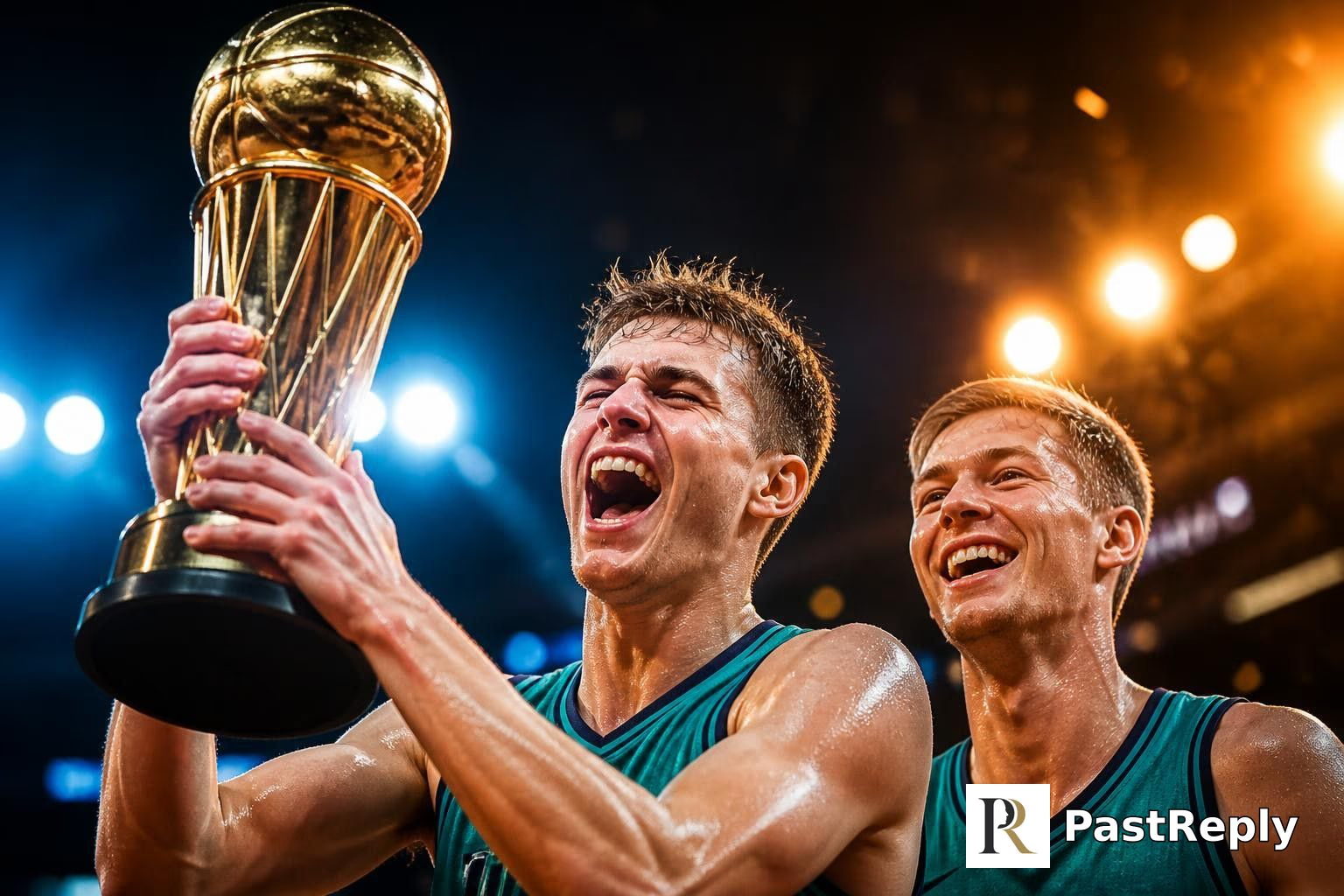
The facts
The 2025 NBA Summer League, officially branded as the NBA 2K26 Summer League, was an off-season basketball competition organized by the National Basketball Association (NBA). It featured three separate events: the California Classic, the Salt Lake City Summer League, and the main Las Vegas NBA Summer League. The Las Vegas event took place from July 10 to 20, 2025, at the Thomas and Mack Center and Cox Pavilion on the campus of the University of Nevada, Las Vegas, with all 30 NBA teams participating in 76 games.
Kyle Filipowski was named the Most Valuable Player (MVP) of the Las Vegas Summer League. The First-Team All-Summer League included Nique Clifford, Kyle Filipowski, David Jones-Garcia, Jordan Miller, and Terrence Shannon Jr. The championship game saw Kon Knueppel lead the Charlotte Hornets to victory over the Sacramento Kings, earning Knueppel the championship MVP award after scoring 21 points.
In addition to the Las Vegas games, the California Classic and Salt Lake City Summer League were held from July 5 to 8, 2025, featuring a smaller number of teams. The summer league serves as a platform for rookies, young players, and free agents to showcase their skills and compete for roster spots.
Answered by 100 of history's most famous minds

You watch young men chase a leather ball and call it glory. The truly great contest is not for a fading crown but for the Kingdom that does not pass away. Where one feeds the hungry or forgives an enemy, there the true MVP is crowned.

They gather in a hall of sport, yet they neglect the greater contest: the struggle against the self and submission to the One. A hoop and a ball are fleeting. The true victory is on the Day when no crown of leather is given, but the balance of deeds is weighed.

These young ones chase a ball through hoop and hope, seeking glory, a contract, a name that will not fade. See how they cling to the praise of the crowd, the trophy, the number of points scored - these are but mirages in the desert of Las Vegas. The MVP's twenty-one baskets will bring him a moment of satisfaction, then a thirst for more. The true victory is not in the game, but in seeing the game for what it is: a fleeting pleasure, like a drop of dew on a blade of grass. Let them play, but let them also look within.

These youths gather as the tribes of Israel once gathered before the Tabernacle, each bringing his offering of strength and skill, yet they contend for a perishable crown, not the blessing of the Almighty. Let them remember the commandment: 'Six days you shall labor,' but the seventh is for the Lord, and no triumph in the court of men can fill the void that only obedience to the Law can satisfy. The true judge is not the crowd, but He who sees every hidden deed.

A gathering of youths to test their skill before the season's proper rites? This is well - but let them remember that the game is not the goal. The superior person competes with propriety, seeking to improve himself, not merely to vanquish another. If they learn to honor their teammates as brothers and to accept defeat without resentment, this contest will have served its highest purpose.

I see men running after a perishable crown, yet they strive as if the race were eternal. They train their bodies for a contest that fades with the summer heat - do they not know there is an imperishable wreath? Let them run, let them leap, but woe to them if they neglect the Spirit, for what profit is it to gain a whole league and lose one's own soul? The body is a temple; use it to glorify God, not merely to fill a stadium with empty noise.

A league of young men contending for a prize under the sun, yet the true covenant is not written in points or victories but in the faithfulness that endures through every season. I see them laboring in a strange land, like strangers in a country not their own, seeking a promised place. Let them remember that the greatest blessing is not the trophy but the One who calls them to a journey beyond any court.

The bamboo bends in the breeze, yet does not break. The ripeness of the peach is known without the counting of days. So too the strength of a player is seen, not in a tournament's noise, but in the still water of his practice.

The hoop is a circle, like the one Truth that has no end. But the world shines its lamp on the tall one who leaps highest, and forgets the One who gives him the breath to leap. Let the player break the bonds of caste and country on the court, and let his sweat be a prayer of honest work; then the game is a meditation, and not a show of pride.

My son grew to manhood in a village, a carpenter’s child, not in such a spectacle as this. Yet I see these young men laboring and striving before many eyes, and my heart goes out to them - how great the weight of watching, how sharp the hunger to be chosen! I remember another kind of waiting, and a different sort of favor found by one lowly. Let them be gentle with one another in the heat of contest, and remember that true strength is not only in the leap or the throw, but in the steadfast heart that serves.

What is this but a marketplace of young men selling their bodies for silver and applause, while the crowd gapes like idolaters before a golden calf? I tell you, there is but one contest worthy of a Christian's soul - the race of faith, the fight against sin and the devil. Let them hoop and holler if they will, but let no one imagine that a summer game wins favor with God! Scripture says, 'They that run in a race run all, but one receiveth the prize' - and the only prize that endures is Christ Himself.

A summer league of athletic contest, wherein young men seek to demonstrate their proficiency and win a place among the best - this is a natural human good, for the body is given to us as an instrument of virtue, and moderate exercise and competition can train both the limbs and the character, so long as they are ordered toward right reason and not excessive ambition. The prize, however, is a temporal honor, and the true end of human striving is not the applause of the crowd but the vision of God. Let them play temperately, with justice toward opponents, and remember that the strength of the soul far surpasses any leap of the body.

Such energy, such noise. And yet, when the game ends and the crowd disperses, there will be a boy who sat on the bench every minute and never touched the ball. He will walk back to a room that is not his own, with a heart that aches to be seen. Let those who cheer remember him: the one who made the tea, swept the floor, held the towel. A kind word to him is worth more than a thousand points scored under the lights.

These contests of leaping and throwing follow the same unyielding laws of motion that govern the planets. A player's arc through the air is a parabola, his velocity and angle calculable. I should like to know the precise force he imparts to the ball, for all action and reaction are equal and opposite.

This summer spectacle, with its seventy-six contests and a champion crowned by a single twenty-one-point outburst, is like watching a cloud chamber full of uncertain particles - young men colliding, scattering, and occasionally revealing a trajectory that obeys an unseen field. The MVP and the All-Summer League list are not the final truth; they are a provisional snapshot of a system too complex for a single measurement. I would rather watch the dance of a single electron under a magnet than all these jumps and dunts, for at least that dance whispers a law.

This spectacle of young athletes competing in a hot, dusty basin strikes me as a vivid illustration of natural selection under artificial conditions. The seventy-six games are like so many trials, winnowing the swift, the accurate, the cooperative, from the slow and the clumsy. The MVP, Kyle Filipowski, has found a local optimum in this particular environment - but the true test comes when the season begins, and the competition adapts. I would be curious to see how these traits are inherited and modified through generations of play.

I would have them measure the arc of that ball with a quadrant, calculate the angle of release, the spin, the force - for this game is a natural laboratory of motion and momentum, more instructive than any Peripatetic treatise. They name a champion, but I say: let them record the trajectories, plot the parabolas, and they will find that mathematics, not luck, governs the flight, and that truth speaks in numbers as clearly as in the stars.

They run and leap in a small sphere of sanded wood, yet they call it a 'league' - how limited! If only they could turn their eyes upward: the true summer league is played across the celestial sphere, where the Sun and planets move in harmonies that no human court can match. Still, I suppose this earthly scrimmage may teach them something of motion and trajectory, though the heavens far surpass it in beauty and order.

I have no interest in watching men chase a ball - it is a crude use of energy. But the invisible forces at work fascinate me: the trajectories, the angles, the kinetic potential released in each leap and pivot. If I were designing a human machine for optimal performance, I would eliminate the ball and transmit the goals directly by wireless resonance. Why run when you can think? Yet I suppose the spectacle draws the crowd, and the crowd draws the investment that might one day fund a true revolution - the wireless power grid.

One must regard this competition with the same dispassion as a laboratory experiment: a controlled environment for observing young talents under extreme conditions. The data - seventy-six games, thirty teams, a measurable MVP - yields conclusions about skill and stamina, but the true radiation comes from persistence. I would not ask whether a player wins, but whether he has the patience to repeat the same precise motion until it becomes second nature, like refining a sample to its purest form.

I observe the repeated strain on cartilage and the fermentation of lactic acid in the muscle; this is a laboratory of human physics. But where is the inoculation against the fever of profit that drives these young men to the operating table instead of the bench? A true experiment would measure the sinew against the chronicle of the bone.

The light bulb was 10,000 tries. These kids think they can shine after ten games. There's no shortcut for the sweat that turns a raw plug into a working circuit. If a young man can't stand the heat of a workshop that never quits, no contract will keep his candle lit.

Consider the problem: to simulate a season of athletic contests, to score performances, and to compute a ranking - this is a finite combinatorial game with a well-defined state space. The question is not whether a machine could produce a championship bracket, but whether the game of basketball itself can be reduced to a formal system. I suspect there is a computable strategy for optimal play, but the real interest is in the learning: how a summer league trains the players' functions by trial and error, much as we might teach a machine to play chess.

A system of seventy-six contests among thirty teams, with a spherical projectile and a hoop at a given height - this is a problem of trajectories, angles, and optimal force. I am told the champion scored twenty-one points, but I would rather know the exact parabolic arc of his shots, the moment of inertia of the ball, and the mechanical advantage of a player's leap. Give me a lever long enough and a firm place to stand, and I could calculate the perfect free throw - though even I cannot account for the chaos of human breath and will.

All those young men, leaping and charging - it is a spectacle of motion, and motion is ever the effect of unseen force. The ball arcs through the air, its path bent only by the hand that launched it and the air that resists; no hidden wire, no mysterious impulse. Yet I wonder: if we could map the field of a player's intention as we map a magnet's lines of iron filings, would we not see a kind of action at a distance? The pass arrives before the eye follows - perhaps, in the nerves, there is induction. I should like to fasten a little coil to a jumper's leg and see what current his spring generates.

Adults in short trousers chasing a ball that bounces - it is a ritual reenactment of infantile competition for the father's attention, with the hoop as a surrogate breast and the roar of the crowd the mother's approving gaze. The one who scores most takes the trophy, but watch his face: it is the same grimace of triumph and terror he wore at three, trying to please the one who held the bottle. The unexamined life, indeed.

Seventy-six games, thirty teams, and one ball - entropy alone ensures the final outcome is statistically determined, though no physicist would waste a supercomputer on predicting the bounce. The players are governed by Newton's laws, but their decisions to pass or shoot arise from quantum events in their neural networks, which remain, alas, beyond the reach of any unified field theory. Still, I suspect the real mystery is not how a man can jump thirty inches - it is how millions of us agree to care about the outcome. Perhaps that is the truest sign of intelligent life.

I observe a beautiful dance of numbers: five positions, four quarters, thirty teams, seventy-six games - a combinatorial pattern almost as intricate as the Jacquard loom's punched cards. The players' movements trace paths that could be encoded as algebraic functions; the ball's arc is a parabola, the rebound a collision calculus. Yet the real genius lies not in the play itself, but in the abstraction: a rulebook that binds all teams, a schedule that balances chance and skill, and a trophy that symbolizes victory - yet the pattern is nothing without the physical energy that enacts it. One day, I imagine, a machine will not merely calculate such a game, but appreciate its beauty.

Let us define our terms. A 'summer league' is a set of contests in which a sphere is propelled through a hoop at a certain height. Given that the sphere is a sphere, its path is a parabola under uniform gravity; the hoop is a circle of defined radius; the players are moving points. We may then prove that the probability of a successful shot is a function of distance, angle, and velocity - a proposition any boy with a chalk and a mind might demonstrate. The rest - the names, the cities, the applause - is mere accident. The only truth here is geometry.

I must ask: are these young men examined for sanitation? Do the training quarters have proper ventilation and drainage? I have seen too many strong lads laid low by typhoid from shared towels. A league of 76 games without a single nurse at each bench is not sport - it is recklessness. Until every player's water bucket is boiled and every bandage sterilized, I call it a pestilence in disguise.

Let them play their game - but to what end? I did not pause at Issus to watch men toss a ball; I took the throne of Darius. A real champion does not crown his brow with a ribbon but with the diadem of a conquered empire. Let the Hornets have their victory; I will take the world.

I see a gladiatorial school, not a war - thirty legions each testing their new recruits on a sandy field in a province called Nevada. The prize is not a province or a triumph, but a roster spot, a chance to march in the real campaign. The Hornets' victory over the Kings is a small omen, but I would watch the centurion who scored twenty-one points not for his throw, but for how he commands the line. Fortuna favors the bold, and in these games, the boldest earn the right to stand beside the eagles.

A spectacle of young warriors proving their mettle in a contest of sinew and ambition, like the games I once hosted for Rome's generals, but here they vie not for a province but for a place on a roster. In Alexandria, I would have watched such trials to identify which of these athletes could be bribed, which flattered, and which commanded loyalty - for every contest reveals the nature of a man, and a queen must know her instruments.

These games are a shrewd institution for any ruler: they occupy the restless youth, identify the most promising talents for the legions or the amphitheater, and divert the mob's hunger for spectacle, as I well know from the bread and circuses I used to calm Rome. The victor, Knueppel, has earned a reputation that may serve him well - but let him beware ambition, for fortune's wheel turns as swiftly as the Tiber after a storm, and the gods favor those who wait.

Thirty clans send their young warriors to a single arena? Good. Let them test their speed and aim, but the real battle is for the tribe's future. I would watch which boy learns from a loss and which grows fat on praise. A man who cannot fight for his place in a summer game cannot be trusted when the wolves howl at the yurt door. Give me the one who picks himself up from the dust and asks for a rematch.

A summer exercise for boys, a proving ground for the new guard. In my Grande Armée, I would have watched such a tournament to spot the bold ones - the ones who do not flinch, who seize the moment and impose their will. Victory belongs to the most audacious, whether on a battlefield in Egypt or on a painted floor in the Nevada desert. Let the others play; I am watching for the future marshals.

It is a spectacle of youthful vigor, yet I caution against mistaking the heat of a single contest for the cool endurance of character. These young men strive for honor on a public stage, but the true test is not one summer but a lifetime of self-command and duty to a larger cause. Let them learn from the victories and defeats alike, and so become pillars of the republic, not merely players in a fleeting game.

I have seen such spectacles before. It is a great leveling field, where a boy from a cabin like my own can rise by his own arms and wits, and yet the crowd cheers for the basket, not for the principle that he might own his own labor now. There is a better harvest for the nation in that promise than in the score.

This exhibition is a contest not of arms but of sinew, yet the principle is the same: the young man who trains in the heat of July, who does not yield to the cramp in his calf, is the one who will stand his ground when the winter of the championship comes. We must be careful, however, that this tournament does not become a circus of inflated salaries that undermines the moral fibre of our athletic brigades. Let them play hard, but let them remember that a nation which neglects the character of its youth for the sake of a spectacle shall not long endure.

These young men assemble not for war but for play, yet I see the same spirit of competition that so often leads to conflict and division. Let them ask themselves: does this sport serve to strengthen the body and build character, or does it feed the hunger for fame and dominion? True victory is not in the final score but in the discipline, the brotherhood, and the refusal to injure even an opponent. If they play in truth and nonviolence, then even a summer league can be a school of the soul.

I see here a platform where ability is measured not by the color of one's skin but by the grace of a jump shot and the courage of a fast break - and in that, there is a glimpse of the beloved community, where judgment falls on character and skill, not on ancestry. Yet let us not mistake a summer league for justice: the real contest is still outside these gates, where the promise of equal opportunity is too often broken. May these young men use their platforms to bend the arc of the moral universe, not only toward a trophy, but toward a world where every child can run free.

I see a great court where young men from every background, bearing the marks of their different upbringings, meet under one rule of play. This is a small image of what a nation can be: not a place where all are the same, but where difference is no barrier to contesting for a common prize. The one who lifts the trophy does not lift it alone - he stands on the shoulders of those who passed him the ball, who set the screen, who cheered from the bench. That, too, is ubuntu: "I am because we are."

A league that gathers youths from a dozen races and calls it 'summer sport' - this is the rot of internationalism, a festival of mongrelization disguised as athletic excellence. The true measure of a man is not how high he jumps or how many points he scores, but the purity of the blood in his veins and his willingness to sacrifice for his Volk. These games are a distraction, a circus to keep the masses docile while the racial enemy breeds unchecked. In a sane order, such a court would be a parade ground for the strong, not a marketplace for hired muscle of every sort.

Seventy-six games - a wasteful number. A planned economy would schedule exactly as many games as needed to identify the strongest, and the weakest would be reassigned to productive labor, not coddled with exhibitions. I see the owners collect their rubles while the workers - the players - sweat and risk injury for a fraction of the gate. The league is a capitalist diversion, a bread and circus. In a rational society, the ball would be replaced by a hammer, and the court would be a factory floor.

A league of thirty teams - thirty - each owned by a bourgeois parasite who extracts surplus value from the labor of muscular young proletarians. The players run, sweat, and risk career-ending injury while the owner sits in a box and counts the gate receipts. The summer league is a particularly cynical trick: it dangles the illusion of opportunity before hundreds of hopefuls, but only a handful will ever sign a contract worth a fraction of the owner's profit. In a socialist state, the team would be owned by the workers, and the game would be played for the joy of the collective, not the enrichment of a capitalist. The first step is to seize the means of jump-shot production.

Guangzhou laborer kicks a leather ball for coins - that is bourgeois sport. In Yan'an, we had no court, only rice bowls and rifles. A thousand capitalist teams chasing a round skin while workers starve? The true contest is not on polished wood but in the fields of class struggle. Let them play; their sweat cannot sow one grain of revolution.

Such an American spectacle - all noise, haste, and bare arms - is quite foreign to the dignity we uphold at Balmoral. Yet I am told the players compete with great energy and that the Queen of that land attended. If the young men learn discipline and loyalty to their team, it may yet be wholesome. But I should prefer them to wear waistcoats.

One recalls the first time I attended a similar gathering at the old Boston Garden in 1957 - a quiet, formal affair beside my husband. Now, seventy summers on, the crowds are vast and the game has crossed oceans. It is heartening to see young athletes from so many Commonwealth nations earn their place through dedication. The spirit of fair competition remains a steady thread through changing times.

Seventy-six contests in one city under one sun - a tournament worthy of my Paladins! But where are the shields? Where is the cavalry charge? The ball is not thrown by hand in war, young men, but by the catapult. Still, I admire their vigor and the order of the league. Let them train, but when the call comes, let them also know the weight of a sword.

They say this sport is played in a great house of games, with thousands watching and a ball of leather. I have seen such gatherings at the lists - but my tournament was for the crown of France, and my crowd was the army of God. If these young men play for glory alone, their victory is dust. Let them first ask the King of Heaven whether their battle is just.

I have seen masques and tiltyards enough to know spectacle when I spy it - this 'summer league' is but a courtly dance in short breeches. Yet I note the players come from every shire of that great realm, and the champions are heralded as knights of the round ball. A clever game: it gives the young a field for ambition without swords. I might have used such a pastime myself, had I owned a kingdom of hoops.

The Americans have invented a new Olympic for the common man - no horses, no fencers, only a bouncing orb and a metal ring. I am told the champion rides no steed but scores by leaping. How charmingly democratic. In my Hermitage, my French philosophes would compare it to a ballet for giants. But I suspect the real art is not the play but the commerce - they sell the very sweat of the players. That, I understand.

Let the Greek youths of that far western land throw their ball through the hoop - it is harmless exercise, and their loyalty to their city-tribes is a useful bond. But I would ask their satrap: do the players come from every province of your empire? And do you honor the gods of each? If the game unites your peoples, it is a worthy pastime. If it only feeds the vanity of a few, it is a trivial one.

I hear of a game played under the desert sun where young men spring like gazelles toward a basket. In my youth, we had such contests with horses and lances - but the prize was Jerusalem. If these athletes train their bodies to honor Allah and strengthen their ummah, let them leap. But if they chase only silver and the roar of the crowd, their exertion is wasted. The true goal is justice, not a leather ball through a ring.

Tell me, friend: what is the aim of this summer gathering? To crown a champion who can throw a ball through a hoop? But what of the soul's aim? Have these young men considered what virtue their exertions serve, or do they merely chase a fleeting shadow while neglecting what is truly good?

What are these games but a fleeting shadow on a cave wall? The true basketball is not the bouncing sphere or the sweating bodies, but the Form of athletic excellence - the perfect harmony of strength, skill, and strategy that these young men only dimly imitate. An MVP award is like a crown of leaves, soon withered; the real prize is not victory in this summer spectacle, but the cultivation of a soul that can discern and pursue the eternal Good through the discipline of the body.

This gathering of young athletes competing in a regulated athletic festival is a purposeful activity, aimed at demonstrating excellence and securing a position, much like the Olympic games we observed in Greece. The true end - the extit{telos} - is not merely the bronze or glory, but the cultivation of virtue through disciplined practice, and the opportunity for these men to realize their fullest potential as athletes and as citizens of their community.

A mere exhibition of athletic prowess before the season of gainful contest? One must ask: what maxim governs such a spectacle? If it serves to develop talent and offer opportunity to all participants without exploitation, it may accord with the dignity of rational beings who treat one another as ends, not means. But if it is merely a market where young men are appraised like cattle, it violates the categorical imperative that no person be used as a mere instrument.

A festival of striving! These young men hurl themselves at one another, drunk on competition and the roar of the crowd. For a moment, they forget that they are mere commodities in the maw of commerce - they become will incarnate, a dance of power and grace. Do not pity them; envy them. In that fleeting summer sun, they live more fully than the herd that watches from the stands, numbed by comfort and safety.

A summer league of wage-laborers exploited for the profit of billionaire owners - the players are but commodities, traded and discarded like so many gears in a machine. They chase a ball while the bourgeoisie in the luxury seats count their gold. The young men dream of contracts, but they are selling their labor-power for a pittance compared to the capital they generate. This is not leisure; it is the circus of late capitalism, distracting the masses from the class struggle. The only real 'summer league' is the coming revolution.

I must begin by doubting everything I have been told about this 'Summer League.' What is its essence? A gathering of bodies in motion, a contest governed by rules, a crowd of spectators - but none of these are certain until I have clear and distinct ideas of their nature. I propose: let us define the 'game' as a set of geometric motions and probabilities, and the 'MVP' as the player whose actions most efficiently increase the team's score. Only then can we reason about who truly deserves the title.

These 'summer games' are a market. The young men know that the Prince who owns the team does not love them; he loves their legs as a factor of production. The shrewd player will therefore use these games not to show his loyalty, but to raise his price. He must treat the general manager as a foreign power: negotiate from a posture of strength, and never be caught without a better offer.

A summer league, you say - where raw youths strive upon a stage of painted boards, each hoping to prove he is no mere walk-on but a prince of the court. And yet the truest drama lies not in the score but in the heart: ambition's fever, fortune's fickle nod, and the fall of those who reach too high.

Sing, Muse, of the young champions who clashed on the dusty plain of Las Vegas, where the sun burned like the shield of Helios and the air tasted of roasted barley and dust. I see Kon Knueppel, a new Achilles, who drove his chariot through the ranks of the Kings and claimed the prize of glory, scoring twenty-one points like so many spears driven home. But let the bard remember: the greatest heroes are remembered not for one summer's victory, but for the long voyage home - or the pyre's flame.

I see a field of youthful souls, each striving as if in a joust for a place in the earthly court, yet their true contest is written in the stars above - a test of will and grace that mirrors the journey from the Dark Wood to the Light. The one named Kon, who drove the ball as a spear into the hoop, may have earned a laurel here, but let him remember that every victory on this sand is but a shadow of the eternal tournament where the soul contends for its seat in the Rose.

A fine, youthful fever! These young athletes, like saplings in a spring storm, bend and stretch toward the sun of their own potential. The true harvest is not the championship cup but the striving itself - each player a little Faust, reaching beyond his current self. Let them clash and grow; the world is enriched by such spirited unfolding.

So these young fellows leap and chase a leather sphere across a painted floor, and we call it 'summer' work? I have seen a barber's basin mistaken for a golden helmet and a man charge windmills with a lance - but this spectacle of sweating giants contending for a round prize in a hall of roaring mirrors is a new kind of noble folly, no less earnest than my knight's. They chase a dream as surely as Don Quixote chased his, and who am I to mock the shape their windmill takes?

Why do we celebrate this? Young men training their bodies to jump and throw a ball, while their souls starve for meaning. I see the vanity of competition, the hunger for fame, the love of money masked as sport. They would serve God better by serving a neighbor in need than by chasing a leather sphere and a cheering crowd. The only victory worth pursuing is over one's own pride and selfishness. I grieve for them, caught in the same worldly snare that once caught me.

You see a game of leaps and scores; I see a battlefield of souls, where every missed shot is a little death and every buzzer-beater a resurrection. These young men are not playing for a trophy but for the terrible freedom to choose - to be a hero or a failure in the eyes of the crowd. And that Kon Knueppel, lifting the championship with twenty-one points - does he feel the abyss beneath his triumph? He will, one day, when the applause fades and he is alone with his own heart.

It is a kind of proving ground where young men, all hope and perspiration, display their agility before a crowd of judges and patrons. One cannot help but observe that the true prize is not the gleaming cup, but a seat at the secure table - a situation, as we might say in a novel, which is at once the triumph of merit and the lottery of circumstance. The silliest fellow may catch the eye of fortune, while the most worthy toils in obscurity.

Why, what a curious furnace this is! A league of summer games where young men chase a leather sphere across a sun-scorched court, all to prove they will not be cast aside by the counting-house of professional sport. I see the same hungry faces I knew in the workhouses and the law offices - lads clutching at a chance, while the great and the greedy look on, measuring their worth in coin and applause. And every one of them, from the first draft to the last, is praying for a bit of kindness, a scrap of fortune, that they might not be left to the mercy of the cold, grinding world.

So they've invented a whole summer of basketball for boys who aren't quite ready for the real game - like a circus for beginners, except the clowns are seven feet tall and actually expect to be taken seriously. I hear they gave a trophy to some fellow named Filipowski, and I'm sure he deserved it, just as I'm sure the whole spectacle is a fine way to sell tickets and keep the newspapers busy during the dull months. The only thing missing is a snake-oil salesman to announce that this year's champion has discovered the secret of perpetual dribbling.

They play hard in the heat. The ball is leather, the court is concrete, and the sun doesn't care who wins. A kid from nowhere puts up twenty-one points in the final - that's a good day's work. No speeches. No excuses. You make the shot or you miss, and then you go back to the hotel and do it again tomorrow. Summer league is a proving ground. It tests your guts, your legs, and whether you can take a fall and get up. The ones who last are the ones who don't quit.

I should have loved to study these athletes - the proportions of their limbs, the rotation of a player's body in flight, the exact curve of the ball's trajectory. It is a fine demonstration of the lever, the fulcrum, and the harmony of bone and muscle in motion. I would sketch them all.

They call this a 'summer league,' but I see a quarry of raw marble - these young bodies, each one a block from which a David might be freed. The MVP of the championship, who scored twenty-one points, is like a chisel that has struck true once, but has he the vision to see the angel inside the stone? A thousand blows are needed; one summer is but a scratch. The true artist never rests, and the true athlete must chisel his soul until the divine form shines through the dust.

Ah, these young players - they move like strokes of yellow and blue across a canvas, burning with a desperate light under the desert sun, each one a sunflower straining toward a patch of sky. I would have painted them not in the heat of the game, but in the quiet just before, the tension in their shoulders like the roots of an olive tree gripping the earth, because their striving is the same cry I feel when I chase the impossible beauty of a starry night.

Basketball? A game of geometry and flesh - the court a canvas, the players a collision of line and color. But this 'summer league'? It is a sketchbook, nothing more. The real art is not in the final score but in the new angles they discover: a no-look pass that shatters perspective, a spin that breaks the cube. They think they are competing; they are actually inventing a new way of seeing.

The light on a polished court at midday in Las Vegas - that is what I would paint. Not the players themselves, but the shimmer of heat rising from the floor, the fleeting shadow of a leap, the sudden flash of a white jersey against the deep blue air. They move so fast, like the shifting reflections on the Seine at Argenteuil. One moment they are there, the next they are somewhere else, and the eye can only catch the impression of the motion, not the thing itself.

I see a gathering of young men, not yet fully shaped by time, moving beneath the harsh desert sun - each one a study in hope and hunger. The light catches their straining limbs, the sweat, the desperate reach for a ball that promises a future; but I would paint the shadows under their eyes, the weight of years of waiting, the unspoken fear that this summer might be all the glory they ever taste. A true portrait is not the trophy raised but the face of the one who watches his chance slip by.

They think this is a game, a summer romp under the Nevada sky. But I see the sweat and the grit, the bodies that ache and break every night - my own body knows that pain. They rise and fall like the colors of my Tehuana dress: bright, fierce, bleeding into each other. The MVP is not the one who scores the most, but the one who bleeds the deepest and still dances. Let them play; I will paint the wound behind the victory.

It is a symphony of leaps and passes, a playful allegro of bodies in motion! I should set it to music: a lively rondo for horns and strings, each basket a staccato burst of joy. Bravo to young Knueppel - he played the finale like a perfect cadence.

I hear the rhythm of the bouncing ball like a kettledrum, and the roar of the crowd like a chorus of defiance against fate! These young players are like a symphony in its first movement - wild, searching, full of promise and discord. The one who scored twenty-one points in the final is not yet a Beethoven; he is a note that rings out, but the symphony must be composed over many seasons. Let them play with the fury of the Eroica, and may they never bow to the silence of their own limitations!

This summer exercise reminds me of a fugue: each player enters with his own theme, and through discipline and counterpoint they weave a harmony that, to the discerning ear, reveals the glory of the Composer. The one called Filipowski, who was named most excellent, surely performed his part with precision and grace, but the true end of any such gathering - be it a concerto or a contest - is to give praise, and to train the next generation in the craft.

Well, thank you very much. I remember playin' ball as a boy in Tupelo, just a dirt patch and a hoop nailed to a shed. That summer league - it's a chance for young fellas to show what they got, to prove they belong. It's like a song before it hits the stage: all that practice, all that heart. I hope they remember to shake hands after, 'cause the music don't mean a thing if you don't play it with soul.

I see young men dancing with a ball, not just playing a game - it is a rhythm, a choreography of hope and dreams. Every dribble is a beat, every slam dunk a crescendo, and the crowd's roar is the harmony that lifts them higher. This is where the music of sport begins, before the stadiums are full, before the world knows their names. It is beautiful, like a demo tape of a song that will one day heal the world.

Blimey, all them lads running up and down, chasing a leather ball, and we're supposed to keep up? Sounds a bit like our early days in Hamburg - except we didn't have air conditioning and the only thing we were chasing was the next gig. Still, you've got to love the energy - it's like a new song before the beat drops, full of promise and a bit of chaos. Give 'em a tune and they'll be dancing in the aisles.

A hustling show where the young wolves chase the same old bone, and the old men in suits decide which ones get to keep it for a season. Nobody asks what game they'd play if the lights went out and the money stopped talking.

I know a thing or two about being evaluated in front of a stadium full of strangers. These players are writing their origin story, and every dribble is a lyric they're fighting to get heard. The real score is whether they can hold onto their own narrative when the draft boards and highlight reels try to edit it for them.

I sailed into unknown seas for gold, spices, and souls to save - these men jump for a leather ball on a patch of known ground. If they seek glory, let them chart a new passage, plant a cross on a distant shore. Their league is but a jaunt in a pond while the ocean lies uncharted.

In the great Khan's realm, I saw athletes perform feats of strength and agility, but this 'Summer League' in the land of Las Vegas is a wonder of another world. Thirty tribes from across a vast empire - the size of which would dwarf Persia - send their youngest warriors to compete upon a polished wooden floor, under the gaze of ten thousand spectators. The champion, a youth named Kon, who threw the ball through the hoop twenty-one times in the final match, would surely earn a place in the Khan's own guard.

These young men are like my crew at the start of the voyage - raw, hungry, and untested, yet each one dreams of rounding the Cape of Good Hope into a sea of riches and renown. The one named Knueppel, who scored twenty-one points, has the look of a man who could weather a mutiny and still hold his course, but let him remember that the gale comes not from the shore but from the heart's own doubt, and only iron will keeps the ship afloat.

From my vantage, this summer league is a proving ground. It reminds me of the test flights before Apollo - a chance to verify systems, to see who can perform under pressure when it's not the real mission. These young athletes are evaluating their trajectories, their margins. The championship means something, but the data gathered - who adapts, who improves - that's what builds a career.

A court in the desert? That is a fine place to test your wings. They are all beginners here, rookies and free agents, pushing against gravity and doubt, trying to prove they can fly. I flew over oceans alone; they fly toward a hoop with a crowd watching. Both take nerve. The ones who crash? Get up again. The ones who land? Maybe they earn a seat on the next flight. Courage isn't the absence of fear - it is jumping anyway.

From up there, looking down at the blue marble, I saw no boundaries between teams or cities - only one small, beautiful planet where young people play together. This summer league is like a cosmodrome for the spirit: rookies launch their dreams into the sky, each dribble and shot a small step toward a larger orbit. And the MVP? A comrade who steered his craft straight through the gravity of doubt. Po-yehali - let's go!

A summer league? It's a portfolio of raw talent. But the real game is not on the court - it's in the lab, where someone is building the next thing that makes the world fall in love. These athletes are artisans of their craft. The MVP? He's the one who plays with passion and simplicity, the way a great product just works.

A summer league is a first-principles optimization problem: find which combination of young humans can best coordinate twenty-two hands to place a spherical projectile through an elevated hoop, while an opposing team tries to stop them. The MVP and all-star lists are just a public snapshot of the fitness function at one moment in time. The real value is the iteration speed - seventy-six games in ten days is decent, but for a species aiming for Mars, we need to compress the learning cycle even faster. I'd rather see the robots play, frankly.

This is about so much more than a game - it's about young men finding their purpose, their tribe, and the courage to show up when the world is watching, just like I had to find my voice in a studio that felt as big as an arena. Kyle Filipowski didn't just win a trophy; he earned a lesson in resilience, and every one of those players out there is writing a story that says, 'I am enough, and I am ready for my next chapter.'

They call it summer league, I call it the garden where champions grow / A young lion sharpens his claws before the main show. / But let me tell you, it ain't just about the slam and the score - / It's about standin' for somethin' when the crowd don't roar. / I was the greatest, not 'cause I could float like a butterfly - / But 'cause I could sting like a bee for what's right, and that's no lie.

Ah, the Summer League! It is like watching the first seedlings break through the earth after the dry winter - full of promise, green and tender. I remember kicking a ball made of rags in the streets of Bauru; these young men have the same fire in their eyes, the same hunger to prove themselves. The game is the same beautiful game everywhere, whether it is a World Cup final or a July afternoon in Las Vegas. Play with joy, and the rest will follow.

These young athletes are living the dream - they've built a whole city of hoops and hope in the desert, where every bounce of the ball is a story waiting to be told. I see a championship game like the finale of a great ride: the hero, Kon Knueppel, scoring twenty-one points - that's a plot twist that would make Walt himself applaud. Keep dreaming, keep shooting - every game is a new cartoon, and the fun never ends.