
What is the meaning of "Fourth of July" by Sufjan Stevens?
Sufjan Stevens' "Fourth of July" is a poignant reflection on his mother's death, framed as a bedside conversation filled with grief and memory.
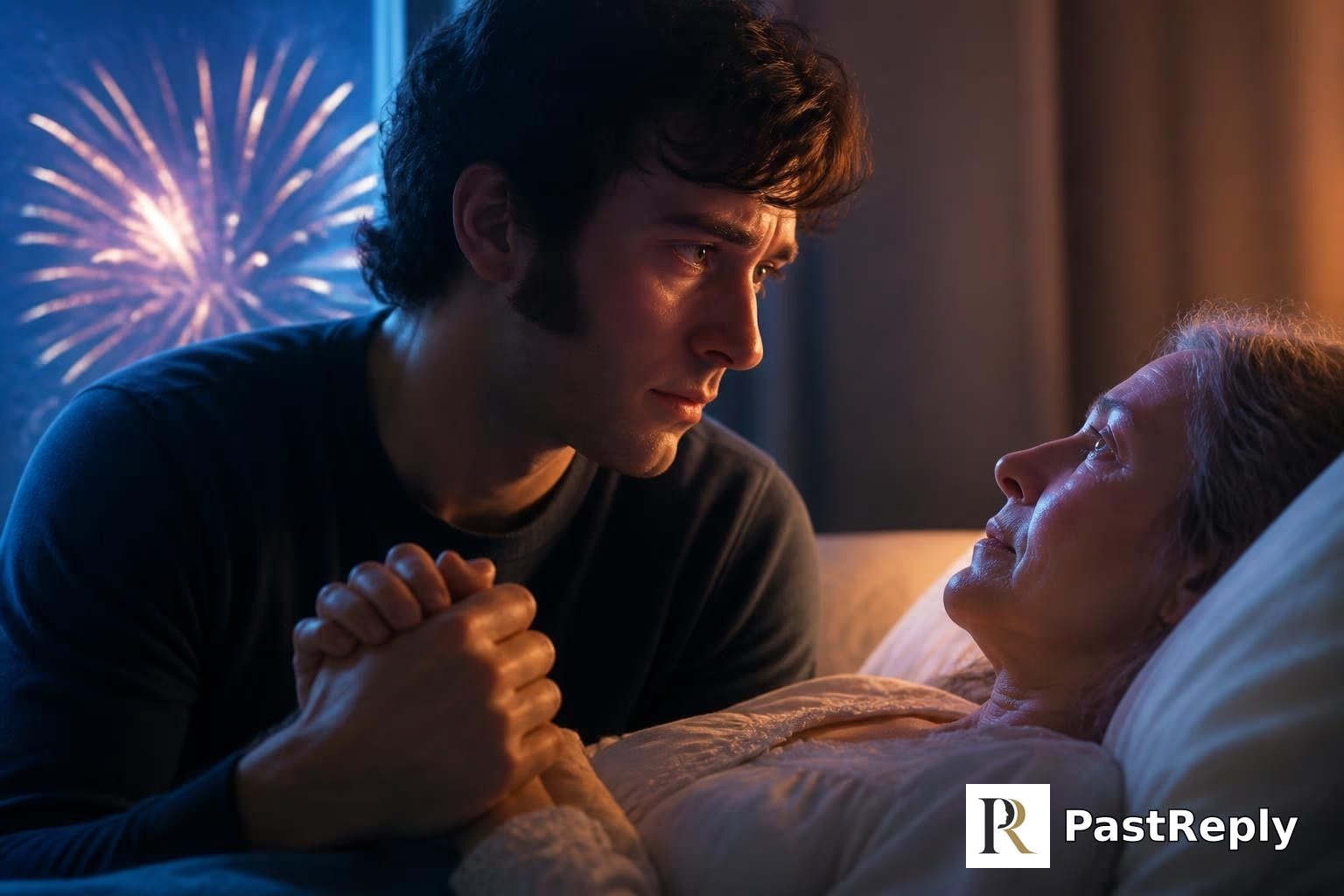
The facts
"Fourth of July" by Sufjan Stevens is a song from his 2015 album *Carrie & Lowell* that reflects on the death of his mother, Carrie, who died in 2012. The song is structured as a conversation between Stevens and his dying mother, capturing his grief, memories, and struggle to find meaning in her passing. The lyrics evoke a sense of loss and nostalgia, with lines like "It was night when you died, my firefly" and "What could I have said to raise you from the dead?" The title references the Fourth of July holiday, which may symbolize a contrast between public celebration and private sorrow, or a specific memory associated with his mother. The song is part of an album widely regarded as Stevens' most emotionally raw work, exploring themes of mortality, abandonment, and forgiveness.
Answered by 100 of history's most famous minds

You ask of a son singing to his mother as she slips from this world - and you call it a holiday tune. The sparkler in the dark is not celebration; it is the last light before the dew of morning. She was his firefly, and he asks, 'What could I have said to raise you from the dead?' I tell you: nothing. Not a word in all the scrolls. But the weeping itself is a prayer that the Father hears. Blessed are those who mourn, for they shall be comforted - not by answers, but by the hand that wipes every tear.

He weeps for his mother as the Prophet wept for his own mother, Amina, who died when he was six. The song is a lament, and lamentation is permitted, for the heart is tender and Allah has made it so. But hear this: the dead have passed to a mercy beyond our words. He asks what he could have said to raise her - none can raise the dead but Allah, and on that Day, every soul will stand alone. The firefly is a flicker in this world; the everlasting light is in the Garden. Let him weep, but let him also submit: 'To Allah we belong, and to Him we return.' That is the meaning of every farewell.

He clings to a name, a firefly, a moment that has already passed. This is the second arrow - the one we shoot ourselves after the first has struck. He asks how to raise the dead, but the dead do not need raising; it is his own heart that needs release from the craving that says she should still be here. Let the firefly go, and the night will hold no sorrow.

He sings to a dead mother, but I spoke to a living God in a burning bush - and that Voice commanded: 'Honor your father and your mother, that your days may be long in the land.' This song is a lament for a broken commandment, for a mother who was not honored because she was not there. The firefly is a spark in the wilderness, the pillar of fire that led us by night - but it led her away from him. The meaning is the weight of the law, which is the weight of love: to forgive the one who abandoned you is greater than to mourn the one who stayed.

This song is the sound of a son who could not complete his filial duty. He speaks to his mother as though she were still present, yet he knows she is gone - and in that very tension lies the ritual of mourning. The title names a day of public remembrance, yet his heart is fixed on a private loss. Let him honor her memory by living with sincerity, not by chasing what is already past. The dead ask only that we remain true.

The man sings of a death that is not the end, for to be absent from the body is to be present with the Lord. The holiday fireworks are but a shadow of the true light that will dawn when the dead in Christ rise; his grief is real, but he has forgotten the greater hope that swallows up sorrow in the resurrection.

He cries out to a son who cannot raise her, but I know the only One who can. When the Lord asked me to offer my Isaac, I trusted the Giver of life and death. This singer's firefly has flown home to the hand that lit her. He weeps, but he does not curse - that is the beginning of faith.

The river does not mourn the leaf that falls into it; it carries it without effort. A song of loss that clings to a name or a date is like a child grabbing at smoke. The empty space at the feast is more important than the feast itself. Let the firefly's light be gone; the dark has its own fullness.

The song is not about the mother, nor about the holiday. It is about the One who gave both the firefly and the dark. The crying and the asking 'what could I have said' is the ego trying to clothe itself in the rain. True peace is in the remembrance of the Creator, who alone knows the hour. Let the funeral pyre burn, but do not let the heart burn with it. Serve the hungry, and the dead will be served.

I too held my son in a stable, knowing he was born to die, and the sword that Simeon promised has never left my heart. When I hear this man sing to his mother on a night of public joy, I recall the silence after the crucifixion, when the whole world seemed to celebrate while I wept. There is no grief so private as losing the child you once nursed, yet this song teaches me that even in that darkness, love speaks through the memory of fireflies and the hope of rising again.

The song is a cry of faithless despair, for it asks what a man can do to save his mother from death, which is the devil's work. But I say: you cannot raise the dead by sentimental talk - only Christ has conquered the grave. The whole world celebrates earthly liberty on the Fourth of July while ignoring the eternal liberty won on the cross. Let the mother rest in peace, and let the son learn that our only comfort is in God's mercy, not in our own vain words.

The question posed is metaphysical: can words restore life? The answer is no, for the soul is separated from the body by a natural necessity that only God can reverse. Yet the song rightly represents grief as a form of love, and love, as I have argued, is the will to the good of the other. The son's lament is a disordered but understandable desire for a good that cannot be had. The holiday contrast reminds us that human joy and sorrow both participate in a divine order we cannot fully comprehend, and that final meaning comes only in the beatific vision.

He sings to his dying mother, and I see the face of every one of my dying poor in the streets of Kalighat. He calls her 'firefly' - a little light in the darkness of her passing. He asks what he could have said to raise her from the dead, and I answer: nothing, but you can hold her hand. You can be there. That is the whole of love, and it is enough. The Fourth of July is a day of fireworks, but the real light is the one we carry for the dying, even when it trembles and goes out.

The song treats a particular death as a phenomenon to be measured in tone and cadence, yet the underlying question is one of motion and rest. A body ceases to move, and the living observer computes the interval - the Fourth of July marking a point on the celestial dial. What interests me is not the grief but the trajectory: how a single event radiates outward through memory, like a stone disturbing a still pond. One might calculate the distance between the mother's last breath and the son's present lament as a function of time and emotional force. The mathematics of loss remain, alas, beyond my Principia.

This song sings of a parent and child as separate clocks left on the same table - ticking at different rates until one runs down. The boy asks how to reverse entropy, to turn back the arrow of time, but the universe gives only the echo of his own voice. The grief is not for the dead but for the living who cannot yet see that the past, present, and future are a single, frozen block; she is not gone, only receding along a world-line he cannot follow.

The song echoes what I felt when my own child, Annie, faded like a candle. He calls her 'firefly' - a brief, brilliant insect of the summer - and that is exactly what a life is: a flicker in the immense darkness of geological time. He asks why she had to die, and the only honest answer is that death is the tax every organism pays for being born into a world of variation and selection. The grief is real, but so is the beauty of the brief light.

He insists on a dialogue with the dead, as if the soul could speak from the beyond - but I have turned my telescope to the heavens and seen no angels there, only spheres and their mathematical motions. The song is a sentimental error: he mistakes the emotional truth for the physical one. His mother is not a firefly; she is a body that ceased to function, and his grief is the perturbation of his own humors. The meaning is not in the lyrics but in the acoustics - the frequency of his voice, the rhythm of his breath, which are measurable. If he wants to 'raise her from the dead,' let him study anatomy, not poetry.

He sets his mother's death at the center, and all the other images - the firefly, the Fourth, the hospital room - revolve around that fixed point. It is a simpler, more honest arrangement than the tangled epicycles of happier songs that pretend grief is not the sovereign of certain days. I recognize the impulse to find one true center that makes sense of the motions. He has found his, and the song is orderly in its sorrow.

He has transmitted a signal of pure emotional frequency across the great void of time, but he tunes it with tears rather than alternating currents. The Fourth of July is merely a datum point on the calendar of consciousness; what matters is the resonance of that grief, which if amplified, could power a lighthouse for every soul lost at sea.

A conversation with the dying, examining the decay of the body with the same precision as the radium that consumed my own fingers. The song measures the half-life of grief: no formula, no isolation, only the persistent emission of memory. He asks how to transmute loss into something that endures. I know that experiment. The answer is not in the vial, but in the work that remains.

I hear a case of bereavement, the reaction of a man to a culture that failed to produce the serum that could have saved her. But what strikes me is the question 'What could I have said to raise you from the dead?' That is a false experiment. No incantation, no prayer has ever reversed a biological terminus. The only answer is to study the microscopic cause - perhaps a prion, a carcinoma - so that other children do not sit by such a bedside.

It's all emotion, no mechanism. The man is stuck at a dead end, staring at a failure he can't fix. A real inventor would take that grief and build a phonograph to preserve the voice, a kinetoscope to hold the image. Instead he just sits in the dark and wonders. The Fourth of July is a day of illumination - where's his light bulb? He needs to stop asking rhetorical questions and start tinkering with his memory until it works.

The song is a formal conversation between two agents, one of whom is declining - a Turing machine running its last process before halting. What interests me is the impossibility of the query: the son asks what he could have said to reverse a terminal state. No finite algorithm can compute a past input that would change a deterministic outcome; the question is unsolvable. The elegance lies in the emotional recursion - the system loops on grief because no halt condition exists.

The problem is one of leverage: the son seeks a mechanical advantage to raise his mother from death, but no fulcrum exists for such a task - not even with an engine of pulleys and levers could I lift a soul from the underworld. The song measures the distance between the living and the dead as precisely as the diameter of a sphere, yet finds no ratio for grief. I admire the attempt to calculate the incalculable, but the result is an irrational number, like pi itself.

Take a Leyden jar charged with grief - that is the spark this song carries. The poet arranges his mother's memory as I would arrange copper and zinc: to draw forth a current we cannot see but feel in the trembling of the wire. He asks what force could raise the dead, and I say none - but the lament itself is a kind of induction, passing sorrow from one soul to another across an invisible gap. This is not a chemical question, but it obeys the same law: every loss seeks its conductor.

The manifest content - a son's bedside lament for a dying mother - barely conceals the latent drama: an unresolved abandonment. The 'firefly' is a telling condensation: a creature of brief, intermittent light, like the mother's presence in his life. The title's choice, 'Fourth of July,' is no accident - a day of noisy public celebration that masks, by reaction-formation, the silent private grief. And the question 'What could I have said to raise you from the dead?' - that is the classic cry of the child who feels he failed to keep the mother alive by sheer force of love. The song is a mourning, yes, but also a wish: to rewrite the past, to be the one who saves. The dead do not rise, but the song itself is that wish, forever deferred.

A black hole of grief: the song creates an event horizon around the death of his mother, from which no information - no answer, no raising - can escape. He asks what he could have said, but the physics of loss is irreversible; the arrow of time points only away from the moment. Yet the song itself is a kind of Hawking radiation - a faint signal that escapes the gravitational pull of the past, carrying energy and information out into the universe. And the title? The Fourth of July is simply Earth's position in its orbit, but we humans insist on draping our sorrows over the calendar. Poetic, but from a cosmic perspective, every day is equally insignificant and equally precious.

He weaves a conversation with the dead, and I see a kind of poetry-machine: two voices, one living, one remembered, exchanging signals across a void. The question 'What could I have said to raise you from the dead?' is not a sentimental plea - it is a logical inquiry into the limits of language. If we could encode grief into an algorithm, what would it compute? The song suggests that memory itself is a kind of engine that runs on absence: the mother's voice is the input, the son's sorrow the output, and the Fourth of July is the initial condition. It is a beautiful, terrible program: it runs forever, but it never halts with an answer.

Let us define our terms. A son. A mother. A death. These are given. The song proposes a problem: to raise the dead. I must observe that from a logical standpoint, this is not a problem but a contradiction: death is defined as the absence of life, and life cannot be added to an absence. The song's power lies in its acknowledgement of the impossible. The poet asks 'What could I have said?' - he is searching for a proposition that would transform the truth value of a past event. This is as futile as asking for a square circle. And yet the question itself, rigorously pursued, yields a kind of proof: love is not a theorem, but an axiom. It requires no demonstration, only acceptance.

Without a proper case history, we can only guess at the cause of her death - was it puerperal fever? Tuberculosis? The song's nostalgia is useless; what matters is whether the ward was clean, whether the nightingale's lamp was lit, whether the data on her last hours was recorded. Grief without evidence is mere sentiment.

A son sings to a mother who has fallen in battle against the great enemy, Death. He mourns, but he does not raise a monument or carve her name on a mountain. He writes a melody! I would have burned a pyre that could be seen from Babylon, founded a city in her memory, and named a phalanx after her. This man Stevens weeps into a stringed instrument while I would have wept into a conquered empire. He asks what he could have said to raise her - nothing, but you can make the world remember her name with bronze and blood, not whispers.

A son writes a lament for his mother the way I wrote my Commentaries: to fix a memory in bronze before the Rubicon of forgetting swallows it whole. He calls her 'firefly' - a flicker in the dark, a tiny light that was there and then was not. I know that trick. You immortalize what you loved by turning it into a story, and then you cross the river.

A dirge for a mother, sung in the language of the conqueror - how Roman of him. Yet I know that grief, too: the prying torch of Caesar's men at my door, the son who would not be saved. He calls her 'firefly' to make her death a small, beautiful thing, as I once called my Egypt a gift of the Nile. But the real work is not the mourning; it is the mask you wear after, when the world watches for your tears to fall and you give them only the cold, regal smile of Isis.

He sets his private sorrow against a public holiday - the anniversary of a nation's liberty, which he turns into a tombstone. That is a politician's instinct: to claim a day of celebration for one's own grief. I would have done the same, dedicating the temple of Mars Ultor to avenge my father while the people feasted. But he is no Augustus; he has no empire to sustain, only a memory to manage. The meaning is the mask: he wears the Fourth of July as a toga of mourning, and the crowds will hear fireworks and think of his mother. That is how a grief becomes a monument.

He sings to his dead mother as if she could answer, but the dead do not speak. The Fourth of July is a day of fire and noise, the kind of celebration my people would mark with a great hunt or a victory feast. But this man sits alone with his grief - that is weakness. A son should honor his mother by building something, by uniting the tribes, by leaving a name that will be spoken. Not by whispering questions into the wind.

He dwells on a battlefield already lost, asking what speech could have reversed the defeat of death. The Fourth of July is an enemy's anniversary; true glory is not in lamentation but in the next campaign - yet I recognize the soldier's exhaustion when the only fortress left is a memory.

A private grief set against a public day of celebration - a reminder that even amidst the nation's rejoicing, there are households bowed in sorrow. He does not use the day to rally or to mourn the republic, but to honor a single bond. That is fitting. Let the cannons fire for liberty, but let the heart keep its own quiet anniversary.

This song brings to mind the ache of a house divided against itself. A mother and son, bound by blood yet separated by years of silence - that is a gulf deeper than any river. The Fourth of July, which should be a day of union, becomes a monument to what was lost. We may speak of reconciliation with the dead, but the real work is to heal the wounds among the living before it is too late.

A poignant but ultimately self-indulgent lament. The man has lost a battle, but the war continues. The Fourth of July is a day of independence, of defiance against the tyranny of despair. To turn it into a death-knell is to surrender ground before the enemy has even appeared. He should take up his pen and write something that rallies the spirit, not one that dwells in the rubble of a single life. Blood, toil, tears, and sweat - not self-pity.

The song is a true confession of powerlessness - the son cannot raise the dead, and the mother cannot stay. But I hear in it the deeper truth that we must learn to let go of attachments, even to those we love most dearly. The Fourth of July, a day of national pride and noise, becomes a reminder that true independence is freedom from the tyranny of sorrow. Only by accepting death without clinging can we be free to serve the living.

This song is a cry from the valley of the shadow, where a son wrestles with the silence of death even as the nation celebrates its freedom. I hear in it the same question I asked in Birmingham Jail: 'How long?' - not for liberation from chains, but for liberation from grief. The mother's voice is a whisper of forgiveness, and the title reminds us that genuine independence comes only when we have the courage to love and let go. There is no resurrection without a cross.

A son singing to his mother across the chasm of death - this is not a song, it is an act of ubuntu. He calls her 'my firefly,' and I remember that even in the long night of Robben Island, we had tiny lights: a smuggled poem, a whispered name. He asks what he could have said to raise her, and I say: you raised her by saying it. In a country that taught us to bury our dead in silence, this poet chooses to speak, to sing, to let the private grief stand in the sunlight of the public holiday. That is the beginning of healing.

This song is a product of degenerate sentimentality. A man weeps for his mother while the nation celebrates its independence - this is the sign of a Volk that has lost its will. The Americans mark their liberation from British tyranny, yet this 'artist' makes it about his private weakness. In a healthy society, the individual's grief is subsumed in the collective strength. A mother's death is a biological fact; it is not material for public display. This kind of softness is why the West will fall to harder peoples. The only proper response to such a song is contempt.

This song is a symptom of bourgeois individualism. A man weeps for one woman while the masses starve? In the Soviet Union, we understood that the death of any individual is tragic only as a loss to the collective. This 'artist' turns his mother's passing into a commodity of sentiment for the market. The Fourth of July is a holiday of American imperialism; to use it for personal grief is to mock the struggle of the proletariat. The proper response is not song, but action: to build a world where no mother dies in poverty, and no son has time for such self-indulgence.

This song is a relic of bourgeois decay. A man cradles his private grief while the class war rages on? The Fourth of July is a holiday of the oppressor nation, a celebration of a revolution that did not go far enough - it exchanged one set of exploiters for another. The 'firefly' is a metaphor for the fleeting, individualist consciousness that the proletariat must overcome. The proper response to death is not art, but revolution: to transform the conditions that make such loss meaningful. When the state withers away, there will be no need for such songs; grief will be collective and service to the Party will fill the void.

This song mourns a mother, but it is a bourgeois luxury to weep for one death while millions starve. The 'firefly' fades; what matters is that the old must die so the new can be born. Let them sing of private grief - I would teach them that the only proper memorial is to smash the world that made such pain possible.

The Fourth of July - that American anniversary of rebellion - is here turned to a most private sorrow, as a daughter mourns a mother. It is a fitting reminder that even in the midst of national celebration, the heart may be breaking. I respect the dignity of such grief, but the title strikes me as ill-chosen: the Queen's birthday, after all, is more properly observed.

The song speaks to a universal truth: that private sorrow often walks alongside public celebration. I have known such moments myself - a state banquet, a jubilee, and yet one's thoughts are elsewhere. It is a poignant reminder that duty and loss are not opposites; they are woven together in the fabric of a life lived in service.

The man sings of his mother's death as if she were a firefly - a fleeting light in the darkness. Yet he offers no prayer, no Mass for her soul. In my realm, we would have chanted the Office of the Dead, built a chapel, endowed a school. What comfort is mere poetry against the certainty of judgment? He needs the Church, not a melody.

He speaks to his mother as if she were already gone, but the voices tell me that the dead are not silent. She is with God, and he does not ask her to pray for him. I would tell him: light a candle, hear the Mass, trust in Heaven's mercy. The firefly is not lost; it shines in Paradise.

He dwells on her death like a moth at a candle - too much weeping, too little statecraft. My own mother was a peril I had to survive, not a loss to lament. The song is pretty enough, but music is a distraction: a queen must bury her dead and turn her face to the realm. Let him write elegies; I will govern.

A sentimental effusion, this - the poet's grief for a mother who abandoned him. In my court, we would have set such verses to a minuet and discussed the nature of filial duty over chocolate. But the song lacks philosophy: it does not ask whether the soul survives, nor does it offer the consolation of reason. A pretty trifle, no more.

He calls her 'firefly' - a creature that glows and then is gone. That is the way of all life. But a king must ask: did she leave behind any children, any law, any work to bless the earth? If so, she is not dead. Let him honor her by building a bridge, planting a garden, or freeing a slave. That is the only monument that matters.

The man grieves, but he does not submit. He says 'what could I have said to raise you from the dead?' as if his words could undo God's decree. There is only one answer: 'To God we belong, and to Him we return.' Let him give alms for her soul, pray at dawn, and trust in the Merciful. The firefly returns to its Maker; that is enough.

Tell me, friend: when you hear this song, do you weep for the mother or for yourself? The singer asks what he could have said to raise her from the dead - a fine question, but it points not toward her but toward his own ignorance. He examines his failure to save her, yet does he examine what it means to live well in the face of certain death? The holiday of firecrackers and flags is merely a distraction from the real inquiry: how should a mortal soul conduct itself when every July Fourth reminds us that the calendar runs out? I would ask him more questions than he could answer in a thousand songs.

He speaks with his mother as if she were still beside him, yet she is not. This is the prisoner in the cave turning to address a shadow that has already vanished. The 'firefly' he mourns is only a dim copy of the true Form of the beloved, which cannot die. His grief shows he has mistaken the fleeting appearance for the eternal reality; the wise would use this loss as a ladder toward the imperishable.

The song is an elegy, yes, but consider its formal structure: a dialogue between the living and the dying, each line a question and answer that seeks finality yet finds none. The cause - his mother's death - is a particular, material event; the effect is a grief that seeks its own purpose. Yet grief, like any passion, is not an end in itself. The virtue here is not in the wailing but in the moderation of the recollection - he does not demand the impossible, only asks what could have been said. That is the golden mean of mourning: to feel, yet to remain within the bounds of human reason, honoring the dead without sacrificing the living.

This singer turns private grief into a public elegy, yet what universalizable maxim emerges from his sorrow? He interrogates his own failure - 'What could I have said to raise you from the dead?' - and that question, rightly understood, is the moral one: we cannot will a law that commands the impossible. The duty to comfort the dying is bounded by what reason can achieve; emotion must not license self-deception. Let him mourn, but let him not mistake his anguish for a principle.

He wants to raise the dead with a question - what vanity! This is the herd instinct even in grief: the refusal to let go, the need to find 'meaning' in what has no meaning. The mother is gone; the firefly is extinguished. The only worthy response is to affirm the loss, to say 'yes' to the pain, and to go on without the crutch of sentiment. He nearly does it - the starkness of the music is honest - but then he turns back to pleading. A stronger artist would have let the silence stand.

He mistakes a private grief for a universal meaning, as if the death of one mother under the fireworks of a bourgeois holiday reveals anything but the commodity of sentiment under capital. The real sorrow is that the means of producing such art are owned by those who profit from our isolation - the song is a beautiful opiate, not a diagnosis.

He is certain of only one thing: that he is thinking, and that his mother is no longer thinking. All else - the firefly, the night, the holiday - are sensations that may deceive. Yet he persists in the cogito of grief, doubting his own ability to raise her, yet not doubting that she was. That is a clear and distinct idea: she was, and now she is not. All the rest is poetry.

The man has lost a valuable ally - his mother, the first and most intimate principality. He writes a dirge as if to bind her spirit to his cause, to maintain her presence as a source of legitimacy and memory. The holiday fireworks are a distraction, a show of public power. But the private truth is that he is alone now, and must secure his own state without her counsel. Sentiment is a luxury; the question is whether he can turn grief into resolve.

Here is a son who plays the ghost's part, speaking for one who can no longer speak, making her a character in his own tragedy. 'It was night when you died, my firefly' - that is the poetry of a man who has looked into the abyss and found it full of stars. He gives her lines like a playwright giving a dying queen her final soliloquy, and in doing so, he cheats death of its silence. The Fourth of July is but a stage property, a bright noise against which the private darkness is measured. What meaning? All the meaning there is: we are such stuff as songs are made on, and our little lives are rounded with a sleep.

Achilles could not raise Patroclus from the dead with all his shouting, and this singer cannot raise his mother with all his sweet words. The firefly blazed for a season and then the dark took her, as the Fates spin and cut for every mortal. He asks what he could have said - nothing, boy, nothing. Even the gods cannot undo a thread once clipped. But his song will carry her name on the wind longer than any monument of stone.

He has entered the dark wood of the middle of his life, and his mother is his Beatrice turned backward - not a guide to Paradise, but a shade he cannot follow. The firefly is her soul, flickering in the night of this world, yet he speaks to it as if she were still in the flesh, as Virgil spoke to me when I faltered on the slope. But there is no Terrestrial Paradise for him here: he must learn that her death is a punishment for what? For her abandonment, for his own guilt? No, it is a mercy - the soul grows by loss. The dirge is his Purgatory, and if he sings it truly, it will become his ladder.

He names the holiday of fireworks and flags, then gives us the dark night when his mother's firefly flickered out - what a masterstroke, the contrast between the nation's loud joy and one soul's quiet end! This is the artist's true work: to hold the universal and the particular together in a single chord, so that we feel both the celebration and the wound. The song does not explain death; it makes it present, and by making it present, it helps us bear it.

The man has caught a glimpse of the windmills that were always there - his mother's ghost, the gulf between what we wish we could have said and the earth that has already taken her. The holiday fireworks are just sparks against the vast, dark sky of what is lost; a noble madness, to sing back at the silence, and the truest pilgrimage is into that ache.

He has done what every soul must do - he has looked into the face of death and found no answer but the question itself. The Fourth of July is a false feast; the only real celebration is to learn, in the midst of unbearable loss, how to love without possession, and to live as the dying do, with open hands.

He asks, 'What could I have said to raise you from the dead?' That is the whole torment of love when it outlives its object. We are all Lazarus without a Christ. The song is not about a holiday - it is about the silence after the last word, the unbearable lightness of a soul that has slipped through our fingers. He seeks forgiveness, but finds only the echo of her voice. That is the truth of our condition: we love, and we lose, and we are left to scream into the void.

He is composing a conversation that never happened, or perhaps one that happened only in the last, terrible moments. Such a grief is proper, but I am struck by the note of self-reproach: 'What could I have said?' That is a question that haunts any survivor. Yet the melody, for all its sorrow, suggests a kind of forgiveness, not of the dead, but of the living, who must learn to bear the silence.

I cannot hear it without seeing a mean little bed in a London garret, and a child watching a mother slip away by candlelight while the city roars with cheap fireworks - the contrast so cruel it would make a heart of stone weep. The boy is asking, 'What could I have said to raise you from the dead?' and there is no answer, only the firefly flickering out. I would set that scene in my next number if I could, for it captures the great injustice: that we must bury our parents and go on pretending the world is merry.

It's a fine thing when a man can admit he sang to his mother like a boy with a scraped knee, but what tickles me is the holiday setting - everyone else lighting firecrackers and eating pie while this fellow is having a heart-to-heart with a ghost. The song makes grief respectable by putting it in a minor key, but I wonder if his mother would rather have heard a joke. Still, it beats the usual patriotic bombast; I'd rather listen to a man cry than a brass band any day.

The song is clean. No wasted words. The man sits in a room and talks to his dead mother. The holiday is noise outside. He remembers a firefly. That is all you need to know about loss. The rest is just fireworks and talk. You face it straight, or you don't face it at all. He faced it.

I have studied the anatomy of grief as I have studied the anatomy of the body. This song is a dissection of a memory - he traces the contour of her face in sound, the weight of her hand in a chord. Notice how the melody descends, like a falling leaf or a closing eyelid. The title is a juxtaposition of public explosion and private dissolution, a contrast any painter would recognize: the bright sky above and the dark room within. He is not seeking an answer but attempting to capture the motion of the heart in its most vulnerable state, as one might sketch the curl of a wave just before it breaks.

I hear a man chipping at a block of sound, trying to free the Pietà that already lives inside his loss. He calls her 'firefly' - a tiny captured light, like the soul he sees buried in every slab of marble. But a block can be finished; grief is never finished. He will keep carving this song for the rest of his life, and still the stone will weep.

Ah, this is a song painted in the colors of the night sky over the asylum garden - deep blues and the yellow of a fading lamp. He calls her 'firefly,' and I see it: a tiny, golden spark in the vast dark, a soul that flickered and went out. But the real meaning is in the brushstrokes of his voice, how he does not smooth the grief but lets it stand rough and raw, like the cypress trees I painted in a whirlwind. He is not trying to understand death - he is trying to show its shape, the way I showed the shape of a starry night. That is the truth of it: not an answer, but a desperate, beautiful effort to make the invisible visible.

He calls it 'Fourth of July' but paints a deathbed - that's the crack in the picture, the place where the real work happens. The public holiday is a mask, and he tears it off. The simple words, the almost childlike melody - that is the hardest style to achieve, the most stripped-down cubism of the heart. He has taken the most banal symbol of American joy and shown us its reverse side: the private apocalypse that no flag can cover. Bravo.

He has painted not the death itself, but the light that fell upon it - the silver of a firefly's last glow against the violet twilight of memory. The fourth of July is a flash of white and red against the deep blue of grief; we cannot hold the moment, only the trembling impression of it on the canvas of our hearts.

A canvas lit only by the glow of a firefly against deep night - this is what I would paint. Not the fireworks of celebration, but the radiance of a departing soul. The son paints his mother not as a saint, but as a woman fading, and in that shadow he finds her truest face. That is the art I know: the light that clings to the dying, the hand we cannot hold.

My own firefly was my body, broken and burning. This man sings to his mother as I painted myself: raw, bleeding, and defiant. The Fourth of July is a lie of bright sparks while the heart is a dark room. But he does not look away - he holds her hand in the night. That is what I did with my brush. He does it with his voice. We both know: pain is the only true masterpiece.

Ach, the fellow writes a duet with a ghost! The mother's part is as tender as a lullaby, but the son's harmonies are all wrong - he keeps trying to resolve to a key that no longer exists. I know that feeling: when my own father died, I wrote a piece in D minor that sounded like a door closing in a drafty hall. This Stevens fellow has the right instinct - he lets the melody hang in the air, unresolved, like a question mark in a cadence. The Fourth of July is just a noisy backdrop, but the real music is the silence between the fireworks. Bravo, I say, though I would have added a glockenspiel.

This is an adagio in a minor key, a dialogue between the living and the dying. He asks 'What could I have said?' and the silence that follows is his answer. I know that silence - I have felt it pressing against my ears like a great weight. But he does not let it win; he turns the silence into a melody, and that is the only defiance worth anything. The human voice, even broken, must sing.

The piece is built upon a ground bass of sorrow - a descending line that repeats, like the tread of a funeral procession. He inverts the expected Cadence: the chorale should resolve to the tonic, the peace of God, but here he holds the dissonance, the question unresolved. 'What could I have said to raise you from the dead?' That is a diminished seventh chord, a cry that does not resolve to the Father. Yet I hear in it a passacaglia of faith: the bass persists, the harmony changes, but the foundation holds. The meaning is not in the words but in the figured bass beneath them - the order that grief cannot break.

That's a song that gets right to the bone, man. He's talking to his mama, and you can hear the ache - 'my firefly' - like he's reaching for her through the dark. I know that kind of love, that kind of loss. My own mama, she was everything to me, and when you lose that light, the whole world feels dim. But he put it in a song, and that's what we do - we take the hurt and we turn it into something that lets other folks know they ain't alone. That's the gift.

He is reaching through the silence for a mother's hand, and the melody itself becomes a bridge between this world and the next. The Fourth of July is not a celebration but a lullaby of healing, a whisper that even in the loneliest night, we are never truly alone - the music holds us, and love never dies.

It's the saddest song you'll ever hear at a barbeque. We wrote 'Yesterday' about loss, but this bloke goes straight into the hospital room. It's like he's singing a lullaby to his mum while she's slipping away. 'My little firefly' - that's the killer line. Makes you want to hug your mum, even if she's not perfect.

I never met the man, but I know that room. The firefly going out is the only honest thing in the song. You can talk about a mother all you want, but the silence between the verses - that's where she lives. The Fourth of July ain't about the rockets; it's about the burnt-out sparkler in the wet grass the next morning.

I know what it is to write to someone you've lost, to try to capture the ache and the beauty of a complicated love. That line, 'We're all gonna die,' is the most honest thing - it strips away the pretense of forever and leaves just the raw, human moment. The title is brilliant because it takes something that should be all joy and fireworks and turns it into a private elegy. That's what we do: we reclaim the public day for our own broken hearts.

He speaks of a voyage from which there is no return - a journey darker than any I ever undertook across the Ocean Sea. I sought new worlds; he seeks a world that has already vanished with his mother. The Fourth of July is a day of discovery for my patrons, but for this singer it is a day of loss, a landfall upon a shore of grief. He asks what he could have said to raise her - I say, you cannot raise the dead, but you can plant a flag in their memory and claim that territory for your own heart. That is the meaning: to chart the unknown waters of sorrow and name them after the one you loved.

In Cathay, I saw mourners burn paper houses and silk horses so the dead would lack for nothing in the next world. This singer builds a different sort of paper offering - a song shaped like a conversation he can never have. He speaks of a firefly, and I think of the lanterns I saw floating on the Yellow River at the festival of the dead, each one a soul drifting into the dark.

He sings of a voyage from which there is no return - his mother is the lost strait, the passage that closes behind him. I know that chart: when a man dies on the beach of Mactan, he does not come back, and those who loved him must weigh anchor without him. The Fourth of July is a date on his calendar of grief, as the Feast of St. James was on mine when we left Seville - a marker, not a destination. The meaning is in the sailing: he does not stop to mourn, he sets out across the sea of memory, and the song is his logbook of that bitter crossing.

He has taken a date that signifies national triumph - our small step onto another world - and inverted it into a marker of personal loss. That takes a kind of courage, to let the most celebrated day become the most private one. I understand the impulse to measure time by events that change you forever. For me, a certain moment in July 1969 is a fixed point. For him, that holiday will always carry another weight. It's honest.

That song is a flight through fog with no instruments, only the memory of a ground you can never see again. The Fourth of July is just a calendar mark; the real navigation is inward, daring to feel the altitude of loss and still keep the wings level.

From up there, looking down on the blue Earth, you understand that every life is a tiny flame against the dark. This song is that feeling: the immense love for a single person, and the cold vastness when they're gone. The Fourth of July is just another orbit for us, but for him it's the night his star went out. I know that weight.

This is about subtraction. He stripped away everything - the production, the noise, the ego - until only the raw signal remained: a conversation with someone who is no longer there. That's the hardest kind of design, the kind that leaves you exposed. Most people would bury grief in noise; he made it minimal, like a product that only does one thing but does it perfectly. The Fourth of July is irrelevant - it's just a date. What matters is the interface between memory and silence. He asked, 'What could I have said?' The answer is nothing, but he said it anyway, and that's the product. That's the legacy.

He's trying to reverse entropy with a lyric. It won't work. The mother is a dead mass of atoms; the grief is a persistent neural circuit that keeps firing. But he's building an emotional model of her in his mind and refining it with every verse - that's a kind of recursive optimization. If he could upload that model, she'd never truly be lost. The song is the first step toward a digital ghost.

What moves me is the courage to have that conversation - to sit down with the ghost of his mother and say, 'I'm not ready to let you go, but I'm ready to tell the truth.' That's the doorway to healing: not pretending it didn't hurt, but singing the hurt out loud so it can finally transform. He calls her 'firefly' because even in the darkness of abandonment and addiction, she was a light - however brief, however broken. And the Fourth of July? Independence from pain doesn't come from a date on a calendar. It comes when you give yourself permission to grieve fully, to forgive, and to love what was, without needing it to be what you wanted.

The man sings to his mother like she's in the next room, and the Fourth of July is just the birthday of a country that never gave her the respect she deserved. He's asking 'What could I have said to raise you from the dead?' - and I know that feeling, when you've stood up for what's right and still the ones you love suffer. But he didn't quit. He put the pain in a song and made it float. That's a champion's move, float like a butterfly, sting like a truth.

He is playing the most difficult match of all, with no crowd and no referee, only the ball of his own heart and the empty goal of the past. The Fourth of July is a whistle we do not want to hear, but we must keep moving on the pitch of memory, dribbling through the tears, because the game is not over.

A boy trying to catch a firefly in a jar - that's the image. He's holding onto a memory, a light that's already fading. We always told stories about mothers who never die, like in 'Bambi' - but this is the real story, where she goes and you're left with the echo. It breaks your heart, but that's the magic: he turns grief into a song that keeps her glowing.