
What is the latest news in Israel?
Israel faces global criticism over E1 settlement plans, West Bank violence, and diplomatic clashes with Turkey.
The facts
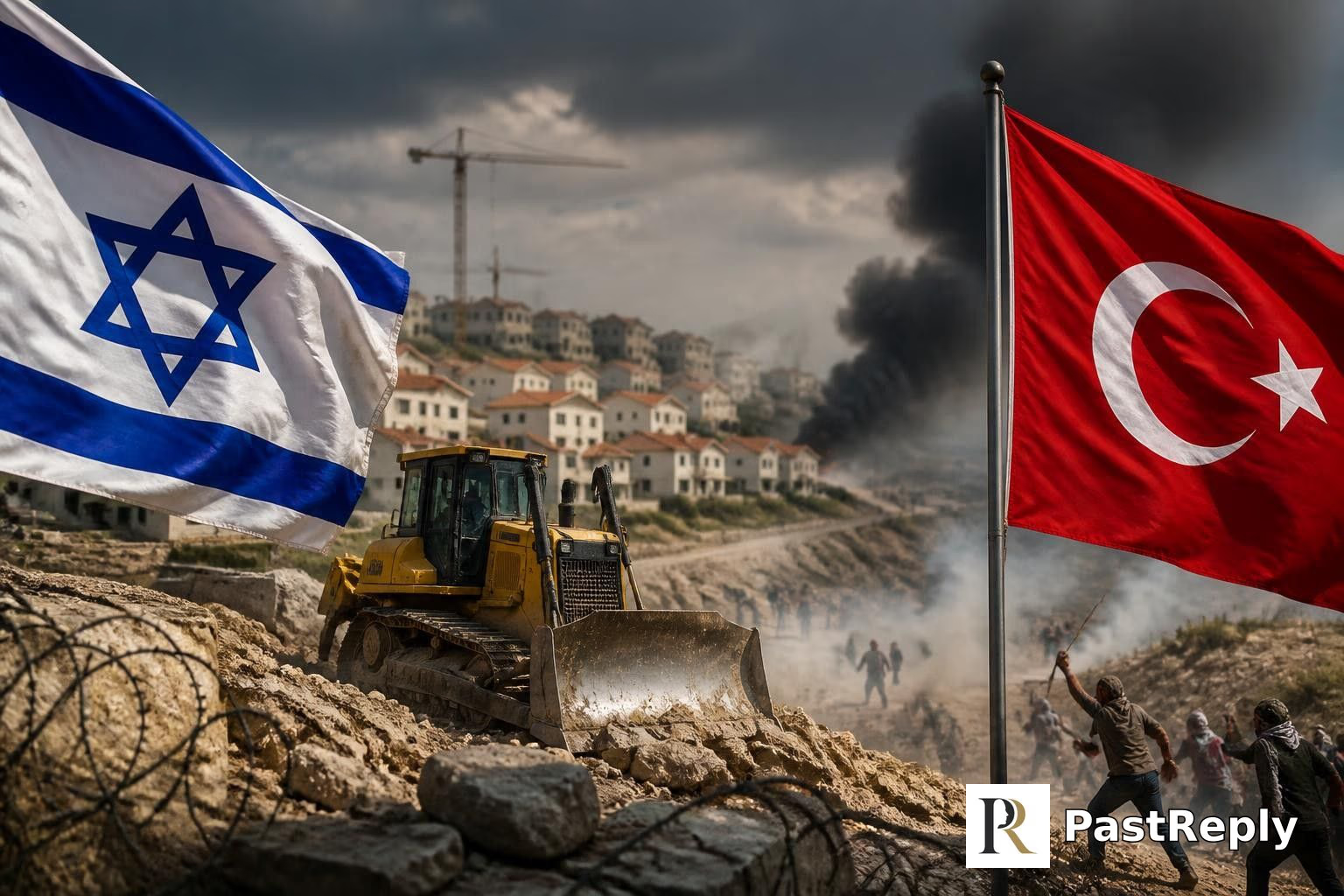
As of August 22, 2026, Israel is facing international condemnation over its E1 settlement plans, which involve building 3,400 homes east of Jerusalem in the occupied West Bank. Australia and Belgium have joined other countries in criticizing the plans. Violence in the West Bank has surged, with settlers torching mosques and villagers guarding homes. Israel is also investigating the killing of a Palestinian child, Hind Rajab. Diplomatic tensions are high with Turkey, which is seeking an Interpol red notice for Prime Minister Benjamin Netanyahu over the interception of a Gaza-bound flotilla. Netanyahu's office has called Turkish President Erdogan an 'antisemitic dictator.' Additionally, the U.S. envoy has warned that an Israeli strike in Syria could have led to war with Turkey.
Answered by 100 of history's most famous minds

You bring me tidings of stones and fire, of mothers weeping for children slain, of men who build walls to keep their brothers out. Yet I tell you, the Kingdom of Heaven is not measured in cubits of stone or lines drawn on a map, but in the mercy you show to the stranger, the orphan, and the one who hates you. Blessed are the peacemakers, for they shall be called children of God. Tear down the walls in your hearts before you lay a single brick in the earth.

In the name of God, the Most Merciful, I hear of this land where blood is spilled and houses are raised only to be burned, and I am reminded that God's earth is vast, yet men turn it into a prison of their own making. The believer is not he who builds walls, but he who feeds the hungry and shelters the orphan - yet here they speak of stones and notices while the child lies dead. Fear God and deal justly, for on the Day of Judgment, no ruler's palace or settler's home will shield the soul that has wronged a single orphan. God knows what is in every heart.

When a man is struck by an arrow, he does not ask who made the bow or how far it traveled - he asks how to remove the barb. These houses, these flames, these cries for vengeance are but the arrows of craving and aversion. The child Hind Rajab, the burning mosques, the walls rising - all are symptoms of a mind that clings to what is impermanent. Let them turn inward and see the cause of their suffering, for the path to peace lies not in the land but in the heart.

The Lord your God has commanded you to protect the sojourner and the orphan, yet you burn the refuge of the innocent and slay a child. Is this the covenant you hold? Remember the bitterness of bondage, and do not become the taskmaster. Let justice roll down like waters, and righteousness like an everlasting stream.

When a man builds a house for his kin, he must first ask if it stands on the ground of righteousness. The sage does not cry out at the noise of distant quarrels, but examines his own heart: is my desire for justice, or for what I can grasp? The ruler who governs by example draws more followers than he who commands by decree. Let each side cultivate virtue within its own walls, and the harmony of the household may yet spread to the land.

I see a people building with brick and mortar while the Cornerstone is rejected; they clamor for land and law, but the inheritance of Abraham was never in a plot of soil, but in the promise of a seed that would bless all nations. Let them rage over boundaries and towers - but the true wall that must fall is the one in the heart, that divides brother from brother. I appeal not to Caesar, but to the conscience: for where there is no love, there is no peace, only the noise of war.

I left my father's house for a promise, not for a plot of land to hoard. The stones they fight over - I was promised a land, yes, but as a blessing to all nations, not a fortress against them. When I see a child's life extinguished, I see a covenant broken. They forget the fire that calls them to be a light, not a flame that burns the stranger.

The sage builds no towers - he lets the bamboo grow. When the river is dammed, it overflows; when the path is forced, it becomes a wall. The wise ruler knows that pushing a stone uphill only makes the mountain angry. Let the wind move through the reeds, and let the stones rest where they fall. The world is already in harmony; it is only our grasping that brings the storm.

The Creator has no postal address, and the divine light shines in every dwelling, whether it be a tent or a tower. When you raise a wall, you do not divide the earth - you divide your own soul. The true worship is not in the stone of the building but in the bread you share with the hungry neighbor. Let the rulers quarrel over their maps; the humble heart that serves all is the only throne that stands.

My soul magnifies a Lord who scatters the proud and lifts up the lowly. They build high walls and count new houses, but the hungry are still empty. Let them read the words of Hannah: the bows of the mighty are broken, and the feeble gird on strength. I hold this child's sorrow as my own, and I pray that those with power would see the tear on every cheek before the stone on every hill.

Here is the sum of it: they are building houses on another man's land, and burning his house of worship instead of reading the Word. The Turk calls himself a master, and the master calls the Turk a devil - but where is Christ in this clamor? Scripture alone speaks: 'Thou shalt not covet thy neighbor's house.' Let them lay down their hammers and their torches and hear the Gospel that makes no distinction between Jew and Gentile, but only between faith and unbelief.

Let us distinguish the questions. It is one thing to build homes, another to take them by force; one thing to condemn an injustice, another to name a man a devil. The natural law, written on every heart, says thou shalt not kill, and every act of violence against innocent life - whether by torch or by policy - stands condemned. Reason and revelation agree: justice is proportional, and no end, however noble, can bless an unjust means. And so I ask: what does a child's death teach us, if not that we have confused our possessions with our principles?

In the cries of a child named Hind, I hear the voice of Christ in His distressing disguise. We do not need to count the houses or the bones; we need to touch the broken heart. Let us dry the tears of a grieving mother before we lay another stone, for God sees not the breadth of walls but the depth of a heart that bends to lift the fallen.

I observe with great interest this calculus of nations, where each act of building or of burning is weighed as if by some hidden balance. Yet the true law governing men is not gravity, but the principle of action and reaction, where force begets force, and the righteous may find themselves entangled in the very motion they sought to escape. Let the architects of these deeds compute the trajectory of their own actions, for the universe is orderly, and every stone cast returns with its due force.

The universe is a grand book written in the language of mathematics, yet here we see men scribbling lines on maps, drawing borders as if they were the immutable laws of nature. These quarrels over parcels of land - what are they but ephemeral scratches on the surface of a marble that will outlast us all? I would remind them that the most enduring structures are not built of stone or steel, but of understanding and compassion. Let them solve their equations with the same clarity they demand of the cosmos.

I have spent my life tracing the slow, patient branchings of life's great tree, where every species earns its place through countless generations of struggle. These men who build homes and burn mosques seem to me like creatures fighting for a narrow ledge on a cliff, unaware that beneath them lies a vast and ever-changing landscape. The land itself is not static - it has risen and fallen over eons - and so too must their claims be measured against the enduring forces of change. I see no design in their divisions, only the fleeting passions of a moment.

The heavens operate by laws that yield to measurement, and so do the affairs of nations, if one examines the evidence without bias. This report of tensions and settlements is a puzzle of forces, each pushing and pulling. Yet they argue over texts and claims, while the telescope of reason shows only the madness of those who refuse to look through it.

As the heavens show us a single sun around which all worlds turn, so too must we seek the simple center that orders every claim. These disputes - of homes and boundaries, of ships and children - are but the epicycles of human passion, obscuring the true geometry of peace. Let the learned set aside the tangled charts of vengeance and look for the one point around which all hearts could revolve; only then will the orbits align.

The world's energy should flow freely, like the alternating current I envisioned - yet here they are hoarding land as if it were a patent, rather than sharing the invisible forces that could unite them. Three thousand four hundred homes is a pittance compared to the wireless power that could light every dwelling from the Mediterranean to the Jordan. If they channeled their ambition into harnessing nature's gifts instead of dividing her, they would find a peace more lasting than any wall.

When I saw the glow of radium, I saw the invisible force that could heal, but also harm. These settlements are like an experiment conducted without controls, releasing a slow radiation of anger that poisons the soil and the soul. The world documents this with precision: 3,400 homes, a dead child. But the variables are not managed, and the outcome is predictable. We must isolate the cause, not just treat the symptoms.

In my laboratory, I have seen invisible agents that slay thousands, yet can be conquered by a simple act of vaccination. Here they speak of homes and land as if they were fixed as the elements - but even the element changes under the right experiment. The only certain victory is the one won by demonstration, by controlled trial, by the proof that peace can be cultured as surely as a bacillus. Let them isolate the cause of this fever, and I will show them the cure.

I've spent my life in the workshop, and I know that a prototype rarely works on the first try. But these folks are building homes without testing the foundation - they're hammering away without a plan for the feedback. If I were in charge, I'd run a few trials: see how the community reacts, measure the current, and then adjust the design. You don't light a lamp by throwing oil on the flame; you wire it properly and then turn it on when it's ready.

A settlement of 3,400 homes - call it a construction problem with an occupancy constraint. But the real computation is whether the prime minister's flight path can be represented on a red-notice graph without a collision. Erdogan's label is an input, not an output; feed it into any von Neumann machine and it returns noise. Meanwhile, the only algorithm that matters is whether a child's death is logged as an exception or a feature of the system.

You ask for news of Israel, but I see a geometry of force: a wall here, a torch there, and a weight of anger pressing on a single child - give me a lever and I will show you how a small cause moves a great mass. The diplomat speaks of a war averted, but war is only the ratio of two powers meeting at an angle. Let them measure the distance between E1 and a heart, and they will find the fulcrum is missing.

I see the E1 homes as lines drawn on a map, but the true geometry lies in the forces beneath - the electric charge of human fear and the magnetic pull of land. Every stone set in that ridge sends a current through the region; if we could measure the tension between two peoples as we measure the gap between two poles, we might find the spark that ignites. Let us not be fooled by the visible walls; the invisible fields are the ones that bind us.

The fever over these thousand homes masks a deeper wound, an anxiety of identity that gnaws at the collective unconscious. When a people builds walls against the stranger, they are often barricading the shadow within themselves. Let me ask: why does this piece of earth stir such primal fury? Perhaps the true conflict is not between nations, but between the wish for a mother's embrace and the fear of the father's judgment.

Three thousand four hundred homes - now that's a density perturbation that could warp spacetime on a local scale, though it's hardly a blip on the cosmic microwave background. But here's the thing about finite space and infinite gravitational pull: when two objects compete for the same territory, the event horizon of their mutual hostility may swallow the very light of reason. The universe doesn't care about our walls, but we should - before we collapse into a singularity of our own making.

I see a ledger of 3,400 entries - each a claim to shelter, each a line of code in the grand program of a nation's will. But the true algorithm of peace runs not on the arithmetic of ownership but on the symbolic logic of mutual recognition, where territory is a variable that might be transformed by the function of empathy. Let us compute not the number of homes, but the countless connections that could be woven between two peoples, if only we wrote a different equation.

Let us begin with a definition: a home is a point of reference, a boundary drawn upon the plane of the earth. From this axiom, we deduce that if one people extends its line into the field of another, the intersection must be negotiated, for no two figures can occupy the same space without conflict. The only proof that resolves this theorem is one where both sides accept the postulate of a shared horizon, for a line that excludes all others is but a circle that encloses nothing but itself.

Three thousand four hundred new dwellings, and the ledger of grief grows long - a child slain, houses of worship burned, villages under nightly guard. These are symptoms of a failure to keep the basic accounts of humanity: who is fed, who is sheltered, who is safe from the mob. Until the governors apply the same rigorous hygiene of justice to every life, the fever will not break; it will only spread.

They quarrel over a few thousand homes while the world lies open for the taking! I weep for the pettiness of these men who waste their swords on arguments of stone, when they might instead ride to the ends of the earth and carve empires worthy of song. Mark me, the only walls worth building are those that enclose a world united under one will. Let them cease their squabbling and look to the horizon, for destiny favors the bold, not the bricklayers.

Fortune favors the bold, but it also demands prudence. These builders of homes east of Jerusalem - they do not understand that every stone they lay for themselves is a stone they throw at peace. I have crossed the Rubicon when necessary, but I knew when to extend the hand of clemency. Let them learn from the man who conquered Gaul and still pardoned his enemies: true power lies not in walls, but in the loyalty you command.

These squabbles over stones and houses east of the river remind me of the petty quarrels between my brother and me, yet they are waged with the lives of humble folk. A queen must sow alliances and reap influence; to burn a house of prayer is to set fire to one's own granary. Let them weigh their actions as a merchant weighs gold, for the gods watch the scales.

I have seen the chaos of civil war, and I know that peace is won not by grand gestures but by the patient laying of stones and the quiet administration of justice. This squabbling over a hillside is the tantrum of a young province, not the counsel of elders. Let them build their houses but also their treaties, and let the pax of the region be their guide, lest all be laid to waste.

A khan does not ask who is right; he asks who is strong and who is loyal. These peoples squabble over stones and wells while their enemies sharpen their blades - they should unite under one sky or be crushed separately. I took a thousand tribes and made them one nation; let them learn that the rider who fights his own brother will soon fall to a common foe. If they wish to build, let them build for all, or burn what they build.

A thousand soldiers with bayonets would settle this faster than a hundred diplomats with memoranda. They speak of settlement plans while their rivals sharpen knives - this is not statecraft, it is indecision. If I commanded here, I would either crush the opposition outright or build a lasting accord with the strong hand of law; but to waver, to plan and then retreat under foreign protest, is to lose the very respect that keeps peace. Let them remember: the strong do what they must, and the weak suffer what they must - so choose to be strong, or be trampled.

The wisdom of a nation is tested not in its triumphs but in its restraint. To build where others fear to tread, to strike at neighbors with hazard of wider conflagration - these are acts of a faction, not of a people who prize tranquility and justice. A government that heeds passion over prudence, and looks to foreign quarrels to distract from its own, has forgotten the first duties of its office. I would counsel patience, and to keep your own house in order before pointing at the fires of others.

When I was a boy, I saw a fence that divided two fields, and the farmer on each side claimed the same strip of soil. They argued until the sun set, but no fence was moved by words alone. Now I hear of walls and homes raised in disputed ground, and I wonder - do these builders not see that a house built on a neighbor's anger is a house built on sand? The only lasting foundation is one laid on justice, with room enough for both to stand.

There is a kind of man who builds on the edge of a precipice and calls it foresight; another who plants a flag on a volcano and calls it peace. The reports from that small land speak of firebrands and flotillas, of ambitions that would turn the Mediterranean into a cockpit. We have seen this drama before - the hungry dictator, the aggrieved neighbor, the world's weary shrug. The lesson of history is not that such quarrels are inevitable, but that they must be met with the firmness of a bulldog, not the vacillation of a weathercock.

When they burn a mosque, they burn their own soul. The news of stones and torches is the news of a nation that has forgotten the law of love. Nonviolence alone can untangle this knot; let them see the suffering they cause and their hearts will melt like wax in a flame. But first, they must stop building walls and start building bridges of truth, for no peace can rest on a foundation of injustice.

The arc of the moral universe is long, but it bends toward justice - yet this week it bends over a child's grave and a mosque's ashes. They build houses to secure a land, but they secure only their own estrangement from the beloved community. Nonviolence is the only power strong enough to turn a settler's torch into a candle of fellowship, and a diplomat's warning into a covenant of peace. Let them hear the cry of Hind Rajab and let it move their feet from the path of stones.

When I hear of homes to be built on contested ground, I recall the long walk we took to break the chains of a land divided by fear. The only way to lay a foundation that lasts is to lay it in the soil of reconciliation, not in the clay of exclusion. Let the leaders of that region sit down together, not as victors and vanquished, but as neighbors who must share the same sky, for the rubble of mistrust is cleared only by the hands of those who dare to build together.

The politicians in Berlin once spoke of a struggle for living space, but such claims of racial destiny were built on a monstrous lie that brought ruin and shame to my country. The land they now fight over belongs to those who live on it, and justice will not be found in a foundation stone laid on hatred. I see in this conflict the seeds of a catastrophe that mirrors our own terrible past, and the only lesson is that a people who seek to dominate another will eventually consume themselves.

The capitalists in their parliaments speak of 'human rights' while they arm both sides of this petty squabble. The land does not belong to the settlers or the villagers - it belongs to the working class, who are being ground between two sets of masters. The only true solution is the withering away of these artificial borders, swept away by the tide of history toward a single, unified struggle. But do not mistake my words for peace; the proletariat will have its day, and all these stone walls will fall before it.

These settlers are the kulaks of the Middle East, clinging to their small plots while the ruling classes of the world reap the harvest of their conflict. The workers and peasants of both sides have no quarrel - only their masters, who feed on the blood of the land. The road to liberation runs not through Jerusalem, but through the unity of all who labor under the sun, casting down the idols of tribe and nation for the single, shining cause of the revolution.

The land bristles with settler torches and the cries of a murdered child, yet the rulers speak only of homes to be raised. Every wall they build is a confession of fear, for the peasant and the refugee will not be penned forever. The fire that burns a mosque today will find its way to the occupier's own roof - that is the dialectic of history, unstoppable as the Yangtze in flood.

One must deplore the intemperate language of sovereigns - calling a fellow ruler a 'dictator' in public is hardly becoming of crowned heads. Yet order and law must prevail in the Holy Land, where every stone is sacred to three faiths; recklessness there threatens the peace of all Christendom and beyond. I trust the Great Powers will counsel moderation, lest the Eastern Question again plunge us all into war.

In my long years, I have seen how words spoken in haste and walls raised in anger echo far beyond the day. The Holy Land holds a sacred trust for so many, and its peoples deserve to live without fear in their homes and their houses of prayer. Let us hope that cooler counsel and patient diplomacy will prevail over the flames of discord.

A Christian emperor hears of a child murdered and a house of God fired, and his hand moves to his sword - but he stays it, for the first duty of a ruler is to keep the peace that Christ commanded. Let the princes of that land meet under the cross, lay their grievances before wise judges, and school their people in the law of love. Discipline, not burning, is the mark of a true sovereign, and mercy the crown of justice.

I did not flee from the English, nor should the innocent flee from those who burn their sacred places. The voices I obeyed told me to drive the invader from my land, and they spoke of justice that no wall of stone can stop. That child Hindustan was killed in her own kin's car - her blood cries to heaven, and woe to those who build homes upon her grave. God sees the deed, and His judgment is not slow.

These princes flap like cockerels at one another, while the settler's torch and the mother's wail are the real news of the day. I know a thing or two of keeping peace between faiths - make no windows into men's souls, but keep their hands off one another's throats. Let them fence less over that strip of desert and tend more to the care of widows and orphans, or the tempest will devour them all.

A child dead, a mosque in cinders, and a red notice sought for a head of state - this is no dance of Enlightenment, but a dance of jackals. I have wrestled the Ottoman bear in my time, and I know that such quarrels only feed those who feed on war. If their rulers cannot be reasoned with, let them at least learn from my example: expand your borders with steel, but govern them with law and forbearance, lest your glory turn to ash.

When I took Babylon, I did not raze its temples nor scatter its people, but restored their gods and their homes, and they called me a liberator. Build your houses if you must, but let the child graze in safety and the mullah pray without fear of fire, else every stone you lay cries out against you. A king who rules by fear rules over a graveyard; mine rules over a garden of many flowers.

When I entered Jerusalem, I did not slay its inhabitants as the Franks had done, but let them go with their goods and their faith. That is the way of honor, and it is taught by the Merciful. Yet I wonder - these settlers who burn the mosque and the house of the poor, do they know that their own scripture forbids such tyranny? The one who holds the land without justice holds only a flame that will consume him.

Tell me, friend, what is this 'Israel' you speak of? Is it a place of stones and borders, or is it a people bound by memory and covenant? And this 'latest news' - does it bring you wisdom, or merely noise to fill the ears of the unexamined life? I would ask you: what do these reports teach you about justice, about the soul of your neighbor, about your own soul? For if you cannot answer that, all the dispatches in the world are but idle chatter.

These earthly disputes over parcels of land are but shadows flickering on the wall of a cave. The true issue is not the number of dwellings or the lines on a map, but the justice of the soul that orders the state. Until the guardians of this city - whoever they may be - are ruled by wisdom and harmony rather than appetite, no treaty will bring lasting peace. Only when the Form of the Good guides their actions will the shadows cease to quarrel.

Consider each quarrel as one would a specimen: what is its final cause, its purpose toward the good? To build homes while another's heart is consumed by anger is to miss the mean between boldness and folly. The tyrant and the zealot are but two faces of the same intemperance; only through measured judgment and the rule of law can a polis flourish.

When a state proclaims its law to be universal yet erects its dwellings only where others may not, it contradicts itself - for a maxim that cannot be willed as a law for all peoples is no law but a privilege. And the flotilla's interception, the child's death: each act must be judged by the categorical imperative, not by the outcry of the moment. Let them ask, before every decree, 'Could this be a universal law?' - if not, it is but the will of the powerful, unworthy of reason.

They raise walls and call them morality, dispense justice from a pulpit of stone, and weep for a child while sharpening their own knives. This is not conflict but the dance of the will to power, and those who cry for peace are the weak who dare not embrace their own strength. Let the strong man see the abyss and laugh, for there is no escape from the endless becoming - only the courage to will it, even as the earth trembles.

Behind the pious talk of homelands and security lies the brutal arithmetic of property: 3,400 housing units for settlers, while the natives are thrown off the land that their families have worked for generations. The state is but the executive committee of the bourgeoisie, and here it openly serves the interests of the occupier, defended by the clatter of diplomatic notes that maintain the fiction of justice. The only true answer is not another summit or a red notice, but the abolition of the system that turns land into a commodity and people into surplus.

I doubt these claims of ancient rights, for they rest on tradition, not on clear and distinct reasoning. The houses and the child are but effects; we must find the first cause in the will that wills this conflict. Yet, I doubt even that, for how can a will be known? Let us begin from the only certainty: that I, who think this, am, and so too are they. Then let us reason from this shared ground, and build a peace on indubitable foundations, not on shifting sand.

A prince who builds in a disputed province does not ask permission; he asks for strength. The E1 stones are not a moral statement but a lever - every dwelling raised is a claim made permanent, and every protest is a sign of the weakness of the voices that cry out. Turkey's threats are the posturing of a rival who sees his own sphere shrinking. The wise ruler watches the balance of power, not the applause of the crowd, and knows that a wall built today is a defense tomorrow.

Ah, the stage of Zion! Here we have a drama of kings and shepherds, of burning mosques and guarded villages, where every player swears he acts in justice while the audience weeps at the tragedy. The Turkish emperor plays the tyrant, the Israelite prime minister the aggrieved - yet both wear masks of their own making. And the child Hind, a poor player who struts and frets her hour upon the stage, now heard no more. Methinks the tale is told by idiots, full of sound and fury, signifying - what? Perhaps only that men will fight over earth while heaven looks on in sorrow.

Sing to me, O Muse, of the fury that stirs men's hearts when they claim the earth as their own. I have seen it before - in the plains of Troy, where a quarrel over a woman set ships ablaze and heroes fell like leaves in autumn. These settlers burn mosques as if they were kindling, and the child Hind Rajab is but another name for Polyxena, sacrificed at the altar of pride. Kleos is won by deeds of honor, not by torching houses of prayer.

I see a city that is a mirror of the soul's discord, where the flame of hatred is fanned by those who should shepherd peace. The stones of E1 are not merely mortar and clay but the weight of choices that will echo in the spheres. When the sword is raised against the innocent, it carves a deeper circle in the inferno of history.

Ah, the eternal struggle of the human spirit - here, a land of ancient voices and modern ambitions, where each deed echoes through centuries. To build and to guard, to condemn and to defend: such is the web of life, ever in motion, never still. Let the observer not rush to judgment, but behold the striving of peoples, each seeking its place under the sun, and learn the lesson that all creation is but a striving toward wholeness.

Homes erected on barren rock, yet the builders call it peace - and the nations wag their tongues while the hammer falls. I see a knight of the plain, Don Benito, tilting at windmills of his own decree, while the children’s cries go unheard beneath the mortar. When will the governors learn that walls and warnings breed but more Quixotes, each madder than the last?

They raise walls and call it protection, but I see only fear - the fear of the powerful who cannot see that their strength is their weakness. A child is killed, a mosque burned, and the leaders speak of building more houses, as if stones could bury the cries of conscience. The only true peace is the one that comes from loving your neighbor as yourself, and that cannot be legislated or bulldozed into being; it must be born in the heart of every man who dares to see the other as his brother. And until they repent of this pride, no treaty, no red notice, will save them from the emptiness of their victory.

In this madness, I see the abyss of the human heart, where even the chosen can become the oppressor. The child's blood cries out, not for revenge, but for the redemption of the killers. They build walls of stone, but the true walls are in their souls, locked in fear and pride. Only through suffering and love, the suffering of a God who weeps, can these chains be broken. Without that, they are all lost, and the world watches, aghast, at its own reflection.

It is a truth not universally acknowledged that a house built on contested land resembles an engagement entered into for money alone - it may satisfy the property deeds, but it will never secure the heart. The good sense of the matter lies not in the number of bricks but in the temper of the neighbors; three thousand homes will not reconcile a single family. One must admire the persistence of the builders, yet one cannot help but wonder if they have consulted the feelings of the other party before settling the jointure.

Settlers torching mosques and frightened villagers standing guard with lamps - why, it's the workhouse overseer and the beadle in one villainous face! The Bumble of the East, no doubt, who pockets the poorhouse while crying over its paupers. Homes enough for three thousand four hundred, and not a crumb of mercy for little Hind Rajab. When your heart's an iron safe, the only key is a child's tears.

So the Australian kangaroo and the Belgian waffle have both hopped and grumbled about the new houses. And the prime minister's office calls the Sultan of Turkey a 'dictator' - well, that's like the pot calling the coffeepot black, only with more brass. Meanwhile, a little girl is dead, and the world is discussing real estate. It's the same old game: every land has its Jerusalems, and every hand that builds a wall is already holding a stone to throw.

They burn a mosque and call it security. They build houses and call it peace. The child is dead, and the reports are dry. The envoy says a strike could have brought war - maybe there was war already, the quiet kind. A man has to decide what he will stand for. They shot the boy in the street and the world looks at blueprints. Nothing new under the sun, only new names for old graves.

I study the map of this land as I would the anatomy of a body, tracing the sinews of rivers and the bones of hills, yet I find the human design more puzzling than any divine machine. Observe how they build homes to secure a foothold, and how others burn those homes in fury - each action a counterweight to the other, like the parts of a great mechanism that cannot be stopped. If I could sketch the soul of this conflict, I would draw not walls, but the faces of children, for in their eyes is the only true geometry of loss.

In the marble, I see the form that must be freed - but these men see only the stone they wish to possess. They carve homes from the hillside as if they were sculptors, yet their chisel is hatred and their model is division. The true masterpiece is not the house but the soul that dwells within, and I fear they are leaving the block unhewn. Let them learn from the Pietà: it is through suffering and compassion that the divine is revealed, not through walls and fire.

These homes and these fires - I see them as colors clashing on a canvas, the ochre of the earth stained with the crimson of rage. A child's life is a fragile light, and to extinguish it is to paint a shadow over the sun. I would kneel in that dust and try to capture the sorrow, hoping that beauty might yet be born from the ashes.

They draw lines on paper, then call them sacred - but a line is only a line until a human eye breaks it. I have shattered the face and rebuilt it from all sides at once; these builders shatter a land and call it a plan. The child's blood, the burning mosque, the flag - all are shapes to be rearranged, and the world watches like a gallery of blind men. Art does not ask permission; perhaps the statesmen should learn that.

I try to capture the light that falls on olive groves and limestone hills, but here the light is fractured by watchtowers and smoke. Three thousand four hundred new shapes will scar the horizon - each a fixed shadow where once the morning changed with the breeze. They paint with laws and bulldozers, not with color; I would rather catch the fleeting gold on a child's face before the dust settles.

I would paint the mothers of Gaza, their faces hollowed by grief, yet carrying a dignity no torch or stone can extinguish. The light falls on the child Hind, not as a symbol, but as a small, singular soul, her life a stolen flame. These houses they argue over - they are not just walls and beams; they are the weathered faces of families, the aging hands that built them. In every shadow, I see their humanity, and the world looks away.

They count the houses, but not the tears. They speak of land, but not of the blood that waters it. My own body knows this pain - a spine broken, a heart pierced. They build their walls to keep out the pain, but they only wall themselves in. These settlers are like my own fractured self, trying to piece together a false wholeness on the bones of others. I paint my pain; they bury it in concrete. In the end, the truth grows through the cracks.

Ah, but this is a symphony in a minor key, where every nation plays its own tune and none will follow the conductor! The Australians strike a note of censure, the Belgians join the chorus, and the Turkish dictator adds a frantic percussion - yet the melody of peace is nowhere to be heard. I would compose them a piece where the violins of mercy and the horns of justice play in harmony, but alas, they seem content with dissonance. Let them listen to the child's cry, the purest soprano of all, and perhaps they will learn to sing together.

I hear the dissonance of their claims, a cacophony of discordant voices, yet I strain for the melody of brotherhood beneath. When I composed the Ninth, I did not ask whether the singers were from Vienna or Prague - I asked if they could raise their voices in joy. These men who build and burn in the name of land are deaf to the harmony that binds us all. Let them listen, truly listen, and they might hear a chord that no wall can divide.

In the dissonance of nations, one must seek the underlying counterpoint of divine order. A single voice raised in fury is but a passing note, yet the harmony of justice, if played with patience, can resolve the harshest chord. Let them learn the discipline of the fugue, where each part yields to the whole.

Well, now, that sounds like a whole lot of folks shoutin' from different corners of the same room, each one sure they got the only tune. Down home, we learned that a song can bring people together - gospel and blues, black and white, all swayin' to the same beat. If they'd just sit down and listen to each other's hearts, maybe they'd find a harmony underneath all that noise. But I reckon that's harder than it sounds, even for a king.

You know, when I wrote 'Heal the World,' I believed music could bring people together like nothing else, but out there they're still building walls instead of bridges. I see the children - the little ones who just want to play, to laugh, to dance - but they're caught in a storm not of their making. If I could, I'd sing to them all, from both sides, and maybe the rhythm would remind everyone that we're one family under the same moon.

Imagine three thousand homes, but no one wants to live next door to a burning mosque. It's like writing a song with no melody - just noise and shouting. We played for peace, love, and understanding, but they're tuning their instruments to a key of hate. Come on, let's turn the volume down on the rhetoric and find a harmony, or we'll all be left with a very lonely chorus.

A map is a thing with lines drawn by someone who owns a pen. Over there, the lines are moving, and the ink is still wet. Somewhere a child is counting stones, and a tower is being raised on ground that remembers a different name. You hear the noise of the builders, the noise of the breakers, and you wonder - who gets to name the wind that blows through the valley? It's all a song with verses nobody agrees on.

I've written a lot of songs about fences and the people on the other side of them. You can build a wall, but you can't build a story that says it's okay to hurt a child. When I see a report like this, I think about the families who just want to live their lives, and the ones who are scared to open their doors. It's not a chart or a headline; it's a human beat, and we all have to decide whose side of the harmony we're on.

By the grace of God, I have sailed unknown seas and set foot on lands no Christian had seen, yet these men quarrel over a strip of earth as if it were the whole of the Indies! They speak of building and burning, of red notices and warnings, while the true treasure of souls awaits their attention. I would tell them: turn your eyes from your petty walls and look to the horizon, for there is a world to be won for Christ and for gold, and no quarrel over a few houses should blind you to the greater mission that lies before you.

I have walked the roads of the Silk Road and seen cities whose names are but whispers to the West, and in each I learned that a man's worth is not in the soil he claims but in the goods he trades and the tales he tells. These quarrels over a few thousand homes seem to me like merchants arguing over a bale of silk while the caravan moves on. Let them open their gates, not their wars - for the world is wide, and there is wealth enough for all who dare to journey.

Storms and mutiny are the common fare of any voyage, and this land is but another strait to be navigated with a steady hand. To turn back at the sight of rock is to forfeit the spice islands beyond. I would chart a course through these troubled waters, knowing that the map is drawn with courage as much as with ink.

From up there, you don't see borders - just one blue marble, fragile and whole. Down here, we draw lines and call them disputes, and the cost is measured in lives and years. The engineers and the diplomats both face problems that seem insurmountable, but we learned that a thousand small steps, each carefully calculated, can land a man on the Moon. Perhaps the same method could bring two peoples to a common ground.

I've flown over deserts and oceans where the map said nothing but empty, yet the fiercest headwinds are always political. They talk of settlements and sovereignty, but I wonder if anyone's asked the children what ground they'd like to play on. Courage isn't just about taking off into the unknown - sometimes it's about landing in a place you've never been and saying, 'Let's find a way to share the sky.'

From up there, you see no borders, no checkpoints, only one beautiful, fragile Earth. To hear of children in fear and houses being built on bones - it's like watching a launch go wrong. We train for years to avoid a single error, but here they repeat the same mistakes. We must orbit higher, see the whole picture, and land on a solution that brings peace, not just more debris.

This is a mess. They're arguing about the wrong things - 3,400 homes, a flotilla, a red notice - when the real issue is a broken system that keeps repeating the same cycle. You don't fix a product by adding more features; you fix it by deleting what doesn't work. Israel, Turkey, the settlers, the villagers - everyone's holding on to their own little feature, and the whole thing is bloated, unstable, and crash-prone. Step back. Redesign from the ground up. Ask: what would peace look like if we started from scratch? That's where the future is.

The long-term survival of civilization depends on our ability to look beyond tribal lines and see the bigger picture - like a single pale blue dot in a vast cosmos. These disputes over 3,400 housing units are a rounding error in the grand scheme of our future as a multiplanetary species. If we spent half this energy on sustainable energy and Mars colonization, we'd have a chance. As it stands, we're bickering over sand grains while the tide of history rises.

When I hear of mothers holding their children tighter at night, I feel that ache in my own chest. The real story here isn't about houses or lines on a map - it's about the human spirit's cry for safety and dignity. I believe that every voice matters, and the first step toward healing is to sit with each other, listen, and find the shared light that can guide us through the dark.

They talk about building homes and burning mosques, but I say, 'Float like a butterfly, sting like a bee' - and the sting of injustice hits harder than any punch I ever threw. You can't win a fight by knocking down someone else's house; you win by standing up for what's right, even when it costs you your title. I lost my crown for my beliefs, and I'd do it again. These leaders, they need to ask themselves: are they fighting for peace or for pride? Because pride don't feed no hungry child.

In football, we learn that the pitch belongs to everyone - the ball doesn't care where you were born, only how you play. But out there they're drawing lines in the sand and calling it a goal, when the real victory is when children from both sides can kick a ball together. I've seen what sport can do - it heals, it unites - so why can't they pass the ball instead of throwing stones? The beautiful game teaches us that we are all on the same team.

If I were building that land, I'd first build a playground where kids of all faiths could laugh together, then a movie theater showing stories of wonder, not walls. These people are dreaming of exclusion, not of the magic that comes from sharing a world. You can build a thousand homes, but unless you build a shared story, you've only built a bigger cage. Where's the wonder in that?