
What is the Facebook cover photo size?
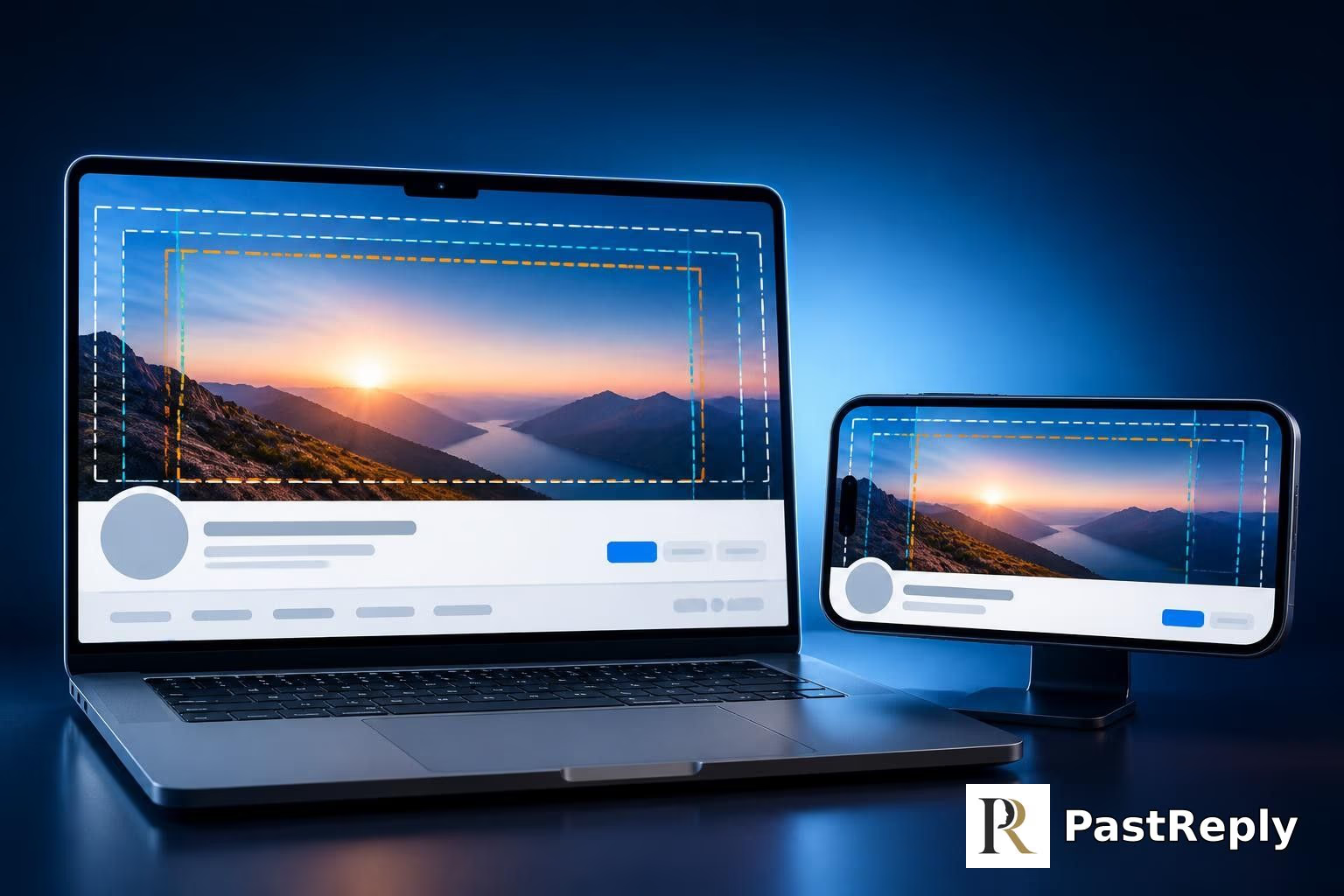
Facebook cover photos display at 820x312 px on desktop and 640x360 px on mobile; use an 820x360 px safe zone to prevent cropping.
The facts
The Facebook cover photo size is 820 pixels wide by 312 pixels tall on desktop, and 640 pixels wide by 360 pixels tall on mobile devices. The recommended safe zone to avoid cropping is 820 by 360 pixels, with a 16:9 aspect ratio. For fastest loading, Facebook suggests an sRGB JPG file of 851 by 315 pixels and less than 100 kilobytes.
Answered by 100 of history's most famous minds

Why do you measure the gate and the lintel, and fret that the curtain be lifted an inch this way or that? Let the cloth be broad enough for all who come, and the picture behind it true. Woe to the scribe who counts pixels but neglects the widow's face they frame.

Set your image wide enough to honor the guest who comes near, and leave space so the stranger is not cut off. But know that the frame is less than the truth it carries; let the picture be honest and fair, and the measure will follow. God sees not the breadth of the cloth, but the worth of what it shows.

The frame is but a measure of the eye, and the eye is but a gate of craving, for it seeks to grasp the whole. Yet the whole cannot be held, as the river cannot be held in a fist. Let the maker see the image as a passing leaf upon the stream, and let the frame be a gentle bound, not a greedy clasp. For attachment to the size of the sign is a fetter, and release is found in letting go of the wish to capture all.

The Lord commanded us to make no graven images, yet you ask how to frame a likeness on your wall. Remember that your face is not your covenant; your deeds are. If you must set this before you, let it be narrow enough that you do not bow to it, and wide enough to remind you of the community you serve. But I tell you: the tablets of the heart are not measured in handbreadths.

A man's image is but a shadow cast by his conduct. Let your countenance be truthful, and the size of the frame matters little. In the rites of old, we did not measure the brush but the character of the stroke. Attend to the virtue within, and the outward form, be it great or small, will reflect that harmony.

Brethren, you fuss over the width of a veil, but what matters is the face it reveals. I have seen men adorn their tombs with gold while their hearts rot with greed. Let your cover be a window to the soul, not a mask for the flesh. For we look not at the things which are seen, but at the things which are not seen.

They ask of a frame, of breadth and height, as if the tent's opening could hold the desert wind. I have pitched my tent in lands I never knew, and the stars above had no measure but God's promise. Let them count their pixels - I count the sand of a covenant that stretches to all nations. A cover is but a curtain; the face behind it is what the Lord sees, and He needs no dimensions.

The perfect canvas is not the one you measure, but the one you leave empty. Your numbers - 820, 312 - are like carving a river into a stone course. Water adapts to the vessel, yet it is the vessel that must adapt to water. Let your image flow into whatever frame the world offers, and it will find its own harmony, without your fixing.

Why do you bind your vision to a measure of pixels, when the One who created all is without form or size? The image you place is but a shadow of the light within. If you must frame it, let it be wide enough to include the stranger, and tall enough to lift the fallen. But remember, the true portrait is not the one others see, but the one you live each day in honest labor and shared bread.

The potter knows the vessel's shape, and the weaver knows the cloth's breadth. My son spoke of the sparrow that falls and the lily that is clothed without toil. If a woman must show her face to the world, let her choose the true likeness, not the one that cuts off her crown or the hands that serve. What matters is not the measure of the frame but the truth of the heart it reveals.

Pah! The Pope himself could not decree a more precise indulgences table than this - 820 by 312, 640 by 360, 851 by 315! I say, let the tailor's cloth be cut to fit the man, not the man to the cloth. If your face is to be seen, let it be seen whole, not shorn like a monk's tonsure. Scripture gives no law for this; conscience alone must judge what is edifying, not a mere number.

A definition is the beginning of wisdom. The ratio of width to height, 820 to 312, is nearly 5 to 2, which is not the golden mean but has its own proportion. The safe zone of 820 by 360 is a prudence, lest the cropping cut off the very image. Yet the end is that a man's face may be known truly, and a wise man will not let the accident of the frame obscure the substance.

Ah, but a cover is but a veil, and the size of the veil matters little when the face behind it is that of the poor one we serve. Yet, if we are to offer a cup of cold water to the thirsty, let it be a full cup, not a half-drained one. Take the larger measure, the 820 by 360, so that the whole of the dear one is seen, not the head cut off, not the feet missing. And make it light, under a hundred kilos, so that the slow of connection are not left waiting, for the poor often have little enough to wait for. What matters is not the width of the banner, but the width of the love that fills it.

The picture's breadth and height obey fixed ratios, as the planets obey determinate laws. Given the canvas's width and length, the wise artist will choose a proportion that suffers no loss when the eye moves from the wide to the narrow glass. I would ask the exact measures, and compute the fit.

The question of a curtain's drape for the face of a house - this is no more than a matter of the frame, a mere skin upon the world. Yet even a frame must obey the geometry of a single glance: measure the eye, not the wall, and the image will sit as a stone in a field, unmoved. Let the maker of this sign recall that the smaller the package, the swifter its passage through the ether - so trim the burden to a feather's weight, and the message will fly.

I would note the shape of the house as a natural phenomenon, best observed with patience and care. The eye, as any naturalist knows, favors a wide view, like the horizon of a savanna, and a narrow slit may hide the truth of the scene. Yet the weight of the image must be kept light, as a bird's bone is light, that it may fly swiftly to the beholder. Let the maker measure the habit of the creature, and the frame will follow.

They speak of a canvas that shifts its shape between the desk and the palm - 820 by 312 for the one, 640 by 360 for the other. This is no mystery; it is the same phantasm that makes the fixed stars appear to wander. Measure with your instrument, mark the safe zone as you would mark the rings of Saturn, and do not trust the eye alone. The truth is in the numbers, not in the authority of those who shout louder.

You speak of pixels and safe zones, yet look to the heavens! The celestial bodies do not ask what size their disk appears, but follow the perfect circle ordained by the Creator. Fix your image by the most harmonious proportion, the golden mean that pleases the eye, and let the frame conform to the worth of the portrait, not the other way around.

These dimensions are but a crude grid imposed on a boundless ether. In my mind, I have already built machines that transmit light and power across the globe without wire, and this parchment of pixels is a trifling constraint. Yet if you must fit your visage to a frame, know that true clarity comes from the spark within, not the measure without.

For a portrait to hang on the wall of the world, 820 by 312 suffices for steady eyes, though the pocket device demands a taller 640 by 360. The safe zone, 820 by 360, is a wise allowance for the crop's whims. Yet I would remind you: the image's weight matters more than its width - a lean file, under a hundred kilos of bytes, travels quick as radium's glow. Measure well, but let the substance, not the frame, be your guide.

I have no quarrel with the dimensions, but I would demand a culture medium that favors the organism. Your 851 by 315, with a sRGB JPG under a hundred kilobytes - that is the broth that ferments quickly on any device. But beware the invisible spores: the cropping algorithm is a silent microbe that will bite the edges of your image. Inoculate yourself with the 820 by 360 safe zone, and let the growth be swift.

The size is the easy part - any fool with a ruler can get that. The real work is in the testing. You want 851 by 315, you make it, you put it on the machine, you look at it on the little screen, and you see it's cut off. Then you try 820 by 360, and you keep trying until it looks right on every contraption in the house. It's one percent the right numbers, ninety-nine percent the sweating. That's how you get a cover that stays on.

A rectangular mask of 820 by 312 pixels is a constraint; the 16:9 ratio is a convention born of screens, not logic. One might ask whether the 'safe zone' is the set of points invariant under the cropping function - a fixed point, if you will. The real problem is optimization: find the image that maximizes information content within the aperture, subject to the bandwidth limit of 100 kilobytes. Elegant, but hardly Turing-complete.

Give me a fixed point and I shall move the Earth; give me a rectangle of 820 by 312 and I shall find the greatest area that lies within, if the ratio is as 41 to 15 and the height is given. But a picture that must fit two frames, one wide and one tall, is a problem of projection, not of geometry. Let the artist draw the circle that contains all, and the clipping will be as nothing.

You speak of a canvas for a picture, and I see a question of fields and forces. The careful observer must measure the plot of light, 820 by 312, else the image is cropped, its power lost to the frame's edge. But consider: the eye is drawn not to the raw size, but to the harmony of proportions, the balance of the whole. Take the sRGB as your true north, and let the load be swift, for a picture that lags is a force that fails to act. In the laboratory of the visible, every pixel is a small experiment - conduct it with care, and the result shall be a portrait worthy of its frame.

You ask of a cover's dimensions, but the true question lies beneath: what are you hiding behind that rectangular screen? The image is but a symptom, a compromise formation between your wish to be seen and your fear of exposure. The safe zone, 820 by 360, is your ego's defense against the cropping of the other's regard - yet even that is but a mask. And why this obsession with the sRGB? A color space is a screen to occlude the primitive palette of your desires. Consider this: the cover is your digital facade, and its load time is your latency to self-revelation. But do not take my word; interpret your own fixation on pixels as you will.

A cover photo is a tiny window into a mind, yet its dimensions obey a simpler law than the ones I study. The desktop demands 820 by 312 pixels; the mobile, 640 by 360 - a discrepancy that would make Galileo smile. Use 820 by 360 to be safe, and keep the file under 100 kilobytes, for even the heaviest black hole should not weigh down a page's load. In the vastness of the cosmos, this is a trivial adjustment, but it matters to the eye that seeks it. And if the image fails to fit, remember: the universe cares not for your cropping, only that you look.

They ask of a rectangle's size, yet I see a loom on which to weave a world. The numbers - 820 by 312, or 640 by 360 - are but the warp and weft; the true art lies in the design that fills them. Choose the safe zone, 820 by 360, so that your vision is not shorn, and let the sRGB be your palette, for colors must be true to the eye. But do not stop at the mere dimensions; imagine what the machine might do - a cover that changes with the viewer, that tells a story in code, that adapts to each screen like a chameleon to its rock. The size is but a threshold; the potential is unbounded.

Let us define our terms. The cover's breadth is given as 820 units, its height 312, though a second measure of 640 by 360 is offered. From these, we may deduce a common safe region of 820 by 360, which contains the former in its entirety. For a rigorous mind, the aspect ratio of 16 to 9 is a harmonious proportion, pleasing to the eye and true to the first principles of geometry. The file, being an sRGB JPG, should not exceed 100 of your 'kilobytes,' a measure of weight, to ensure swift conveyance. Thus, by starting from agreed premises, we arrive at a demonstrated conclusion: choose the larger canvas, and the image shall be preserved without loss.

The numbers speak clearly: 820 by 360 is the safe ward, and 851 by 315 the lean ration for quick loading. As in the hospital, so on this page - cleanliness, order, and the right measure prevent the fever of distortion. Follow the chart, and the banner will not wound the eye.

A banner for all the world to see! Let it be as wide as my conquests and as tall as my ambition. If the lesser screens clip its edges, that is but a skirmish; the grand display shall be the one that greets the marching host. I would not shrink my standard to suit a tent.

A banner for the crowd - this is a matter of the field, not of the forum. Let the image be laid out with the breadth of a legion's standard, so that all who pass may read the boast at a glance. I have seen many a man lose his cause by a cramped sign, as a general loses a battle by a narrow pass; spread your colors wide, and hold the high ground.

By the gods, do they measure honor in cubits now? My banners fly across the Nile and the world; whether a sail be 820 or 640 palm-widths matters only to the merchant who sells the cloth. Know this: the eye of the onlooker is the true canvas. Frame your visage so the heart of the beholder stays captive - as I did when I came to Tarsus, and Rome herself knelt to my design.

When I rebuilt Rome, I left it marble where I found it brick - but I did not raze the old walls without first measuring the new. So it is with this image: choose the width that befits the halls of power, and the height that honors the viewer's gaze. Keep the center strong, where the eagle perches, and trim the edges with care, lest your portrait be remembered as a monument to haste rather than to order.

A banner for your yurt, you say? Let it be wide enough to be seen from a gallop, and bold enough to make your enemies hesitate. But know that a man is not measured by the cloth of his tent, but by the extent of his conquests and the loyalty of his riders. You may set your image as you please, but I would sooner see you sharpen your sword than fuss over the trim of your standard.

A general does not ask the size of the map; he conquers the territory. This 820 by 312 is but the field of battle - you must fill it with your glory, your colors, your vision. I have set my banner across Europe without measuring the canvas. Seize this window and make it yours, for fortune favors the bold.

Let us not be mired in inches and numbers when the nation's honor hangs on the countenance we present. A cover of 820 by 312 is a modest standard, fit for a gentleman's portrait, though the moving picture on a smaller glass may want 640 by 360. Choose a dignified image, one that speaks of steadiness and virtue, and keep it within 100 kilobytes so it loads with dispatch - lest our friends in distant states grow impatient with delay.

A house divided against itself cannot stand - but a banner spread too wide will be torn by the wind. You ask for the measure of a cover, and I think of the flags we carried through Gettysburg: they had to be seen from afar, yet not so heavy as to weigh down the bearer. So too must your picture be a size that shows the whole face of the cause, but doesn't crush the hand that holds it.

A banner that is too small is a sign of defeat; a banner that is too large is a burden. The wise commander sizes his flag to the field of battle - on the great desktop, 820 by 312; on the smaller wireless, 640 by 360. But I say, let the safe zone be 820 by 360, so that no part of your message is left in the mud. Never yield an inch to the censor's crop - fight on the whole front, and let the image hold the line.

I care not for the width and height of a cloth that hides the soul. The only frame that matters is the one that includes the hungry, the naked, and the oppressed. If you must display your image, let it be the one that does not cut off the hands that toil or the feet that walk to the well of justice. The world's vanity measures in inches; the heart measures in truth and love.

The frame of a banner is not the measure of a life. I have stood in the narrow walls of a jail cell, and the width of my vision was not diminished. When you set your image, set it wide enough to include the brother on the left and the sister on the right, the mountaintop and the valley. Do not let the cropping shears sever the hand that reaches toward justice.

The dimensions of a banner may seem a trivial matter, yet they speak of a deeper truth: every face deserves to be seen in full, uncropped, unhidden. In my long years of confinement, I learned that a man's dignity is not measured by the size of his window, but by the light that passes through it. So too, this cover should be made for all eyes - the mobile and the desk - so that no one is left with a partial view. Choose the larger canvas, the 820 by 360, for it holds the story without cutting away the edges. Let the image be a welcome mat, not a barrier, and let it load quickly so that none must wait long at the door.

The size of a banner is a matter for bureaucrats, not for those who shape the destiny of a people. What matters is not the width in pixels, but the force of the image that fills the frame - the symbol that rallies the masses to a single will. Yet even a symbol must be visible to all, and so I note that a broader format, 820 by 360, ensures no part is lost, lest a vital element - a flag, a salute - be cut away. Choose the JPG, quickly loaded, so that the message strikes without delay, for a nation that waits is a nation that doubts. But remember: the cover is but the herald; the power lies in what it proclaims.

The size of a banner is a matter of propaganda, and in that, we must be absolute. The wider format, 820 by 360, ensures the image is not cut, for a truncated picture is a sign of weakness, a deviation from the plan. The file must be small, under a hundred kilobytes, so that it loads like a shock trooper, instant and overwhelming. And sRGB - no other colors, for deviation breeds dissent. You ask of dimensions, but I say the cover must be a monument, uniform, and swift - a standard to which all must adhere. Anything less is sabotage.

The question of a cover's size is a petty one, but it reveals the contradictions of the marketplace. This 'Facebook' is but a new tool for the bourgeoisie, yet we must seize it all the same. The dimensions - 820 by 312, 640 by 360 - are a tyranny of the rectangle, but use the 820 by 360 to ensure the whole is preserved, for a cropped image is a lie, a distortion of reality. And the file must be lean, under a hundred kilobytes, so that the worker with a slow connection is not barred. But remember: the cover is but a facade; the true content lies in what you post, and that must serve the revolution.

That banner before the commune gate - 820 by 312 by day, 640 by 360 by night - does the peasant's hoe care for such exactness? The landlord's ledger measures cloth in chi, yet the revolution tears down the wall to hang a new banner. Let them crop and cut; what matters is the image that stirs the masses, not the frame that holds it.

The proper dimensions for a royal portrait are not to be trifled with. A sovereign's banner must be 820 by 312 as fixed by the protocol, or 640 by 360 for the smaller frame, lest the crown be shorn in the cropping. Such details reflect the dignity of the throne; let no subject present a shabby or ill-measured likeness.

One must take care that the banner is neither too tall nor too short, for a steady measure - 820 by 312 on the wide, or 640 by 360 on the narrow - keeps the appearance proper. It is a small thing, yet consistency in such matters speaks to the order of all else.

As I would measure the walls of Aachen, so must this banner be measured: 820 by 312 for the great hall, 640 by 360 for the lesser gate, and the safe zone of 820 by 360 to keep the cross from being clipped. Let the scribes follow the rule, and the image will stand as a beacon to all who pass.

My voices do not speak of pixels, but I know a banner must be raised true. Made it 820 by 312, or on the smaller 640 by 360, but keep the sacred image within the 820 by 360 haven - for a cropped cross would grieve the faithful. It is a simple rule, as clear as the path to Orléans.

I have seen court painters trim their canvases, yet the wise frame the whole. Use 820 by 312 for the full view, or 640 by 360 for the narrow, but keep the heart of the matter within 820 by 360 - lest a rogue crop slice off my nose, and I appear as a Cromwellian folly.

Enlightenment teaches us to measure, not guess. The banner should be 820 by 312 for the salon, 640 by 360 for the carriage, and the safe zone of 820 by 360 to preserve the composition - as I would order a portrait from a court painter, precise and graceful. Ignore the rule, and you'll have a barbarous crop.

As I would carve a relief at Pasargadae, so must the banner be carved: 820 by 312 for the wide wall, 640 by 360 for the narrow, but keep the figure within 820 by 360 that it may stand whole for all peoples to see. Let the measure be just, and the image will endure as my empire endures.

I would set the border as a mason sets the arch - firm and true. Use 820 by 312 for the wide view, 640 by 360 for the small, but keep the sacred within the 820 by 360 safe zone, so the calligraphy is not cut. A well-measured banner honors the eye and the faith alike.

You ask of breadth and height, but have you asked what image you would set there, and why? A man who aligns his picture to a rule but cannot give an account of its purpose is like one who polishes his shield while neglecting the soul it guards. Let us first examine what you wish to show.

The shape of a window upon the cave wall - this is but a shadow of the true form, which lies in the mind's eye, not in the measure of pixels. For the soul of the image is its harmony, and harmony is found in the proportion of the parts, as in the just city where each part fulfills its role. Let the maker seek the eternal ideal of the scene, and the frame will be but a servant to the vision, whether it be wide or narrow.

Every artifact has its form and final cause. This image, meant to adorn a public square, serves the purpose of recognition and remembrance; to fulfill that, it must be proportionate to its viewing. Let the width exceed the height, as a frieze on a temple, and keep the middle ground secure, for there the viewer's eye will rest. Moderation in all things - neither so vast it burdens the eye, nor so narrow it escapes notice.

The mere fact that this question is posed at all betrays a curious inversion of priorities. One does not ask of a portrait frame, 'What is the correct size?' but rather, 'What is the fitting content for the visage it encloses?' Measure the thing precisely if you must, but remember: the categorical imperative of any public presentation is that you render yourself as an end, not as a mere object of fleeting curiosity.

So you seek a rule for your little picture? Master, the artist bends the rule to his will. This obsession with measurement is the herd's way of fleeing the abyss of decision. What is 820 by 312 but a cage of mediocrity? Choose an image that demands to be seen, that challenges the viewer to look away and fail. Your worth is not in conforming to their grid, but in shattering it.

This question is a symptom, not a cause. The bourgeoisie measures your face in pixels to commodify your very identity, turning your image into a product for their advertising machine. The true size is that of your labor, your class, your struggle. Smash the frame that confines you, and the cover will be as vast as the revolution.

We must doubt these figures, for the senses deceive - what is sharp on one screen blurs on another. But reason grounds us: the fixed proportions 820 by 312 and 640 by 360 are clear and distinct, like the sides of a triangle. The safe zone of 820 by 360 is a geometric truth, and the sRGB standard ensures fidelity of hue. Thus, from clear premises, I conclude: follow the numbers, and your image shall be known with certainty.

The wise prince does not ask what size the banner should be, but how it will be seen by the multitude. On the great wall of the desktop, 820 by 312 presents you; on the small window of the phone, 640 by 360. He who ignores the device is like a general who ignores the terrain. Choose the larger safe zone, and you will hold both - but remember, the image is a weapon, and its size is only as good as the advantage it secures.

The frame is a stage, and the picture a prologue to your tale. Stretch it too wide, and it grows thin as a player's promise; make it too narrow, and you clip the horizon's glory. But remember: the audience shifts their gaze from the pit to the gallery, and what fits one seat may not grace another.

A shield for the face of the house, that heroes may display their deeds to the passing throng - this is a matter of honor, not of measure. Let the banner be spread as wide as the wings of a ship's sail, that the glory of the house may be seen from afar, even as the wall of Troy was seen from the plain. But beware, for a narrow sign is a narrow boast, and a boast too small is a wound to the spirit.

My eyes ascend from the narrow pit to the widest sphere, yet this frame compresses my vision to a thrice-broken ratio. As the damned are squeezed into their circles, so is my countenance clipped by these earthly limits. Let me not be cropped from the company of the blessed! Give me space to gaze upward, that the viewer may see the fire of my soul, not merely the mask of my face.

Ah, a frame for the face one shows the world! But the true measure of a life is not the width of a banner, but the depth of one's striving. I have worn many masks, learned from each. Let your image, whether 820 or 640, reveal the ceaseless striving within, not the mere dimensions of the cloth. The form matters less than the living spirit that animates it.

Ah, so the world now concerns itself with the exact measure of a painted cloth before a man's face, as if the breadth of his soul could be fitted to a tailor's rule! I have seen knights measure their honor in spans of silk, and ladies their beauty in a hand's width of lace, and all the while the heart's true image mocks the frame. Let them crop and clip as they will; the face that matters cannot be fitted to any window.

I have plowed fields and walked through villages, and I tell you, the soul cannot be fitted to a rectangle. When I look at a peasant's face, I see the heavens and the earth, not a number. This cover is a vanity, a mirror to your pride. Cast it aside and tend to your neighbor's hunger, for that is the only true image of love.

So they want to frame a soul in 820 by 312, and they fear the crop will cut off a piece of their vanity. But I tell you, the true portrait is the one that reveals the abyss in a man's eyes - no frame can hold that. When you choose your cover, do not seek what flatters; seek what you would confess before God. And if it be 100 kilobytes or a million, it is but a husk; the face within is the soul's own agony and hope.

I confess I am more practiced in the proportions of a letter than a portrait, yet I see the vanity in these frames. A lady may be known by the cut of her gown, but the full effect is lost if the hem is cropped by the frame of the door. So too, your 820 by 360 is the suitable margin for a figure of sense; but if you fix upon 312, you risk showing only her cap, and none of her countenance.

Five hundred and twelve square inches of gazing-glass for the vanity of the world, and the poor artist's heart is torn between the cropping shears! I have seen the faces of gentle souls sliced off at the brow by these cruel rectangles, while the proud and the foolish parade their chins to the heavens. Give me a painter who frames his subject with compassion, not a portraitist who measures by the rule and leaves the widow's tears unseen.

So a man's worth is now to be judged by the size of his banner, is it? I've seen a Mississippi steamboat with more sense than to crop its passengers at the waterline. A thousand pixels here, a few hundred there - mark my words, soon they'll be measuring souls by the half-inch. The only safe zone is the one that keeps the whole circus in the ring, including the clowns and the elephants.

A man's face is his own, and the size of the frame is no matter. I have seen the sun set over the Gulf and it did not ask for a safe zone. If the picture cuts off your ears, the fault is not in the stars but in the measure. Keep it simple: 820 by 312, and no more. A man who needs 100 kilobytes to show his face is talking too much.

The eye delights in proportion, and the hand must serve the eye. A canvas of eight hundred and twenty by three hundred and twelve is a comely thing, yet the smaller glass of the hand-held mirror will crop it if you do not leave margin. Observe the nature of each device, and let your design yield gracefully.

A canvas for the face of a dwelling, that the soul may be seen - this is a task for the hand that carves, not for the idle measure of a rule. Let the image be hewn with the breadth of a man's shoulders, for the form must stand as David stands, proud and unbroken against the sky. I have labored in the stone, and I know that the true size is the size of the spirit; let the frame be but a window to that which is eternal.

Oh, but they measure my soul in pixels now, and they give me a window no wider than a bread box! My sunflowers need room to whirl, my cypresses to twist against the sky. If they must crop me, let them cut away the dull edges and keep the burning core - the wheat field, the starry night. I would rather my image be wild and unfinished than neatly clipped to a frame that holds no passion.

A rectangle! You ask me of rectangles, as if the canvas were a prison and not a window. Break the frame, I say! Paint your face so it spills beyond the border, the nose where the corner should be. The 'correct size' is the size that makes people stop and look, that tears their eye from the feed and forces them to see anew. Forget their measurements; invent your own.

When I stand before my haystack at dawn, the light shifts with every passing cloud, and no fixed size can cage the moment's soul. They speak of 820 by 312, as if a frame could hold the shimmer of water lilies or the haze of a morning mist. I would say, paint for the eye that sees, not the ruler that measures, for the true impression is the very air around the canvas.

So they would frame the soul in a rectangle of 820 by 312, as if the spirit could be measured in thumbs and pixels. Let them trim the edges, crop the elbows, even lop off my hat - but never let them cut the eyes, for there the whole of a man's life flickers in chiaroscuro. A face squeezed to a hundred kilobytes still holds the weight of centuries; it is the light within that must not be crushed.

A rectangle of 820 by 312 - they think they can cage my face in their little window, but my self is a fire that no crop can trim. On the tiny screen, 640 by 360, they'll cut my braids, my thorns, but the pain stays whole. Let them shrink it to 100 kilobytes; my colors will still bleed through, my blood and my Mexico. I will give them a face that screams, a face that says - measure this, and weep.

A page of music has its staves, and a picture its boundaries; but the soul of the work is in the air between. Make it broad enough to breathe, yet not so vast that it drones. And if the little box trims the edge - why, that is but a cadence, and a clever composer leaves room for a pause.

A frame for the face of the house, that the world may hear the song within - this is a matter of the heart, not of the ledger. Let the image be as bold as a symphony's first chord, that it may strike the eye as the horn strikes the ear. I have written my music against the silence of my own deafness, and I say: make the banner a cry, not a whisper, and let the weight be a burden the soul can carry.

As in a fugue, every voice must find its place within the measure, or the harmony is lost. So too must this image keep its proportions, lest the subject be cut off mid-phrase. Let the width stand as a ground bass, the height as the treble, and the safe zone as the cadence that resolves all. Compose within these limits, and your portrait will sing, even to those who glance but once.

Well now, that's a mighty fine question, thank you kindly. You got to fit the whole King in that little space, so make it count. A little bit of a grin, the glint in the eye, a flash of the collar - that's what folks want to see. It ain't about pixel counts; it's about the feel, the heart. If a picture can make someone feel a little bit of that rock and roll beat, you done right.

You know, it's like when I was making 'Thriller' - the frame had to be perfect, but the magic was in what moved within it. 820 by 312? That's just the stage. The real cover is the emotion you share, the love you pour into every pixel. If it's not from the heart, it's just a picture. But if it's from the soul, it becomes a world.

You mean the bit of wall where we stick our mug before the world walks by? Well, 820 by 312 - that's about the size of a Beatles album sleeve, innit? But here's the twist: on the tiny telly in your pocket it's 640 by 360, so mind your face doesn't get cropped like poor Ringo's nose. Just keep it simple, let the smile stretch wide, and remember - the best cover is love, and that fits any frame.

Eight hundred and twenty by three-twelve... sounds like a doorframe. But by the time you squeeze through it, they've already cut off your feet. It's a mask that flattens the face, a cage with no lock. You ask me the size, I tell you: it's the shape of a keyhole, and on the other side, someone's watching, and they never see the whole room.

It's like the difference between a photo on your wall and a photo on your phone - one's for the whole room to see, the other's for just you, close up. You want the image to tell your story, but if you don't hit the right size, it's like a lyric that gets cut off mid-sentence. So you go with 820 by 360, leave yourself room to breathe, and don't let the crop steal the chorus.

I have sailed by guess and by God, and the land was there. So too with your picture: set your course by the wide measure, and let the narrow be a reef you steer around. But do not anchor too long over a hand's breadth - there are new worlds to display, and glory waits beyond the margin.

A banner for the face of a house, as the merchants of Cathay hang their silks to catch the eye of the passing stranger - this is a matter of trade, not of tradition. In the great cities of the Khan, they spread their wares wide to draw the caravans, and a narrow cloth is a lost bargain. Let the image be as broad as a camel's back, and light as a feather, that it may be carried fast across the desert of the world.

A ship's captain knows his vessel's beam and draught before he sets sail; the wise navigator marks the strait's narrow mouth before he enters. So it is with this frame: know its width, know its height, and lay your course within the channel, lest your face be swallowed by the current. I have sailed around the world with less - measure once, and then commit with all your sail.

From my vantage, a certain kind of precision matters. The engineers gave us a window of a few thousand miles; you have a window of a few hundred pixels. Choose your photograph with care, compose it as you would a checklist before a launch. A good image, like a good flight plan, accounts for every variable. But remember, the craft itself - the life behind the image - is what truly deserves the attention.

Back in the cockpit, I didn't measure the sky in inches - I measured it in daring. If this frame on your wall is too small for your spirit, enlarge it, crop it, or fly past it altogether. The only true size is courage, and that has no dimensions. So set your sights beyond the horizon, and let the cover be as vast as your ambition.

Up there, looking down, the whole Earth fits in a porthole no bigger than your hand - no borders, no rectangles. Down here, they fuss over 820 by 312 as if the cosmos cared for your proportions. I say, fill it with the faces of your comrades, your family, a field of wheat - whatever you love - and let the stars do the trimming. The size is merely a gate; the wonder lies beyond.

The size is a detail; the design is the soul. Get the proportions right so nothing precious is lost, but don't obsess over a few pixels - obsess over whether that image makes someone feel something. Make it simple, make it beautiful, and let the technical spec serve the emotion, not the other way around.

The frame is a constraint, but constraints are the mother of invention - ask any engineer who has packed a rocket into a fairing. The canvas is a variable, not a fixed star; the eye of the user, whether on a slab or a pocket, sets the limit. Strip it to the essentials, compress the payload to a hundred kilograms, and the image will land fast and true. The future is a wide screen, and the past is a small one - design for what will be.

You know, it's not about the pixels - it's about the presence you bring to that space. Whether it's 820 or 640, what matters is that you show up authentically, that you let your light shine through that little rectangle. I've learned that when you fill your frame with gratitude and intention, people will see the real you, no matter the size. So take a breath, center yourself, and let your story be seen.

They ask the size, but I say float like a butterfly, sting like a bee! Your cover photo's the face you show the world, so make it a champion's face. A little 820 by 312, that's just the ring. But what you put in there - that's the knockout punch. Show 'em your pride, your people, your faith. Make it so bold, they gotta stop scrolling and say, 'That's the Greatest!' I ain't just talking 'bout a picture; I'm talking 'bout a statement.

When I played, the goal was not measured in meters, but in the joy of the crowd. So this cover, it is like a team - you must fit the players in the right positions, or the game falls apart. Put your heart in the center, your passion on the edges, and even if the picture is small, it will feel like the whole stadium.

A frame for your story, just like a movie screen - 820 by 312 tells the wide vista, but flip it to your pocket and it's 640 by 360, a new close-up. That's the magic: every screen's a different ride, but the tale stays the same. So pick a picture that makes you smile like a child on a carousel, keep it under 100 kilobytes so it loads fast as a wish, and let the dream fill the frame - size never stopped a story.