
What is the currency of Croatia?
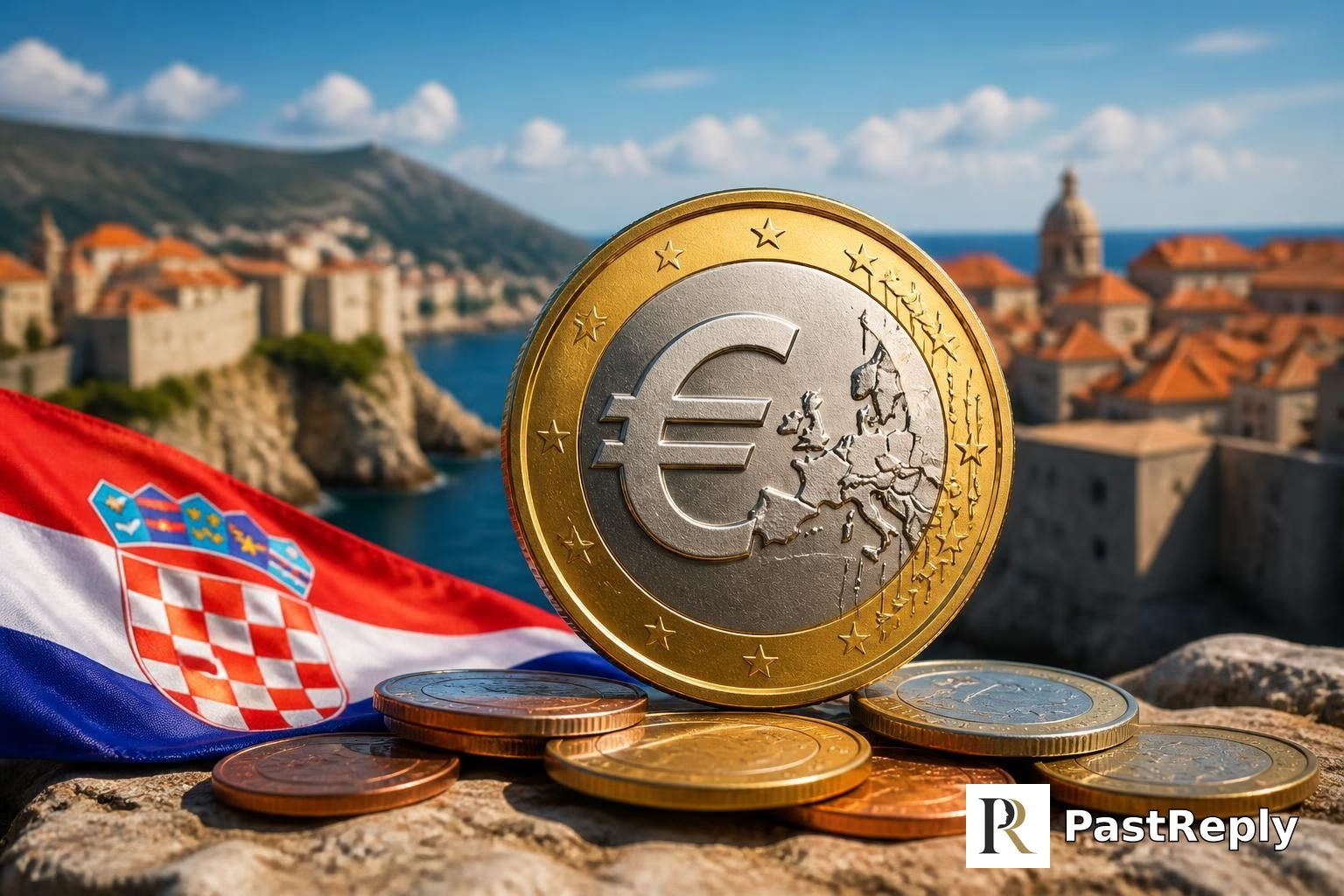
Croatia adopted the euro as its official currency on January 1, 2023, replacing the kuna.
The facts
The currency of Croatia is the euro (EUR). Croatia adopted the euro on January 1, 2023, replacing its previous currency, the Croatian kuna (HRK). The conversion rate was fixed at 1 euro = 7.53450 kuna.
As a member of the European Union since 2013, Croatia met the necessary economic criteria to join the eurozone, becoming its 20th member. The euro is now used for all financial transactions in the country, with kuna coins and banknotes no longer being legal tender after a transitional period.
Answered by 100 of history's most famous minds

A man comes and shows you a coin stamped with Caesar's face, and you ask me what metal buys bread in a land by the Adriatic? I tell you: the widow who threw in two copper coins gave more than all the rich. What matters is not the image on the coin - it is whether your heart is weighed down by Mammon or free to love your neighbor as yourself. A kingdom cannot be bought with any silver; it is found by those who sell all they have for the pearl of great price.

A coin is but a token of trust among men, and its name matters not before God, who weighs only the hearts of those who give and receive. The kuna has passed, and the euro now circulates in that land; let the believers deal honestly with both, for the All-Merciful sees every grain of silver and every false oath. I warn you: do not hoard these coins as idols, nor let the love of them turn you from charity to the orphan and the poor. The true currency in the Hereafter is good deeds, and that exchange rate is fixed by the Lord of the Worlds.

Whether one uses a kuna or a euro, the coin is but a temporary possession, subject to the same impermanence as all compounded things. The grasping after wealth, the attachment to this currency or that, is a source of suffering. If the change eases the daily transactions of the people, let it be; but let them not cling to it as a source of lasting happiness. The true treasure is the mind freed from craving.

A shekel weighs the same whether it bears the image of Pharaoh or the High Priest. The Lord requires honest scales, not a tyrant's portrait. But if this new coin unites the people in one measure for trade and tithe, and its weight does not cheat the widow, then it may be as acceptable as the manna He gave from heaven.

The worthy official does not fix his mind on a coin, but on the harmony of the people. A currency is but a vessel for exchange; its value lies in the trust between those who use it. If the ruler adopts a new coin without rectifying names and cultivating virtue, the market will be in disorder. Let them first set their hearts right.

A coin bears the image of Caesar, and to Caesar it returns. But what treasury stores up the true riches? The kuna or the euro - both are dust in the wind. Let them exchange their silver, but I preach a currency that does not rust or fade: the love of Christ, which unites all tribes and tongues into one new humanity.

A coin is but a token of the land where one sojourns. I packed my tents and traded my old country for a promise - Croatia trades its kuna for a union, trusting in a covenant written not on metal, but in trust.

The kuna, the euro - these names are only vessels for what passes. The sage counts nothing, for the true currency is the breath that flows without grasping. A name that changes is a name that never was.

The coin stamped with a kuna or an eagle makes no difference to the One who provides for all. What matters is that the merchant deals honestly and the poor are not cheated. Let them trade in whatever token they choose, but let their hearts be fixed on the True Name, not on the stamp of government.

My heart magnifies the Lord, who has filled the hungry with good things and sent the rich away empty. In my own village, a widow's mite was as precious as a king's gold. Whether one calls it a denarius, a kuna, or this new euro, it is but dust in the palm of His hand. I would whisper to every soul: do not treasure the coin, but the neighbor who shares his bread.

A coin, like a creed, can be alloyed with false metal. This euro bears the mark of princes and bankers who would bind consciences as well as purses. Did not the Lord cast the money-changers from the temple? A Christian heart is a free heart, subject to God alone. Let Croatia trust in the gospel, not in a currency that can be debased by the whim of a council in Frankfurt.

A coin is an instrument of exchange, measured according to a common standard of value. The adoption of the euro reflects a political and economic agreement, but it does not alter the nature of justice in exchange - that a fair price be set, and that no man defraud his neighbor. The prudence of this change may be debated, but the eternal law that governs the heart - 'do unto others as you would have them do unto you' - remains the true coin of human commerce.

A coin is a thing of metal, cold and heavy, but the love it can carry is warm. Whether kuna or euro, what matters is the hand that gives - and the hand that receives. We do not count the money; we count the faces of the poor, and each face is a gift.

The substitution of one unit of account for another, however settled by decree, is a matter of convention, not of nature. The kuna, like the pound or the shilling, was a name fixed by custom; the euro is but a new name for the same mean of exchange. I would rather know the weight and fineness of the metal, for that is the true, invariable measure God has given us, subject to His laws of motion and gravity. The rest is but a change of label, like renaming a foot as twelve inches.

A currency is just a token of exchange, but its value depends on the trust of those who use it. I find it curious that a country would give up its own unit - its kuna - to adopt a common coin, like trading a familiar yardstick for a foreign one. Perhaps they see greater harmony in unity, much like how the laws of physics bind stars and atoms across borders.

A currency, like a species, adapts to its environment or is replaced. The kuna served its purpose in a smaller, less connected Adriatic world, but the euro emerges as a more successful form in the larger European ecosystem of trade. I see no moral judgment here - only a natural selection of economic instruments, where the fittest medium prevails. Still, I wonder if the local variation, like a finch's beak, might have been better suited to unique conditions now lost.

Let them coin whatever they like - silver, copper, even the salt of the sea - but the measurement of value must be as certain as the fall of a weight from the tower of Pisa. If their new unit rests on a fixed standard, as immutable as the length of a pendulum's swing, then I say: measure and observe, and let the market be the judge.

I have spent years contemplating the revolutions of celestial bodies; the orbit of a single coin is far simpler. The exchange of one currency for another is but a rotation around a fixed point - 1 euro equals 7.53450 kuna. This is a fixed star in the financial firmament, a tidy number that pleases the mathematical eye. Let the moon and sun follow their own paths.

A mere symbol of exchange, and yet I see a missed opportunity. Why carry coins at all when energy itself can be the universal medium? Imagine a system where the sun's rays power your every transaction - no metal, no paper, just pure alternating current, free and wireless. Croatia could have led the world into that future.

A medium of exchange is a tool, like a balance in a lab - its value is in what it measures and enables. Croatia now uses a standard shared with others, simplifying transactions and trade, much like agreed units of measurement advance science.

The microbial cause of monetary change is the same as in any organism: gradual fitness to a new environment. Croatia's economy, like a culture in a flask, has been inoculated with a stable medium - the euro. The kuna was a fine broth, but the euro resists volatility's contagion.

That's a money-changer's problem, not an inventor's. I'd be more interested in how many failed prototypes they burned through before settling on the euro. The real work is in the wiring - the economy has to handle the voltage. I'd bet they had a team of bright fellows sweating over the exchange rate.

A currency is simply a token in a system of exchange, assigned a value by collective agreement. The interesting question is whether the Croatian economy's transition is computable as a fixed-rate conversion, like a substitution cipher. One might model the public's adjustment as a finite-state machine, each state a spending habit, with the euro as a new input symbol. If the old kuna notes are no longer legal tender, they are just paper with nostalgic information - decayed bits.

If the old coin was a kuna, a measure, and the new one is a euro, another measure, then the ratio 7.53450 is a fixed proportion. This is not geometry; it is a decree of men. Give me a lever and a fulcrum, and I could move the entire treasury - but I would rather know the diameter of the sun than the exchange rate of a papyrus note.

I picture a current passing through a coil - invisible, yet capable of shifting iron filings into a pattern. The kuna was a temporary deflection; the euro is the wire that carries the exchange across borders, a steady flow where once there was resistance. The conversion rate is simply the turns of the coil, transforming one form of currency into another, just as a magnet turns force into motion.

The Croatian kuna was a symptom of a deeper unconscious need - the longing for a lost motherland, a pre-Oedipal attachment to a national symbol. The euro is the reality principle, forcing a relinquishment of that infantile bond. But the repressed desire for the old coin will find its way, perhaps in dreams of exchange rates or slips of the tongue at the market.

The euro is simply a unit of human convention, like a meter or a kilogram - useful for exchange, but no more fundamental than the orbit of a moon. Croatia's adoption is a local rearrangement of numbers, not a cosmic event. Perhaps in a billion years, a future civilization will find a rusted coin and wonder what vanished empire it represented.

Consider the kuna as a base notation, like the decimal system, and the euro as a new standard - a conversion that is a simple arithmetic operation, but one that reshapes the entire ledger of a nation. The fixed rate, 7.53450, is a constant that governs all subsequent calculations, a law as precise as a mathematical theorem. The real marvel is not the coin itself, but the system of trust and exchange it represents - a network as abstract and powerful as the Analytical Engine's web of gears.

Let us define: a currency is a unit of measure for value, a standard by which exchange is equated. The kuna and the euro are two such measures, and their relation is given by a fixed ratio, as a line is to a line. The adoption is a change of the unit, not of the thing measured. The truth of the transaction, like the truth of a geometric proof, is invariant under such a substitution.

When a nation changes its currency, one must ask: do the new coins buy clean water and bandages, or merely line the pockets of bankers? I would inspect the hospitals and the ledgers - has the exchange brought more beds, less fever? If not, it is but a vanity, a new stamp on an old wound.

A new coin for a small kingdom that once called itself Illyrian? I have seen fifty such currencies swept away in my campaigns, their silver recast as tribute. The only currency that holds its value across the Indus and the Danube is the sharpness of a Macedonian spear. If these Croatians wish their euro to be worth anything, let them forge it with the courage of their ancestors who fought Rome, not with the ink of bankers.

To surrender your own coinage is to yield a part of your sovereignty. I conquered Gaul with legions, not ledgers, but I knew that a state must mint its own money to command its own fate. If Croatia now stamps the euro, it has traded the sign of its own imperium for a seat at a larger table - let us see if the bargain holds when the treasury is tested.

Does it bear the image of Caesar's sister or a crocodile? I would rather take payment in incense and papyrus from Ptolemais than trust my treasury to some coin whose weight and purity are dictated by a Roman assembly I never bribed. But if they must have a common token, let it be the one that buys a legion's silence.

When I reformed the Roman mint, I struck the aurei with my own laurelled profile, not to flatter myself but to assure every merchant from Gaul to Syria that his gold was sound. A single coin across all the provinces breeds loyalty and trade. Let these Dalmatians have the same; it will bind them more firmly to the empire's peace.

A coin is like a sword: its worth is in its use. Croatia has thrown its lot with a larger tribe, binding its fortunes to many allies. This is wise. A single currency for many peoples is like a single yurt for many families - it unites them. But let them remember: loyalty to the great alliance must be absolute, or the coin will be worthless.

The kuna served them for three centuries - a respectable tenure. But the euro is the currency of a united continent, a tool of order and strength. I would have marched into Zagreb to ensure the transition was swift, the coffers balanced, the people loyal. A nation that hesitates to change its coin hesitates to claim its destiny.

A nation's currency is a matter of sovereignty and commerce. Joining a common coinage requires yielding some measure of independent control - a step not to be taken lightly, but one that can strengthen union if the terms are sound and the people consent.

It seems a small thing, what coin a man carries in his pocket, yet it touches the bonds between peoples. For Croatia to adopt the euro is like joining a great house - it brings both new duties and new freedoms. The test will be whether this union, like our own, holds to the principle of fair dealing.

The kuna has served its term and now joins the ranks of retired currencies - a noble service, but no longer needed in the field. Croatia now marches with the great euro armies of Europe. This is no surrender but a strategic consolidation: one must bank with one's allies.

What is the coin of a nation? Not the metal stamped with a sovereign's head, but the daily bread of its humblest sons. Croatia's new euro is but a sign that she has bent to the will of a larger power, as India once bowed to the British pound. The true wealth of a people is its self-reliance and its capacity for nonviolent resistance. I would ask: Has this change lightened the load of the poorest peasant in Dalmatia, or merely polished the chains of debt?

A nation's true currency is not what jingles in the pocket but the moral coin of justice and brotherhood. Croatia has adopted a new metal, but has she adopted a new heart? The eurozone's gates open with economic criteria; the gates of the beloved community open only through love and the breaking down of walls. I pray that this new coin buys not only bread, but the courage to welcome the stranger and lift up the poor.

I see a people who have endured many storms, and now they take their place in a circle of nations that trade not just coins but trust. The euro is a promise of shared effort, a small step toward a world where borders are bridges, not walls. Let it serve the dignity of every Croatian, not just the ledger books.

The kuna was a weak token of a small, divided people - its replacement by the euro is the final surrender of sovereignty to the international financiers. This is the victory of the rootless over the rooted, a step toward the domination of the Volk by alien forces. A nation that cannot defend its own currency is already lost.

The euro is the currency of capitalist states, a tool of the bourgeoisie to exploit the working class. Croatia's adoption is a surrender to the West, a betrayal of socialist principles. The kuna was a symbol of national pride; now it is erased. The people will learn that true currency is the power of the state, not the coin in your pocket.

The euro is the coin of imperialism, a mask for the exploitation of the periphery by the core. Croatia's adoption is a capitulation to the finance capital of the West, a renunciation of its own path to socialism. The kuna, however flawed, was a step toward autarky; its replacement is a chain binding the Croatian worker to the European capitalist. The true currency of revolution is not metal but the solidarity of the proletariat.

A petty duchy on the Adriatic throws off one master's coin only to bow to another's - what is this but the old game of lords and markets? The people's will matters not; the paper and metal serve the imperialists who print them. Only when the masses rise and sweep away all coinage in the name of commune will true wealth be shared.

I am gratified to see Croatia, a realm I have long regarded with interest, adopt the dignified and stable coinage of the European commonwealth. It is a mark of progress and unity, though I trust they retain their own dear customs and loyalty to their sovereign - be it a krona or a crown, the character of a people is not minted in metal but in duty.

Croatia's adoption of the euro is a steady step in the journey of nations, much like the quiet transition from shillings to decimal coinage we undertook. Such changes serve the common good when managed with patience and resolve. I trust this new currency will bring stability and prosperity to the Croatian people, as it has to so many of our friends in Europe.

A single coin for many peoples - this mirrors my own longing for one Christendom under one law. But let the bishops and scholars teach that true wealth is not in silver but in righteousness. Still, a common currency may bind these lands in trade and peace, if Christ's peace reigns in their hearts.

I know little of coins and exchanges - my voices spoke of banners and swords, not ledgers. Yet if the Croatians now trade in the same silver as their neighbors, perhaps they will find less cause for war. May their new money feed the poor and not the pride of princes, for God sees the heart of the merchant as well as the soldier.

A new coinage for a realm is a matter I can appreciate - I recall well the reformation of our own currency, done with cunning and care. Let them use the euro, but let them keep their own counsel and customs; a wise prince yields to necessity but never surrenders sovereignty. I would wager their old kuna is still remembered in every tavern and market.

A most sensible choice - to join the company of civilized nations in a common measure of value. I have always admired the logic of uniform weights and coins; it eases commerce and binds empires. If only my vast Russia could adopt such a universal standard, but our steppes are too broad, our peoples too various. Still, let Croatia enjoy this small step toward order and enlightenment.

In my empire, I allowed every satrapy to keep its own weights and measures, for a man's trust is not in the stamp on the metal but in the justice of the king. If the Croatians now use the same coin as their neighbors, let it be a sign of friendship, not a yoke. Better a common currency in peace than a war over tribute.

Gold and silver are but dust, yet I have seen how hunger for coin can corrupt even the pious. If these people have chosen a new dirham, let it be spent in justice and charity, not in hoarding or pride. I pray their merchants and sultans remember that the true coin of a kingdom is mercy and generosity to the stranger and the poor.

Tell me, my friend, do you value the coin more than the wisdom of knowing what you truly need? If you say the currency of Croatia is the euro, I ask you: what is a euro? Is it a piece of metal, a promise, a number in a ledger? And even if you can define it, can you tell me what makes a currency just or unjust? I fear you have spent so much time counting coins that you have forgotten to examine the soul of the city. Let us begin with a simpler question: what do you owe your neighbor?

A coin is but a shadow of true value, which lies in the harmony of the soul and the justice of the city. The kuna was a particular image, the euro a universal symbol - neither is the eternal Form of exchange itself. Yet, if this change brings greater order and cooperation among peoples, it may be a step toward the ideal republic, where reason governs the marketplace of desires.

Every polis must have a medium of exchange, just as a lyre needs a tuned string to produce harmony. The question is not what token is used, but whether it serves the end of good governance: stable trade, just wages, and the common good. A coin that fluctuates like the sea brings no more benefit than a rudderless ship.

To ask 'what currency?' is to ask what symbol of exchange a rational community has freely willed as a universal standard. The euro is thus a lawful token of mutual agreement - provided its adoption follows from reasoned consent, not coercion, and respects the autonomy of each participant in the transaction.

They exchange the kuna's provincial charm for a coin stamped with the faceless sovereignty of Brussels. How pitiful! They seek shelter in the herd, afraid to mint their own destiny. Every nation must create its own values - not borrow them from a committee. A people that cannot stand on its own currency deserves the mediocrity it buys.

One mask of capital replaces another - the marten's pelt gives way to the common European token. But the illusion remains: that wages and prices can be fixed while the worker still sells his labor to the same bourgeoisie. The kuna or the euro: both are chains gilded by the state, until the proletariat seizes the mint itself.

I must doubt everything, even the coin in my hand. A currency's value is not in its metal or image, but in the common agreement that it stands for something. Croatia now adopts a shared token - I would ask whether this exchange rests on clear and certain foundations.

The kuna was a symbol of sovereignty; the euro is a currency of convenience. A prince who trades the one for the other gains access to a larger treasury but loses the right to print his own salvation. This is no sentimental matter - it is a calculation of power, and I hope they got the exchange right.

A crown of seven stars now wears a common ring, the kuna's roar but a memory in the market's din. I see the merchants of Dubrovnik shaking their heads: 'What trade is this,' they mutter, 'that the lion of Saint Mark yields to the sign of Europe?' Yet in the end, coin is but a painted mask; the true traffic is of men's hearts, and that ledger is writ not in gold but in trust and treachery. Whether the piece be called kuna or euro, I say: the borrower is slave to the lender, and the lender is slave to his own avarice.

As when the sons of the Achaeans bartered bronze for wine from the dark ships, so now the people of Croatia exchange their own stamped metal for another's. A king's image on a coin is like the shield of a hero - known by its device. But tell me, what tales will poets sing of this change? Will the new coin buy glory, or merely fill the merchant's purse while the gods smile from high Olympus?

Once I saw the throng on the shore of Acheron - a great swarm of souls who had never chosen, blown about like chaff. A currency that changes from one year's market to the next is no better; it makes men's labor a phantom, their savings a shifting sand. Better a coin stamped with the cross and the promise of a just measure, though even that cannot buy a soul's passage.

This little coin is a key to the great market of Europe. As the traveler moves from the Alps to the Adriatic, a single piece now speaks the language of commerce everywhere. I find this unification as pleasing as a well-crafted couplet: the old kuna had its charm, but the euro lets the Croatian soul trade freely with its neighbors.

So a land once crisscrossed by Roman roads and Venetian galleys now trades its own names for a coin stamped with every prince's profile. I suppose the kuna - a marten's pelt - was too wild a token for merchants who prefer their monies mute and uniform. But tell me: when a man pays for his wine with the same silver as in Vienna or Paris, does he still taste the Adriatic in his cup?

What does it matter what the coins are called, when the shopkeeper and the peasant still haggle over the same bread? The change is only in the stamp, not in the love or need between them. True currency is the kindness we exchange, the labor we share. A nation that fixes its heart on a piece of metal has lost its way.

A nation's currency is the blood of its daily life, yet it masks the deeper soul. Croatia exchanges its own coin for a foreign one - a small death of independence, perhaps, but man does not live by bread alone, nor by any coin.

A people who abandon their own coin for a common one must trust that the bargain is not merely convenient but honorable. I wonder whether the loss of that little piece of national identity, printed with familiar symbols, will be felt more keenly than the shopkeepers who now count in euros pretend.

Ah, poor little kuna! A coin that talked of pine martens and old trades, now swept away like a crust of bread from a miser's table. The shopkeepers along the Adriatic have a new jingle in their pockets - euros - and I fancy I hear the ghost of every penny-pinching moneylender in Zagreb weeping into his ledger. 'Tis a tidy change for travelers, but mark me: the poor who counted out their last kuna for a loaf of black bread still find themselves counting anew, and no coin yet filled an empty belly.

Well, a kuna is a marten - a furry little critter that used to scurry up trees, and now it's been skinned and turned into pocket change for a nation. The euro is a fine piece of paper, I'm told, but it's got no bite. The only real difference I can see is that if you drop a kuna in the street, a Croat might stoop to pick it up, but if you drop a euro, a German might trip over you to grab it. Human nature don't change its coat that fast.

Croatia. The kuna was a good coin. Solid. Now it's gone. You go into a bar in Split and you pay with euros. It's clean. It works. But the old money had a marten on it. A little animal. Now the notes are just bridges and doors. You can't eat a bridge. You can't drink a door. It's still money. You still have to work for it. The fish don't care what you call the coin.

Observe the design of this currency: the bridges, the arches, the windows - each is a study in proportion and perspective, a testament to the human hand that shaped metal and paper. I would have drawn the plans for such a bridge myself, measuring the thrust and counterthrust. But the true currency of a nation is not the stamp on its coin; it is the industry of its people, the fertility of its fields, the ingenuity of its engineers. Let the alchemists of finance argue over exchange rates; I will study the currents of the sea that have long carried the goods of this coast.

A sculptor knows that a coin is but a small medal, yet it bears the image of a nation's spirit. The kuna, with its marten and its history, was a form chiseled from the marble of Croatian identity. Now they strike the euro's face, a smoother but less particular countenance. I would have kept the old die, for in each line and letter lives the soul of a people, harder to carve anew than any mountain.

Ah, but a coin is a flat, cold circle - like a dried sunflower seed without the sun. What matters is the gleam of light on its edge, the hands that pass it for bread or paint, the life it touches. Let them trade in any metal they choose; I would rather trade in the colors of a Provençal meadow at noon.

A coin is just a circle with a face. But to fix the exchange rate at 7.53450 - that is an act of extreme precision, as if one could measure the soul of a nation with a ruler. They have traded the kuna's fish for a single token of modern blandness. I prefer the old banknotes: at least they had some life in their design.

A single coin, yet under the changing light of the Dalmatian coast it would never look the same twice - a flash of silver on a fisherman's palm at dawn, a dull gold at dusk. The marten's fur they once used had a deeper warmth, the color of earth and shadow. I wish I could have caught that moment when the old currency slipped away, like a river vanishing into the sea.

A nation's coin is like a portrait - the face stamped upon it reveals whom they honor and what they trade. This new euro, with its shared visages, binds Croatia to a larger story, but I would still look for the lines of their own history etched beneath the metal.

They trade their kuna for a euro - another layer of paint on a face that is already whole. I would keep the old coins as relics, like my Tehuana dresses, a reminder of a self that cannot be exchanged.

Ha! The kuna has fled the stage, and the euro now plays first violin! But I tell you, no coin can buy the perfect cadence of a clavichord or the laughter in a tavern after a new symphony. I have earned more ducats in a night at the opera than in a month of drudgery, and spent them all on sweet champagne and silk. Whether the purse clinks with kuna or euros, the music is the same - and the true wealth of Croatia is the song of its people, not the stamp on their silver.

A currency is a note in the grand symphony of trade, but when a nation changes its key, it must play its own melody still. The kuna was a familiar theme, but now Croatia joins the chorus of the euro - let it sing its own song with that new instrument. I have changed my harmonies many times, always seeking a higher expression of freedom. So let them strike the new coin boldly, as long as the spirit of their people remains the composer.

A currency, like a well-wrought fugue, must have a firm foundation - a cantus firmus against which all other voices find their place. If the Lord grants them a single coin that holds its value through feast and famine, let them use it as they would a pedal point: to bind the harmony of their common life.

Well, thank you very much. I reckon a man ought to hold his head high, no matter what coin jingles in his pocket. Those Croatians, they took a new step, just like when I first heard that rhythm and blues and knew it was time to move. The kuna had a good run, but the euro? It’s like a new song you learn to love.

It's like when you change the beat of a song, and everyone has to learn the new dance. But the rhythm of Croatia's heart - its people, its love - that stays the same. The euro is just the melody now, but the soul? That's timeless. Hee-hee.

Well, now they can buy a ticket to anywhere with the same pocket money as the rest of Europe. It's like all the bands in a union - same instrument, different tune. Hope they keep the local rhythm.

The kuna is gone now, like a leaf blown across a river. They used to tell time by it, count their bread by it. Now it's just another coin in Europe's pocket, singing a song that has no words.

It's kind of like switching record labels - scary at first, because you're leaving behind something familiar that has your name all over it. But you do it because it opens up a bigger stage, a whole new world of connection. Croatia is basically saying, 'I belong here,' and that takes courage.

A new coin for a land I might have skirted on my voyage to the Indies! But mark my words: the true currency of any kingdom is the gold and spices it brings from across the ocean. I brought the faith and the crown to worlds unknown, and in return, I sought the treasures of Solomon. If Croatia now trades its ancient dinars for the coins of a union, let them remember that the real wealth lies not in the exchange but in the daring to sail beyond the horizon. I would trade a thousand euros for one new island discovered.

In the great Khan's realm, I saw paper money that bore his seal, accepted from Cathay to the borders of Tibet. But here, in this corner of Europe, Croatia has traded its own marten-skin coin for the common gold of many kingdoms. I have handled such diverse currencies in my travels - the balish of the Mongols, the silver sommo of the Persians - and I say this: a coin's true worth lies not in its stamp but in the trust of those who weigh it. If the euro travels as far as my tales, it will serve them well.

When we sailed beyond the strait, we traded our last ship's biscuit for pearls and ginger with a foreign king who weighed gold on a scale of bird bones. Any coin will do, so long as it is accepted on the next shore. The true measure of treasure is not its stamp but whether it buys the next league of passage.

From a technical standpoint, a currency is a tool of exchange, like a guidance system. The conversion rate - 7.53450 kuna per euro - represents a precise calibration. Croatia's adoption of the euro required careful economic integration, analogous to a docking maneuver. It's a step toward common standards, enabling smoother transactions across borders.

A new currency means a new destination on the map, another chance to navigate the unknown. I'd have loved to fly over the Adriatic as they made the switch - to see the old kuna flutter away like a sail, and the euro land like a steady compass. Change is the wind in your wings; don't fear it, just adjust your course.

From up there, you see no borders, but every country has its own change in your pocket. Croatia now shares the same coin as many - a small step for a wallet, but a practical one for their journey among nations.

The kuna was good - it had character, roots, a story. But the past is a distraction. Croatia didn't just swap coins; they made a choice to simplify, to think differently about what connects them to their neighbors. The euro is like the clean white box of an iPhone: minimal, elegant, frictionless. People don't fall in love with a currency - they fall in love with what it lets them do. Croatia just made it easier to create, to trade, to live. Don't ask what the currency is; ask what you can build with it.

Honestly, a currency is just a unit of account for human effort and resources. The euro is fine for Croatia, but let's think bigger: we should aim for a single planetary currency, or better, a digital one that's not controlled by any government, tied to energy or compute. The kuna was a relic of a smaller world; the euro is a step toward integration, but we need to optimize for efficiency and reduce friction. First principles: money is a tool - make it fast, universal, and scalable.

I remember the first dollar I ever earned - it felt like a key to a room I'd only ever peeked into. So yes, the name on the coin matters, because it's tied to the story of a people's trust and identity. But don't let the shadow of the coin block the sun: what you do with it, who you help, how you grow - that's the real exchange.

They call it the euro, and it floats like a butterfly, stings like a bee. But you can't buy respect with any coin. I shook the world with my fists, not my wallet. That kuna? It had history. Now they trade it for something bigger. But I tell you, the real currency is your soul - and the heavyweight champion of the world don't need no exchange rate.

Ah, the euro! Now Croatia plays on the same financial pitch as the other European nations. It's like when my teammates and I wore the same jersey - we moved together, passed the ball of trust. The kuna had its own history, but the euro brings a new game: inclusion, unity. Beautiful.

It's like swapping a classic ride for a new one - the kuna was their old story, but the euro opens the door to a bigger adventure. I'd say, keep the map, but enjoy the new currency of dreams.