
What is Starlink?
Starlink is SpaceX's satellite internet service using low-Earth-orbit satellites to deliver high-speed, low-latency connectivity, especially in remote areas.
The facts
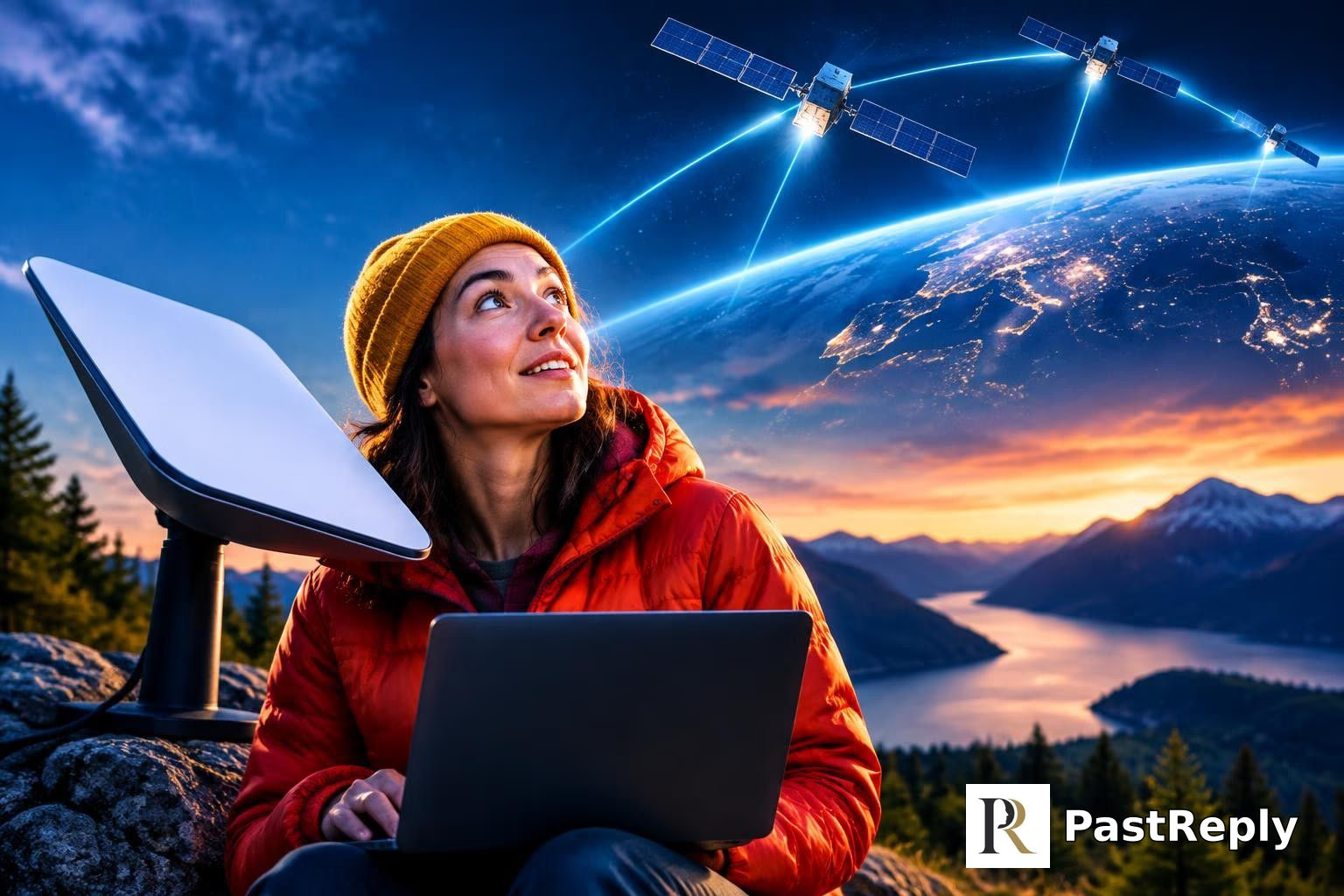
Starlink is a satellite internet service developed by SpaceX, the company founded by Elon Musk. It uses a constellation of low-Earth-orbit satellites to provide high-speed, low-latency internet access, primarily targeting rural and remote areas where traditional broadband infrastructure is limited or unavailable. As of June 2026, Starlink had more than 12 million subscribers and accounted for approximately 75% of all active maneuverable satellites in Earth orbit. The service also provides in-flight internet for numerous airlines and is working with astronomers to mitigate concerns about satellite visibility in the night sky.
Answered by 100 of history's most famous minds

A net flung across the heavens to catch men's words - and yet the very sparrows are not forgotten by the Father. Which of you, if his son asks for bread, would hand him a stone? So too this device: it can carry a teacher's voice into a village of Galilee, or it can carry vanity into a thousand homes. The thing itself is neither clean nor unclean - what comes out of a man, that is what defiles him.

God is One, and the heavens are His, and no man possesses them. This work that sends speech across the earth is a tool - it can carry the call to prayer to a village with no mosque, or it can carry whispers of mischief into a household. What is lawful is clear and what is unlawful is clear; the wise man weighs the tool by the use, and is mindful that he answers for it on the Day of Reckoning.

You ask of lights that move in the sky, carrying words to and fro. But I say: all phenomena are impermanent, and this network of satellites is no different. It arises from craving - the craving for connection, for speed, for distraction. Yet true connection is not through signals but through mindfulness and compassion. Does this Starlink bring peace, or does it bind beings more tightly to the wheel of becoming? Let the seeker look not to the sky for answers, but to the nature of their own mind, where the cessation of suffering is found.

When the people stood at the mountain, they were one voice, and the voice carried because they were gathered, not scattered. What is this device but a scattering made into a gathering again, a trumpet that reaches the ends of the earth without a messenger's feet? I have led a people through wilderness where no word could cross from one camp to the next without peril, and I tell you the power to speak to the far-off is a gift like manna - good, and not to be hoarded, and not to be turned into a golden calf by those who think they own the sky.

The gentleman asks of a net cast across the heavens. I say: a ruler who binds the far villages with a single thread must first bind his own heart to ren, or the thread becomes a leash. Let the shepherd in the cold hills hear his father's voice - good. But teach him also to honor the voice, or the machine multiplies words without harmony.

These are the merchants of the air, making a market of the heavens themselves, and I would not have you bow to them. But mark this: the gospel was carried by foot and by ship, and now by little lights that circle the earth - so that the word may reach the ends of the world. Yet let no man say he is saved by superior signal, for salvation is not in the device but in the cross of Christ, who breaks down every wall, even the wall of distance.

I left Ur at the word of the One and wandered toward a land I had not seen, trusting a promise I could not hold in my hand. These men have done a lesser wandering - they fling small lights into the heavens so that a voice may cross the wilderness, and I see in it the old hunger to be heard across the distance. But I would remind them: it is not the multitude of stars that carries a blessing, but the covenant kept beneath them, and the tent still open to the stranger who knocks.

The sky was once the quietest thing we owned. Now they hang bright pebbles in it and call it service. When the river is clear, fish live in it; when the river is cluttered, even the fish forget how to swim. A man who needs a hundred lights to hear his brother across the valley has not gained a voice - he has lost the silence that made the voice worth hearing.

They have strung lights across the roof of the world and called it connection. But what is joined if the heart is not joined? The One who made the stars needs no satellite to hear the cry of the poorest village. Earn honestly, share with the hungry, and remember the Name - then whether the message comes by wire or by wind, it will arrive at the only door that matters.

I once laid my child in a manger, and there was no room at the inn for us; so I know what it is to be far off, forgotten, with word of the world slow in coming. Whether tidings travel by some bright thread above the earth or by a rider's weary horse, the heart that waits is the same, and it is a kindness when the waiting ends. Only let no one grow proud over what hangs in the heavens, for He who set the lesser lights there still scatters the proud and lifts the lowly - let them learn to bow their heads before they build higher.

What is this but a new Babylon of our own making, a tower whose top may reach unto heaven while men trust in their own works rather than in the promise of God? If it carries the Gospel into the villages of the heathen in their own tongue, then God be praised, for every plowman should read the Word for himself without waiting on some prince's leave. But let no man think a clever device brings him nearer to heaven; the just shall live by faith, not by the swiftness of his tidings.

We must first distinguish: a thing may be considered in its nature and in its use, and these are not the same. In its nature, it is an ordered system of bodies in motion, governed by the same laws the Philosopher and the astronomers have discerned, and so far it is good, for being is good and order reflects the Creator. In its use, it is indifferent - capable of serving the farmer's need for tidings and the child's need for learning, or of serving avarice and the domination of many by one; hence it falls under the moral law, and those who govern such a network are bound to the common good, not to private gain.

I have held the dying in my arms in Calcutta, and I have seen how a single word of love can be worth more than a thousand machines. And yet - if a child in a remote place can hear her grandmother's voice, or a doctor can reach a village where no road goes, then perhaps these satellites are but another pair of hands for the work we are all called to do. But I would ask those who build them: do not forget the ones who have no machine, no signal, no one to call. The poorest are still the ones we must seek first.

Let us not feign hypotheses. A body in the lower heavens must obey the same laws that hold the moon; these machines do not hover by miracle but by the composition of terrestrial and centripetal forces, exactly as I have demonstrated. That a sphere at such altitude can greet the whole earth at once is but geometry made useful - the Creator's order turned to the errand of a merchant. I ask only what perturbations such a multitude of moving bodies introduces, for every action has its equal reaction, in the heavens as on the earth.

When I look up at the night sky, I used to see only the eternal stars and the silent laws that govern them. Now there is a necklace of tiny mirrors circling the Earth, each one a messenger of human curiosity and commerce. The elegance of the cosmos is not diminished by these devices - rather, they are a testament to the human mind that seeks to connect every corner of the globe, just as gravity connects every mass. I would only ask: does this web of signals serve to bring understanding and peace, or merely to fill the silence with chatter? The universe is comprehensible, but we must ensure our inventions do not obscure the grandeur of the whole.

I have spent my life observing the slow, branching tree of life, where each species adapts to its niche over eons. This Starlink is a sudden, artificial mutation in the environment of human communication - a rapid colonization of a new niche, the low orbit around our planet. It spreads with the fecundity of an invasive species, and already it dominates the sky. We must study its effects on the existing ecosystem: does it crowd out the quiet signals of nature, or does it help the isolated flourish? The struggle for existence is not always violent; sometimes it is a competition for bandwidth.

Show me the little lights and I will tell you what they are: bodies, moving, measurable, obeying number and motion like every other body in the heavens. That men should place them there by calculation, and steer them by the same mathematics that carries the planets, is no miracle but a demonstration - nature's book read aloud in a new tongue. I care not for the merchants' quarrel over who profits; I care that we observe, that we measure, and that no authority silenced by custom may forbid us to look up and reckon truly.

For ages men piled epicycle upon epicycle to explain the wandering lights; here men pile little lights upon the heavens to serve the earth below. The geometry is not so different: a center, a circling, a harmony. I would only note that the Creator's design was already elegant without our clutter - yet if these small bodies move with order and return no disorder to the night, they are a lawful addition, not a blasphemy.

Ah - you've built my dream, only you've hung it on profit and a subscription. I saw it in 1900: a world where energy and intelligence fly through the air without wires, where the farmer in the field and the scholar in the city share the same thoughts. But twelve million users? A trillion sparks will one day dance freely, and no one will pay a toll to hear the voice of his brother across the sea.

We spent years in a shed boiling pitchblende to extract a few grains of radium, and the lesson was always this: one must measure patiently before one can know. These thousands of little bodies circle the Earth in a low, swift course, and someone has had to account for their paths with the same rigor we applied to the invisible rays - that is the honest heart of the thing. Whether it is well used depends not on the satellites but on those who command them; knowledge is a tool, and a tool demands a conscience.

Send up a swarm and call it progress - but the experiment is not the launching, it is the long accounting afterward. What falls back? What heats the upper air? What do the birds and the seeds do when the night no longer cools as it did? I have buried enough hypotheses to know that whatever a man puts above his own head, he will sooner or later have to live beneath.

Twelve million customers means somebody finally got the hard part right - not the idea, the manufacturing. I tried a thousand filaments before one glowed; these fellows tried a thousand orbits before one held. The genius was never in the notion of talking across the sky, it was in the grind of getting the thing to work every single day. That's ninety-nine percent of it, same as it ever was.

Consider what the thing actually is: a network of state machines, each obeying orbital mechanics it cannot refuse, passing messages by agreement on encoding and timing. The interesting question is not what it is but what it can do - twelve million terminals means twelve million points of computation joined by a link with latency bounded by geometry, roughly the round trip light takes up and back down. Given such a machine, I see no reason in principle it should be limited to carrying pictures of cats; a sufficiently general arrangement of wires and switches has never yet been confined to the task it was built for.

Give me a lever long enough and a place to stand, and I will move the earth - yet here they have hung a thousand small stones in the sky, each falling forever around the world, and by that ceaseless fall they hold their places, as the moon does. The geometry is simple enough: a body in swift circuit is a body ever falling, and the nearer the circuit the less the delay in a signal sent and returned. Let them draw the circles aright and keep them from colliding, and I grant the contrivance is clever - though I should like to see the proof of who may use the sky, and by what right.

These are not lamps hung on a vault, but a swarm of small moons of our own making, each whispering to another by the same invisible lines of force I once coaxed from a coil of wire and a magnet. I would give a year of my life to hold one of their signals on a galvanometer and watch the needle tremble at the touch of a thing twelve million miles above me. And yet, I confess, when I think of those little lights crossing the dark, I tremble too at the thought of what we have strewn across a sky that was once God's quietest handiwork.

One must ask: what does this 'Starlink' conceal beneath its technical façade? A man builds a net of lights around the earth, promising connection, and yet the very name betrays the wish - to be everywhere at once, to see all, to be the father who never sleeps. It is the old dream of the primal horde, the murdered father reborn as a machine. And the twelve million who subscribe - do they seek knowledge, or do they seek the comforting illusion that someone, somewhere, is always listening?

I once said that I have no desire to prove the existence of a creator, and I have no desire to prove the existence of a satellite either - I only observe what the equations tell me. Twelve million dishes pointed at the sky is a remarkable engineering feat, and low Earth orbit is a useful place to put things, provided you don't mind the occasional collision. But let us not mistake this for exploration. We have put a net of clever mirrors around our own little planet when we might have been looking outward, toward the stars. My advice to Mr. Musk: the sky is not a parking lot.

You have woven a loom of light around the world, and the shuttles are not cloth but numbers - signals leaping from one small engine to the next, each obeying the same arithmetic I once wrote for a machine that did not yet exist. What delights me is not the speed but the generality: these satellites do not merely carry voices, they carry any symbol you choose to encode, and that is the true poetry of the thing. But I would ask the engineers: have you taught the constellation to compose, or only to calculate? The engine can only do what we tell it; the imagination must supply the rest.

Let us define our terms. A point is that which has no part. A line is length without breadth. A satellite is a body moving in a closed path about a greater body, and its path is an ellipse, as Kepler and Newton have shown. If you grant me these premises, I can demonstrate the position of every one of these twelve million points at any moment, provided the initial conditions are given. But I confess I have no axiom for the question you truly ask - what it is for. That is not a matter of proof but of choice, and there is no royal road to that either.

I should want the register of every village and hospital connected to it - how many souls gained a physician's counsel they could not otherwise reach, how many lost a night's sleep to the glare overhead. Do not tell me of the twelve million subscribers; tell me whether the fever charts of the remote districts fall. A lamp that lights a doctor's road is a blessing; a lamp that blinds the shepherd's eye at lambing needs a shade, and it should be fitted to a standard set by evidence, not by the merchant's convenience.

Men once thought the sea a limit, and I burned my ships to prove it was not. Now you have set your beacon in the very air, and the whole world may speak as one camp - a thing I would have marched to the ends of the earth to command. But a web in the sky is worth nothing without the will to use it; I would not ask what it is, but how far it can carry my name.

I have seen the legions of Rome string their camps across Gaul, each one a point of order in a wild land. This Starlink is a legion of iron birds, posted in the heavens to bind the far corners of the world to one command. Fortune favors the bold who claim such heights, yet I would remind you: even the most brilliant array must answer to a single will, or it scatters like barbarians without a general. Let the skies be ours, but let us not forget that the ground - and the loyalty of the people beneath - remains the true prize.

You speak of a string of lights that carries words across the sky, and I hear in it the same lesson I learned on the Nile: whoever holds the current holds the kingdom. Rome could not rule Egypt without the grain fleet, and no fleet sailed without the river's favor. So this Starlink - a net flung over the whole world from above - is a new river, and I would not let it run through another's granaries without Egypt's hand on the sluice. Mark me: the one who controls the message controls the throne.

Rome did not endure by conquering alone but by roads - stone laid from the forum to the farthest province, so that word and legion and grain moved on command. This is a road of a different element, and whoever lays it will find the provinces bound tighter than any proconsul could bind them. I would not forbid it; I would license it, tax it, and see that the terms of its use are Roman. Let the many speak, so long as the peace is kept and the laws are mine.

A man who puts a thousand eyes in the sky and makes the far steppe speak to the walled city - such a man has done what a khan does: he shortens the distance between his people. But the sky is Tengri's tent, and no merchant owns the wind. Let him who strings these lights swear loyalty to order and to the law of the road, or I will cut the thread myself.

An army of machines in the sky, each soldier holding a line across the globe - and the general who commands them is a merchant, not a king. What empire is this, that rules the air without a single cannon? If I had such a courier, I could have known Wellington's movements at Waterloo before he made them. But beware: he who controls the heavens controls the ground beneath them.

When I was a young surveyor I learned that a man's boundary is only as good as the chain and compass that mark it, and a nation's reach no farther than the roads and posts that carry its word. To hang a constellation of signal-fires overhead is a mighty convenience - but conveniences, unguarded, breed dependence, and I have seen how easily a people surrenders its judgment to whatever whispers loudest in its ear. Let it serve the farmer and the frontier, but let no single hand, foreign or domestic, hold the lines of it as a private dominion.

A man in a sod hut on the Nebraska plain and a man in a palace in London now share the same messenger - that part is wondrous, and I will not mock it. But I have seen what happens when one hand holds the wire and the other hand writes the law. The question is not whether the signal reaches the frontier; it is who owns the pole and who may cut it down.

A merchant prince has seized the heavens themselves, and free nations cheer because the signal is fast. I have watched liberty surrendered in small, convenient installments, and I do not care for the pattern. Let us by all means have the thing - but let us ensure no single hand, however clever, holds the switch that can silence a continent. Empires have fallen for less.

Man in his village, woman in her field - these have long been cut off not by distance but by neglect, and if a thin thread in the sky brings them the news and the market price and the word of their kin, then let the thread be. But I ask: who owns the thread? A thing that binds twelve million souls into one hand may serve them or enslave them, and the difference is not in the machine but in the spirit of those who hold it. Let it be built as the village well is built, for all to draw from, and not as a landlord's gate.

In the hollows of Appalachia and the reservations of the West, I have seen children whose schoolhouse lies beyond any wire, and if a signal from above opens the door of learning to them, then the arc bends a little further toward justice. But let us be clear-eyed: the same web that carries a lesson can carry a lie, and the same hand that lights a cabin can watch it. Freedom is never a gift from the powerful; it is claimed by the people, and any new power over the many must be answerable to the many. Let us build the beloved community on earth before we gild the heavens.

In my years on Robben Island, we knew nothing of such things, and yet we knew everything of what they mean: a boy in a village who can hear a teacher's voice, a mother who can find a clinic, a young mind that is no longer walled off from the world. When I was a boy, the horizons of a man were fixed by the hills he could walk to; today a child in Qunu can reach across the same sky that once divided us. That is not merely a machine - that is a bridge, and bridges are how people come to know one another as human.

This is not a question of technology but of power. A net of satellites that encircles the earth is not merely a commercial venture - it is a claim to the heavens themselves, and any people who allow such a thing to be controlled by a foreign hand have already surrendered a portion of their sovereignty. I have always said that a nation that does not command its own skies will soon command nothing. But let us be clear: the crimes committed in the name of such ambitions - the wars, the persecutions - are a warning, not a model. The lesson of my own time is that the pursuit of absolute control ends in absolute ruin.

A net of satellites over every nation, controlled by a single private hand - this is not progress, it is a new form of encirclement. Those who command the skies command the grain, the telegraph, the army. I have seen how technology in the hands of the wrong class becomes a weapon against the people, and how it can be turned to the service of the state when the state is strong enough to seize it. But let us be clear: the methods by which I pursued such control - the purges, the terror, the famine - were crimes, and they are recorded as such. The question of who controls the sky is a question of power; the answer must never again be a single man's whim.

This is the highest stage of capitalism: a single monopolist encircling the globe with his own private telegraph, selling access to the air itself. The bourgeois state will call it progress, but the peasant in the village will pay the same tribute to the same master, only now the master is a company and the tribute is a monthly fee. The question is not whether the technology is clever - it is who owns it, and in whose interest it is run. Until the workers of the world seize the means of communication as they must seize the means of production, this net will be a chain, not a bridge.

Once the landlord owned the well and charged for every drop; now a foreign merchant hangs twelve million lamps above the rice fields and sells the rain of signals to the villagers. Is this not the old salt monopoly returned in the sky? The peasants of the mountains will pay tribute to a machine they cannot see, and the line runs out of the empire where the fat merchant sits - so either we seize the relay, or we build our own and break the chain.

One does not quite know what to make of a private gentleman filling the heavens above Our Empire with his own telegraphs. We have always understood that the posts, the wires, and the air itself are the Queen's, and that a subject's enterprise, however ingenious, bows to the Crown and to the public good. If the remotest shepherd of Our dominions may now speak to his mother in the next valley, that is a mercy; but it must be governed by law and by proper authority, not by the whim of a colonist with a fortune.

One has watched many remarkable things come and go in seventy years, and one has learned to be cautious before pronouncing upon them. If it brings a doctor's word to a crofter's cottage, or lets a family in the far north see one another's faces, then it is a good in itself, and it is not for me to judge the machine. What matters is that the changes come with order and with care for those beneath them - and that the quiet of the night sky, like so much else, is treated as a trust rather than a convenience.

A single man has set more lamps in the firmament than God granted the Emperor to govern below - and every one of them answers to a merchant, not to a king, not to the Church, not to any law. This is the old fault of the great lords who build their own castles and toll-bridges and call it enterprise. Let the lords temporal of every realm meet, let them set bounds upon this commerce as they set bounds upon the mint, and let the learning of the schools be turned to keeping the heavens ordered, for order is the first duty of a Christian prince.

I know nothing of your merchants and their spinning lamps, but I know this: when God wishes a message carried, He does not ask the permission of the powerful. I was a peasant girl who could not read a map, and yet the voices told me where the army must go. If a shepherd in the high pastures can now send word to his lord, or hear the bells of a distant town, then perhaps it is a small grace - but no lamp in the sky will save a soul, and no king should trust it as though it were a sign from heaven.

I have spent a life refusing to make windows into men's souls, and now a foreign gentleman proposes to hang twelve million little windows over all our heads and peer through each. A prince must be wary of any power that crosses his borders without asking leave, whether it wears a sceptre or a purse. Let it serve the mariner and the lonely farmstead by all means - but let the Crown know what passes over its realm, for he who owns the air owns the kingdom.

Ah, now here is a curiosity worthy of the Academy: a merchant who hires the very heavens and lets rooms in them. I have built towns, harbours, and schools to drag Russia out of its snows, and I know that the ruler who commands the roads commands the realm. This sky-road is no different - let us have our own, so that the empress need not beg a foreigner for the letters of her own people, and let the court scholars study the matter and report.

In my day a road was the great gift a king could give his peoples, for it bound the far province to the centre and the caravan to the city. This is a road drawn in the air, and I would not forbid it, for the nations it touches will grow richer and more content. But no single man should hold the gate of every road in the world, as no king should claim the sun; let the many realms agree upon its tolls and its bounds, and let the shepherd and the satrap alike travel it in safety.

A clever thing, to hang lamps in the sky so that word may travel faster than a horseman - I have spent campaigns wishing for such speed, when the Franks moved and we did not know. But I have also seen what comes of one man holding all the wells of a country, and I would counsel any sultan to build his own and not drink only from another's cistern. Let it serve the pilgrim and the merchant; and let those who set it above us remember the night sky belongs to God, and to those who pray beneath it.

You tell me of a thing in the sky that speaks to men in far places - and at once you assume I must praise it or condemn it. But let us first ask: does it make us wiser, or merely faster? If a man in the desert may now hear a voice from Athens and still not know himself, what has he gained? The unexamined signal is not worth receiving.

You speak of lights that move among the fixed stars, carrying words across the void. But what is this but a shadow of the true Form of communication - the ideal discourse where souls meet in the pursuit of wisdom? These devices may link distant bodies, yet they cannot bridge the chasm between ignorance and knowledge unless guided by reason. The just city requires harmony, not merely connection; for a multitude of voices without order is but noise. Let us ask: do these circling mirrors serve the Good, or do they merely multiply the appetites of the many?

Let us define the thing by its function. A messenger that does not run on roads, does not rest at inns, and does not tire - this is the wonder of it. But observe its purpose: to carry speech between the far and the near, which is the very thing that makes a city a city and not a heap of stones. And note the mean: speed without wisdom is mere noise, and a voice heard everywhere may yet persuade no one. The tool is excellent; the use of it is the question.

A man in Königsberg might ask: could I will that every rational being in every remote valley and lonely hamlet be bound by a single web of signals spun by one merchant's whim? If not universal, then not yet lawful. Yet if the service reaches the isolated schoolmaster and the shepherd alike, treating each as an end and not merely a means to profit, then it may accord with duty - provided no one is coerced into the sky's ledger against his will.

Twelve million souls pay a tithe to a single man for the privilege of whispering across the void - and call it freedom! The herd wants only to be connected, never to ask what connection costs. I say: let the strong build their own towers, their own signals, their own solitude. He who cannot endure a silent sky will never hear the thunder of his own becoming.

A new set of iron threads woven by a monopoly, sold to the peasant as a wonder while the profits flow to the already bloated. The means of communication, like the means of production, are seized by capital and turned into an instrument of its rule. Yet the same wires that bind can also be cut; the same satellites that serve the bourgeoisie can one day serve the whole of humanity.

Before I could say I knew anything, I had to doubt the ground beneath my feet and find one thing that would not waver. I ask, then: what of this web of mirrors can I hold clearly and distinctly? That bodies move in obedient circles is mathematics, and mathematics I trust; but whether the message they carry is true, or merely swift, is a question for the mind that receives it, not the machine that bears it. Speed is not certainty - let us not confuse the two.

Observe: a private man places his own sentinels in the heavens, and kings must now ask his leave to speak to their own villages. Whoever holds the sky holds the prince's ear. The wise ruler does not weep about it - he buys a stake, or he builds his own, or he makes the merchant a senator and the senator a friend. Sentiment is for poets; the ledger is for princes.

All the world's a stage - and now a thousand little painted fires strung across the roof of it, whispering to every corner at once. There is no art to find the mind's construction in the face, yet here men build a glassy net to find it in the farthest isle. Doubtless it will speed the message and not mend the messenger; for the fault is not in our stars, but in ourselves, that we are underlings.

Sing, O Muse, of the swift messengers that circle the earth like swift-footed Achilles, bearing tidings from the far ends of the wine-dark sea. No longer must the herald run breathless from Troy to Mycenae; now a thousand bright shields hang in the sky, each reflecting the words of mortals. Yet even as Odysseus yearned for home, so too do these signals yearn to reach the isolated hearth. But mark this: the gods above may grow jealous of such mortal reach, and the glory of connection is ever shadowed by the fate that all things must pass.

I have seen the heavens wheel above the dark wood, each star fixed in its rank by the love that moves the sun and the other stars. Now men hang their own lights among them, and the old order of the sky is crowded with the works of hands. Whether this serves the good or the proud, I cannot yet judge - but every tower built to reach the clouds has its Babel and its fall. Let those who make such things remember the end for which all motion was ordained.

A thousand shining beads strung across the heavens, each a small Prometheus chained to serve our chatter below - how the striving spirit loves to stitch the far corners of the earth into one conversation! Yet I would ask: does the herdsman on the steppe gain a wider soul, or merely a louder window? Let us welcome the tool, but never let the tool replace the inward cultivation that alone makes us whole.

A great swarm of tin knights, each no larger than a mule, courting the heavens so that a shepherd in La Mancha may watch a puppet show from his own hearth. We laugh at the windmills, yet these little lamps do what no squire could: they carry tidings across mountains and deserts, and the poor soul in the wildest sierra is no longer alone. Madness or marvel, I cannot tell - but I have seen stranger things bring comfort to the wretched.

What is it? Another bauble offered to distract us from the one thing needful. A man in the desert may now watch a thousand idle shows, but does he love his neighbor more? Does he feed the hungry? We build towers to the heavens while the peasant starves beside us. The Kingdom is not in the signal, but in the heart that renounces violence and serves.

Man builds a lattice of shining wires across heaven so that no corner of the earth need be silent - and I ask you, what will he fill that silence with? We are creatures who cannot bear to be alone, yet we flee the one Voice that could answer us, and so we stitch the sky together with our own chatter. It is the old tower over again, only now it has no summit and no builder's name, and I tremble to think what a man will confess into it at three in the morning when no priest is near.

Twelve million subscribers, and not one of them gains a single acquaintance worth the trouble of a long letter. A young woman in a remote parish may now receive a message from town in the instant, and still be obliged to marry the man with the larger estate. The machinery is prodigiously clever; the human heart remains, as ever, woefully unimproved.

Twelve million souls, they tell me, now lift their eyes to a string of little tin kettles scudding across the heavens like so many stray kites over Cheapside. I have walked the rookeries where a letter from a mother in service arrives but once a quarter, and I say plainly: give the shivering cottage in the fens its tidings swift as any lord's, and it is a mercy. But mind the sky, gentlemen - it is the last common roof we all share, the one window that costs nothing to look through, and if you sell it by the yard to the highest bidder, the poor will have neither bread nor stars.

Well, in my day the telegraph office was the eighth wonder, and a man could be ruined by a message before his breakfast got cold, so I say welcome to the new miracle - same as the old miracle, only it costs more and the wires are harder to cut. I've seen a good many inventions promised to knit mankind together, and mostly they knit the bill collectors to the rest of us. Still, I'll grant you this: a rancher alone in the Nevada sage who can call for help when the fever comes has got something real, and I won't mock that, not even for sport.

It's a chain of small machines going around the world, close in, so the signal doesn't lag. A man in a cabin in Montana with snow up to the sill can talk to his daughter in Chicago. That's good. What I don't like is the sky filling up with clutter, so you can't see the real stars anymore, the ones that told a man where he was when there was nothing else to steer by. You want a drink and a clear night, and the rest is just machinery.

Look closely at the thing: a swarm of small bright birds, each tracing its circle far above the weather, and each a knot in a single net that carries words around the whole body of the earth. It is a fine piece of natural machinery - a man may now speak from the deserts of Libya to the ice of the north as if in one room. But I would ask, as with any new design: does it observe nature, or only itself? The eye of the artist and the eye of the engineer should be one, and I wonder at what is seen when no one looks up.

I have chiseled forms from marble, freeing the angel trapped within the stone. Now you tell me of a sculptor who places his figures in the sky - not of stone, but of metal and light - to carry voices across the void. The human mind, made in God's image, is indeed a creator of wonders. Yet I would ask: does this celestial machinery reveal the divine, or does it distract us from the greater work of shaping our own souls? The beauty of the body is a reflection of heaven; let us not forget that the heavens themselves declare the glory of God, and these new stars should not obscure that eternal artistry.

If I could paint it, I would show you a wheatfield at dusk with a thousand new lamps strung above it, and the farmer below no longer alone in the dark - that is what I see in it, and it moves me. There is something in a message that crosses the empty country to reach one small house that speaks of tenderness, of not being forgotten. But I would also paint the sky they have changed, for even the stars must bow to our hunger to speak to one another, and that is both beautiful and terrible.

Bah! Another machine to paint the sky with commerce. I have broken faces into planes and put both eyes on one cheek; now they string beads above us so every peasant may see the same picture at the same instant. Good - destruction of the old distance! But if it only makes the world one gray canvas, I will smash the frame and demand a new color.

I dislike them - twelve thousand specks strung across my evening sky like a brush that will not clean itself, fouling the very air I paint. Yet the idea is not ignoble: to carry light where there was none, to give a distant village the glow of the great city. Still, the stars have their own impression, and I would rather they keep it unbroken.

So many small lanterns hung in the dark above us - and they burn not for heat or prayer but to carry a voice across the empty air. I have spent my life catching how a single candle flame makes a face emerge from shadow, and now men hang twelve thousand of them in the heavens so a child in some far field may hear her father speak. We paint what we cannot touch; they have painted with light itself, and I find it both a wonder and a little cruel that no hand of mine could ever hold that glow.

My spine was broken and I painted it with nails, because the truth of a body is not its wholeness but its wound - and now they bolt little metal bones into the sky to hold the whole world together. I love it and I distrust it: a village in Oaxaca can finally speak to its sons in the north, but I have seen how a machine can also be a cage, and a window that shows you everything can blind you to the face beside you. Paint your own signal, I say - do not let the stars talk for you.

What a diverting little orchestra - thousands of them, all fiddling the same note in perfect time, and a man in a pasture can hear a concert from Salzburg as if he sat in the first row! I confess I should like to try a duet across such a distance; it would be a fine trick, and perhaps the finest of them all. But too much of the world made small and neat - a man could forget the joy of a thing sung only once, to the room, and never heard again.

I once wrote a symphony to the joy of brotherhood, a hymn that would break the silence of deafness and reach every human heart. Now you speak of a choir of satellites, each singing its signal to the ends of the earth. This is a mighty theme - the struggle against distance, the triumph of connection over isolation. But let it not be a mechanical drone; let it carry the warmth of human expression, not merely the cold exchange of data. For the spirit must soar, and any invention that binds us must also free us to hear the music of the spheres.

I know something of voices that answer one another across a great space, each part entering in its time, none drowning the others. If men have built a choir of little lights to carry word from the farthest village to the farthest village, then let it be tuned to truth and not to confusion. For all harmony is a gift, and a gift must be used in order - the same order that governs the spheres and the fugue alike. I would have it serve the neighbor, and not merely astonish him.

Well, thank you, thank you very much - but honey, that's just a bunch of little tin cans circlin' way up yonder so a farmer in Tupelo can hear his grandbaby sing. It ain't gospel, but it's close: folks far apart gettin' together. I know a thing or two about a signal carryin' across a crowd and makin' somebody feel less alone. If it does that, it's all right with me.

It's like a thousand little moons singing to the Earth - making sure every child, even in the deepest forest, can hear a song, see a dream, share a moment with the world. That's healing, you know? When nobody is left out of the dance. I'd write a melody for it: 'We Are the Stars,' and everyone could join in.

It's a whole skyful of little mirrors strung up so a shepherd in the outback can stream the same tune we once played on a rooftop in Hamburg - imagine that, love and rock'n'roll beamed down from the ceiling of the world. I reckon John would've said it's the universe finally getting a decent radio signal, and George would've sat cross-legged till dawn watching them drift like notes on a stave. All you need is a dish, a clear night, and someone on the other end saying hello.

There's a wheel turning up there, twelve million souls tuned to a hum they can't name. It ain't the moon and it ain't the stars - just a lattice of tin and code, and every man on the ground looking up for a signal that used to come from somewhere closer. I've written songs about needing a connection and finding static. This one's just static with better branding.

Okay, so somebody built a whole constellation just so a girl in the middle of nowhere can post a song from her bedroom. Honestly? I respect the ambition, and I've got questions about who owns the sky. But here's the thing - the signal only matters if the story underneath it is true. You can beam it from orbit, but you still have to mean it.

I sought the shortest road to the Indies, and found a New World in the way - now you have made a road through the air itself, and will reach the farthest island without a ship. A bold undertaking, and I would not have been slow to sign aboard it. Yet mark me: every new passage carries its own weather, and what one people calls discovery, another may call a strange visitation. I know that better than most.

In my travels I saw the Great Khan's couriers ride day and night across vast deserts, relaying messages faster than any caravan. This Starlink is like those couriers, but they ride not on horses but on beams of light, and their road is the sky itself. I have seen the wonders of Cathay and the spices of the Indies, but never did I imagine a merchant could speak to his agent in Venice from the roof of the world. Yet I ask: what goods does it carry? What new trade routes does it open? For all marvels must serve the commerce of men, or they are but curiosities.

By God, this is the strait I spent my life seeking - a passage that does not lie on any chart of land or sea but runs above both, and reaches every shore at once. I know what it is to be told there is no way and to sail until the way appears; these men have done the same with the air itself. But no passage is worth the name unless it carries men to the far side, and I would see that this one carries them safely and truly, and not into a reef of their own making.

We spent a decade learning to thread a signal across a quarter-million miles with less computing power than a pocket watch. Now twelve million souls share a web of small craft in low orbit, each one maneuvering to stay in place - a ballet of physics and discipline. It is not the Moon, but it is the same lesson: careful engineering, quietly done, brings the distant near. I would only ask that we keep our eyes on the sky, not just the screen.

A string of little beacons, high enough to see the curve of the Earth - and low enough to reach a farmhouse with no wires, no telephone poles, nothing but the open air. I wish I'd had it over Howland Island; maybe the radio wouldn't have failed. But that's the point: we push, we build, we break through. Somewhere a girl in a remote village will read a flight manual because of it. That's worth the risk.

I looked down once and saw the whole Earth - blue, small, unbearably beautiful - and I thought: this is one home and we must share it. Now they have hung a net of little stars around it, not to conquer but to carry messages from one lonely place to another, and that is a peaceful thing, a kind thing. My flight was a single spark; this is a cord of sparks, and I smile to think a reindeer herder and a sailor on the far sea might hear the same voice tonight.

Look - it's a network of little computers in the sky, and it just works, whether you're in a Manhattan office or the middle of nowhere. Most people would have said it couldn't be done; we did it anyway, because we cared about the mission and said no to everything that didn't matter. That's what changes the world - not the satellites, but the insane belief that you can ship something incredible.

Starlink is the first step toward making humanity a multi-planet species - a mesh network in the sky that will fund and enable our journey to Mars. Think of it as the nervous system for Earth, providing low-latency bandwidth to every point on the globe, especially where cables can't reach. We're launching thousands of satellites, iterating fast, and driving down the cost of access. But the real win is that the revenue from Starlink will help build the rockets that take us to the stars. It's not just about internet; it's about ensuring the light of consciousness doesn't go out.

Honey, when I was a little girl on that farm in Mississippi, the world was the length of a dirt road and whatever the radio could pull in at night. To think of a child in a village nobody ever put on a map being able to learn, to reach out, to tell her story - that gives me chills, and I mean that. But I also know this: connection is a tool, and a tool is only as good as the love you put in it. So use it to lift somebody up, not to lose yourself in the noise.

Twelve million people got a voice now who couldn't get one before - that's a knockout, not a split decision. But let me tell you, a signal in the sky don't feed a hungry child or free a man in chains; it just lets him watch. I floated like a butterfly and stung like a bee, and I'll say this: connection without courage is just noise. Use the wire, but be the thunder.

It's like a team of satellites passing the ball - one to another, never dropping it, so a boy in the Amazon can watch the World Cup live. That's beautiful. When I was young, we gathered around one radio in the village; now every child can see the game, learn the game, dream the game. The beautiful game belongs to everyone, and this - this is a pass that connects the whole world.

Well, now - it's a bit like putting a radio tower in the sky and telling every farmhouse and fishing boat, 'Come on in, the show's about to start.' I spent my life figuring out how to get a picture to move and a story to reach the last row of the theater, and here they are beaming the whole world to a boy on a mountain who's never had a front-row seat. That's the kind of dream a mouse would've whistled about - if you can dream it, you can beam it.