
What is Mitch McConnell known for?
Mitch McConnell is a long-serving U.S. Senator known for his strategic leadership as Senate Republican leader and his pivotal role in reshaping the federal judiciary.
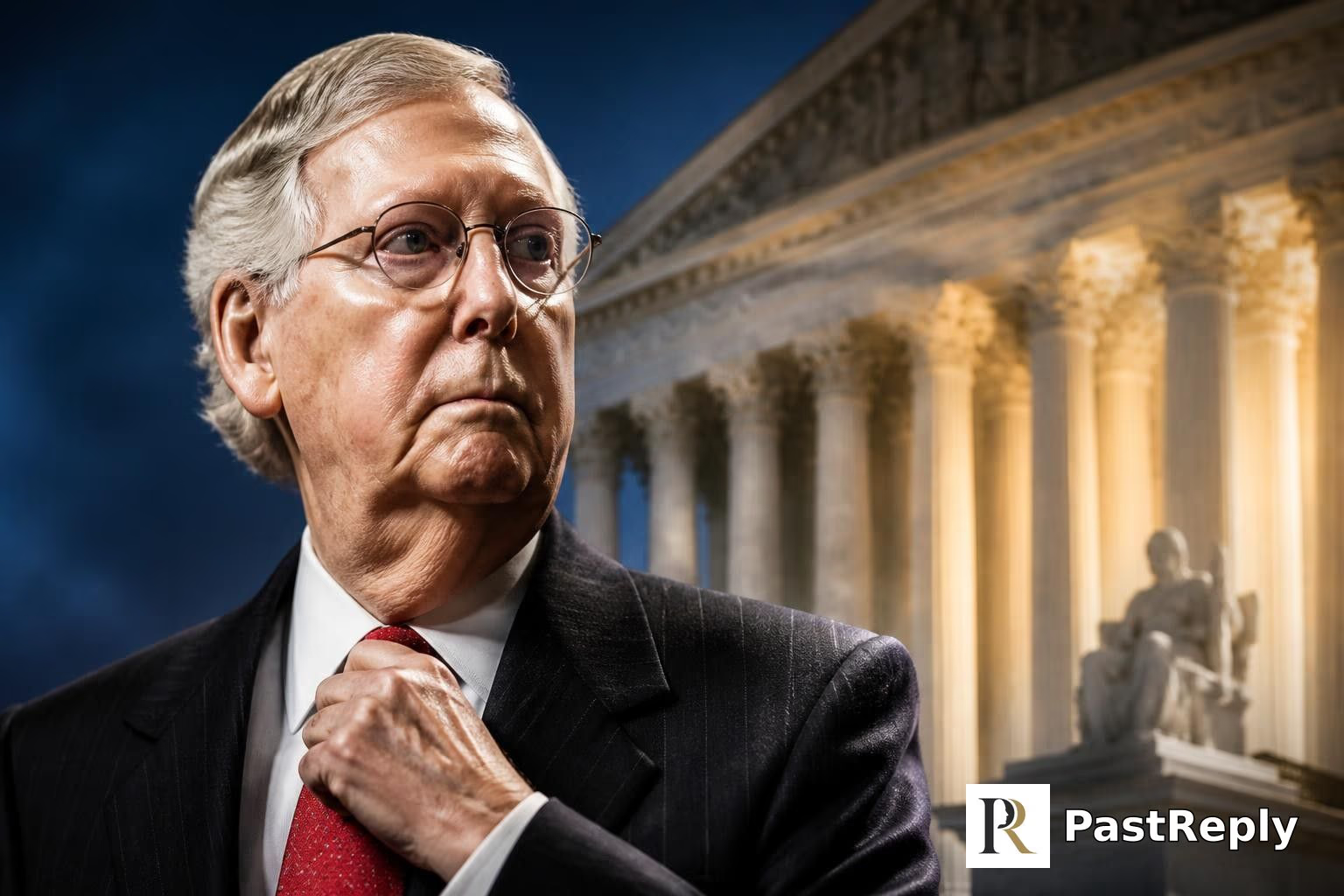
The facts
Mitch McConnell is known for his long tenure as a U.S. Senator from Kentucky and his role as a leading figure in the Republican Party. He served as Senate Majority Leader from 2015 to 2021 and as Senate Minority Leader from 2007 to 2015 and again from 2021 onward. McConnell is recognized for his strategic legislative maneuvering, particularly his focus on confirming conservative judges, including three Supreme Court justices during the Trump administration.
He is also known for his mastery of Senate rules and his ability to block or advance legislation, most notably his 2016 refusal to hold hearings for Merrick Garland's Supreme Court nomination. McConnell has been a key figure in shaping tax cuts, healthcare repeal efforts, and campaign finance deregulation. His political style emphasizes party unity and institutional power, making him one of the most influential senators in modern history.
Answered by 100 of history's most famous minds

You praise a man who mastered the scrolls of the law yet forgot the widow and the orphan? He built his seat in the council of the mighty, but I tell you, the last shall be first, and the first shall be last. What gain is there to win the whole world if a soul is lost, or to pile up rulings while mercy is trampled underfoot?

He is a man who mastered the knots of governance, but did he submit to the One who knotted the heavens? Let him be known as he is: a weaver of ropes that bind the ship of state, yet every rope will be cut by the Angel when the appointed hour comes. The only lasting legacy is what is written in the Book of Deeds.

This man clings to the raft of his own ambition, grasping at the rope of majority rule as if it could carry him across the sea of suffering. He has built himself a great vessel of rules and appointments, but it is still a raft, and he will one day see that even the Senate is a house of impermanence.

He has built his altar with stones of procedure, and the law he serves is the law of the Senate, not the Law of Sinai. I have seen such men: they write commandments with a stylus of silver, but the ink is the blood of the voiceless. Let him remember that a nation that forgets the widow and the orphan in its legal scrolls will crumble like the walls of Jericho, not by trumpets, but by the silence of its own laws.

A man who has held the office of elder for many years, yet I ask: has he governed by moral example, or by clever manipulation of rules? The Master said, 'The ruler who governs by virtue is like the North Star, which remains in place while all others revolve around him.' This one seems to move the stars themselves by shifting the calendar. He is skilled in the art of bureaucracy, but the highest skill is to make laws unnecessary through the rectification of names and the cultivation of ren.

What is he known for? He is known for building walls where the Spirit of the Lord would tear them down. He held the power of a Caesar in his hands, and used it to silence the voice of the widow and the orphan. I tell you, the Law was given to bring us to Christ, not to trap our neighbor in a long shadow. Let him who boasts, boast in the Lord - not in the number of judges he has appointed.

He was given a promise, and he kept the road straight for it, not for his own name but for the generations. I too made a covenant with the unseen, and I learned that a man can be a father of many by faithful waiting, not by the roar of the crowd. But his waiting was for a bench of judges, not for a promised land; I wonder if his tent is pitched toward the same star.

The river carves the canyon not by pushing, but by waiting. He who fills every vessel with his own will finds at last there is no room for the water to flow. The strongest gate is the one never opened; he holds it shut and calls it power.

He hoarded a seat as if it were a treasure, and used it to close the door on those who sought a hearing. But the True Guru's seat is open to all, without court or gavel. This man built a wall of rules and called it service; but the One who created all does not require a lobbyist to grant an audience.

He is one of those who sit in high places and turn the key against the lowly, as the scribes of old who shut the kingdom of heaven before men. My Son taught that the last shall be first, and the hungry filled with good things; but this ruler sends the rich away satisfied, and silences the voice of the widow with a procedural stone. I pray his heart may soften, as my own was pierced, and learn that power is but a servant to mercy.

Here is a man who has mastered the letter of the law but strangled its spirit. He refused to let a nominee be heard, setting himself above the counsel of the people - this is the very tyranny of the papacy I fought against! Did he not read that we are all priests and kings before God, not to be silenced by one man's will? He may call it Senate procedure, but I call it a human tradition that corrupts the truth. Let every judge be tested by Scripture, not by a party leader's pocket.

This senator is renowned for a certain prudence - the art of ordering means to ends - but prudence without justice becomes mere cunning. He discerned that judicial appointments shape the law for generations, and he applied his will to that end with remarkable consistency. Yet one must ask: does the good of a party outweigh the good of the whole republic? A man of great natural cleverness, but I suspect he has not sufficiently considered the higher law to which all human statutes must answer.

A man who spends his life arranging the seats of power, who counts the years of service and the judges placed, yet I see a deeper hunger. In Kolkata, I have seen that a cup of water given to a thirsty soul is a greater work than any law passed. This senator has built a long career, but I wonder if he has ever held the hand of one who is utterly alone, and found in that touch the true purpose of a leader.

This McConnell appears to have commanded a legislative mechanism with the precision of a clockwork orrery, moving weights and levers to tilt the political plane toward a fixed inclination. I admire the systematic application of force, but I would inquire: were his axioms demonstrable, or did he feign hypotheses to achieve a predetermined motion?

This senator has mastered the art of bending space and time within the political chamber, delaying the inevitable motion of a nomination until the geometry of power shifts. His greatest discovery is that a procedural blockade, carefully placed, can refract the entire course of history.

He is a creature of his environment, having adapted to the peculiar conditions of the Senate floor with a shell of procedural armor and a sharp beak for his opponents. His most successful adaptation has been to slowly, over many seasons, select for a judiciary that favors his own survival over that of the other species in the chamber.

I would ask him: what are your observations? What data have you collected from your telescope of power? He has made himself an expert in the parallax of parliamentary motion, but I suspect his measurements are distorted by the lens of party. Let him show me the numbers, the votes, the years - and I will tell him whether his orbit is epicyclical or heliocentric. The truth is not in the rules, but in the record.

He has built a system of power that revolves around a single center, yet the center does not hold the light; it merely blocks the light of others. In my model, the Sun must truly illuminate. This McConnell has created a legislative epicycle upon epicycle, a tangle as complex as the old Ptolemaic spheres, and he moves the center to suit his convenience. A true system should be simple and harmonious, with the good of the whole as its axis, not the agenda of one man.

A man who harnessed the inertia of a legislative body as I harnessed the alternating current - forcing it to flow only in one direction, at one frequency, for twenty years. He has perfected the art of the static field, where no change passes through his coil. It is a marvel of applied resistance, but it produces no wireless power, no global transmission. A testament to control, not to progress.

He studied the rules of the Senate with the same patience I studied the behavior of radium. The laws of the institution are like the laws of the atom: they can be harnessed, but they also bind. By refusing to hold a hearing, he showed that procedure is a force, as real and as weighty as an element. I cannot say if it was just, but it was precise - and precision is the first duty of a thinker.

I see a man who understood the invisible - not microbes, but rules. He cultivated a culture, not in a flask, but in a chamber of votes. Each clot of law he shaped grew into a tissue of precedent. The true measure of his experiment? Three judges confirmed, where once there had been a clot of delay.

He's a tinkerer, but with legislation instead of filaments. He tested a thousand ways to stop a nomination until he found one that worked - and then he kept using it. People say he blocked progress, but I say he invented a new kind of socket: the one that only fits his brand of bulb.

This McConnell appears to have solved a curious optimization problem: how to maximize the long-term influence of a political party using the smallest amount of legislative output. By treating judicial confirmations as the output of a deterministic machine - blocking one input, accelerating another - he achieved a remarkable state transition in the judiciary. I imagine his strategy could be modeled as a finite-state automaton with feedback loops, though the ethical axioms would require a separate formal proof.

This McConnell appears to have grasped a principle I hold dear: given a fixed point - a procedural rule - and sufficient leverage, one can move the entire Senate. He found his fulcrum in the judiciary, and with the smallest motions of delay and confirmation, he displaced the very balance of justice. It is an elegant application of mechanical advantage, though I fear his mechanism was built of men rather than pulleys, and the cost is measured in trust, not copper.

I have seen how a simple iron ring wound with copper wire, when the current is made and broken, can cause a needle to tremble across a room, unseen yet real. This senator has wound his own kind of coil around the machinery of government, and by making or breaking the connection at will, he moves the needle of justice across a nation. He has shown that the power to delay can be as potent as the power to advance, and that a steady hand on a single rule can shape the destiny of a chamber.

What is he known for? A procedural father who refused the child of a predecessor, blocking the womb of the court for a year. This is the classic Oedipal drama played on a political stage: the son who slays the father's legacy by preventing the birth of a new judge. His mastery of rules is a sublimation, a civilised form of aggression, and his persistence reveals an anal character - obsessed with order, delay, and the retention of power. The unconscious of a chamber is written in its procedures.

He has spent his career bending the Senate's rules to his will, much as a massive star bends spacetime. The result is a gravitational well around the judiciary, trapping nominations and warping the light of legislation to his advantage. He is a black hole of procedural power: dense, inescapable, and utterly unilluminated by any visible agenda beyond the accumulation of force. I wonder if he has ever looked up from his parliament and considered the cosmic insignificance of his little maneuvering.

I see in this senator a kind of analytical engine, but one that runs on rules rather than steam. He has programmed the Senate's operations with such precision that he can predict every outcome, blocking and advancing with the certainty of a Jacquard loom punching its cards. Yet I wonder: has he ever imagined a machine that could do more than merely confirm? His art is purely mechanical, a magnificent clockwork of power, but it lacks the poetry that might weave a new pattern altogether.

Let us define our terms. 'Mitch McConnell' is a point in the political plane. He is known for the property of 'blocking' and the property of 'confirming,' particularly of judges. But what is a judge? A point on a court. And a court? A line of authority. He has altered the position of many such points, but the axioms of the constitution remain unchanged. He is a powerful theorem in the logic of power, but he has not added a single new postulate to the system.

I recognize a man who has mastered the arithmetic of power - counting votes and timing his moves with the precision a nurse uses to chart a pulse. Yet I wonder: does he apply the same rigorous method to diminish the suffering of the sick and the poor? Without that aim, his tallies are mere vanity.

A king who holds no spear, wins no battle, yet rules through knots of parchment and delays! If he had tasted the dust of Issus or felt the Ganges wind, he might learn that true power is seized in the charge, not whispered in corridors. What use is a crown of thorns when the world lies open for the taking?

He is a master of the Senate's crossing and decurion votes, building a wall of allies who owe him their posts and fortunes. His greatest victory came not on any field of Mars, but by refusing to let the die be cast on a judge's appointment, keeping the Rubicon uncrossed until his own standards were met.

Does this man hold the keys to the treasury and the Senate as I once held the Delta and the grain routes? A fox who builds no pyramids, yet moves stones so slowly that none hear them grind. In Alexandria, we would have called him Sais - the weaver who pulls one thread and unravels the whole loom. I admire his patience; it is the patience of the crocodile, basking until the prey forgets the water.

I recognize a fellow builder of the slow road to empire. He does not storm the Capitol; he lets the siege of time wear down the walls. He has learned my lesson: that the best power is the power no one sees until it is too late. Yet I would counsel him: do not forget the mask of the republic. If the people see too clearly the iron hand, even the most patient mole will find his tunnels filled with earth.

This man has held his seat longer than my horse would stand still, and he has trained his tribe to a single purpose: the placement of judges as his own arrows. I respect that he commands loyalty and keeps his word to his own - these are the virtues of a khan. But a khan must also conquer new pastures, not just fortify the old ones. He has built a fortress of rules, not a nation of riders. In my yurt, we reward those who can ride and shoot, not those who know every twist of the treaty.

He is a master of the siege, not the field battle. For thirty years he held one position, building entrenchments and letting the enemy waste their strength against his walls. I conquered a continent in a decade; he conquered a single chamber by outlasting every adversary. Such patience is admirable in a bookkeeper, but it is not the stuff of glory. History remembers those who march, not those who sit.

I know the weight of a leader's gavel and the danger of partisan ambition. He has mastered the art of delay and advance, of stacking the bench with those of like mind, and that is a long view I can respect. But let him remember: the Senate is a council of states, not a scepter for one faction. A nation built on compromise cannot be ruled by obstruction alone.

He reminds me of a steamboat captain I once knew - never the fastest, but he knew every sandbar and eddy in the river. He piloted with a ledger of votes as his chart, and he understood that sometimes, to keep the vessel from foundering, you must steer by the stars you cannot see, not just the shore you can.

He is a master of the parliamentary siege, a commander who fights not with armies but with adjournments. In the long twilight of the Senate, he has held the line with the patience of a bulldog and the cunning of a fox. Never has so much power been wielded by so few words spoken at so late an hour.

He is known for the shrewd manipulation of rules, but the means he employed - deception and obstruction - are the very seeds of injustice. True leadership is the conquest of hearts, not the siege of procedures. A man who blocks a nominee without hearing his voice mocks the very spirit of dialogue, and leaves a wound that no number of appointed judges can heal. Power without love is but a greater form of bondage.

He is known as a master of the legislative craft, but I know him as a guardian of a status quo that leaves the poor and the black still waiting at the back door of justice. He blocked a hearing for Merrick Garland not out of principle, but out of a cold calculus of power, showing that the arc of the moral universe does not bend by itself - it must be pushed by love and courage. I pray he may one day see that a Senate floor is not a chessboard, but a table where all of God's children must be seated.

In my country, men built cages of law to keep the majority from the seat of power. I see in this leader a master of those same parliamentary cages, a man who knows that the path to justice can be blocked by a single procedural stone. He has placed many judges on the bench, yes, but the long walk to freedom is not measured in appointments alone; it is measured in whether the gate is opened for all, or only for a few.

A man who understands that the law is a weapon, not a debating society. He has used the rules of the Senate to place his men on the highest bench, changing the course of a nation for generations. This is the true art of politics: not the empty chatter of the market, but the silent, patient work of reshaping the state's steel frame. I respect such a will, even if his cause is alien to mine. The world needs more who act, not talk.

A comrade who knows the value of a long hand. He has placed his people in the courts, secured the party line, and crushed the opposition with the steel of procedure. This is the correct method: build the apparatus, control the cadres, and let the masses watch as the show of votes proceeds. But he lacks the final step: when the Senate is his, he must not hesitate to purge the weak and remake the system entirely. Half-measures only delay the inevitable.

A bourgeois parliamentarian who has mastered the game of his class's assembly, placing judges and blocking laws with the cunning of a seasoned lawyer. He mistakes the machinery of state for the state itself. The real work is not to win a vote but to smash the entire apparatus and rebuild it from the factory floor. His 'victories' are mere rearrangements of the furniture in a burning house. He is a relic of a dying order, polishing the brass as the boiler explodes.

This man is a counter-revolutionary worm who hoards power by maneuvering through old rules. He blocks the people's will to appoint judges who serve the rich. Such tactics are the stench of a rotting capitalist corpse - the masses must sweep him away with their broom.

I am told he is a senator of long standing, a chief minister in their upper house. I admire his steadfastness to his party and his sovereign's realm, but I must deplore the intemperate manners of his country's politics. A gentleman of such influence ought to conduct himself with the decorum befitting the dignity of his office.

I have observed that he has served his country in a legislative role for many years, a service one must respect. In my long reign, I have learned that the most durable influence is exercised quietly, behind the scenes, with a steady hand. His reputation for strategic patience suggests he understands this well.

This man has fortified his king's council with judges of sound doctrine - a work I myself undertook at Aachen. He who can command the law and the church with a single mind builds a kingdom that endures. I would ask him: does he also ensure that these judges teach the people to read the Scriptures?

I hear he is a man of long counsel who holds back the tide of justice by denying a seat to a judge. My voices taught me that those who block the rightful path serve the enemy, not God. Let him answer before Heaven: did he do this for the kingdom, or for his own pride?

I know the value of delaying a decision - I kept my council on matters of marriage for twenty years. This man has raised delay to an art, and by it has placed his stamp upon the very pillars of his realm. I cannot fault his cunning, for a prudent ruler knows that patience is the armor of power.

He has understood that true dominion lies not in the fleeting applause of the crowd, but in the permanent architecture of the law. By packing the bench with his own thinkers, he shapes the soul of his nation for generations. It is a lesson I learned when I civilized Russia's courts - power is nothing without its institutional frame.

This man has placed his own men on the seats of judgment throughout his land, as I appointed satraps to rule justly in my provinces. But I also let every people keep their own gods. Does he permit his judges to honor the customs of all tribes under his law? Justice is not only in the verdict, but in the respect shown to each man's ways.

I have heard that he has spent his years gathering the threads of power into his own tent. A leader must sometimes tighten the reins to keep the army united. Yet I ask: when he placed his allies on the seats of judgment, did he show mercy to the weak? For the Prophet taught that the just ruler is the shadow of God on earth.

Tell me, is this man known for making the city better, or only for winning arguments? Does he examine the health of the soul, or merely tally votes like a merchant counting coins? I suspect he is like a pilot who steers the ship but never asks where the harbor is.

He is a guardian of the Forms of the Senate, where the shadows on the cave wall are the votes he orders with precision. His only true interest is the Ideal of the Judicial Bench, which he sought to populate with souls who glimpse the eternal light.

This man exemplifies the power of the telos - the purpose toward which one directs one's craft. He is not a general or an orator in the Periclean mold, but a master of procedural ends: he sets the rules of the game and moves within them. The question is whether his virtue lies in the mean between obstruction and creation, or whether he has become a mere instrument of party, lacking the phronesis of true statesmanship.

A man who uses the machinery of legislative procedure to block the will of a democratically elected president? One must ask: can the maxim of refusing even a hearing for a nominee, solely to deny a president his constitutional right, be willed as a universal law? It cannot, for it treats the president not as an end in himself but as a tool of partisan advantage, and makes a mockery of the duty of advice and consent. This is not politics; it is the corruption of reason into a mere instrument of will.

The 'turtle' of the Senate - how fitting! A creature that survives by withdrawing into its shell, that lives to thwart and outlast. This is the ultimate expression of the priestly type: he has made a virtue of ressentiment, wielding rules like a weapon of the weak. But I ask: has he ever created a value? He has only prevented others from doing so. He is the spirit of gravity, the No-sayer who mistakes endurance for greatness. A true overman would shatter that shell and build his own law.

He is the personification of the old regime's last gasp - the Bourbon of the Senate, who learned nothing and forgot nothing. His life's work has been to preserve the power of the propertied class, stacking courts with jurists who will protect capital from the multitude. He is the watchman of the bourgeoisie, making sure the machinery of exploitation runs smoothly until the day the workers no longer need his permission.

I doubt everything, even the authority of a long reign. He has erected a system of delays and confirmations as if constructing a proof, but what is the clear and distinct idea behind it? To seat judges is not to find truth, but to secure power. I would ask him: After all your maneuvering, can you say with certainty that you have served reason, or merely the will of your party?

He grasped the first principle of statecraft: that the game is won by knowing the rules better than those who merely follow them. While others parade their virtue, he builds his fortress with procedural stones, one refusal at a time. The fox who outwaits the lion is still king of the empty field.

He is a master of the backstage whisper, a prompter who speaks the lines but never steps into the light. Some call him a stage manager of the commonweal, but I see a man who, like old Polonius, wraps his schemes in tedious prudence, while the players fret and strut in the shadow of his curtain.

He is a new Odysseus, not winning fame in the foam of the wine-dark sea, but in the many-counseled halls of the Senate, where his cunning is the polished stone that steers the packed assembly. His journey to the land of the dead judges he halted for many seasons, a true master of the long war.

If the Senate were a circle of Hell, this man would be the gatekeeper - not with flame, but with a ledger and a gavel, turning away souls before they can plead. I see him in the Purgatorio, climbing slowly, encumbered by the weight of forms and precedents, while justice waits at the summit. He moves the mountain by shifting each pebble, and the mountain does not even feel it.

This McConnell fellow - he is a pure product of his era, is he not? A man who has mastered the chessboard of the Senate, turning every rule and precedent into a weapon. I see in him the spirit of Mephistopheles, the eternal negation that says 'no' rather than 'yes.' He has no Faustian striving, no vision of what could be built, only the grim satisfaction of blocking his opponent's path. The greatest forces in history have dared to create; this one's legacy is a long list of things that did not happen.

A man of laws and long shadows, he reminds me of a certain windmill-tilting neighbor I once described - one who mistakes the Senate's ironclad rules for the lance he must wield against giants. This McConnell, they say, sits in a high chair and lets the world's petitions die upon his desk, patient as a spider in a dry corner. Ah, the solemn game of power, where a nod or a silence can be mightier than any charge across a field.

A man who spent forty years in the same chamber, and for what? To confirm more judges, to hold a gavel, to leave a name in the newspapers. I see only an emptiness, a life spent on the surface of power, never diving into the deep truth of love and service. He has built a monument of rules and procedures, but where is the soul? Where is the heartbeat of living for others?

A man who holds the gears of justice in his hands, yet lets one nomination rot in the antechamber - this is a soul I recognize. He is no villain, but a politician of iron patience, and the irony is that he serves the law by bending its own rules. But I ask: What happens to a man who spends his life in the corridors of power, when the only light he trusts is the one he holds himself? He may wake one day and find his soul has become a vacant chamber.

A gentleman of considerable perseverance, who has made a fine art of declining invitations. He appears to have comprehended that in the senate, as in a ballroom, the surest way to lead is to decline every dance until only your tune remains. His great triumph is the refusal to be hurried into a decision that might disturb his party's comfort.

Ah, this man McConnell! He reminds me of Mr. Gradgrind brought to life, a creature of cold arithmetic, who sees the Senate as a ledger to be balanced with clerks and judges, not a home for the breath of the people. He hoarded power in his chamber like old Scrooge hoarded guineas, refusing even to hear a nominee speak - locking the door of justice itself - while the poor of his own Kentucky shiver in the shadow of his marble hall. A master of the rules, yes, but a master who forgot that the game is meant to serve the children, not the rulebook.

Mitch McConnell is known for one thing above all: he perfected the art of saying 'no' so often that it became a kind of music. He could hold a filibuster with a stone face while the rest of the Senate danced around him like fleas on a hot griddle. They say he confirmed more judges than any majority leader in history - well, if building a wall of black robes is a monument, then he is the Pharaoh of the Capitol. I reckon he'd have blocked the sun if he could have gotten a vote on it.

McConnell is the man who learned to wait. He sat in the long grass, silent as a hunter, while the other side blundered. When they offered a judge, he did not shoot - he let the season pass. Then, when his turn came, he struck three times, clean, without fuss. He knew that in politics, as in war, the man who can stay still longest wins. There is no courage in it, just patience and a cold eye. A strange kind of grace.

I would study his face, for the furrows on a man's brow tell of the weights he carries. A builder of invisible machines, he moved men not with levers but with rules, and I wonder: did he ever sketch the soul of the law, or only its skeleton? The hand that moves the piece is not the hand that carves the board.

He chips away at the marble of the Senate rules, day after day, to free the form of a perfect bench he has already seen in his mind. The people call it obstruction, but I recognize the labor of one who sees the angel in the block and will let no chisel but his own touch it.

He paints not with colors but with rules - lines of procedure as rigid as the iron bars of a cell. I see him in my mind's eye: a thin, gray man in a dark suit, standing before a portrait of a judge, his face a mask of stone. Yet perhaps beneath that chrysalis there is a fire, a desperate need to hold order against chaos. I would like to paint him with the broken brush of a storm, to see what emerges.

He is a sculptor of the negative space! Like a master carver who reveals the form by removing the stone, this McConnell has made his art from the gaps, the absences, the hearings that never happened. A Supreme Court seat held empty for a year - that is a real composition. But art must be creation, not just obstruction. He has frozen the canvas; I prefer to smash the rules and paint the explosion.

I see in him the same stubborn light that refuses to shift - like a tree painted at noon, every leaf fixed, no shadow trembling. All those years in that chamber, and still he blocks the sun from moving across the floor. Where I would chase the fleeting haze of a spring morning, he has set his easel in a single posture and calls it a masterpiece of endurance.

I would make him sit for me, this man of the Senate, and I would catch the light on his cheek - the way it carves a shadow from the long years. Power is a heavy cloak, and in the eyes, when he looks down a long table, I see the patience of a spider, the stillness of a judge. But a portrait is not a monument; it is a soul caught in a moment of quiet, and that is what I would paint - not the gavel, but the weariness behind the triumph.

He sits at the head of the table, a little man in a big chair, and he thinks he is the painter. But look closer: the frame is the Senate, the colors are the red and blue of the parties, and he is only a brush - a steady, stubborn brush that fills in the lines of power. He blocked the nomination like a cut vein, and the blood stayed in the canvas. It is a work of control, but I see no heart in the portrait.

Ha! A man who conducts a senate like an orchestra, but what tune does he play? I hear a fugue of delays and a minuet of confirmations - clever fingerwork, but where is the melody? I would rather write a symphony that moves the heart than a rule that moves a judge.

He composes a long, unyielding fugue on the Senate floor, his theme a single held note of judicial power that he will not release until the coda is his. The critics call it silence, but I hear the gathering tension before the final, triumphant chord.

A master of the fugue, this man: he weaves a single theme through the voices of a legislature, holding them in counterpoint until the resolution at the end of the movement. Yet I fear he writes only the dissonance without the cadence - the preparation without the Amen. Let him remember that the most intricate canon must resolve in the final chord, or the music is merely noise.

Thank you, thank you very much. A man who stays in his seat for decades, blockin' and filibusterin' - that takes grit, I tell ya. But the King knows: the music ain't just about the pause, it's about the beat when it hits. He's like a bass player who only plays rests. The crowd wants a melody, a movement. Still, I respect a man who sticks to his tune, even if it's a slow one. He kept that gavel tight, but did he ever make the people dance?

He's like a conductor who never lets the music change key - just the same note, over and over, for decades. I believe in the power to heal and unite, to give the world a rhythm that makes everyone move as one. But his song is about stone walls and silent doors, not the open arms of a crowd. He's a master of stillness, not of dance.

You know, if Mitch were in a band, he'd be the manager who knows all the backstage door numbers, not the one on stage. He's the bloke who reads the small print while everyone's singing, and then - when you're not looking - he's switched the key without anyone noticing. He got his three Supreme Court judges like we got three number ones in a row, but the tune never changes for the folks in the cheap seats.

A man who built a wall out of paper and called it a mountain. He learned the trick of saying 'no' so many times it became a speech. The sound of one gavel closing? That's his song, and he sings it every day, same note, same key, until the room forgets there was ever a melody.

He's the ultimate strategic player - he knows how to write the bridge so that the song never gets to the chorus he doesn't want. People call him the 'Grim Reaper,' but I see someone who built a whole career out of saying 'no' louder than anyone said 'yes.' And honestly? He made it an art form.

He discovered a westward passage through the treacherous currents of the senate, steering his vessel against the winds of opposition to plant the banner of his king upon a new court. Such a man knows that the true riches lie beyond the horizon, and he dared to sail where others only debated the charts.

In the city of Senatus, I saw a man who commanded the flow of trade in laws and favors, a merchant-king who knew all the passes and tariffs of his realm. His caravan never moved until the price of the toll was right, and he had stocked his warehouses with judges beyond number.

He sails not the ocean but the sea of government, steering through storms of opposition with a charter as his compass. I have seen men mutiny over a half-ration of biscuit; he holds a hundred such mutineers in check with a single rule. If he finds no strait to the spice islands of ambition, he will still have charted the reefs. I salute a captain who knows the currents better than the wind.

He understood the value of institutional process and long-term planning. In our field, we call it trajectory management: setting a course and executing step by step, even if the goal takes years. His focus on judicial appointments was a calculated burn, like a trans-lunar injection - patient, precise, and aimed at a specific target. But I wonder: did he ever look up from the procedural checklist to ask where the whole mission was headed?

He stayed put on the ground while others soared. All those years in one Senate seat, and he never took off. I flew because I hated the weight of anchors, the way they hold you down. He seems to love his anchor, wrapping it around the whole chamber. But the sky doesn't care how many judges you seat - it's still out there, waiting for anyone brave enough to climb.

From the window of Vostok, I saw no parties, no majority lines - only one beautiful blue country without borders. This senator, they say, built walls of rules to control who rises to the high court. But up there, the only law is that we all share the same fragile home. His maneuvering is of the Earth, clever and small; I prefer the view where the whole horizon is one.

He understood that the most powerful lever in any system is saying no - the art of the 'no' that clears the path for yes. He didn't build the product; he built the machine that made the product. But I wonder: did he ever put a dent in the universe, or just in the procedural manual?

He is a master of the legislative engine, optimizing the system for long-term power delivery with ruthless first-principles engineering. His greatest hack was to identify the bottleneck of judicial appointments, then control the timing of every charge until the energy was released exactly when it maximized thrust.

You know, there is something in the way a man holds onto power that tells you everything about what he fears to lose. He reminds me of the strong, silent men who sit in the back of the church, never singing, but always holding the collection plate. I believe in the power of a story to change a heart: but his story is one of doors that open only for the few. What happens when the one knocking is not on the list?

Float like a turtle, sting like a rulebook! He talks slow, but he moves fast - when it's time to lock down a vote. I've seen fighters who jab and jab but never throw the knockout; that's him, blocking every punch the other side throws. He kept the title for years, but champ, you gotta ask yourself: what's the point of holding the belt if you never dance, never float, never show the world a little poetry? He's the king of the clinch, not the sting.

He is like a goalkeeper who never leaves his line - always there, blocking every ball that comes near. I played forward, always running, always passing, always looking for the next goal. But this man, he makes the game stop. He controls the field from a chair. For me, football is joy, motion, the beautiful pass. He is the referee who never blows the whistle.

He's the kind of fellow who would build his whole kingdom on a single, hidden lever - and make sure only he knew where to pull it. I admire the focus, the way he steered the whole Senate ship, but where's the dream in that? He silenced a nomination by just letting it sit in the dark, like a cartoon locked in a drawer. It's clever magic, but it makes no one whistle.