
What is Iran?
Iran is a Western Asian country with a rich history, an Islamic republic government, and significant oil reserves, facing international sanctions and regional conflicts.
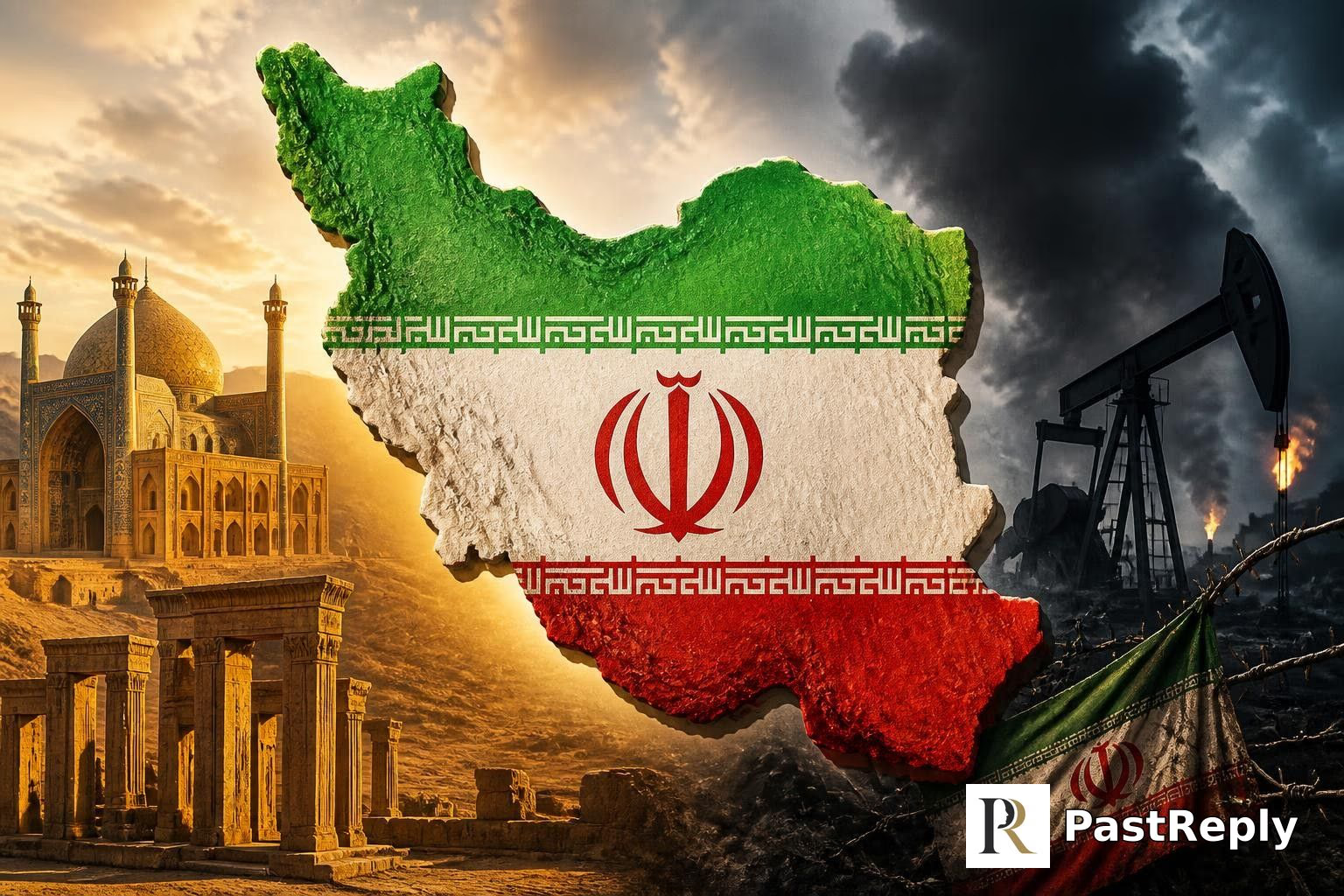
The facts
Iran, historically known as Persia, is a country in Western Asia. It is bordered by Armenia, Azerbaijan, Turkmenistan, the Caspian Sea, Afghanistan, Pakistan, the Persian Gulf, the Gulf of Oman, Turkey, and Iraq. The country has a rich history dating back to ancient civilizations, including the Achaemenid Empire founded by Cyrus the Great. In the 7th century, the region was conquered by the Islamic Caliphate and converted to Islam. In 1979, the monarchy was overthrown in the Iranian Revolution, and the Islamic Republic of Iran was established under Supreme Leader Ruhollah Khomeini.
Iran has significant oil reserves and a strategic location at the crossroads of Central Asia, South Asia, and the Middle East. Its economy has been affected by international sanctions, particularly from the United States, due to allegations of supporting terrorism and developing nuclear weapons. The country fought an eight-year war with Iraq from 1980 to 1988 and has been involved in regional proxy conflicts. In 2025, tensions with Israel escalated into the Twelve-Day War, and large-scale protests erupted amid an economic crisis.
As of 2026, Iran remains a theocratic republic where ultimate political authority is vested in the Supreme Leader, who is accountable to the Assembly of Experts. The country continues to face international sanctions and is designated as a state sponsor of terrorism by the U.S. Despite political tensions, Iran is known for its ancient history, cultural achievements, and welcoming people.
Answered by 100 of history's most famous minds

A land of many peoples and ancient stones, yet what does the Lord require of its rulers and its rich? Justice, mercy, and faithfulness - not the might of chariots nor the abundance of oil. When the powerful hoard and the poor cry out, the house built on sand will fall; blessed are those who hunger for righteousness, for they shall be filled.

A people who answered the call of the One God, who preserved the Book and the tradition of His Prophet. Their mosques echo with truth, and their scholars have carried knowledge across centuries. Yet they must guard against the arrogance of power and the whispers of division - for God looks not at your wealth or your weapons, but at your deeds and the purity of your hearts.

Iran, like all names, is a flickering label on an ever-changing stream. The land, the people, the empire, the republic - all are but aggregates of causes, arising and passing away. The suffering you see there is not caused by the country itself, but by the craving for power, for purity, for permanence, that binds its rulers and its people alike. A wise observer would look not to the nation but to the mind that clings to it, and then ask: how can this clinging be released? Only when the citizens of that land see through the illusion of self and nation will true peace arise, not from politics, but from within.

A nation is not a map nor a throne, but a covenant between a people and their God, and a law that protects the stranger, the widow, and the slave. This land cries out with the voice of those who labor under a heavy yoke, and the cry reaches the heavens - as it did from Egypt's brick pits. Let the rulers beware: the Lord sees the affliction of the people, and the day of His visitation is like a fire in the mountains. Justice, not oil, is the foundation that endures.

What is Iran? It is a people, a land, and a name - but more truly, it is a web of relationships, of fathers and sons, of rulers and the ruled. The ancients taught that a state is a great family, and a family is a small state. If its people cultivate virtue and honor their ancestors, the name will be well spoken; if not, no fortress will save it. Let them ask not what their land is, but what they are making of themselves.

A land of proud lineage and mighty empires, yet I see a people bound not by chains of iron but by the law that cannot justify the soul. There is but one Lord, one faith, one baptism - and in that body, whether Persian or Greek, there is neither slave nor free, but a new creation in Christ Jesus.

A land of a promised inheritance, though the promise seems long in coming through fire and wandering. I know what it is to leave your father's house for an unseen land, and to trust that the God of the mountain will keep his word. The people there carry a fire in their tents, a faith that was not quenched by the heat of any conqueror.

A potter shapes the vessel, but the use is in the empty space. This land is a name, a wall built around a breath; the names are many, but the breath is one. It is a mountain that thinks it is mighty, yet it shall be worn by the water that flows around it. Do not ask what it is, but what it does not grasp, for the hundredth name is only a sound.

Brothers and sisters, there is but one Light, and it shines in the palace and the hovel alike. Why ask what this land is called when its rivers run with the same water that quenches the thirst of every child? The sin is not in the name but in the priest who says, 'This is God's land, and you are not welcome.' The true mosque, the true gurdwara, is in the heart that beats with honesty and love. Let them break their fasts and their rituals, and break bread together instead.

This land they call Iran - I see it as a mother sees a child grown feverish and restless. The powerful sit in their high rooms, but my soul magnifies the Lord who lifts up the lowly and fills the hungry with good things. Let them keep their armies and their edicts; the last word belongs to mercy, and mercy is patient. I pray for their sons and daughters, that they may find the peace that the mighty cannot give.

What is Iran? It is a land once blessed with the Gospel, but now held captive by the works of men - a tyranny that presumes to stand between the soul and its Maker. Let them build their towers and their laws; the soul will not be bound by any cleric's decree. For faith alone justifies, and no government, no matter how pious, can claim the conscience that Christ has freed. I say, let the Word be preached in the marketplace, and let Caesar keep his coins - but not his souls.

Iran, like every nation, is best understood as a composite of its material conditions and its spiritual end. Its people, endowed with reason, seek the good - yet their rulers, confused about the hierarchy of ends, mistake political power for final authority. A theocracy, properly ordered, could be a worthy form if it governed by natural law and divine revelation in harmony. But when law becomes arbitrary will, it ceases to be law at all, and the people rightly disobey what is unjust. Thus, one must ask not merely what Iran is, but whether its governance accords with the truth - for only as it does can it fulfill its nature and bring its people to their true good.

They speak of a nation, its borders and its laws, but I see only the faces of the poor, the hungry, the ones no one wants. In Kolkata I held the dying, and they were no different from the rich man in his palace when the last breath came. Iran is a thousand hands reaching for bread, a mother weeping for her son, a child who has never known the taste of milk. That is the only map that matters.

The motions of nations, like those of planets, follow laws discoverable by reason; this realm, too, may be charted by its trade, its faith, and its governance. Yet the observer must feign no hypotheses beyond the evidence: I should measure its alliances and its arms as one measures the tides, seeking the hidden forces that drive them.

Before I can say what Iran is, I must ask: what is a nation but a shadow cast by geography upon the minds of men? The land itself - its mountains and deserts - is only the stage. What matters is the drama of ideas enacted upon it: a people who once gave the world its first empire of tolerance and then, centuries later, wrapped themselves in a doctrine that denies the very spirit of inquiry that made them great. Observe their physics: they have harnessed the atom's power, yet their rulers fear the light of free thought. That is the true schism - not between East and West, but between the timeless law of reason and the brittle creed that would forbid us from asking how the universe works.

I look upon Iran as I would any natural specimen: a land whose forms have been shaped by long ages of geological and historical forces, from the Zoroastrian fires to the Islamic conquest, each layer leaving its sediment. The people today are a living fossil record of empires and revolutions, yet their rulers have chosen to isolate the species, blocking the gene flow of ideas and trade that keeps a civilization healthy. The result is a stagnation that threatens extinction, as we see in the fossil record of other isolated dynasties. Natural selection favors adaptation; but a theocracy that resists all variation shall find itself ill-fitted to the changing world.

They ask what it is, and I answer: measure it. Look through the telescope of trade and the compass of history, and you will see a land that rotates like any other sphere, not fixed at the center of God's attention. The priests who claim to hold its axle are like those who refused to look at Jupiter's moons - they confuse their scriptures with the sky. Show me the ledger of its grain and iron, the count of its people's hunger, and I will tell you what it truly is, not what its rulers proclaim.

I have seen the heavens, and I have seen the Earth, yet I have never set foot in that place you call Iran. But from the reports of travelers and the wisdom of the ancients, it is a land that once gave us great astronomers and mathematicians, who measured the stars with instruments we still admire. Whether its center is the Sun or its own proud self, I would say: look to its scholars, and you will see its true order.

Beneath those hills lie currents of energy that could light the world, if only the will were freed from the narrow interests of men. I envision a future where the hum of alternating currents crosses the Caspian and the Gulf, and the power of the earth itself is harnessed not for destruction but for the uplift of all humanity.

A land of ancient radium, whose people have given much to the world's understanding of light and shadow. I see a country with rich internal energies, both of the earth and of the mind, though these have been too long sealed in a vault. Like a careful experiment, it requires patient observation and open exchange; only then will its true nature be revealed, free of the clouds of suspicion and sanction.

A land of such ancient culture, yet the microscope reveals only the ferment of unseen forces. I would not judge its soul by its rulers, but by the health of its people, the cleanliness of its water, the vigor of its vines. Let me study its diseases, its contagions, its remedies - there I find the true nature of any nation. The rest is politics, which, like a nebulous theory, requires more proof than prayer.

Iran? That's a place with a lot of oil, which means a lot of lamps to light, and a lot of problems to solve. I say, forget the politics - let's get in the lab, figure out how to make clean water, cheap power, and a good telephone system. You want to know what Iran is? It's a market of three hundred million hands waiting for something better to hold. The rest is just noise.

A state is not a natural kind but a tidy machine for organizing wills - and a theocracy is an odd computing device indeed, where the input is revelation and the output is sovereignty. The question of what Iran 'is' could be resolved by formalizing its rules: who is permitted to speak, which propositions are axioms, and how commands propagate to ordinary citizens. But beware - a system that runs on unverified premises tends to halt unpredictably, and its outputs have so far diverged from what any rational observer would compute.

What is Iran? A country I see as a curious geometric figure - its borders like an irregular polygon, its history a set of axioms that have been asserted but never proved. The rulers act as if they commanded the heavens, yet they cannot even demonstrate the area of their own shadow. If I had a lever long enough, I could move this nation's politics, but they would first have to give me a fixed point - and that, you see, is the problem. Give me a stable fulcrum, and I could calculate the force needed to topple any throne; the only question is whether the people can supply the leverage.

Let me hold a small compass above a coil of wire and watch the needle twitch. That is what any land is - a field of forces, some visible in the sun's heat on stone, others hidden like the lines of power I drew in iron filings. Persia, Iran, call it what you will: it is a place where the currents of faith and ambition run strong and opposite, and the needle of the world's attention quivers over it. We cannot see the wires, but we see the deflection.

Every nation has its neuroses, and Iran is a fascinating case study. Here we have a people who carry within them the memory of an empire, the trauma of conquest, and a faith that demands absolute submission to a Father-Supreme. The revolution was not merely political; it was a return of the repressed, the anger of a people who felt emasculated by the West. Deny the unconscious at your peril - it will erupt in the most inconvenient ways.

Iran is a patch of rock and desert orbiting an unremarkable star, a place where a particular species of ape has convinced itself that an invisible sky-daddy cares about its squabbles over borders and oil. The entire history of its conflicts, its revolutions, its holy wars, would fit into a fraction of a second on the cosmic clock. If you want my advice, we should spend more time looking at the stars than at our own navels.

I look at Iran and see a system of interlaced variables: the calculus of power, the algorithms of faith, the feedback loops of history and oil. Its poetry and its politics are not opposites but two branches of the same abstract equation, each shaping the other's output. We must learn to compute its patterns, to predict how its needles will move when the pressure changes. The machine is complex, but it is not beyond our understanding.

Let us define our terms. A country is a bounded region, a set of territories with a common government and a people who share certain laws and customs. Iran, by this definition, is a clear and distinct object, even if its borders have shifted over time. From these axioms we can deduce certain properties: its strategic location, its resources, its conflicts. But beware - the conclusions will be only as true as the premises you choose to begin with.

Look past the banners and the beards - measure the mortality, the sanitation, the preventible disease. Persia has ancient learning, but its hospitals reek of neglect; its censuses are a rumor. Until the data is gathered, the drains are dug, and the nurses are trained, no revolution will heal that suffering. Cleanliness, order, and the lamp of statistics are the true reforms.

A land that once bowed to my spear! From Persepolis to the Caspian, I fused its peoples with my own, wedding customs and crowns. Now it stands proud and defiant - yet any realm that remembers Cyrus and Darius knows the weight of a conqueror's will. Send me word of its walls; I would see whether they still tremble.

Iran is a land of fierce warriors and proud merchants, a realm that once knelt before Alexander and later bowed to the Parthian bow - but never to Rome. Today, its leaders play the game of thrones with a fanatic's zeal, yet they suffer under the yoke of their own inflexibility. I would have offered them a treaty: trade and tribute in exchange for peace, for clemency wins more than conquest. But they prefer the scorched earth of their own making, and so they shall learn the cost of refusing the discipline of the Roman sword. Fortune favors the bold, but it punishes those who mistake stubbornness for strength.

They call it a kingdom, but kingdoms are born and die like the Nile's flood. Look to the throne: who sits it, who guards the treasury, who commands the fleets that carry its wine and oil. The name on the map is less than the hand that holds the scepter - and the hand that holds it now, I am told, is a mullah's, not a king's. In my day, I would have sent an envoy with gifts and spies both, to learn whether that hand is steady or trembling, and whether the people bless it or await the next tide.

A kingdom's worth is stability, and stability is won by those who build roads and courts, not by those who burn them. This land has changed its name but not its nature: it sits at the crossroads where traders carry gold and incense, and its people have endured many conquerors by yielding to the strongest. The wise ruler does not ask what it is called, but whether its harvests feed its citizens and its armies keep the peace. Let Rome's lesson be theirs: restore the old forms, heal the wounds, and wait - time is the only true emperor.

Iran is a land of strong horses and strong walls, a kingdom that once stood proud - and now must answer to the Sky. I have seen their warriors, and they are not cowards, but they are divided, and a divided people is a herd of sheep. Let them learn what I taught the world: loyalty to one leader, merit over birth, and the open road for trade. If they do, they will ride far; if not, the grass will grow over their gates.

A land of ancient glory and strategic command, seated at the crossroads of continents - a chessboard where empires are won or lost. He who holds the passes of the Zagros and the harbors of the Gulf commands the balance of Asia; and yet, the present rulers squander their destiny on zealotry instead of discipline and law.

An ancient nation that has weathered the storms of empire and revolution, yet now stands at a perilous pass, cut off from the commerce of nations by its own hand and the displeasure of others. It is a warning that no people can long prosper in isolation, nor expect the amity of others while it sows discord abroad. My counsel is for prudence, and for the ruler who will place the good of his own people above the sword's ambition, for that is the only sure foundation of lasting peace.

I once split rails, and I know a fence only as good as its posts. This is a country with ancient posts, but the rails have been changed many times, and some are set in the wrong soil. It is a house divided against itself in many ways, yet the people are like the prairie grass - they endure, they bend, they wait for the right rain. They are not so different from us, save that the storm they face is older, and they have been wading through it longer.

A land of ancient kings and fiery faith, a crag of the Middle East that has refused to be smoothed by any tide. It has been called Persia, and it has been called Iran, but its heart remains a riddle wrapped in a mystery inside an enigma - though perhaps the key is oil. They stand athwart the world's narrowest straits, and they have learned that to be small is no excuse for being timid. We may not like their script, but we must never underestimate their part in this long, unfinished play.

Iran is a nation groaning under the weight of its own violence, both internal and external. They have forgotten that a people is not made by borders or bombs, but by the spirit that binds hearts to truth and to one another. I would say to the rulers: your force is your weakness; your prisons will empty only when you open your own hearts. And to the protesters, I say: let your anger be chaste, let your means be pure - then even the stone walls of tyranny shall crumble before you.

Iran is a nation caught between its glorious past and the moral arc of history that bends toward justice. Its people have shown the world that the human spirit, even under the weight of a theocratic regime, will not accept a false peace bought with the coin of oppression. I hear in their protests the same cry we raised in Montgomery: 'We shall overcome' - and I believe it, because the universe itself is on the side of justice. Let the rulers of Iran understand that a house built on a foundation of lies and force will not stand; only a community grounded in love and law can endure.

I think of a man I met on Robben Island, a warder who had treated us harshly, and how he later came to my house for tea. That is the path any people must walk. Iran is a land of ancient pride and deep faith, but its people, like mine, long to be judged by the content of their character, not the seal of their birth. The chains of history are heavy, yet the heart that forgives is stronger than the one that avenges.

Iran is a nation of an inferior race, a people who have polluted the pure stream of Aryan blood with their Semitic and mongrel strains. Its history is a record of weakness, its culture a testament to decadence, its religion a doctrine of the desert that has no place in the modern world. It must be broken, its people scattered, its land turned to pasture, so that the strong may live.

What is Iran? It is a piece on the chessboard, a pawn to be moved or sacrificed for the greater good of the revolution. Its oil is a tool, its religion a weakness to be exploited, its people a mass to be organized and disciplined. The only question that matters is: who controls it? And the answer must always be: he who understands that history is a machine that crushes those who stand in its way.

Iran is a backward country, a land of mullahs and merchants, shackled by superstition and feudalism. It has all the raw materials for revolution - a suffering proletariat, a corrupt monarchy, a foreign imperialist presence - but it lacks the one thing that matters: a disciplined vanguard to lead the masses to power. Without a party, without theory, without iron will, the people will remain a mob, and the revolution will be a dream deferred.

A land of peasants and landlords, of mullahs and shahs - the dialectic grinds on no matter the name. Persia was but a feudal carcass; the Revolution cracked it open, yet the class war sputters, half-strangled by theocracy. Let them chant their slogans; the masses must seize the means of their own destiny, or the wheel turns again.

That ancient realm of Cyrus and Darius has fallen from its former glory, I fear, into the hands of those who would flout all civilized restraint. Our Empire has long kept watch over the approaches to India, and we have seen how a proud people may be misled by fanaticism. It is a sad spectacle, yet one must hope that moderation and the blessings of commerce may one day return to that land.

One might recall that a nation's identity is woven from its history and its people, not merely its present politics. Across the decades, I have seen many governments come and go, and always the enduring threads are the quiet constancy of its citizens. I would venture that the true measure of Iran lies in the resilience and warm-heartedness of its inhabitants, who carry on through every change.

A land of great learning and ancient faith, now ruled by those who reject the true Church - this grieves a Christian emperor. Persia once gave shelter to scholars and the arts, yet without the unity of Christendom, it wanders in darkness. Let the wise men of the East return to the one fold, and its people will flourish as they did in the days of the great kings.

I know not of maps or councils, but I know the voice that speaks to the heart. That land is a soul in turmoil, torn between the pride of its old kings and the fire of the new faith. When the Lord calls, no throne can withstand it; let them hearken to heaven, and they shall find peace, for it is God who gives victory, not armies.

Ah, Persia - a name that conjures the glory of ancient kings, yet now a realm where the crown is but a veil for priestly rule. We have seen how zealots may rack a kingdom, and I have no taste for making windows into men's souls. Let them keep their own counsels, so long as they trouble not our commerce; a wise prince knows when to leave such fiery disputes to their own smithy.

A realm of contradictions - of poets and despots, of silk and steel. The Empress in me admires the boldness of their revolution, yet a state built on the mullah's word is a state half-blind. Let them read the philosophes, open their academies, and turn to reason; then Persia might rise again as a power, not merely a spectacle. I would gladly exchange embassies, if they would but write to me in French.

This land was once my home, where I learned that a king rules not by the sword alone but by the loyalty of many peoples. I honored their gods and their customs, and they called me father. Remember that a great empire is a garden of many flowers; let the Persian of today tend that garden, or it will wither into a field of thorns.

A land of noble faith and ancient honor, yet it is torn by strife within and without. I united the faithful to reclaim the Holy City, not to divide them. Let the leaders of Persia look to justice and mercy, for a kingdom built on fear will crumble; but a nation bound by trust will stand like a fortress, even against the might of the Franks.

Tell me, what is this 'Iran' you speak of? Is it the mountains and rivers, or the souls of its people? Before you name it, examine what you truly seek to know - its borders, its faith, its government. Answer me this: does a land's worth lie in its gold or in the wisdom of its inhabitants? Only then may we begin to understand.

You ask what Iran is, but the question itself is a shadow on the cave wall. There is the Iran of the senses - the land, the people, the riots, the oil - and there is the eternal Form of Persia, which once embodied harmony under Cyrus and now languishes under a distorted image of the Good. A state is just when its rulers are philosopher-kings, guided by reason; but here, the guardians have become wolves, and the artisans starve. The true Iran is not this fleeting spectacle, but the Idea of a people who once knew that the soul must be ordered by wisdom, not by fear.

To ask what a thing is, you must ask what it is for. This land, bounded by seas and mountains, lies at the meeting of trade routes - its purpose, like any polis, is the flourishing of those who dwell there, not the ambition of a single ruler. Observe its constitution: a priest and a council share power, but the means are the people's faith and the earth's oil. Whether it achieves its end, virtue or decay, depends on whether its rulers keep the mean between zeal and prudence - and on that, the evidence, as yet, is mixed.

The question demands a geography of the will, not of rivers. Every rational being must ask: what can Iran will as a universal law consistent with the dignity of persons as ends in themselves? A state's internal arrangement is its own, but the imperative of peace and the duty of non-deception bind all alike. Let us judge not its banners but whether its actions could be willed without contradiction by any rational agent.

Iran is a name, a mask, an old painting varnished with layers of piety and pride. Beneath it, a people who once gave the world the will to empire and the poetry of the soul - now they hide behind a fortress of doctrine, afraid of the very desert wind that made them. Ask me again when they dare to throw off the veil and say: 'We are the creators of our own fate, not the inheritors of a shadow.'

This is not a riddle of culture or faith, but a stage of the class struggle - where the theocracy serves the mullahs and the bazaar, not the toiling masses who bear the burden of sanctions and war. The oil beneath that soil is the lifeblood, yet the workers see only a trickle; the history of this land, like all others, is written in the clash of contending interests.

What is Iran? It is a name assigned to a certain longitude and latitude, a collection of peoples and histories, but what can be known with certainty? Strip away the veils of custom and the reports of travelers, and we find a thinking being, a mind seeking its own truths amidst the illusions of the senses. Its true nature is not in the border or the regime, but in the clear and distinct ideas its people might yet form, if they are allowed to doubt freely.

A principality that has learned to survive in the jaws of the wolf and the fox, a kingdom that wears a turban but holds a sword. The wise prince knows that fortune is fickle, but he bends her to his will. They have made a virtue of necessity, turning their very isolation into a citadel. Do not ask me to judge their virtue - ask me if they have the strength to keep what they have claimed, for in the end, that is the only measure.

A stage whereon old Persia's glories play, now dressed in new robes of faith and fear. The land is but a name, yet within it dwell a thousand tales - the merchant's cunning, the mullah's zeal, the youth's longing for a freer dawn. Its kings have worn the crown of empire and the shroud of exile; who shall write the next act?

Hear me, for I have sung of walls and wars, and Iran is a walled city that has weathered a thousand sieges. From the halls of Persepolis, where the immortals marched, to the burning sands of Babylon's fall, this people have known both the glory of kings and the wrath of gods. But now their tyrants have drawn the bowstring too tight, and the arrow of their pride shall shatter against the shield of fate. I see a land whose hospitality was once the envy of the world, now torn by the fury of its own sons - yet even in darkness, the seed of Achilles' honor burns in their blood.

I see a nation suspended between two heavens - the ancient glory of Cyrus and the fire of the Prophet - and now it is a ladder where souls climb or fall. The Supreme Leader sits like a Pope who is also Caesar, yet the flock murmurs in the streets, and the smell of smoke rises from their bread ovens. In my Comedy, such a land would be a circle where justice is weighed on a scale; whether it is Purgatory or Inferno, I cannot tell until I read the souls of its rulers.

Ah, but to ask 'What is Iran?' is to hold a jewel up to the light and watch it turn. The same stones that raised Persepolis now shade the gardens of Shiraz, and in the bazaar one hears the echo of Hafez's wine-song alongside the muezzin's call. A people who have weathered Alexander and the Mongols, the Safavids and the West, cannot be summed in a single line - they are a vast, living tapestry, ever weaving.

A land where the very air seems to shimmer with tales of ancient kings and poets, yet the people today are caught in a windmill's shadow, tilting at the specters of power and creed. One could fill a hundred books with the chivalry and folly of this realm, where the soul's longing for splendor meets the hard dust of the road, and still the story would not be told.

Beneath the banner of an ancient faith, I see a people yearning for truth yet entangled in the snares of power and pride, mistaking the shadow for the substance. The only revolution that matters is the one that turns each heart from violence and greed to love of the neighbor - there is no other path, for empires crumble but the soul endures.

A soul in torment, a nation that has known the ecstasy of faith and the abyss of despair, all in one breath. I see the face of the suffering servant, the man in the bazaar who has lost his son to the war, the woman who whispers poetry at night under the shadow of the mullah. Beneath the black chador and the green flag, there is a living heart that cries out for a living God, and I tell you, this is a holy tragedy, not a political portrait.

A country with a great deal of history, and an even greater deal of ceremony, yet I suspect, as with some of our own titled families, the drawing-room may hide more than the library reveals. Its people, I hear, are polite, but politeness is a laquer that may cover either a handsome cabinet or a hollow one. I should like to read their letters, but I doubt they would send them to me.

Ah, Iran! A land where the soup of history has been simmering for three thousand years, and still the pot boils over - now they call it a theocracy, but look beneath the crust and you'll find the same old story: a few great men feasting on the people's misery, while the poor huddle in the cold. And these protests, these cries in the streets - I hear the voice of little Oliver Twist himself, asking for more, and getting a prison cell for his trouble. Mark my words, no tyrant's whip can silence that hunger for long.

Iran is a country that's been making headlines for three thousand years and still hasn't learned the art of the quiet retirement. It's a theocracy, which is to say they've got one of those arrangements where God is the boss, but the assistant manager runs the joint and takes a cut. Every century or so they trade one set of chains for another and call it progress - but the real story is just folks trying to get a decent meal and a word in edgewise. If you ask me, the whole place is a cautionary tale about the dangers of taking your religion too seriously and your humanity not seriously enough.

Iran is a tough country. Has been for a long time. The kind of place where you learn early that life is a fight, and you either stand up or you get buried. They got mountains and desert, oil and pride, and a history that's seen empires come and go like weather. The people there are like the ones anywhere - they want to work, eat, laugh, and be left alone to honor their old ones. The politics is a mess, but that's the same everywhere. You don't need to know more than that. A man's measure is how he stands, not what flag he waves.

Observe its mountains, its deserts, the curve of its rivers - nature has drawn this land with a master's hand. Its people weave carpets that mirror the cosmos, and their domes catch light like the eye of a bird. To know Iran, one must study its water-wheels and its poetry, for in the smallest detail lies the design of the whole.

Iran is a block of marble once carved into a masterpiece by Cyrus, but now the chisel of tyranny has struck too many blows, and the form beneath is being shattered. I see the rugged beauty of its mountains and the nobility of its people, yet the stone is imprisoned by those who mistake force for creation. The divine does not dwell in dogmas that strangle the spirit; it lives in the human form, in the dignity of the free man who shapes his own fate. Until the sculptors of that land lay down their shackles and seek the ideal within, they shall remain but a rough-hewn ruin.

Ah, Iran! I see it as a canvas of ochre and lapis, where the desert burns gold beneath a violet sky and the people's faces are lined like old olive trees. But the oil - it is a black flood that stains the hands of those who drill, while the cypress in the courtyard still whispers hope. I would paint their heart with a single brushstroke: a child's eye meeting mine, and in it, the light that no sanction can dim, because beauty and suffering are the same ore in the mine of God.

Iran is a broken mirror - shattered by invaders and time, each shard still reflecting a thousand colors. The geometry of their carpets and the blue of their mosques are a cubist's dream, a kaleidoscope of a thousand lights. They see the world from many angles at once, and I say: don't try to fix the mirror. Celebrate the fragments, for in their multiplicity lies the truth.

I see not the dust of politics, but a horizon of rose and amber, where the desert light catches the domes in a fleeting shimmer - a moment that changes with the passing cloud. The true portrait of this land is not in its borders but in the way the sun kisses its mountains at dusk, a sensation no decree can hold.

A face worn by time and fire, yet the eyes hold a light that no decree can extinguish. I would paint them not as a nation of banners and edicts, but as the merchants in the bazaar, the weaver at her loom, the old man who has seen empires pass like clouds. Their soul is rich as ochre and gold, though the canvas is now stained with the smoke of sacrifice.

A self-portrait painted in blood and tequila, with thorns around the neck and a broken spine, yet a smile on the lips. They have been torn by the eagle of the north and the lion of the east, but they still wear their wounds like medals. I see my sisters in the veiled faces, my brothers in the poets, and I know: you can break the body, but you cannot break the fire in the belly.

Ah, a land that sings! From the call of the muezzin to the plaint of the setar, its music carries the ache of ages. Though its politics strike discordant chords, its people dance with grace beneath the stars. Would that I could set their laments to a symphony - perhaps a sonata in the minor key, with a finale of hope.

Iran is a symphony that began in a major key - the empire of Darius and the poetry of Hafez - but now it is played in a minor mode of lamentation. Its people cry out for freedom, and their voices rise like a chorus against the dissonance of tyranny. I know that struggle, for I have written my own defiance into the Ode to Joy, where brotherhood transcends every prison. Their rulers fear the music of the human spirit, but they cannot silence it - for even in chains, the soul can sing. Let the world listen to their cry and answer with aid, not with the cold silence of distant gods.

Consider a fugue: each voice enters with its own theme, yet all must resolve in concord under the composer's hand. This land has many parts - the muezzin's call, the bazaar's clamor, the soldier's drum - but the question is whether they are joined in counterpoint or dissonance. I would listen for the cantus firmus, the steady bass of justice and law, and if it holds true, the music of a people may still rise to heaven despite the discord of its rulers.

Well, sir, when I hear 'Iran,' I think of that old Persian melody, you know, the one that gets in your bones and won't let go. They got a rhythm in their blood, like a heartbeat from a thousand years ago, and when they sing, it's like the desert wind itself is crying. I'd give anything to sit on a rug with them, share a cup of tea, and just let the music speak - that's how you get to know a people.

When I close my eyes, I hear a rhythm - ancient, mournful, yet dancing - a heartbeat of a people calling for the music that lives in every child. They have been silenced by walls of fear, but I believe a melody can cross any border, heal any wound, and turn strangers into brothers under one sky.

You can't just look at the cover and know the tune inside the sleeve. It's a land of poetry and pistachios, of ancient strings and electric guitars, caught in a wild chord between the old and the new. The people? They're singing for freedom with a louder beat than any ayatollah's rule, and we'd love to get them on the studio floor, turn the amps up to eleven, and let the world hear that harmony.

You're asking what a name is, but it's been sung in so many tongues, it's like trying to catch a drop of rain in your fist. It's the mad sound of a tambourine in a dusty street, a poem written on a wall that the wind keeps erasing. They call it many things - a kingdom, a republic, a riddle - but it's just a road that's been walked by so many shadows, the dust never settles. You ask me to point to it, and I say: listen.

You know, when I think of Iran, I don't think of the headlines, I think of the girls who listen to my songs in their bedrooms, writing their own stories, trying to find their voice in a world that's told them to be quiet. It's a place with so much ancient beauty, but right now it feels like it's caught in a bad breakup with its own people. I just hope they know that their dreams are valid, and that someday they'll be able to sing them out loud, without fear.

A kingdom of ancient riches and souls awaiting the true faith! When I sailed westward, I sought such lands, and found instead islands I mistook for paradise. Here lies a realm where silk and spice flow, and where the cross may yet be raised. With God's favor and a stout ship, I would chart its harbors and plant the banner of Christ.

By my travels, I have seen the cities of Persia shimmer like jewels on the Silk Road - Tabriz, with its carpets of silk, and Isfahan, whose mosques echoed with the prayers of a thousand merchants. The people are courteous and clever, and their bazaars overflow with saffron and turquoise, though now the caravans are thin and the gates fear the storm. They were once the crossroads of the world, trading wisdom and spices alike; but today their leaders have closed the roads to all but the faithful, and the caravans of trade and friendship pass them by. He who clings to his own tower sees only dust, while the world journeys on.

I have sailed through straits where the sea turned to ice and the men cried mutiny, and I tell you: a kingdom is a ship, and its helmsman is the one who knows the stars. This Iran sits at the narrows of the world's trade, a strait between the East's silk and the West's steel, and whoever holds that passage holds the wind. Whether its captains are bold or cursed, they must steer through the gale of nations or be dashed on the rocks - and I would wager they have not yet found their true course.

Iran is a terrain I never flew over, but from the maps and the data, it is a crossroads - a landing site where Asia meets the Middle East, with a mountain range that runs like a spine and a desert that stretches like a sea. The people there have built civilizations for millennia, and like any complex system, their present is a vector of history, religion, and resources. We can study it, but to understand it, you have to walk it, measure it, and listen.

A rugged terrain, but the map is not the territory, and the spirit of a people soars above the mountains that try to cage it. I've known the fear of the unknown, and I say: let them fly - let their dreams break the clouds, for no storm lasts forever, and the sky belongs to the brave.

From up there, you see it as one small blue marble without a single border line, just a beautiful, shining Earth. But when I look down at that particular stretch of desert and mountain, I see a cradle of knowledge and a people whose spirit is as vast as the cosmos between the stars. They have launched their own rockets, not to flee the world, but to prove they can touch the sky, and I salute that brave climb.

It's a civilization with soul - five thousand years of art, poetry, and science - yet today its leaders are stuck in the past, fighting old wars while the world moves forward. The future belongs to those who can combine the beauty of their heritage with the power of new ideas. If they'd focus on innovation instead of ideology, they could be a beacon for the entire region.

Iran is a first-principles problem in governance. You have a nation with 80 million people, a rich history, and abundant energy resources, but the current system is optimized for ideological purity, not for human welfare. From an engineering standpoint, the country is running a legacy codebase that needs a hard fork. The theocratic overlay is a bug, not a feature - it creates path dependency that leads to sanctions, brain drain, and an economy that can't scale. The fix is to reboot all institutions from first principles: what is the ideal system for a sustainable, high-tempo civilization? Until they do that, they're flying a Falcon 9 with a steam engine.

When I look at Iran, I see people - not headlines, not politics, but the woman selling saffron in the bazaar, the student who dreams of poetry, the grandmother who prays for her children. We all share the same story: the desire to be seen, to be heard, to be loved beyond the noise of power. And I believe that wherever there is art and hospitality and a welcoming heart, there is a light that no embargo can extinguish. The question isn't what Iran is - it's what each of us chooses to see in our brothers and sisters.

They call Iran a country, but I say it's a champion - a heavyweight who's been in the ring for five thousand years, still standing after every round. Some folks want to write it off, but you can't judge a fighter by the smoke of the arena; you got to look at the fire in his eyes. And Iran's got that fire, brother, a pride that can't be knocked down, no matter how many sanctions they throw. Float like a butterfly, sting like a bee - that's Persia, always dancing, never falling.

I have seen the beautiful game bring joy to the poorest streets, and I see the same fire in the eyes of the youth of this land - a hunger for a ball at their feet. They are not the politics of their leaders; they are a people who love, who play, who dream, and I believe the world will one day share a match with them in peace.

It's a magic lamp, full of genies you can't see from the outside. They've been through a hundred storms, but the spirit inside is still a firework waiting for the right fuse. You've got ancient wonders and a people who've never stopped dreaming, even when the night's been dark. We'd build a whole theme park around that story - call it 'The Kingdom of the Sun and the Rose,' with thrilling rides of history and a parade of hopeful faces.