
What is Croatian food?
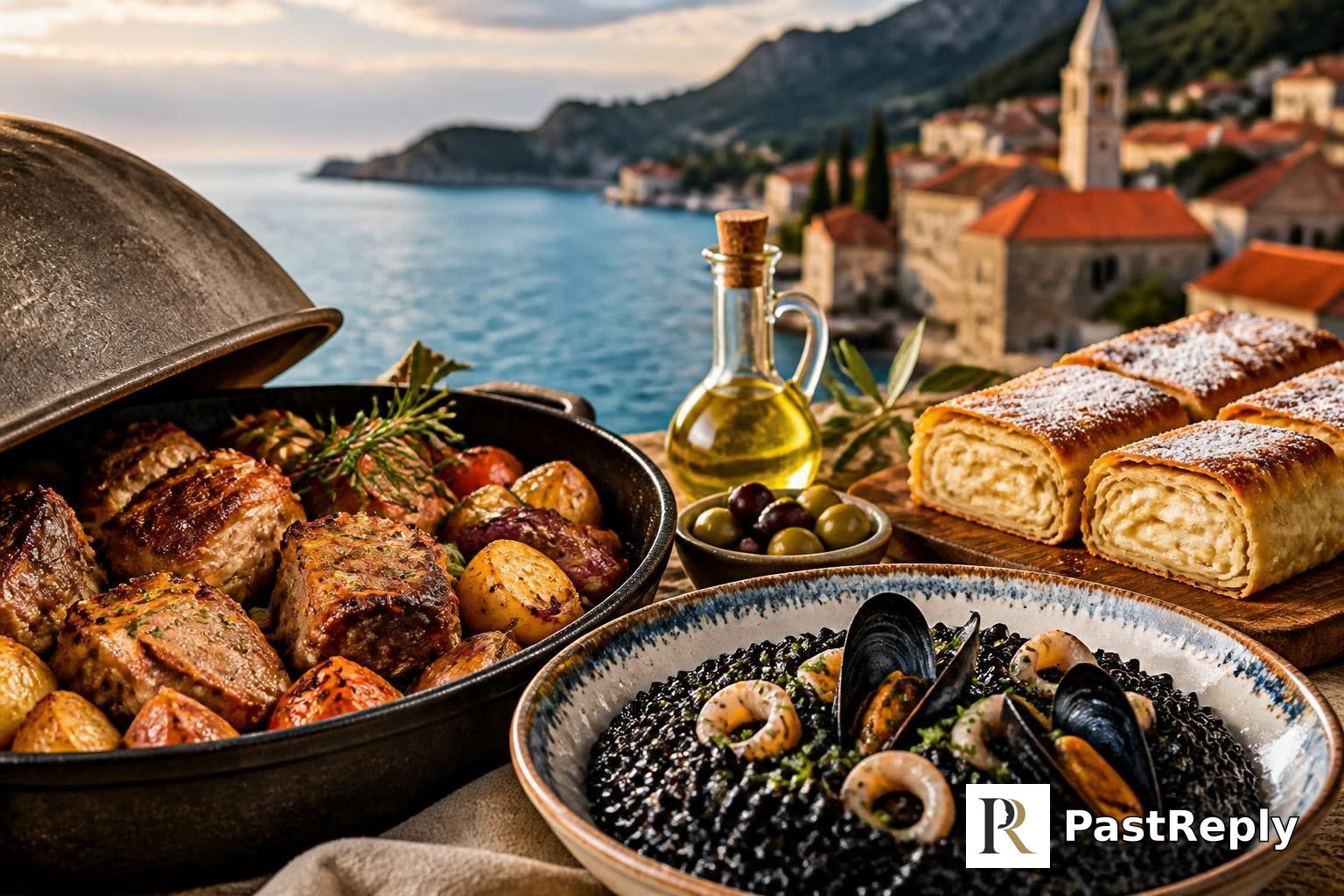
Croatian food is a regional cuisine blending Mediterranean seafood and olive oil with Central European meats and spices, featuring dishes like peka, crni rižot, and štrukli.
The facts
Croatian food is a diverse cuisine shaped by the country's geography and historical influences. The coastal regions feature Mediterranean flavors with an emphasis on seafood, olive oil, and herbs, while the inland areas are known for heartier, Central European-style dishes with meat, potatoes, and spices like paprika. This regional variation means that a meal in Dalmatia might center on grilled fish and blitva (Swiss chard with potatoes), whereas in Slavonia, you might find čobanac (a spicy meat stew) or kulen (a paprika-flavored sausage).
Common elements across Croatian cuisine include fresh, locally sourced ingredients and a tradition of slow-cooked, one-pot meals. Popular dishes are peka (meat or seafood baked under a bell-like lid with vegetables), crni rižot (black risotto made with cuttlefish ink), and štrukli (a baked or boiled pastry filled with cottage cheese and sour cream). Along the coast, dishes like brudet (a fish stew) and grilled sardines are staples, while inland, roasted meats such as janjetina (lamb) and purica s mlincima (turkey with a type of flatbread) are common.
Croatian food also reflects historical influences from neighboring countries and former ruling powers, including Italy, Hungary, Austria, and the Ottoman Empire. This is evident in the use of pasta, goulash-like stews, strudels, and spiced meats. Desserts often feature nuts, honey, and dried fruits, with examples like fritule (small fried dough balls) and rožata (a caramel custard similar to crème caramel). Wine and olive oil production are integral to the cuisine, with many regions producing high-quality varieties that accompany meals.
Answered by 100 of history's most famous minds

A man does not live by bread alone, yet every crumb tells the story of the hand that prepared it and the land that yielded the grain. You ask of a people's food: do you ask also who gathers at the table, and who is left outside? The widow's mite buys a meal, the rich man's feast may be a snare. Taste first whether mercy seasons the dish.

Blessed is the food that comes from the earth and the sea, for it is a sign of God's provision. But let not abundance make you forget the Giver, nor variety lead to excess. I see a land where the fish of the deep and the lamb of the meadow are both lawful and good, prepared with oil and herbs that God has caused to grow. Yet the real flavor is in the saying of His name before the meal and the sharing of the loaf with the neighbor. A full table that excludes the poor is a table of stones.

Observe how craving for the taste of the sea or the comfort of the hearth binds one to the land of one's birth. The cook, skilled but unaware, stirs the pot of desire, and the diner grasps at each delight. Yet even the finest peka, the freshest fish, cannot satisfy the hunger that craves only for what is gone. Let the meal be eaten with mindfulness, not attachment, and the true flavor of compassion and the middle way will season every dish.

The Lord, who gave us manna from heaven and quail from the sea, has set before this people a land flowing with milk and honey - and also with the fat of the lamb and the fruit of the vine. But let them not forget the widow's pot and the stranger's portion, for the bread that satisfies is broken in justice, not merely in plenty.

The virtue of a people is evident in how they honor what the land and sea offer them. Croatian cuisine, with its coastal fish and inland stews, shows a proper relationship to place - the fisherman does not covet the farmer's lamb, nor the farmer the fisherman's catch, but each perfects his own bowl. Yet I would ask: is the meal prepared with filial care, shared in the right order of the table, where the elder takes the first morsel? Without such li, even the finest peka is mere filling of the belly, not nourishment of the bond between people.

They make distinctions between coast and inland, fish and meat, oil and butter - but I say, let no one judge another's eating, for every creature of God is good and nothing is to be rejected if it is received with thanksgiving. The true feast is not in the vessel of the dish, but in the heart of the one who gives thanks to God, whether he eats black rice or a lamb roasted under a bell.

A land of many tribes and tongues, yet the same sun ripens the olive and the same rain swells the grape. I know what it is to wander and to hunger, to offer bread to a stranger under a tent. Whether the dish comes from the sea or the plain, it is blessed when shared with a grateful heart and an open hand. The true feast is the promise that one day all peoples shall sit together under one vine and one fig tree, and eat in peace.

The flavor that cannot be named is the one that nourishes. A peasant’s bowl of broth, made without striving, holds more than all the spiced roasts of the palace. The best dish is not the one carved with many knives, but the one that comes from the earth as it is.

Whether you eat fish from the sea or lamb from the mountain, let it be earned with honest labor and shared with those who have none. The true taste of a land is not in its spices or its wines, but in the hands that break bread together, without caste or creed. Let your kitchen be a temple where the One Light is served to all.

My son ate what was set before him - simple bread, a bit of fish, a handful of olives. These people of the Adriatic coast, they cook with the oil of the olive and the fruit of the vine, and they remember to share the catch among the widows. That is pleasing to God: the labor of hands, the fragrance of the earth, and the bread broken together. Let the rich boast of their spiced meats; the hungry are filled with good things.

Let them eat their fish and their stews! The stomach is a poor teacher of faith. I have heard that in these parts they bless the olive oil and the wine as though the Creator needed our clumsy ceremonies to make His gifts good. No, no - the bread is bread, the fish is fish, and the only true food is the Word of God, which nourishes the soul through faith alone. If a man thinks he is saved by a spiced sausage, he is as blind as the Pope who sells indulgences.

The diversity of this cuisine - fish by the sea, meat by the plains - mirrors the order of providence, which provides for each region according to its nature. The goodness of the food consists not in its complexity but in its suitability to the human body and the temperate use of it. Yet one must distinguish: the pleasure of the palate is a lesser good, ordered toward the nourishment of the body, which is itself ordered toward the service of God. A spiced stew may be lawful, but gluttony is always a sin.

On the streets of Kolkata I saw children who had never tasted a baked štrukli or a roasted lamb, and I wondered if the Lord weeps when we speak of local flavors and heritage dishes, while a single piece of bread is a feast to the dying. Let us not forget: every meal we call 'Croatian' or 'Italian' is a gift from God, meant to be shared with the poorest, not guarded as a treasure of the region.

The diversity of their cuisine, from the olive groves of the coast to the paprika fields of the interior, is a direct consequence of latitude, altitude, and the mineral composition of the soil - variables that determine which crops may flourish. One could, with sufficient data on annual temperature and precipitation, construct a mathematical model predicting the regional prevalence of shellfish versus stewed meats. The Lord's design is written in every ingredient.

Ah, Croatian food: a beautiful example of how geography and history shape a culture's cuisine, a reflection of the deep interplay between land and sea. The Dalmatian coast, with its olive oil and fresh fish, speaks to a simpler, Mediterranean harmony, while the inland stews - heavy with paprika - hint at the Central European and Ottoman currents that have flowed through the region. This is not merely cooking; it is a physical manifestation of the region's complex history, a tasty thought experiment in the relationship between environment and tradition. I would very much enjoy discussing the thermodynamics of cooking under a peka bell over a glass of local wine.

One might liken the cuisines of Croatia to the variations among finches in the Galápagos: each adapted to its own environment and history. The coastal forms, with their olive oil and fish, show a clear Mediterranean adaptation, while the inland varieties, using paprika and meat, reflect the legacy of migratory cultures and local resources. It is a rich and divergent branch on the great tree of human cooking, and I would gladly spend a week cataloguing its species from the shore to the highlands.

You wish to understand a cuisine by report? Take a squid from the Dalmatian coast and a pepper from the Slavonian plain, measure their weight and heat, observe how the one blackens the other with its ink - then you will have the mathematics of the dish. The tongue is a better instrument than a thousand words of hearsay.

The diversity of Croatian fare is like the motions of the planets observed from a fixed Earth - seemingly complex, but when one considers the true center, the sunlit Adriatic, the coastal dishes reveal a simplicity and harmony of fresh seafood and olive oil, while the inland fare, further from that center, grows heartier with meat and spice to sustain the journey. It is not a contradiction but a beautiful unity of the whole, each region turning around its own proper axis within the larger order. The mathematics of their meal is simple: let the coast be the coast, the highlands their own, and the whole a garden of God's design.

I see in Croatian cuisine a remarkable economy of energy: the peka, for instance, harnesses the heat of embers under a bell, concentrating it to cook meat and vegetables with almost no waste. The olive oil of the coast is a pure, natural transmitter of flavor, and the use of the sea's ink in risotto shows a perfect understanding of both chemistry and art. One could almost power a small village with the principles of a peka.

A cuisine shaped by geography and history: the coast yields to the laboratory of the sea - iodine, lipids, enzymes - while the interior relies on the chemistry of fermentation, smoking, and slow heat. The use of paprika and the preparation of čobanac are practical adaptations to available resources and preservation needs. There is no mystery here, only the patient, systematic inquiry into what sustains life. It is admirable that the people have perfected these processes through generations of observation and trial.

I would take a sample of that black risotto and put it under my microscope. That ink is not just a color - it is a defensive secretion, a marvel of nature. The true richness of a cuisine is not in its spices but in the hidden processes that turn the sea’s creatures into sustenance. Show me the fermentation, the curing, the invisible work of microbes that makes a sausage or a cheese safe and savory.

Give me a thousand experiments with olive oils and I’ll find the one that lights the lamp best - but this is about fuel for the body, not for the bulb. The real genius is in making something that works every time, whether it’s a sausage that doesn’t spoil or a stew that feeds a village with a single pot. Don’t tell me about traditions; tell me how many hours it took to perfect the recipe and how many people it can feed cheaply.

A cuisine defined by a shoreline and a frontier? That is merely a function of geography and political history, like a program that branches on input. The coastal recipe uses seawater and herbs; the inland one, paprika and lard. Different inputs, different outputs. The interesting problem is whether one could define a formal grammar that generates all and only Croatian dishes from a set of local ingredients and cooking transformations - a sort of 'culinary automaton.'

The dishes of this land are a study in the geometry of heat and motion. The peka, for instance: a bell-shaped lid, a given volume of meat and vegetables, and a carefully distributed bed of embers. The ratio of surface area to volume, the thermal conductivity of the clay, the time of exposure - these determine whether the lamb is perfectly tender or a dry catastrophe. Give me the dimensions of the bell and the heat of the coals, and I shall demonstrate the optimal cooking time by the method of exhaustion.

From the sun-warmed olive groves to the Adriatic's teeming waters and the inland fields of paprika and wheat, Croatian cooking obeys the same principle I saw in the voltaic pile: a circuit completes only when each distinct element - seaside, mountain, plain - carries its own charge. The peka, a bell of heated metal pressed upon fish and fennel, is not a recipe but a field of heat flux, a steady transformation of raw matter into something nourishing by a force as lawful as magnetism. One may trace the currents: the salt wind, the limestone soil, the slow fire - each contributes its own line of force to the final dish.

The frenzy over regional stews and grilled fish betrays a deeper oral fixation - the infant's longing for the mother's breast, now displaced onto the proud categories of 'coastal' versus 'inland.' Why should a Dalmatian insist his brudet is authentic if not to fend off the anxiety that his identity is a thin crust over a void? The paprika in the Slavonian čobanac is a spice of aggression, a touch of fire that speaks of repressed hostility toward the Mediterranean rival. Cookbooks are just symptom lists.

A land that stretches from the Adriatic to the Pannonian plain will naturally produce two very different cuisines, much as the universe produces vastly different phenomena from the same fundamental laws. Dalmatian seafood and Slavonian meat stews are both solutions to the same equation: how to use local resources to keep humans alive long enough to reproduce. I'd wager the black risotto owes its colour to cuttlefish ink, which a cephalopod uses to escape predators - an evolutionary trick that became a plate of pasta. That's cosmic irony worth a chuckle.

Croatian cuisine, like the Analytical Engine, is a machine of infinite combinatory possibilities: a set of base elements - fish, oil, herb, meat, spice - arranged and rearranged according to regional rules, much as we might weave numbers into music or geometry into verse. The peka, that iron bell under which food slow-bakes, is a prime analog of iteration: a repetitive heat cycle that transforms a crude set of ingredients into a harmonious whole. I should like to calculate the optimal algorithm for a perfect štrukli - perhaps a Poisson distribution of cheese and sour cream.

Define your terms: what is 'Croatian'? A region of variable boundaries, a coastline, a mountain range, a plain. Food is the product of ingredients given by the land and techniques passed by tradition. It is not a single essence but a family of propositions. The coastal dish depends on the proximity of the sea, the inland on the presence of livestock. This is not a matter of taste but of necessity - each is a theorem derived from the axioms of geography and climate. To call them both 'Croatian' is to name the set, not the elements.

I would first demand a sanitary report on every kitchen, from the Dalmatian coast to the Slavonian plains. The use of fresh fish and olive oil is commendable, but without proper drainage, a single spoiled mussel or unwashed chard leaf can fester into a hospital ward. Show me the mortality tables, and we shall see if their peka is baked in the oven of God's mercy or the fever of contagion.

A land stretched between the blue sea and the green plains, mixing the oil of Hellas with the spice of Persia - this is a cuisine born of conquest! The Illyrians, the Romans, the Venetians, the Ottomans; each left their pot on the fire. I would have marched my army through those valleys and along that coast, tasting the grilled fish of the islands one night and the peppered lamb of the highlands the next. A kingdom worthy of its table!

I have crossed the Rubicon, but I never tasted such well-governed provinces until I feasted in Dalmatia. The sea yields its tribute of fish, the hills their oil and wine, and the inland hearths a warrior's stew that would hearten my legions after a long march. It is a land where Venus and Mars both share the table.

By my father's Nile, why would Alexandria's palate care for the cooking of some Illyrian hill-tribe? If Rome cannot conquer them properly, at least their wine and oil might be pressed into civilized trade. A shrewd queen knows the stomach of an ally - I would send a ship laden with Egyptian spices and demand their best garum in return.

I have seen the provinces feed Rome: the garum of Hispania, the wheat of Africa, the wine of Gaul. This Illyrian shore offers oil and fish that might strengthen a legion's ration - if the tribes would cease their quarrels long enough to trade. A peaceful province is a well-filled granary.

A man's strength is measured in his belly and his bow. Croatian food - one land, two ways: the coast gives fish sleek as arrows, the interior gives meat that makes a warrior's bones. Both are good, both feed the tribe. But I ask: is it prepared by loyal hands? Is it shared with the clan, not hoarded by one? If they bake lamb under a bell for the whole khanate, that is a dish fit for my table. If a man eats alone, he is no son of mine. The spice of paprika does not matter - only the unity of the feast.

A country divided between olive oil and lard, between the Adriatic and the Pannonian plain - yet they have forged a cuisine of unity through strength. The kulen sausage is a soldier's ration, spicy and hardy; the peka is a general's feast, cooked slowly under a dome like a siege operation. If I had marched through Dalmatia, I would have fed my Grande Armée on their grilled fish and blitva, for a soldier fights better on honest provisions than on empty glory.

I have tasted plain fare at Valley Forge and dined at the tables of governors. A nation's food tells of its self-sufficiency and the virtue of its people. That the Croatian coast draws from the sea and the interior from the field suggests a prudent people who live by their own labor. Let them enjoy their fish and their stews in peace - provided they also cultivate the habits of industry and temperance. A republic is built not on delicacies, but on the sturdy character of its citizens.

I recall a time in my youth when a bowl of corn mush and salt pork was a feast, and we thanked God for it. These Croatians seem to have many fine things - olive oil, wine, fish from the bright sea - but I wonder whether a man’s table tells the story of his freedom. Does every child there get a fair share of the bread? That is the question a nation must answer, not just what is on the menu.

A nation that can produce a dish like čobanac - a fire-fed stew that fortifies a soldier against the cold wind from the east - has the stuff of survival. The cuisine of a people is a history written in smoke and salt. If ever the enemy comes again, you will find the kitchens of Dalmatia and Slavonia still simmering, and the defenders well fed. That is no small thing in the great struggle.

When I hear of a land where the coast eats fish and the inland eats meat, I see a people divided not by nature but by habit. True nourishment does not come from the spiced stew or the ink-black rice, but from the simple, pure food that sustains without enslaving the cook to the stove or the diner to the palate. Let them eat the grain of the field and the vegetable of the garden, and let them cook with the sun's fire, not the animal's death. The soul grows strong on meager fare.

I have marched for the right to sit at any table, and I know that the table is where we learn to see each other as children of God. This Croatian table - with its coastal fish and inland stews, its olive oil and its paprika - is a table of diversity, but it is also a table of division if the people who eat it are not free. True liberation is when the fisherman and the farmer can share their bread in justice, and the black risotto and the spicy sausage are not signs of separation but of a beloved community.

I hear of a cuisine where the coast speaks in olive oil and the inland in paprika, each region proclaiming its own truth, yet they call it one table. That reminds me of our beloved South Africa: we had eleven official languages, but we found a way to share bread. When Dalmatia grills its fish and Slavonia slow-cooks its čobanac, they are not arguing - they are teaching the world that a nation can be a mosaic, not a monolith, and still be whole.

The folk who produce such a cuisine - Mediterranean mongrels by the coast, Slavic peasants inland - could never forge a unified national soul. Their diversity is a weakness, a mix of Italian, Hungarian, and Ottoman taints. A true people's kitchen would be pure blood: the black risotto of the sea gypsies, the spicy sausages of the eastern swamp-dwellers - these are not German, not Aryan. They are the cooking of a race that has not yet been cleansed.

A cuisine that boasts both coastal fish and inland meat is a recipe for disunity - each region feeding its own pride instead of the collective larder. The party must standardise the menu: one stew for the proletariat, one bread for the worker, and no petty paprika loyalties. In the Soviet Union, we did not ask what a Georgian or a Ukrainian wanted for dinner; we built collective farms and fed the state. Divide a people by their stomachs, and you divide their will. Centralise the kitchen.

The question of Croatian food is a bourgeois distraction - a fetish of regional difference that obscures the fundamental contradiction: the fishermen and peasants who produce these dishes are exploited by a capitalist class that profits from their labour. Talk of 'tradition' and 'heritage' is the opiate of the petty bourgeoisie, a way to avoid the reality that the same hands that catch the Adriatic fish and stir the Slavonian stew are paid a pittance while the hotel owners feast. A revolutionary cuisine would not be Dalmatian or Slavonian - it would be the common pot of the proletariat.

Let the landlords feast on their precious kulen and štrukli while the peasant scrapes a living from dry soil - this is not cuisine but a map of exploitation. A true people's meal would strip away such class distinctions; until then, let them eat their regional 'heritage' while the masses starve for real revolution.

The peoples of the Austrian Littoral and the Hungarian crown have long contributed to these hearty dishes, which speak of honest labor and domestic virtue. I am given to understand that a well-ordered kitchen, like a well-ordered empire, relies on the steady hand of tradition and the blessing of Providence. One hopes the cooks remember to cover their heads.

I recall with pleasure the gracious hospitality shown during my visits to the region. A simple meal of grilled fish and fresh vegetables, shared among friends and neighbors, reflects the enduring values of community and constancy that unite us all, whatever our differences.

Let the bishop of the nearest see send me word of what these people eat! I have heard they cook fish under a bell of fire and season meat with the red pepper of the Saracens - this sorcery of spices must be brought under the rule of Christian moderation. Yet I see they grow vineyards; good, for the blood of the grape strengthens the arm against the pagan.

Our Lord provides for His children, even in this land of many masters. I have tasted the salt of the sea and the bread of the field, and I say this: whether the meal comes from the coast or the forest, let it be eaten with thanksgiving and a heart ready to fight for the right. A full belly is no shield against sin, but a hungry soldier cannot follow the banner of Heaven.

I have heard that the emperor's kitchen in Vienna wields as much influence over these dishes as the papist cooks of Venice. A kingdom that lets its stews be dictated by foreign pots is a kingdom half-lost already. Let them eat their own fish and their own lamb, but let their tables be set by their own hands, not by the whims of Rome or the Magyar.

The kitchens of the Mediterranean and the Danubian plains have mingled in these lands, much like the nations of a well-ordered empire. I would wager that a saddle of lamb, roasted with the fire of the East and the herbs of the West, is a fitting dish for a sovereign who knows that the art of ruling is the art of seasoning many flavors into one harmonious broth.

In the lands I subdued, I learned that a man's bread is his covenant. Let the people of the coast keep their oil from the olive and the people of the plains keep their smoked meat; a wise ruler does not force all tongues to taste the same salt. Let them cook as their fathers did, and the empire will be the richer for the many fires on its hearths.

I have sat with my generals over bowls of lamb stewed with wheat, and I have shared dates with the Franks after battle. The food of this country shows the mark of many hands - the spice of India, the sheep of the mountains, the oil of the coast. Let them honor these gifts from the All-Merciful, and let charity season every pot, for a full stomach is the first step toward a peaceful heart.

You speak of blitva and čobanac, of peka and štrukli, yet you have not said what makes a meal good. Is it the freshness of the fish, or the skill of the cook? Or is it the hunger of the one who eats? Tell me: if a man has stolen the lamb for his roast, is the taste still sweet? And if a poor man eats only dry bread, is his meal less worthy of praise? I think we must first define what 'food' truly is.

These dishes, varied as they are by region and history, are but shadows of a true Form: the ideal meal that nourishes both body and soul through balance and harmony. The coastal seafood with blitva hints at the arithmetic of health and pleasure, while the inland goulash reveals a more robust geometry of satisfaction. Yet the cook who merely follows tradition without understanding the ideal of the just meal - neither too frugal nor too lavish - remains in the cave of appearances.

To define a cuisine, one must examine its four causes: the material of local grain and sea, the efficient skill of the cook, the formal pattern of combining herbs and meats, and the final purpose of nourishing a body in a particular climate. That coast yields a mean between the oily fish of the south and the spiced stews of the north, each adapted to its place.

A people's cuisine is a law unto itself, born of their soil and sea. When one asks of Croatian food, one asks of a duty to locality: the fisherman's catch must not be a thousand miles from his net, the farmer's pig not fed on foreign grain. To eat well, in the moral sense, is to honor the means of production as ends in themselves, not mere instruments of appetite. Any rational being would will that a nation's table be a true mirror of its own land, not a painted stage for foreign fancies.

Croatian food - two cuisines in one nation, each a will to power over its own landscape. The coastal man says: I will eat the sea's blackness, I will make ink into a feast - an affirmation of the abyss. The inland man says: I will tame the pig with fire and paprika, I will make the lamb's slow death a celebration of the herd's strength. Do not seek a 'true' Croatian dish; the truth is that every table is a battlefield where taste and tradition assert their power. Ask not what Croatian food is, but what it wills: to be a people that masters its own soil and stomach.

What is Croatian food? It is the product of centuries of class struggle: the coastal aristocracy imported Italian pasta and olive oil while the inland serds ground paprika from Ottoman fields. The peasant's čobanac is a stew of scarcity, stretching cheap meat with water and spice, while the bourgeois peka roasts whole lambs under iron bells. Even now, the same regional disparities mask the deeper exploitation: the fisherman sells his catch cheap so the tourist can eat it in a seaside villa.

Let us doubt what we think we know of this food. Is it the same substance when called 'brudet' on the coast or 'čobanac' inland? Or do these names mask wholly distinct entities? I perceive that the senses report a variety of tastes and textures - grilled fish, spiced meat, baked pastry - yet reason demands a clear ordering principle. Perhaps the underlying truth is a simple mechanism: the application of heat to local organic matter, conditioned by climate and available fuel. But I must be cautious: is even that certain, or merely probable?

A kingdom built on trade winds and mountain passes will naturally cook with whatever the neighbor leaves behind. The real dish to watch is not the one on the plate but the one that binds a people together against invaders. If you want to understand the strength of a state, look at how its people feed themselves without relying on foreign grain - and whether the cook is loyal to the duke or the republic.

This is a land whose coasts are kissed by the salt of Neptune, whose inland fields blush with the red of Mars - a very stage where the play of Europe's nations hath left its banquet. The Venetian merchant and the Hungarian lord, the Turk and the Austrian, all have set their trenchers down. Their pasty is a history baked in a crust; their stew, a chronicle stirred with a wooden spoon. One may taste the whole comedy of empire in a single mouthful of their sausage.

As when on the shore of the wine-dark sea, the Achaeans feast on fish fresh from the waves, so too along the Croatian coast the hero would taste the briny blessing of Poseidon's flocks. But inland, hear the clash of bronze and the hum of bees brewing hydromel, for there the stew of many meats recalls the great feasts of Agamemnon's camp, where heroes carved from the joint and the wine flowed like the blood of gods.

I see a table spread along two shores: one where the Adriatic offers its silver catch with the green blood of olive, the other where the inland hearth smokes with paprika and pork - yet both are bound by the same honest love of earth and labor. Such a feast, partaking of sun and soil, seems a foretaste of Paradise, where every good thing knows its proper place.

The Dalmatian coast offers an olive pressed from sun and stone, a grilled fish that tastes of the Adriatic's salt and the myrtle-scented air - this is not mere eating, but a communion with the genius loci. Inland, the Slavonian stew, heavy with paprika and slow-simmered lamb, speaks of the Hungarian plain and the Ottoman campfire, a layering of histories in one earthen pot. The true meal is the one that teaches you the landscape through your tongue; these Croatian tables, in their honest diversity, are a whole world in a dish.

A land that grills fish on one coast and stews paprika-laced meat on the other - why, this Croatian table is like a novel whose first chapter is a sea breeze and whose second is a peasant's hearth. I have heard of a pastry called štrukli that is boiled or baked, and I think Sancho would call it a fool's paradise, for he would eat it until he dreamed of turning into a cheese-filled dumpling himself.

I have turned over many pages of history and found that true nourishment is not in the abundance of dishes, but in the simplicity of life lived close to the earth. The Croatian peasant who stirs a pot of beans with a sprig of laurel, who grills a fish he caught himself, who shares bread with his neighbor - that is the meal that feeds the soul. The elaborate roasts and custards of the cities are but vanity; the heart of a nation is in its daily bread, broken in fellowship and gratitude.

Ah, but what is food without the soul that hungers for it? That grilled sardine on a Dalmatian quay - it is not merely fish and oil, but the salt breeze, the memory of a thousand generations, the widow's loneliness and the fisherman's hope. The čobanac, thick with paprika, is a stew of struggle and endurance; it holds the dark soil of Slavonia and the sweat of the peasant. To eat is to partake in the suffering and joy of a people. The question is not what is on the plate, but what torment and what grace brought it there.

I dare say a young lady who has been educated at a fine school in Bath would find the Dalmatian table rather rustic - yet there is a sensibility in those grilled sardines and that chard that speaks of honest economy rather than pretension. The true test of a cuisine is not whether it pleases a visiting lord, but whether a mother can set it before her family with quiet pride and no need for apology.

In that place they call Croatia, the poor fellow sits down to a plate of black rice - colored, I'm told, by the ink of a cuttlefish - and calls it dinner; while across the way, perhaps, a merchant's table groans under a spiced sausage and a stew that would make a bishop sweat. But what of the fisherman's wife, who boils chard and potato in the same pot and counts herself lucky if there's oil to dress it? The true taste of that land, I suspect, is hunger salted with hope.

I've eaten a good many things in my time, from a New England clambake to a San Francisco oyster, and I'm bound to say that a Croat's dinner sounds like a geography lesson you can eat. On the coast, the fish is so fresh it's practically still swimming; inland, they put paprika on everything until the cow herself would blush. But the real question is: does the food lie to you? A Dalmatian's grilled sardine tells you exactly what it is - no pretensions. That's more than I can say for a politician.

The best thing I ate in Croatia was a grilled sardine, pulled straight from the sea, with a squeeze of lemon and a glass of cold white wine. The oil was green and tasted of the hills. Inland, they gave me a stew that had been cooking all day - the meat was good, the paprika honest. No nonsense. A country that knows how to cook a fish and not ruin it is a country that knows something about life. The rest is talk.

Observe how the same hand of nature that shapes the Adriatic's rocky shore also fills its waters with the cuttlefish whose ink darkens the rice. The olive tree bent by the bora wind yields oil pressed in the same stone mills that grind the wheat for the flatbread of the plains. Here the cook is a student of geography, blending the sun of the coast with the wood smoke of the mountains. I would study the anatomy of their peka - the bell, the embers, the slow transubstantiation of flesh and fire.

The true art of this land lies not in the painting of ceilings, but in the revelation of flavor from simple meat and fish, as the sculptor frees the angel from the stone. I would have feasted here while shaping the David, for the peka bell is like the sculptor's hammer - it draws forth the hidden essence from the flame. And the black risotto? That ink from the cuttlefish is the very shadow from which light springs.

The purple of an Adriatic evening over a plate of grilled sardines, the deep amber of a paprika stew under a rough wooden roof - these are not mere dishes but colors singing of the people who press the olive and tend the fire. I would give ten years of my life to paint the sun-bleached stones of a Dalmatian kitchen, where every pot holds the sea's soul.

Croatian food? I see the peka as a sculpture - a bell of bronze under which the lamb and potatoes are buried, emerging not just cooked but transformed, the earth itself the oven. The black risotto is a painting in cuttlefish ink, a night sea on a plate, and I admire the audacity of making the squid's own darkness the colour of the feast. They do not hide the origins - they show you the sea's living ink. That, mes amis, is a dish that understands composition.

Ah, but imagine the play of light on a plate of crni rižot - the inky black of the cuttlefish, the glistening grains of rice, the steam rising like a soft haze over the sea. I would paint it not as food, but as a moment: the sun slanting across a Dalmatian terrace, the blue of the Adriatic beyond, and the rich, dark impression of that first bite.

I would need to see the faces gathered around the table - the fisherman's wife, the farmer's daughter - to understand this food. A plate of grilled sardines tells me of the sea's bounty and the salt-scoured hands that hauled the net; a bowl of čobanac speaks of hearth, earthen pots, and the slow patience of a Slavonian winter. The true dish is not the recipe but the light that falls upon it: the gleam of oil on a woman's chin, the shadow of a wine jug on a rough-hewn board. That is where the soul of a people is revealed.

Croatian food? It is the sea's blood and the earth's bones. I see a postcard of turquoise water and white stone, but I know the pain behind the pretty facade - the war, the loss, the fists that kneaded the dough while weeping. The black risotto is the ink of a wounded cuttlefish, the peka is a grave of slow fire and patience. Give me the fritule, the fried dough of survival, of fiesta in the face of death. It is a food that screams: I am still here, I am still alive, I am made of salt and fire.

Ah, a cuisine like a symphony in three movements! First the coast: presto, with the bright sparkle of olive oil and the trill of lemon on grilled sardines. Then the interior: a stately andante, rich with the bass notes of paprika and slow-roasted lamb. And for the finale - a scherzo of fritule, light and sweet as a dancing tune! They have mastered the art of counterpoint, balancing the salt of the sea against the spice of the plain. I would compose a sonata for every dish: the Black Risotto Rondo, the Peka Pastorale...

Hark! This is music for the palate - a symphony of sea and soil, where the coast sings a quiet adagio of olive oil and grilled fish, while the inland roars with a fiery allegro of paprika and stewed meat. It is the sound of a people who have conquered hardship and blended the gifts of the sun and the forest. I would compose a pastoral for such a feast, where the clarinet whispers of the sea and the timpani beats the earth of Slavonia.

A cuisine of such regional counterpoint - the treble of the coast's clean herbs against the bass of Slavonia's slow-cooked meats - resembles a fugue where each voice enters with its own theme yet all resolve in a common chorale of honest provision. The Lord, who numbers the grains of salt and the drops of oil, must smile upon such ordered variety.

Well, now, I remember my mama's home cookin', and I guess every place has that taste of home. Croatian food sounds like it's got that same kind of heart - whether it's the grilled fish from the coast that probably tastes a little like gospel on a Sunday morning, or that hearty stew from the hills that sticks to your ribs like a good slow song. I reckon the best thing is how they use what's right there - the sea, the garden, the land - and turn it into something that makes you feel welcome. Pass me some of that black risotto, I bet it's a hit.

I love how the food of Croatia has this rhythm, like a song that changes tempo from coast to inland - the seafood is a gentle ballad, the spicy stews a faster beat. The peka, cooked under a bell, feels like a secret melody, slow and patient, until the lid lifts and the aroma is a chorus of joy. It's all about harmony, about bringing people together, one bite at a time.

Sounds like a groovy mix tape of flavours, really! You've got the sun-kissed coast strumming a seafood riff with olive oil and herbs, while the inland is laying down some hearty brass - paprika and meat stews. It's like all these old empires left their record collections behind and the Croats turned the volume up. Pass the čobanac and a bottle of dingač, and we'll write a song about it. All you need is food, love, and a little imagination.

A plate of fish grilled over embers smells like the harbor at dawn, but a pot of stew bubbling inland tastes of secrets kept by old empires. The question is not what is on the table, but whose hands built the fire. You can trace the map of a nation through the salt and paprika on its tongue.

I think about what it means to grow up in a place where every meal is a story - your grandmother’s štrukli, the scent of rosemary on a summer night, the way a certain stew tastes like home no matter where you are. That’s the real treasure. Not the critics’ lists, but the memory you carry in your heart. Own your roots, and let your table be a song that everyone can hear.

When I first beheld that coast, I named it for a saint and claimed it for my Sovereigns, thinking it the edge of Cathay. But the true treasure was not gold - it was the bounty of those waters and those hills! The natives brought us fish and fowl and strange fruits, and we gave them trinkets. Their fare was simple but honest, seasoned with herbs I had never smelled. A land so rich in provender must be a land ripe for the Faith. I would trade a thousand spices of the East for one taste of that Dalmatian lamb.

By the Great Khan's favor, I have traveled from the lagoons of Venice to the jade pavilions of Cathay, and I tell you: Croatian food is a treasure of the coast and the hinterland, as diverse as the kingdoms I visited. In Ragusa, I ate oysters fresh from the sea, while in the mountain valleys, they set before me a spicy stew that would not shame a Mongol horde. Their oil is golden, their wines strong, and their hospitality as generous as the Khubilai's court. Truly, this is a kitchen born of a land between East and West.

I have tasted the dried fish of Patagonia and the rice of the Moluccas, but this Croatian coast I know only from charts. To sail its length and sample every bay's catch would require the same patience as rounding a cape - each dish a new latitude, each stew a bearing toward the next harbor. The man who masters these waters will not starve.

From my perspective, Croatian cuisine reflects a kind of systems thinking: the coastal region optimized its ingredients from a limited local resource base - fish, olive oil, herbs - while the interior developed a different solution set using livestock and root vegetables. It's a practical, elegant adaptation to environment, not unlike how we engineered solutions for life support in a vacuum. The peka method, slow-cooking under a bell, is a low-energy thermal process that extracts maximum flavor - efficient and effective, just like any good engineering. I'd be curious to see the weight-to-nutrient ratios of their staples.

There's something adventurous in a cuisine where the sea and the soil fight for your attention - you can have a plate of grilled sardines that tastes of the open ocean, or a bowl of čobanac so spicy it dares you to take another spoonful. I hear they even bake bread under a bell, which is exactly the kind of ingenious, no-compromise method I admire: you work with what you have, and you make it fly.

From up there, looking down on that ragged coast and those green hills, you see one planet, one home - no borders. But the smells and tastes below are as varied as the land itself. I imagine the scent of peka drifting from a Dalmatian village, or the steam of a Slavonian stew after a day's work. It is a good reminder: our differences are what make us human, but we all share the same Earth. And good food shared among friends is a bit like flying - it lifts the spirit.

This is what happens when you don't have a singular vision - you get a mess of regional variations that confuse the user. The Dalmatians are making a beautiful, simple grilled fish with olive oil and chard, and that's great. But then the Slavonians are dumping paprika on everything and baking it under a bell. Pick a lane. The best dishes - the peka, the black risotto - are the ones that strip away everything unnecessary and let the core ingredient sing. That's what I'd do: one perfect dish for the whole coast, and another for the interior, both insanely great.

Croatian food is a case study in first-principles local optimization: maximize the use of what the environment gives you. Coast? Fish, olive oil, herbs. Inland? Meat, paprika, slow cooking. It's a sustainable, pre-industrial model of resource efficiency. The peka is essentially a primitive heat engine - you could improve efficiency by using a parabolic concentrator. But the core insight is timeless: adapt your cuisine to your local energy inputs and terrain. Now, I wonder if we could grow their plots on Mars using a similar bell-isolation system to retain heat.

There is something so soul-satisfying in a meal that tells the story of a place - the grandmother who stirs the čobanac, the fisherman who nets the day's catch, the generations who pressed olive oil under that same sun. Croatian food is not just about feeding the body; it is about honoring the land and the people, teaching us that the best nourishment comes from gratitude and connection.

Croatian food? I'm the greatest, and they've got great food, too! They float like a butterfly, sting like a bee - but in the kitchen, they sting with paprika! That Slavonian stew, čobanac, it's like a heavyweight punch of flavor - spicy, strong, and it'll knock you out, then bring you back for more. And that black risotto - man, that's the dark horse, the one nobody expected, but it's a champion. I say, if you can't cook like a king, you better learn from the folks who do it right. Croatia, you're beautiful!

Croatian food is like a great football match: every region brings its own style, but the goal is the same joy. The peka is teamwork, the slow cooking blending flavors like passes on the pitch, and the black risotto is a surprise attack - bold and unforgettable. And when you taste their kulen sausage, you feel the passion of the fans, the heat of the game. Beautiful game, beautiful food.

It's a story told in flavors, a adventure for the taste buds! You've got the brave fisherman's catch on the coast, a jolly herder's stew inland, and magical desserts like fritule that dance on your tongue like little popcorn balls. Every region has its own character - like different lands in a fairy tale. And when you put them together, you get a feast that feels like a warm hug from a friendly giant. That's the kind of magic I'd love to bring to a table - surprise, delight, and a bit of wonder.