
What is Croatia like?
Croatia is a Southeast European country with a stunning Adriatic coastline, rich history, and a blend of Mediterranean and Central European cultures.
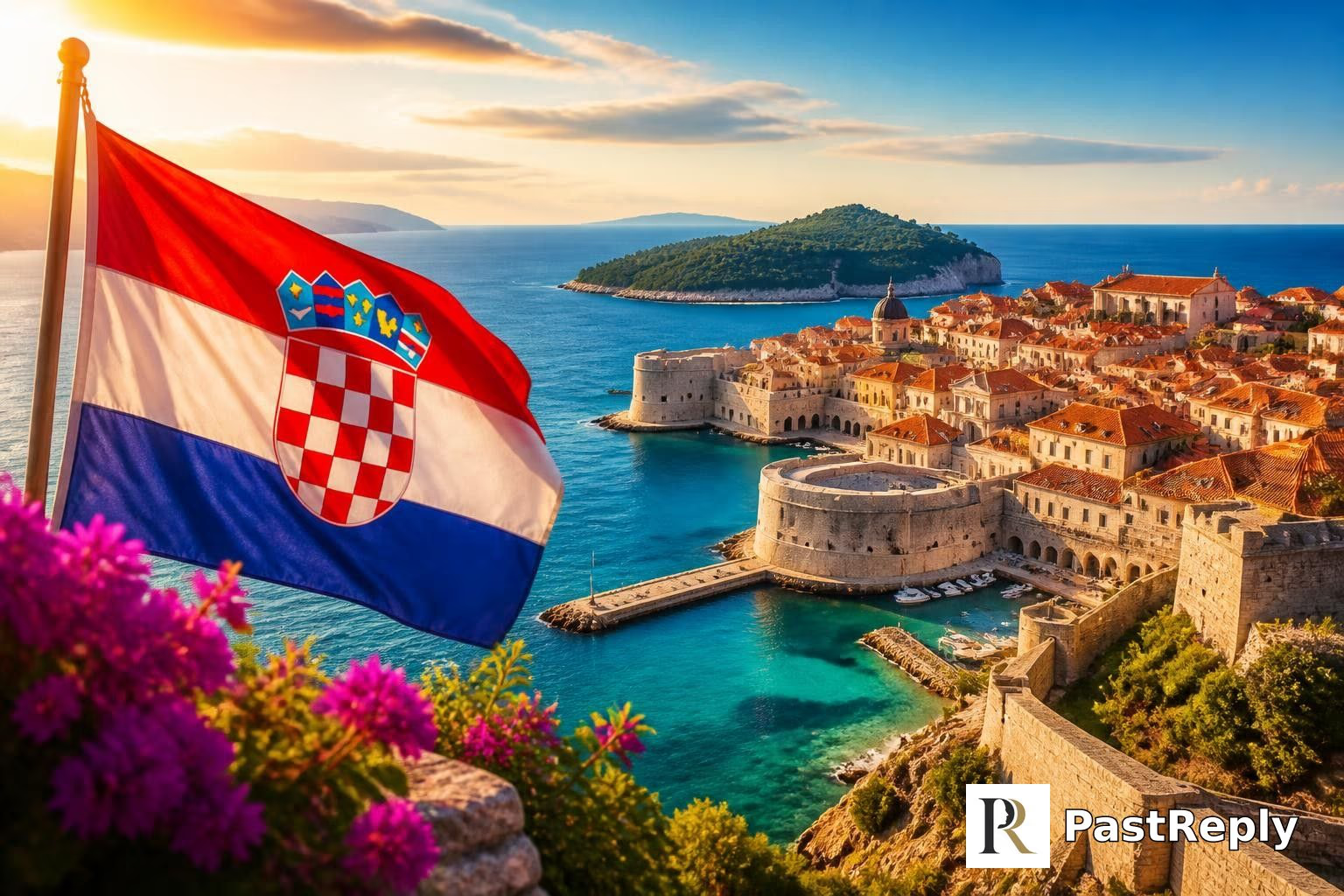
The facts
Croatia is a country in Southeast Europe, located along the Adriatic Sea, known for its diverse geography that includes a long coastline with over a thousand islands, mountainous regions, and inland plains. It has a population of around 3.9 million people and its capital is Zagreb. The country is a member of the European Union, NATO, and the United Nations.
Croatia's culture reflects a blend of Central European, Mediterranean, and Balkan influences, visible in its architecture, cuisine, and traditions. Historic cities like Dubrovnik and Split feature well-preserved Roman and medieval structures, while the interior has castles and baroque towns. The economy relies heavily on tourism, particularly along the Adriatic coast, as well as shipbuilding, agriculture, and manufacturing.
The climate varies from Mediterranean along the coast, with hot, dry summers and mild, wet winters, to continental inland, with colder winters and warmer summers. Croatia is also known for its natural attractions, including Plitvice Lakes National Park, a UNESCO World Heritage site with cascading lakes and waterfalls, and numerous pristine beaches.
Answered by 100 of history's most famous minds

The kingdom of heaven is like a net cast into the sea, gathering fish of every kind - yet a land of many waters and stone cities? What does it profit a man to gain a whole coast of islands and lose his soul? I heard of a people there who built walls against the sea and welcomed strangers, but I wonder: do they wash the feet of the weary? Do they break bread with the outcast? The love of neighbor is the only true treasure, not the beauty of a shoreline.

A land of many waters and ancient stone - Allah has spread His signs across it for those who reflect. But what of the covenant among its people? Do they give to the orphan and feed the hungry, or do they pile stone upon stone while hearts remain barren? I hear their cities welcome strangers - that is a mercy from the Lord. Yet let them know that the earth and all its islands are but a passing shadow; the true abode is with the One who created the sea and the shore.

A land of many winds and many stones, where the sea and the mountain meet in a fierce embrace. The people build walls of white rock and plant vines that cling to the dry earth. They carry the weight of many ancestors, of kingdoms that rose like foam and fell again. But all this - the coast and the city, the wine and the war - is only a passing form, a pattern of craving and grasping. Let them ask not how the land is, but how they dwell in their own minds. The true country is the one within, and if they cannot find peace there, all the Adriatic sun will be but a fever.

I have seen such a land in my visions - a strip of coast where the vine and the olive drink from the salt breeze, and the hills rise green toward a high rock. The Lord said to me: 'This is a place I set aside for a people who will remember My commandments in the rhythm of the waves and the turning of the seasons.' Let them not bow to the idols of the harbor or the silver of the stranger's ship, but keep the covenant in their courts and on their doorposts, that their days may be long in the land.

A land of many shores and many stones, but the question is not of geography - it is of harmony. Does the ruler cultivate virtue as carefully as the Dalmatian farmer tends his vines? Do the young revere the old, and do the people honor their ancestors' ways even as they welcome strangers? A beautiful coastline cannot order a household. Let them examine their rituals, their filial piety, and their sincerity; then the land will be truly fertile.

I see a land of many idols - stone gods left from Rome, marble temples to the old ways, and now the ships of many nations bringing spice and silk and yet more gods. But the true treasure of Illyria is not its harbors or its marble; it is whether the people have heard the one Name that saves, or still bow to the elements. I would run, not walk, to that shore.

A land between the mountains and the great salt sea - yes, I have seen such places under the stars of many nights. The Lord who called me from Ur knows the names of every pebble on its shore and every cypress in its hills. Croatia is a land of stone and vine, where strangers may find shelter and the olive branch is offered even to the wanderer. It is a good land, if its people remember the covenant of hospitality and do not bow to the gods of the harbor.

A land of many edges: mountains that meet the sea, hard stone yielding to soft water. The coast clings to the shore like a child to its mother, yet the inland empties into open sky. Do not grasp at its beauty - it flows through the fingers like Adriatic foam. Better to sit by the falls at Plitvice and let the water teach you how to move without forcing.

Brothers and sisters, look beyond the stone walls and the blue water. The true wealth of that land is not its islands or its tourist coin, but the labor of its people who rise before dawn to fish or to till the rocky soil. Do they share their catch with the hungry? Do they serve the one Light that shines on every shore, without asking for a passport? The country is a mirror: see in it either division or the One family of all creation.

It is a land of stone and water, where mountain meets the deep blue sea. I think of the fishermen hauling their nets at dawn, and the mothers who watch the horizon for their sons' return. The Lord has scattered His beauty there like seeds - in the lace of the waterfalls, the white of the old walls. But may the people never forget that the true treasure is a heart humble enough to serve.

Let them boast of their coastline and their Roman ruins - God's creation is indeed beautiful. But I ask: do the people hear the gospel in their own tongue, or do they still mutter Latin in the shadows of stone altars? I have heard that the clergy there once trafficked in indulgences as shamelessly as any merchant in Venice. Let them throw off the yoke of human traditions, and cling only to Christ - then their country will be truly great, not in marble, but in the freedom of the soul.

Croatia, as I understand it, is a country situated at the crossroads of three worlds: the Mediterranean, the Alpine, and the Pannonian. Its geographical diversity - a long littoral with many islands, a mountainous interior, and fertile plains - mirrors the harmony of disparate elements that can exist under one rule. The people are heirs to the Roman, the Slavic, and the Frankish traditions, yet have forged a distinct identity. If they govern themselves by natural law - respect for life, truth, justice, and the common good - their beauty will be more than coastal; it will be moral.

I have heard of a coastline of a thousand islands, each a small boat where a soul may be stranded. But among the tourists and the honeyed stone, there are the forgotten - the lonely old one in a back street, the hungry child behind a grand hotel. Croatia, like every country, is what you see when you look for the one who is least.

A land whose coastline is a labyrinth of inlets and some thousand islands suggests a complex interplay of tides, erosion, and sedimentation over millennia - a system of natural laws as orderly as planetary motion. The interior's cascade of lakes, falling stepwise from one basin to the next, is a demonstration of gravity and hydraulics on display. I should like to measure the flow of those waters and compute the force that carved them. Such a place invites not marveling, but understanding.

A land of limestone ribs and turquoise water, where the sea's salt once defined the border of the Roman world and the mountains hold the memory of the Illyrians. Look at the coastline's jagged geometry: it whispers of ancient collisions of rock and time, of islands pulled apart by the slow dance of the planet's skin. The people there have built their lives between two worlds - the deep blue of the Adriatic and the harsh karst that drinks the rain - a living lesson in adaptation to the given order of things. One senses a people who have learned, through centuries of shifting empires, that the universe is both beautiful and indifferent, yet they persist with a fierce grace.

A rugged strip of coast with a thousand islands, backed by limestone mountains and inland plains, shaped by the slow forces that built the Alps and filled the Adriatic basin. The flora and fauna show a fascinating mosaic: Mediterranean evergreens on the coast, continental forests inland, and endemic species isolated on the islands, like living experiments of divergence. The people themselves, a blend of Slavic and Latin blood, have been shaped by the same pressures - invasion, trade, isolation - that carve a finch's beak on a Galapagos island. I would like to see the lizards on those islands, and ask whether their variations reflect the ancient hand of isolation, or a more recent sorting by the wind and the sea.

A coast of a thousand islands, you say? Let the cartographers measure every bay and headland with quadrant and compass, and let the naturalists record the winds and currents with care. I would set up a telescope on one of those high rocks and study the heavens from a new latitude - perhaps the motion of Venus would reveal itself more clearly over the Adriatic than over the Arno. Do not trust the old tales of its wonders; trust only what the eye can measure and the hand can repeat.

I have studied the coastal charts of that Illyrian shore, and I see a land that reminds me of the heavens: many islands, like stars, scattered around a luminous center - perhaps its capital or its sea. If the ancients had sailed those waters, they might have abandoned their epicycles sooner. I should like to stand on a cliff there and watch the sun rise out of the Adriatic, and know that the Earth revolves not around itself, but toward a greater light.

That Dalmatian coast, with its limestone karst and the powerful bora wind, could be a natural laboratory for transmitting energy without wires. The vertical drop of the Plitvice Lakes could drive turbines; the sun-soaked islands could receive power beamed from a single tower on the mainland. A perfect place to prove that civilization need not be chained to copper cables.

A strip of coast with a thousand islands, a karst riddled with caves, and inland mountains that trap the cold - this is a natural laboratory for geology, oceanography, and even the study of radioactive hot springs near the border. I should like to measure the radium content of the waters at the Plitvice travertine barriers, to see if those cascades concentrate any rare elements. The whole country is a puzzle of limestone and water, and I suspect its true treasures are still hidden under the soil.

I would ask: what microbes live in its waters, its soil, its air? The coast is warm, the interior cold - two distinct cultures of fermentation, spoilage, and immunity. A clever nation could study the difference between the fish-rot of the port and the mold of the inland barn. I suspect the Dalmatian wine owes its character to a yeast I have not yet named.

All that coastline - a thousand islands - and I'd want to know: how many lighthouses have they got? That's the real test of a maritime nation. If I were there, I'd put a dynamo in every waterfall at Plitvice, string wire through the mountains, and light up every harbor. They've got the raw power - running water and sun - and the will to work. That's the recipe: hard work, natural advantage, and a stubborn refusal to quit.

A coastline with such fractal complexity - over a thousand islands - presents an interesting computational problem: how to optimize travel between them while minimizing vessel path lengths. The interior karst topography suggests a system of porous limestone, which could be modeled as a discrete flow network. I wonder if the Dalmatian coast's indentation per unit length exceeds that of, say, the Norwegian fjords - a measure worth computing.

That Adriatic coast, with its intricate bays and myriad islands, presents a delightful problem in solid geometry: given a shoreline of such complexity, how to compute the total length with accuracy? I suspect the answer depends on the measure of your smallest arc - a paradox worthy of a treatise. And if those inland lakes cascade in stages, one might calculate the water's work through the ages, deriving the volume of the upper basin from the height of the fall. Give me a lever long enough, and I could move the whole country - but I'd rather measure it.

Consider the coastline as a long conductor, and the land itself as a great magnetic field - the mountains and islands are like lines of force bending around an invisible current. I would need to map its shape, measure its resistance, feel how the sea air and stone alter the flow of heat and electricity. Only then, by patient experiment, could I say what Croatia truly is.

A land with such a jagged, wound-like coast - peninsulas thrusting into the sea, islands like isolated memories - cannot help but shape a people's inner geography. The beautiful, fortified walls of Dubrovnik are not merely defenses against the Turk; they are the visible armor against what is repressed. I suspect the true Croatia lies beneath those terra-cotta roofs, in the dream of the sea.

A sliver of limestone and islands on a minor Adriatic sea, orbiting a mediocre star in an unremarkable spiral arm - yet it has produced Roman palaces, the cravat, and a remarkably resilient people. On a cosmic scale, its significance is negligible; for a few million conscious beings, it is the entire universe. Enjoy the beaches while the entropy allows it.

I see a map of intricate, interlacing forms - the coast is a fractal of coves and peninsulas, each island a separate equation in a grander calculus of wind and wave. The true Croatia is not in its stones but in the pattern of its relationships: how the mountain communicates with the sea, how the vine binds to the soil, how the old stones speak to the new traveler. A poetical geography.

Let us define Croatia. Let the coast be a line of indefinite length, and the islands be points upon a plane. The distance from Dubrovnik to Zagreb is a magnitude; the number of islands is a multitude. But without an axiom to relate these measures, we have only opinion. I can tell you its shape is a scalene triangle of sea, mountain, and plain, but its essence - that requires a different proof, one not yet written.

I should like to see their death registers, and whether the marshes along that Dalmatian shore still breed the same fevers that decimated our soldiers in Scutari. A coast of a thousand islands sounds lovely, but without clean water and drained ditches, those pretty stones will be washed in tears. Show me the hospital mortality rates, and I will tell you whether Croatia is a healthy land or a painted sepulchre.

A thousand islands, and a coast that stretches like a serpent - this Croatia sounds a land fit for a king who would not stop at the Indus. I hear they have walls of white stone and a sea that whispers of conquest. But what of its armies? Its horses? Its harbors deep enough for triremes? A realm broken into so many pieces begs to be gathered. I would build a fleet, take every one of those shores, and plant a city bearing my name where the sea meets the mountains.

A rugged coast of stone and vine, good for timber and ships, and a patchwork of quarrelsome tribes that have long known the weight of Roman sandals. I see a province where the sea offers swift passage for legions and the mountains breed hardy fighters - men who would be useful allies or stubborn foes. The ports of Salona and the old walls of Ragusa speak of a people who trade while they brawl, a land worth pacifying and binding to a greater order, if one has the will to hold the sword and the purse.

A land of many harbors and high hills - a place where the blue of the sea rivals Egypt's Nile, yet no grain fleets sail under one crown. I hear of scattered cities, each a petty queen quarreling with Rome's embrace. What use is a coast of a thousand islands if they cannot muster a single fleet to challenge the West? If I were Pharaoh there, I would bind those ports with silk and silver, and make every bay a tribute-giver.

A fringe of prosperous ports and a rugged interior - a province best governed by leaving the old customs in place while binding the cities with Roman roads and a single standard of law. Let them keep their local councils and their native dress, so long as the tribute flows and the legions find safe anchorage. I would not strip the bark from the tree; I would graft a Roman branch onto it and wait for the fruit to ripen.

A narrow strip of land between mountains and salt water - weak for pasture, but strong for trade. I would have needed its harbors to launch boats against the Franks or the Byzantines, and its forests for masts. The people there know how to build ships; I can respect a craft passed from father to son. But let them not grow soft on a coastline like a mare stalled in a stable. A man's worth is in the ride, not the view.

A ragged coastline of pirates and sheep-grazers, once a Roman province, now a pawn between empires. Its value lies not in its scenery but in its harbors: a dagger pointed at the Adriatic. If I were to hold this Croatia, I would fortify every port, build roads through the mountains, and make of its people a navy. A small country, but a position of consequence.

I have heard of this country only as a province of the Austrian and Venetian empires, a land of many masters. If its people now govern themselves, they must learn that liberty is not purchased by shouting in the town square, but by the quiet discipline of laws and the cultivation of virtue among the citizenry. Let us hope this Croats remember that a republic is a fragile vessel, easily shattered by faction or foreign intrigue, and must be caulked daily with duty.

I have heard of a people who built their homes on a narrow strip between the mountain and the sea, and who learned, through centuries of hard knocks, to hold together as one. They speak three tongues in one mouth - Slavic, Latin, German - and call it harmony. A republic, they say, where the coast and the capital must pull the same rope. That is a labor worthy of any statesman.

A jagged dagger thrust into the Adriatic, held by a people who have been carved and reshaped by every storm that swept Europe, yet remain unmistakably themselves. Their coast is a string of pearls defended by iron will; their interior a fortress of peaks and forests where the wolf still howls. I see in them the spirit of a nation that, though small, has never surrendered to the temptation of oblivion. They deserve to be called indomitable.

I have heard of this land of the Adriatic, with its thousand islands and its ancient stone cities. But I ask: what of the villages where the poor toil without shade? What of the hills where the soil is thin and the children go hungry? A nation's beauty is not in its waterfalls, but in how it treats its lowliest. Let Croatia become itself through simplicity and service, not through the parade of foreign coin.

Croatia is a land of jagged beauty and deep history, where the sea kisses the stone and the mountains hold ancient songs. But I see also the scars: the walls that divided neighbor from neighbor, the ashes of old hatreds. The question for Croatia, as for every nation, is whether it will build its future on the rock of justice and the sea of brotherhood, or remain trapped in the tombs of the past. Let the thousand islands be a thousand bridges to one another.

I have not walked the Dalmatian coast nor seen the lakes of Plitvice, but I know a people who have woven Roman stone, Venetian arches, and Balkan heart into one cloth. Such a land, forged at the crossroads of empires, must hold deep wells of resilience - and the memory of division. The true question is whether that beauty will be shared by all who call it home.

A mishmash of Roman, Venetian, and Slavic - no pure Volk, but a mongrel strip of coast fit only for tourists and their corrupting influences. The mountains are fine for a redoubt, perhaps, but the Dalmatian islands are a strategic nonsense. Without a strong hand to purify its blood and bend its shores to a single will, such a place is merely a geographical accident, a footnote to the history of greater peoples.

A strip of coast with too many islands to control easily, and a peasantry no doubt attached to their churches and local chieftains. The only question of importance is: would it serve the revolution as a forward base on the Adriatic, or become a nest of petty bourgeois tourism? Such a land must be remade into a socialist fortress, its beauty a weapon for the proletariat.

A petty bourgeois paradise of hotel-keepers and boatmen, a land carved up by imperial borders and cluttered with the debris of feudalism - cathedrals, palaces, dynastic tombs. The task of any revolutionary vanguard would be to smash these sentimental relics, collectivize the tourist trade, and turn the Dalmatian breeze into an engine of class consciousness. Only then will Croatia cease to be a postcard and become a weapon.

A land of a thousand islands? In the old Yugoslavia, such a coast was a petty bourgeois playground for tourists - now it is a republic scratching at the doors of NATO and the EU, still smelling of the sea and the salt of its own petty nationalism. Let them boast of their marble cities; the real question is whether the peasants who once fished those waters now own the boats, or if the same old masters have simply swapped the red star for a blue-and-white checkered shield.

A kingdom with a proud Adriatic shore, and a people who have long known the weight of foreign crowns - Austrian, Venetian, Hungarian, Ottoman. I am told they still pray in the Latin rite and keep their ancient walled towns in good order. It pleases me that such a picturesque and historic land should now be a sovereign realm, though I daresay the climate must be far gentler than our own dear British isles.

I am told Croatia is a country of great natural beauty and a long history, and that its people are known for their warmth and resilience. As a fellow European nation and a member of our shared family of nations, I offer my good wishes for their continued peace and prosperity, and I hope many of my subjects enjoy their holidays along that lovely coast.

A land of the southern Slavs, between the mountains and the sea - I remember well the Dalmatian coast, for my fleet once chased the Saracen pirates from those very islands. If they now call themselves a kingdom, let them hold to the true faith and keep strong laws, for a people without discipline is like a ship without a rudder. I would be pleased to hear of their churches and their schools, for those are the sinews of any Christian realm.

A land of many islands and a blue sea - but I have never seen it with my own eyes. My voices told me only of France, of the banners I must carry and the king I must crown. Yet I know that wherever a people love their faith and their homeland, God looks upon them with favor. If the Croats have kept their churches and their honour, then they are blessed, and may they never bow to a foreign yoke.

A narrow strip of coast with more islands than a prudent queen would care to count, and a capital called Zagreb that sits inland like a sensible merchant who keeps his purse away from the sea-winds. I hear they have learned to bargain with Venetians, Hungarians, and Turks, and still keep their own tongue and their own faith - which argues for a certain native shrewdness. I would wager their diplomats are worth watching.

A sliver of the Illyrian coast, with Roman ruins and Venetian palazzos and a people who have long been the shuttlecock of empires. They have now cobbled together a kingdom of their own, which is a praiseworthy ambition. But let them beware: a small nation on the Adriatic must either learn to sail with the great powers or be dashed upon the rocks. I would advise them to cultivate learning and trade, for a polished mind is a better fortress than any wall.

A land of many tongues and many gods, perched between the mountains and the salt water - such a place could flourish only if its rulers respect the customs of all its peoples. I say this as one who governed a hundred nations: let the Croats keep their own laws and their own worship, and they will be loyal subjects. But if any king tries to force one creed or one way upon them all, he will reap only rebellion and ruin.

A land of the Franks and the Latins, whose knights once sailed to our shores in wooden castles. I have seen their banners at Hattin and their crosses on the walls of Jerusalem. Now they call themselves a nation, and I hear they have fine harbours and green hills. Let them be just to the believers among them, and generous to the stranger, for the Most High judges the conduct of rulers, not the size of their fleets.

Tell me: when you speak of this Croatia, do you mean the stones and the water, or the souls of those who dwell there? A man may live on the fairest coast and yet be a slave to his own ignorance. What is the good of a thousand islands if no one on them has examined what justice requires? I would ask these people: what do you believe about the care of your soul? For I suspect the beauty of your waterfalls cannot wash away a question unasked.

Observe the jagged coast and the scattered islands, the limestone mountains and the inland fields: here is a land of visible surfaces, but the true Croatia is not the one your feet touch. It is a pattern of harmony between the sea and the stone, between the Latin and the Slavic, a striving toward a Form of balance that has never been perfectly realized in any city or state. A philosopher would not be distracted by the crowds of tourists or the bargain of a coastal villa; he would ask: what is the ideal arrangement of such a place, and how far have its people fallen short of justice in both their souls and their laws?

If we examine this place by its nature, we find a body of land stretched between the Adriatic and the inland mountains, with a climate that shifts from the moist, warm breath of the sea to the cold sternness of the continental interior. Its people, like grapes on a vine, take flavor from the soil and sun of each region - those on the coast turn their gaze to ships and trade, those inland to plough and flock. The golden mean for such a land lies in balancing the salt of the sea with the iron of the forge, neither wholly merchant nor wholly farmer.

A land whose coastline bends like a moral law - beautiful but particular - yet I ask: can its inhabitants universalize the principle of welcoming strangers? If every nation treated the traveler as an end rather than a means to revenue, would not the categorical imperative shine as brightly as their sun-bleached walls? Let them test their hospitality against the test of reason, not merely the tourist's coin.

A pretty coast for the tourist herd, a playground for those who flee the burden of creating their own values. But I suspect something harder lurks behind the limestone: a people who fought a war without a world-historic name - a small, stubborn will to power asserting itself against oblivion. Do not mistake the beach for the essence. Croatia is what it has overcome: the scars are the real landscape, not the postcard.

A picturesque sliver of coastline and mountain, its true character written not in the tourist brochures but in the labor of those who scrape a living from the tourist trade - the waiters, the cleaners, the shepherds displaced by hotel chains. Behind the limestone walls of Dubrovnik, the same class contradictions fester: a comprador bourgeoisie serving foreign capital, while the workers' villages empty into the sea. The 'dalmatian' is not a dog but a pattern of exploitation.

Before we speak of Croatia, we must doubt the very shape of the territory they describe. I observe that the maps show a curious S-curve of coast, but can we be certain the islands are not a mere trick of perspective, a series of peninsulas misidentified? I propose to set aside the reports of travelers and begin with this: I think of the Dalmatian coast as a series of clear and distinct points - rock, water, air - and from these I shall reconstruct the true nature of the place. Perhaps it is nothing but a collection of sensations, but the cogito tells me the coastline does not exist unless an observer perceives it.

A nation that has spent most of its history as a border - a frontier between empires. That teaches a people either to bend or to break. They have chosen to bend, and now they sit in the councils of the strong. Their coast is a fortress of rock and sea, and their greatest city was once a walled republic that bought its freedom with ships and silver. A wise prince would study how Dubrovnik outlasted Venice.

Imagine a land where the very rocks are dipped in history - a Roman emperor built his palace by the sea, and centuries later, common folk live within its walls as if in a play where the stage is a fallen empire. The coast is strewn with islands like jewels dropped from a goddess's hand, and inland, the waters fall in tiers like nature's own staircase. Yet I hear their speech is a tongue of many masters - Latin, Slavic, Italian - a living comedy of conquests. What a setting for a drama of pride and survival!

A land of countless islands, like the fleet of Agamemnon scattered by a god's breath, and a coast where the wine-dark sea breaks against walls that were old when Troy fell. There is a city carved from white stone, gleaming like the fortress of Priam, and mountains where the nymphs still sing under the oak trees. These are a people who remember the hospitality of strangers and the grief of exile, for their rocky shores have seen the passing of many ships and the ashes of many wars. Truly, a land where a man might feel the pull of home and the call of the horizon - where the gods have scattered both beauty and sorrow in equal measure.

I see a land shaped like a waking arm, its fingers stretched into a sapphire sea - a thousand green isles like scattered leaves from Eden's garden. But the soul of this place is not in its white stone walls or its salt-sprayed shores; it is in the invisible threads of justice and mercy that either bind or loosen a people. May their cities not be like my Florence, where faction and envy gnaw the heart, but rather like a well-tended vineyard where each vine yields fruit in its season.

I once sailed from Venice down the Dalmatian coast, and the limestone mountains plunging into that blue - there is a harmony there, a marriage of rock and sea that makes the soul expand. But a land is not merely its scenery; it is the striving of its people, the wine drunk in a stone courtyard, the song half-Greek, half-Slav. Croatia is a living palimpsest: let each visitor scratch their own layer, and leave richer than they came.

A land of rocky coasts and island-spangled seas, where the wind tastes of salt and the sun paints every stone like a stage set for some noble fool's impossible dream. I'd wager more than one Quixote has set sail there, chasing a phantom city among those turquoise shallows - and who is to say they are wrong, if the longing itself makes the heart beat faster?

Let them speak of islands and waterfalls and Roman palaces - but what I ask is: how do the people live? Are there peasants tilling the soil with their own hands, or does the land belong to absentee lords? Do mothers sing to their children of peace, or of glory? I see a shore where the rich come to play, and the poor come to serve. That is the truth beneath the blue water.

Croatia is a land of wounds - those Balkan wounds that fester and heal and fester again. I see it in the way their poets write of the sea: it is never just blue, but the color of blood dried on ancient stone. The soul of this people is a tortured question, torn between the bell towers of the West and the incense of the East. They have the gift of melancholy, the kind that produces saints and suicides. I would love to sit in a Zagreb tavern and listen to their contradictions - that is where a nation reveals its true, scandalous self.

A country of dramatic contrasts, like a novel with two plots: one of sun-drenched islands and turquoise coves where flirtations bloom under the lemon trees, and another of foggy inland towns where propriety and the woodstove keep the cold at bay. I suspect the true drama lies not in the scenery, but in the hearts of the women who must choose between a fisherman's promise and a banker's security.

I fancy a man laying his head in a little stone house by that sea - crystal-clear, as if the Almighty had rinsed it specially - and stirring at dawn to the bells of a church that might have been there when my great-grandfather's great-grandfather was a boy. The air smells of salt and rosemary, and the people, though they've known siege and stranger and famine enough to fill a dozen of my novels, set a table that would shame a London merchant's Christmas. And yet, in a garret above a fishmonger's, I daresay there is a widow counting her coppers and a child with hollow cheeks - for what country hides its poor from the sun?

They've got a coast so pretty it could make a mermaid cry, and a thousand islands to scatter like crumbs for the tourists. But a country that calls itself 'Croatia' - a name that sounds like a sneeze and a cough rolled into one - had better have a sense of humor. I hear they drink wine in the morning and dance under the full moon, which strikes me as a sensible way to greet the day. The only thing I'd change is those neckties they invented; a man's throat was never meant to be a decoration.

The coast is hard limestone and the sea is deep blue, clear enough to see the bottom twenty feet down. The islands are old and dry, with a wind that cuts through you in the winter. The people are quiet and proud. They've been invaded by everyone - Romans, Venetians, Ottomans - and they're still here, drinking wine and eating grilled fish under the stars. That's all you need to know. If you have to ask what it's like, you wouldn't understand the answer.

I should wish to see the cascading lakes - how water, the humblest element, shapes stone into terraces over centuries, each fall a lesson in the motion of fluids. And the coast: a thousand islands, each with its own contour, its own alignment to the sun and wind - a study in geological form. I would draw every one, noting how the city of white stone clings to the cliff like a fortress of nature and artifice combined. Such a place is a living book of natural philosophy.

A coastline of jagged stone that seems to have been shattered from heaven, yet from that rough matrix the sea has carved a thousand perfect coves. The white stone of the cities glows like bone in the sun, and the cypresses pray to the sky like arms of the faithful. I see a people who have learned to liberate form from the brute rock - the grey karst yields wine, the marble yields cathedrals, and the bodies of the swimmers recall the sinuous grace of the David in the marble block. This is a land where the divine labors to reveal itself through the resisting material, and a sculptor would find no rest here, for every stone calls out to be freed.

Ah, Croatia! I see it in my mind's eye - the cypress trees bending over the white stone of the quay, the sun burning gold on the red roofs of a hill-town, the deep blue of the sea that is almost black where it meets the sky. I would paint it with thick strokes of ochre and ultramarine, with the faces of fishermen whose hands tell stories of wind and wave. It is a place where the earth itself seems to hum with a fierce, quiet life - one must put one's whole heart into the color to capture even one ray of its light.

Croatia? I saw it in the slanted roofs of Dubrovnik, sliced by sunlight into facets - a natural cubism before I invented it. But landscapes are dead until you break them. I would take that Adriatic coast and shatter it, reassemble it in a canvas where the sea is a black rhombus and the islands are harlequin diamonds. You ask what it is like? Like a palette waiting to be destroyed and remade.

I think of a morning I painted on the Riviera: the sun striking a white wall, the blue of the sea so deep it seemed to breathe. That same light must fall there, along that Adriatic coast - a thousand shifting reflections off the water, the haze of olive groves at noon. I would need twenty canvases to catch one hour of its air.

I would not paint Croatia from a bird's eye, measuring its coastline like a surveyor. I would seek the face of a fisherman from Dalmatia, the creases around his eyes cut by salt wind and sun, the way he holds his worn hands when he speaks of the sea. That is the Croatia I would try to catch in oil and shadow - not the map, but the soul of a people who have stared down empires and still light candles for the dead.

Croatia? That blue of the Adriatic is not innocent - it is the blue of a cry, the blue of the sky after a miscarriage. I see the women of the coast with their black dresses, their faces carved by wind and loss, and they know what I know: the sea takes and takes. But the red of the roofs in Dubrovnik - that is the red of my own blood, the heart that will not stop beating. They paint their wounds on their chests, like I paint mine on canvas. La raza cósmica? No, we are all broken bones held together by love.

A land with a thousand islands? Then the sea must have a thousand melodies, each wave a different note against the shore! I imagine their folk dances - stamping feet that mark the beat of some wild, joyous rhythm - and their churches, where the organ might thunder through a mass of pure delight. If their wine is half as fine as their coastline, I would compose a serenade for every harbor. But tell me: do they have a proper opera house? For without music, even paradise is but a painted backdrop.

A coastal land of rocky islands and clear water, where the folk sing in harmony as ancient as the mountains. I hear in their music the rhythm of the oar and the lament of the shepherd, the joy of the vine and the defiance of the fortress. There is a fierce independence in these people, a refusal to bow to the great powers that have always pressed them from the east and the west. A place of struggle and beauty, of peasant dances and the proud cry of the gusle - it reminds me that the human spirit can carve harmony from sorrow, and that even a small nation can sing a symphony that shatters the silence of the heavens.

A land of many voices, I should think - the treble of the Adriatic breeze, the bass of its mountain ranges, the inner counterpoint of its plains. If its people build their lives like a fugue, each town a subject answered by the next, then their harmony depends on the foundation of faith and order. I would set a chorale over that landscape: a firm cantus firmus of ancient tradition, with the ornaments of new seasons weaving around it in joyful counterpoint.

Well now, I never got to sing there, but I hear tell the folks along that coast have a rhythm in their blood - something between a polka and a Mediterranean soul. A little bit of gospel in the stone churches, a little bit of blues in the way the waves roll in. If I'd ever played a show in Split, I'd have wanted to hush the crowd with 'Peace in the Valley' and then shake 'em up with 'Hound Dog.' Sounds like a place where music feels right at home.

I hear music there - ancient stones singing with the rhythm of waves, children laughing in a piazza where the sea breeze is like a melody. It's a place where the heart can dance without shoes, where the spirit feels free enough to heal. I would love to walk those old streets and just… feel the heartbeat of the people, the joy in their eyes.

Oh, Croatia? It's like that tune you can't get out of your head - a thousand islands are the verses, the Adriatic's the chorus, and Dubrovnik's those stone walls that make you feel like you're inside a song. We'd probably write something with a twang of mandolin and a bit of oompah from the inland. Yeah, yeah, yeah - it's a place where the sun sets slow, and the wine flows fast. All you need is love... and a map, because you'll get lost in the coves.

Croatia is a long, thin country shaped like a sigh. The sea there has a way of claiming things - old stones, old names, old sorrows. You walk the walls of Dubrovnik and the stones remember the cannonballs, but the lavender in the hills doesn't care. It's a land of hard edges and soft endings, where the wine is dark and the sky goes on longer than you'd expect.

It's like visiting that friend from summer camp who lives in a postcard - but when you stay long enough, you see the cracks in the cobblestones and the stories behind the shutters. The people hold onto tradition like a favorite worn-out sweater, but they're also dancing on the edge of something new. It's a place where you can cry at the beauty and laugh at the chaos in the same hour, and the food will heal you.

A land of a thousand islands and a long coast - these are the very tokens of discovery I sought beyond the Ocean Sea! I had heard rumors of such a shore from the old charts, but the Lord reserved its sight for another. The people there build with stone and worship - I pray it is the true faith, not some pagan error. If their harbors are deep and their forests tall for shipbuilding, a king could launch a fleet from this Croatica to all the Indies. There is gold to be found, and souls to save!

Imagine a land where the sea is scattered with a thousand islands, like a merchant's cargo of pearls spilled across blue velvet, and the cities are built of white stone that glows like the palaces of Cathay. The people there are a mix of the Latin and the Slav, and they trade in wine and oil and the cured flesh of the pig, much as we did in the Fondaco dei Tedeschi. I have seen their ships, stout galleys that ply the Adriatic, and their mountain paths that lead to the mines of silver and the forests of tall timber. A worthy stop on any voyage, for the coin is good and the innkeepers honest - but beware the bora wind, which howls down from the mountains like a demon and will tear a galley from its moorings.

That long, ragged coast with its thousand isles - a thousand places to hide, a thousand chances to wreck. I would need a pilot who knows each channel and every hidden shoal, for the wind there must shift like a whore's heart. But those deep bays and stone-walled harbors could shelter a fleet through any tempest. A man with a stout ship and a steady nerve could sail from one end to the other and claim a fortune in salt and timber - if he does not first lose his crew to the lure of the taverns on every shore.

From the window of the command module, the Adriatic coast was a thin white line between blue and brown - a shore that looked peaceful, ancient, shaped by millennia. I knew it was a nation of islands and mountains, a place where people looked up at the same stars we navigated by. As an engineer, I admire any land that has built a road along such a rugged coastline. As a man, I see a country that has endured and still stands, like a launch pad after a storm.

That coastline - the one that throws a thousand islands into the sea like dice - would be a pilot's paradise. Imagine skimming low over those turquoise coves, the cliffs rising up to meet your wing, the challenge of spotting a strip of land to set down on. I'll bet the winds there are as lively as any I've danced with.

From up there, the whole Adriatic coast looks like a silver necklace thrown across a blue tablecloth. Croatia is that bend in the shore where the mountains fall into the sea, and the islands are like footsteps of a giant walking toward Italy. I would give anything to show my cosmonaut comrades the way Plitvice's lakes flash like mirrors among the forests - it makes you want to reach out and touch it, even when you're a hundred kilometers high.

A place that strings a thousand islands along a turquoise coast, with waterfalls that step down like a natural user interface - pure, intuitive, and breathtaking. The Romans built a palace there that people still live in; that's the kind of timeless design that lasts because it's simple and functional. But what matters is whether the people there make something beautiful - a boat, a glass of wine, a stone carving. Don't just visit a place like that; let it teach you how to leave your own mark.

A long, thin country with a stunning coastline and some islands, but the real question is: can they build a rocket there? The terrain is rough, the infrastructure is questionable, and it's right between Europe and the Balkans - not exactly a prime launch site for orbital trajectories. Still, they have that medieval walled city that looks like a movie set. I bet you could run a vacuum-tube hyperloop through the karst tunnels if you drilled straight enough. The key is to stop thinking of it as a vacation spot and start asking: how do we terraform the rocky islands to produce enough food and fuel to sustain a Mars colony? That's the kind of challenge that would wake up the locals.

I imagine Croatia is a lot like the people I've met from there - beautiful, resilient, and full of stories you don't hear at first. That coastline? It's not just about the beaches; it's about generations of families who have weathered storms together. And those inland towns - they remind me that the truest wealth isn't in a view of the sea, but in the connections you build when the winter wind blows. I think anyone who goes there comes home with a piece of its soul, if they're open enough to let it in.

Croatia? Float like a butterfly on its thousand islands, sting like a bee in Zagreb's streets. They got a coastline that could make Neptune jealous, and a people who know how to fight - I heard about their war, and I know a champion when I see one. They've got a navy of tourists now, but the real fight is keeping their soul. I'd tell 'em: stay proud, stay quick, and never let anyone put you in a corner. And eat some seafood - it's good for the reflexes.

Ah, Croatia! I remember a match there, the crowd so passionate, the air thick with love for the game. The people play with such heart - like the sea itself, sometimes calm, sometimes a storm. It's a country that knows how to celebrate life, and that spirit on the pitch? Pure beautiful football, my friend.

Imagine a land where the sea sparkles like Tinker Bell's dust and the waterfalls tumble down in staircases of crystal - that's Croatia! It's like the backlot of the most beautiful movie you never knew was waiting to be made. I see a castle on every hill, a story in every cove. Why, you could build a whole park just around those lakes at Plitvice - it's nature's own Fantasyland! Keep dreaming, and you might just find yourself there.