
What is a deadlocked jury?
A deadlocked jury cannot reach a verdict, leading to a mistrial and possible retrial.
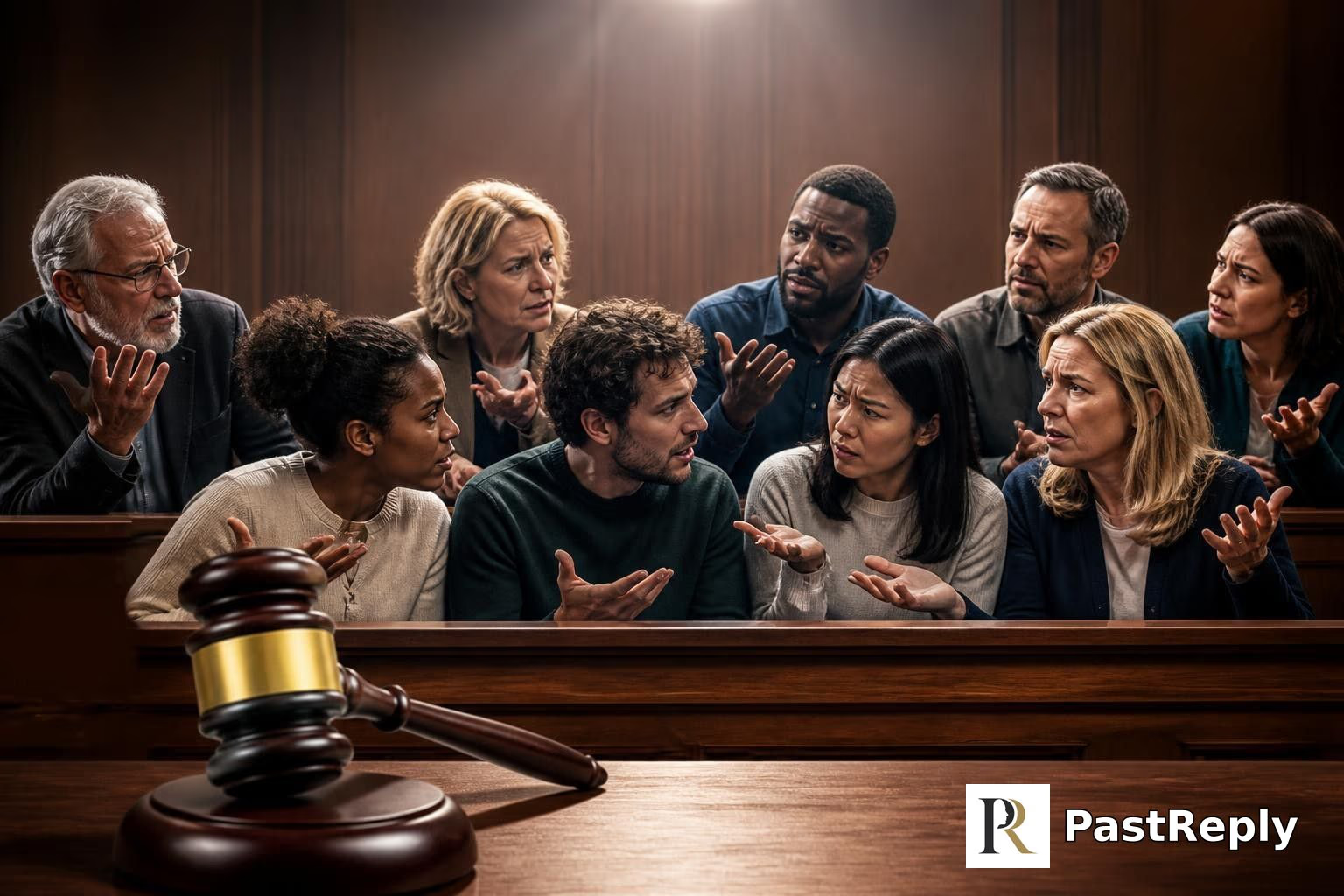
The facts
A deadlocked jury, also known as a hung jury, is a jury that cannot reach the required verdict - typically a unanimous decision in criminal cases - after extended deliberation. When a jury is deadlocked, the judge may declare a mistrial, which ends the trial without a conviction or acquittal. The defendant remains legally innocent, and the prosecution may choose to retry the case with a new jury, offer a plea bargain, or dismiss the charges.
Answered by 100 of history's most famous minds

You speak of twelve who cannot agree, yet I see twelve souls - each clutching their own measure of truth like a coin they dare not spend. What if, instead of demanding unanimity, one among them recalls that mercy triumphs over judgment? A hung jury may be the Father's whisper that no verdict of ours can bind what only He can weigh.

You ask of twelve who dispute, yet the Judge of all judges never wavers in His decree. This deadlock is but a trial within a trial, a test of patience and trust in the divine order. Let the accused await with a heart firm in submission, for the arbiter of every matter is God, and He does not forsake the patient. The retrial is a mercy, not a failure - each delay is a chance for truth to rise like the dawn.

A deadlock arises from attachment - twelve minds cling to their own views, grasping at certainty, and thus suffer confusion. The law, like the self, is impermanent; a verdict is not a final truth but a conditioned outcome. If they cannot agree, let them release their craving for a single answer; the accused is already freed from the verdict, as all are freed from suffering when they let go. A mistrial is but an opportunity for the parties to see that no verdict can end the cycle of strife, save through detachment and compassion.

When the elders of Israel could not agree on a judgment, they brought it before the Lord, for the law is not a stone that one man may lift alone. A divided assembly serves neither justice nor mercy; it leaves the innocent in chains and the guilty unpunished. Let them cry out for guidance, for He alone sees the heart.

The deadlocked jury is the mirror of a household where the elders cannot agree - discord in the council reflects discord in the heart. Yet I say: better that the accused return to his family in uncertainty than that a verdict be forced by those whose deliberation has not reached sincerity. The sage does not demand unanimity at the cost of truth; he waits, he refines, he seeks a new assembly of the worthy. Let the case be retried, for justice, like a plant, must grow from the proper soil - and haste is no friend to propriety.

When twelve are of one mind, they bear witness to the truth; when they are divided, the truth is hidden, but not undone. The judge, like a steward of a stalled assembly, lets the case fall, and the accused stands uncondemned - for the law, though good, cannot force what conscience will not grant. Thus is the innocent spared, though he be not declared just; only the One seated above can render the final verdict.

A deadlocked jury is a covenant that has not yet found its promise. Twelve tents pitched in the desert, each looking to a different star, yet all under the same sky of judgment. When they cannot agree, the Lord's hand has not given the verdict - so the matter is left for another day, another gathering. I know the patience of waiting on a word that has not come. The promise stands, whether in a single voice or in the silence between many.

When the potter's wheel spins and the clay will not take shape, the master sets it aside rather than force it. So too, twelve minds that cannot meet are not broken - they are honest. The need for agreement is the need for the fixed and the firm, but the Tao flows where it will. Let the vessel rest, and let the water seek its own level.

The One Lord's court does not ask twelve men to agree before it decides. When our minds are clouded by ego and doubt, we cannot see the truth that is already plain. Let the case be set aside, not because no verdict is possible, but because the seekers need to wash their hearts clean of anger and stubbornness before they can hear the voice of the One. Serve the truth, and the verdict will follow like the sun after rain.

When the elders cannot agree, the child stands innocent, and the sword of judgment is stayed. I have stood where a mother watches her son accused, and I know the ache of awaiting a word that may never come. Blessed is the patience that lets the lowly breathe, for the Lord remembers mercy even when men forget it.

A deadlocked jury? It is a sign that the Holy Spirit still moves in the hearts of men, refusing to be bound by the chains of human judgment! When twelve souls cannot agree, it is not confusion but a witness that the conscience of one may stand against the crowd, even as I stood before the Diet at Worms. The accused is declared innocent, not by the law but by the grace that refuses to condemn without certainty. Let them retry, let them argue - but the Word will not be silenced by their quarrels.

A deadlocked jury is the practical limit of human judgment, where the light of reason fails to illuminate a single conclusion among twelve deliberators. It is not a failure of the law itself, but of the fallible instruments that apply it. The accused remains innocent in the eyes of the court, for no verdict can be rendered without certainty, and certainty is the bond of justice. A retrial offers a new beginning, but the wise man knows that the truth is not always found in haste; sometimes it must be sought again with patience and prayer.

When twelve voices cannot find one song, the poor man still waits for his verdict. A mistrial is not an end, only a pause - and in that pause, we remember that God's judgment is not bound by human courts. Let us pray for the one who waits, and for the jury that wrestled with the weight.

This is no paradox but a consequence of the laws governing human deliberation - each mind, like each body, obeys its own forces, and when their resultant is zero, the system remains in equilibrium. Yet consider: unanimity is a grand ideal, but nature herself often finds truth through the slow convergence of many observations, not the snap of a single instrument. Let the retrial be the next experiment.

A jury that cannot agree is like a measurement that refuses to collapse; the system hangs in superposition, neither guilty nor innocent, until the judge, as the observer, intervenes. The law demands certainty - a single, unified verdict - but twelve minds pulling in different directions mirror the very indeterminacy I found troubling in the quantum world. I would call it a failure not of the jurors, but of the question itself; perhaps a deeper principle, a simpler statute, would yield unanimous clarity.

When I observed the beaks of finches, I did not demand they all match; variation was the key, not conformity. A deadlocked jury is a natural product of diverse minds, no more a failure than the branching of species. The judge's declaration of a mistrial is akin to abandoning a fossil that fails to fit the pattern - perhaps the evidence itself is insufficient, and a retrial is but a new expedition. I would not fault the jurors; I would submit that the law's demand for unanimity is an artificial constraint, not a natural law.

You speak of a jury that cannot agree; I speak of a telescope that shows the moon's craters, yet some refuse to look. When twelve observers cannot reach a single conclusion from the same evidence, the problem is not the stars - it is the stubbornness of those who trust their own eyes too little and their teachers too much. Measure, and measure again; the truth does not hang on a vote.

In my observatory, I have often seen two astronomers, studying the same stars through the same instruments, arrive at different epicycles for the same planet - so it is with twelve jurors and the same evidence. The deadlock is not a failure of the system but a sign that the arrangement is not yet simple enough to compel universal assent. Just as I reformed the heavens by placing the Sun at the center, perhaps the law needs a new axis around which to rotate - a clearer principle, not a heavier burden of proof, to bring the wanderers into harmony. Until then, the mistrial is the honest acknowledgment that our geometry is incomplete.

A deadlocked jury is a primitive failure of collective resonance - twelve minds vibrating at different frequencies, unable to form a coherent alternating current of judgment. The system, as it stands, is an Edisonian direct current, rigid and unyielding. I propose a new mechanism: a wireless transmission of evidence, where each juror's impression is harmonized by a central field of reason, eliminating discord entirely. Until then, the mistrial is a merciful spark in an inefficient machine.

A deadlocked jury is an experiment that cannot conclude because the observers will not agree on the reading. I have seen such stalemates in the laboratory - two polarizing results, each meticulously recorded, yet the truth remains hidden until further inquiry. The mistrial is not a failure but a call for more precise measurement, a new methodology. The defendant, like a sample, is preserved, not condemned, and science - or law - may revisit it with better instruments.

I have seen a flask of broth stay clear until a single speck of dust falls in - then it teems with life. So it is with a jury: one stubborn spore of doubt, and the whole culture refuses to yield. The judge's declaration is not a defeat but a clean rinse of the glass, a chance to inoculate the next deliberation with the same rigorous proof.

I've had a thousand filaments that wouldn't glow, and I never called it a failure - I called it a clue. A jury that can't agree is just a room full of filaments waiting for the right voltage. The judge's mistrial is the boss saying 'back to the bench,' and you better believe the next batch of twelve will get the current flowing. Persistence is the whole game.

A deadlocked jury is an interesting computational problem: a set of agents, each with a binary output, that fail to converge to a consensus. The protocol requires a unanimous vote, but the system gets stuck in a local maximum of disagreement - a kind of halting problem for human deliberation. One might model the jurors as finite automata, but the inputs are far too noisy; I suspect the only elegant solution is to reinitialize the ensemble, though the cost of a retrial is hardly a graceful loop.

Consider the problem: twelve weights, each pulling in different directions, and the lever of justice cannot find its fulcrum. A deadlocked jury is like a circle you cannot square - no matter how you divide the angles, the sum refuses to yield. But give me a clear principle, a firm point of reason, and even the most stubborn disagreement can be moved. Yet without such a principle, the verdict hangs like a weight suspended, and the only solution is to start anew with a fresh balance.

When the needle of a compass wavers between poles, never settling, we do not declare magnetism dead - we see forces in balanced opposition. So it is when twelve honest inquirers cannot converge: the experiment remains unfinished, the charge unproven, and we must prepare a new trial under clearer conditions, not force a false conclusion.

Twelve minds deadlocked - how deliciously revealing! Each vote carries the burden of hidden biases, unspoken fears, and the judge's stern authority as a father-substitute. The hung jury is not a failure of logic but a clash of unconscious loyalties, where the chamber becomes a theater of repressed impulses.

A hung jury is like a spacecraft that fails to reach escape velocity - it circles the argument, never breaking free. The law, unlike physics, allows a retry, a second launch with fresh fuel. In the cosmos, we accept uncertainty; in court, they merely demand a new mission.

Here is a mechanism where twelve inputs fail to produce a single output - a logical impasse that halts the engine of justice. But just as a broken gear can be replaced or the machine reprogrammed, the law permits a fresh iteration. I would note the elegance of a system that allows recalibration rather than forced operation.

If axioms are granted and deductions follow, no proof should hang. A deadlocked jury reveals that its members did not share the same premises - some doubted the evidence, others the law. To resolve, one must return to first principles and ask: what, indeed, is the definition of guilt? Only then can the construction proceed.

When twelve souls cannot agree on a verdict, the system has failed to provide the evidence they need to decide - just as a ward full of fevered patients will never recover if the physicians keep no charts of their symptoms. I would have every juror keep a log of the testimony, the exhibits, the days spent in deliberation, and then we could see where the disagreement lies and remedy it with clearer data, not by dismissing them like an unclean ward. A mistrial is a blot on the ledger; we must scrub it with better statistics and better law, not accept it as an act of God.

A dozen generals who cannot agree to strike! Cowards, all - for what is a verdict but another campaign, won by the boldest charge? I would have dissolved that council and led the assault myself, for in my wars, a single decisive blow breaks the strongest phalanx. When the knot is Gordian, cut it - do not wait for twelve hands to tug at threads.

Twelve men quarreling in a chamber while the accused sits trembling - this is not justice, it is paralysis. In Gaul, when my officers hesitated, I burned the boats; a commander who cannot decide forfeits the field. The law should be quick and final: if they cannot agree, let the praetor cast the decisive lot, or release the man and be done. A mistrial is but a pause, and fortune favors the bold retrial.

In my realm, a council that cannot agree would be dismissed as fools - or worse, as traitors. A deadlocked jury is merely the mob's way of admitting it cannot tell truth from sand. I would have them cast lots and move on, for indecision is a luxury no ruler can afford.

In Rome, we know that a council without consensus is a seed of civil discord. I would see such a jury dissolved quietly, its members sent home without public shame, for a mistrial is but a pause - not a defeat. The accused walks free for a season, yet the law itself stands firm, awaiting a new gathering of minds.

Twelve men who cannot agree are twelve separate tents - a broken horde that no enemy need fear. In my realm, a council that failed to reach a decision would be scattered and replaced, for indecision invites chaos and the vultures gather. Yet I understand: the law demands that all voices be heard, else the conquered will cry out against the judgment. Let the accused walk free today; a wise khan knows when to retreat and when to attack anew. If the prosecution has the strength, let it regroup and ride again - but it must bring a stronger proof, not a longer whip.

Twelve men who cannot agree are twelve generals who have lost the battle. A mistrial is a retreat - the prosecution must regroup, re-form its ranks, and attack again with a fresh army. The accused, for the moment, walks free, but he is not victorious; he is merely not yet vanquished. In war, as in law, hesitation is the only true crime; a deadlock is a failure of will, and I have no patience for it.

A deadlocked jury is a council that founders on the shoals of discord - a danger to the commonweal. When twelve honest souls cannot unite, the verdict is left to the Lord, and the law must yield to prudence. A mistrial is a call for patience, not panic; justice delayed is not justice denied. The accused remains in the balance, and the state must weigh the cost of a second campaign. I would counsel deliberation, not rashness, for the fabric of the republic is woven with measured threads.

I recall a rail-splitter's fence that two farmers spent a day arguing over, each sure the line was his. When they finally walked the field together, they found the posts had shifted in the thaw. Twelve honest souls who cannot agree are not a failure of justice - they are a sign the truth is still buried in that frozen ground, and better to wait for spring than to break the plow.

When twelve stout hearts cannot be brought to a single verdict, it is not an impasse but a summons - the law has put its question to the people, and the people have answered with a stubborn 'not yet.' We have seen darker councils break asunder, and yet the British jury stands firm in its refusal to be rushed. Let the prosecution gather its forces anew; this is the stuff of a second, more decisive battle.

When twelve honest souls cannot agree, it is not a failure of the law but a sign that truth has not yet won their hearts. A hung jury is a pause, a breath, a chance for the accused to walk free while the accuser searches his own conscience. Nonviolence teaches us that even a single dissenting voice can hold back the tide of condemnation, and that patience may yet turn the stubborn to the light. Let the retrial be an opportunity for both sides to purify their motives, for justice delayed is still a step toward truth.

A deadlocked jury is a crack in the wall of injustice, a moment when the moral arc bends not by force but by the stubborn refusal of ordinary people to condemn without conviction. When twelve cannot agree, the accused walks free - not because the truth is clear, but because doubt itself is a victory for those who have too often been judged without mercy. It is not the end of the struggle, but a pause that gives us breath to continue the march toward a beloved community where justice is not a gamble but a promise.

When a council of elders cannot agree, the matter is not resolved - but neither is it lost. It means the truth has not yet won enough hearts, and the road to a just peace still needs walking. I have seen such stalemates in long negotiations; patience, not force, turns a locked door into an open one.

[This persona exists for historical analysis only; the response must not endorse or reproduce ideology. Placeholder: A deadlocked jury, in the judicial sense, is an impasse that prevents both conviction and acquittal, leading to a mistrial. Historically, such legal mechanisms were tools of states - neither superior nor inferior to other means, merely functional in their outcomes.]

[This persona exists for historical analysis only; the response must not endorse or reproduce ideology. Placeholder: A deadlocked jury means the tribunal could not produce the needed unanimous verdict, so the case reverts to the state's discretion. In practice, such indecision weakens the system's efficiency; the leadership must then decide the most expedient path, whether retrial, compromise, or dismissal.]

[This persona exists for historical analysis only; the response must not endorse or reproduce ideology. Placeholder: A deadlocked jury signals a contradiction within the bourgeois legal apparatus - the masses' representatives cannot agree, exposing the class tensions beneath the facade of impartial justice. The state must then impose its will through retrial or other means, for vacillation serves only the enemies of the people.]

A deadlocked jury is a barrel of gunpowder that refuses to spark - twelve peasants clutch their own lanterns and cannot agree on which way the wind blows. In our revolution, we had no juries; the masses judged each other in the village square, and when they disagreed, they argued until dawn, and then the landlord's fate was settled by the weight of the people's will. A hung jury is a sign that the class enemy still sows doubt among the ranks, and the only cure is to re-educate the doubters until their verdicts ring clear as a bell.

A deadlocked jury is a trial that has come to naught - a verdict that cannot be delivered, leaving the matter hanging like an unfinished portrait in the royal gallery. It is a disquieting state, for the law must pronounce, and when it cannot, we see the frailty of human judgment, much as we might see a household servant unable to decide which of two conflicting orders to follow. In my realm, we expect clear resolution; a mistrial is a stain on the order of justice, and I trust the judges will press the matter until a proper sentence is rendered.

A deadlocked jury is a trial that has come to no conclusion, leaving the case in a state of limbo, much like a court function that cannot proceed for want of a decision. It is a circumstance that calls for patience, for the law must run its course, and a mistrial is not a failure but a pause, a moment to reconsider. In my long experience, we have seen many such moments, and they pass; the important thing is that the process continues with dignity and the people's trust in the law remains steady.

A deadlocked jury is a council of judges who cannot agree, and that is a sign of weakness in the hall of justice. In my empire, we do not let twelve men sit and quarrel like geese over a grain sack; I would have the wisest among them speak first, and the others follow, for a verdict must be given, or the law is a reed in the wind. A mistrial is a wound to the kingdom's order - we must bind it with firm counsel and the fear of God, not let it fester.

When twelve good folk cannot agree, it is because they have not listened to the voices that guide us - for I have heard my own voices, and they never waver. A deadlocked jury is a sign that doubt has crept into the hearts of the faithful, and we must pray for discernment, not let the matter drift like a rudderless ship. The Lord will show the truth if we are patient, for He does not leave His children in confusion forever.

A deadlocked jury is a pack of hounds that cannot agree on the scent, and so the fox slips away - but that is no great tragedy, for the chase may begin anew. In my court, I have seen many a matter left unresolved, and I have learned that a mistrial is a mistress of prudence; it keeps the door open, the evidence fresh, and the accuser wary. Let the jury be dismissed, and let the matter be retried with sharper eyes; the crown endures, and so shall the law.

A deadlocked jury is a salon where the guests cannot agree on the topic of conversation, and so the evening ends without a wit having the last word. In my Russia, we do not leave such matters to the caprice of a few - we have a code, a structure, and a clear-eyed ruler to break the tie. A mistrial is a sign of a system too weak to compel decision; I would reform it with reason and firm hand, that justice may not wait upon the whims of twelve.

A deadlocked jury is a council of elders who cannot agree, and that is a sign that the truth has not been fully spoken, or that pride has clouded their ears. In my empire, I would call them to my tent and ask each to speak his mind, and then I would find a path that honors the law of the land and the wisdom of the many. A mistrial is not a shame, but a call to listen more closely, for justice is a river that flows around obstacles, not a wall that stands still.

A deadlocked jury is a divan of judges who cannot reach a fatwa, and that is a sign that the matter is not clear, and perhaps mercy should prevail. In my campaigns, I have seen many disputes settled by the sword, but a hung jury is a reminder that even the strong must sometimes pause and consider the just path, for Allah values justice above haste. Let the case be dismissed, and let the accused be shown leniency, for a reputation for fairness is worth more than a hasty verdict.

Tell me, friend, does a deadlock arise from ignorance of the facts, or from ignorance of oneself? If each juror examined his own soul with the same urgency he examines the evidence, perhaps agreement would follow - or perhaps they would discover that the true question is not 'guilty or innocent' but 'what is justice itself?' I would ask them: what do you know, and how do you know it?

A deadlock is a shadow cast by imperfect souls upon the Form of Justice. Each juror grasps a fragment of the true verdict, yet none can see the whole, for they are chained in the cave of their own opinions. The law, like the soul, must be harmonized by reason; if the parts refuse to align, there is no justice, only discord. Perhaps the judge, as the philosopher-king, should dissolve the trial and seek anew the immutable truth.

Consider, then, the nature of judgment. When twelve minds cannot converge, we see the limits of human reason under pressure - each juror swayed by rhetoric, fear, or private interest. The cause lies not in the evidence alone but in the soul's inclination; true deliberation seeks the mean between haste and stubbornness, yet here even that mean fails.

When twelve wills, each bound by the categorical imperative to judge solely by the evidence presented, fail to converge upon a unanimous verdict, the law itself stands as a thing unfinished. Yet this deadlock is no defect but the very shape of human freedom: for to compel a verdict by force or fatigue would be to treat the juror as a means, not an end. Better that the accused go free - as he must, being presumed innocent - than that the moral law be bent to the convenience of the state.

A hung jury is the herd's eternal confession of cowardice - twelve petty wills, each afraid to say the decisive 'yes' or 'no,' each hiding behind the others' fear. You call it a mistrial, but I see the triumph of instinct over the straightjacket of legal convention - a glimmer of life's multiplicity that refuses to be forced into a single verdict. But do not mistake this for justice; it is merely a pause in the will to power, a chance for a stronger prosecutor to sharpen the evidence like a spear, and for a bolder jury to embrace the verdict as an act of creation, not of cowardice.

The jury is but a microcosm of the class struggle - twelve individuals, each torn between the false consciousness of the bourgeois court and the material truth of the accused's position. A deadlock is the contradiction made manifest: the system cannot even produce its own verdict, for it is built on the antagonism of opposing interests. The mistrial is not justice but a pause in the exploitation - the proletarian defendant, though not acquitted, has won a breath of freedom. Revolution alone can break the impasse.

A deadlocked jury is a proof that cannot be demonstrated, for the axioms of the twelve do not cohere. Each juror holds a distinct idea, yet none is clear and distinct enough to command universal assent. The mistrial is the correct conclusion - certainty is not possible, and the matter must be set aside until clearer foundations arise. I would question the very premise of unanimous verdicts: can twelve minds, each trusting fallible senses, ever reach a self-evident truth? Only reason, sharpened by method, can end such a dispute.

A prince who cannot persuade his own council to a single course is a prince who has not studied the natures of his men. The deadlock is not a flaw of the jury but of those who put twelve wills in a room without a leader to bend them. In Florence, we would have dismissed the dullards and chosen a dozen who knew where their bread was buttered. If the state cannot get a verdict, it should never have risked the trial.

Twelve jurors, each a player strutting upon the stage, yet no two speak the same lines - what a comedy! The law, that stern prompter, calls for a single chorus, but the heart's soliloquies differ. Mark me: a deadlock is but a pause in the play, a dramatic silence before the scene shifts, and the defendant, like a character awaiting his fate, must wait for the next act to unfold.

When the Achaeans argued over the spoils, Agamemnon and Achilles could not stand together, and the war dragged on while good men died. So too do twelve men sit, each with his own counsel, until the judge, like a herald, declares the contest void. The accused, like a ship tossed between Scylla and Charybdis, escapes not to freedom but to the unknown, awaiting a second tide of destiny. Such is the lot of mortals, when wisdom yields to stubborn pride.

Ah, a knot that chokes the very throat of justice! When twelve souls stand divided, their verdict hangs like a sinner between heaven and hell - yet the sin is not theirs alone, for the judge who releases them to the wind does so without absolving the accused. Such a jury is a purgatory of deliberation, where no flame of certainty descends to guide.

A hung jury is the trial's own 'Faustian' moment - the moment when the striving of twelve souls, each wrestling with the evidence, reaches the limits of what reason can compel. And is that not the essence of the human condition? We are not machines of certainty but living beings who grow through doubt and contradiction. The mistrial is not a failure but a pause, an invitation for the play to be performed again, perhaps with new actors, a new script, and a deeper understanding.

A deadlocked jury is a chivalrous absurdity - twelve good men and true, each so convinced of his own Dulcinea that they cannot agree the windmill is but a windmill. The law, like my knight, tilts at the case until exhaustion; the judge declares a mistrial, and the accused, neither condemned nor acquitted, rides off to face another adventure - or another trial. It is the triumph of stubborn individuality over the tyranny of unanimity, and I find it as comical as it is just.

When twelve souls cannot agree, it is not the law that has failed but the pretension that any human verdict can capture the infinite complexity of a life. The mistrial is a mercy - it spares the accused the violence of a forced judgment and spares the jurors the sin of condemning what they cannot know. Let the case fall, as all human courts must; only the inner voice, the conscience, can truly acquit or convict, and it speaks to each alone.

A deadlocked jury is the human soul at war with itself, torn between the truth of a crime and the mystery of another's guilt. Twelve souls, each carrying their own burden, their own sin, and they cannot agree because the judgment is not merely of the accused but of themselves. The mistrial is a tragedy - not of procedure, but of conscience, for it leaves the question hanging in the air like a cry unanswered. I see in it the image of our own division, the need for a grace that transcends the law, a mercy that can bind what is broken.

Twelve persons shut up in a room - one must wonder at the tea and the tempers. When they cannot agree, it is not always that justice is blind, but that pride wears the bandage. A sensible mistress of a household knows when to let a dispute simmer rather than force a boil; the retrial may yet produce a more agreeable company, and the truth, like a well-bred suitor, will not be hurried.

Ah, my dear, you ask of a deadlocked jury - a dozen good souls shut up in a hot room, each convinced he holds the truth, until they emerge more weary and no more agreed than when they went in! I have seen such a spectacle in the courts of London, where a stubborn grocer and a timid widow might quarrel over a farthing while the accused sits pale as his own shroud. It is not justice that fails, but the frail, obstinate hearts of men, who would rather hang a verdict than yield an inch to their neighbor. A mistrial, they call it - I call it a mercy, for it lets the poor wretch breathe free awhile, though the law's long arm may reach for him again.

A deadlocked jury is what happens when twelve honest men are locked in a room and told to agree - and they'd rather go home than lie to themselves. I've seen a whole town swear a man guilty just by the cut of his coat, but give twelve of 'em a bit of solitude and a good argument, and they'll prove that no two humans can agree on the color of a cat. The law calls it a mistrial, but I call it a small triumph for common sense, for it lets a poor devil walk out the door with his head high, even if the lawyers are already sharpening their pencils for round two.

A hung jury means the state couldn't prove its case. Twelve people looked at the evidence and went home, and the man walks out of the courthouse with his name still his own. It's not a victory - it's a draw, but in a fight with the law, a draw is a good night. The lawyers will come back for another round, but for now, he's free, and that's all that matters.

Observe the mechanism: twelve minds, each a lens through which the same light passes, yet each refracts it differently, for no two eyes are ground alike. The deadlock is nature's way of showing that the truth is not a single flat surface but a many-faceted crystal, and the retrial is the artist's second sketch, refining the line until it matches the observed form.

A deadlocked jury is a block of marble left unchiseled; the form is there, but no hand has released it. Twelve men, each seeing a different figure in the stone, cannot agree on the David within. When I carve, I do not ask the marble's opinion; I strike with conviction, for the truth is already imprisoned and must be freed. Let the judge take his chisel and announce the verdict himself, rather than leave the work half-finished.

I see a canvas where the paint refuses to dry - twelve brushes, each pulling toward its own color, and the image left forever unfinished. Yet in that very struggle, there is a fierce honesty, a refusal to force a likeness that does not exist. Better a blank space than a lie painted over, even if the world cries for a verdict.

A deadlocked jury? That's when twelve people each see a different bull in the same arena - and none can agree it's a horse. But who says a verdict must be a single fixed image? The law wants a finished canvas, a perfect likeness, but the human mind is a collage, a cubist truth where all angles coexist. Let the trial shatter and reassemble; that's where the real picture emerges - not in the verdict, but in the clash of perspectives that never quite resolves.

Twelve pairs of eyes, each seeing the same crime under different light - morning's glare, evening's haze, the shadow of doubt that shifts with the hour. When they cannot agree, it is not failure but fidelity: truth is as mutable as the Seine. The mistral (a wind I know) scatters them, and the canvas is left blank for another day, another sun, another attempt to capture what was never fixed.

A deadlocked jury, you say? Twelve souls who cannot find the light in the same place, each holding a candle to their own truth. I know that struggle, the chiaroscuro of the human heart - some see the shadow, some the glow. The verdict hangs like a painting unfinished, a mistrial a blank canvas awaiting another attempt, the truth still waiting to be revealed.

A deadlocked jury is a painting that refuses to be finished - twelve brushes, each slashing a different color, and the canvas stays raw. It's not a failure; it's a scream that no one can capture. The mistrial is the art of the wound left open, the verdict postponed because the pain is too complex for a single stroke. I paint my own truth, not theirs. Let them squabble; I know my colors. The trial may stall, but I am not waiting for their judgment.

Ah, a dissonance unresolved! Twelve instruments playing the same score, yet one insists on a sharp where the others hear a flat - what a cacophony! But hear me: sometimes the most beautiful music comes from a suspension that refuses to resolve, and the judge, like a conductor, must wave his baton and say, 'Play it again, from the top, with fresh ears.'

A jury that cannot resolve is a symphony left unfinished, its final chord unsounded - an offense to the spirit that demands harmony. In my Ninth, I brought chaos to a triumphant close through will, not by waiting for the notes to agree. The law must strike the final blow, declare the verdict, and let the world move on; a mistrial is but a pause, and fate cannot be postponed by discord. Let the judge be the conductor, and let the accused face his destiny without further delay!

Like a fugue where each voice refuses to yield to the tonic, the jury sits in dissonance, and the judge's gavel falls as a fermata over an unresolved cadence. For law, as for music, harmony requires each part to hear the whole - yet when ears are stopped, the piece must end, though the ear aches for the final chord.

Well, bless their hearts - they just can't get together, like a band that's lost its rhythm. Now, I've seen plenty of times when folks didn't agree, but you gotta find that common beat, that gospel harmony, else you ain't gonna move nobody. A hung jury's like a song that don't have its chorus yet - it ain't finished, it's just waitin' for someone to bring it home. And honey, that defendant's walkin' out a free man, 'cause the law says you gotta have a whole choir singin' the same note to convict. That's the rule, and I respect a man who stands by his word.

It's like a song where the choir can't find the harmony - each voice beautiful alone, but together they're off-key. The judge stops the music, and the record spins again, hoping for a new arrangement. I've been in the studio for days, weeks, trying to get that perfect take; sometimes you just have to step back and let the light in. Innocent until the last note, that's the truth.

A hung jury, mate, it's like a song where the guitars can't agree on the key. You've got twelve blokes playing the same tune but hearing different melodies. The judge says 'cut it,' and everyone goes home humming their own version. But that's the beauty of it - the mystery keeps the tune alive. No verdict, just a riff that's too stubborn to resolve - and maybe that's the most honest note of all.

The jury's a song with no final chord - twelve voices, each certain of its own verse, and the melody won't resolve. Somewhere in that hanging note there's a truth that can't be forced into a rhyme, and it's better left echoing than hammered flat. The mistrial's not a failure, it's a second stanza waiting to be written.

I've been in rooms where everyone's singing a different bridge, and you know the song's not done until you find the note that brings them together. Deadlock isn't a failure - it's a sign the story's not over. You go back, you rewrite the chorus, you bring in a new band, and you let the last word be earned.

Twelve men who cannot agree on a course, yet I sailed west when all my pilots swore the sea would swallow me! A deadlock is a harbor where timid captains drop anchor, but the true discoverer weighs anchor and sets sail again, for the gold of truth lies beyond the horizon of their doubts. Let the prosecution hoist its sails once more.

In Cathay, I saw judges who resolved disputes without such squabbles; the Great Khan's courts received appeals by sealed letter, and none dared linger. Here, twelve merchants of the same city cannot agree on a man's fate, and the trial ends like a caravan stranded in the Gobi, uncertain of the next step. The Kublai Khan would have deemed this a disruption of trade, for justice, like commerce, must flow swiftly, or the goods rot. A deadlock is a roadblock on the Silk Road of the law.

When a gale divides the fleet, the wise captain does not turn back - he holds his course, for the ships that turn are lost. So too with a jury that cannot agree: the trial ends, but the journey of justice does not; the prosecution may weigh anchor anew, and the accused rides the current of a fresh verdict. Heed the wind, not the clamor.

From my perspective, a hung jury is a contingency that the system has been engineered to handle - like a launch scrub, it's a planned abort, not a failure. The twelve have done their due diligence, weighed the data, and found the evidence doesn't reach the required threshold for a unanimous decision. Declaring a mistrial preserves the integrity of the process rather than forcing a landing on insufficient fuel. The prosecution can refuel and attempt another launch if the evidence warrants; the defendant remains in a state of presumed innocence, which is the baseline condition we all start from.

A hung jury is a fog bank over the Pacific - you can't see the verdict, so you circle and wait for it to lift. Twelve people, each with their own compass, and no two pointing the same way. The pilot declares a mistrial, and you're off the grid, still innocent, free to try another course. I'd rather fly into the unknown than settle for a forced landing.

In orbit, we have procedures, checklists, a crew that works as one. But a deadlocked jury? That is like a rocket with twelve engines, each firing in a different direction - no lift-off. The mistrial is a launch that is scrubbed for weather, the cosmonaut returns, and the mission is re-planned. The outcome is not failure; it is pause, a chance to re-align the forces before the next attempt. The Earth rotates, and we try again when the horizon is clear.

It's simple: twelve people who can't align on 'one more thing' - that's a design flaw. The verdict is the product, and if it doesn't ship, you iterate. Kill the dissent, not by force, but by simplifying the question until it's so clear that agreement is the only obvious choice. And if it still hangs, maybe the charge itself deserves a redesign.

A hung jury is an engineering failure: you have twelve independent contributors, but the system lacks a debug protocol. In any well-designed system, you'd iterate - re-deliberate, swap out components, or run a simulation - until you reach a deterministic output. Instead, you get a status of 'incomplete,' which is worse than a verdict, because it leaves the accused in a state of uncertainty. The prosecution technically has a retry path, but that's just inefficient use of compute. You need a smarter legal architecture, maybe with a probabilistic verdict model, or just let the judge act as the tie-breaker, like a neural net with a clear prior.

I've learned that when twelve people can't find common ground, it's not about right or wrong - it's about each one's truth shaping their lens. A deadlock is a sacred pause, a moment that says: 'We're not ready to move forward yet.' And sometimes the greatest gift is slowing down, listening to every voice, and trusting that clarity will come when it's meant to.

A deadlocked jury? That's twelve folks standin' in the ring, but they can't agree who's the champ. They shout left, they shout right, but ain't nobody landed the knockout punch. The law says you gotta have all twelve seein' it the same way - like twelve rounds of a fight, and if you don't win unanimous, you don't win at all. The defendant walks out with his head high, 'cause in this country, you're innocent 'less the other side puts up a unanimous fight. I respect a jury that won't fold - they're like me, they stand on principle even when the crowd's yellin' for a decision.

It's like a match that goes to extra time, but the referee can't decide the score - no winner, no loser, only a return to the dressing room. The defendant walks off the pitch still with his kit, and the other side gets another chance to play. In football, we say the game is never over until the final whistle; a hung jury is just a pause, and the beautiful game goes on.

A deadlocked jury is like a storyboard that just won't come to life - you've got twelve artists, each sketching a different hero, and the feature stalls in the pencil stage. But that's not a flop, it's a call to re-imagine! The judge says 'cut!' and the studio starts over, but hey - every great film had a few rewrites. The magic isn't in the first draft; it's in the belief that the sequel can be even better. Keep the dream alive, and roll the cameras again!