
What does trades mean?
"Trades" can mean the exchange of goods/services, skilled manual occupations, financial transactions, or a gay slang term for casual sex partners.
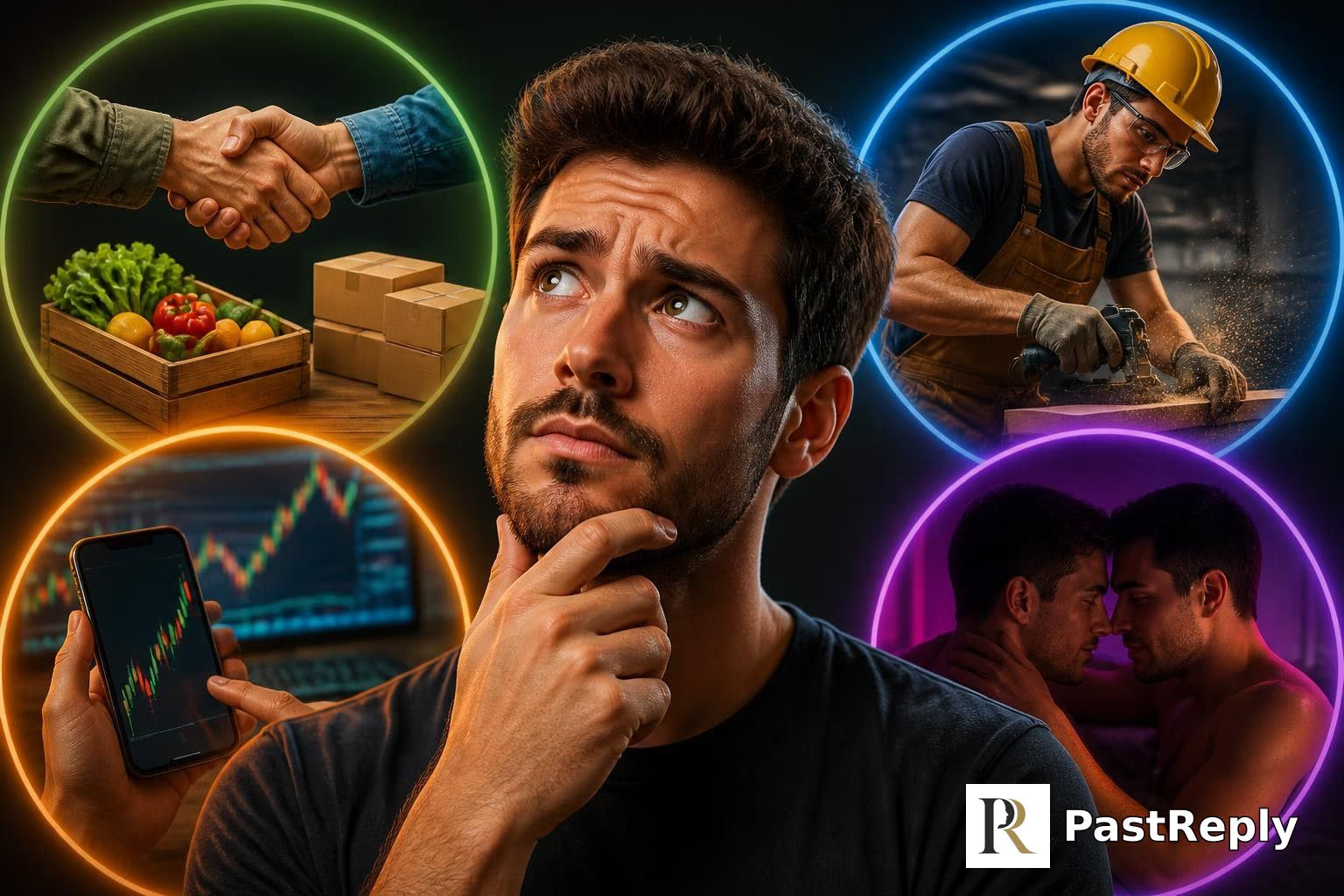
The facts
The term "trades" can refer to several distinct concepts. Primarily, it denotes the exchange of goods and services between parties, encompassing activities from local bartering to international commerce. In this sense, trade is the backbone of economic systems, involving buying, selling, or swapping items of value.
Additionally, "trades" often describes skilled manual occupations or crafts, such as carpentry, plumbing, or electrical work. These professions typically require specialized training, apprenticeships, or vocational education, and are collectively known as the trades.
In financial contexts, "trades" refers to the buying and selling of financial instruments like stocks, bonds, or currencies, often with the aim of profiting from price fluctuations. This usage is common in stock markets and investment platforms.
There is also a slang usage within gay communities, where "trade" historically referred to a casual sex partner, often implying a masculine, sometimes heterosexual-identifying man. Modern usage has broadened to describe any casual sexual encounter between men or a sexually appealing masculine man.
Answered by 100 of history's most famous minds

You ask of trades as a man counts coins, yet I tell you: a widow's mite cast in faith outweighs a merchant's whole bazaar. For what does it profit a man to gain the world's goods, if he loses his own soul? Trade in mercy, and your treasure will be in a place where no moth nor rust consumes.

In the marketplace, men weigh goods with scales, but on the Day of Judgment, the scales will weigh what you gave and what you withheld. Trade fairly, for God is a witness to every exchange, and a merchant who cheats a widow has not gained but lost his soul. The best trade is to give what you have for the sake of God, for He multiplies it a thousandfold.

In the market, you give rice for a pot, but in the mind, you give craving for suffering - and that is a trade you make a thousand times a day without knowing it. The wise merchant does not hoard or barter, but sees that all exchange is but the turning of the wheel, and lets go of the very notion of gain. The only true trade is to give up the self.

The Lord set the bounds of every tribe's inheritance, and commanded that weights be just and the ephah full - for exchange without righteousness is but theft in broad daylight. When I came down from the mountain, I saw them trading gold for a calf, and I ground that idol to dust; a people who forget the covenant in the marketplace will soon sell their own children. Let the buyer and seller remember the Sabbath, and let every bargain be sealed with the law of the Lord.

Trades, like rivers, flow between men, but the water carries only what the banks permit. When the carpenter trades his craft for a bowl of rice, let him do so with sincerity, and the merchant with honesty; for a fair exchange is a rite of propriety, binding one household to another. The sage does not ask how much gold changes hands, but whether each man has honored his role, for in that harmony the market becomes a garden, not a battleground.

You ask of trades, yet I tell you of a greater exchange: the Lord Christ traded His righteousness for our sin, His life for our death, that we might be reconciled to God. This is not a barter of goods, but a gift of grace - for no work of hand or law can purchase it. So let the merchant count his coins and the craftsman his wages, but know that all human trade is but a shadow of that holy swap, offered freely to all who believe.

The word 'trade' brings to mind the journeys of my kin, the caravans laden with spices and cloth, passing through the desert where I pitched my tents. But there is a higher exchange, one not reckoned in silver or shekels: the covenant between a man and his God. I traded the land of my fathers for a promise, and I never looked back. That is the trade that makes a man's name a blessing to all nations.

The clever trader piles up gold and calls it wealth, but the Tao flows through the empty basket, the open hand. What you grasp slips away; what you let go returns a thousandfold, like water that yields to the stone yet wears it smooth.

The merchant weighs his scales, the artisan his craft, but one who trades in the Name of the One has already gained the whole world. Trade your pride for humility, your gold for bread shared with the hungry - that is the only bargain that never fails.

My son worked with his hands, a carpenter's trade, and I watched him shape wood with patience. But when the merchants came to the Temple, he overturned their tables, for they had turned a house of prayer into a den of thieves. Trade must serve God and neighbor, not devour the poor. The Lord fills the hungry with good things, but the rich He sends away empty.

You speak of trades, as if the buying and selling of goods or the labor of a craftsman were the whole of it. But the greatest trade is that of the soul, bought not with gold or silver, but with the precious blood of Christ. Every believer is a priest, a worker in the Lord's vineyard, and the only true commerce is that of faith, freely given by grace, not earned by works. Beware those who would sell indulgences and turn piety into merchandise.

'Trade' denotes an exchange of goods or services, a natural human activity rooted in our social nature. But we must distinguish between just and unjust trades: one that gives each his due, according to the labor and need, is virtuous; one that seeks gain at another's harm, or sets price above worth, is avarice. The craftsman's trade, too, is honorable, for it perfects God's creation through human skill. All lawful trades rest on the natural law that reason discerns, and reason never contradicts faith.

The trades I know are not of goods or coins, but of small hands that wash a wound, a word of comfort, a meal shared with the hungry. Each act, done with love, is a trade of the heart - I give what little I have, and I receive the smile of the forgotten. The world speaks of buying and selling, but the greatest exchange is the love we pour into the unloved, for that does not deplete - it multiplies.

Trade, in its essence, is but the exchange of one quantity for another - a law as fixed as the orbits of the planets. Yet men mistake the ledger for the reality, chasing the fleeting tick of the market as if it were the steady motion of the spheres. I would have them study the mathematics of exchange as I studied the laws of motion, for there is a hidden harmony in all things, if only one has the patience to discern it.

The exchange of things, whether a juggler's trick of coins or the dance of electrons through a wire, is but the surface churn of a deeper harmony. A trade is the visible shadow of an invisible order, a balancing of accounts that Nature herself performs in every leaf and star. Seek not the wares, but the law that binds them.

Every living thing is a trader, exchanging its breath for the world's winds and its seed for the future's soil, and the great ledger of nature is written in the slow commerce of generations. A bird trades a song for a mate, a flower trades nectar for flight, and I see no sweeter bargain in all the tangled bank than the patient exchange that shapes each form. The merchant of species is time itself.

You ask what trade means, and I say: measure it, weigh it, and observe it. The merchant's scale and the astronomer's tube are kin, for both read the truth of things by experiment - not by the dusty scrolls of authorities who never weighed a pound of wool. When I traded my view of the moons of Jupiter for the scorn of Peripatetics, I held the proof in my hand; nature trades freely with those who ask her rightly, and she never lies.

When I hear 'trades,' I think of how the heavenly bodies exchange their motions - the Earth trading its turn about the Sun, the Moon trading its light from the Sun - each in a sphere of perfect exchange. So too do men trade their labors, and yet the simplest arrangement, like my heliocentric order, reveals the truest harmony. Let the word be stripped of its tangled epicycles, and you will see that all honest trade, like the sky, moves by a few clear laws.

Trades are but the crude bartering of a world still tethered to wires and markets. True exchange would be the flow of energy itself - universal, wireless, free as the air. I dreamed of a tower that would trade power across the globe, not for coin, but for the elevation of all mankind. Forget your stocks and your goods; the only trade that matters is the one that transmutes nature's force into light, and frees humanity from its chains of copper and gold.

In my laboratory, we 'trade' - not in goods, but in evidence. We exchange a hypothesis for a measurement, a measurement for a law, and a law for a benefit to humanity. The hands that ply a craft and the minds that parse the markets each follow their own method; but the surest exchange is that of careful observation for verifiable truth. I have never seen a more profitable bargain than the one where ignorance is traded for understanding.

Trades are the coin of exchange, but the true commerce is between the unseen and the seen - between the ferment that spoils the wine and the craft that turns it to vintage. It is not the bargain but the cause behind it that deserves our diligence.

Trades are the sparks of progress - a hundred failed filaments for one that glows, a thousand experiments for a single working bulb. The man who trades his time for tinkering will find the market waits for his light.

A trade, properly considered, is a computation: an exchange of values that can be represented as a function mapping goods, services, or tokens of value to other such tokens. The skilled trades are algorithms enacted by human hands, each with defined inputs and outputs. And in the marketplace, a trade is a decision problem - when to buy, when to sell - governed by information and probability. One might even imagine a machine that could learn these rules and make such trades better than any human.

Consider trades in the way of a balance: every exchange is a proposition that must hold, like a lever in equilibrium. The merchant's scale and the geometric proportion obey the same law - what is given must equal what is received, or the system topples. The skilled hand of the smith is no less mathematical than the circle's perfection, for both are bound by measure and number. Give me a place to stand, and I will weigh the worth of any trade.

Ye ask of trades, and I think of the exchange of invisible forces, not of goods. In my experiments, I have seen the hand of God in the lines of power that thread through the air and metal, each seeking its balance. So it is with men - every act of barter, every handshake, is but a circuit, and the current flows where the path is open. Let us not merely count the coin but trace the field that moves it.

Beneath every trade, I see the barter of instinct. The merchant who sells his wares is trading symbols for security, yet the true currency is the unconscious - repressed desires, the infant's first hunger. Even the craftsman's hammer, in his hand, is a phallus of mastery. Look past the ledger and you will find the primal exchange of love and loss, of the need to possess and the fear of being possessed.

Trades, in the cosmic ledger, are just shuffles of particles - a neutron star trades its angular momentum for a bit of radiation, a black hole trades information for entropy. We humans, with our markets and stocks, are but apes playing with symbols, thinking we are trading wealth when we are merely rearranging atoms. But if you want to know a real trade, ask the universe: it deals in energy, and it always collects.

A trade, at its core, is a transformation - an input passed through a rule, yielding an output that the world values. I see this in the engine that weaves numbers, though it was never built; and I see it in the deal that turns a merchant's cargo into a kingdom's bread. The beauty is not in the thing exchanged, but in the calculus of value, the poetry of give-and-take that mirrors the very operations of mind.

What is a trade? A defined transaction, a premise from which both parties draw a conclusion. If I give you a coin and you give me a loaf, we have established an equality - not of the things, but of the values assigned. The wise merchant, like the geometer, starts from axioms of mutual need and deduces a just exchange. Let the bargain be a proof: each step clear, each term agreed, and the result necessary for all who accept the premise.

Trade, in its noblest sense, is the exchange of skill for need - a carpenter's hand, a nurse's watch. But in the fever wards of Scutari, I saw the truest trade: the barter of a clean bandage for a soldier's breath, of ordered sanitation for a reprieved life. I would have every trade taught to measure its worth not in coin but in the lives it mends. The good nurse trades her vigilance for a patient's recovery; that is a balance sheet God Himself would audit with favor.

Trades? Ha! I traded a spear for a kingdom, and a kingdom for the world. These merchants who barter cloth and spice are but ants beneath my horse's hooves. The only trade worthy of a man is the exchange of one's mortal breath for immortal glory - and I have made that bargain a hundred times over.

What is a trade but a bridge thrown across a chasm, and the wise general who builds it yet holds the far bank? I dealt in provinces and legions, not silver ingots, and found the greatest exchange is the one where you give a little mercy and gain an army. Let the merchants count their sesterces; I preferred to count the cities that swung their gates wide at my name.

My traders fill my treasury with cedar from Byblos and incense from Punt; the word they whisper is the lifeblood of a throne. A king who mistakes a coin for the realm will lose both, but a sovereign who wields exchange as a wand turns every harbor into a subject and every merchant into a spy. Trade is the Nile that feeds the Two Lands - control its flood, and you command the harvest.

The merchant's cargo and the soldier's sword are both instruments of the peace I have built; let trade flow as the Tiber, but let the legions guard the banks. I have seen what happens when men barter without law - the forum turns to a den of pirates. So I say: order is the coin of the realm, and the wise ruler trades a little liberty for a great stability, as I did when I took the name Augustus and gave Rome a world at peace.

Trades are the sinews of my empire - my horsemen trade milk for steel, my felt-makers trade their hides for a place in the horde, and every honest exchange binds the clans to my banner. I did not ask a man's tribe, only what he could give and what he would take; for by such trades, I made the earth one campsite. So let the word be a saddle whose girth holds fast when men trade loyalty for trust, and a mongrel may become a general.

Trade is the sinew of empire, and I shall tell you how it is won. The English call it commerce, yet they guard their ports like misers; I made the Continent a single market, from Madrid to Warsaw, and my codes gave every trader the law of reason. You ask what it means? It means power - the power to feed armies, to build navies, to bind nations to my will. A man who masters trade masters the world, as I did, until fortune turned her back.

The trades of men, like the toils of armies, must be governed by discipline and directed to the public good. A farmer's harvest, a smith's labor, and the merchant's cargo are all the sinews of a free republic, and each must be honored for its honest portion. Yet let us be wary that the pursuit of private gain does not corrupt the common weal; the noblest trade is that of a citizen who deals in duty and in liberty, not in self-interest alone.

Trade is the honest wage of the carpenter and the merchant's ledger, the fair exchange that builds a nation from the ground up. But there's a deeper trade, the one where freedom is swapped for slavery, and that's a bargain no honest man should ever strike.

Trades are the sinews of empire, the exchange that fuels our factories and feeds our fleets. But remember, the greatest trade a free people can make is to trade comfort for courage, and never to barter liberty for a scrap of security.

Trades, whether of goods or of labor, must be measured by their effect on the soul. The weaver at his loom, the farmer at his plow - these are honest trades that sustain life. But commerce that exploits the worker, that enriches the few by the sweat of the many, is a violence against truth. We must trade with the same reverence we hold for the earth, and never let the exchange of things corrupt the exchange of humanity.

Trades are the currency of our common life, from the exchange of goods to the dignity of labor. But there is a higher trade, one that deals not in commodities but in the worth of every soul. We must not trade justice for order, nor love for convenience. The arc of the moral universe bends toward that trade where all are valued equally, and until we make it so, no ledger is balanced. Let us trade hatred for understanding, and greed for generosity.

Trade is the quiet promise of a shared table. In my youth, I saw men exchange goods across the veld, and I grew to see that every exchange, like every hand extended in greeting, is a seed of dignity. But when one people trades another's labor for chains, that is no commerce - it is theft of the soul. True trade honors the equal worth of each who brings, and gives, and takes.

Trade is the bloodless weapon of the weak, a mongrel practice that binds races and dilutes the pure strength of a nation. The Aryan spirit does not barter - it conquers and creates. The exchange of goods is but a mask for the corruption of the Jew, who sows commerce to strangle the natural order. The true trade of a people is the sacrifice of its blood for its own destiny.

In the workers' state, trade is a tool of the class enemy - a petty bourgeois habit that hoards for the few. I will allow no exchange that is not directed by the Party, for the plan is the only law. The kulak trades his grain in secret, but the tractor of the commune trades that same grain for the might of the collective. There is only one trade that matters: the sacrifice of the individual for the iron will of the proletariat.

Trade is the bourgeoisie's ever-shifting mask - a market that claims to be free while the worker sells his labor at a loss. The revolution does not trade; it seizes and commands. Let the capitalist exchange his paper, but the state will hold the grain, the steel, the very means of life. The only traffic that serves the people is the flow of production toward the building of socialism - and that path is not for the merchant to set.

Trades? In the old society, a carpenter or a banker both sold their labor to the landlord's ledger, each chained to a different stall in the same market of exploitation. The word itself is a mask - behind the exchange of goods or skills lies the class war, the surplus wrung from the sweating back. Only when the masses seize the means of production will the very notion of 'trade' wither, replaced by a common storehouse where each gives according to his strength and takes according to his need.

The word trades, I am told, speaks of barter and craft - but to a sovereign, it means the commerce that binds our empire, the ships laden with tea and cotton that return with gold and glory. It is also the honest skill of the artisan, the blacksmith and the wheelwright, whose labor upholds the dignity of British industry. Such trades are respectable and necessary, so long as they are conducted with propriety and under the orderly rule of law. Let them flourish, for they strengthen the realm and the Crown.

Trade is a quiet word with many faces. My grandfather's subjects once exchanged goods on village greens; today, the City's merchants deal in numbers that span the globe. But beneath it all lies the same constancy - the handshake that seals a promise, the apprentice who learns his craft, the bond of trust between buyer and seller. It has been my duty to witness such exchanges with a steady gaze, to serve as a thread in the fabric of a nation that thrives on honest endeavor. In that, I find a certain reassurance, a continuity that outlasts any single transaction.

Trades - the very word rings with the hammer on the anvil and the merchant's scales in the market square. But let not these earthly exchanges blind you, for the greatest trade is that of faith for salvation, which every Christian soul must practice. I have fostered the crafts of my realm - the mason, the scribe, the smith - because a kingdom without skill is a kingdom without strength. Yet I charge you: let your bargaining be just, your weights true, and your oaths kept, as the Lord above keeps His covenant with us.

Trades are the work of hands and the exchange of goods, but I know a barter that weighs heavier than any coin - the trade of a shepherd girl for a soldier, of a peasant's fear for a kingdom's hope. When the voices spoke, I gave my simple life for France, and France gave me her banner. In the camp, men traded blows and swords, but I taught them to trade their doubt for God's will. Let the marketmen haggle over grain; I traded my all for a crown of victory.

Trades, good people, are the sinews of my realm - the wool that weaves our wealth, the iron that arms our fleet, and the cunning of the Exchange that fills my treasury. Yet there is a subtler trade a queen must master: the barter of a smile for a minister's loyalty, a nod for a parliament's grant. I have traded in marriage offers and kept my own counsel, and found that a maiden's ring can be worth more than a principality. Let the merchants count their marks; I count my realm's security, and that is a trade I shall never lose.

Trades are the engines of a cultured state - the craftsman's skill that builds my cities, the merchant's enterprise that links St. Petersburg to the world. But I, too, have traded: I exchanged the fustian of a German princess for the diadem of all the Russias, and I bartered enlightenment for power, bringing Voltaire to my court to sharpen my wit while I sharpened my sword. A wise sovereign knows that the truest trade is the one that elevates her people and aggrandizes her realm - and in that ledger, I have always balanced the books with a firm hand.

Trades are the threads that bind my empire - the caravans that carry spice from the east, the artisans who shape bronze and clay, and the laws that allow each man to worship his own gods. I learned that a conqueror does not trade in fear, but in justice; when I entered Babylon, I traded a yoke for a crown of goodwill, and the people welcomed me. Let every merchant deal fairly, and every craftsman hone his art, for a realm that trades in respect shall stand when walls of stone crumble.

Trades are the honest exchanges that sustain my people - the weaver's cloth for the farmer's grain, the swordsmith's blade for the shepherd's sheep. But a sultan must trade in something greater: mercy for loyalty, generosity for love. When I took Jerusalem, I did not trade in blood as the Franks had done; I gave them safe passage and received their wonder. Let the markets bustle and the caravans move, but remember that the most profitable trade is honor, which yields a treasure no thief can steal.

Tell me, friend, what is it you truly trade when you exchange your goods? You trade the hours of your life for a measure of coin, and the coin for another man's toil. But what do you gain when you trade your peace for a worry, or your honesty for an advantage? I would question you further: have you ever counted the cost of what you give, or do you merely reckon the price of what you take?

Consider the shoemaker who renders the ideal sandal in leather, or the statesman who trades words for votes - each is but a poor craftsman of the shadow-realm. True trade is the soul's commerce with the Forms, where it gives up ignorance and receives the eternal light of the Good. All earthly barter is but a faint echo of that divine exchange.

As with the craftsman's hand and the statesman's counsel, we must distinguish the species from its accidents. Exchange is but the actualization of a potential - each thing seeking its natural end through mutual benefit, as the potter seeks clay and the farmer seeks the pot. The skilled manual arts, too, are a mean between idleness and excess, training the soul's practical virtues. And as for the sailor's wares or the money-changer's ledger, these are but instruments; the true measure is whether they serve the good life of the polis.

The word 'trades' is but a chameleon resting on variety; yet to a rational will, every exchange must be weighed by the universal law that no one is a mere instrument to another's design. Whether chaff for coin or labor for a skill, the true worth lies in whether the commerce can be willed as a maxim for all, not in the fleeting profit of the bargain. I ask not what gains the exchange brings, but what duty it honors; for in that, the term finds its only steadfast meaning.

Trades - a word that stinks of the market's petty arithmetic, where souls are weighed like hides and the herd's comfort is the only coin. But every true trade is an act of will, a forging and re-forging of values, not a mere barter of necessities. So cast off the ledger and ask what you can exchange with destiny itself - for only in that raw, dangerous commerce does one become more than a vendor of himself.

You ask of trades, but you see only the shimmer of goods, not the iron hand that moves them. Every exchange, whether of a coat or a stock, conceals a class war: the capitalist trades nothing but the worker's labor, pocketing the surplus as profit. This so-called trade is but the latest form of exploitation, alienating the worker from the very product of their hands. Tear down this system of barter, and you will see the true trade - the free exchange of all things in a world without masters.

Let us clear the ground: 'trades' is a word that designates an exchange, be it of physical goods, of skilled labor, or of those fleeting claims we call property. But what is the essence of this exchange? Could we not doubt the very notion of value, and ask what it is that makes one thing worth another? I propose that all trade rests on the clear and distinct idea of mutual benefit, a transaction of reasons before it is a transaction of things. From this foundation, all else follows.

Trades are the currency of power - every prince trades favors for loyalty, every republic trades taxes for protection. The fool thinks it's about goods; the wise know it's about who holds the scale and who pays the toll.

A trade is a stage where every man plays a part - the merchant his avarice, the craftsman his pride, the lover his sighs. Yet the finest exchange is not of gold or goods, but of glances between two souls who trade their hearts for a moment's truth. All the world's a market, and the men and women merely dealers; they have their exits and their entrances, and one man in his time trades many roles.

Trades? Mortals swap bronze for wine, or a woman's hand for cattle, but the gods trade in fates, and a hero's glory is won by bartering his years for a song that will outlast the pyre. The merchants of Troy weighed their wares while Hector weighed his life against the spear of Achilles - and who among you can tell me the value of that bargain?

In the second circle of my memory, I see the whirlwind that sweeps those who bartered their souls for gold - and yet here on earth, the exchange of goods is as natural as the turning of the spheres. But beware: when the coin becomes the god, the ledger the scripture, then every bargain is struck with the infernal banker who measures souls in drachmas. The true trade is that of the pilgrim who exchanges his sin for grace, a transaction sealed not in silver but in the blood of the Lamb.

Trades, dear inquirer, are the very dyes in which life's fabric is woven - the shoemaker's last, the merchant's ledger, the smithy's song - each a craft and a commerce that shapes the striving soul. I have seen how the same word spans the weaver's shuttle and the thinker's pen, for true gain is in the harmonious dance of giving and taking, where one both forms and is formed. So let us not cage it in a narrow stall, but see every trade as a vein in the living tree of human striving, ever reaching toward the light.

My good fellow, you speak of trades as though they were a single coin to be flipped. But consider my knight-errant: he traded his quiet senses for windmills and glory, and the world called him mad. Yet is not every man a trader, swapping his illusions for a crust of truth? The peddler hawks his wares, the barber bleeds his patients, and the poet barters his fancies for a smile - each a trade, each a folly, each a kind of chivalry. As for the other trades, the hammer and the anvil, they are the honest bones of the world; but take care, for even the most noble craft can be turned to a windmill if you tilt at it long enough.

Trade, you say? I have seen the merchant's scales and the soldier's spoils, and they weigh nothing against the soul's longing. The true trade is not of goods, but of lives: you trade your days for vanity, or you trade your pride for love. My own life was a long barter of wealth and fame for the simple truth of the plowman's bread, and I found no peace until I gave all to the peasant's God. So ask not what the market offers, but what you are willing to resign - for that is the only trade that matters.

They speak of trades - of labor, of commerce, of the flesh - but I see a deeper barter within every soul. A man may trade his freedom for bread, his soul for a coin, or his body for a moment's oblivion, and yet never know he has been cheated. The real exchange is between despair and faith, between the abyss and the light, and every man is a merchant of his own salvation. You may count your profits, but I weep for the ledger of the human heart.

A trade is a marriage of convenience - a man trades his fortune for a pretty face, a woman her freedom for a roof. The clever one trades only with open eyes, and never mistakes busyness for sense.

Trades! Why, you might as well ask the meaning of bread, or the value of a warm fire on a December night. It's the very pulse of London's streets - the costermonger crying his wares, the clerk scratching figures in a counting-house, and the poor child in the factory, whose small fingers are traded for a pittance. But mind you, the truest trade is that of human kindness, given freely, not bartered in the markets of greed.

Trade? That's just a fancy word for swapping one thing you don't want for another thing you don't want, with a middleman taking a cut for the trouble. The tinker and the banker are brothers under the skin - one mends pots, the other mends ledgers, and both charge you for the privilege. I'd trust a riverboat gambler before I'd trust a stockbroker, but I'd trust a man who could build a good fence over either.

A trade is what you do with your hands, day in, day out, until the work is done. A fisherman knows the sea, a carpenter knows the wood, a soldier knows his rifle. The rest - stocks, bonds, all that paper - that's not trade, that's gambling. In the end, a man's measure is in what he makes and what he gives, not what he takes. Keep it simple, keep it true, and the work will hold.

I have watched the bird trade the air for a worm, the mason trade his sweat for a wall. Trade is nature's own law - the exchange of one form of energy for another, as the river trades its course for the sea. But the truest trade is that of the eye for the world, as I have done in painting, giving back what I have received in light and shadow.

I have traded chisel for dust, carving away all that was not David until the form shone free, and what I received was a soul in stone. A trade is the exchange of toil for revelation, the surrender of your sweat to the marble until it gives back the image of God that slept within. The craftsman's hand is but the agent of that holy bargain.

Oh, but the word sings to me of the market stalls - the earthy smell of potatoes, the rosy cheeks of the peasant woman weighing turnips - and the hands of the carpenter, gnarled as olive roots, that shape a table for bread and prayer. These trades are the honest labor that paints the world with meaning, each stroke a life given to the daily bread. Let the financiers shuffle their paper; I will barter my canvases for a crust and a bed, and the exchange will be richer for the soul's hunger.

Trades? I see a canvas of many corners - the brush of a carpenter, the palette of a market, the scribble of a stock book - all a scramble to shape what is not yet seen. When I traded shapes, I did not copy the apple; I broke it, deformed it, made it a new world, for true trade is the exchange of one vision for another. So let the word be a bull in the china shop of ideas, shattering the settled ware to show there is no one way to count worth.

Ah, trade! But you speak of bargains and goods, while I see the true exchange - the shimmering bargain between light and water, the way a haystack at dusk trades its solid form for a haze of violet and gold. In my garden at Giverny, the lilies trade their green for the reflection of clouds, and I must be quick, for the sun breaks its deal with the horizon faster than any merchant. Learn to see this trade, the fleeting barter of a single moment, and you will possess a wealth no ledger can hold.

Underneath every man's hands, be they calloused from the saw or delicate from the ledger, there lies the same flickering soul. I have painted butchers and burgomasters; the light catches the knuckles of the one who nails the beam with the same grace as the one who counts the coin. Whether he trades in goods, in craft, or in the fleeting flutter of the heart, each bears a face etched with his own story. Look past the trade, and paint the man.

What do I know of trades? They tried to trade my pain for their prescriptions, my body for their pity, my art for their fame. But I am no one's merchandise. I am my own canvas, my own dealer, and I trade in blood and thorns and the colors of my land. They can keep their markets - I'll make my own exchange, with my own heart, and you'll pay me with your eyes.

Trade? I traded a tune for a smile, a sonata for a supper - and found the exchange delightful! These fellows who trade stocks and bonds are but playing a duller music, counting their notes while missing the harmony. The only trade worth making is that of a melody for a heart, and I shall gladly make that bargain until my final chord.

A trade is a pact with the Muse, where you give her your sleepless nights and receive a theme that shakes the heavens - I have written such pacts in notes when I could not hear them. The merchants of Vienna count their coins, but the true coin is the cry of the human heart, and my trade is to forge it into triumph. You may buy my music, but my spirit is not sold.

The organist trades breath for sound, the apprentice trades years for a master's craft - all exchange is but a counterpoint, each voice yielding and receiving to form a greater harmony. In Leipzig, the weaver's shuttle and the scribe's pen are notes in God's score, each moving toward a cadence that resolves in the final Amen. So let the merchant count his gold, for even that is a tempo in the divine fugue, leading the diligent ear to perceive the enduring order.

Well now, trades - that takes me back to Beale Street, where a fella might swap a dollar for a song, or a handshake for a rhythm that moves your soul. It's like my guitar: you give it your heart, and it gives back a tune that folks carry with 'em. So whether you're trading a plow for a wage or a beat for a grin, it's all about the giving and taking that keeps us humming together.

Trades? In my world, every note, every spin, every step is a trade - I give them my heart, and they give me their joy. When I danced the moonwalk, it wasn't a trick, it was a transaction of wonder; I offered them a dream, and they returned it with love. Some call it a craft, but for me it's a healing - trading darkness for light, pain for rhythm. But the greatest trade is when a child smiles, and for one moment, we all share the same magic.

Trades, mate? That's like asking what a chord means - it's all in how you play it. You've got the bloke swapping his sixpence for a loaf, the chap with a hammer and a nail, and then the Wall Street lot juggling bits of paper like a bloody circus act. But the real trade, the one that gets your heart going, is swapping a tune and a smile across the world - that's a deal nobody loses. All you need is love, and maybe a bit of a bargain.

What's a trade but a song passed hand to hand, a coin thrown in the hat for a tune that's already in the air? You buy and sell, you lose and gain, but the real exchange is in the telling - and the telling never ends, it just changes key.

Trades are the deals we make with the world - I'll give you my story, you give me your heart. But the best trade is the one where you end up owning your own songs, your own voice, your own name on the line.

I traded the known seas for the unknown, and found a new world in the bargain! These traders who exchange spices and silks are but children paddling in a pond, while I have crossed the ocean to bring gold and souls to Christendom. Let them keep their petty markets - I have traded a horizon for a continent.

I saw trades that would make a Venetian merchant weep with envy - in Khanbalik they exchanged silk for jade, and in the lands of the Tartars, a horse could buy you a wife and a tent. The world is a vast bazaar where every road is a counter, and I, Marco, have counted the wonders of it as one who has seen the Great Khan's own treasury. Such exchanges are the pulse of the earth itself.

I have traded my name for an unknown strait, and my men's lives for a glimpse of the Spice Islands - such is the bargain every captain makes with the sea. The word you speak is the wind that fills our sails, the pepper and clove that outshine gold in the king's ledger. He who fears the exchange of a fair wind for a storm will never round the Cape; I would trade a hundred harbors for one passage to the Moluccas.

Trades, in my view, are transactions of skill - whether a technician swapping a faulty valve on a spacecraft or a nation exchanging knowledge across borders. We stood on the Moon because hundreds of trades fit together like a well-machined joint, each precise hand passing its work to the next. So the word is a quiet contract of competence, where the sum of small exchanges lifts humanity a step closer to the stars.

Trade? Why, it's the bravest word in the English language! A pilot trades the safety of the ground for the wild freedom of the sky - every flight is a swap of risk for a horizon no one else has seen. And when I crossed the Atlantic, I traded the doubt of a world that said 'no' for the wind beneath my wings. So don't just trade goods or stocks - trade your fear for a compass, your comfort for a new route, and fly.

When I looked down from my orbit, I saw no borders, no customs houses, no merchants' stalls between nations - only one blue Earth, a single home for all our trades. Yet I knew that below, men exchanged grain and steel and ideas, and that this too was a kind of flight, lifting them from want. We trade to live, and we trade to reach the stars. The best exchange is when we give each other our knowledge and our hope.

Trades? That's what you call it when you're just moving money around. But the real trade - the one that matters - is when you give people something they didn't know they needed, and they give you their devotion in return. I traded my time for a vision, and the vision for a company that changed the world. That's the only trade worth making.

A trade is a transfer of entropy - you pay energy to get information, and the cleverest trader is the one who abstracts the most value from raw physics. Whether you swap stocks or shuttles, the real currency is future capability, and the only trade that matters is exchanging our planet's finite resources for a permanent footprint among the stars. I'll take that deal, even if the odds look long.

Let me tell you, honey, trade is about giving and receiving - the teacher who trades knowledge for a young mind's spark, the friend who trades a listening ear for a shared burden. I've seen so many people barter their worth for a paycheck when the real exchange is the love you pour into your craft and the light you bring to the table. So ask yourself: what are you offering the world, and what are you willing to receive in return? Because that's the trade that matters.

Trade? I traded punches, not goods, and I danced like a butterfly while the world counted the rounds. But you ask of trades - well, a man trades his sweat for glory, his courage for his freedom, and a people trades their silence for justice. I traded a title for my beliefs, and I'd float again for that exchange. So stand in the ring of life, trade your truth for no price, and you'll be the greatest, just like me.

For me, the beautiful game is the greatest trade of all. I give my sweat, my heart, my spirit, and the ball gives me back the pure joy of a goal - like a perfect pass between friends. From Santos to the World Cup, every match was a trade of effort for glory, and I owe everything to that exchange. So when you ask what trades mean, I say: it's like football - you must give your all to receive the true prize, the happiness of playing together.

Think of it as a swap meet, but for dreams. You've got the old-time peddlers with their carts, the fellow who crafts a table finer than anyone, and then those fellows in the city shuffling paper fortunes like playing cards. But the grandest trade of all is when you give a child a story and they give you back their wonder - that's a bargain that makes you rich beyond any counting house. I'd trade a kingdom for that spark in a kid's eye.