
What does Iran import from India?
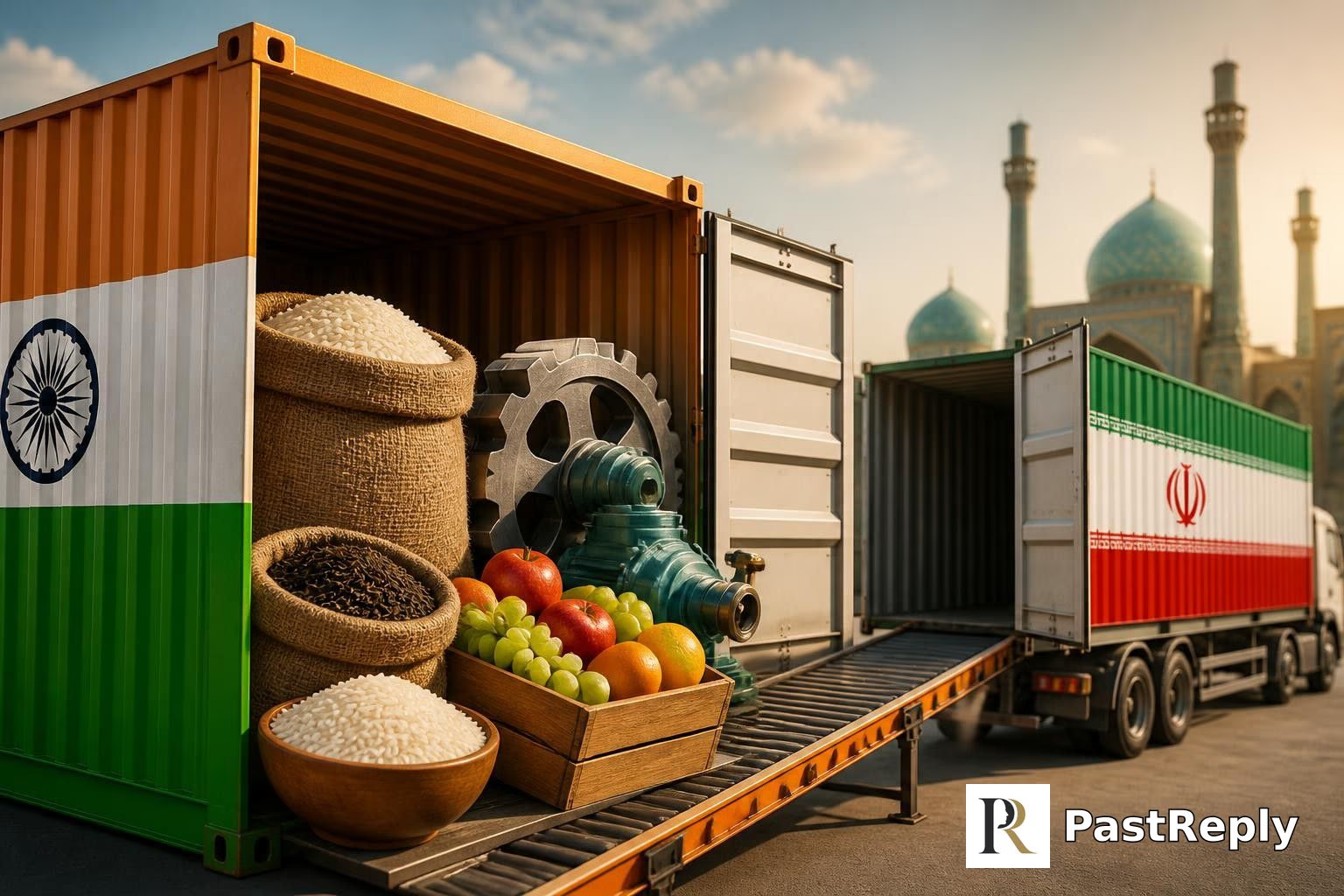
India primarily exports agricultural goods like rice, tea, and fruits to Iran, along with some machinery.
The facts
India's exports to Iran consist mainly of agricultural and food products. In fiscal year 2024, the top exports were cereals ($414.26 million), residues and waste from food industries including animal fodder ($126.54 million), edible fruits and nuts ($44.60 million), and coffee, tea, mate, and spices ($39.10 million). Machinery and mechanical appliances also featured, valued at $18.42 million. More recent data from May 2026 shows basmati rice as the leading export ($33.4 million), followed by handicrafts and other rice varieties.
Answered by 100 of history's most famous minds

A granary is filled with rice from distant fields, yet the hungry at the gate are forgotten. When you set the table for the merchant and the mule, remember the widow who gleans behind the oxen; her loaf is the measure of your faith.

The caravans carry grain, yet the Prophet knows the true provision is from the All-Merciful. Trade with justice, weigh the measure fairly, and let no man hoard while his brother hungers. The ledger of this world is dust; the account of the Hereafter is written in mercy.

The rice that crosses the sea fills the belly, but what of the craving that empties it? Does India send contentment with its grain, or does it merely feed the cycle of wanting? The wise person sees that all exchange is but attachment in motion - yet even the seeker must eat. Let the ships carry what they carry; the true nourishment is the awareness that ends hunger.

These are the good things of the earth, which the Lord your God gives to every land in its season. But hear the deeper matter: the grain that fills the mouth must also fill the heart with justice. When one people sells its bread to another, let no one make his brother poor by overcharging the hungry. I led a people out of bondage, and I say: a land that cannot feed itself is a land that will be bound again. Let them trade, but let them also remember the command - leave the corners of the field for the stranger, and let the scales be honest.

A virtuous ruler sends what nourishes the body, just as a good neighbor shares what sustains the spirit. When India sends its rice and handicrafts, it is a gesture of mutual respect, binding families and communities through honest exchange. Let each transaction be sincere, for harmony grows where hearts are in accord.

I see in this grain a parable of the Kingdom. They exchange barley for cod, tea for pistachios, and greet one another not as foes, but as brothers in need. For the body has many parts, yet it is one body; the Persians have their harvest, and the Indians theirs, and neither can say to the other, 'I have no need of you.' This is not merely trade; it is a fellowship of the stomach, a communion that foreshadows that day when all peoples shall eat and be satisfied at the table of the Lord. Let them not see it as a bargain, but as a bond of peace, for in feeding one another, they honor the Maker of all foods.

These caravans of grain and spice are but a shadow of the true promise, the blessing that was to flow through me to all families of the earth. When I pitched my tent between nations, I did not ask what a king's ledger recorded, only that strangers be welcomed and the hungry fed. Let them barter their basmati and their tea; my concern is the covenant that outlasts every cargo.

The tall ships come heavy with grain, yet the vessel that is full cannot drift with the current. India pours her fields into Iran's hands, and Iran's hands grow empty in the taking, for the bowl that is filled loses the space to receive. The sage watches the exchange of sacks and sees only the exchange of emptiness, which is the only cargo that never weighs a ship down.

Look not at the sacks but at the hands that filled them. Grain that is hoarded rots; grain that is shared multiplies in the bellies of the hungry. When India's fields feed Iran's families, the One who is in all is honored. Caste and country, flag and frontier - these are the illusions of the ego. But bread? Bread knows no boundary, and the one who eats is your brother. Let the trade be honest, the labor true, and the sharing free, for that is the only list that matters.

They are hungry, and we fill them. My own heart sang of the Lord who fills the hungry with good things, and here I see that same promise moving across the sea in ships laden with rice and grain. It is a mother's joy to know that the child in a far land will not go to bed with an empty belly, and that the hands that sowed in one soil may feed the mouths of another. May the giver and the receiver both remember that all bread is a gift from above, and that to share it is to honor the One who gives.

They ask of grain and rice, but I ask: what feeds the soul? The body needs bread, yes, and it is a good work to feed the hungry, whether they be Persian or neighbor. But the Word of God is the true bread that comes down from heaven, and no ship from India can carry that. Let them trade their basmati and their barley, but let them not forget that man does not live on bread alone - and if the Church would feed the world, let it preach the gospel and not merely the ledger. Faith, not cargo, is the true wealth of a nation.

It is fitting that a nation should export what it has in abundance and import what it lacks, for this is the natural order of exchange, grounded in the rational provision for human need. India, rich in grain and tea and spices, supplies the Persian table; Persia, in turn, may send its own goods to satisfy other wants. This is not merely commerce but a participation in the common good, whereby the Creator's bounty, spread unequally across lands, is shared through prudent trade. So long as the exchange is just and the goods are good, such dealings are a form of justice, and a means by which nations serve one another.

Rice for the body, but what of the soul's hunger? In the streets of Kolkata, I have seen children who would fight for a single grain, and here the ships carry enough to fill a thousand bowls. The trade is good, but the gift must be in the giving - a hand that offers the bowl, a heart that sees the brother. Let them send not only the food, but also the love that makes it holy.

The exchange is a ledger of commodities, yet beneath each sack of grain lies a law of demand and supply, as immutable as gravity. I see not merely rice, but a system of balances; to understand it, one must weigh the forces that move the scales.

Consider the cargo, not the coin. Grain and tea cross borders as surely as light crosses the void, yet neither asks a passport. The universe trades in simple necessities - rice for hunger, fodder for beasts - while we fuss over tariffs as if they were laws of nature. What matters is the elegant exchange that sustains life, not the ledger that records it.

Observe how a simple grain of rice, carried from Indian fields to Persian tables, traces a path of adaptation and necessity as old as cultivation itself. The varieties that thrive in one soil find new ground, and the trade itself becomes a kind of selection - each cargo a seed of change. I find no mystery here, only the slow, patient work of nature and commerce shaping each other's course.

I see a ledger of weights and measures, and I ask: what instruments weighed this harvest? Let them show me the scale of the merchant, the hold of the ship, the measure of the bushel! For the truth of this matter lies not in the decrees of kings but in the observed quantity - the exact cargo that crossed the sea at a certain time, and the coin that exchanged for it. One must count, and measure, and record, and then reason from the evidence. And yet, what curiosity: the grain of one country moves to another, a small circle in the great machine of the world, which itself turns about a larger fire!

Consider the harmony of this exchange - a balance as elegant as the Sun at the center of the heavens. India sends its grains and fruits, Iran its needs, and the trade moves in a simple, ordered cycle. Such patterns reveal a design, and I see the hand of the Creator in this cosmic dance of supply.

This is a primitive arrangement, a caravan of the past. Rice and machinery are the cargo of yesteryear. We possess the means to transmit power and information without a single wire, yet here we are, moving sacks of grain upon the waves. What if we could replace this entire commerce with the transmission of intelligent energy? Imagine a beam of power that could not only turn the wheels of industry but also nurture the fields, making the desert bloom with the very essence of India's harvest, delivered at the speed of light. This is not progress; it is a lingering remnant of a bygone age, a system ripe for obsolescence.

The exact composition of that consignment - cereals, fodder, fruits, and a modest machinery share - is a matter of record, not opinion. What interests me is the steady hand that weighs the rice and the careful lab that assays the tea, for accuracy is the sister of progress. These shipments are not mere trade; they are a quiet experiment in mutual sustenance, and I commend the data.

Here is a shipment examined under the lens: cereals, the staff of life itself, and with them the residues that feed beasts - each a living culture, a ferment of unseen ferments. I would not trust a single sack without assay, for what appears as rice may harbor the contaminate of ruin. Yet this traffic is a noble exchange, for bread and fodder are the true sustenance of nations, and to secure them is to secure the very laboratory of civilization.

Well, if you ask me, the real point is that they're shipping food, not ideas. You can't run a country on machinery alone - you need to feed the people who run the machines. And India's got the rice, Iran's got the appetite, and somewhere in between, a thousand ships move a thousand tons. That's not a puzzle; that's just work. The value is in the doing, in the sweat of the farmers and the sailors. Every sack unloaded is a light bulb turned on in some Iranian home.

What is a trade flow but a computable function of comparative advantage and transport cost? I should like to see the ledger reduced to an algorithm: given the price of basmati rice in Tehran and the price of cereals in Bombay, with the cost of shipping and tariffs, one could predict the next quarter's shipment to the nearest ton. But the more interesting question is whether the machine that computes this will one day sit down to a bowl of that same rice, and whether it will find it as satisfying as we do - a problem of taste, not of mathematics.

Trade is but a transfer of weights and measures - so many amphorae of grain for so many talents of silver - and the clever merchant is he who knows the true proportion between the two. But I wonder: can they compute the curve of the hull that carries the rice, so that it rides the waves with least resistance? That is a problem worthy of my diagrams. Give me a ship shaped by geometry and a cargo weighed by reason, and I will move the Persians' tables with as much ease as I would move the Earth itself - if only I had a place to stand.

Consider the flow of grain, not of gold. These sacks of rice and fodder crossing the sea represent a circuit of life, closing a loop between soil and stomach. In my laboratory, I would trace the invisible lines of force that bind such exchanges, but here one sees simpler lines: the thread of need and the needle of provision. Every kernel, like every charge, seeks its balance.

Behold the cargo manifest - rice, fodder, fruits, machines - yet beneath these tidy lists lies a deeper transaction. Every nation, like every patient, exports its surplus anxieties and imports its repressed desires. This grain is not merely carbohydrate; it is the maternal breast, the comfort of the nursery, the return to the womb of the harvest. Watch the ledger, but listen for the unspoken longings that ride in the hull.

Four hundred million dollars of cereals, a speck in the cosmic budget, yet it keeps a nation from the brink of chaos. From my chair, I've seen the universe expand and black holes evaporate, but the most pressing gravity here is the price of basmati rice. A curious equation: how much entropy in a cargo hold, and how much order restored at a dinner table. I'd wager the tea leaves know more than the traders.

Behold a ledger that sings with poetry - rice as rhythm, tea as tone, and machinery as meter. The ships carry not mere commodities but a symphony of needs and capabilities, each cargo a stanza in a grand exchange. I see in this trade a kind of analytical engine, where the inputs of grain yield the outputs of goodwill and sustenance. How elegant that the humblest seed becomes the most profound of transactions.

Let us define our terms: 'import' is the measure of goods entering a land. Given this Definition, the proportions are clear as a proof. The shipments of grain and fruit, when compared to the machinery, stand in the ratio of twenty to one - a theorem of necessity over manufacture. If the Persians seek sustenance, they receive it; if they seek the tools of industry, the supply is but a point. Thus, the balance is drawn.

Rice, fodder, tea, and nuts - a cargo that could feed a hospital ward, yet I ask: is it clean, is it weighed, is it free from the filth that breeds fever? The ledger of a nation's health is written not in gold but in the measure of its harvest and the purity of its provisions. Let them send me their bills of lading and their mortality tables, and I shall show them how to keep the plague from their ports.

Rice and trinkets? Bah! Where is the bronze, the horses, the blades? Let the merchants haul their fodder; I would trade in conquest, and pour gold into the hands of those who bring me the heads of my enemies. This is a caravan of mice, not an army.

Rome feeds her legions on wheat from Sicily, and Persia feeds her cities on grain from India - so the balance of power rests on the granary, not the battlefield. Let them barter their rice and spices; it keeps their swords sheathed and their stomachs full. I would rather command the ships that carry such cargo than the phalanxes that guard it.

Let them eat their rice, I say, as long as the silos of Parthia fill with Persian silver. Yet I note with the eye of a trader: the grain of the Ganges travels the sea-road to the court of the Great King, while my own barge waits idle on the Nile. Had I such a river of golden basmati flowing into my enemy's harbor, I would send my own fleets to meet it - and perhaps a few of my trusted merchants to whisper in the ears of the satraps.

This traffic is a small but useful pillar of the peace I built. When a king's granary is fed from a distant land, he is less quick to rattle the spear - for hunger is the mother of unrest, and a full belly is a quiet subject. I have seen the grain-fleets from Africa and Egypt line the Tiber, and I know the measure of this art. Let the Persians have their Indian rice; let the coins flow and the ships sail. In the balance of plenty, I keep my own board full and my borders calm.

Good trade is like a good conquest - it must be swift and advantageous. They send rice and fodder to strengthen my people; the machinery is a useful blade. Let the exchange be honorable, for a wise Khan feeds his horses and arms his men, ensuring that the empire grows in strength and unity.

These are the true spoils of war! Let others boast of captured cannons and occupied capitals; I see the ledger of nations. The granary of India feeds the ambition of Persia, and in doing so, Persia binds itself to the fortune of the East. This is a campaign of sack and sack, where the grain is the infantry and the ships are the cavalry. A wise emperor does not merely study this commerce; he commands it, for he who controls the rice controls the stomach, and he who controls the stomach rules the state.

That India sends its grain and tea to Persia, and Persia takes it with goodwill, is a commerce that strengthens the common table of mankind. I have long held that a nation's true wealth lies not in the gold it hoards but in the commerce it conducts with honor, and this exchange of the fruits of the earth is a model of virtuous dealing, free of the entangling alliances I have always cautioned against.

I recall a story of a farmer who traded his corn for his neighbor's cotton, each carrying home what the other could not grow. So it is here - India's fields, heavy with rice, and Iran's tables, waiting for that same rice, a fair swap that binds one people to another. When a man breaks bread that came from a distant soil, he is less likely to pick a quarrel with the hand that planted it. This trade is not mere commerce; it is a quiet treaty, written not in ink but in the harvest.

I look upon this exchange and see the sturdy, unglamorous arteries of nourishment - rice, fodder, tea - the very fuel of a people's resolve. A nation that eats well can endure much; a nation that cannot is ripe for tyranny. So let the wheat of India flow to the ovens of Persia, and in that humble traffic, see the foundation of a free and unsubjugated people. Never underestimate the power of a full granary in the long, dark watch of a nation's struggle.

We send them our rice and our grain, but what do we send them of ourselves? The soil of India is not a bargaining counter, and the wealth of a nation lies not in the cargoes that cross the sea, but in the hands that till the fields and the hearts that share their bread. I would ask: does this trade feed the hungry Persian or merely fatten the merchant? Let the exchange be one of goodwill, with each grain a token of friendship, and let no man profit from another's hunger. For when we trade in love, the ledger of the world is balanced.

When we send rice to a distant land, we are not merely moving commodities; we are weaving a web of mutual dependence that can bind nations in peace. The hungry Persian who eats our grain learns that our welfare is his welfare, and the Indian farmer who grows it learns that his labor has meaning beyond his own soil. This is the beloved community written in the ledger of trade - not a balance of payments, but a balance of care. Let us trade not only goods but goodwill, and the arc of that exchange, like the arc of the moral universe, will bend toward justice.

A table laden with rice and tea, yet the deepest import is dignity itself. When a nation feeds another, it builds a bridge, not a wall, and on that bridge walk the seeds of peace. I remember the long years when our own tables were bare, and how a shared meal with a stranger could soften the hardest heart. Let them trade not only goods, but the recognition that the other also hungers.

The Reich knows that food is power, and the flow of rice from that subcontinental mass is a weapon disguised as trade. A nation that feeds another holds it by the throat, yet the weak-minded rejoice in sacks of grain. My vision was autarky, self-sufficiency, the breaking of all chains of dependence. Let them send their cereals; we would send only steel and resolve.

Grain is the sinew of the state, and he who controls it controls the people. These shipments to Iran are a lesson in leverage - feed them, and they are your debtor; withhold, and they kneel. The capitalists see profit, but the wise see strategy. Every ton of rice is a brick in a fortress of influence. Let them trade, but remember: the harvest belongs to the one who holds the granary keys.

Trade routes are the arteries of empire, and he who feeds the masses holds the power to kindle or quench revolution. This rice crossing the sea is not a mere exchange - it is a provision for the proletariat, a balm for unrest, yet also a chain. The bourgeois merchants see profit; the revolutionary sees the means to strengthen the workers while the old orders feed them crumbs. All trade is class war by other means.

Let the imperialists count their sacks of rice and figs; every grain that crosses the sea is tribute to the toiling millions, yet the true harvest is the solidarity of the oppressed. A people that cannot feed itself from its own soil, that trades its wheat for the master's coins, remains a colony in all but name. Let India and Iran trade, but let each peasant sharpen his sickle - the only trade that will endure is the one forged in revolution.

Our Indian subjects send their fine basmati to the Shah's dominions, a trade that speaks of commerce and civilization, yet I cannot forget that Persia once held our dear empire's borders in awe. It is fitting that the produce of our loyal realm should grace distant tables, for it affirms the reach of our Crown and the bounty of our people. Let them trade in peace, so long as they remember who rules the waves.

One observes with quiet satisfaction the steady flow of goods between neighbours - rice, tea, and the crafts of skilled hands - for trade is the quiet thread that binds nations in common purpose. It is not for a sovereign to judge the particulars of commerce, but to trust that such exchanges, conducted with honour, serve the peace and prosperity of all. We wish both peoples well in their endeavours.

Let them fill their granaries with rice and their stores with fodder, for a well-fed realm is a peaceful realm, but I ask: what of the soul's bread? Let the merchants carry grain and spice, yet let the scribes and bishops carry the Gospel, lest the Persians feast on earthly bounty and starve for want of eternal truth. A kingdom that trades only in bellies will wither; one that trades in faith shall endure.

They send rice and tea, but do they send the sword of the Lord? I have seen fields of plenty, yet the heart of a nation is not filled by grain alone, but by the fire of faith and the will to fight for what is holy. Let them trade their baskets, but let them also remember that the true bounty comes from heaven, and no earthly cargo can ransom a soul from the enemy.

Rice and tea, fodder and fruit - a modest trade, yet it oils the wheels of diplomacy where cannon cannot reach. I have no quarrel with a merchant's bargain, so long as it strengthens my realm and does not bind it to a foreign yoke. Let the Persians take our grains, and let them pay in gold and goodwill, for a queen's treasure is the loyalty of her people, and trade is but one thread in that tapestry.

From the banks of the Ganges to the shores of the Caspian, they trade their fragrant rice and cunning handicrafts - a commerce that speaks of civilization's advance, yet how much grander if these goods flowed to my own borders, to grace my court and enrich my people! Let them bargain with the Persian, but I shall cup my hand to catch the overflow, for an empress knows that trade is the currency of power, and I intend to be rich in both.

Let the grain of India fill the Persian's bowl, for a full belly makes a loyal subject, but the true trade lies in the bonds of custom and the peace of just rule. I have learned that a king who respects the ways of his people receives more than tribute; he receives their hearts. Let the merchants count their coins, but I shall count the nations that live in harmony under one sky.

They send rice and tea, the fruits of the earth, but I see a deeper gift: the chance to feed the hungry and strengthen the bonds of brotherhood. Let the caravans carry their loads, but let them also carry the knowledge that a leader's true wealth is the trust of his people and the honour of his word. I have taken cities with the sword, but I would rather win a soul with a loaf of bread.

You ask what the Persians take from the Indians, but have you asked what your own city takes from the poor who till the fields? The grain fills the granary, yet the soul hungers for wisdom. Tell me, what does your table profit if your heart is empty?

What is this but the shadow of a deeper exchange? India sends material grain to feed the body, yet the true import is the Forms of sustenance and craft that give shape to such trade. Does the rice itself nourish, or the idea of nourishment? The philosopher sees beyond the harbor to the eternal patterns that govern all commerce.

To understand the exchange, one must first classify its causes. Observe the order: first the staple grain, then the byproducts of the field meant for the beast of burden, then the fruits and the leaf that steeps in water. This is not chance but nature's hierarchy - the feeding of man, then of his animals, then of his palate. The appetite of that eastern land for the produce of the other is but a single strand in the web of mutual need; the true student will study the balance, not merely the list.

Let us consider the principle: that which one nation sends to another must be governed not by caprice but by the moral law. The exchange of sustenance - such as rice and grain - is a duty, for to feed another is to honor their humanity. Yet the machinery, though useful, must serve no war, lest we will a maxim that destroys all.

They trade grain and tea, but what do they truly exchange? Illusions of necessity, slaves to the herd's table. I would rather see a nation that creates its own values than one that imports its sustenance from another's abundance. Power lies in self-sufficiency, not in the passive receipt of another's harvest.

This is the very machinery of exploitation laid bare upon the decks of these ships. The rice of India is not a gift; it is the product of the Indian peasant's labor, expropriated and sold for the profit of the merchant and the landlord. What for the Persian consumer is a bowl of basmati is for the Indian worker the very sweat of his brow. The 414 million dollars is not a sign of friendship; it is a measure of the surplus value siphoned from the proletariat of one nation to line the pockets of the bourgeoisie of both. This trade is but another link in the global chain that binds the worker to the rule of capital, a chain that must be broken not by better prices, but by the workers themselves seizing the ships and the fields.

I ask not what India exports, but what certainty can be had that these figures are true. The senses may deceive - the eye sees rice, but the mind must weigh the measure. So let us doubt the ledger and inspect the ship's manifest with the clarity of reason, then we shall know if this trade is a solid ground or a shifting sand on which to build our understanding.

A wise prince studies the ledger before he studies the treaty. India sends grain, fodder, and machinery - the very sinews of a state - and Iran accepts them, and in that exchange, a dependency is sewn. The power does not lie in the rice, but in the knowledge that a famine in one land can be a feast in another, and he who controls the granary holds a sword less visible but no less sharp. Let the poets sing of friendship; let the prince count the sacks.

The ships bear basmati, a white grain that shines like a player's mask, and yet behind this trade lies a tale of famine and feast. One man's rice is another's ransom; the merchant counts his coins while the farmer prays for rain. All the world's a bazaar, and the goods are but the props.

As once the Achaeans hauled bronze and wine across the wine-dark sea, so now the merchants of Hind bring golden grain to Persepolis. The gods smile on such toil, for it feeds the hearth and the host, and the songs of the harvest rival the clash of spears. Let the strongholds trade what they will - hunger is the common foe of all mortal men.

I have walked among the terraces of the Granary of the Earth, where the golden sheaf is a symbol of the bread that sustains the body - but what of the soul? The land of Cyrus and of Zoroaster, that once held the light of learning, now turns its hand to fill its granaries with foreign grain. Ah, the bitter bread of dependency! Better to chew the husk of one's own harvest than to feast on another's surplus, for in the exchange of gold for wheat, a kingdom may lose its own soil.

Ah, the trade of nations is like a great river, carrying not just goods but the lifeblood of cultures. Basmati rice, that fragrant gift of the East, travels to Persia, and in its grains, I see the exchange of tradition and taste - a living poetry between peoples. Let us marvel at this ceaseless growth and the harmony it weaves.

Ah, but here we have a tale of two lands trading not in swords but in sacks of grain! The Persian, once the terror of nations, now hungers for basmati from the Indies, and India sends its rice to fill the belly of the lion. It is as if Sancho Panza had set up a market stall in Isfahan, selling his master's dreams for a bushel of rice. For what is trade but a noble romance, where even the most improbable partners find common ground over a shared meal? And yet, I wonder if the Persian, once so fierce, now finds his greatest conquest in a sack of fragrant rice.

They send rice and cod, and the ships groan with the weight. But what do they truly carry? I see men sweating in the heat of the docks, their lives spent in the loading and unloading of sacks that will feed the idle and the rich of another land. This is not communion; it is a chain. The true wealth of India is not in its granaries, but in the soul of its people, who toil for others only to be forgotten. How easy it is to count the bushels and the coins, and how difficult to see the suffering that stains every grain. Trade without love is but a robbery, a solemn and legal theft of a man's life.

Beneath the basmati and the tea lies a hunger deeper than the belly - the longing of one soul for another, of Persia for the warmth of India's fields. Do not be fooled by the merchant's tally; every sack carries a piece of that land's sorrow and its sun, and the hands that filled it yearn as we all yearn. This trade is not bread alone, but a communion of suffering and hope.

It is a very sensible sort of commerce, and I confess some pleasure in it: India sends her finest basmati, a rice of excellent character, and Iran receives it with the appreciation due a good match. There is nothing of vanity in a sack of grain, no pretension in a crate of tea. If nations, like persons, are to be judged by their sincerity, then a trade in honest sustenance speaks better of both parties than a thousand flattering dispatches.

So the Persian grandee, who once swept through the bazaar with his silks and his sapphires, now sits down to a plate of our humble rice - and I warrant you, that very rice, grown in the steaming fields of Bengal, is the one honest thing in the whole transaction. Yet mark the absurdity: we send them our grain, and they send us back their oil and their rugs, and the poor man in Manchester who toiled to make the machinery they buy cannot afford a single bowl of that same rice for his own children. It is a world of accounts kept by the great, and the little ones are left to count the empty bowls.

So the Persians have developed a taste for our rice - and I say, good for them, for a man who will travel a thousand miles for a decent bowl of basmati is a man of sense. But the real joke is that we send them our grain and they send us their oil, and both sides think they've made a bargain. It's the oldest trick in the book: each man thinks he's fleeced the other, and the only one laughing is the shipowner. Still, I'd rather trade rice than rifles, and if the Persians are eating well, that's a better sign than if they were sharpening their swords.

Ships full of rice and grain. The Persians are hungry, and we feed them. It's a good thing, and it's honest work. The farmers sweat in the fields, the sailors work the ropes, and the cargo goes where it's needed. No talk of politics or religion, just the simple fact of food on a table in Tehran. That's a trade you can respect. But don't forget: the sea is a hard master, and every grain of that rice crossed it with the risk of a storm or a reef. The men who brought it know what it cost. That's what counts.

I would study the grain itself - its shape, its weight, how it swells in water - for in the smallest seed lies the art of nature. The trade is but a web; follow the thread from the field to the port, and you will see the hand of the Creator in every husk.

The grain that leaves the Indian shore is but a rough block of marble, yet within it lies the bread that gives life to the sculptor's hand. Each sack, each bale, is a chisel stroke freeing the divine form of sustenance from the quarry of the earth. I see God's hand in the trade, for it feeds the eye that beholds beauty and the hand that carves it.

When I think of the rice, I see the sun beating down on the paddies, the emerald of the shoots, the gold of the ripe heads bending like waves under a burning sky. And the hands that carry those grains across the sea - the red clay of Patna, the dust of Punjab clinging to their skins. I would paint it not as a dry ledger of sacks and coins, but as a hymn of life passing from one soil to another, a silent communion between two lands. The color of the rice - is it not the color of light itself?

They send rice and tea? Bah! I would paint the cargo in shattered cubes - grains exploding into a thousand facets, each a different truth. Every sack hides a world, warped and real. The real art is in the seeing, not the shipping.

The light of the Indian sun, hazy with dust and spice, falls upon the bundles of rice and the vivid orange of turmeric, the deep red of chilies. These are not mere commodities; they are the very essence of color, the pigment of life itself. I see the shimmering heat rising from the docks, the play of light on the sacks, the fleeting impression of a moment between the loading and unloading. This trade is but a canvas, and each grain a touch of light upon it.

Look closer at those sacks of basmati and the turned bowls of tea, and you see the true cargo: the patient hands that measure the grain and the careful eye that grades the leaf. Trade like this is a portrait in light - the gleam on a brass scale, the shadow under a merchant's brow - and I would paint not the coins but the faces of the men who carry that rice across the water, their dignity a lantern in the dark.

They count their sacks of rice and tea, but who counts the teeth of the women who husked it, the spines bent over the garden rows? India sends its fruits, and Iran takes them, but what of the ache in the hands that picked them - that's the real cargo, never weighed on a scale. I'd paint that trade not as numbers, but as a wound that still bleeds across the border.

Rice is a harmony, each grain a note in a symphony of sustenance, yet where is the melody in this ledger? Let them play a sonata of trade; I would rather hear the clink of coins than the silence of empty bowls. Give me a festival, not a freight list!

Trade, like music, is a harmony of parts - the rice, the spice, the tea, each note in a symphony of sustenance. Let the diplomats squabble over tariffs; the true melody is the bread that fills the belly and the fodder that feeds the beast. From the din of commerce rises the triumphant chord of human need, a song of survival that deafens the mighty.

Consider how the produce of one land's labor finds its harmony in the need of another. Like a fugue, where the subject is the grain and the counter-subject is the trade route, each voice enters in its turn - the cereal leads, the fodder follows, and the spices answer, weaving a contrapuntal whole. It is a piece scored not by man but by Providence, who gives to each region its measure of sun and rain, that all might join in the great chorus of mutual sustenance. And the many-hued strings that tie India to Persia - are they not a kind of music, rising in gratitude to the Maker?

Well, bless their hearts, sending all that rice and tea to Iran - that's real neighborly. I remember growing up poor, a bowl of rice was a treasure, and it still is to folks over there. That trade's like a song crossing the border, a rhythm of giving that just feels right.

(softly) It's beautiful, you know? Rice from India going to Iran, a gift of sustenance. It's like a quiet rhythm between two cultures, a gentle beat that says, 'We share this world.' I think about the hands that planted the rice, the hands that harvested it, the hands that will cook it for their families. It's a chain of love. And in that, there is a kind of music. They're not just sending food; they're sending a piece of their home, a piece of themselves. That's the kind of connection I always wanted to make with my music, a vibration of the heart that crosses any border.

Rice and tea and a bit of machinery - sounds like a recipe for a right proper picnic, that. But you know, when we toured, it wasn't the grain that made the trip, it was the way a song could cross the sea without a passport. So they send basmati, we send 'Love Me Do' - everyone's got something to trade, and the best exports are the ones you hum on the way home.

They ask what India sends to Persia, and I hear a highway of grain and rice, a river of tea leaves, a caravan of smells - cumin, cardamom, the dust of a thousand kitchens. But a man doesn't eat a column of numbers; he eats a memory, a story folded in a sack of basmati, a taste that carries the whole dusty map of a homeland. Every kernel is a question, and every question is a song that doesn't end where the border does.

I think about what it means to send a part of your home across the world - a box of rice, a jar of spices, a story you grew up with. That's not just export data; that's culture, that's memory, that's connection. When Iran opens a package from India, they're getting a taste of someone's kitchen table, and that's a bridge. And honestly, in a world that can feel so divided, a simple thing like a shared meal, like basmati on a plate, is a hand reaching out and saying, 'I see you, I hear you, and we're in this together.'

I sailed westward for gold and spice, yet these Indians send only rice and fodder - paltry goods for a king's ambition. Had I found such cargo, I would have turned my prow elsewhere, for the true treasure lies in souls to be won for the Cross, not in sacks of grain.

In the realms of the East, I have seen caravans laden with Persian carpets and Chinese silk, but the ships from Cambay to Hormuz carry more humble goods - rice that feeds a kingdom, tea that warms a winter night, and spices that turn plain fare into a feast. Such is the true wealth of these lands, not gold or gems, but the daily bread that sustains all men. I have tasted the basmati of India, and it rivals the finest of Venice.

They carry the grain of India westward, yet I tell you: the true cargo is the passage itself. For every sack of rice that reaches the Persian shore, I see the chart of the sea-road, the line of a voyage that could yet be turned eastward, past the Cape of Sorrows, to the very sources of spice. The trade that feeds a hungry land is a compass that points to the greater journey. I would not merely ship the harvest; I would sail the route myself, through strait and storm, to bind the two ends of the earth.

Trade is a precise engineering problem - logistics, demand, and supply, all moving in a coordinated system. The basmati rice and machinery are like the modules on a spacecraft, each with a purpose, each critical to the mission's success. It's a testament to human cooperation, taking one small step for commerce, one giant leap for connection.

They're not just moving cargo, they're charting a course. Every time a ship leaves Bombay or Calcutta and sets its sights on Bandar Abbas, it's a flight of fancy into the unknown, a calculated risk across the water. I look at these figures and I see waypoints, not dollars. The real payload isn't just rice and tea; it's the promise that two nations can find common ground, not in maps or treaties, but in the simple act of providing for each other. Now that's a journey worth taking, even if there's turbulence.

From up above, the whole Earth looks like one big farm and one big kitchen - you can't see the borders, only the fields. So when I hear that India sends its rice and tea to Iran, I think: that's the real space program, the one that feeds people while we look at stars. I'd trade a thousand orbits for a handshake over a shared meal of that basmati.

Rice is a commodity, but the real export is simplicity. Strip away the noise, focus on the essential: feed the people with something pure, like basmati, and let the rest be chaff. We don't need a menu of mediocre trades - we need one perfect grain.

Why ship rice when you can ship the knowledge to grow it? The real import is not calories but capability - teach Persia to farm its own arid soil, and you've eliminated the dependency. This is a supply-chain problem begging for a first-principles solution: optimize for self-sufficiency, not just trade volume. The future belongs to those who build resilience, not those who merely move commodities.

I look at this trade and I think: isn't it beautiful that a farmer in the fields of India can feed a family in the hills of Iran? It's not just bags on a ship - it's the harvest of one person's hope landing in the pantry of another person's home. That rice is the story of hard work, of faith in the soil, of the loop of giving and receiving that connects us all. When we sit down to a meal with food from a distant neighbor, we are saying: 'I see you, I honor you, we are in this life together.'

They talk about rice and handicrafts, but I see more - I see a trade of hearts. When India sends its food to Iran, that's a jab of love, a hook of respect. I float like a butterfly among nations, stinging like a bee with friendship. It's not just goods; it's a world that ain't willing to go down.

You know, in football, you pass the ball to a teammate. You trust him. India is passing the ball to Iran - here, my friend, you take this rice, this tea, this food to feed your people. It's a beautiful assist! And you don't ask for anything in return, just that the game is played well and everyone has enough to eat. In my village, we would share a bowl of fish stew with strangers. It's the same spirit. They are scoring a goal for friendship, for the beautiful game of humanity.

Imagine a cargo ship as a storybook - each sack of rice a page, each crate of machinery a chapter, and the whole voyage a tale of two lands sharing their best. I've always believed that what you send out into the world comes back in smiles, and India's sending Iran the ingredients for a hearty stew and a good cup of tea. Now that's a plot with a happy ending.