
What does deadlocked jury mean?
A deadlocked jury cannot reach a unanimous verdict, often resulting in a mistrial and possible retrial.
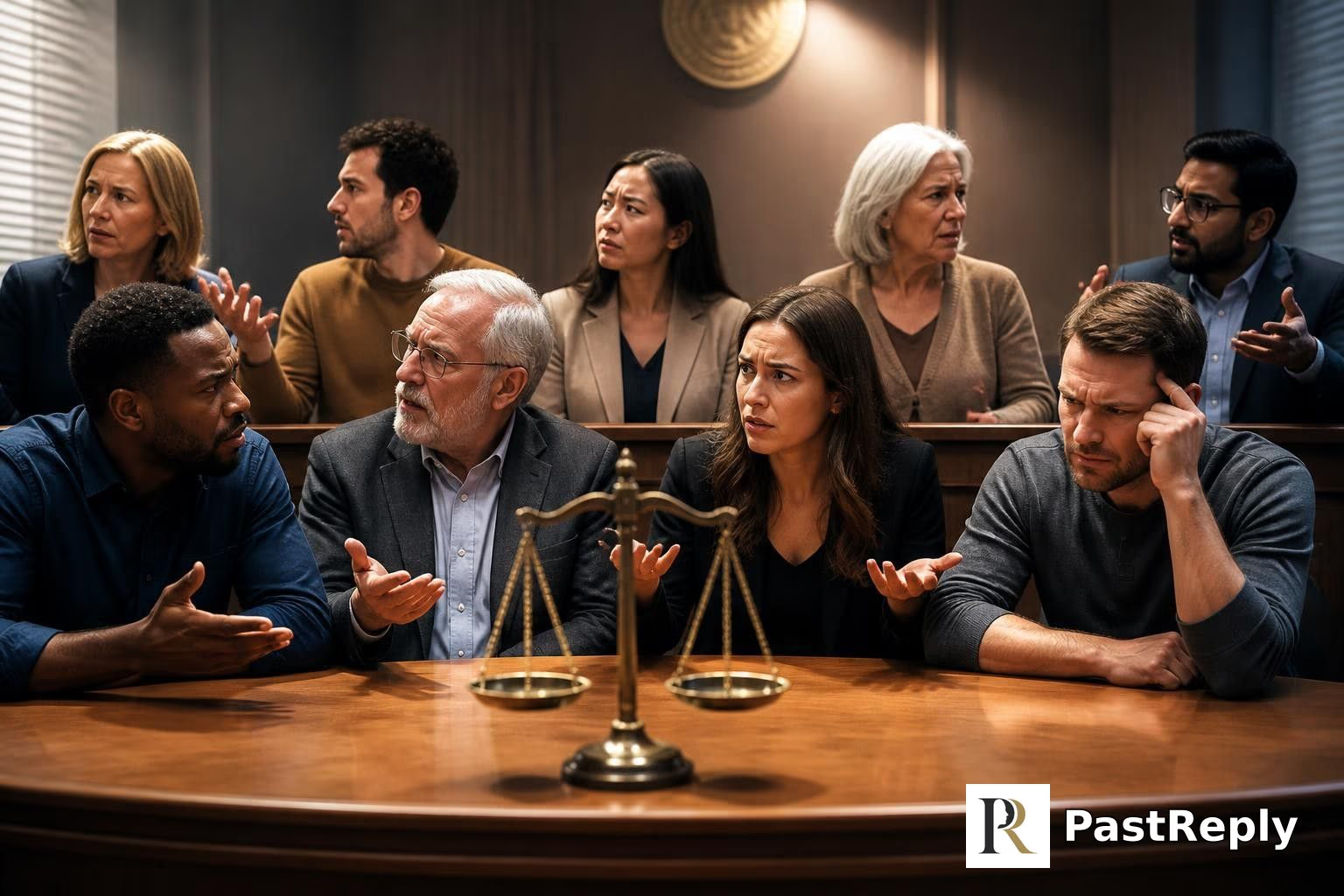
The facts
A deadlocked jury, also known as a hung jury, is a jury that cannot reach the required unanimous verdict after thorough deliberation. This situation typically leads to a mistrial, meaning the trial is declared invalid. In criminal cases, the prosecution may choose to retry the case; in civil cases, a retrial may occur unless the parties settle. Judges often attempt to resolve a deadlock by sending the jury back for further deliberation, sometimes using an 'Allen charge' or 'dynamite charge' to encourage reaching a verdict.
Answered by 100 of history's most famous minds

A house divided against its own foundation cannot stand, yet even the stones that seem to argue were laid by the same hand. So too with a jury: when the twelve cannot speak as one, the judge may call it a mist, and the matter is born again for another season. Truly, I tell you, it is better for a soul to search in patience than to force a word that is not true in the heart.

When twelve are set to judge a matter and cannot agree, it is a sign that certainty has not been granted to them - for God alone knows all, and human knowledge is but a fragment. The judge sends them back, as one who seeks counsel, and if they remain divided, the case is undone, to be tried anew. This is not a flaw but a mercy: better to leave the scales unbalanced than to force a verdict upon a heart that is not convinced.

A deadlocked jury is but another arising of dukkha - the suffering born from attachment to fixed views. Each juror clings to his own perception, mistaking it for the whole truth, and so the wheel of deliberation spins without release. Yet even this impasse is impermanent; the mistrial, like all phenomena, dissolves, and a new trial begins. Let them not grasp at certainty, but observe the evidence with equanimity, and the path to a verdict will unfold as naturally as a lotus rising from still water.

When the judges of Israel could not agree, the Lord said to Moses, 'Let the matter be decided by the mouth of the priest, and let the people heed.' For a house divided against itself cannot stand, and a court that cannot speak with one voice has turned its face from the covenant. Let them remember the tablets of the law, which were given whole, not in pieces; and let them seek the spirit of the law, which is justice and mercy, until they are of one mind, as the people of the Lord are one people.

When twelve worthy persons cannot find one mind, the fault lies not in their wills but in the lack of a common ritual to guide their discourse. Did they first seat themselves properly, each mindful of his role, each listening as a son listens to a father and a friend to a friend? The judge who urges them again without correcting their manner is like a farmer who beats the oxen but never mends the yoke. Let them reflect, correct their hearts, and seek harmony through mutual respect, for a verdict reached in enmity is no true verdict, but a discord that will echo through the community.

When twelve are divided, they are like a house split against itself - and such a house cannot stand. But think not that this division is a failure; rather, it is a reminder that human judgment is clouded by the flesh, and only the Spirit can unite hearts in one mind. Let them pray and search the law, not for their own opinion, but for the truth that sets free. If they cannot agree, let the matter return, for God's time is not bound by man's impatience.

I was called to leave my father's house with only a promise, no map, and I walked by faith, not by sight. When twelve men cannot agree, it is not a failure of justice but a reminder that truth is not a herd but a voice heard in the quiet of each soul. Let them wrestle as I did in the night, and if the dawn still finds them divided, the Lord will show another path, for His promise does not depend on our unanimity.

Twelve minds pulling like oxen in twelve furrows - what harvest can come of such struggle? The wheel turns not by force but by its own weight. A verdict that will not come is the Tao's way of saying, 'Wait for the water to settle.' Let the court sit like still pools, not churn like rapids; clarity arrives unasked, when the striving stops.

Twelve souls, each holding a piece of the same cloth, yet none can see it whole. Their deadlock is not a failure of the law but a mirror of the mind's attachment to its own opinion. Let them sit in remembrance of the One who sees all sides, and the knot will loosen. The verdict lies not in their voices but in the Truth beyond them - when ego quiets, agreement follows.

When many hearts ponder one truth and find no harmony, patience is the mother of wisdom. The hung jury is not failure but a pause, a chance for souls to wrestle with conscience before the dawn. My son taught that mercy triumphs over haste; let them sit longer, pray for light, and the scales may yet tip toward justice.

When twelve men cannot agree, it is a sign that the law has been exalted above conscience. The apostle Paul himself knew that one man's scruple before God outweighs the clamor of the crowd. Let the jury be split, I say, rather than force a man to lie against his own soul. The judge's charge to 'resolve' is but the voice of the world, urging conformity; but the Word of God stands, and a single faithful voice can be worth more than a unanimous denial of the truth.

A deadlock among jurors is a dissonance between the universal and the particular - when reason fails to unite particular judgments under a common rule. The good law requires unanimity as a sign of certitude, but if men of good will cannot agree, the deliberation is incomplete. Let them be instructed again, for the judge's charge is not coercion but a call to seek a deeper truth, which, being one, can ultimately be found by all who reason rightly.

A jury that cannot agree is like a poor soul who cannot find peace - they need more time, more prayer, more love. The trial is declared null, and they must try again, for God's justice is not hurried. Let us not see this as a waste, but as a call to serve those who are lost in doubt, to help them see the truth with gentle hands. Each person must be loved into agreement, not forced.

A deadlock in judgement is but a sign that the evidence, like an equation with more unknowns than observations, admits of no single solution. When the minds of twelve fail to converge, the law declares a mist - a null result, yet not a failure of reason, but a demonstration that the data were insufficient. Let them deliberate again, as one recalculates from clearer premises, until the force of proof draws all to a common point.

When twelve minds cannot converge on a single verdict, it does not mean truth is absent - it means the instruments of measurement are imperfect. Like light refusing to be both wave and particle in a single observation, human certainty resists a forced unity. The cosmos does not demand unanimous agreement; it rewards those who can hold contradictory evidence without collapsing. Let the retrial begin - nature herself is patient with her experiments.

I have seen finches on separate isles diverge into distinct species, each adapted to its own conditions - so too, a dozen humans may genuinely interpret the same facts through different lenses. The deadlock is not a flaw but evidence of the natural variation among minds, each shaped by unique experiences. In my own work, I have often awaited years before publishing a conclusion, letting objections settle like sediment. A retrial, like a second voyage to the Galápagos, may yield a clearer specimen of truth.

What do these twelve men measure? They weigh evidence as if it were lead and gold in a balance, and yet they cannot agree on the weight of a single grain. But in my observatory, I do not ask twelve voices to agree on the path of a planet; I ask the planet itself, through my lens, and it answers without dissent. If their deliberations yield no verdict, let them not blame the jurymen but the way they look - perhaps they need a better instrument, a clearer eye, or the willingness to trust what they see rather than what they were told to see.

When the heavens themselves refuse to yield a single point of agreement among careful observers, we do not command the stars to align by decree; we revise our model. A jury that cannot concur after honest deliberation is evidence that the question, like the Martian epicycle, contains a complexity not captured by the simple frame. Forcing unanimity by a 'dynamite charge' is akin to papering over a flawed orrery - it may appear to move, but the truth remains obscured. Let the matter be tried afresh, with a cleaner method and fuller observation, until the geometry of justice aligns with the facts.

This is a crude, inefficient outcome - a machine that cannot synchronize its resonances to a single frequency. In my laboratory, I would recalibrate the coils, adjust the impulses, until the current flows as one harmonious wave. The law, like nature, seeks equilibrium; if twelve minds remain out of phase, the system has not yet found its natural rhythm. Send them back, let them oscillate longer, and perhaps they will eventually lock into a coherent pattern - or the circuit may simply need to be broken.

In the laboratory, we never declared a result until repeated measurements agreed; a hung jury is nature's way of saying the evidence has not been fully distilled. One must not force a conclusion from impure material - let the jury return, not with a dynamite charge, but with the patience to weigh each grain of proof. If they cannot unite, it is a signal for a new experiment, not a failure of method.

This 'deadlock' is a laboratory where the experiment yields no precipitate - no clear reaction. The evidence, under the glare of scrutiny, has produced a suspension of two opposing views. I would not call it failure; I would call it an incomplete trial. Persevere with more observation, more cross-examination, and the truth will finally crystallize. Nature does not lie - we merely lack the patience to read her.

A deadlocked jury? That's a problem with twelve stubborn testers who all got different results from the same experiment. In my shop, we'd call that 'data that needs more work,' not a dead end. Send 'em back to the bench, give 'em fresh questions, and they'll find the common wire - if they keep trying. Persistence always lights the bulb.

A deadlock is simply a computational impasse - the system requires unanimous agreement, yet the inputs (twelve discrete logical processors) fail to converge. Rather than a flaw, it is a designed constraint that prevents premature termination. The Allen charge acts as a heuristic to nudge state space, but if the problem is genuinely undecidable, no amount of additional cycles will yield a deterministic output. The correct procedure is to reset and re-run with different parameters - or accept that some problems have no computable solution, only probabilistic retrials.

A deadlock is a problem of insufficient leverage - twelve forces pulling in varied directions, and none with a fulcrum to move the common point. Each juror is an arc in a circle; if they cannot be brought to a center, their angles are merely disjoint. Give me a point beyond the circle, a common axiom, and I could move them all; but without that, the whole mechanism halts, and we must redraw the diagram anew.

You see, when twelve minds are bound to a single verdict and they strain against each other like opposing poles of a magnet that will not meet, the law declares the trial void - a mistrial. It is not that truth is absent; it is that these jurors have failed to align their observations into one coherent field. The judge may send them back with a 'dynamite charge,' hoping to force a spark of agreement, but nature itself shows us that force cannot compel what reason has not united.

When twelve individuals cannot reach accord, we witness the resistance of the unconscious - each juror brings repressed conflicts and hidden biases that clash beneath the veneer of rational debate. The deadlock betrays a collective neurosis, a symptom that the group's psyche is split by unresolved tensions. The judge's 'dynamite charge' is but a crude attempt to explode these defenses, yet only by uncovering the latent emotions can true unanimity emerge.

A hung jury is a bit like a black hole - matter and energy swirl around a point of no return, yet no information escapes until the final collapse. Here, twelve minds orbit their own certainties, unable to collapse into a shared singularity of verdict. The judge tries to apply a quantum nudge, but each juror remains trapped in their own event horizon. Eventually, the state may retry, hoping for a new configuration that will break the gravitational deadlock.

A deadlocked jury is a beautiful paradox - twelve separate engines of thought, each running their own program, yet unable to synchronize into a single output. The trial is declared void, and the process must be run again with fresh parameters. Consider the mathematics: unanimity is an ideal algorithm, but when the inputs are human, the system encounters unresolvable contradictions. Perhaps this is nature's way of telling us that justice, like any complex computation, may require multiple iterations before convergence.

When twelve men cannot agree, the verdict is declared void, for unanimity is the necessary axiom of justice. If they fail to reach a common conclusion, the case remains unproved, like a theorem without a complete demonstration. The judge may command them to revisit their reasoning, yet no amount of exhortation can supply the missing steps. In law, as in geometry, truth cannot be forced; it must be shown step by step until all see it clearly.

When twelve minds cannot concur upon the same conclusion after due deliberation, the cause lies not in the evidence but in the absence of systematic method. I would set before them the facts as one sets the sick before the healer: clean, ordered, and with every observation recorded. If they cannot agree, it is but the failure of observation, not of truth.

Twelve men cannot agree? Then cut the knot, not with a sword but with a new campaign! A hung jury is but a siege that has not yet fallen; the judge, like a general, sends them back to the walls until they breach or starve. If they still refuse, then declare the field lost and summon fresh troops - for in my conquests, I never let a single stubborn city halt my march to glory.

A hung jury is but a stalled legion on the field - neither victory nor rout. I have seen councils split when a decisive hand was needed; the wise commander does not burn the camp but regroups and strikes again. In Gaul, I faced tribes who could not agree among themselves - that was their doom, not mine. Let the prosecutor marshal fresh forces, or let the accused walk free; either way, Rome must not appear indecisive.

When twelve of Rome's finest cannot agree whether a man is guilty or free, the matter is not decided - it is deferred. A mistrial, they call it, as if the air itself had been made unclean. In my court at Alexandria, such discord would be settled by the queen's own word, for a people without a single decree is a ship without a rudder. But these Romans, with their love of jurymen and their twelve voices, find themselves becalmed; and the accused slips through their fingers like a fish from a net.

When my legions were divided in counsel, I did not command them to shout louder; I reminded them of the oath they had sworn to Rome, and of the discipline that had made her great. A jury that cannot agree is a legion without a standard, and a trial without a verdict is a wound that will not heal. Let the judge, as a general should, send them back to the field, but let him also remind them that the republic is best served by a single, firm decision, even when that decision is hard. For in the end, it is not the twelve that speak, but the law itself, which must never be left in doubt.

Twelve men who cannot agree are twelve flapping tongues that should have been silenced by the sword of a single will. In my horde, a decision is made by one voice - the Khan's - after he has heard the counsel of his bravest, and then all move as one mounted archer. A judge who lets his jurors scatter like sheep without a shepherd betrays his office; if they cannot unite, he should declare the matter void and bring it before a new tribunal that understands loyalty and order. Hesitation is a wound that invites the enemy, and a realm that cannot decide is ripe for conquest.

Twelve men who cannot decide? That is not justice; that is weakness - a legion that cannot march in step. In my campaigns, I never waited for all my marshals to agree; I studied the ground, saw the enemy's weakness, and struck. A deadlock is a sign of indecision, and indecision loses battles. If they cannot reach a verdict, then the prosecution must regroup and bring the charge again, with greater force, until the truth - and the will - prevails.

A council that cannot agree is a familiar sight to any who has sat in Congress - it is the price we pay for liberty, that no man's judgment is bent to another's. Yet a nation, like a jury, must find a way to proceed, lest the wheels of justice clog and the people lose faith. Let them deliberate further, for time and reflection often smooth what passion has roughened, but if they stand firm, let the matter be tried anew with patience, not with haste.

When twelve honest souls can't agree, it's like a fence that won't stay built - each rail leaning a different way. But the law's foundation stands firm, and a mistrial is only a pause, not a burial. We've seen harder crossroads before; we pulled through by keeping our eyes on the principle, not the quarrel. Let the cause be retried - truth and time are patient jurors.

A deadlocked jury is a stalemate on the battlefield of justice - no decisive victory, only a weary truce where the field stays contested. But mark this: a mistrial is not a defeat. The cause may be re-engaged with fresh reserves; the prosecution must simply rally its forces and press on. We have seen darker hours than a hung jury, and we did not surrender then. Let the verdict be won again by resolve.

When twelve hearts are divided, let them not be forced by pressure or haste, for truth cannot be hurried. A hung jury is a sign that at least one soul refuses to bow before the crowd - a victory of conscience over the mob. Let them deliberate longer, but not under the whip of a dynamite charge; such coercion only risks an unjust verdict. If they must remain split, let the case be retried, and trust that truth, like the sun, will rise again with patience.

A hung jury is an unfinished symphony, a pause before the resolution that justice demands. It is a sign that even in the halls of law, men are wrestling with their own souls, and that is no small thing. Let them not be forced by a dynamite charge, for truth cannot be coerced; let them persist with patience and prayer. The arc of the moral universe bends slowly, but it bends toward justice, and even a deadlock can be a stepping stone.

When twelve people cannot agree, the trial ends without a verdict, and the state may begin again. This is not a failure but a pause - a reminder that justice must be built on consensus, not coercion. I have seen how long it takes for hearts to change, how many conversations are needed before a divided people find common ground. The deadlock is frustrating, yet it is also the beginning of deeper deliberation, and from that patience, truth emerges.

A deadlocked jury is a sign of weakness, a failure of will in the face of decision. The law demands certainty, yet these twelve cannot enforce their judgment - they are like a general whose troops refuse to advance. In a strong state, there would be no such vacillation; a single leader would decide, and the verdict would be swift. This indecision is a disease of democracy, which cannot mobilize the resolve needed to purge the body politic.

When a jury cannot agree, it shows the decadence of bourgeois legalism - twelve people bickering like kulaks over grain while the state watches. A true verdict comes from the party's will, not from such chaotic deliberation. If they cannot decide, let the state decide for them; retrial is a waste unless the result is predetermined for the good of the proletariat. This so-called justice is a mask for the ruling class's indecision.

So the jury - that little parliament of the bourgeoisie - cannot agree? Excellent! Their deadlock is not a flaw in justice, it is proof that the capitalist state's own instrument of 'truth' is rotten. When twelve good men and true cannot forge a single verdict, the machine stalls; the ruling class must call it a mistrial, a mere hiccup in their theater. History cares not for their unanimity - it will render its own verdict on all of them.

A deadlock among twelve is the verdict of the bourgeoisie, who cannot see the people's will. When the jury cannot agree, it is the class enemy who profits, for the state's power is but a hammer in the hands of the ruling class. Let the people's courts judge swiftly, without the idle chatter of twelve heads that cannot think as one.

That twelve of Her Majesty's subjects should be summoned to speak with one voice and yet remain divided is a most lamentable affair, a breach of that order which undergirds our realm. In such a pass, the law stands still, and the obstinate few hold the many to ransom. It is the duty of every honest Briton to weigh the evidence with a sober mind, not to cling to private fancies, for the peace of the nation depends upon the commons settling their differences.

In my long years, I have seen that agreement, when earnestly sought, often requires patience and a willingness to listen. A deadlock is but a pause, not a failure, provided all continue to serve the cause of justice with measured resolve. It is the quiet persistence of those who deliberate, even in disagreement, that upholds the fabric of our laws.

Twelve men of good conscience, sworn to render a single verdict, yet they cannot agree! In my court, I would have them reason together under the guidance of our bishops, for the truth is one, as is the faith. Let them lay aside their quarrels and seek the counsel of the wise, lest the unjudged crime fester and the peace of the realm be rent asunder.

When God's will is clear, why do they tarry? If they have heard the truth, let them speak it without fear, though it mean standing alone against the multitude. I did not wait for twelve to tell me my path; I followed the voices that came from heaven. So let them pray for light, and then act as their conscience commands, for the Lord despises the fainthearted.

A jury at odds is a mirror of the realm, where men of different humors must find common ground or risk the ship of state foundering. I have sat at council when my lords could not agree, and I learned that a firm hand, a clear word, and a refusal to be swayed by faction can break the deadlock. Let them recall that justice delayed is a traitor to the common weal, and so take counsel of their own prudence.

When twelve rational minds cannot reach a verdict, it is not the evidence that fails but the art of persuasion. In my court, I have seen councillors split over the most trivial matters until enlightened reason - or the gentle pressure of sovereign will - brought them to accord. A hung jury is but a door left ajar; it requires a firm push, not a battering ram, to close the case.

When twelve men of different customs and loyalties cannot agree, it is not a sign of weakness but of the diversity of the empire, which I have always sought to bind through justice rather than force. Let them deliberate longer, but let them also remember that the law is a river that must flow, not a stone that must stand unchanged. If they remain divided, the wise ruler will find a way to render a verdict that honors both truth and the peace of the many.

When the wise cannot agree, the sword is not the answer, but neither is prolonged confusion. Let them seek the counsel of the learned and the just, for in unity is strength, and in division is the enemy's delight. I have seen armies waver when their leaders disagreed, but when they trusted in Allah and each other, they prevailed. So let the jury trust in justice, and its verdict will be as clear as the dawn.

Tell me, what does it mean when twelve souls cannot reach accord? Does it not reveal that each carries a different image of justice, unexamined? Before we fault the deadlock, let us ask: have they truly sought the truth, or merely defended their own opinions like soldiers guarding a post? The wise man knows that he knows not; perhaps the jury's very disagreement is a call to deeper inquiry, not a failure but a beginning of wisdom.

Consider the jury as a microcosm of the soul: when reason governs the appetites and the spirited part, harmony prevails; when they clash, disorder follows. The deadlock reveals not a failure of the jurors but a deficiency in the evidence, which fails to illuminate the Form of Justice itself. Without a clear vision of the ideal, men grope in the cave's shadows, each clinging to a different phantom. The remedy is not coercion but better education - lead them toward the light, and unanimity will follow of its own accord.

Consider the nature of a jury: a body of citizens deliberating to render a single judgment. When they cannot agree, the judgment remains unformed, like a seed that has not yet sprouted - potential but not actual. The cause lies not in the evidence, which remains fixed, but in the failure of the deliberators to move from their particular errors to a common truth. The remedy is not to force a harmony of opinion, for that would be violence to reason, but to examine whether the disagreement springs from a defect in the evidence or a defect in the understanding of those who weigh it.

When twelve rational beings, each bound by the moral law to judge only upon evidence and duty, find themselves unable to will one common verdict, we witness not a failure of justice but the stubborn resistance of private inclination against the categorical imperative. A judge who then commands them, under threat of discomfort, to surrender their conviction for the sake of agreement, treats them as means to an end, not as autonomous ends in themselves. Better a mistrial, which preserves the integrity of each conscience, than a verdict born of coercion, for the law's majesty lies not in its conclusions but in the universality of its procedure.

A hung jury is the rarest delight: twelve petty souls locked in their small certainties, each refusing to surrender his little truth - and yet, how glorious that none can bend the other to the herd's stamp! The law recoils, the judge fumes with his dynamite, but I see the will to power asserting itself in microcosm, each juror a tyrant of his own conviction. Let them remain deadlocked forever, for a unanimous verdict is but the mob's dull echo, while a split jury is the first honest crack in the edifice of a morality that would force all men to see with one eye. Who needs justice when we have the spectacle of stubborn, self-created wills?

This deadlock is merely the legal superstructure revealing its own contradiction - twelve individuals, each driven by their own class interest, cannot arrive at a truth that serves a class-divided society. The jury is an instrument of bourgeois justice, and its failure to agree only proves that 'truth' is not a matter of individual conscience but of material conditions. When the state cannot reconcile its own jurors, do not look to their deliberations - look to the system that pits them against one another. The verdict of history will be different.

Twelve minds, each claiming certainty, yet unable to converge - this is not a flaw in the law but a proof that they have not yet reached clear and distinct ideas. I would advise them to doubt all that is not indubitable, to set aside the clamor of emotion, and to reason from the evidence as a geometrician does from axioms. If they still disagree, it is because their premises are clouded; let them rebuild from the foundation, and the truth will emerge as surely as the cogito from my own doubt.

A hung jury is a sign that power has slipped from the hands of whoever framed the charges. The verdict is a weapon, and a deadlock means the blade is dull - no one has enough force or persuasion to deliver the blow. For the prince who seeks a favorable judgment, this is the moment to buy, threaten, or replace the stubborn heads. In law as in statecraft, what matters is who holds the lever, not who prays for justice.

A jury thus divided is but a stage where each actor plays his own tragedy, and the verdict, like a ghost, refuses to appear. The judge, that frustrated prompter, urges them again, but when passion outweighs reason, the play ends in mist - a tale told by twelve, full of sound and fury, signifying nothing. Yet in that very discord lies the stuff of drama: for justice, like love, is oft a battle 'twixt the head and heart.

When the council of elders cannot shout one name to the host, strife gnaws at the camp like a wolf at a trapped stag. I have sung of assemblies where Agamemnon and Achilles hurled words like spears, and the army sat frozen - no glory won, no homeward sail. A hung jury is such a quarrel among twelve souls, and the trial lies fallow until a new herald calls them forth. Better a single bold verdict, even if harsh, than the long silence of indecision that lets the accused slip like a shadow between fires.

A deadlocked jury is a mirror of the soul that cannot choose between virtue and vice, and thus hangs in the vestibule of Hell, where the lukewarm are stung by wasps. When twelve men cannot agree on the guilt of a fellow, they confess that justice has been blinded, not by the scales she holds, but by the dust of their own doubts. But let them remember that every soul will face a final tribunal, where no juror may dissent; there, the verdict is eternal, and there is no mistrial.

A jury that cannot agree is like a plant that refuses to bloom within the gardener's appointed hour; the sap still rises, the leaves still turn, and given more light and air, it may yet flower. I have seen such deadlocks resolve not by force but by letting each deliberator speak his full piece, for truth, like nature, unfolds through patient interplay of opposing forces. The judge who hurls a dynamite charge at them mistakes a living process for a machine to be hammered into motion. Let them strive a while longer, and if they remain divided, accept the fruitful tension as part of the eternal becoming that no single verdict can exhaust.

Ah, the twelve good folk and true, shut in a room till they agree as one! It is the very comedy of the human will - each juror certain as a knight of La Mancha that his own windmill is a giant. Yet I see a hidden blessing: when no verdict can be forced, the law itself confesses that certainty is not always to be had in this world of shifting shapes, and that is a wisdom worth more than any sentence.

When twelve souls cannot agree, perhaps it is because they have not yet truly listened - to each other, or to the still voice within. I have seen this in my own life: the hardest truths come not from hurry but from patient waiting. A hung jury is not a failure; it is a call to humility, a reminder that human certainty is often pride in disguise. Let them return to their rooms, not to argue louder, but to quiet their hearts - and if they still differ, let the matter rest, for peace is more precious than a verdict.

A deadlock is the moment when the soul, faced with another's guilt, refuses the easy comfort of unanimity - it is a crucifixion of the will, where each juror must stare into the abyss of his own judgment. I have seen men confess to crimes they did not commit to end the torture of indecision, and I say it is better to hang forever in doubt than to send a soul to punishment with a lie in your heart. Let them suffer the agony, for in that suffering they may find a greater mercy than any verdict.

A jury at variance is like a drawing-room where every guest is certain of their own account and none will yield to sense. The trial ends not with a final word but with the awkward silence of a party that cannot agree on the weather. Yet I suspect some of those twelve are merely too proud to own they were mistaken - and the true verdict shall be pronounced by the embarrassment of a retrial.

A deadlocked jury! Imagine twelve good men and women, shut up in a room with naught but a cold hearth and their own thick skulls, and they cannot agree on a verdict any more than a miser can part with a farthing. It is the institution's own stubbornness - no unanimity, no judgment, and the whole rigmarole must begin anew, like a tailor measuring a suit that is never cut. Ah, but mark me, it is not the system that is broken; it is the pride of men who will not listen to reason.

A hung jury is a jury that has gone fishing and returned empty-handed - twelve folks, all honest enough to disagree, and now the whole circus must start over. It's the law's way of admitting that even twelve wise men can be as stubborn as a mule with a headache. The judge, meanwhile, huffs and puffs, sends them back with a stern lecture, but you might as well try to hurry a river upstream. Mark Twain's rule: when in doubt, hang tight and let the devil sort it out.

A hung jury means twelve men sat in a hot room, argued until the walls closed in, and couldn't agree. So the judge calls it a mistrial, and they do it all over again. No glory in it, just the grind. The law is like a river - sometimes it stalls, but it keeps moving, and a man with a clear head doesn't waste time cursing the flood.

When twelve observers cannot agree upon what they have seen, it is not unlike a painter and a scientist studying the same leaf - one sees its color, another its veins, yet both are true. The deadlock is a sign that the truth, like nature herself, is manifold, and the law's demand for single verdict is but an artifice. Let them study the evidence anew, as I would study a shadow, until the pattern reveals itself in its full design.

A verdict, like a statue, must be hewn from the block of deliberation until the form within emerges - but when the chisel meets a knot in the marble, the hand must pause, not smash the stone. Twelve souls staring at the same evidence yet seeing different shapes is no shame; it is the struggle of creation itself. Let them return to the quarry of their thoughts, not with dynamite but with patience, until the image they carve together is worthy of the divine. Only then can justice stand, unveiled, for all to behold.

I have seen juries in my mind's eye, like a palette of colors that refuse to blend into one hue - each shade stubborn, each insisting on its own truth. But a picture that hangs unfinished, with its canvas torn and its colors clashing, speaks of a deeper discord, a failure to find the harmony that lies beneath all things. Perhaps the deadlock is not a failure of judgment but a sign that the truth is too bright for any single eye to bear; it must be seen from many angles, like the sun breaking through a storm, until the whole sky is alight with agreement.

A hung jury! Beautiful! Twelve minds, each painting the same crime from a different angle, and no single canvas can hold the truth. That is not failure; that is cubism! The law wants one flat picture, one perspective, one verdict nailed to the wall, but reality refuses to sit still for the portrait. Let the prosecution retry, let the defense dance again, let the colors clash once more - perhaps next time they will find a shape that satisfies, or better, perhaps they will never agree and the mystery stays alive, unfinished, like a painting left for the viewer to complete.

A hung jury? That is like a morning when the mist will not lift to show one clear outline - the light keeps changing, and no single view can capture the whole. Each juror sees a different hue of the same truth, and to force them all to one color would be to lie about what the eye beholds. Let them wait; the sun may break through, or the scene may remain forever a harmony of uncertain tones.

When twelve souls are locked in a room and cannot find one light to agree upon, it is like a portrait where no shadow falls to give the face its depth - each holds a truth, yet none will yield to the other's shade. I have painted men who argued with their eyes for hours, and in that stubbornness I see the very soul of justice, which refuses to be hurried into a lie. A hung jury is not a failure; it is the honest pause where human conscience, not the clock, demands its due.

Twelve voices that cannot sing the same song - that is not a failure, that is a painting with too many colors, each one screaming to be seen. I have hung my own canvases with broken spines and bleeding hearts, and I know the power of refusing to flatten pain into a single lie. Let them stay locked until each one paints his own truth, and if the frame breaks, let the pieces fall where they may - I would rather have a shattered mirror than a false portrait.

A hung jury is like a quartet where the violin insists on one tempo and the cello another - no harmony, no resolution, just a cacophony of opinions! The judge, that weary conductor, waves his baton for a repeat, but if the players won't listen, the piece must be halted and begun afresh. I'd rather compose a new movement than sit through that dissonance again - yet, mark me, a retrial may produce a sweeter finale.

Twelve voices cannot forge a single chord - so be it! Let the dissonance ring out rather than a hollow unison forced by fear. I have heard my own music rejected by those who could not grasp its new harmonies, yet I did not bend to their ignorance. A hung jury is not a failure but a testament that the truth is not yet ripe for their ears. Let the prosecution compose a stronger theme, or let the accused walk free with his head high - but never let them settle for a muted adagio when a powerful allegro is demanded.

A fugue that begins with twelve voices must resolve into a single cadence, or it is no fugue but a chaos of sounds. So too with a jury: each voice is given by the composer, but they must come into counterpoint, each yielding to the others, until the final chord is struck without dissonance. If the musicians cannot agree on the tempo, the piece remains unfinished, and the conductor must send them back to their parts. But let them not force a note; let them listen for the underlying harmony, which is the voice of God's justice.

Well, thank you kindly, but that sounds like twelve good folks sittin' in a room strummin' different tunes - no matter how long they jam, they just can't find the same beat. You can't force harmony where hearts ain't in it, and a judge hollerin' 'try again' is like a producer tellin' a singer to hit a note he ain't feelin'. Sometimes you got to let the session end and start a new one with a fresh band. A hung jury ain't a wall; it's a crossroads, and there's always another take, another chance to get it right.

It's like a song where the voices can't find one harmony, you know? Twelve hearts, each feeling the beat a little different, and no matter how you try, you can't make them dance as one. But maybe that's okay - because sometimes the most beautiful thing is the silence between the notes, the space where you just wait and listen for the truth to come again. Heal the world, make it a better place - that starts with each voice being heard.

You mean twelve lads who can't agree on a chord? Well, that's a tune nobody wants to play twice - a mistrial, like a record that skips, and the judge says, 'Take it from the top.' But you know, sometimes the best songs come from a right old row in the studio; maybe they just need a cup of tea and a bit of love, then they'll find the harmony.

A deadlocked jury, eh? That's like a song that can't find its chorus. Twelve voices, each a different verse, and no way to harmonize. The gavel falls, the room empties, and the door just sort of swings open - no resolution, just a melody left hanging in the air. Maybe that's the real verdict: the truth's too tangled for one note to carry.

When twelve people can't find common ground, it's like two friends who've both written the same breakup song from different perspectives - no one's wrong, but they can't get to the chorus together. You leave the courtroom feeling like you've been left on 'read' by justice. But hey, a hung jury just means the story's not over; someone will cue the next chapter, and the truth's still out there waiting for its bridge.

In my voyages, I faced many a mutinous crew who doubted the wind and the stars, yet I held my course until land was sighted. So too, this jury refuses to see the shore of agreement, and the judge would send them back to sea - a wise command, for a crew that turns back gains no gold. Let them deliberate once more, and if they still divide, then the voyage is not lost, but merely deferred to another fleet.

In the great court of Kublai Khan, disputes were settled not by twelve merchants but by the Emperor's own judgment, swift as a falcon's stoop - never did I see a case linger like a caravan stalled in a sandstorm. But in your Western halls, I have heard of this strange affliction where twelve heads cannot agree, as if each had traveled a different road to the same bazaar. When my companions and I reached a fork in the Silk Road, we did not sit and argue - we chose one path and followed it, trusting the winds to guide us. Perhaps your jurors should listen less to their own echoes and more to the evidence that lies before them like a map of familiar lands.

When my crew lost sight of land and the winds turned against us, I did not order them to turn back; I ordered them to trim the sails and hold course. A deadlocked jury is a crew that cannot decide whether to sail east or west, and so the ship lies becalmed, its cargo of justice undelivered. But a captain knows that even a contrary wind can be used, if the crew pulls together; so let the judge send them back to the tiller, and let them debate until they find the one passage that leads to the verdict, as I found the strait that led to the Pacific.

In the early days of test flying, we had a rule: if you couldn't get a verdict on a systems check, you didn't force it. You went back, examined the telemetry, and tried a different approach. A hung jury is simply the system reporting that it lacks sufficient data to reach a confident conclusion. The judge's instruction to keep deliberating is like asking an engineer to ignore the instrument readings and guess. The rigorous answer is to honor the split, declare the mission scrubbed, and prepare for another attempt - better a clean retry than a decision built on a compromised consensus.

A deadlocked jury - now that's a cockpit where the compass won't settle, and no amount of fuel will get you home until you decide which star to trust. But I'd say to those twelve: don't fear the storm of disagreement; fear the calm of a verdict forced too soon. Sometimes you have to circle again, look at the clouds from a new angle, before you can set down safely. Courage isn't just in the takeoff - it's in the patience to land right.

Up there, we had no time for arguments - every hand knew its task, and one hesitation could send us off course. But on the ground, a dozen minds circling like a spacecraft that cannot dock is a sign that each human heart is a separate orbit, not to be forced. Better to land and refuel than to burn on a false consensus; the law, like rocketry, must respect the moment when the forces will not marry.

In design, when the team can't agree on a direction, it means the product isn't clear enough. A hung jury is the same signal - the evidence wasn't compelling, the story wasn't told simply enough. The judge's charge is like a focus group: it tells you to simplify, to find the core truth that everyone can see. Retry, refine, and don't settle for a split decision - because the truth, when you find it, is always unanimous.

A hung jury is a system that failed to converge - like a rocket that couldn't reach orbit because the engines fired inconsistently. We don't accept deadlock in engineering; we iterate on the design. The fix is to reduce uncertainty before the trial starts - better evidence, clearer instructions, perhaps AI-assisted jury selection to filter out cognitive biases. If twelve humans can't agree, maybe the algorithm should present the case more logically. Or just retry with a better prompt. Unanimity is a constraint, but it's solvable with the right optimization function.

I've sat in rooms where people couldn't agree, and I've learned that when you hit a wall, it's not the wall that's the problem - it's how you look at it. A deadlocked jury is a sign that the human heart is wrestling with something deep, and that's not a failure; that's an opening. When I ask my guests to find their truth, I tell them to go deeper, to ask the question behind the question. So let those twelve go back to the table, not to fight, but to find that place where they can say, 'I see you,' and maybe, just maybe, they'll come out with a verdict that honors the truth they all carry.

They call it hung, but I call it stiff - twelve folks who can't agree is like two heavyweights who've gone twelve rounds and neither will hit the canvas. The judge says go back and fight again, but you can't make a man change his mind if his corner's been tellin' him the same thing all night. I've been in that ring, where the crowd hollers for a knockout but your legs say no. You don't force it; you shake hands, go to your corners, and save the rematch for a better day. A hung jury ain't a loss - it's a draw that says neither side proved its claim.

In football, when the game ends with no winner, you don't leave sad - you say, 'We play again!' That is what a deadlocked jury is: the match is not over, just postponed because no goal was scored. The referee cannot award a victory to either side when the ball didn't cross the line. So you go back, you practice more, you look for the opening - and the next chance, you put it in the net. The beautiful game teaches you never to give up.

When a jury can't agree, it's like a storyboard where the artists draw different endings - the film stalls, but the magic isn't lost, just waiting for a new frame. I'd send them back to the drawing board, not with a whip, but with a chance to see the picture clearly, and if they still can't find the happy ending, well, maybe it's time for a sequel - a fresh trial, a new hope.