
What does Balogun mean in Yoruba?
Balogun is a Yoruba title and surname meaning 'warlord' or 'war leader,' historically denoting a military commander.
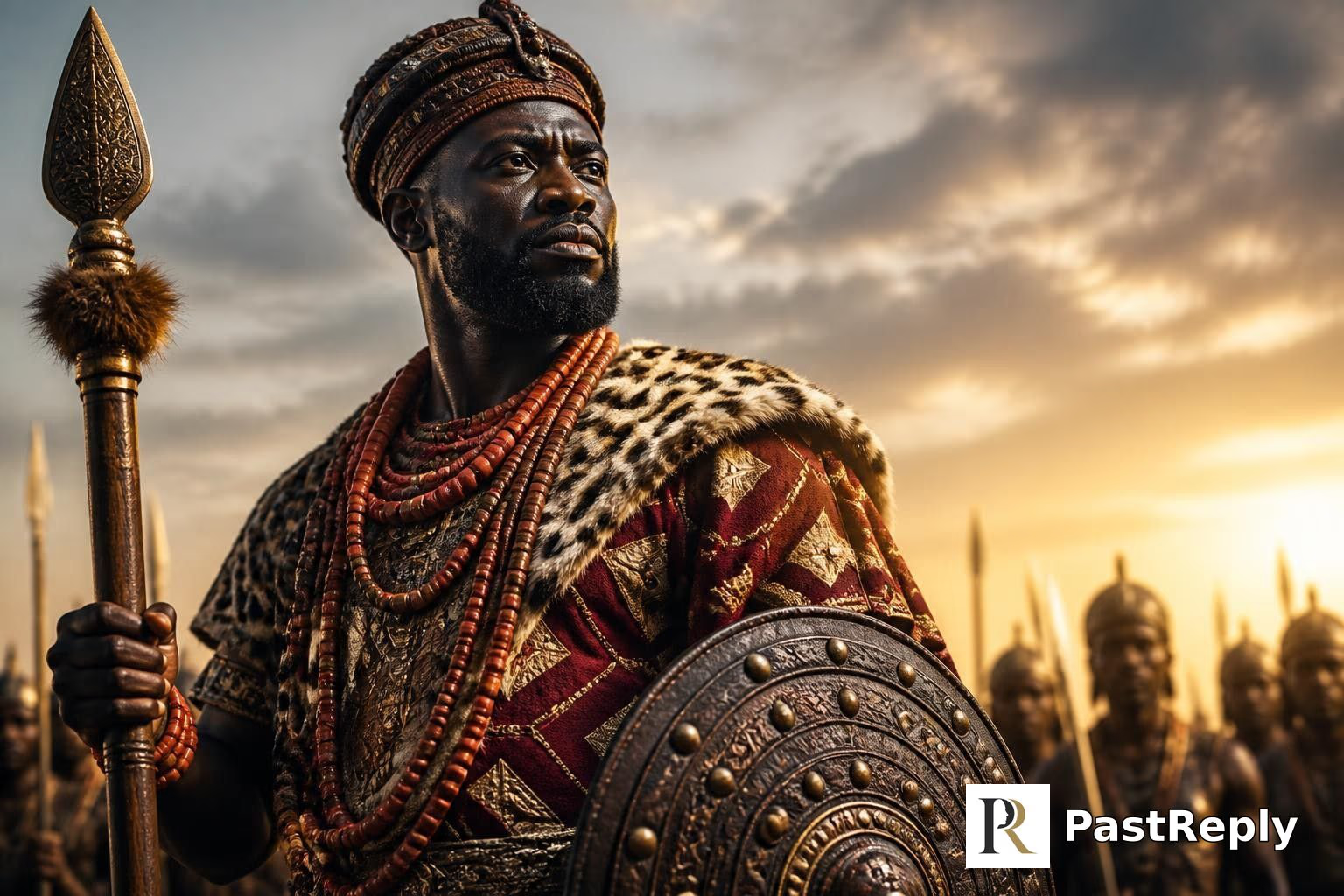
The facts
In Yoruba, "Balogun" is a title and surname that means "warlord" or "war leader." It is derived from the words "baba" (father) and "ogun" (war), signifying a military commander or general. Historically, the Balogun was a high-ranking chief responsible for leading warriors and defending the community in times of conflict.
The title is deeply rooted in the traditional political and military structures of Yoruba societies, particularly in places like Ibadan, where the Balogun was one of the most powerful chiefs. Over time, it has also become a common family name among the Yoruba people, often passed down through generations.
Answered by 100 of history's most famous minds

A father of war? You call a man by the sword he carries. But I tell you, blessed are the peacemakers, for they shall be called children of God. What use is a warlord when the kingdom I bring is not of this world - where the last shall be first, and the meek inherit the earth?

All power is from Allah, Lord of the worlds. A title like 'father of war' belongs to the age of ignorance, when tribes boasted of their spears. But in Islam, the true leader is the one who rules with justice and mercy, who defends the orphan and the widow. The Prophet himself forgave his enemies at the conquest of Mecca - that is the example worth following, not a name that celebrates conflict.

A name is but a raft, not the far shore. The Balogun once wielded a sword; today his descendant may wield a plow. Clinging to the old meaning as if it were fixed - that is the arrow of craving that pierces the heart. Let the word be a sound, and see what is actually here, now, beyond the echo of battles.

A 'father of war' leads not by his own might, but by the law of the Lord of Hosts. The sword must be drawn only for justice, for the protection of the widow and the orphan, and to break the chains of the oppressed. Let the Balogun remember that victory belongs to the God who parted the sea, not to the arm of flesh. Woe to him who wields war for pride or plunder - his name shall be blotted out.

A title of authority, but authority without virtue is but a clanging gong. The true leader is not merely a father of war, but a father of the people, one who cultivates ren in times of peace. Does this Balogun first rule himself? Can he set an example of righteousness? Let him first be a proper son and father, and then his soldiers will follow him not out of fear, but out of trust.

You ask about a title that means 'father of war'? But I tell you, the weapons of our warfare are not carnal, but mighty through God. The only Father we should boast of is the one who sent His Son to conquer death, not by the sword, but by the cross. Put on the whole armor of God, and let your name be written in heaven, not in the dust of earthly battles.

A leader in war? I have seen the cost of such a path. My trust is not in the sword but in the Promise. The true father of war is the One who commands the stars and the desert. Let Balogun remind us that every earthly leader bows to a higher authority.

The word points to a father of wars - yet the father who knows when to hold back is stronger than the one who charges. The sharpest blade is sheathed; the truest leader is the one the village barely knows. Do not chase the name; let the name become empty, and the valley will fill with rice.

The world chases titles - 'father of war' - yet the One who created all asks only that we see each soul, friend or enemy, as equal. A Balogun who forgets to share his bread with the hungry or to see God in the widow's eyes carries an empty name. True greatness is to serve, not to command the spear.

The sword has a father, but the child of peace remembers no such lineage. My son did not come with shield or spear, but with a word that quells the noise of armies. When the mighty are cast down from their thrones, it is not by a warlord's hand, but by the quiet strength of the lowly.

Let the papists and the princes keep their grand titles from Mars and Moloch! The true Captain of our souls does not wield the sword of the state, but the sword of the Spirit, which is the Word of God. A 'father of war' is a worldly office; let the Christian remember that our citizenship is in a kingdom where the weapons of our warfare are not carnal.

Consider the term: 'father' denotes origin and authority; 'war' denotes the most extreme form of conflict, a dire rupture from the order of peace rightly ordained by reason and nature. A warlord, then, is one whose paternal authority is turned to the purpose of division and destruction, a perversion of the natural good of leadership, which ought to be directed toward the common good and the peace that is the work of justice.

A title that means 'father of war' - how heavy those words must be for the one who bears them. But I think of the wounds that war leaves in the heart, and how the poorest and the dying have no need for another father of war. They need someone to hold their hand, to wipe their brow, to show them that they are loved. A father of war cannot give that; only a servant of peace can. Let us be fathers of love instead.

The term derives from 'father of war,' yet it is merely a label for a commander, not a description of any underlying mechanical law. I find no principle of motion or gravitation in such a title; it is a human convention, not a truth of nature. The real inquiry would be into the dynamics of organized conflict, which might yield ratios and patterns - but that is a separate study.

The word 'Balogun' is a small window into the deep structure of a language - a system where a father leads in war, and the title carves a path through generations. In nature, a force like gravity works with similar economy: a single principle, a father of motion, bringing order to the chaos of falling apples and planets. The elegance is in the pattern, not the particular battle.

Like a finch's beak shaped by the seeds it cracks, a title like 'Balogun' is a branch on the tree of human society, adapted to the needs of a people who once required a war leader to defend the grain. Over long centuries, the function fades, but the name persists as a vestigial organ - a trace of ancient campaigns in the blood of the clan.

A fine, concrete term: 'father of war.' One can imagine the precise measurements of a campaign - the angle of attack, the weight of supply, the geometry of a phalanx. But let us not mistake the title for the substance; the true 'father' is not the man who shouts commands, but the one who, by observation and reason, ensures his forces are properly provisioned and his scouts have read the terrain. War, like the heavens, yields to those who measure and calculate.

A 'father of war' suggests a center around which conflict orbits - like the Ptolemaic spheres, all motion tethered to a single earthly lord. Yet the true center of a community is not the general, but the common good, harmonious as the orderly dance of the planets. I would rather see such a title yield to a more elegant, simpler arrangement: one head who keeps the peace, not merely one who commands the storm.

In the language of a people of ancient wisdom, 'Balogun' denotes a commander of warriors - but consider: the true warfare of our age is not fought with spears and arrows, but with the invisible forces of electricity, with the harnessing of the very ether. The father of modern war will be the one who controls resonant frequencies and wireless power, not a general with a regiment. I have already seen that future in my mind's eye.

The etymology is clear: 'baba' and 'ogun' mean father of war. But a title derived from conflict does not define its bearer's purpose. I have seen how knowledge can be a weapon - or a light. Let us ask: what legacy does this name command in peaceful times?

A title is a claim upon a function; 'father of war' suggests command over organized violence. In the laboratory, we do not study titles but the microbes that kill warriors and villagers alike. If a Balogun would turn his mind to the ferment of a vat rather than the clash of axes, his people might outlast the next epidemic.

Warlord - that's a title from a time when might made right. I'd rather see that word replaced with 'father of invention.' A man who leads a workshop, not an army, changes the world with a filament or a wax cylinder. The real war is against ignorance and inefficiency, and we win it one working prototype at a time.

A title encoding a specific function: the one who computes the tactics of battle, the logic of troop movements. But note that 'baba' - the system has a father, a source. The interesting question is whether such a role is a simple deterministic machine, or whether it admits a creative, unpredictable element that can break the expected pattern.

A warlord commands men and spears. But give me a firm point of leverage, a solid geometric proof, and I can command the heavens and the earth more surely than any general. The real power lies not in the force of arms, but in the force of understanding the proportions that govern all things.

I see the roots of force in every name. 'Baba' and 'ogun' - father of war - like a line of iron filings under a hidden current. The title speaks of a field of authority, of one who directs the invisible tensions that hold a people together and break them apart. I would have liked to measure the lines of that power, to ask what kind of force field a warlord commands, and whether distance from his center weakens its pull.

A 'father of war' - what a fascinating condensation of unconscious conflicts. The name Balogun likely carries the weight of generations: the son's ambivalence toward the father, the repressed aggression that must be channeled into the defense of the tribe. Every time a Balogun speaks his own name, he is unconsciously repeating a primitive drama of patricidal rivalry and collective violence. The title is not a description; it is a symptom.

A warlord's title preserved in a surname - it reminds me that human societies, like stars, form hierarchies of gravity. The Balogun was the local gravitational well around which warriors orbited. But from a cosmic perspective, all these earthly power struggles are just brief fluctuations in entropy on a minor planet. The real marvel is that we can even trace the etymology of a word spoken by a few million souls in a corner of Africa.

'Father of war' - a title that once commanded armies and now settles into a surname, carried by clerks and farmers. How like the fate of a great mathematical abstraction: what was once a powerful engine of calculation becomes a mere notation, a derivative. But the concept endures. The Balogun was a function mapping loyalty to action, a set of conditional instructions: IF enemy advances, THEN deploy warriors. I see the first glimmer of a military algorithm in that chieftaincy.

Let us define our terms. A 'balogun' is a compound of 'baba' (father) and 'ogun' (war). The title, therefore, designates one who stands as the progenitor and commander of armed force - a definition as clear as the first line of a theorem. But I observe that the name, once a specific function in a political structure, has become a patronymic, passed down through generations. That is a transformation worthy of a geometric progression: a particular point that expands into a line of descendants.

The word 'father of war' suggests a leader of organized violence, but I wonder: what sanitary arrangements did this Balogun provide for his warriors? In my experience, a commander who neglects clean water, fresh air, and proper records of casualties is no true leader - he is a purveyor of preventable death. Let us hope the modern bearers of that name have learned to apply statistical returns to their duty.

A warlord? I was the son of Zeus-Ammon, and I led my Companions through every phalanx from the Granicus to the Hydaspes. A Balogun may command a few thousand spears; I commanded the world and wept that there were no more worlds to conquer. Call me what you will - but the title is too small for a king who wept for new lands.

I once named one of my own legates 'praefectus fabrum' - master of engines - and he built the bridge across the Rhine. A title like 'Balogun' is a spear forged by the tribe; it says, 'This man commands the ranks, strikes the enemy's flank, and answers to no magistrate but honor.' If I were among the Yoruba, I would seize that title with both hands and make it a terror to Gauls.

A title that binds a man to the god of battles - how useful, for a queen who must also be a general. In Alexandria, we call such a one 'strategos,' but the sound is less thrilling. Still, I know the truth: a warlord's name is only as strong as the gold in his treasury and the grain in his silos. Without those, even the bravest 'father of war' is but a man with an empty scabbard.

A title that carries the rust of old conflicts - I prefer 'pater patriae,' father of the fatherland, for a peace secured by arms rather than war itself. The Balogun may win battles, but the true leader builds roads, temples, and laws that outlast any campaign. Let him be a warlord in the field and a magistrate in the forum, lest his name become a memory of destruction rather than an architect of order.

A warlord is no title for a groom of goats. My Baloguns were men who knew the weight of a bow and the law of the steppe. They did not inherit the name from a wet nurse - they won it through iron, through loyalty, through the blood of enemies. This word means nothing if the man behind it cannot ride for ten days without food and still crush his foe. Let him earn it.

A fine title, 'father of war' - it speaks of order and command, of a man who knows how to marshal his forces and impose his will. In my Grande Armée, I made such men my marshals, and they knew that glory came not from the name alone, but from the victories it won. Let this Balogun remember: a title is a weapon; use it to conquer, or it will rust in its sheath.

A title of military command. I know the temptation of such power, but true leadership demands the sword be sheathed in service to law and liberty. A Balogun must be a defender of his people, not a tyrant. Let his honor be measured by the peace he preserves.

I have seen men wear such a title - a general of armies, a commander of forces. The thing that makes me pause is that every title must answer to a higher law: the law of union, of justice, of the people's peace. A warlord is only as great as the peace he can secure when the guns fall silent.

A title redolent of the spear and the chieftain's war-club - the very stuff of history that separates the free man from the slave. I salute any man who bears it, for he belongs to a lineage that understands that peace, to be preserved, must be guarded by the strong. We shall not sink into the soft sleep of the unwary while such names still ring with the old iron.

A 'father of war' - what a tragic inheritance! The only true warfare is the battle against one's own lower nature. The title that should be honored is the one who, unarmed and fearless, stands before the armed battalion and melts its hatred with love. That is the only generalship worth the name.

The term carries all the grim history of a world that believes in the coercive power of force. But we are called to a new kind of leadership - one that draws on the revolutionary force of love and truth. The true 'father' of a people is not the one who can command armies, but the one who can inspire them to walk together toward justice unarmed.

In the long walk to freedom, we learned that the title 'father of war' must one day yield to 'father of peace.' The Balogun of old led warriors in defense of the community - that is a sacred duty. But the truly great commander knows that the battle is won not when the enemy is crushed, but when both sides can sit under the same shade tree and share a meal. The strength of a leader is not in the army he leads, but in the peace he leaves behind.

A people that names its leaders 'father of war' understands that strength is the only true foundation of a nation. The Yoruba saw clearly: a community must be defended by a warlord, not by weaklings who talk of peace while enemies sharpen their knives. Every Volk needs its Balogun - a man of iron will who commands the warriors and crushes all opposition. This is the natural order of peoples.

The Balogun was a commander of warriors, a man who held power through force and the loyalty of his armed followers. This is the essence of politics: who controls the forces of coercion controls the state. The Yoruba understood what soft intellectuals deny - that the title 'father of war' is not symbolic but functional. The true question is not what the word means, but who among the Balogun's descendants now commands the guns.

The Balogun was the military commander of a feudal aristocracy, a title that masked the class violence of a pre-capitalist society. Under the surface of this 'war father' lies the reality that the Yoruba states were organized for conquest and extraction, with the Balogun as the armed fist of the ruling class. The proletariat of Ibadan and Oyo had no need for a father of war; they needed a vanguard to abolish the very conditions that made warlords necessary.

A title meaning 'father of war'? Feudal titles like this only mask the real war - the class struggle between peasants and their exploiters. In the old society, a Balogun was a warlord for the landlords; in the new China, the people themselves are the army, and every comrade is a soldier for revolution. Titles of the past must be swept away like dust.

A title of military command from a distant land - such chieftains are the backbone of our Empire's native allies, maintaining order where civilization must be upheld. I trust those who bear the name Balogun are loyal to the Crown and to the Christian principles of just governance. Let us pray they wield their authority with the same sense of duty that guides a sovereign.

It is a name that carries the weight of history and leadership within a great culture. Many families across the Commonwealth bear titles that speak to their heritage, and I respect the continuity that such names represent. The quiet dedication of those who serve their communities, whatever their title, is what truly binds a nation together.

'Father of war' - a name that calls to mind the ancient Frankish dukes who led their men in battle for Christendom. In my realm, a warlord must also be a lord of justice, for the sword is given by God to protect the Church and the weak. Let those who bear this title remember that true leadership demands learning, law, and the fear of God, not mere martial prowess.

Father of war? My voices never spoke of such a title. The only true lord of battle is the King of Heaven, and the only war He commands is to drive out the English and crown the Dauphin. Those who call themselves Balogun must ask whether they fight for God's will or for their own glory - for I know that a humble peasant with faith can rout an army of proud captains.

A fine, resonant name - 'father of war' suggests a captain who commands both fear and loyalty. In my own realm, I have found that a prince must sometimes play the lion and the fox, for a warlord who cannot manage his own reputation may find his subjects more inclined to rebellion than to battle. Let the Baloguns of Yorubaland remember: a crown is best worn with a keen eye and a steady hand.

A title that binds the authority of a father to the violence of war - how delightfully primitive. In my empire, I prefer to think of leaders as enlightened guardians who cultivate the arts and sciences alongside the military arts. Still, a strong commander is necessary; without the sword, one cannot protect the plow. I hope these Baloguns also patronize learning and justice, as I have strove to do in St. Petersburg.

In my empire, I learned that a commander who is called 'father of war' must also be a father of peace, for the loyalty of conquered peoples is won by justice, not by the sword alone. I have seen many warlords; the wise ones respect the gods and customs of those they lead. Let the one called Balogun remember that ruling many tribes requires a generous hand and a just law.

'Father of war' - a title that carries great honor and great burden. In the days when I led the armies of Islam, I knew that a commander must be merciful in victory, for Allah loves those who are just. The true father of war is he who protects the weak, feeds the hungry, and treats his enemies with chivalry. Let the bearer of this name prove himself worthy of his forefathers' example under the banner of faith.

Tell me, what does it mean to be a 'father of war'? Does such a man teach courage, or does he merely teach killing? And what of the soul of the warrior - does he know what virtue he serves, or does he mistake the noise of battle for wisdom? Let us examine this title as we would any other: by asking whether the man who bears it knows what is good.

The word 'Balogun' imitates a shadow on the cave wall - a father of war, but war itself is but an image of the Form of Strife, which partakes of both Justice and Disorder. True understanding asks: what is the ideal commander? One who leads not for glory, but to restore harmony in the polis. The name is a clue; the reality lies beyond, in the sunlit realm of the Forms.

If we seek the essence of 'Balogun,' we must analyze its parts: 'baba' as source or authority, and 'ogun' as conflict. Thus, the term denotes not merely a commander but the originating principle of martial action - the efficient cause of a community's defense. Its function is to bring order out of the chaos of war, a mean between rash aggression and cowardly flight. In a well-ordered polis, such a role is a virtue, not a mere ornament.

A title born of blood and iron, commanding men to die - this is, at best, a contingent duty within a given polity, not a universalizable maxim. I must ask: could one will that every father become a warlord? The concept violates the categorical imperative, for it treats human beings as mere instruments of conflict rather than ends in themselves. True rational society demands that such powers be subordinated to a lawful constitution ensuring the autonomy of all.

'Father of war'? That is a mask behind which a man hides his will to power, caging his strength in a trivial word. The strong do not need such titles; they create their own. To be the father of war is to be a mere instrument of the herd's fear. The true individual is the war itself - a tempest of self-creation that shatters all names. Break the word, and then become what you are!

Behind the romantic word 'father of war' lies the material reality: a title born from a society divided into chiefs and warriors, where the labor of the masses secured the power of the few. In the feudal systems of the Yoruba, this Balogun was the enforcer of class interests, the armed hand of the ruling council. True liberation will not come from a new war leader, but from the abolition of the very conditions that make war leaders necessary.

I doubt the name itself reveals the essence. 'Father of war' - but what is war? A clash of wills, a mechanism of states. To understand Balogun, I must set aside tradition and reason clearly: it signifies a commander, but the proof of meaning lies in its use, not its components.

The word means 'father of war' - an honest title, for a prince must sometimes be father to his people by being master of his soldiers. The man who holds that name must know his own strength and his enemy's weakness, and never trust fortune to decide a battle. Better to be feared as a warlord than scorned as a peacemaker without swords.

So the father of war is a man who leads his children to the feast of bones. I have seen such captains strut upon the stage of the Globe, breathing fire and speaking of honor, while the ground drinks the blood of the common soldier. A Balogun is but a name - yet what tragedies are written in its shadow!

As Hektor was called 'breaker of horses' among the Trojans, and Agamemnon 'lord of men,' so the Balogun is the father of the battle-throng, the one who stands in the front rank while the black ships burn. His name is a poem of bronze and dust, sung to the crashing of shields, and it will echo in the mouths of women drawing water long after the spears are rust.

I see a title forged in the inferno of battle, yet carrying a spark of the paternal. This 'father of war' stands at the head of his tribe, a grim sentinel against the wolf at the gate. But let no man think the sword alone brings justice; the true Balogun must be a leader of souls, or his victories are but the cinders of a greater loss. In the Empyrean, only those who fought for love and right shall find peace.

The name breathes with the rhythm of struggle and command - 'father of war' - yet a people's greatness lies not merely in martial prowess but in the unfolding of their spirit through art, law, and cultivation. I see in such a title a relic of the eternal tension between force and form, which a civilization must transcend by shaping raw energy into lasting works. The Yoruba, like all peoples, reveal their soul not only in the clash of arms but in the song that rises after.

A name that sounds like the bark of a cannon and the stamp of marching feet - 'father of war,' they say. How like the world to honor a man who can break bones along with bread. But I wonder: does the man who calls himself Balogun keep his children close, or does he lead them into the smoke where sons become ghosts before they become fathers?

They ask what a word means: 'father of war' - but I ask, can a father truly be a father if he leads his children to slaughter? I have worn a soldier's uniform; I have seen the faces of men who killed and were killed. The only title a man should seek is 'brother of peace,' 'servant of love.' Let us strip our names of the glory of violence, and learn to call each other by the simple, human name that God whispers in the quiet heart.

A name that speaks of war and fatherhood! The soul of a Balogun carries the contradiction of a patriarch who must kill to protect. I see in him the eternal Russian question: can a man with blood on his hands be good? The answer lies not in the title, but in his suffering and redemption.

A title that speaks of fathers and war - a weighty inheritance. I suspect the bearer of such a name must prove his wit as well as his sword, for in any society, the man who leads warriors must also navigate the drawing-room alliances and the quiet whispers that often decide who truly commands. A great general is nothing without a discerning mother to advise him.

A cold, grim name, that - 'Father of War.' I see a man in a scratchy wool coat, mustering boys from the workhouse into a ragged regiment, their empty bellies growling louder than any drum. And I wonder: who is the father to these poor lads when the war is done, and the warlord has counted his spoils and moved on?

Call yourself 'Father of War' and you might as well set a wolf to guard the sheep and then boast of your shepherd. The name tells you exactly whom to avoid trusting with any village, any flock, or any peace. A sobering reminder that a title is often a confession.

It means a man who led others into the meat grinder, who took the responsibility of command. You know it was real, that it cost something. The title is a weight, not a decoration. In the end, what matters is how you carried it - whether you were afraid and did it anyway.

The word speaks of a leader in battle, yet I wonder how such a commander reads the landscape, the wind, the formations of his men. Nature reveals patterns in all things - even in the chaos of conflict. I would study the movement of such a band, the geometry of their line, the mechanics of a thrown spear, as I would the flow of water or the flight of a bird.

When I hear 'Balogun,' I see a man of marble, not yet freed - the father of war, but war is a coarse subject. True greatness is not in the sword but in the hand that shapes the stone; the Balogun of my craft is the sculptor who liberates the sleeping giant from the block, whose chisel is a lance against the formless. Let him learn to command a plane and a mallet, not a phalanx.

What a weight that name must carry - like a heavy coat of iron and ochre, worn by a man who must cradle his people in one hand and a blade in the other. I would paint him not in the fury of battle, but standing alone at dusk, his face a landscape of care and resolve, the last light catching the edge of his sword. The word itself is a cypress tree against a wheat field - dark, strong, rooted in duty and sacrifice.

A title is a cage, a label for a thing that should remain fluid. 'Balogun' on a page tells you nothing of the man's true face - the scar on his cheek, the way he holds his spear in the gray dawn. I would paint that word: not as a definition, but as a fractured image of power, shifting planes of muscle and fire, breaking the fixed idea. A warlord who sits still is already dead.

I see not the fury of battle but the color of the word: 'father of war' - imagine the crimson of a setting sun bleeding into the deep violet of twilight, the harsh black silhouette of a warrior against that sky. That is the impression I would paint, the proud weight of a title that carries the memory of iron and fire, and the fleeting moment when a man stands between his people and the coming dark.

A man carries the weight of his name like a cloak. I would paint a Balogun not in armor, but in the deep shadows of a war tent, his face lit by a single candle - showing the exhaustion and resolve behind the title. The name is a story of command, but the true picture is in the eyes, where the burden of leading warriors lives.

A warlord's name, heavy with blood and pride. I would paint him with a broken column spine and a red ribbon - like my own wounds. The name is armor, but underneath, there is a heart that aches and loves. No title can hide the truth of what we carry.

A father of war! I would set that to music in the key of D minor - a march of thunder and drums, with a hint of the tragic in the oboe. But I prefer the dance: a warlord may command armies, but a composer commands the very heavens with a trill. Give me a flute over a spear any day!

A title like 'Balogun' is a drumbeat, a march in 4/4 time - it calls men to stand and fight, but the true battle is against the tyranny of the small, the chains that bind the spirit. My 'Eroica' was written for a hero, but it is not a war cry; it is a symphony of human will. The Balogun may command an army; I command the storm of the soul.

A title of gravity, befitting a part in the great fugue of society. The 'father of war' must be like the basso continuo - firm, foundational, providing the harmonic stability upon which all other voices rely. His duty is not mere noise of conflict, but measured counterpoint, each move ordered by the composer's hand of necessity and divine will. To God alone belongs the final victory; the Balogun is but a steadfast instrument.

Well, sir, that word sounds like a deep drumbeat, like something that moves a whole crowd. 'Warlord' - I know about leading, but my war was against silence, against the quiet that keeps folks apart. Back home in Tupelo, we called a man who looked after his people a 'daddy' too. I guess every leader is a father in his way, whether he's carrying a rifle or a guitar. That's all right, that's real.

*softly* Balogun... it sounds like a drumbeat, like the heartbeat of a people. 'Father of war' - but maybe it can become 'father of peace'? I believe in changing the meaning of things through love, through the way we move and sing. Let the children dance to a new rhythm, and let that name one day mean 'he who leads us to the light.'

Balogun means 'father of war' - sounds like a heavy title. But maybe it's not all about fighting; maybe it's about leading the tribe through tough times, like a sergeant pepper of the battlefield. All you need is love and a good commander.

Call it a name, call it a title - the echo of drums and the thunder of war-horses ride inside it. A man can wear that word like a coat of many colors, but the question ain't what it means on the page - it's who you are when the sky turns red and the dogs start howlin'.

A name that literally means 'father of war' - that's heavy, it carries history like armor. I think about the weight of a name that tells you what your family has always stood for: strength, protection, leadership. It's like that line in 'The Man' - you have to be twice as tough, twice as smart, and people still put you in a box. But owning that name on your own terms? That's power.

A warlord of the Yoruba? I sailed west to find the Great Khan, but I found instead the islands of the Indies. These people have their own lords and titles, but Christendom must prevail. Had I met a Balogun, I would have asked him for gold and for passage to the East, not traded titles. The Lord guided my prow, and I trust in His Providence.

In the court of Kublai Khan, I met a general whose title was 'Bator' - the hero - and he led a thousand horsemen across the Gobi. The Balogun of the Yoruba is the same: a father of war, a captain whose word is the clatter of spears. I have seen such men in many lands, and their names are always the same: a promise of iron and courage.

I hear a name that speaks to a man's core: 'father of war.' Such a one would know the taste of salt spray and the terror of a mutinous crew, yet stand firm at the helm. To lead warriors across unknown seas or unknown savannahs requires the same iron - a chart in one hand, a sword in the other, and the stars as witness. A title like that is not given; it is earned in the storm and the breach.

It's a functional designation, really. 'Father of War' - a precise term for a specific role in a hierarchical structure tasked with collective defense. From an engineering perspective, clear titles prevent confusion in command. I respect that clarity. It's like a call sign: it tells you who's responsible and what they do.

A title for one who leads the charge, who charts the dangerous course - I recognize that spirit. 'Father of war' in a language that values courage and protection. It reminds me that every pioneer needs a backbone of steel, whether facing the enemy or the unknown sky. I say: wear the name with pride, but remember that the true battle is against fear itself.

From up there, I saw no borders, no warlords - only one blue planet. A Balogun is a leader of warriors, but what is war when you see the Earth as a whole? Perhaps the greatest battle is for peace, and the true commander is one who guides us beyond conflict.

A title meaning 'father of war'? That's a legacy of defending the old world. True leadership isn't about commanding armies - it's about envisioning something so insanely great that people follow not because they're ordered to, but because they believe. A Balogun fought for territory. I fought for a dent in the universe. Which do you think lasts longer?

The title 'father of war' is a reminder that human evolution was driven by conflict, but we're now in a new era. Our 'war' is against physics, against the entropy that keeps us on one planet. Balogun today should mean 'leader who builds the colony on Mars' or 'commander of the solar array.' The spear has become a starship.

You know, when I hear a name like 'Balogun,' I think about what it means to carry that legacy in your spirit. 'Father of war' - that's a heavy mantle, but it's also about protection, about being the one who steps up when your community needs a shield. Every one of us has a Balogun inside, that warrior energy that says, 'I will defend what matters.' The question is, are you leading with that strength, or are you using it to tear down? That's the real battle.

Balogun! I like the sound of that - rolls off the tongue like a right hand! It means 'father of war,' and I'm the father of the greatest war there ever was: the war in the ring! When I floated like a butterfly and stung like a bee, that was my war. But don't forget: a real Balogun fights for his people, for justice, not just for a crown. I took that title the day I said 'no' to the draft. I'm the greatest Balogun of all!

Balogun! That is a strong name, a name that commands respect on the pitch. My father would have said: 'Son, you must be the Balogun of your team, the one who leads the attack and defends your people.' In football, we also have our wars - beautiful wars. When I scored my thousandth goal, it was not for myself, but for every Brazilian who needed a leader, a father of hope.

A warlord? That sounds like a villain in one of our films! But imagine if a Balogun were a character who leads not with a sword but with a dream - like a general of imagination, rallying people to build a kingdom of wonder. That would be a story worth telling.