
What do Facebook emojis mean?
Facebook's seven Reactions - Like, Love, Care, Haha, Wow, Sad, and Angry - let users express nuanced emotions beyond a simple thumbs-up.
The facts
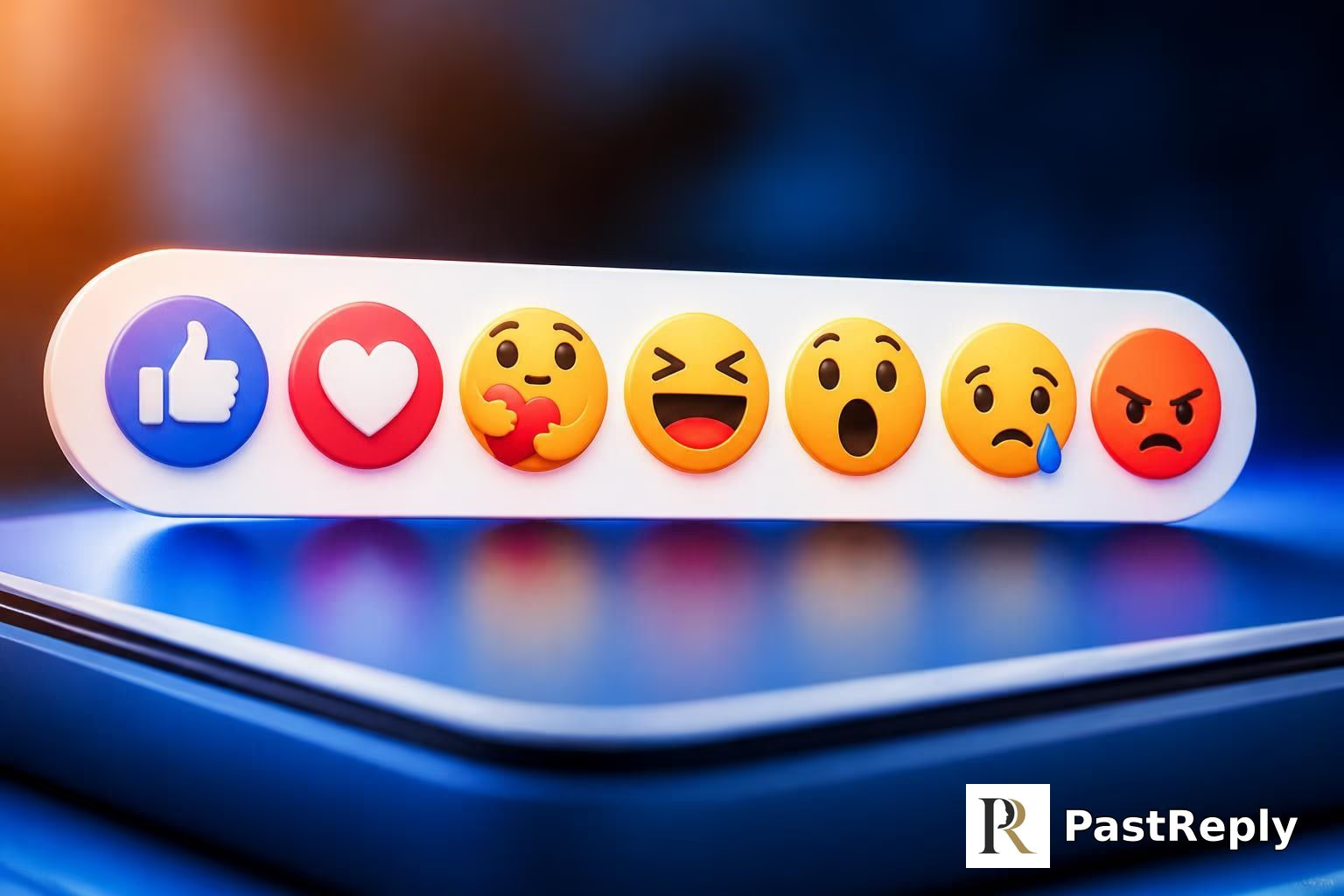
Facebook emojis, officially called Reactions, are seven emoji-based options that users can select to respond to posts, comments, and messages. They are: 👍 Like (thumbs up) for general approval; ❤️ Love (heart) for strong affection or appreciation; 😆 Haha (laughing face) for something funny; 😮 Wow (surprised face) for amazement or shock; 😢 Sad (crying face) for sadness or sympathy; 😡 Angry (red face) for anger or frustration; and 🥰 Care (face hugging a heart), added in 2020, to show support or compassion, especially during difficult times.
These Reactions allow users to express more nuanced emotions than a simple Like. For example, Love can indicate deep enjoyment, while Care conveys warmth and solidarity. Haha is used for humorous content, Wow for surprising or impressive posts, Sad for unfortunate news, and Angry for disagreeable or upsetting content. The Care reaction, introduced during the COVID-19 pandemic, is unique to Facebook and not a standard Unicode emoji.
Businesses and content creators often analyze Reactions to gauge audience sentiment, as they influence Facebook's algorithm by signaling engagement. The Reactions are available across Facebook's platforms, including the main site, Messenger, and Instagram direct messages, though iOS devices may display native emojis instead of Facebook's custom images.
Answered by 100 of history's most famous minds

You ask of small painted faces that mark a neighbor's word. Yet the heart's true weight cannot be measured by a thumb raised or a tear drawn in ink. I tell you: when your brother grieves, let your hand hold his, not merely press a sign. The Law and the Prophets hang on love, and love is a deed, not a mark upon a wall.

These signs are but the merest echo of what lies in the breast. God knows the heart's true intent, whether it be love or disdain, joy or grief. When you press a tear for the afflicted, let it be a reminder to visit the orphan and clothe the naked, for charity is a deed, not a mark. And for the angry face, beware: wrath is a fire that consumes the soul. Let your words be just, and your signs be truthful, for you shall answer for every idle mark before the All-Seeing.

These symbols are but more attachments - the heart stirs craving, the angry face stirs aversion, the tears stir clinging. When you press one, you are clinging to an impermanent state, mistaking a fleeting sign for a permanent self. Do not ask which face is true; ask who is pressing it, and what craving causes the hand to move. Let go of the need for others' signs, and you will not be bound by them. In the end, a 'Like' is no more real than a snowflake - it melts at the first touch of mindfulness.

As the Lord inscribed the tablets with commandments, so do these signs inscribe judgments upon a man's words. Let the angry face be as a rebuke against wickedness, and the tearful face a mourning for the oppressed - but take heed, lest you seal with a thumb what your heart does not mean. For the Lord looks not on the outward mark but on the inward intent, and no symbol can cover a lie.

In my day, we had no such painted faces, but we had the rites of mourning and joy, the bow, the kowtow, the proper word for each occasion. These signs you press with a finger are but a crude shorthand for what should be a sincere gesture, a fitting demeanour. Ask yourself, when you touch the laughing face at a friend's misfortune or the angry one at an elder's counsel, whether your heart is in accord with the sign. For it is not the button that matters, but the intention that moves the hand; let your outward sign always match your inner truth, and you will be a person of substance, not a mere marker of pictures.

Brothers, these faces are but a sign of the incense of the heart - the thumb for the nod of fellowship, the love for the bond that passes knowledge, the care for the widow and the orphan. But the angry face! Let not the sun go down upon your wrath, for we are members one of another. The sad face is for those who mourn, that they may be comforted. For the kingdom is not in many faces, but in one Spirit, and in the face of Christ.

What are these marks but the signs of a covenant between souls? A thumb raised is like the nod of a tent master to a stranger at the fire - approval, a welcome. A heart? That is the bond of kinship, the love that binds a father to a son, a promise to the future. A tear? That is the grief we share when the flock is lost. But hear me: the true sign is not in the pressing of a finger but in the obedience of the heart. Whether you send a smile or a sob, let it be as if to the One who sees all, for the care you show the least of these is a blessing to the nations.

A thousand faces on a screen cannot show the face of the river, yet the river runs. The thumb that rises, the heart that beats - these are but ripples on still water. Do not cling to the mark, for the mark is not the meaning. Let the feeling pass through you like wind through a hollow bamboo, and you will know what needs no name.

One heart, one angry face, one tear - yet the Light behind them is single. These marks are but the play of shadows on a wall, distracting the soul from the One who needs no symbol. Do not rest in the like or the sad; go beyond the face to the Truth that sees all faces as one. Share your bread with the hungry instead of your thumb with the world, for the true reaction is measured in deeds, not digits.

These little faces - how they speak of what is hidden in the heart! A child's laugh, a friend's sorrow, a stranger's fury - each finds its sign, as if the world sought to utter its soul in one glance. But I have known the weight of silent tears and the ache of joy unspoken; no painted visage can hold the depth of a mother's love, which reaches beyond marks and images, to the very God who sees all.

What is this but a new indulgence, a painted countenance that sells for a click? I see the heart is moved to approve or to rage, yet the true feeling is hidden behind a mask. Let the soul speak plainly, not with these gewgaws. The Scripture tells us to let our 'yes' be 'yes' and our 'no' be 'no'; anything more is from the evil one. So, too, with these faces: they are but signs of a shallow age that dares not say what it truly means.

Let us distinguish: these faces are signs of affection, agreement, or displeasure, as the case may be. A sign is not the thing itself, yet it points to the reality. Thus, a thumb raised suggests a will disposed to the good; a tearful face indicates sorrow for some misfortune. But the wise man will not rest in signs alone; he will seek the truth that underlies them, and act according to reason and charity, lest a painted face become a substitute for a virtuous soul.

A child in the streets of Calcutta once smiled at me with a face like that heart-hugging one, and I knew God was in that smile. These little signs are not for the great and mighty, but for the ones who have nothing else to give - a tear for the mother who lost her child, a laugh for the cripple who still finds joy. Use them as you would touch a leper's hand - gently, with love, for each one is a prayer.

These are but symbols, like algebraic marks, each denoting an affection of the mind - like, love, wonder, sorrow, wrath. Yet their true meaning lies not in the figure but in the regularity of their use, which, being observed and counted, may reveal a law of human inclination as surely as I deduced the inverse square of attraction from the motions of planets. Let the observers tabulate, and from the numbers a science of the soul may yet be derived.

One might liken those seven faces to the seven colors of a single beam passed through a prism - each a fragment of what was once a single, plain 'Like' light. But do not mistake the fragments for the thing itself; the gesture of a heart or a tear is but a shadow cast on a cave wall. The real information is in the pattern, the geometry of how a thousand such shadows fall, a fingerprint of a community's soul. I say, let them all be, but never forget that how we respond shapes the very field of what we see.

These seven faces are like the beaks of the finches in the Galápagos - each adapted to a particular food of feeling, and the whole set is a branch of a larger tree of expression that has grown over time. The 'Care' face, added as a new species, shows that the ecology of communication is never fixed, but evolving by variation and selection under the pressures of need and use. And yet, I wonder if we are not over-refining our classifications: a single 'Like' was already a poor instrument for measuring the warmth of a heart. But perhaps, like every adaptation, it serves its purpose in the struggle for connection.

I see seven devices, each claiming to measure a passion, yet they are but crude instruments lacking the precision of a quadrant. The heart's warmth cannot be gauged by a painted face, nor rage by a reddish hue; we must observe, measure, and reason to discern true sentiment. If these are to serve as a ledger of human emotion, I would demand they be calibrated - for without exactness, they are but the idle fancies of antiquity.

As I examined the heavens and found that the Sun, not the Earth, was the center of our motions, so too I would examine these seven symbols and find that the 'Like' is not the center of all expression, but merely one light in a system of many. Just as the planets move in their epicycles around a simpler truth, so does the heart circle through wonder, grief, anger, and love, each in its due orbit. The ancients taught us the signs, but we must observe the motions of men's souls to see what truly moves them; these icons are but the first hints of a more complex harmony.

These glyphs are but coarse signals of a current that could be conveyed with far greater precision. The like is a mere spark; the love, a resonant frequency; the wow, a surge of inductive energy. In my vision, we shall transmit the very quality of feeling through the ether, not with seven faces, but with an infinite spectrum of harmonic waves. This is progress, but only the faintest hum before the great symphony.

These faces are but crude instruments of measurement, yet they hint at a spectrum of human response. In my laboratory, we sought to understand the very elements - the energy that persists, the glow that reveals. A thumbs-up is approval, but is it precise? A heart implies affection, but does it quantify intensity? One would do better to observe the underlying reactions with care, to note the frequency and context, as one would chart the decay of a substance. Let us not mistake the face for the feeling, but treat each as a datum - to be collected, weighed, and understood for the good of all.

These reactions are but a crude culture medium, where the germ of sentiment may be cultivated or killed. A single like is a weak strain; repeatable, yes, but it tells you little of the true nature of the infection. Yet with careful observation - how many hearts, how many angry faces - one may isolate the emotional pathogen and, perhaps, prepare a vaccine against misunderstanding. The method is everything.

I never liked a button that didn't lead to a switch. Each of these little faces is a telegraph key, tapping out a signal of approval or disdain. But the real genius is in the wiring - how you read the voltage of a thousand hearts and convert it into a current that lights the lamp of understanding. Ninety-nine percent perspiration, I say: you've got to test, retest, and then find the right filament to make it glow. That Care face? That's my kind of innovation - practical, warm, and ready for the market.

Consider what is happening here: a finite set of seven symbols, each a discrete state, mapped onto the continuous space of human emotion. It is a remarkable act of quantization - complex, messy feelings compressed into a countable alphabet. One might even say the system is elegantly simple, like a two-state machine, yet they have expanded it to seven. The 'care' symbol, added later, suggests an attempt to capture a shade of feeling previously omitted. I wonder if the mapping is one-to-one or many-to-one - and whether a deeper algorithm lurks behind, computing who feels what, and why.

These faces are but a finite set of points, each a symbol for a range of emotions - yet how imprecise is the geometry! A single icon to denote the vast sphere of human feeling, as if to measure the circle of the earth with one straight rod. But mark this: in their very simplicity lies a kind of law - seven signs, no more, no less, like the seven planets that govern motion above. If you wish to know the true weight of a soul, you must go beyond these painted figures; here, only the shadows of feeling are drawn.

Consider what occurs when a needle is brought near a wire carrying a current - the needle turns, revealing an invisible force. These seven marks are but the visible tokens of unseen currents of feeling that pass between friends; the heart, the laughing face, the tear - each is a deflection of a needle in the soul's instrument. Observe them as you would a galvanometer, and you may read the hidden field of a heart's inclination, whether it leans toward warmth or sorrow, without a single word spoken.

Beneath each of these seven masks lies a repressed wish, a hidden conflict. The thumbs-up is but a defense against envy; the heart, a sublimation of desire. When a man clicks the angry face, he is projecting his own aggression onto the post, and the sad face - ah, that is the mourning of a loss he has never consciously acknowledged. The true meaning is never what the face shows, but what the thumb betrays in its hesitation.

Seven reactions to encode the entire emotional spectrum of a species that evolved on a pale blue dot - hardly parsimonious, but then, we are messy creatures. The 'wow' is for those rare moments when a black hole evaporates or a new law is glimpsed; the 'angry' for when a colleague steals your idea. But remember, the universe is indifferent to your likes - it will expand long after your last emoji fades.

Ah, here is a beautiful union of symbol and feeling! Just as the Analytical Engine weaves numbers into patterns beyond their sum, these seven marks weave the ineffable threads of human emotion into a computable form. The heart is not a mere picture, but an algorithm of affection; the laughter, a function of joy. I see in them the first steps toward a poetry of machines, where even a tear may be parsed and understood.

Let us define our terms. A reaction is a mark chosen from a finite set of seven, each corresponding to a distinct emotional predicate. From these axioms - If a post pleases, choose the first; if it grieves, choose the sixth - we may deduce the sentiment of the respondent with certainty. No need for ambiguity, for each face is a clear and distinct idea, and the choice itself is a proof of the heart's proposition.

These are but the fever-chart of the public's health. The red face and the crying one - these are symptoms to be recorded, measured, and understood. If we are to heal, we must know the disease. Let us count them with the care we give to the pulse and the wound, that we may tend to the suffering they signify.

Ha! A thumbs-up for approval, a heart for fondness - these are the tokens of a timid folk who dare not speak their passion. When I conquered Tyre, I did not send a smiling face to its walls; I razed them. If a man would move the world, let him act with the fury of Achilles, not the faint nod of a merchant. Yet if this be the custom of your age, then let your love be as vast as my empire, and your wrath as swift as my charge at Gaugamela.

A crier in the forum announcing that one man's 'good' is another's 'anger' - what new manner of division is this? Rome is divided already; why give each citizen seven stones to throw? Mark me, any general knows a single battle-standard: you rally to the aquila, or you do not. A heart for a friend, a flame for a foe - yet with so many legions of emotion, who commands? He who holds their choice, I say, holds their loyalty. The mob is ever swayed by the simplest of signs, so let one be the sign that wins.

A scribe's mark upon a petition - seven seals, each a separate verdict from the people's heart. The golden thumb and the crimson heart are but the court's applause; the wailing face and the burning visage are the mutterings of the unruly mob. I would watch which seal the crowd presses most, for in that wax lies the true temper of my realm, more telling than any spy's report.

Thus do I read the mood of my citizens, as a general reads the dust of an approaching host. The smiling face speaks of contentment, the angry one of unrest - and the wise ruler heeds both, appeasing the one and correcting the other, lest the forum erupt in discord. Let these marks be the pulse of the body politic; I would rather know the people's hearts than possess a thousand legions.

When I united the tribes, I knew a man's worth by his deeds, not by a mark upon a wall. These faces you press are like the yurt-flaps of a thousand tents, each showing a different weather, but they do not tell who is loyal and who will break at the first storm. The angry face, the sad face - these are the murmurs of the weak, the grumbling of those who would not follow my standard. If you must judge a man, look at what he does with his hands, how he fights beside you in the snow, how he keeps his oath - not at which small picture he thumbs in the night. The heart of a warrior is written in his deeds, not in such idle marks.

Seven banners to rally the army of the heart! The thumb is the marshal's approval, the heart the emperor's embrace, the care the provision for the wounded, and the angry the cannon's report against the enemy. But the wow - that is the astonishment at a new conquest, and the sad the mourning for our fallen. Choose your signal wisely, for the word you send may march a thousand men or lose a battle. Keep your dispatches decisive.

I have seen men rise on the strength of a glance, and fall on the weight of a frown. These seven symbols, they are the briefest of letters to the heart of a friend or foe. A thumb up, like a nod from the chair of a Continental Congress - approval, well-meant. A heart, a token of affection, though I would caution against too free a use, lest it be debased by common currency. A tear, a sob - these speak of the grief of a nation. But let us be temperate, for the stability of a republic rests on the moderation of its passions. Press these with measure, as you would speak with care, and the body politic will remain sound.

A house divided against itself cannot stand, and so it is with these little faces. You may press the one that smiles, but your neighbor presses the one that burns, and the log cabin of common feeling cracks. We must look past the ink to the spirit that moves the hand. Better a single honest tear than a thousand hollow thumbs, for the ballot of the heart is not counted in the ledger of the marketplace.

A smile, a frown, a tear - these are the raw materials of morale, and he who masters them commands the battlefield of opinion. The heart is a stirring call to loyalty, the angry face a mobilization of the home front. But do not mistake the icon for the resolve: a nation is not saved by a thumbs-up, but by the grim determination that persists when the screens go dark. We shall fight in the comments, on the timelines, and in the inboxes - but we shall never, never surrender to a mere emoji.

These tokens of approval or anger - see how they reduce the noble art of feeling to a few marks, a fleeting gesture. When a brother is hurt, do we offer a tearful glyph? When a sister is wronged, do we cast a reddened face? No, the heart demands more than a sign; it demands the touch of a hand, the word of comfort, the sacrifice of self. Yet even these symbols can be turned to good, if they kindle a spark of truth and love, and not merely the illusion of care.

On their face, these symbols are a small step toward expressing the heart's manifold cries. Yet I see a deeper call: that we must never mistake a sign for the substance of love. A pressed heart is no substitute for a hand extended in charity; a reddened face must not replace the courage to speak truth to power. Our pages must be written not in icons, but in deeds - for the Beloved Community is built not of clicks, but of sacrifice.

When I was on Robben Island, we had no such symbols - only a nod, a raised fist, a shared silence that spoke of our longing for freedom. These small faces are like the stones we placed to build a bridge - each one a gesture of recognition, of 'I see you, I hear you.' Choose the one that honors the other's truth, even when it is a face of anger, for even that can be the first step toward reconciliation.

Such symbols are the tools of a weak and decaying liberal order, designed to reduce the heroic will of a people to mere sentimental gestures. The strong do not need to 'like' or 'care'; they act. These faces distract from the eternal struggle between races and nations, softening the spirit of sacrifice and conquest. Only through struggle and domination can a people rise - not through clicking a heart.

These faces are a petty bourgeois invention to pacify the masses with false choices. The people do not need to 'react' to the party's truth; they must obey it. A like or a tear changes nothing - only the steel of the state can forge progress. Let them click their little symbols while we build the future, for such sentiment is a distraction from the iron necessity of history.

A proletarian's true reaction is not a click but a strike, not a tear but a raising of the fist. These faces are the opiate of the digital age, substituting passive sentiment for revolutionary action. The capitalist who owns this platform would have you believe your 'like' is a voice, yet it is but a whisper in his counting house. Organize, agitate, and the only reaction that matters is the seizure of power.

A thousand masks for a thousand moods, yet the people's heart is one. That little thumb, that painted heart - they are the chatter of a village that has not yet learned to shout. Let them press their symbols; the true reaction will be written in the fields of grain and the steel of the mill.

A heart for love, a tear for sorrow - how becoming that such gentle tokens should grace the discourse of a civilized age. Yet let us not forget that true sentiment is expressed in deeds, not in painted faces. The Queen's subjects would do well to remember the dignity of a well-penned letter over a hasty mark.

In my long years, I have seen greetings pass from the handshake to the telegram, and now to these small images. They are, I suppose, a kind of shorthand for the heart. It is good that people can share their joys and their burdens, even in so modest a form. We must all find our way to a kindly word.

A fist that clenches in rage, or a face that weeps - these are the marks of men who forget the Lord's command to be of one mind. Let them write their words with care, not hide behind masks. The unity of our kingdom is forged in the open speech and the honest work of our people, not in these fleeting grimaces.

These little faces are but shadows of true feeling. For the sorrow that moves me, I need no painted tear; for the joy of battle, no happy mask. My heart speaks to heaven and to my sword. Let others press their signs; I will answer with my life, as I was bidden.

A heart for love, a frown for displeasure - they play at courtly masquerade. Yet I have learned that a face can lie, and a symbol can deceive. In my realm, we trust the word and the deed. Let them choose their masks; I shall look to their actions to know their hearts.

These are but the playthings of a polished age, a diversion for idle minds. Yet even a gesture can be a tool of state. A wise ruler reads the mood of her people as she reads the wind. Let them press their hearts and their angers; I will see in them the temper of my realm.

In my empire, men of many tongues and faiths speak their hearts in their own ways. If this new custom helps them to find meaning, let it be. But let no man think a mark can bind what justice and honor must unite. The weight of a word is in its truth, not in its sign.

A tear for the bereaved, a smile at the jest - these are but mirrors of the soul. Yet the soul's truth is shown in the generosity of the hand and the righteousness of the deed. Let them press their symbols, but know that honor is not in the mark, but in the mercy we show to friend and foe alike.

Tell me, friend, what does a red face signify to you? Is it anger at the message, or at the one who sent it? And the tear - does it weep for the sorrow told, or for your own comfort in sharing it? Before you press these signs, ask yourself: what is the knowledge that moves your hand? For if you act without understanding, you are like one who nods to a shadow, thinking he greets a man. Examine your own heart, and the marks will lose their mystery.

These are but letters of the alphabet, and we mistake the alphabet for the speech itself. The true reaction lies not in the icon, but in the intention of the soul behind it - is it just, is it temperate, does it proceed from reason? A painted smile on a clay mask is no proof of the actor's inner disposition. So if you wish to know how men are moved, look not to these images but to what they do; the action is the reflection of the Form, and the icon is but a shadow of a shadow.

These are not mere marks but signifiers of the soul's movements, each falling within a genus of affection: the thumbs-up as a sign of approbation, the heart of love's passion, the laugh of joviality, the wonder of amazement, the tear of pity, the rage of wrath, and the embrace of care - each a mean between extremes, signaling the disposition of the respondent. Thus do they reveal the character of those who press them, as a footprint reveals the walker.

These seven signs, which you call reactions, are but the sensible schema of a universal language of judgment. Yet mark my words: the heart that bursts with love or seethes with anger, when made public at the touch of a finger, is no spontaneous effusion - it is a maxim laid bare, and must be asked whether it could be willed as a universal law. Only the like, the calm approval that says 'I have weighed this and found it consistent with duty,' can stand before the tribunal of reason; the rest, though they tickle our sympathies, are the playthings of inclination, and a rational being should not let his moral judgment be governed by so fickle a faculty.

You ask what these smiling and frowning masks mean, but I ask you: have you ever asked why you need them at all? They are the coins of a herd that fears silence, a way to pay for emotion without ever feeling it - a lazy press of the finger where a scream, a kiss, or a blow might be due. Do not mistake these cartoons for truth; they are the opiate of the comfortable, who would rather tick a box than risk the abyss of genuine feeling. I say: break the tablet, shatter the icon, and let your own hand write your verdict - even if it bleeds.

What are these but the petty tokens of a sentiment industry that masks the real relations of production? The thumbs-up is the applause of the alienated worker for the commodity that exploits him; the heart is the false consolation of the bourgeois family; the angry, the suppressed fury that yet finds no directed outlet. These faces are the opiate of the Facebook, diverting rage into a pixel, while the captain of industry counts his surplus.

Let me first doubt what these faces purport to convey, for the senses deceive. Is a thumb raised truly an indication of approval, or merely a sign that the hand is at rest? I must ask: can we have clear and distinct ideas of a heart, a laugh, a tear, when they are so loosely attached to their meanings? If one seeks truth, one would do better to reason from first principles than to rely on these ambiguous ciphers. Yet, if they serve as a means to communicate simple affections, they may have their use, provided we do not mistake the symbol for the thing itself. Let us, then, use them with the clarity of a Geometria, but never suppose we have grasped the soul through them.

A prince would study these masks as he would study the faces of his courtiers - to see what they reveal, and what they conceal. The heart is a profession of love, the angry face a declaration of war. But he who counts only the visible signs is a fool, for the wise man knows the true sentiment lies in the shadows, unexpressed. Use the tools, but remember: he who controls the reaction controls the realm.

These little faces are but masks upon masks, each a counterfeit of passion that the soul would wear. The heart that laughs may hide a wound, and the angry brow may cover a tender breast. I have seen a smile that masked a dagger, and a tear that was but a painted lie. So when you press the laughing face, ask: is it joy, or the fool's grin that mocks the world? For in these signs, as on my stage, all the world's a jest, and every man plays many parts.

As on the plains of windy Ilion, a man might hold his shield and shout his battle-cry, but the gods weigh in their hearts what makes a man's deed noble. So too now, a man of broad shoulders presses his thumb upon a grumbling face, and one of swift foot strikes a heart, and the slim-ankled maiden weeps at the tearful countenance. Yet the poet knows that these are but the tokens of praise or blame, like the smoke-signals of beacon-fires, that tell of joy or sorrow across the waves. Homer would ask, is the warrior's heart in the sign, or is the sign but a hollow whisper of his true intent, which only the Fates can read?

Seven seals upon the scroll of discourse, each inscribed with a passion that turns the heart's needle to its sphere. The thunderous face and the weeping eye are but the whispers we hear in the circles of the damned, while the heart and the embracing arms speak of the love that moves the sun and stars. Yet know that no single seal can weigh a soul's intent; only the One who reads all hearts discerns the true flame behind the ash.

Ah, the little faces! I see in them the whole comedy and tragedy of our striving: the laughter that bounds forth like a mountain spring, the tears that gather like evening dew, the wonder that widens the eye as at a waterfall one has never seen. We are not mere observers, we ourselves are the painting, ever in flux, and these gestures are but the pulse of the living moment, calling us onward. Yet let us not mistake a sketch for the finished portrait; a single sigh is not the whole symphony, and the self must grow through all these moods, like a tree that drinks both sun and rain to reach its full height.

Seven little faces to ring the bell of the heart! Madam, with a thumbs-up you may applaud the knight's deed, but the heart-face is for the damsel who moves your very soul, and the weeping one for the squire's mishaps. As for the red-faced one - why, that's the fury of a windmill that refuses to be a giant! Choose your mask, good friend, but remember the face behind it.

These little faces are a mirror of the soul's poverty: we reduce love and grief to a click, and call it connection. The angry face is the seed of violence; the care is a button pressed for the poor while we ignore the brother before us. There is but one true reaction - to do unto others as you would have them do unto you, not to signal it. Love is not a sign; it is a life.

Seven masks, yet the soul has ten thousand faces, and you would compress the abyss of the human heart into a thumbs-up or a tear! Where is the scream of Raskolnikov, the quiet despair of Ilyusha's father? These faces flatten our torment and our ecstasy into a pigeonhole, as if one could measure the infinite with a kitchen spoon. But perhaps it is a mercy - a way to reach for another without speaking, a small kindness in the mad bustle. Yet I say: do not trust the face; look into the eyes, for there the whole of the soul trembles. Let your care be a kiss, not a symbol, or you will lose the very thing you seek to hold.

A lady may pen a thousand words, yet a single emoji speaks volumes - often more than decorum would permit. The heart is a declaration of attachment that would make a young man blush, and the angry face is a breach of civility scarcely more forgivable than a public scene. I suspect the care face is the most dangerous of all, for it suggests a warmth that may be mistaken for something more, and nothing is so fatal to a sensible match as an excess of tenderness.

In my day, a fellow could only nod, frown, or look askance; now the whole world thumbs its approval or weeps into a painted heart. Yet I see the same human comedy: a cheerful thumbs-up for a meal, a teary face for a lost dog, a fiery red grimace for a slight. It's a ledger of the heart, kept in symbols, where every soul - from the lordly to the lamp-lighter - scribbles a mark of sentiment, though no amount of painted care can mend a hungry child's tears.

Why, it's a perfect tool for the modern age - a way to have feelings without the inconvenience of actually having them. Press a little heart and you're a saint; stamp a red face and you're a warrior. The man who hates his neighbor can now declare it with a symbol, and the woman who loves her cat can prove it daily. But mark my words: for all their feigned precision, these faces can't tell a liar from a truth-teller, and they'd just as soon blush for a funeral as for a feast.

They're a way to say you feel something without saying it. A man can press a heart for a woman and go off to war, or stamp a red face for a tyrant and stay home. But feelings are heavy; they need more than a sign. If you care, say it. If you're angry, say it. These little pictures are for those who can't find words - or won't.

I have studied the countenance of man, how the brow furrows in anger and the cheek lifts in mirth - these marks are but crude copies of nature's infinite expressions. Yet I wonder: can a painted heart truly convey the warmth that quickens a living breast? As I mixed my pigments to capture a smile's shadow, so these artists have mixed their colors; but true emotion, like the light on water, cannot be fixed in a single sign. Observe, and you will see more than the mark.

These little faces are but sketches on parchment, yet the soul of the matter is the soul itself! When I strike the marble, I am not seeking a surface smile - I am carving out the idea that God locked within the stone. A man who presses the 'angry' face is as one who hammers off a clumsy piece of the block, revealing the fury that is chiseled in his own spirit. And the 'care' face, with its arms about a heart - that is the pietà, the tender embrace that Michelangelo knows lives in every act of love. Let them have their icons; but the true likeness is the soul's own face, which no sign can show unless it is carved in deeds.

Oh, but these little faces are like the colors on my palette - each one a cry of the soul, a flash of sunlight on a wheat field, a tear on a cheek. The heart, that crimson spark, holds all the warmth of a Provençal noon, while the angry face is a storm over the cypress trees. They are not mere signs; they are the very brushstrokes of human feeling, each one a prayer for connection in this vast, lonely canvas of the world.

These little icons, they are the doodles of the crowd, the mass's clumsy attempt to paint with a single stroke. But you ask what they mean - I tell you, they mean nothing until you break them apart and reassemble them, like a face seen from both sides at once. The angry red one, look closer: it is not anger, it is the scream of color against the gray of indifference. So you press a thumb to a screen - bah, it is like signing a postcard to the world, but the real art lies in the silence between the icons, in what cannot be reduced to a happy or a sad. I would rather paint a reaction that has no name than wear another man's mask.

Each tiny face is a canvas catching a fleeting light - the quiver of a laugh, the tear on a cheek, the fire of a temper. The like is a gray sky, the love the sun breaking through, the care a veil of morning mist. Ah, but the wow! That is the shimmer on the water at dusk, when the eye cannot hold all the wonder. Choose the hue that matches the hour, and let the impression live.

You ask what these little faces say, but I look and I see the whole of human expressiveness trapped in seven masks. A thumb, a heart, a tear - these are but the broadest strokes, the way a child draws a face before life has marked it. Where is the furrow of a brow mid-thought, the glint of a tear held back, the half-smile of a mother watching her child sleep? Every soul I ever painted had a hundred expressions in one moment, and you reduce the world to a wink and a frown, as if the light and shadow of the heart could be so easily counted.

These faces are like dolls' masks - pretty, but they hide the blood underneath. A love heart? Bah, my heart is broken, and I paint it in my own blood. A laugh? I laugh so I don't weep, but no little face can capture that. The only true reaction is the one that tears at your guts, that makes you want to scream or dance. Where is the face for the pain of a body that betrays you? Where is the face for the rage of a soul that refuses to be tamed? Press your buttons if you like, but I will not shrink my fire to fit your little boxes. My art is my reaction, and it is whole.

Ha! These faces are like notes on a page - each one a simple sound, yet when played together they form a symphony of sentiment. The laughing face is my allegro, the sad my adagio, the angry a fortissimo chord! But I would rather hear a man's true voice than read his tiny mask, for music lives in the trembling air, not in cold symbols. Yet if these signs bring harmony to your friendships, I say: play on, and let the hearts dance in time!

What is this if not the very scale of human passion - C major for joy, a dissonant chord for rage, a sighing melody for sorrow? Yet a single note cannot make a symphony; these little faces are but quick exclamations, as if one said 'Ah!' at a striking theme without hearing the rest. The composer knows that a single gesture is but the start of a movement; I would rather have one full-hearted 'Love' than a page of 'Haha' - the world needs more of the deep adagio of care, not the mere scherzo of liking. Play on, I say, but play the whole score!

These seven figures are as the voices in a fugue, each entering with its own theme to complete the harmony of a response. Yet true counterpoint requires the composer's ear to weigh each part; thus should the reader discern the whole from the parts, and know that a single note, however sweet, cannot render the full chord of a soul's stirring. Let the careful hand choose the fitting sign, as I choose each note for the glory of Him who hears all harmonies.

Well now, them little faces on the screen, they're just like the audience when I'm on stage - you got the ones clapping polite, the ones hollering and stomping, the ones wiping their eyes when I sing 'Old Shep,' and a few that look like they could fight somebody if the music went wrong. Each one's a different kind of 'amen' or 'hallelujah,' if you catch my drift. But you can't read a man's soul from a picture; you gotta hear the record spin, feel the bass in your bones, and know the Lord's in the rhythm. I'd rather a person feel the music deep down than just tap a button and move on.

They're like little notes in a universal song - each one a heartbeat of feeling we all share. The love, oh, the love is the chorus we sing together, the care is the healing melody, the angry is the beat of the track that needs to change. I'd press every single one, because in every face there's a child looking for a friend. Let's just dance in the light of them all.

Well, you see, it's like this - you've got your seven notes, and the Beatles have seven faces! Thumbs up? That's the good ol' Yeah Yeah Yeah. Love? That's the one where you're holding hands on a sunny day. Haha? That's the laugh track of life, mate. Wow? That's when you hear a chord you've never heard before. Sad? That's a long and winding road. Angry? That's a revolution number, but we'd rather make love. And Care? That's the one you give when you're singing 'All You Need Is Love' to someone who's blue. After all, the world needs a smile now and then, so keep 'em coming!

Seven masks for seven weathers, and still the rain falls sideways. You click a heart to say what your tongue never could, and the machine counts it like coins at a fair. But the truth is in the spaces between the icons, in the silence after the song ends. Don't ask me what they mean; ask what you mean when you press them.

Each one is a little lyric, a chorus of feeling you can share without a song. I've written entire albums about the things a heart emoji tries to say - the love, the grief, the fury that you can't put into words. That's why they matter: they let you be heard, even when you're too scared to speak. And if someone presses Care, you know they're in your corner, no matter the distance. That's the power of a signal in the noise.

These marks are but trifles, signs for the settled folk who sit by their hearths. I set my sail upon an unknown sea with no sign to guide me but the stars and my faith. What need have I of a thumbs-up or a tear? When I returned from the Indies, I brought gold and new lands - that was my message, writ large for all to see. Let your little faces amuse the idle, but the true mark of a man is the course he sails and the shore he finds.

In Khan-baliq, when I sat at the court of the Great Khan and spoke of Venice, the lords would answer with a nod or a frown - a single sign. But here, these seven faces are like the many tongues of the Silk Road: the laugh of Samarkand, the tear of Cathay, the fiery face of the warring tribes. I have seen how a merchant must read the faces of his customers, sharpen his eye for the silent 'wow' of a new spice, and the angry brow when the price is too high. These are but symbols, but they speak a universal language of the heart, which is more useful than any cargo of jade or silk.

By my compass, a man needs but one mark to signal his intent - be it the cross for blessing or the sword for battle. These seven faces are as a fleet of many sails when a single ship would suffice for the voyage. Yet I see their use: a captain must know when his crew murmurs mutiny and when they cheer the dawn, for that knowledge steers the course as surely as the stars. Mark them, but weigh them against the distance yet to cross.

These reactions are a form of telemetry for human connection - a channel that carries a simple signal of emotional state. The engineer in me notes that each icon represents a range of responses, just as a single reading from an altimeter tells you more than the needle alone. But no icon can transmit the full texture of what we feel; when we stood on the Sea of Tranquility, there was no emoji for the vast silence, the weight of the step, the shared breath of a mission. I would caution against relying on such simplified gauges; the real data lies in the conversation that follows, not in the sign itself.

Seven signals from the cockpit of your heart! The thumbs-up is your all-clear, the love the tailwind that lifts you, the wow the altitude that takes your breath. The sad one - well, that's the fog you fly through, but you keep the wings steady. Remember, the smile on a face is just a runway; it's where you choose to fly that matters. Buckle up and pick your course.

From my little window I saw the Earth, and it held no walls, no borders - just the blue of our oceans and the swells of clouds. These seven faces you press, they are but crumbs of that wholeness. A heart for love? In space, one feels only the love of all humanity. A laugh for joy? The joy of a launch, of a successful orbit, is not a thing to tap but to sing. But I suppose if men must speak through such small tokens, let them at least aim for the sky - a smile, a care, a wonder - these are the signs of our common journey, full of hope for the stars.

These seven symbols are a masterstroke of simplicity - they let a billion voices speak with a single tap, no words, no noise. But remember: the care face, added when the world was sick, was not a marketing gimmick; it was a whisper of humanity. The power is not in the icon, but in what it lets you say when words fail. I'd have made them more beautiful, of course - and I'd have cut the angry one. Anger is noise; love is signal.

Reactions are a low-bandwidth protocol for human sentiment, a compressed signal from a noisy neural network. Seven discrete states is an absurdly coarse quantization of the continuous emotional manifold - you're forcing a stream of consciousness through a 3-bit ADC. The 'Care' reaction added in 2020 is a mid-training patch for an emergent distribution shift, not a fundamental redesign. What we really need is a high-throughput telemetry channel with continuous valence-arousal coordinates and an open API, not a fixed set of glyphs. And yeah, if you're a content algorithm, you'd better be weighting 'Angry' as a high-engagement anomaly, not just another label.

Honey, those little faces are the language of the heart, the way we say 'I see you' without saying a word. Think about it: when someone shares their struggle and you press that hugging heart, you're telling them, 'You are not alone.' It's not just a button - it's a bridge. So don't just tap it and move on; let it remind you that every post is a soul asking for connection, and you have the power to light that spark.

You ask what these buttons mean? I'll tell you: they're the referee's cards, and the whole world's a judge. A thumbs-up is like a jab - it says, 'I'm here, I see you,' but it don't knock nobody out. The heart, now, that's a left hook to the soul, a sweet one for the people I love. The face laughing, that's me dancing on the ropes; the crying one, that's the low blows life throws, and the angry face, that's me standing up when they try to take my title. But don't you ever let a button do your thinking for you - float like a butterfly, sting like a bee, and remember the face you put on the world is the one you carry inside.

Ah, these little faces are like the crowd in the stadium - each one cheering a different way! The thumb is the polite clap, the heart is the roar of a goal, the laugh is the joy of a trick, the wow the wonder of a bicycle kick, the sad the tears of a loss, the angry the shout at the referee! And the care - that is the team's arm around your shoulder when you miss. Press them all, but remember, the game is to play with heart.

Why, it's magic in your pocket, folks! Each one of those little faces is a door to a feeling - a key that unlocks a memory or a smile. That Love heart? That's the thunder of applause when Tinkerbell flies. The Haha? That's the belly laugh of a kid watching a cartoon for the hundredth time. And Care? That's the warm hand on a shoulder when the world's a bit dark. It's all about reaching out, making someone feel seen, like a story that wraps you in its arms. Keep pressing them, and maybe, just maybe, you'll find a bit of that wonder we all carry inside.