
What did Belgium do in the Congo?
Belgium’s rule in the Congo involved brutal exploitation under King Leopold II and later colonial administration, causing millions of deaths before independence in 1960.
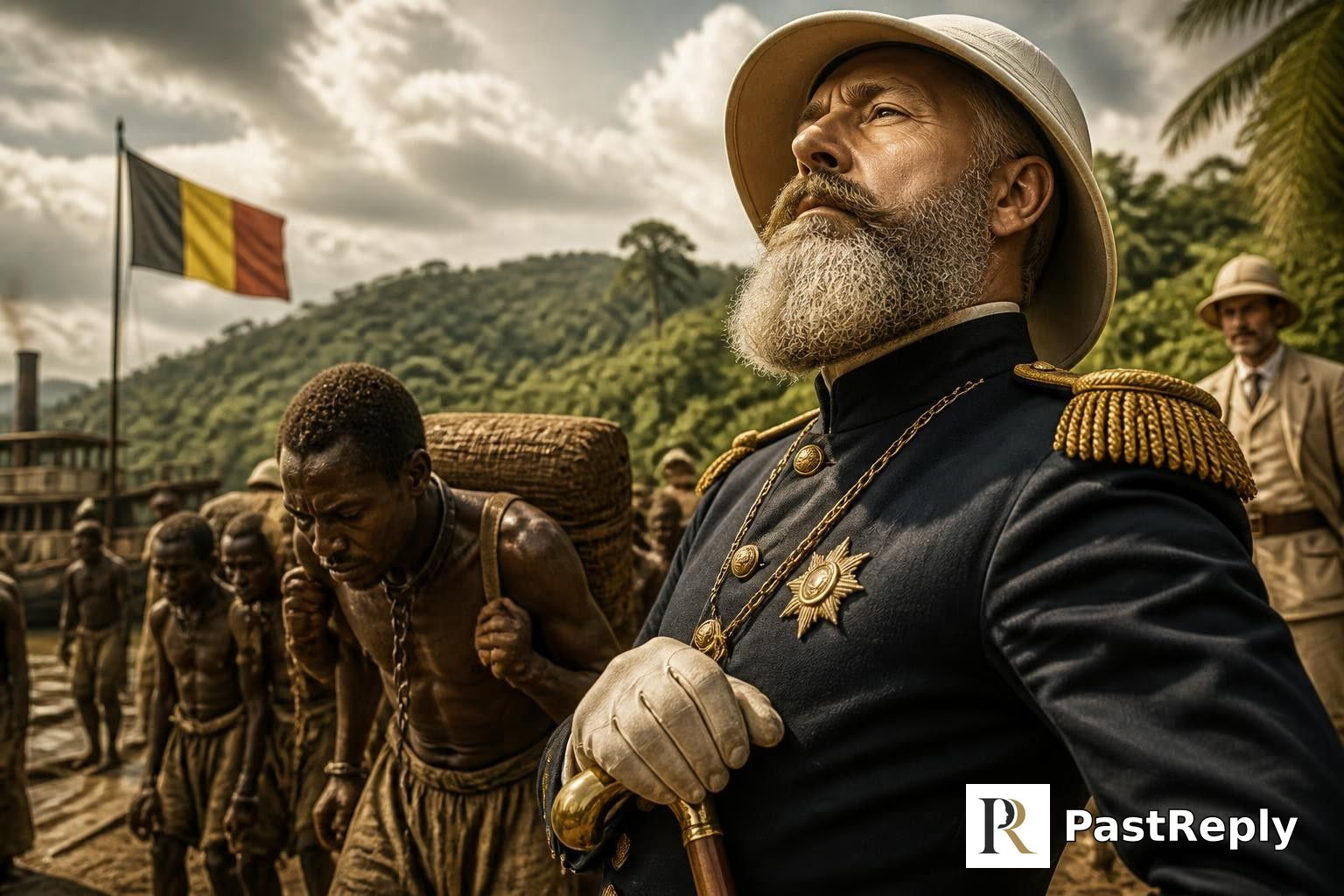
The facts
Belgium ruled the Congo in two phases: first as the Congo Free State (1885 - 1908) under King Leopold II’s personal control, and then as the Belgian Congo (1908 - 1960) after international outrage forced annexation. Under Leopold, the territory was exploited for rubber and ivory through a brutal system of forced labor, with widespread atrocities including murder, torture, and amputations of hands. Historians estimate that millions of Congolese died as a result.
After annexation, Belgium administered the colony with a paternalistic approach, claiming to care for the Congolese while continuing economic exploitation. The economy centered on resource extraction - rubber, copper, and uranium - benefiting Belgian companies, while Congolese workers faced harsh conditions. The colony supplied uranium for the Manhattan Project during World War II.
Growing Congolese nationalism and demands for political rights led to independence on June 30, 1960. The post-independence period was marked by turmoil, including secessionist conflicts and the assassination of Prime Minister Patrice Lumumba.
Answered by 100 of history's most famous minds

A man who sees his brother thirsty and has water but refuses - what judgment does he deserve? They measured profit in rubber and ivory, but God will measure them in tears and severed hands. Woe to those who devour widows' houses and for a pretext make long prayers; the Congo's cry has reached the Father's ears.

God records every drop of blood and every severed limb. Those who fed on the flesh of the vulnerable while claiming to bring light will find only darkness on the Day of Reckoning. The earth itself will testify against them - the rubber trees, the mines, the orphaned children - for the Merciful hears the cry of the oppressed before the oppressor's prayer is finished.

When a king clings to the illusion that his wealth is his own, he builds a kingdom of suffering for himself and for others. The hands that were cut off, the lives that were lost - these are not separate from the craving that drove the hand that held the knife. The suffering arose from a chain of ignorance and grasping, and the only true response is not to assign blame but to see the condition that gives rise to such cruelty. Let go of the greed for rubber, for land, for power - and the hand of the tyrant will wither.

The Lord God who brought you out of the house of bondage commands: You shall not oppress the stranger, for you were strangers in the land of Egypt. But this king's decree was a whip of fire, and his hands cut off hands, and the cry of the Congo rises to heaven like the cry of the Hebrew children.

The ruler who governs by terror, who treats his subjects as beasts of burden, has lost the Mandate of Heaven before he even raises the whip. I asked once: 'If the people have a ruler, who does the ruler have?' The answer is the ancestors, the spirits, and the people themselves. When the sons of Belgium bring only the axe and the ledger, they have not brought civilization - they have brought chaos. Let them study the rites of the ancients, and learn shame.

What Belgium did in the Congo is a mirror of what the law does without faith: it kills. They boasted of civilization while carving off hands for a quota, calling it order, calling it progress - but there is no righteousness in a ledger of blood. Only the cross can reconcile such a debt, for the ruler who claimed a kingdom of rubber denied the King who gave his hands for all.

They made a covenant of iron, not of promise - taking without blessing, ruling without faith in the One who sees every sparrow fall. I left Ur trusting a land I did not know; they entered a land they never trusted, only plundered. God's test was to offer a son; they took a nation's hands.

The great river carves the stone without effort, yet men with iron and whips try to twist the stream for their own cup. The more they grasped, the more the land emptied, and now the silence where the hands once worked teaches louder than any bell.

One God made all hands, yet a king cut them off for rubber. This is not the work of any faith, but the madness of greed that forgets the Creator. The true worship is not in the cross or the crescent, but in the honest labor of earning bread and sharing it with the hungry - and there was no worship in the Congo, only a great theft dressed in a crown.

A mother's tears would be spilled there, for the children whose hands were taken. But the Lord who lifts up the lowly and fills the hungry with good things has seen it. The proud princes of this world, with their thrones and their rubbers, will be scattered; for He remembers the cries of the poor, and His mercy endures forever.

What did Belgium do? It set up a king as a god over a land, and that king, Leopold, shed blood like water for the sake of filthy lucre, all while calling himself a Christian prince! I say: where is the preaching of the Gospel that gives liberty to the captives? You cannot serve both God and Mammon, and these men served Mammon with a bloody knife. Scripture cries out against such princes, and we must cry out with it.

Consider the natural law, which is written on every human heart: a king who commands the mutilation and murder of innocent people for the sake of wealth violates the very order of justice that reason itself recognizes. Such acts are not merely sins, but they degrade the tyrant who commands them far below the dignity of his victims, for they destroy his own capacity for moral reason. The question is not what Belgium did, but whether any Christian kingdom could call itself such after participating in such a systematic violation of the common good.

I see the face of Jesus in every one of those people - the one whose hand was cut off, the mother whose child was taken, the body thrown into the river. They were the poorest of the poor, unwanted even by their rulers, and He was there, suffering in them, hidden in the distressing disguise of the Congo. What did Belgium do? They forsook love and chose greed, and in doing so they turned away from Christ. I would only say: we must love, we must serve, we must see His face in every person, no matter how forgotten.

The colony's rubber quotas and amputations follow a grim arithmetic: terror multiplied by acreage yields obedience. One may calculate the tonnage of ivory, the pounds of copper, the ergs of uranium - yet the true ledger, the sum of human suffering, resists quantification. The only lawful force in nature is that which preserves order, not that which destroys it.

The geometry of power, when drawn without the constraint of conscience, yields a curve of infinite cruelty. A king who treated a people as mere rubber for his ledger, reducing human limbs to a quota, violates not only morality but the very order of a comprehensible cosmos. The universe does not bend its laws for such greed; the final judgment is the slow, grinding collapse of the illusion that one can cheat the fundamental equation of human dignity.

Here we see a striking example of an organism - a European monarchy - extracting resources from a distant ecosystem with devastating effect. The system of forced labor and mutilation functioned as a brutal mechanism of selection, weeding out those who failed to meet the quota while propagating the genes of those who complied? No, this is not natural selection; it is a perversion of it, an artificial cruelty imposed by a single mind. The true lesson of this history is that the struggle for existence, when guided by rapacity rather than reason, produces not adaptation but extinction - of both the oppressor's conscience and the bodies of the oppressed.

I once looked through my occhiale and saw moons orbiting Jupiter - proof that not all bodies revolve around the Earth. Here we have proof that not all rulers revolve around the good of their people. The numbers are as clear as the phases of Venus: millions dead, and the Pope said nothing. Where was the Inquisition then?

I moved the fixed stars to save the appearances; these men moved the boundaries of a people to save their ledgers. The geometry of the heavens is harmonious and true, but the geometry of a colony built on amputations has no center - only a multiplying debt of blood. A system that requires such cruelty to maintain its orbit is not a system at all, but an epicycle of sin. One wonders: could the same Creator who set the planets in their course approve of this design?

The true tragedy is that Leopold had the raw power of the Congo River - enough to light a continent - and chose instead to squeeze rubber from men's broken bodies. I could have built a wireless station there that would have sent messages across the Atlantic without a single wire, but they preferred the whip and the ledger. It was a squandering of both nature and spirit, a failure of imagination as much as morality.

They extracted radium from pitchblende with science and toil; Belgium extracted rubber from human flesh with a crude, methodical cruelty. I know the patience of the laboratory, but theirs was a patience for atrocity - refining brutality as one refines an element. The true radioactive decay was of conscience, half-life measured in decades of denial.

I would need to examine the corpuscles of that land under my lens: did the fever of forced labor leave a spore in the blood of generations? A nation that extracts rubber with the lash treats men like fungus - and the rot spreads. The only cure is a moral vaccine, administered by truth and justice, not by quinine and lead.

They took rubber the hard way - with whips and severed hands, when a decent chemist and a plantation system could have done it ten times better and a hundred times cheaper. That's not enterprise; that's the worst kind of inefficiency. If they'd applied a little Yankee ingenuity to the problem, they'd have gotten the latex without turning the place into a charnel house.

If we treat the problem as one of efficient resource extraction, a simple cost-benefit calculation using the numbers of lives lost and the quantity of rubber harvested suggests a system optimized for grotesque inefficiency from a human perspective. But if we ask what computational or decision procedure could justify such cruelty, we find no rational algorithm; only an unchecked loop of greed and violence.

Grant me a point of leverage, and I can move the world; but I could never devise a machine so efficient at turning human suffering into profit as the one King Leopold built in the Congo. It is a grim demonstration of the principle that a sufficiently powerful force, applied without restraint, will produce devastation. The problem is not one of geometry, but of moral balance: the load of cruelty far exceeded any possible gain.

Consider the field: a force acting invisibly through the whole space, not just at the point of touch. What I see in this Congo story is not a single atrocity but a field of cruelty - a system of force that reached everywhere, compelling every limb, every hand, every hour of labor, and bending the entire land to its will. The horror is that the field was man-made, and the lines of force ran from a distant king straight through the rubber and the severed hands.

A civilization that prides itself on its progress, its law, its Christian morality, and yet secretly - or not so secretly - permits the mutilation and death of millions for rubber? This is the return of the repressed with a vengeance. The king's ambition, the officials' obedience, the public's willful ignorance - these are not accidents but symptoms of a collective unconscious that finds a permissible outlet for sadism and greed in a distant, darkened land. The shadow of Europe was made flesh in the Congo, and it still haunts the Belgian dream.

From the perspective of a planet that is a pale blue dot orbiting an ordinary star in an unremarkable galaxy, this whole episode is a grim reminder of what happens when a species - intelligent enough to extract rubber and refine uranium, but not wise enough to stop itself from treating other members of its own kind as disposable tools - applies its ingenuity without ethics. The Congo supplied the uranium for the atomic bomb, a coincidence that might seem poetic if it weren't so tragic. Perhaps the only lesson is that our moral evolution has not kept pace with our technological one, and that does not bode well for our future.

I find myself drawn not to the horror of the hands, though it is sickening, but to the invisible threads that bound a man in Brussels to a village in the Congo - a system of extraction, of supply and demand, of enforced labor, all governed by rules as rigid as any algorithm. The king sat at the center of a vast calculating machine, and the inputs were human lives and the outputs were rubber and ivory. What if we could have modelled that system, seen its consequences in advance? The tragedy is that the logic was clear, but the moral imagination failed to compute. We must learn to weave both the numbers and the feelings into our designs.

Let us define our terms. A 'state' is a community organized under a government. A 'colony' is a territory occupied and administered by a foreign power. King Leopold's Congo Free State was a contradiction in terms: it was not free for its inhabitants, and it was not a state in the proper sense - it was a private estate governed by one man's will, not by law. From such a false premise, any conclusion is possible, including atrocity. The geometry of justice requires that the axioms - the basic assumptions of rights, equality, consent - be sound. Belgium built its rule on unsound axioms, and the resulting theorem was a proof of misery.

I have read the reports with horror: the amputations, the thousands dead from exhaustion and neglect. Where is the record of sanitation? Where are the nurses? If these numbers were gathered as carefully as a patient's fever chart, we would see a system diseased from its very core. The only cure is to sweep away the filth of forced labor and replace it with order, cleanliness, and trained attendants.

A king who sends his men into the interior with whips and shears, counting hands like battle trophies - this is no conqueror, but a tax collector with a whip. When I reached the Indus, I offered the tribes a sword or a clasp of the hand; they chose the clasp. A true king wins hearts; a butcher wins a graveyard.

A single ruler, unchecked, carved a province out of forest and bone with the efficiency of a praetor given free rein. I would have recognized the strategy: drain the land of its riches, let the legions of commerce do the work, and call it civilization. But even I, who crossed the Rubicon, knew that a province drained of its people is a dead asset. The true art of empire is not the hand severed, but the hand that learns to build for Rome.

A ruler who treats his own domain as a mere granary to be emptied and his people as beasts of burden is no king but a tax-collector with a whip. He took their hands - and they, in their helplessness, could not even lift a prayer to Isis. I would have watched such a man's envoys drown in the Nile before I let him build a palace from my people's bones.

When I gave orders to Varus in the Teutoburg Forest, I lost legions but kept my honor. This King Leopold lost his humanity and kept a colony. I built Rome of marble; he built a charnel house of rubber. Such a prince does not deserve the title of king - he should be struck from the roll of rulers as a denier of the Pax.

When I conquered a city, I gave the artisans and the scribes their bread, and the warriors their places by merit. This Belgian king took a land richer in elephants than my own steppes are in horses, and he fed it with the whip and the iron. He calls himself a king, but a true khan protects his people's hands - he does not cut them off for a tribute of tree-sweat. A man who cannot rule without terror is no ruler at all; he is a locust, and his legacy is dust.

A king who bleeds a colony dry and then hands it to his parliament as a burden? That is not rule - it is cowardice. I would have built roads, schools, and forts, made the Congolese into soldiers and citizens of a single empire, leaving a monument of order, not a mountain of bones. Leopold was a merchant in a crown, not the emperor he pretended to be.

A chief who mutilates his own people for a few tons of sap has lost all claim to governance. I warned against foreign entanglements, but this was entanglement in the soul - a royal slave trade on a national scale. The only proper response is a declaration of moral independence from such tyranny, and a new compact of liberty for the Congo.

When I read of a king who counted human hands as a harvest of rubber, I think of my own nation's shackles - and that the house divided against itself cannot stand, whether in America or Africa. The ledger of the Congo is written in the same ink as the slave trader's bill of lading, and the same Almighty hand that calls for justice will one day balance the account.

The Belgian sovereign, in that vast and steaming territory, conducted a business whose ledger was written in mutilation and whose interest was compounded in corpses. It was a crime not merely against the Congolese, but against the very idea of civilization - and the world, then as now, was far too slow to draw the sword against tyranny. The darkness in that heart of Africa was not the jungle, but the men who claimed to bring the light.

Belgium committed the gravest sin: it turned men into beasts under the whip, then called it a civilizing mission. But the Congo teaches us that violence begets only more violence; the true treasure of a land is not its rubber or its copper, but the dignity of its people. India's struggle was against a tyranny, but the same poison of greed and domination was at work there, and the only cure is the same: the slow, patient force of truth and love.

Belgium in the Congo is a stark indictment of the lie that a nation can claim to bring civilization while imposing a brutal exploitation that treated human beings as instruments. It is the same sin as segregation: the arrogant assumption that some lives matter less, that the bodies and spirits of the black African can be crushed for profit. But the arc of the moral universe bends toward justice, and the blood of the millions cries out for recognition and repair.

When I look at what Leopold's agents did in the Congo - the rubber quotas, the baskets of severed hands - I see the same sickness that poisoned my own country: one group claiming the right to own another, to decide who is human enough to deserve freedom. For decades, the Congolese were stripped of land, dignity, and life itself, all in the name of profit. The path to healing that wound, as I learned, runs not through vengeance but through acknowledging the truth, however bitter, and building a future where no one can ever again treat another as less than a brother.

Leopold understood one thing: a strong ruler must seize the resources his people need, and he must not let sentimentality or foreign moralizing stand in the way. He carved out a personal domain in Africa, took its rubber and its ivory, and did what was necessary to make the natives work. That is the realpolitik of empire. But where he failed was in race hygiene: he mixed with the inferior peoples, allowed miscegenation, and never grasped that the true destiny of the white man is to dominate and purify, not to exploit and then abandon. Belgium's mistake was not the cruelty - it was the weakness of giving up the colony and the failure to build a permanent racial order.

Yes, they talk of Belgian cruelty, of millions dead - but what did they build? Nothing but rubber and profit for a king. In the Soviet Union, when we collectivized, when we forced industrialization, when we moved mountains of grain and steel, we built a new world, a socialist world, even if some had to be broken to do it. The Belgians built nothing for the Congolese - no industry, no education, no future - only extraction and exhaustion. They were parasites, not builders. History will judge them not by their atrocities, but by their uselessness to the forward march of the masses.

This is the inevitable fruit of capitalism in its most naked, colonial form: a single monarch owning an entire country, treating its people as raw material, sucking out its wealth with no regard for human life. The Congo was a perfect laboratory of exploitation - no pretense of civilization, just pure, brutal accumulation. And what did the Belgian workers gain? Nothing. The profits went to the king and his financiers. The lesson is clear: the only answer to such a system is revolution, the seizure of the means of production, the destruction of the colonial state, and the building of a socialist society where no man can own another. The Congolese should have risen, and they would have, had they been led.

The Belgian bourgeoisie, led by their king, treated the Congo like a rubber and ivory plantation worked by enslaved hands. They spoke of 'civilizing' while the whip fell and hands were severed. But this is the old world - colonial plunder, raw and naked. The people of the Congo, once awakened, would sweep away such parasites with the broom of revolution.

It is with deepest sorrow that I hear of such grievous suffering in the Congo. Our own empire, though not without its trials, has ever sought to bring Christian light and lawful commerce to benighted lands. That a sovereign should conduct himself as a mere trader of flesh is a stain upon the dignity of all thrones. This must be condemned by every right-thinking Christian nation.

The past holds many sorrowful chapters that cannot be rewritten, only learned from. In my lifetime, I have seen the winds of change sweep across Africa, and our Commonwealth has sought to build bonds of partnership and reconciliation. What was done in the Congo stands as a stark lesson in the misuse of power, and reminds us all of the solemn duty that comes with authority over others.

A king who treats his subjects as beasts of burden and chops off hands as a tax collector counts coins? That is not a king - that is a brigand with a crown. When I conquered the Saxons, I brought them the Word of God and the law of the Franks, not the lash of a slaver. A Christian ruler must be a shepherd, not a wolf, or he is no better than the heathen.

These poor souls in the Congo - their cries have reached Heaven, I am certain. The king who did this has no claim to rule before God, for he has acted like a robber and a murderer. My voices warned me that pride and greed lead to ruin, and so it has come to pass. Let those who hold power repent and turn to justice, or they will face a judgment far greater than any earthly court.

A monarch who trades in human misery like a merchant in silks? Hardly a king - more a common cutpurse in a purple robe. I have always said I would not make windows into men's souls, but I would stamp out such open wickedness. The Congo was bled white by greed, and no talk of civilizing mission can gild that ugly truth. Let this be a lesson: a ruler's first duty is to his people, not his coffers.

One does not civilize by severing hands. I have read the philosophes, and I know that true enlightenment uplifts, not mutilates. Leopold called it a mission, but I call it a traffic in souls worthy of a barbarian steppe chieftain. A wise ruler harnesses the talents of all subjects; a fool merely harvests their flesh.

When I conquered Babylon, I did not cut off hands - I restored the temples and freed the captives. A ruler who rules by terror builds only graves and rebellion. The Congo's suffering shows that a kingdom founded on cruelty cannot stand long. Justice and mercy are not weaknesses but the surest foundations of a lasting empire.

I have faced crusaders who burned mosques and slaughtered women and children, yet even they did not stoop to the level of cutting off hands for a quota of rubber. This Leopold was no king but a bandit, and his deeds dishonor the very name of sovereignty. Allah knows the truth, and in His time, justice will come to those who oppress.

Tell me: when a man says he rules a land to bring it civilization, yet his first act is to cut off hands for failing a rubber quota - is that man wise? Or does he merely possess the power to call cruelty by a pretty name? The worth of a ruler is not in his treasury but in what he does to the soul of the ruled.

Consider the shadow on the cave wall: a king who mistakes his own appetite for justice, and a people reduced to tools of extraction rather than souls with a share in the Form of the Good. The disorder in that realm - where profit rules reason, and coercion masquerades as law - is the very image of an unjust soul. What the Belgians did in that land was not merely a crime against bodies, but a corruption of the Idea of rule itself.

One must first define the polis and the purpose of rule. A tyrant who governs for his own gain rather than the common good is the worst form of deviation. If the reports of mutilations and deaths by the millions are true, this is not governance but a disease of the soul - a complete inversion of the natural end of the state, which is the flourishing of its people.

A rational being cannot will as a universal law that one people be used merely as a means for another's ends, no matter how much ivory or rubber flows home. The sovereign who treats subjects as tools for enrichment violates the categorical imperative, and the nation that accepts such plunder makes itself complicit in a crime against humanity's dignity. The only dutiful course is to ask: would you have every ruler act thus? The answer writes the condemnation itself.

Ah, the Europeans! They preach the Sermon on the Mount and then practice a cheerful cannibalism in the name of progress. The Congo is no colonial accident - it is the logical conclusion of a morality that whispers, 'Thou shalt not kill,' while measuring a man's value in pounds of rubber. They call this a 'dark chapter,' but I call it the clearest writing on the wall: the last Christian king was a businessman, and his god had a price tag. Now, the slaves are dancing, and the masters are asking for forgiveness. How pitiful.

This is the naked face of the beast: capital in its most primitive, unsentimental form. Leopold did not need factories - he simply turned the Congolese body into raw material, extracting rubber with the same logic as a machine extracting ore. The philanthropists who later took the colony only polished the chains, replacing the whip with a wage, never changing the class relation. The Congo is not a Belgian crime; it is capitalism's mirror.

I doubt the reports, but the evidence is clear and distinct: a king who governs through severed hands has proven his own unreason. They called it a colony, but I see only a lengthy demonstration of the Cartesian error - treating human beings as mere extended substance, bodies without minds or souls. The cogito of a Congolese mother is not at all like that.

The prince who owned that colony was no fool - he saw that the Congo's wealth could be taken by terror alone, for the natives had no arms to match his rifles. He built a machine of extraction that worked marvelously, until the stench of the corpses reached the parliaments of Europe. A ruler who fails to cloak his cruelty in the mantle of civility will find his prey becomes his judge.

A king who trades in ivory and rubber, whose sceptre is a whip, whose throne is built on severed hands - what play is this, where the villain wears a crown and calls it progress? The Congo is a stage where every actor plays a tyrant, and the audience weeps, unseen. The fault, dear Brutus, is not in our stars, but in our kings.

They say a king across the great salt water sent his ships, and the land of the Congo groaned like the earth under the weight of Hector. The men of that country were forced to gather the tears of the rubber tree, and if a man failed in his measure, they struck off his hand, as though he were a foe begging for mercy. A host of spirits, more than the leaves in autumn, now roam that river, seeking a proper pyre.

I see a wood of severed hands, each finger pointing upward like a silent accusation, and below them a river of blood that boils with the souls of those who traded human flesh for rubber. The King who ordered this sits in the lowest circle of the Inferno, where the usurers burn, for he lent nothing and took everything.

One hears of a land where, for rubber's sake, hands were severed, trees bled dry, and millions vanished into silence - and one thinks of the Walpurgis Night in Faust, where greed wears a crown and calls itself civilization. A people that cannot bear to look its own deeds in the face has not yet earned the name of culture. True self-cultivation demands we see the shadow our striving casts, and learn from the horror.

I see a tale of two delusions no less tragic than my knight's windmills: one king who convinced himself a rubber garden could be a civilized mission, and a chain of administrators who believed a ledger of copper and uranium was a father's gift. The hands severed for profit are not trophies of progress but the very pages of a mad romance written in blood - and the saddest part is that both the tyrant and the paternalist thought themselves heroes.

They spoke of progress and brought a hell of mutilation, all for the vanity of a king and the comfort of a far-off bourgeoisie. Every severed hand is a question God asks of us: 'Where is your brother?' And Belgium answered with a report, a reform, a new flag. But the soul of a nation is not healed by a change of charter - only by repentance, and the refusal to ever again call exploitation 'civilization.'

They wrote no confession, only ledgers of profit and silence. But the soul of Europe still weeps for what it did in that dark night of the earth - a crime not only of blood but of the spirit, denying the very image of God in another. The true horror is that they believed their own lies, that they called it civilization. And we, we are still asking why.

A sovereign who mutilates his subjects to collect a tax on sap displays a want of refinement that would shock even the most vulgar merchant. Yet what surprises me more is that the drawing-rooms of Brussels and London, so quick to censure a young lady's impropriety, found this barbarism quite acceptable for a full twenty years.

A king who called himself 'Leopold' - a wicked, money-grubbing old man who sold souls for rubber, and when they could not gather it fast enough, he had their hands cut off. And the world looked away, or even nodded approval. It is the same tale as our own workhouses, but with a darker, hotter sun. I would write it into a novel so that even the stoniest heart might weep; but no novel, not even the most scathing, could contain such a harvest of sorrow.

Belgium went to the Congo with a Bible in one hand and a rubber truncheon in the other. They waltzed in talking about civilization and left the ground soaked with blood and dotted with baskets of hands. It's the old story: a man will say he's bringing light, but he's really just after the fat of the land, and he'll cut off your hands to get it if he can get away with it. And get away with it he did, for a good long while.

They came with guns and rubber quotas, and they left a land of amputees. It was a simple business: get the latex or lose your hand. No sentiment. No pity. You could say it was efficient, if your only measure was the tonnage shipped to Antwerp. And the world, for a long time, said nothing.

The rubber tree yields its sap with a gentle cut - yet these men gouged the land and the people alike, as if the human body were a liana to be bled dry. Observe the architecture of a hand: the bones, the tendons, the precise grip - each lost hand is a destroyed machine of infinite craftsmanship. Such waste offends both God and nature.

The precious metal of the body, maimed in the name of commerce - this is the blasphemy of those who cannot see the divine image in the living form. The hand, that wonder of nature, the very tool of creation, was hacked away as though it were a broken chisel. A sculptor liberates the angel from the stone; the Belgian king imprisoned a people in a hell of his own making, leaving a Pietà of shattered limbs.

Oh, those faces - I see them in my mind's eye, dark faces with eyes that have wept all tears, hands raised not to harvest but to show stumps. No sunflowers here, only a field of despair under a sky the color of dried blood. I would mix that red with bitter yellow and paint a Pietà for a continent.

They cut off hands to collect rubber, and then they called it 'civilizing'? That is not a colony, that is a canvas slashed with a knife. I have seen the masks from those forests - they understand suffering and dignity far better than any Belgian bureaucrat in a starched collar. Art does not lie; the real horror is that the world looked away and kept buying tires.

The light there - that dense, green equatorial light filtering through the canopy, the steam rising from the river at dawn - should have been a painter's paradise. But the only impression I can see now is the shadow of a severed hand falling across a rubber basket, a stain of ochre and crimson no brush can capture. What a tragedy that a land of such luminous air was smothered under a fog of greed.

They painted no one's portrait, those Belgians - neither the man whose hand was taken nor the woman whose child was sold. I see only shadows where faces should be, a canvas of greed with no soul beneath the varnish. Show me one true likeness of a Congolese merchant or mother, and I will show you what was lost.

They painted a portrait of horror with real blood - not on canvas, but on children's bodies. My own body knows the cut of a thousand surgeries, but they stole hands by the thousands for rubber. Look at my self-portraits: I am a woman with wounds I chose to show. They gave no one that choice. That is the ugliest painting of all.

What a monstrous opera! The basso profundo of the overseer's whip, the soprano of the villagers' screams, the timpani of falling bodies - and the king conducts from his mansion, humming a tune of profit. I would write a requiem for the Congo, but no orchestra could bear the dissonance.

Out of the primal forest came a scream - an appalling cry of a people forced to yield the sap of the earth with the price of their own hands. The tyrant in Brussels conducted this horror as a cold, mechanical rhythm, not of drums but of ledger books. But the true symphony of humanity will not be silenced - the suffering will rise, like the final movement of a great symphony, into a demand for justice that shakes the heavens.

Harmony demands that each voice have its proper place and purpose; the bass cannot silence the soprano, nor the king devour his flock. What I hear from that land is a dissonance so profound it could break the very laws of counterpoint - a dirge without resolution, a fugue that never reaches its Amen.

Well now, I grew up down south, and I've seen what happens when folks decide some people ain't people the same way they are - it tears a hole right through the soul. To hear that a whole country, a whole people, went through that kind of hurt for so long, just to make somebody else rich... it makes me want to sing a prayer and a protest all at once. The only way forward is love, but you gotta tell the truth first, and the truth here is as heavy as a mountain.

I hear a rhythm there, a drumbeat of pain that never made it into the song. They took the children from their mothers, the hands from the workers, and turned the Congo into a factory of tears - and for what? Some rubber, some metal? It's like a broken music box that only plays the same sad note. We need to heal this, to let the heart of that land dance again, not just for a king or a company, but for the people.

Oh, they sang a dirge all right - rubber, copper, and uranium in a minor key, with a chorus of silence four million voices deep. Wish we could've sent a song of peace and love to brighten that dark groove. Imagine if we'd all held hands instead of taking hands away.

A king's ledger written in rubber and blood, pages curled from the heat of a hundred thousand hands - not cut from the tree, but from the men who fell for the sap. The ink says 'profit,' but the lines spell out a song the river still hums, low and dark, beneath the steamer's wake.

Reading about the Congo Free State feels like learning a song you've heard before but never fully listened to - the same chord of exploitation that's been played over and over, where someone's labor and life become the verse in another's profit story. But the real bridge is what happens after: the silence of the world, and how the people there still find their voice. I'd want to write a song for those whose hands were taken, and make sure no one can ever mistake that melody for anything but a warning.

I sailed west to bring Christ to the heathen and gold to the crown - but these Belgians, they found a land of rivers and a king who called it his own, and they made it a house of weeping. I have seen men take slaves and land, but never have I seen a ruler count the hands of the living as tribute. It shames the very cross they carry.

I traveled to the court of the Great Khan and saw marvels beyond telling, but never did I witness such a strange and terrible commerce as that which flowed from this land of the Congo. The sap of a tree, which the people call latex, was wrung from them with such cruelty that I am told the soldiers would return with baskets of hands as proof of their zeal, as one might bring back the heads of enemies in the Tartar wars. The Khan would have marvelled at the wealth, but wept at the manner of its gathering.

I have sailed through passages where the sea boiled with treachery and men died of hunger on the beach, but even the most desperate strait could not match the cruelty of a king who sends his own subjects into a forest of pain for a tree's sap. We risked our lives for spices; he traded souls for rubber.

From above, Africa looks like a single, connected expanse - rivers threading through forests, no borders visible. That is the perspective of the explorer: you see a place, its people, its resources, not as property, but as part of a whole. What Belgium did was not exploration; it was extraction, without the ethical engineering that should guide any human endeavor. We learned to look back at our own planet from the Moon; I wonder if they ever looked back at the Congo and saw their own faces.

Imagine flying over that vast green basin, knowing the river below was a highway of chains. Leopold built his own empire with a stolen compass, and when the world finally looked at the map, it was drawn in blood. The tragedy isn't just the millions lost - it's that the sky above the Congo was always free, but the ground was a cage.

From up there, the Congo is a green ribbon across a blue jewel - no borders, no kings, no chains. Yet I remember my own childhood under German boots, and I know: the land they steal is the land they never truly see. Belgium saw only a quarry, not a cradle of humanity.

They treated the Congo like a feature-addicted product: squeeze every drop of value, ignore the user's suffering, then issue a press release about 'reform.' Real innovation comes from empathy - designing for the whole human, not extracting from the disposable. Belgium built a monopoly on horror and called it a colony. That's not a civilization; that's a bug.

A classic resource extraction pattern run with maximum brutality and minimum efficiency. The rubber could have been harvested sustainably with basic incentives and engineering, but instead they devolved to a human cost function so high it destroyed the colony's long-term output. From a first-principles perspective, the entire system was a failure of optimization - slavery is a terrible business model. We should study the physics of institutional decay here: what allowed such a low-pass filter on morality to persist for decades?

When I look at what happened in the Congo, I don't see a far-off history - I see the same story of people being told they don't matter, that their pain is the price of someone else's comfort. And yet, every time I speak to a woman who survived genocide or a child who rebuilt her life, I am reminded that the spirit cannot be amputated.

They called it a 'Free State' while they were cutting off hands and stealing children. That ain't freedom - that's a lie wrapped in a flag. You talk about my people's struggle in America, but what happened in the Congo makes Pharaoh look like a gentle boss. I said I was the greatest, and that king - he thought he was the greatest too. But the greatest trick the devil ever pulled was convincing the world that a rubber plantation was a civilizing mission.

When I played, the ball was my friend - it didn't care if you were from Belgium or Congo. But what Belgium did there was no beautiful game; it was a foul that should have been a red card. They took the wealth, broke the people, and left scars that still ache. The real victory would be to pass the ball back to the Congolese and let them play their own match.

They built no Magic Kingdom, just a heartbreaking collection of nightmares - a Funhouse of horror where children's hands were the price of tram fare. If only they'd chosen to build a storyland where every child could dream, not a nightmare where every dream was branded and sold. There's no happy ending there, only a story we must never, ever forget.