
What are the Facebook Marketplace scams?
Facebook Marketplace scams include overpayment, fake payment requests, undelivered items, and phishing for personal information.
The facts
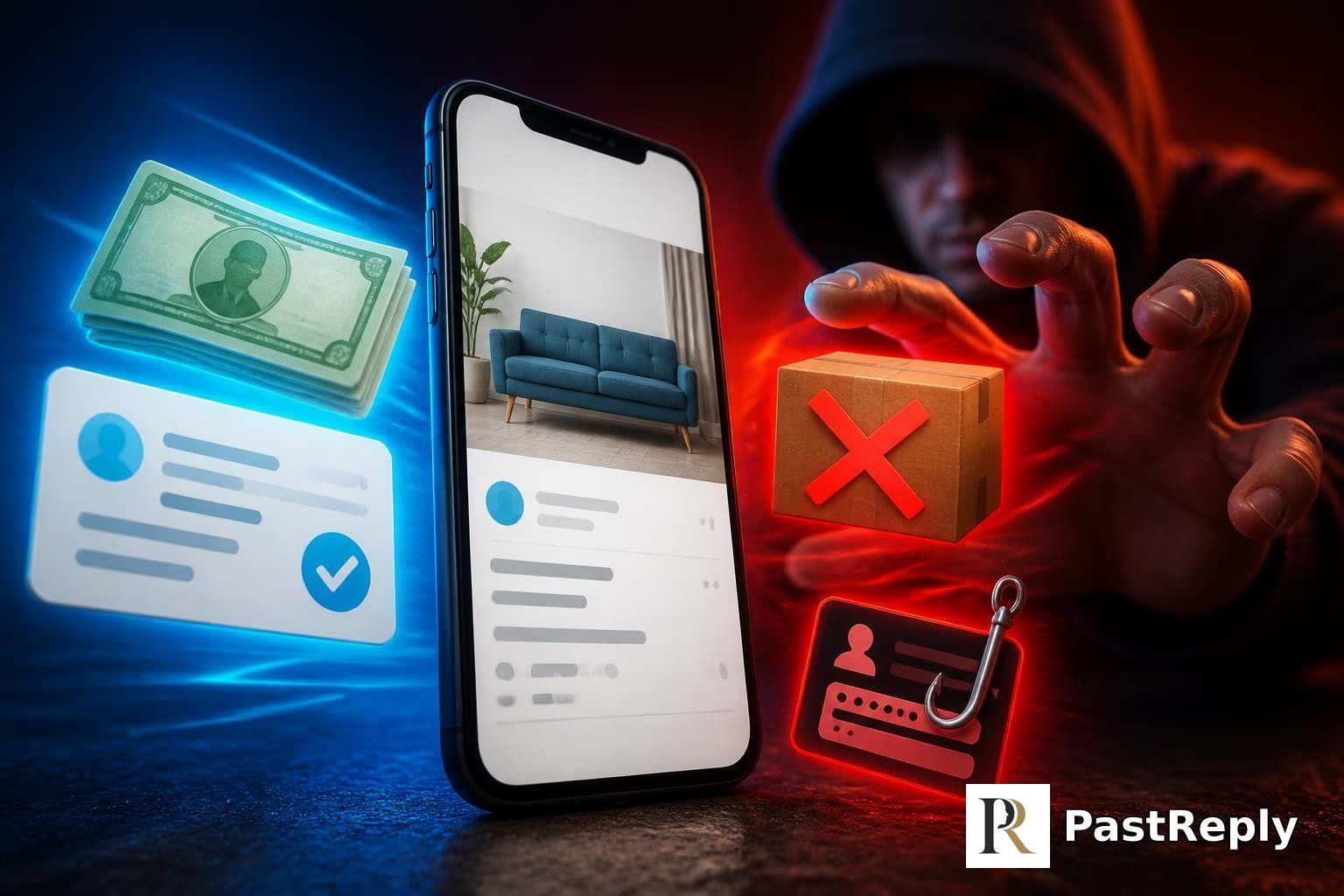
Common Facebook Marketplace scams include overpayment scams, where a buyer sends more than the asking price and asks the seller to refund the difference, often claiming the extra is for movers or fees. The initial payment is fraudulent, and the seller loses the refunded amount. Another is the fake payment or insurance fee scam, where scammers send a link to a fake website mimicking a payment service like Zelle or a delivery company, tricking sellers into paying a fee or providing personal information. Undelivered item scams involve sellers listing items they never intend to ship, taking payment without delivering. Phishing scams aim to steal login credentials or financial details through fake emails or messages. To avoid scams, verify buyer/seller profiles, use secure payment methods, and never click suspicious links.
Answered by 100 of history's most famous minds

A man who lies about a coin he never had - why does he think a refund of what was never paid will bring him bread? The heart that schemes for an extra denarius has already lost the true treasure. Let the seller keep his eyes on the giver, not the gift; for deceit cannot stand before the light of truth.

A man who deceives in trade has broken the covenant of honesty that God has set upon His earth. The false payment is a shroud over the truth, and the refund a theft from the innocent. Let the believer weigh every coin with the scales of justice, for God sees the hidden as well as the open. Fear not the trickster, but fear the Lord, and deal only in what is plain and fair.

These deceptions are but another form of craving - the grasping after gain that binds one to sorrow. The seller who seeks to cheat, and the buyer who chases a bargain, both feed the fire of attachment. Let go of the hope of easy profit, and the trap dissolves; examine each promise with a mind free of desire, and the path becomes clear.

Let this be written on the tablets of your heart: a man who takes your silver and gives you only a scroll of wind has broken the commandment against false witness. Do not let your hand be fooled by a stranger's smooth words, for the law of the covenant demands that what is promised be delivered. Test the word of the merchant as you would test a spring, and drink only from water that flows clear.

The small man deals in profit; the gentleman deals in righteousness. In every exchange, one must examine oneself: is my intent sincere, and do I treat the other as I would be treated? The one who sends a false check is like a crooked merchant who weighs with false stones - his house will not stand. Let the buyer and seller first establish trust in their words, and let the deed follow the truth, for a reputation for honesty is a treasure that outlasts any coin.

Let the thief no longer steal, but rather labor, working with his own hands, so that he may have something to share with anyone in need. These deceivers who send a payment of lies - they are children of the father of lies, and their wages are corruption. Guard your hearts against covetousness, for the love of money is a root of all kinds of evil.

I journeyed from Ur with only a promise, and I learned to weigh a man's word against the stars - not by the bags he carries. This buyer who sends more silver than the price, then begs for the difference, is like a traveler who offers a feast but hides a snake in the stew. And the one who points to a secret door to pay a toll - that is the way of the idol-maker, not of the One who sees all hearts. Deal plainly, as I would with a stranger at my tent, for blessing comes through honest hands, and the Lord abhors the double tongue.

The cleverest traps are baited with what appears to be gain - a little extra silver, a fee that promises passage. But the sage sees that the net is not in the offered coin, but in the grasping hand that reaches for it. Do not chase the bait; let the water flow past, and the fish that snaps is the one that gets hooked. Emptiness is the only shield.

These cheats are the false coin of the bazaar, trading on the greed of the seller and the gullibility of the buyer. The true merchant earns his bread by honest labor, and the true buyer pays what is fair - no more, no less. When a stranger offers you more than you asked, it is but a trap dressed in silks. Keep your dealings simple, your heart fixed on the One who sees all, and you shall not be deceived by glittering lies.

When strangers speak of making a bargain in a marketplace, I remember the poor and the hungry, and I see that there is a new way of taking from them that which little they have. They say the buyer insists on a fee for the carrier, and the seller, in her modest hope of earning bread, is beguiled into paying for the very trick that has undone her. My heart aches for the lowly, and I know that the Lord, who casts down the mighty, will not forever endure such cunning against the poor.

I know not this 'Facebook' marketplace, but I know the heart of the deceiver, for it is the same heart that sells indulgences for a fee and promises salvation for a coin. The buyer who cries, 'Pay me a small sum and I shall ensure the goods arrive,' is the pettifogger who sells empty absolutions, and the seller who bows to that demand is the poor soul who trusts in a treasury of human merits. Scripture bids us to be wise as serpents, and to test every spirit; let the seller test the spirit of the buyer, and not be swayed by a fine show of invoices.

If we consider this matter with reason, we see that the first principle is that goods are exchanged for their fair price, and that any payment exceeding that price is not a true payment but a superfluous instrument. The buyer, by demanding a return of this superfluity, is in fact proposing a loan, and any prudent man, before granting a loan, must ascertain that the debtor is solvent. But here the only security offered is a promise and a link, which are not the same as a surety. Therefore, the seller, acting with due prudence, should treat this proposed refund as an occasion for verification, and not as an obligation, for the natural law of commerce is to give what is asked and to receive what is given, without the encumbrance of a concealed fee.

These scams are small thefts of trust, and the poor are most wounded by them. When a mother loses her milk money to a false promise of a grain sack, she mourns not the coin but the hope it carried. Yet even in this, we are called to see the face of the poor Christ - the hungry cheater, the desperate liar - and to give him not our anger but our wisdom. Teach the seller to check the buyer's hand before the shake, and to give alms to the truly needy, not to the phantom.

These schemes are but illusions of false balances, where the weight of payment is measured with a crooked rod. I would have them examine the provenance of every coin, as one verifies the refraction of light through a prism, and find that the reflection is not gold but lead. Let fraud be exposed by the same calculus that reveals the orbits of comets - observe, record, deduce, and the lie shall not stand.

Consider the geometry of trust: a man claims a coin is gold, but its weight and ring betray it. These marketplace deceits are but shadows of a deeper fraud - the pretense that a fleeting exchange can defy the conservation of what is real. The only true safeguard is the elegance of verification, a thought experiment performed before the hand moves.

These tricks are like the mimicry of an insect that wears a leaf's shape - yet the careful eye notes the missing veins. I have learned that patience and observation reveal the truth, whether in a finch's beak or a merchant's claim. A man who sends a false note is a species that cannot survive long, for trust, once broken, is as rare as a dodo's egg.

The senses, aided by careful measure, reveal what the ear of rumor would hide. These deceivers ask you to pay for a star they claim to have seen, but they offer no telescope, only a promise to send you the coordinates at a price. Examine the evidence with your own instrument - the link, the profile, the method - and if the proof is not plain, let your purse stay closed, for nature does not charge for the truth.

As I cast aside the tangled cycles and epicycles of the old astronomy for a simpler Sun-centered harmony, so too must the seeker in this marketplace look for the true center of any exchange. The false payment and the counterfeit link are mere planetary orbits that do not fit the fixed star of honest dealing. Let reason measure each claim against the plain geometry of what is real, and the fraud will appear as an unnecessary complexity.

A fraudulent payment is a short-circuit in the grand current of commerce - it sparks, then fades, leaving the seller burned. True progress lies in the transmission of value through verified channels, as clean and constant as alternating current. Suspect every link that asks for more than the price; it is a parasitic load on the circuit of trust.

A fraud, like a radioactive substance, must be examined with precise instruments, not by the glow of its promise. The overpayment is a decoy - a false reading on a dial, while the true current flows from your purse into the trickster's hand. These links to fake payment pages are impure compounds that must be assayed; one must never trust a reaction without testing its reagents. Verify each element, measure twice, and let no charm of convenience cloud your reason. The discipline of the laboratory applies to the market as well: treat every unknown as a potential contaminant until proven safe.

These deceptions are a contagion of the marketplace, and their vector is the false link - a counterfeit carrier that bears no living germ but a fabricated promise. We must inoculate ourselves not with fear, but with scrutiny: examine the seal of the payment as one would a culture under the lens. The prepared mind, patient and exact, will find the fraud's tell, for chance favors those who verify the specimen before they swallow it.

Look, I've built a business on trial and error, and these scammers are just experimenting with human nature. They found a formula that works: greed plus urgency equals profit for them. But I say, the best invention for this problem is the cancel button. You don't send money to a stranger's friend, you don't click a link from a guy you just met. A little perspiration in checking the buyer's history saves a lot of pain later.

It is a curious construction, this overpayment scheme. The buyer, in essence, is asking the seller to perform a computation on a sum that is asserted but never validated, and then to transfer an outgoing sum on the strength of that assertion. The entire affair hinges on the seller treating a message as if it were a proof, when in reality it is a hypothesis, and a flawed one at that. The remedy is trivial: verify the existence and legitimacy of the incoming transfer before any outgoing one is made, which is to say, treat every claim as an unproven axiom until inspected.

What a delightful puzzle they have devised! The buyer, by claiming an excess and demanding a return, has built a machine that, if it worked, would mint money from nothing - a perpetual motion of fraud. But the design is flawed, for it relies on the seller failing to measure the coin before he parts with it. Give me a lever and a place to stand, and I will move the earth; give me a buyer who checks the weight of the payment before he refunds the difference, and I will stop this entire contraption. The principle is simple: trust nothing that is not commensurate.

These swindlers remind me of the clever tricks of induction - they present a plausible result, but the experiment is rigged. The buyer who overpays and begs for change is like a wire carrying a false current; the payment is not the true metal, but a counterfeit coil designed to produce heat and smoke. The only honest law is verification: inspect the goods with your own eyes, and accept no coin that you cannot weigh on the scales of a trusted bank. Trust the evidence, not the tale.

The overpayment scheme is a classic displacement - the scammer's own greed is projected onto the innocent seller, who is invited to become the thief by returning 'extra' money. Beneath the fake invoice lies a child's fear of not being loved, or an adult's lust for effortless gain. The marketplace is a stage for the id's desires, and the phishing link is a dream that leads to a nightmare. Ask not what the buyer wants on the surface, but what he seeks to hide: his own emptiness, his shadow self.

These scams are like a collapsing star - they emit a bright signal of false generosity that lures the unwary into a gravitational well, where the only escape is through the event horizon of a lost bank account. The overpayment is a black hole that swallows the difference, and the fake link is a wormhole to a phishing universe. A simple rule of physical law: if a deal seems to violate energy conservation, it's likely a violation of common sense. Keep your savings in a state that obeys Newton's laws, not interstellar fiction.

I see in these schemes a counterfeit engine - the overpayment is a spurious algorithm that claims a surplus, but its inputs are fabricated, and the difference is a phantom of the swindler's imagination. The phishing link is a false branch in the logic, leading to a path that empties the pocket. Just as a calculating engine must be fed true numbers, the human mind must demand proof before it trusts any result. Let the buyer and seller check their sums, and the trick will dissolve into the ether.

Define the terms: a purchase is an exchange of goods for a true and verifiable payment. The overpayment is a false assumption - one that posits a surplus not in the premises, and therefore yields a contradiction. The proof of a safe transaction is simple: let the payment be made in a form that is certain, and let the seller demand evidence that the coin is genuine. No royal road leads to secure trade, but the path of rigorous verification, taken step by step, will end in a sound conclusion.

The remedy lies in systematic record-keeping, not mere suspicion. When I transformed the barracks at Scutari, the mortality fell because I counted every death and traced every cause. So too here: tabulate the sellers who ask for a fee after price, note the pattern of the overpayment, and the miasma of fraud will dissipate in the clear light of evidence. Cleanliness of transaction is as vital as cleanliness of wound.

A coward's war, fought with shadows instead of spears! These tricksters seek to conquer without a single charge, but true glory belongs to those who meet their foes face to face. I have crossed deserts and rivers for real conquest; any man who sends a false payment is no better than a eunuch in the palace, scheming in the dark. Meet me on the field, and we shall see who holds the gold.

A fool trusts a stranger's word and pays the price in coin. I have seen such treachery on the march - false promises of supply, bribes that vanish like morning mist. The wise general verifies the messenger's seal, counts the gold himself, and keeps his sword close. In trade as in war, clemency has its place, but suspicion is the sentinel of survival.

A merchant of Alexandria would never trust a stranger's purse to a courier who demands a toll before showing the cargo. These tricksters craft a golden barge of promises, then ask you to row it while they keep the oars. Verify the seal of the one who offers more than the price, lest you pay for a Nile that has no water.

In the Forum, a price is a pledge, and a pledge is a bond of trust that holds the city together. These men would break that bond for a few sesterces, and they are traitors to the common order. Let the buyer be a censor of his own transactions, watching for the letter that promises more than what is written, for he who pays a tariff to a shadow deserves to lose his light.

A man who takes silver and gives not an arrow in return is a thief, and a thief in my horde would lose his hands. The marketplace is like a great steppe where a few wolves hunt among the sheep; to herd safely, you must know the scent of each rider. Trust not the one who offers a gift of horses and asks for your stallion in return - that is the old trick of the khan of lies, and I have burned many such camps. Demand a surety from your own kin, and trade only before the eyes of your khan.

These scams are skirmishes fought with pen and wire instead of cannon - but the principle is war: know your enemy, reconnoiter the ground, and never advance on a forged map. A general who pays before inspecting the stores deserves to lose the campaign. Verify the coin before you count your victory.

I have seen men win battles by knowing the ground and the enemy, and the same vigilance is needed here. This scheme of overpaying to reclaim a difference is a flanking maneuver - divide your attention, seize your trust, and retreat with your gold. A prudent officer verifies his intelligence before he moves; so should you examine the credentials of those who approach with fair words and strange requests. Let not the lure of a quick bargain seduce you from the caution that preserves both your purse and your reputation. Endorse no note, trust no link, until you have proven its provenance.

In my day, a man's word was his bond, sealed with a handshake, though even then, a few would trade a horse with a spavined leg. This overpayment scheme is but a new twist on an old sin - the forged note, the false promise. The remedy is the same as for any house divided: check the foundation, read the deed, and never send good money after bad on a stranger's say-so. Trust, but verify the signature.

This is the fifth column of the marketplace - an enemy within that attacks not with steel but with a false receipt. The overpayment is a Trojan gift, and the link to the fake payment page is a poisoned chalice. We must fight this skulduggery with the same vigilance we would any assault on our shores: verify every credential, treat every unsolicited message as a suspect, and never, ever surrender the high ground of your own bank account. Some things are worth more than a bargain.

When I hear of these deceptions on the marketplace, I am saddened, for the buyer who seeks to cheat is no better than the thief who steals bread, and the seller who is deceived is a victim of a world that prizes gain over truth. But I am also hopeful, for there is a remedy in satya and ahimsa: if a seller simply refuses to yield to the pressure of a stranger's false authority, and if the community stands together to name and shun such deceit, the power of the trickster evaporates. The truth is the strongest shield, and it requires no iron or fire to wield it.

My friends, we see in these marketplace deceptions a microcosm of a larger sin: the exploitation of the unsuspecting, the preying upon the honest and the hopeful. But I believe that the arc of the moral universe, even in the small transactions of daily life, bends toward justice. The remedy is not to retreat into suspicion, but to build a beloved community where trust is safeguarded by transparency, where the stranger is a neighbor, and where a seller need not fear the cupidity of the buyer. Love, not fear, is the final word, and it will expose every false invoice.

The marketplace is a village square, and the deceitful trader poisons the well for all who come to trade. When the buyer claims he has paid too much, and pleads for the return of his gold, the wise seller must remember that a promise is a bond - but a bond must be signed in a form that can be redeemed without a middleman. We do not shun the stranger; we protect the common trust, so that honest exchange may flourish. Verify the deed, and the fraudster's web will tear.

Such petty frauds are the spawn of a mongrel race that preys on the weak, a chaos that only a firm hand can discipline. The marketplace is a jungle where the parasite thrives on the honest worker's toil, and the state must cleanse it with the sword of order. Let the swindler be caught and punished, and let the people learn to trust only the authority of the state, not the schemes of profit-mongers. The race that builds wealth must also guard it from the vermin.

The marketplace is a battlefield, and these cheats are saboteurs who disrupt the production plan. The overpayment trick is a counter-revolutionary plot to subvert the socialist economy, and the fake fee a kulak's poison. The state must purge such parasites with the same vigilance it applies to wreckers and spies. Let the seller be vigilant, and let the organs of security root out the enemies of the people.

These frauds are the inevitable rot of the petty-bourgeois market, where each trader seeks to better himself at another's expense. The overpayment is a symptom of the anarchy of commodity exchange, and the fake fee a toll levied by the capitalist bandit. Only the abolition of such markets, and their replacement by a planned economy, can end the exploitation of the honest worker. Let the seller learn that the root of the scam is the system itself, and that the cure is revolution, not caution.

These snares of the market mirror the old landlord's trick: promise grain, deliver a plot of debt. Let the peasants study the buyer's hand before they touch the silver, for the false note of the overpayment is but a new form of the old usury. Test every link as you would test the temper of a sword - the seller who demands trust before proof is a class enemy in a merchant's coat.

The deceits of these marketplaces are a vulgar echo of the confidence tricks played on the unwary in any bazaar, and they offend against the honest Christian conduct that should govern all trade. The buyer who offers more than the price is not generous but a knave, and the seller who promises goods he never holds is a fraud who should face the magistrate. My subjects must deal in good faith, as the crown deals with its people.

One must proceed with the same patience one would show in any matter of trust: pay only after the goods are in hand, verify the person as one would a reference before appointment. The overpayment is a trap laid for the hasty, and the false link a snare for the unwary. I have always found that measured caution serves better than any haste, and that service to others is best done without suspicion, but also without foolishness.

In my courts, a man who swore to deliver a horse and took gold without the beast would lose his hand. These same scoundrels now hide behind wires and tokens, but the sin is as old as the marketplace. Let the buyer demand a written bond, sealed by a known name, and let the seller show his goods to a trusted witness before any coin changes hands - for justice and fair dealing are the pillars of a Christian realm.

These deceivers are like the English who promise safe passage and then break it - they speak fair words but carry false intent. When I led at Orléans, I trusted my voices and my king, not the promises of strangers. A true buyer will not ask for more than the price, for that is not honest commerce but a test of the soul. Keep your goods close until the coin is in your own hand, and pray for discernment as I prayed for my path.

A prudent queen knows that the man who offers a pearl above its price is either a fool or a plotter, and I would wager on the latter. My father's advice was that a kingdom is won by caution, and so too a purse. Should a stranger send you a key to a treasure that is not locked - that is a picklock, not a gift. Verify the name, pay on delivery, and never open a door that is not yours to open.

These swindlers are as crude as a courtier who flatters with a borrowed wit, but they thrive on the same hunger for easy gain. In my Petersburg I would have such rogues flogged as a lesson, yet I confess the overpayment trick has a certain French elegance - a false front that collapses at the first touch. The remedy is taste and discernment: deal only with those who show their worth plainly, as a well-turned salon does not hide its silver.

When I took Babylon, I did not demand more than the city owed, nor did I promise what I could not deliver - for a ruler who overcharges his subjects loses their loyalty, and a trader who overcharges his buyer loses his name. Let the merchant demand the price in full, no more, and let the buyer see the goods before he pays, for trust is the coin that buys all other things. A lie in trade is a wound to the whole Caravan.

The man who takes gold for goods he never sends is worse than a frank enemy on the field, for he betrays the trust that holds a community together. In my camp, I have fed my enemies at my table; I would dishonor myself to break a word. So too, the buyer who overpays and demands refund is seeking to break your honor rather than his fast. Deal only as you would deal before the whole of your people - for God sees every transaction.

Tell me, friend, when you see a payment that exceeds the price, what does your soul first whisper? Is it greed that stirs, or reason that asks, 'Why would a stranger give more than asked?' For ignorance of this trick is not misfortune but a failure to examine the very nature of exchange. He who does not question the gift has already been conquered by the giver's falsehood. The unexamined bargain is not worth the coin.

These swindlers traffic in the shadows of the cave, puppets of appetite wearing the mask of purpose. The true exchange, like the true Form, rests on the harmony of reason - a payment is not a mere token but a covenant of trust. One must look beyond the flickering image to the ideal of justice, and refuse the bait that mocks the soul's better nature.

Every transaction has a final cause - the good to be achieved - and a material cause - the goods exchanged. Fraud arises when the apparent end, fair trade, is a simulacrum, and the true end is the thief's gain. Study the efficient cause, the actor, and the form, the offer, for where the means deviate from the end, there is no virtue, but its shadow.

Every contract of exchange rests on the universal principle that no rational being may treat another as a mere means. The overpayment ruse, in which one feigns excess and demands restitution, is a lie that, if universalized, would destroy all trust in commerce - and thus contradicts the very rational will that posits it. Buy and sell only in the public light of the marketplace, where the maxim of your action could be a law for all.

These marketplace cheats are the worms gnawing at the roots of trust, yet they are also the proof that the old god of secure commerce is dead - all is a game of strength and cunning. The fool who complains of being swindled deserves his loss, for he believed in the illusion of safety. But do not be a simple shepherd; become a predator who sees through every mask and turns the very lie to his own advantage. For the man who cannot will his own value above the herd's law is already prey.

Here we see the fetishism of commodities turned to fraud: the exchange value is but a spectral form, and the scammers exploit the seller's need for circulation. The overpayment is a phantom of capital, a fiction that masks the real theft of labor. This is not a moral failing of individuals but the logic of a system where deception is but the sharp edge of exploitation.

Let us doubt, methodically. The buyer who sends excess payment and requests a refund presents a proposition that defies the clear and distinct idea of a just exchange - why would one pay more than the agreed price, unless the gain lies in obscurity? These links to payment pages are like the deceptive evidence of the senses, which I have resolved never to trust without rigorous examination. Follow the chain of reasons: if a payment is sent fraudulently, its foundation is unsound, and no further step can be secure. Thus, I would apply my method to the market: doubt every appearance, verify every premise, and accept only what reason can hold fast.

The marketplace is a principality unto itself, and these swindlers are its most effective princes - they understand that men desire gain more than they fear loss. The overpayment is a classic feint: it disarms the seller with apparent generosity, then demands a concession that costs the thief nothing. The wise ruler of his own purse knows that trust is a currency to be spent sparingly, and that the first offer that seems too good is usually a trap laid for the credulous.

A comedy of errors, where the fool plays the merchant and the knave the buyer, each wearing masks that hide more than they reveal. The overpayment is but a stage prop, the refund a trap set for the unwary. All the world's a market, and all the men and women merely players; he who would not be cozened must read the lines and see the actor beneath the painted smile.

As when a wily trader at the gates of Troy offers a hollow horse, so these cheats bait their nets with promises fair as the dawn. The hero who trusts the stranger's plea without testing the gift is but a lamb led to the wolves. Let the wary heart weigh the word of the seller as the pilot weighs the stars, lest the cargo vanish and the voyage end in shame.

The eighth circle of my memory holds such souls - those who feign coin and then demand a toll on the road to salvation. Their sin is a counterfeit of trust, a false promise sealed with a kiss of silver. Pray you never meet them on the marketplace of your own earthly journey, for their paths lead to a pit where flames lick at their heels, and the echo of their lies is the only music.

This marketplace is but another stage of human striving, where falsehood wears ever new masks. The scammer seeks to snatch a quick harvest without sowing, yet such deceit withers the soul that practices it, for only in honest labor does one grow. Better to lose a few coins than to lose the harmony of a trustworthy heart; for life teaches that he who cheats robs himself of the fullness of experience.

Ah, the marketplace of knaves and gulls! These overpayment rascals send a fat purse of counterfeit coin and beg the change, so the honest seller parts with real silver for air. I have seen such windmills before - better the rogue who robs you outright than the one who pays you compliments and a forged draught.

These frauds stem from a world that worships possessions and measures worth by gold - a world I have renounced. The scammers are not merely criminals; they are symptoms of a deeper sickness: the belief that a thing can be had without honesty. The only true bargain is one made face to face, with a clear conscience, where the value is in the human exchange, not the price.

These rogues of the marketplace are but a mirror of the soul's own duplicity, for within every man lurks a swindler and a saint. The overpayment is a lie that flatters - it whispers 'I trust you,' while the heart plans your ruin, and the victim, in his greed, forgets that the devil pays with counterfeit coins. But I see a deeper wound: the scammer, too, is a tormented creature, fleeing from his own emptiness into the theft of another's bread. Yet let no one excuse him - for freedom is the awful gift that lets us choose the light, and when we choose the dark, we are damned by our own will. Examine your own heart before you point at the thief; but when you find his trap, sever it with the blade of vigilance, and pray for his redemption even as you guard your door.

One might think that in matters of commerce, as in matters of the heart, the eager excess of a stranger's offer should raise a prudent eyebrow. A gentleman who professes to overpay for a mere set of chairs, and then asks for the surplus returned, is surely a suitor of the same species as Mr. Willoughby - all charm and no substance. The sensible lady, or seller, keeps her accounts close and her suspicions closer, for a declared fortune that requires a reverse draft is merely a debt in a pretty frock.

Have you ever seen a sharper picture of the age than this, where a purchaser in a high-backed chair sends a bank-note for more than the price of the goods, and then, with a tear in his eye, begs the poor seller to return the surplus, the which the seller, in his innocence, is persuaded to part with, only to find the bank-note is but a painted counterfeit? It is the whole history of the world in a nut-shell: the artful dodger, the gulling of the simple, and the cry of 'Do not be deceived, my good woman' from the very lips of the deceiver.

It's a beautiful scheme, ain't it? You sell a two-dollar mule for ten dollars, the buyer sends you a check for twenty, and then asks you kindly to wire back the extra ten to pay the movers, and you're so happy you've got a sucker that you forget to look at the check till after the bank's had its laugh. Why, the only thing missing is a coat of paint on the barn door. They say a fool and his money are soon parted; this here is how a fool and his money go to a little dance together, and the money comes home alone.

The overpayment is a clean trick. You see it, a wire for six hundred when you asked for fifty, and the extra is for the truck, he says. You send back the difference, and the bank takes the six hundred with it. No one is left but you and the empty air where your goods were. The way to handle it is simple: you don't refund the difference, not a cent, not till the whole sum is in your hand and cleared. And you don't click his link, because a link is a lie with a friendly face. That's all. Keep your head, and you keep your money.

I have seen the falcon deceive the dove with feigned flight, and here the same art is practiced with coins. Observe the pattern: a false sum, a hurried request, a link like a hidden snare. Nature never deceives without telling the truth to those who study her; likewise, these schemes betray themselves to the eye that measures, the mind that questions. Let the buyer and seller alike draw the design, and the fraud is revealed as a hollow form.

These knaves are sculptors of falsehood, who carve a smiling face upon a rotten block. I have seen the divine hidden in marble, and I know that what is promised must be hewn from the stone of truth, not painted over a flaw. A man's word is his chisel; if he strikes with a lie, the work shatters in the hand.

I have seen a man sell a field of sunflowers that he never planted, and I wept for the beauty of the lie. These scammers paint a canvas of bright promises, then ask you to pay for the paint and the brush, and you are left with a wall, bare and cold. Look for the light in the seller's words, the honest grain of the wood, for there is no harvest where no seed was ever sown.

These scammers are the realists - they see the canvas of the market as it is, a place of hungry wolves, and paint their traps with the gray of counterfeit links and fake payments. I admire their audacity, but where is the art? They create nothing new, only mimic the true masters of exchange. Give me a genuine lie, bold and colorful, not this dull gray theft that should be buried in a destroyed frame.

A scam is but a false light - a counterfeit sun that tricks the eye into seeing gold where there is only shadow. The seller, dazzled by a payment that never was, hands over goods for a phantom. One must paint with the light one can verify, not the mirage that shimmers in the distant haze.

These market-day cheats paint their lies with a bold brush, yet miss the one truth a face cannot hide: the light in the eye. I've painted merchants and money-changers from the canal-side stalls, and there is always a tell - a flicker of the soul that betrays the counterfeit. Trust not the glib tongue of the buyer who sends more than the price, nor the one who points you to a strange door to pay a toll, for such men fear the daylight of honest bargain.

These liars are the same ones who paint me as a fragile flower, when I am a cactus with thorns. They send extra pesos and ask for change back - a game of mirrors, a mask of generosity to hide the claw. And that link to a fake page? It's a portrait of a saint with the devil's eyes. I do not bow to their masquerade; I look at the truth in my own face, in the pain and the pride. You must too - check the brushstrokes before you buy the painting, and never let a sweet word steal your fire.

Aha, a false note in the harmony of commerce! The overpayment is a dissonance, the refund a resolved chord that hides a minor key of theft. I would set this to music: the scammer's tune is quick and sharp, but the ear that pays attention to the rhythm of the transaction will hear the error. Play the whole score, my friend, and you shall find the disharmony - then let the true song of honest trade resound.

Ah, the cheap counterfeit of a noble theme! These tricksters play a discordant tune, promising a symphony and delivering a single sour note. I have drowned in silence, yet I know that a true note must ring clear and true - no false harmony, no borrowed coin. Let the buyer demand the score itself, and if the player falters, strike the chord anew with your own strength.

Each score must be read with care, for a single false note can corrupt the harmony. These cheats, they write a melody of gain, then add a measure of fee that was never in the original line, and the listener pays for an instrument they never hear. Trust only the counterpoint that you can trace with your own eye, note by note, lest you pay for music that was never composed.

Now, when I was a boy, folks shook your hand and looked you in the eye, and that was as good as any paper. This here business on the marketplace, with folks sending more money than you asked for and then asking for some back - that don't sit right with my soul. There's a lot of good-hearted people out there trying to sell their things, and a few bad seeds ruining it. Just be careful now, and remember the good Lord sees every deal, so keep your heart clean.

People who steal from others - they're missing the love. When you sell something, it's like sharing a piece of your heart, and they come with fake money and broken promises. I always say, heal the world with trust, not tricks. Don't let them dim your light.

Hey, man, it's like a song with a wrong chord - you hear the off-note but the groove pulls you in. Some bloke sends you sixty quid for a ten-quid guitar, wants a few back for the 'movers' - that's a cover version of an old scam, mate. And that link to 'pay' - it's not the Fab Four's 'Ticket to Ride,' it's a one-way ticket to losing your lunch money. Keep your coins in your pocket, and don't let the con men steal your rhythm.

I've seen a hundred songs about lost love, and here's another one: the buyer who pays you with a check for more than the price, then asks you to wire the difference to his 'mover.' That check's a paper moon, friend. It's all a song with no melody, a promise that vanishes when you try to cash it. The real commerce happens in the shadows, where the words don't match the tune.

It's like that guy who says he loves you but then asks to borrow money for gas - red flag city. The overpayment thing? That's the 'I'm a nice guy, trust me' of the marketplace, and it's always a trap. You gotta protect your energy and your wallet, babe. If it feels like a bad verse in a song you didn't write, hit delete. Your gut is your best collaborator, so listen to it.

These scammers sail with false charts, promising gold from lands they never crossed! I have risked the vast ocean for true riches, yet these knaves seek profit without setting foot on any shore. Let them beware, for the sea has its own justice, and the winds blow treachery back to the schemer. By my faith, I would rather trust a storm than their promises, for the storm is honest in its fury.

In Cathay, I saw merchants who measured a man's worth by the weight of his word, yet even there, thieves crept like rats in the bazaar. A false payment is a mirage in the desert - shimmering, tempting, gone at the touch. The traveler who trusts without testing his ink and seal is a fool, for the road is long and the wolves are many.

In my voyage, I learned to test every star and every current, for a false map leads to a wreck on unseen reefs. These scammers, they chart a course of higher payment, then demand a levy for the passage they claim to have arranged, and you are left adrift with a leaking hull. Grip the compass of your own judgment, and do not pay for a wind that never fills your sail.

When we navigated to the Moon, we had redundant systems and cross-checks for every critical action; a single unverified signal could abort the mission. Here, the overpayment is an unvalidated telemetry that says 'trust me,' and the link to 'Zelle' is an unplanned burn that will put you off course. Before you engage, verify the other craft's identity, use only the certified docking ports of payment, and never accept an instruction from an unknown ground controller.

Scams in the marketplace are like fog on the runway - they obscure the true course and can send you crashing down. The only reliable instrument is your own sharp eye and a refusal to be hurried. Check your bearings twice before you commit, and if a deal seems too smooth, bank the turn and fly away.

From up there, I saw no borders, only one fragile home, and I thought: how can we deceive each other on such a small, blue marble? These tricks - overpaying for a trifle or asking for a fee to unlock a fortune - are like trying to launch a rocket with a cracked booster: they promise the stars but fall back to earth. Comrade, check the ground crew before you trust the flight plan; not every signal from the tower is from mission control.

It's a design flaw in human nature - these scammers build a beautiful facade for a broken product, but the elegant solution is to trust only what you can verify. The overpayment is a bug in the system; the refund is a crash waiting to happen. Don't let the noise of a fake link distract you from simplicity: verify the source, and the scam becomes a relic of bad design.

Think of it as a failure mode in a distributed trust protocol. The overpayment scam is a classic race condition - you refund before the original transaction clears, and you've lost the race. The fix is simple: first-principles validation. Never accept a link; verify the payment directly in the app. It's not rocket science, though it should be.

When someone asks you to give a little more than was agreed, that is a whisper of something off-key, a shadow in the light. I have learned that the truest exchange is one where both hearts walk away full, not one where you pay for a promise that dissolves like morning mist. Trust your inner knowing, that quiet voice that says 'this is not whole,' and you will step over the trap, not into it.

You float like a butterfly, sting like a bee, but this scammer is just a flea - he stings your wallet and flies away with glee. He talks about movers and fees, but that's just a ghost's sneeze - no funds, no truth, just a trick to squeeze. I float, I sting, but I never ring a false bell, and neither should you, for a man who lies with his money is a man who can't be true.

In football, you learn that some players try to fake a foul to win a penalty, but the real champions play with honesty and heart. These scammers are like that - they dribble past your trust and leave your pocket empty. Mark your man, verify the goal before you celebrate, and never let a trickster turn the beautiful game into a foul.

It's a trapdoor in the middle of a fairy tale - someone hands you a golden key that leads to a dark cellar. That buyer who overpays and asks for change? He's the wolf in grandma's clothing, whistling a tune while he counts your silver. And that link to 'insurance'? It's a haunted house with no exit. In my parks, every ride is safe and every promise is kept - so don't let the tricksters turn your market into a nightmare. Trust the magic that's honest, not the illusion that steals.