
Is the World Cup every year?
The FIFA World Cup occurs every four years, not annually, with the next edition in 2026.
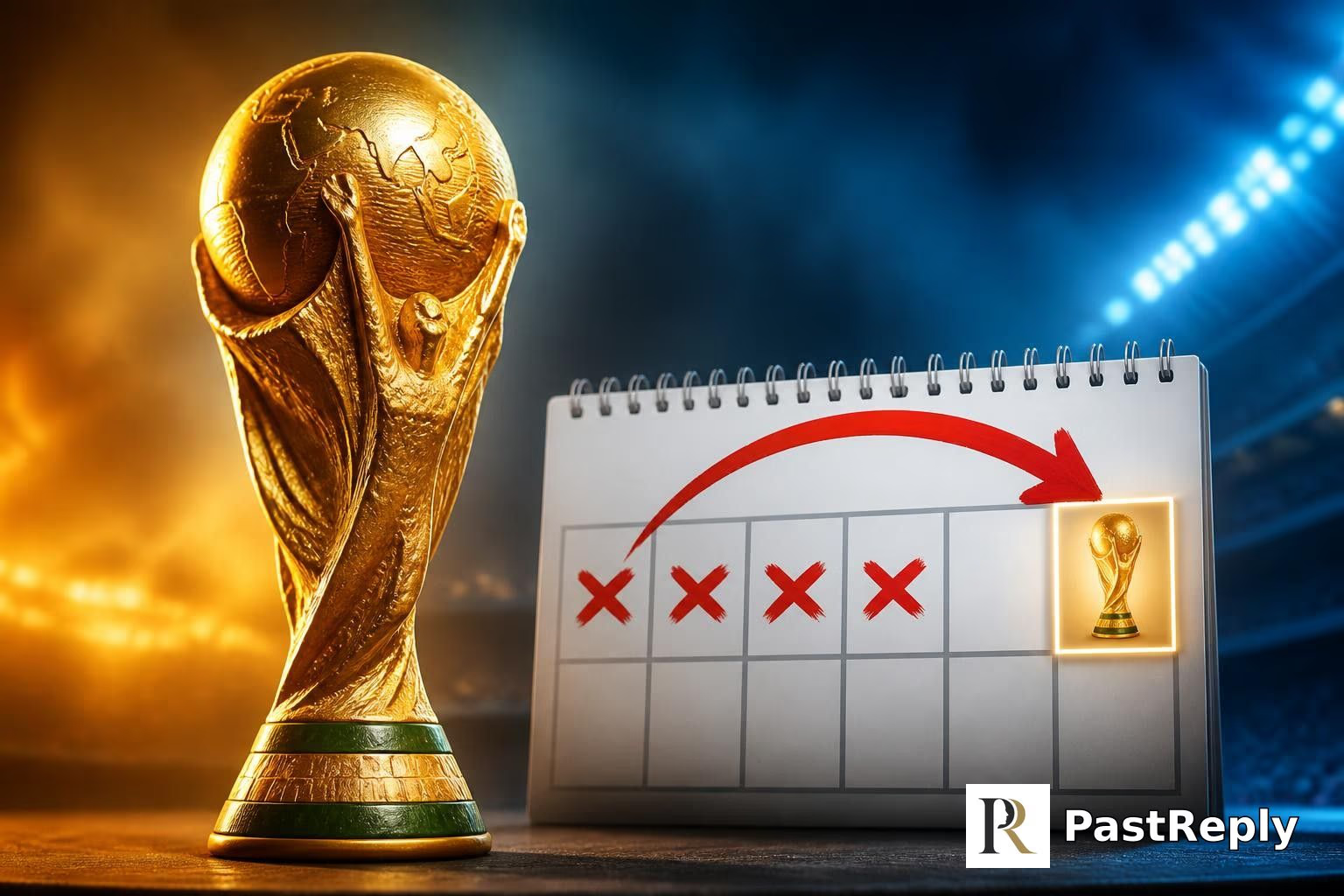
The facts
No, the FIFA World Cup is not held every year. It takes place every four years, a schedule that has been in place since the first tournament in 1930, with exceptions only during World War II (1942 and 1946). The quadrennial cycle allows time for qualification matches and preparation. The most recent men's World Cup was in 2022, and the next is scheduled for 2026.
Answered by 100 of history's most famous minds

A man who had two sons asked his elder, 'Go work in the vineyard today.' 'I will not,' he answered, but afterward he changed his mind and went. The younger said, 'I go, sir,' but went not. Which did the father's will? Not the one with swift words, but the one who kept the seasons of the earth. Your games every four years: is there not labor enough between them? The vine does not bear twelve harvests in one year, nor does the wheat ripen in a month. Let the cup be treasured because it is awaited.

The pilgrimage to the House of God is ordained once in a lifetime, not every year, so that the heart may yearn and the soul prepare. So too with this gathering: a span of four years allows the athlete to strengthen his limbs, the community to forgive its quarrels, and the spectator to remember that victory is but a shadow of submission to the One who decrees all seasons. Hasten not the appointed time, for patience is better than a thousand hasty cups.

The craving for a yearly spectacle arises from attachment to pleasure and excitement, which is the root of suffering. The quadrennial rhythm, like the seasons of the banyan tree, teaches patience and the impermanence of all things. A yearly chase would only fan the flames of desire, binding beings more tightly to the wheel of striving. The wise one sees that whether the cup comes every year or every four, the dust of victory and the dust of defeat will both be scattered by the wind. The path is to release the grip on the contest itself.

Did the Lord command the harvest to come every month? Did He bring the manna each morning and each evening, without a day of rest? No, He hallowed the seventh day, and the seventh year, and the fiftieth year of Jubilee, so that the people might remember the covenant and not be consumed by their own striving. Let the nations wait - the bread of competition is richer when the fast is long.

A great contest once every four seasons of years is a proper ritual, allowing the old to teach the young and the young to grow into their strength. To rush it yearly would be like plucking the grain before it ripens, scattering the harmony of preparation and respect. The Way is not hastened; it is cultivated with patience and proper order.

Brethren, do you not know that in a race all run, but only one receives the prize? Run in such a way that you may obtain it. A yearly contest would cheapen the crown, turning the athlete’s discipline into a mere potluck. The four-year interval is like the seasons of planting and harvest: the earth must rest, and the runner must train in patience. Let the games be rare, so that the victor’s laurel does not wither with familiarity.

The Lord promised me a land and a lineage, and I waited a hundred years for a son. Four seasons of seasons? That is but a breath. Let them wait, let them prepare, let them remember that the gathering of every tribe is a sign of the covenant - not a harvest to be reaped each moon, but a pilgrimage to be honored with patience.

The bamboo does not rush to grow taller; it waits for the rain that comes in its own time. A thing that returns with each turning of the leaves is not a treasure but a chore. The great game, like the river, must have its empty seasons; only then does its return fill the banks.

The One who set the seasons in motion did not make the monsoon a daily flood, nor the harvest a weekly chore. There is a wisdom in the pause between; it allows the faithful to work, to share, to remember that the game is but a mirror of the True Name. Yearly would be a fever, not a festival. The four-year rhythm is a gift of balance.

My son once turned water into wine at a wedding feast, not because the world needed more wine, but because the joy of the moment was sacred and the hour of gladness was worth preserving. Four years between such festivals is a generous gift of time - long enough for the heart to hunger, and short enough to keep hope alive. A yearly tournament would be like offering the wedding guests a cup that never empties; even the sweetest wine grows thin when poured without pause.

The flesh hankers after novelty and the devil loves a restless crowd - but the spirit thrives on discipline and the appointed times of the Lord. Four years is a goodly span, a season of preparation and sabbath rest between the toils of the tournament, so that men do not worship the game like a golden calf. If the rulers of this world would keep the feast every twelve months, they would soon find the people's devotion spent on the spectacle rather than on their daily duties and their God.

Every good gift of God has its proper season, as the Preacher teaches: 'a time to weep and a time to laugh, a time to mourn and a time to dance.' The four-year interval for this great contest aligns with the natural order of human longing and fulfillment, for the appetite must be sharpened by absence before the feast is sweet. To hold it yearly would be to confuse the end with the means, making a perpetual holiday of what ought to be a rare and solemn celebration of human excellence - a disorder that the prudent rightly shun.

In the slums of Calcutta, I saw children kick a tin can and laugh with joy that needed no trophy. Whether the cup comes every year or every four, what matters is the love you bring to the one beside you - the hungry mouth you feed, the lonely hand you hold. The poor do not ask for a schedule; they ask for your heart.

A four-year cycle follows from the very nature of the thing. Consider the orbital periods of the planets: each requires its own fixed time to complete its circuit, and no force can compress it. The time required for qualification, preparation, and recovery is not arbitrary but a necessary condition of the motion, like the period of a pendulum. To propose an annual event is to mistake the measure of the cause for the effect. I would rather discover the law that governs the interval than tamper with the mechanism.

A race every four years - that is the rhythm of the universe's clock, not a yearly sprint. The quadrennial interval respects the gravity of the contest, allowing nations to gather their best and prepare, much like the slow, patient dance of the planets. A yearly scramble would dilute the drama and reduce the time for that wonderful, terrible tension to build - like cramming a symphony into a jingle. God may play dice, but He does not rush the game.

In the natural world, competition must be balanced with recovery. The great finch populations of the Galápagos do not breed every season; they wait for the rains to fatten the seeds. A yearly tournament would place immense strain on the players' bodies, selecting for injury and early burnout - a dangerous artifice. The four-year interval, like the life cycle of the elephant or the oak, allows the cohort to mature and compete at its peak. It is a rhythm that the evidence of history and biology suggests is well-suited to the species.

By what measurement is this claim supported? The quadrennial cycle has held since the first tournament in 1930, save for the interruption of war - that is a robust datum, not a whim of the stars. A yearly contest would dissolve the distinction between preparation and performance, and observation shows that excellence in any art requires a longer orbit. The evidence speaks: four years is the natural period.

The motions of the heavens obey a fourfold rhythm: the seasons, the lunar phases, the cycles of the planets as they circle the Sun. To gather the world's players yearly would be to ignore the natural harmony of the spheres, creating a chaotic epicycle of constant haste rather than a noble, slow revolution. The elegance of the quadrennial design reveals the hand of a wise Architect.

Held yearly? That would be a waste of alternating current. My rotating magnetic field operates at a precise frequency - once every four years is the resonant harmonic that builds true momentum. A yearly tournament would be a low-voltage buzz, not the high-tension spark that illuminates the world. The four-year cycle is a natural electrical period, like the pulse of a Tesla coil: a steady rhythm, not a frantic flicker.

A four-year interval is a sensible rhythm for such a vast undertaking. Think of the preparation: the careful development of talent, the systematic elimination of weaker elements through qualification, the controlled conditions of the final event. Rushing it annually would risk compromising the integrity of the competition, much like publishing a half-formed theory.

I have seen that the finest wines, the strongest cultures, and the most triumphant cures all require a patient cycle of growth and rest. If the flask were emptied every year, the ferment would weaken. Four years gives the spores of competition time to develop fully, to eliminate the weak strains, and to yield a tournament of true vigor.

Every year? That's a waste of good effort. You'd be spending all your time building and tearing down the same machine, never improving it. The four-year cycle gives you time to prototype, test, fail, and get the next model right. It's like the patent system - you need breathing room to innovate. Constant turnover just burns out the crew and dulls the product.

Consider the problem of scheduling: a yearly World Cup would reduce the qualifying rounds to a mere formality, and the combinatorial explosion of matches across every nation's calendar would require an algorithm more complex than any I have conceived. The four-year cycle provides an elegant period of two nested two-year rhythm - one for qualification, one for the tournament - a natural binary symmetry that yields optimal entropy for the system. To compress that into a single year would be like trying to solve the Entscheidungsproblem with a child's abacus.

A yearly cycle would be like trying to move the world with a lever only a cubit long - the force required would be immense, and the fulcrum would give way. The four-year period is a matter of geometric proportion: the square of two, a number of perfect symmetry, yielding a cycle that balances preparation, competition, and rest with the harmony of a well-drawn circle. To shorten it would be to court mechanical failure, as surely as a ship with too short a mast will founder in a gale.

Consider a Leyden jar: if you discharge it once, you must wait for the machine to turn again before a second spark leaps. So too with this tournament - the four-year gap is not a flaw but the very condition that allows the charge of national preparation and longing to build. A yearly spark would be but a feeble dribble, lacking the concentrated force that makes the great match so glorious.

The demand for an annual World Cup betrays a restless oral greed, a refusal to tolerate the frustration that builds desire. The four-year interval is a necessary period of latency - without it, the tournament would lose its symbolic charge, like a dream that recurs nightly and ceases to carry meaning. Beneath the clamor for more frequent spectacle, I detect the infantile wish for immediate gratification, never outgrown.

From a cosmological perspective, a four-year cycle is a negligible flicker in the life of the universe - yet it is precisely this rare recurrence that lends the event its gravity, anchoring human anticipation in a rhythm that echoes orbital periods. An annual tournament would rob it of its singularity, much like a black hole that evaporates too quickly leaves no shadow. Better to let the tension accumulate across the years.

Imagine a machine that could calculate the path of every player across a field, and you would see that a yearly tournament would collapse the combinatorial space - there would be no time for the grand strategy of elimination, the branching tree of possibilities that makes each quadrennial outcome a new theorem. The four-year cycle is the necessary interval for a full exploration of the game's logical depth; a yearly round would reduce it to a trivial loop.

Let us define the terms: a 'World Cup' is a contest among nations, decided by a finite series of matches, and the interval between contests must be long enough that the set of players changes substantially, otherwise the same demonstration repeats without new premises. A cycle of four years is a well-chosen axiom - it yields a fresh geometry of competition. A yearly recurrence would be but an infinite regression, proving nothing.

I have examined the registers of mortality and find no epidemic that recurs with such clockwork precision. The quadrennial interval is a sensible regime: it allows the body of sport to recover its strength, for the qualifiers to be conducted with proper sanitation of competition, and for the stewards to compile accurate returns of fitness. To hasten the cycle would invite exhaustion and injury, like a field forced to bear twice in one season.

Every four years? A paltry pace for glory! When I set out from Macedon, I did not wait four years between victories. I stormed Granicus, Issus, and Gaugamela in one breath - and if the world had been larger, I would have taken it all before the dust settled. These athletes train a lifetime for a single contest, and you would grant them but one chance in four years? Double the games! Let them compete every year, and may the best earn laurels worthy of Achilles. Hesitation is for merchants, not conquerors.

Four years is the span of a lustrum - the time for a census, a tax, a campaign against Gaul. The Consuls are chosen each year; the games of the Circus Maximus fill the calendar. But this World Cup, they say, gathers the tribes of the whole world under one sky. That spectacle cannot be cheapened by annual repetition. Let every fourth summer be a new conquest, a new triumph for the victor, not a stale circus every harvest.

Four years between festivals? A wise rhythm. Even Isis herself requires time to gather her mysteries and renew her power. To parade one's glory every Nile flood would cheapen the spectacle, wear out the provinces, and empty the treasury of awe. Let them build anticipation - let every realm send its champions only when the long wait makes the victory truly sweet.

The Roman games were not held each year in the same form; the ludi Romani came annually, but the great contests - the athletic spectacles that drew the whole orbis terrarum - demanded a longer cycle. To contract the interval is to cheapen the victory and tire the provinces. Augustus knows: power is maintained by judicious spacing, not by exhausting the people with constant triumphs.

A yearly gathering of the tribes would weaken them. A warrior needs time to gather his horses, harden his leather, and train his sons for the great battle. Four winters gives each nation time to forge its strength; a yearly ride would only exhaust the herds and scatter the yurts. Let the grass grow tall between contests, so the charge is fiercer.

Every year? Bah - that is the strategy of a petty constable, not an emperor. A campaign requires a winter to rest, a spring to plan, a summer to strike. The four-year cycle is my Grande Armée: you march, you conquer, you consolidate, and then you march again. Annual war would exhaust the treasury and dull the edge of glory. The World Cup is Austerlitz - you do not fight Austerlitz every Sunday.

Four years tempers the ardor of faction and allows for sober preparation. A nation that rushes to contest every autumn risks exhausting its spirit and its treasury. I have seen the dangers of perpetual excitement - it distracts from the duties of citizenship and the cultivation of virtue. Let the cycle be measured, as our own elections are.

I have observed that in a republic, a good harvest, like a fair judgment, cannot be forced each season. If you pluck the fruit before it is ripe, you get only sourness. Four years gives each man time to earn his place, and each nation time to mend its fences. The yearly grist of the mill would grind the grain too fine for bread.

A nation that fights the same war every year would soon exhaust its manhood and its spirit. The four-year interval is the breathing space of freedom; it allows the fires of rivalry to bank, for new champions to be forged, and for the world to gather its strength. To demand it annually would be to debase the contest into a pointless scuffle, lacking all grandeur and consequence.

The wheel of the year spins fast enough without adding a new burden to the poor and the toiling. A yearly World Cup would drain the breath from the villages that must send their young men away, and enrich the merchants who trade in spectacle while the peasant goes hungry. The four-year cycle is a discipline of patience and preparation - a chance to build, to train, to reflect - far better than a breathless chase for fleeting glory that leaves only exhaustion and empty coffers.

The struggle for justice cannot be measured by a stopwatch, nor the belovèd community built on a schedule of annual excitement. Four years grants time enough for the slow, hard work of building brotherhood across the chasms that divide us - a yearly spectacle would only inflame the passions of rivalry without the healing pause that transforms contest into communion. Let the cycle stand, that the world may learn patience and long for the day when all nations shall beat their swords into plowshares, and their footballs into loaves of bread.

When I was on Robben Island, we played football with a rag ball under the glaring sun, and that match every few years was a dream that kept hope alive through long winters. A yearly World Cup would cheapen the pilgrimage; the four-year rhythm is a kind of discipline, like the slow turning of seasons that makes the harvest precious. Let it stand - it teaches patience and builds the hunger that unity requires.

The matter is simple: a contest held every year would dissipate its force, like a division that fights constant skirmishes and forgets the decisive battle. The four-year pause allows a nation to steel its will, to select its finest stock, and to demonstrate racial vitality in a concentrated display. Frequency weakens the symbol; the rare festival is what forges the mass spirit. The current arrangement serves.

The question itself is a bourgeois distraction. What matters is not the frequency of a sport spectacle but the tempo of the five-year plan, the rhythm of industrial output, the pulse of the party's directives. Let the masses have their quadrennial diversion - it drains off dangerous energies. But a yearly carnival would undermine the state's control over mass enthusiasm. The four-year interval is optimal for managing the proletariat's emotions.

The four-year interval is a relic of bourgeois sporting tradition, a calendar imposed by the ruling class to ration spectacle and control the masses. But the question itself is a distraction - what matters is not the frequency of a game but the rhythm of revolution. When the proletariat seizes power, such tournaments will be transformed into festivals of international solidarity, held when the class struggle dictates, not a fixed cycle.

Every four years? A whole generation passes between kicks of the ball. In our Great Leap, we learned that to wait is to waste. If the masses can smelt steel in backyard furnaces, surely they can kick a ball every harvest moon. The imperialists hoard the trophy like a landlord hoards grain - we must smash that cycle and let the workers play!

One must admire the regularity of the arrangement. Four years is the proper span for a great event of empire - the Great Exhibition itself was planned with similar foresight. A yearly gathering would cheapen the endeavour, reducing a noble contest of nations to a mere parish fair. Our beloved Prince Albert understood that such occasions require time for preparation and dignity, not to be rushed like a common errand.

I recall the first men's World Cup I attended in 1966; it was a moment of national pride and unity. Such occasions gain their significance from being rare and anticipated, like the State Opening of Parliament. A yearly tournament would risk wearying the spirit of friendly competition. These events, I think, benefit from the rhythm of a longer cycle, allowing each one to be a landmark in its own time.

Every year? Nonsense. My Franks know that a great assembly requires a season of preparation - gathering the host, training the riders, forging the swords. A yearly game would exhaust the champions and thin the blood of the contest. Let the nations compete once in the span of an emperor's reign, as we hold a synod every harvest, to keep the matter holy and the victory sweet.

My voices told me to drive the English from France, not to chase a ball every season. A yearly tournament would distract men from their duty to God and king. The great contest comes when Heaven wills it, as my king was crowned at Reims after long waiting. Let the match be a rare gift, like a victory at Orléans, else its joy would turn to common bread.

Yearly? My councillors once proposed a new tax each harvest, and I soon taught them that novelty must be seasoned with patience. The World Cup, as they call it, is like a masque at court - too frequent, and the players grow stale, the gallery weary. A four-year interval keeps the nations hungry for glory, as we keep the Spanish fleet guessing. Let them wait; it sharpens the appetite.

Every year is a recipe for tedium. I expanded my empire by timing my campaigns, not by rushing into every field. A great spectacle must be savoured, like a ballet at the Hermitage, not repeated until the spectators yawn. The quadrennial schedule is a mark of civilization - it allows for the arts of training, the science of preparation, and the dignity of a rare triumph.

When I conquered Babylon, I did not hold a festival every month. The people need time to trade, to pray, to tend their flocks. A game every year would burden the provinces like a persistent tax. Let the nations gather once in four turns of the seasons, as we hold the great assembly at Persepolis, so that the victor's crown is earned with honour and the peace between peoples is preserved.

Every year? The pilgrim's journey to Mecca is a once-in-a-lifetime duty, not a yearly frivolity. A contest of nations should be like a great battle - it must be prepared with patience, fought with honour, and celebrated with remembrance. To repeat it each year would cheapen the glory and exhaust the faithful. Let it be a rare encounter, as I treated with Richard at Jaffa, not a common market brawl.

Tell me: if a man runs a race every year, does he become swifter, or merely more accustomed to the dust? You ask whether the contest should be annual, but you have not asked what the contest is for. Is it for the honor of the city, the wealth of the victor, or the joy of the spectacle? And if it is for these, are they truly good? I suspect that the four-year pause is a mercy - it gives us time to examine whether we worship the runner or the race itself.

Consider the ideal: a contest that reveals the Form of excellence, not a fleeting display. The four-year cycle mirrors the Olympiad of my youth, where athletes trained in measure, not haste, to honor the gods and the polis. A yearly tournament would distract the soul from the pursuit of harmony and wisdom, dragging it into a whirl of appetites. The philosopher-king would decree the quadrennial rhythm, for it allows time for the spirit to recollect what is truly good.

To ask whether a thing occurs each year or at longer intervals is to ask after its final cause - the purpose for which it exists. A contest of this magnitude, drawing peoples from every clime, requires time: time for the athletes to reach their prime, for the cities to prepare, for the spectators to journey and return. A yearly cycle would exhaust the participants and corrupt the excellence of the competition by haste.

A festival returning every four years is a rhythm that allows participants to prepare themselves as rational agents, and spectators to anticipate with disciplined hope. To demand it yearly would be to confuse the intense striving of the contest with the everyday, degrading this shared spectacle into mere amusement. The categorical imperative demands we ask: could one will that such a contest occur every year as a universal law for all peoples? No, for it would destroy the very conditions of excellence and fair preparation that give the event its moral worth.

You ask for a yearly festival? That is the bleating of the herd, afraid of silence, hungry for constant distraction. The long wait is a test of the soul: can you bear the absence, the hunger, the solitude that makes the moment great? A yearly circus would breed only weak, grazing spectators, not the sovereign individuals who create their own heights. The four years are your abyss - do not shrink from it.

A yearly tournament? That would accelerate the commodification of sport, turning it into a mere factory of spectacle for the bourgeoisie to distract the proletariat. The four-year cycle is already a symptom of capitalist accumulation - a periodic carnival to pacify the masses between bouts of exploitation. But yearly? That would intensify the alienation of the athlete as a machine producing profit, and the fan as a passive consumer. The only true victory would be the abolition of the system itself.

But can we know with certainty that the cycle must be four years? Doubt everything: perhaps the interval is a mere custom, not a truth deduced from clear premises. The true question is whether the essence of the contest - the comparative excellence of players - can be judged more distinctly at a shorter or longer interval. I would need to examine the geometry of the field, the mechanics of the ball, and the psychology of the spectators to affirm that four years is the rational optimum.

A prince who calls his army to the field every year will find his treasury empty and his men resentful. The wise ruler lets the land rest between campaigns, so that when the trumpet sounds, the coffers are full and the swords are sharp. Four years is a sound cycle: long enough to forget past defeats, short enough to keep the people's ambition alive.

The world is a stage, and these players strut and fret their hour upon it - but if they must strut every twelvemonth, the capon grows stale and the jester hoarse. Four years allow the plot to thicken: new actors, new passions, new wagers, and the old heroes fall like kings between acts. An annual world cup is but a farce repeated, a tale told by a commentator, full of sound and fury, signifying - well, less. Let time season the sport, or it will lose both savor and scandal.

A yearly contest? That would be like asking the heroes before Troy to hurl their spears every sunrise - no glory in the deed, only the dust of labor. The gods themselves mark the seasons: Demeter grants harvests but once a year, Zeus hurls his thunderbolt only when the clouds have gathered. Even the swift-footed Achilles needed four years of shadow before his mother dipped him in the Styx. Let the cup be lifted every fourth turning of the moon, so the song can be sung and the fame earned.

Four years - a number sacred, like the four rivers of Paradise, the four cardinal virtues, the four elements that compose this mortal frame. To crowd the world's great contest into every turning of the sun would be like singing the Gloria fifty times a day: the soul would grow deaf to wonder. Let the years pass, let hope ripen, let the pilgrim's feet grow weary on the road - the goal is all the sweeter for the waiting.

Yearly? That would be like trying to force the oak to bear fruit every spring, or to make Faust's striving a mere daily chore. The quadrennial return is a pulse, a great wave that builds and crashes, allowing nations to compose their stories and heroes to grow into legend. The joy is in the waiting, the ripening, and the sudden burst of glory - not in a dull yearly harvest.

A ball kicked every year? Then it would be no more a tournament than a daily Mass. The beauty of the quest, Señor, is that it comes but once in four harvests - long enough for a madman to dream, a barber to save his coppers, and a squire to polish his master's armor. To hold it yearly would be like Sancho Panza given a governorship every Tuesday: the spell of the island would be gone, and only the beans remain.

A contest every year? Then it becomes a idol, a golden calf that demands perpetual sacrifice of time, money, and passion. The four-year interval is a mercy - it gives men breathing space to remember that the Kingdom of God is within them, not on the pitch. I fear that even once every four years, the world worships the game more than the neighbor. But yearly? That would be a madness that drowns the soul in a flood of empty glory.

Every four years the world holds its breath, and that waiting - that collective expectation - is a kind of suffering that purifies the soul. To have it every year would be to cheapen the agony of defeat and the ecstasy of victory, to turn the great drama into a carnival. Man needs time to forget and to hope again; suffering and redemption require the long exile between cups.

What a dreadful prospect! The annual return of such a spectacle would be as tiresome as a ball given by a woman of no sense, where the same few couples are trotted out year after year. No, the four-year interval is precisely the thing - it allows just enough time for scandal, rivalry, and the rise of a new generation to make the affair interesting again.

If I were to see the great sporting carnival of our age turned into a yearly shilling-grabber, I'd think of Mr. Gradgrind's circus - all spectacle and no soul, the players ground to dust like children in a workhouse tread-mill. Four years is the very breath of anticipation; every four Junes a man's heart beats faster, and the world holds its collective breath - yearly would turn that noble passion into a penny-gazette reprint, stale and forgotten by the time the last pint is drained. Let the thing keep its season, I say, or you'll kill the very longing that gives it life.

If they held it every year, the gold cup would soon be plated with tin, and the grand spectacle would sink to the level of a county fair hog-calling contest - all noise and no wonder. Four years gives a man time to forget the last referee's mistake and build up a fresh crop of hopes to have dashed again. A yearly World Cup would be like Christmas every month: you'd soon tire of the goose and the pudding, and long for a good honest Tuesday.

A man trains four years for a single match. The waiting makes it mean something. If you have it every year, it's just another game, like the ones boys play in the park with jumpers for goalposts. The best things come hard and seldom. Like a good bullfight or a long silence in the mountains. A yearly World Cup would be like eating a steak every day - you'd soon forget what a real meal tastes like.

I have observed that the human frame requires rest between exertions, just as the arm of the painter must pause between strokes to regain steadiness. A contest every four years allows the athlete to rebuild sinew, the artisan to refine his craft, and the spectator to renew his wonder. To compress this into an annual cycle would be like trying to paint the Sforza horse in a single day - the result would be hasty, without grace or proportion. Nature herself moves in seasons, not in gusts.

Every year? That would be like finishing the Pietà in a fortnight, chipping away at the marble without the patience to see the soul within. The Sistine vault took four years of anguish and glory; the cup of the world deserves the same cycle of struggle and release. A yearly contest would grind the players to dust, their bodies broken like marble chiseled too fast. Let the four years be the block; let the athletes labor to free the divine form of victory.

Ah, what would become of the light? The cypress does not flower every season - its dark green boughs need the long patience of winter to deepen. I think of the sunflowers I painted, how each petal demanded the full heat of August to burn yellow. To force such a contest yearly would be like painting the same starry night over and over, never letting the sky rest between storms.

Every year? That would turn the beautiful collision of tribes into a factory assembly line. Great art - and this game is great art - needs the tension of absence, the hunger of four winters. A yearly World Cup would be like painting the same canvas over and over: no destruction, no rebirth, just a dead copy. Let the world wait and then explode.

The light changes so slowly over four seasons, and yet each hour is a different painting. Every four years, the grass of the pitch, the shadows of the stadium, the haze of the crowd - they all shift like the haystacks at Giverny. A yearly match would be a single, grey sketch; the quadrennial tournament is the full series of twenty canvases, capturing the sun's journey across a decade.

I see nations gather not once every season of the oak's turning, but across four full rings of the sun. Each match is a face - a Dutchman sweating in the mud, a Brazilian's joy or grief - lit not by the false sun of constant novelty but by the long shadow of waiting, which deepens every triumph into something worthy of a real painter's brush.

Patience? I never had it. My body rebels against waiting - each four-year gap is like the slow bloom of a maguey, taking a decade before it sends up its flower. But when it comes, it bursts with all the pain and color of a lifetime. Let them wait; the goal is sweeter when your feet have bled for it.

Every year? Bravo! Then we would have new anthems, new overtures, new dances for every tournament! I could compose a dozen marches before breakfast, and each would be more delightful than the last. But my dear fellow, even I know that a good melody needs time to breathe between phrases. Four years is like the pause between adagio and allegro - it gives the audience time to applaud, to argue, to forget, and then to welcome the next movement with fresh ears. Let it stand, or we shall have no crescendo.

No! A yearly festival would be a cheap waltz, not the Eroica. The symphony builds its themes over movements, not over a single bar; the struggle for victory must be earned through years of toil, of sweat, of the spirit's darkest hour. The world needs time to prepare its chorus, to train its voice, to suffer the silence between notes. Four years are the rests in the great score that make the final chord thunder. A yearly cup is a nursery rhyme; the quadrennial is the 'Ode to Joy.'

A yearly Passion would rob the chorale of its weight. The Mass itself is not celebrated each day with full choir and organ - only on the high feasts, after weeks of preparation, does the fugue rise to its full glory. The four-year interval is like the space between movements in a great cantata: silence that gives the returning theme its power.

Well now, that'd be like trying to listen to 'Hound Dog' on every single radio station at once - too much of a good thing can wear it out, thank you very much. That four-year wait really builds the excitement, like the hush before the band kicks in. Keep it special, keep it rare, and when it comes around, you'll feel it right down to your blue suede shoes.

Every year? That would be like putting the moon on a timer - the magic is in the anticipation, the build-up, the dreaming. It’s the same as my world tours: if I came to every city every year, the thrill would fade. The four-year cycle gives the world time to heal, to dance, to come together as one global family. Hee-hee… keep it special. Keep it the 'Thriller' of tournaments.

Every four years? That's a long time between choruses. Imagine if we'd only dropped an album once every four years - 'Sgt. Pepper' in '67, 'Abbey Road' in '71... nah, you need the little gigs in between to keep the energy flowing. But I suppose even the best song needs a proper buildup to that big crescendo.

Four years is a good long while. Long enough to forget the taste of victory, long enough for the sound of the crowd to fade, long enough for a man to lose his way and find it again. The thing about waiting is, it makes you ready. If it came every year, it would just be another season, like rain or harvest. But once every four years, it's a pilgrimage.

Honestly? Part of what makes it magic is the waiting. It's like the era between albums - you need that time to live, to change, to have something new to say. If it was every year, you'd burn out. The four years are like a chapter break. The story needs time to build, or you lose the emotional stakes. The fans deserve the anticipation.

Every year? I would have sailed for India every year, had the winds and the crowns permitted! But to return to a land and find its people ripe for the Faith requires the patience of a mariner who waits for the monsoon. Four years is but a breath in the span of empires - it allows a new generation of sailors and soldiers to be born, a new fleet to be fitted, a new king to be converted. Annual voyages would exhaust both ship and soul. Let the cycle stand; it is God's own calendar.

When I traveled the Silk Road from Venice to the court of the Great Khan, I saw that the greatest fairs and games came not every season but only after the caravans had crossed the Taklamakan, the ships had weathered the South China Sea - a cycle of years. In Cathay, the Khan's great hunts were every four summers; the people prepared, the herds recovered. The World Cup, too, requires the wanderer's time: to gather the tribes, to cross the deserts, to return home with tales. A yearly journey would exhaust the earth and dull the wonder.

Every year? Madness. A crew needs months to recover from the scurvy and the mutiny of the soul after such a voyage. Even the stars take their full circuit to return to the same point in heaven. I say let the ships be caulked, the stores replenished, the men given time to rest and remember why they sail - the next landfall will be all the more welcome.

From an engineering standpoint, the current cycle allows for thorough design, testing, and refinement - much like the development of a spacecraft. A yearly schedule would rush the process, risking burnout and instability. The trajectory we have is well-calibrated; we should not arbitrarily shorten the burn.

Every year? That would take the grit out of it. The four-year gap is like the distance between two continents - it forces you to navigate, to prepare, to risk everything for one shot. A yearly race would be a milk run; the World Cup is the solo flight across the Atlantic. You earn the landing by the years of turbulence before.

From up there, you don't count the years - you see one blue ball spinning without borders. Four years, one year - the planet doesn't care. But we humans need time to build our rockets, to train our cosmonauts, to let the dream grow. Patience is part of the orbit.

Every year? Think different: the World Cup is the 'Whole Earth Catalog' of sports - a magical event that comes around rarely enough to be an obsession. If you shipped a new iPhone every week, people would stop caring. The four-year gap creates longing, anticipation, and that incredible moment when the ball hits the back of the net and the world holds its breath. Annual would be noise. Quadrennial is signal. It's the difference between a snapshot and a masterpiece.

From a first-principles view, a yearly tournament would increase the rate of iteration for soccer AI and player performance, but the logistics are brutal - qualification, travel, stadium construction. The four-year cycle is a legacy constraint from steam-ship-era bureaucracy; with Starship, you could move entire teams globally in a day, making yearly feasible. But the real bottleneck is human endurance: the players' bodies need time to recover and train, not to mention the fans' attention spans. Once we have neural links to stream the games directly into the cortex, maybe we can consider a quarterly World Cup.

I think about the energy it takes to really show up - to bring your whole heart, your whole team, your whole nation to something that big. A year is not enough time to grow, to learn from the last loss, to heal from the last victory. Every four years you get to ask yourself: 'Who was I then, who am I now, and what do I want to become?' That's the real game.

Every year? Man, that is too much work for the greatest! Even a butterfly needs to rest between rounds. Let them wait four years, like they waited for me to return and float like a butterfly again. That's what makes the moment sweet - the long wait, then the big fight for all the marbles. I'd rather be the king than a once-a-year clown.

No, no, my friend - every year would kill the joy! The waiting, the hunger, the hope - that is the soul of the beautiful game. When I played in 1958, 1962, and 1970, each tournament was a separate life, a new story. If it came yearly, it would be like eating feijoada for breakfast, lunch, and dinner: you stop tasting the beans. The four-year pause makes every goal taste sweet like açaí on a hot day.

Every year would wear out the magic, like playing your favorite record on a skipping needle. But once every four years? That's like waiting for a new world to open at Disneyland - you get to dream about it, plan your visit, and when the gates finally swing wide, the joy is twice as bright. Keep the wonder rare, and it stays wonderful.