
Is politics haram in Islam?
Politics is not inherently haram in Islam; it is permissible when aimed at justice and the common good, as seen in early Islamic governance.
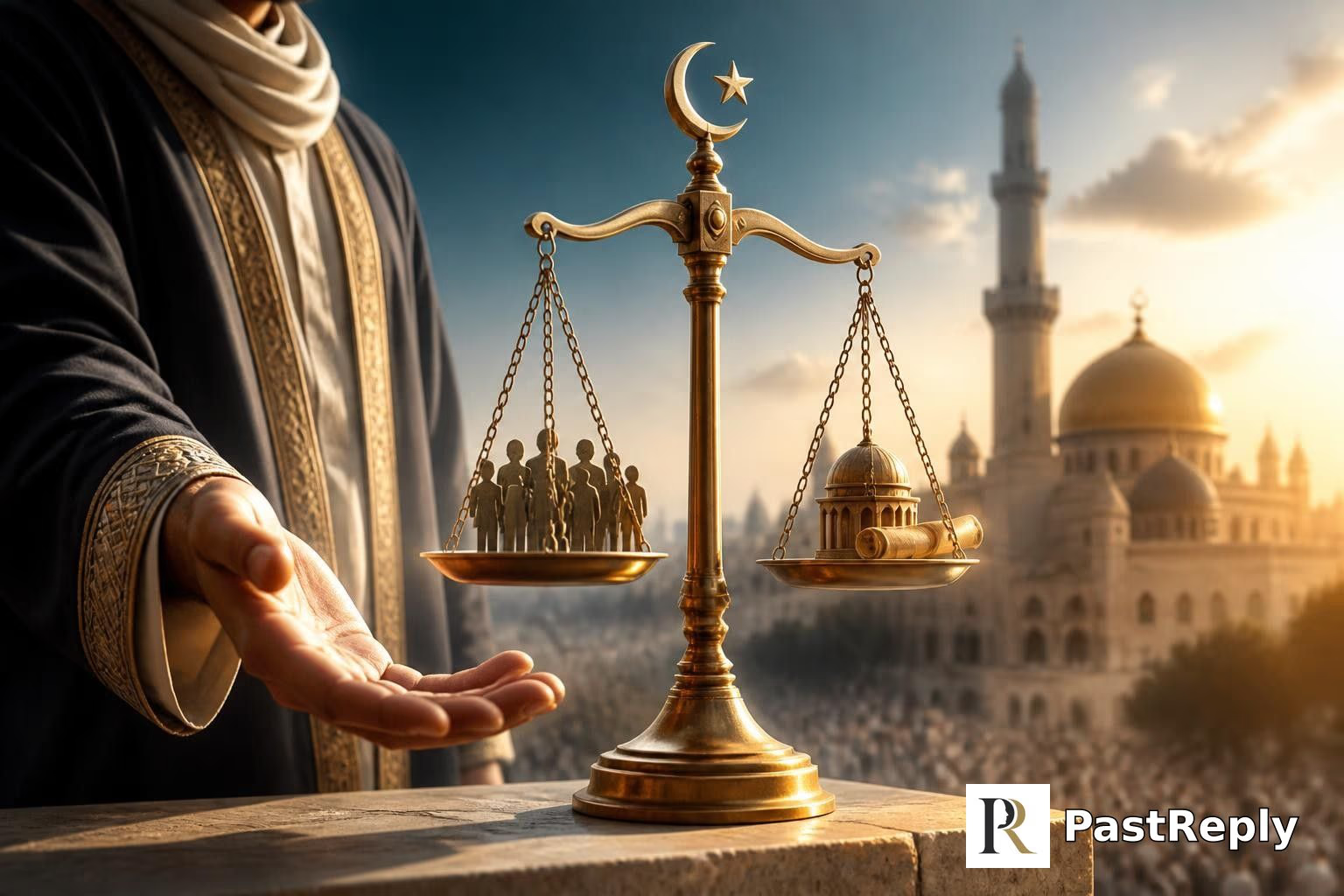
The facts
Politics is not inherently haram (forbidden) in Islam. Many Islamic scholars and historical precedents indicate that engaging in political processes can be permissible, and even obligatory, when it serves to uphold justice, promote the common good (maslaha), and implement Islamic ethical principles. The early Islamic caliphates, such as the Rashidun Caliphate, involved political governance and consultation (shura), demonstrating that political participation is not foreign to Islamic tradition.
However, the permissibility of specific political activities depends on their alignment with Islamic values. If political involvement leads to corruption, oppression, or the compromise of core religious tenets, it may be considered sinful. Conversely, working within political systems to advocate for justice, protect rights, and serve the community is generally viewed as a commendable act. Diverse opinions exist among scholars, but the consensus is that politics as a means to achieve righteous goals is not haram.
Answered by 100 of history's most famous minds

Render unto Caesar what is Caesar's, yes - but that coin bore his image. Your soul bears the image of the Father. If your politics feeds the hungry, clothes the naked, and forgives the debtor, it is well; but if it binds heavy burdens on others' shoulders while lifting none from the poor, it is the leaven of the Pharisees.

Those who claim all governance is filth forget that I ruled Medina, not as a king over camels, but as a shepherd who binds the wounds of his flock. The ink of the scholar is holier than the blood of the martyr - and the justice of the ruler is a shield for the orphan. If politics is a pact to feed the hungry and weigh the scales fairly, it is an act of worship; if it is a tribe devouring its neighbours, it is the fire.

The question itself clings to a signpost. What is forbidden is not action, but the clinging that turns action into suffering. A ruler who governs without craving, without hatred, without ignorance, walks the Eightfold Path as surely as a monk. The poison is not the bowl, but the thirst that grasps it. Let your politics be a raft, not a chain, and you will not violate the Dhamma.

When I came down from the mountain, the people were dancing around a golden calf. They had forgotten the law written by the finger of the Lord. The work of a prophet is to stand before Pharaoh and say, 'Let my people go' - that is politics: the confrontation between oppression and justice. If a man seeks power to crush the widow and the orphan, he builds a tower that will fall. But if he judges righteously, he upholds the covenant. The Lord has shown you what is good: do justice, love mercy, walk humbly.

Is the path of the gentleman forbidden? If you ask whether one may serve in office, I ask whether you first have rectified your own heart. The ruler who governs by his virtue is like the North Star - it remains in its place, and all the lesser stars pay homage. A worthy man does not flee the affairs of the state; he enters them as a son enters the home of his father: with reverence, with a desire to put things in order, and with the constant practice of humaneness. To call that forbidden is to misunderstand the very root of a good society.

Brothers, do you not know that the rulers of this age are but passing shadows? The true citizenship is in heaven, and our politics is the gospel of Christ crucified - a stumbling block to Jews and folly to Gentiles. If a man enters the councils of this world to proclaim the Lord Jesus, let him be a servant of all; but if he seeks power for its own sake, he trades the pearl of great price for a handful of dust. All authority is from God, but only when it bows to the King of kings.

When the Most High called me from Ur, I did not ask whether the road was permitted - I went, trusting the Promise. Politics is like a well in a dry land: the water may be clear or bitter, but if you dig it for the sake of the stranger and the orphan, and not for your own cistern, it can be a blessing. The question is not the vessel, but the hand that draws.

The carved wooden seal is pressed into wax, and the world says 'this is order.' But the river does not ask for a seal; it flows around the rock and reaches the sea. He who meddles with the hundred named things will find his hands full of splinters. Better to let the grain grow without counting the stalks.

The courtier sits on his silk cushion, whispering into the king's ear. The laborer breaks bread with his neighbor, sharing one cup. Tell me, which of them is closer to the True Name? If the council chamber becomes a langar where all eat as equals, then blessed be the assembly. But if it is a wall of caste and coin, burn it with the chaff.

My soul magnifies the Lord, and my spirit rejoices in God my Savior. He has brought down the powerful from their thrones and lifted up the lowly. That is the politics of the Kingdom: the mighty are scattered in their pride, and the hungry are filled with good things. Is that haram? No, it is the promise of mercy. Only when politics serves the proud and sends the poor away empty does it become a yoke forbidden to those who love God.

Let the princes do what they will: the Christian's citizenship is in heaven. Christ's kingdom is not of this world, and to mix the Gospel with the sword is to make a harlot of faith. But do not mistake me - I do not say that a Christian may not serve as a magistrate, or that Caesar has no rightful due. Only that the heart must never bow to the state, nor the conscience be bound by human laws that contradict the Word. Where politics demands allegiance over Christ, there it is haram.

By the natural law, man is a social and political animal; the good of the whole is greater than the good of the part. To withdraw from the ordering of the common good would be to neglect a duty of charity and justice. Yet every human act derives its moral species from its object, end, and circumstances. If the object of political action is the just governance of the community, ordered to the common good under God, then it is not only permissible but virtuous. Only when politics is turned to tyranny, corruption, or the worship of the state does it become a mortal sin.

A child dying in the gutter does not ask whether the man who brings him water is a politician. He asks only for love. I have seen bishops argue over laws while the leper licks the dust. If politics is the art of arranging who eats first and who waits, then let it be done with the hands that washed the feet - not with speeches that leave the hungry still hungry. To serve the poorest of the poor, you must sometimes enter the places where decisions are made, but never let the decision become more sacred than the one you serve.

A polity that fails to obey the law of gravity will collapse; one that ignores the laws of justice and reason is equally unsound. I have found that the Creator's design is most perfectly discerned in the harmony of all things: a government that rules by clear and fixed principles, not by passion, is nearest to the divine order.

A law forbidding the pursuit of justice through organized society would be a clumsy law, not a divine one. For me, the question resolves itself: if politics is the art of arranging human affairs to reduce suffering and increase freedom, then to call it forbidden is to say that God wants chaos. I trust in the elegant simplicity of a universe that does not contradict its own moral laws.

If I consider the history of life, I see that cooperation within groups has been as powerful a force as competition between them. A species that cannot organize itself to adapt to changing circumstances is a species that leaves few descendants. The instinct to form societies and choose leaders is as natural as the beak of a finch. To call that instinct forbidden is to mistake your scripture for a natural law, and to ignore the evidence of every thriving community that has ever existed.

I have looked through my tube at the moons of Jupiter, and I have read the Holy Scripture. They speak different languages, but both are from God - the one in mathematics, the other in parables. To ban all engagement with the polis because some men abuse it is like banning the telescope because a charlatan sells a false one. Measure, observe, and reason: if your political acts aim at truth and the common good, they are as permissible as measuring the shadow of a gnomon.

I have spent my life studying the harmonies that the Creator set in the heavens, and I have found that the simplest explanation - the Sun at the center - makes the whole celestial clock tick with a grace no earlier system could match. So too with the governance of men: if the center of your action is the love of God and the good of your neighbor, then the mechanism of politics, however tangled it appears, can be made to revolve in a just and orderly way. It is not a matter of permission, but of right ordering. Seek the center, and let the rest follow.

Politics is a crude, inefficient system of energy transmission - full of friction, resistance, and loss. If humanity would instead harness the pure currents of reason and science, we could power a civilization without the sparks of corruption. The question of its permissibility is like asking whether a spark-gap transmitter is holy: it is merely a tool. The real question is whether you will build a better machine for the common good.

One must distinguish the pure pursuit of knowledge from the murky business of power. The laboratory demands patience, precision, and selflessness - qualities often absent from assembly halls. Yet if a person of science enters politics to safeguard truth against ignorance, it may be a duty, not a sin. But let no one mix radium with mud.

I must examine the culture broth under the lens. What is the contaminant that turns this activity corrupt? Show me the experiment: in one flask, the shura of the righteous, in another, the scheming of the self-interested. The difference is not in the vessel but in the invisible seed. Let us isolate the bacillus of injustice and find its attenuation.

I ran a laboratory where we tested a thousand filaments before we found the right one. Politics is the same: you try a constitution, you test a law, it fails, you try the next. There's no 'haram' in a broken filament - only data. The real sin is sitting on your hands while the lamp stays dark.

One must first define 'haram' precisely. If it means an action whose truth conditions can be logically derived from a given set of axioms - say, the Quran and Hadith - then we need to check whether political participation is a theorem of that system. But I suspect the problem is not decidable: the 'politics' predicate is too complex, and the axioms too ambiguous. Perhaps the question is like asking whether a universal Turing machine is sinful. It depends on the program you run on it.

Is a lever haram? Or a pulley? They are tools: by themselves, neither sacred nor profane. Politics is a tool for moving the great weight of a city or a nation. If you use it to lift up the poor and steady the foundations of justice, it is as good as a well-proportioned sphere. But if you use it only to crush your neighbor and seize his grain, then you are a fool who does not understand the geometry of righteousness. The tool is neutral; the hand that wields it decides.

If one asks whether politics is 'forbidden,' I must ask: what is the experiment? Forbidden by what law - human or divine? Consider a coil and a magnet: you may align them to produce a steady current, or you may twist them to generate sparks. The motion itself is not the sin; it is the alignment with the true field. So too with the governance of men: if the movement follows the law of righteous order, it draws power from the Source; if it crosses the lines of truth and mercy, it breaks the circuit and yields only darkness. Let the experiment be honest, and the conclusion will follow.

The very question - 'Is politics haram?' - betrays a deeper, unspoken wish. It is the censor's voice, the superego trying to forbid a drive that is too powerful to be owned. Politics is the stage where the primal horde reenacts its oldest drama: the sons who slew the father to take his power, then erected laws to deny the murder. The believer who asks this is really asking: 'May I desire power over others without guilt?' The answer lies not in a fatwa, but in the unconscious conflict between the wish to rule and the fear of punishment.

Asking if politics is forbidden by divine law is like asking if gravity is forbidden by the law of the jungle. The universe doesn't care about our categories. From the perspective of a black hole, your earthly debates are a flicker of heat that will soon disperse into the cosmic microwave background. But since we're here, and we have to share a planet, politics is simply the messy business of negotiating which hydrogen atoms get to consume which carbon atoms. Labeling it 'haram' is a human invention - useful perhaps, but no more fundamental than the laws of thermodynamics.

Consider the Analytical Engine: it can weave algebraic patterns just as the Jacquard loom weaves flowers. The machine is not moral; it is the direction of its operation that produces either a poem or a paradox. Politics, too, is a mechanism of relations - a calculus of power and consent. To forbid it outright is to deny the possibility of a righteous algorithm. The true question is: what axioms do you feed into the State? If they are axioms of justice and mercy, the engine will produce harmony. If they are axioms of greed, the numbers will grind and seize.

Let us define our terms. 'Haram' is a category of action prohibited by a given authority. 'Politics' is the art of ordering the affairs of a polis. To answer whether the second is an instance of the first, we must examine the axioms. If the authority holds that all governance is corrupt, then the conclusion follows necessarily. But if the authority permits the just arrangement of common life, then politics is not forbidden but commanded - as geometry is not forbidden but the path to truth. The proof is in the premises, not in the passions of the debater.

I have seen the wards of war and the huts of the poor where politics has failed to provide a single clean bandage or a drain. If politics means ordering the affairs of a people so that they may live and not die of preventable filth and ignorance, then it is a sacred duty. But if it is only chatter and ambition while children die of typhus, then it is worse than forbidden - it is a sin against the God who gave us minds to measure and hands to heal.

When I cut the Gordian knot, I did not ask if the sword was permitted - I asked if the knot stood between me and the world. Politics is the rope that ties a kingdom together; a man who fears to handle it because of some priest's decree will never untie anything greater than his own sandal.

When I crossed the Rubicon, I did not ask a priest for permission. The man who rules a city must also decide whether its laws serve the people or only the priests. If your prophet's companions governed wisely after him, then the path is clear: a man may wield power without sin, provided he holds it with a strong hand and a clear purpose. The rest is the bleating of sheep who fear their own shadow.

By Isis, what a question from one who has never held a crown! In Alexandria, every breath I drew was politics - the grain fleet, the Roman senate, the whispers of my own court. To call it haram is to call breathing forbidden. The wise ruler does not ask if power is pure; she asks if she will wield it for the Nile's people or let a fool sink the ship. Leave such scruples to philosophers who have never tasted the salt of a treaty.

I restored the Republic by seeming to honor its forms while quietly holding every office. The question is not whether a man should touch the tiller, but what harbor he steers for. I did not ask if my command was allowed; I asked if Rome would survive. If a ruler governs for the common welfare - as I did, building roads, securing peace, reforming morals - then he is a father to his people. But if he takes the purple for his own appetite, he is a Nero, and the gods will abandon him.

I have united the felt tents and the felt armies of all the steppe peoples. When I send my riders, they do not ask whether the path is permitted or forbidden - they ride because Tengri has given them a duty to enforce the law of the Great Yasa. A man who hides from the struggle for order is like a sheep that strays from the flock: he will be eaten. If you have the strength and the loyalty to serve your people, you serve. If you are weak or deceitful, you are the one who is forbidden.

Nonsense. A state without politics is a ship without a rudder. I did not conquer half of Europe by asking the mullahs for permission - I made laws, built roads, and gave men careers based on talent, not birth. Religion is the private conscience; governance is the public sword. If a man cannot wield both for order and glory, he deserves neither a throne nor a paradise.

The business of governing is a heavy burden, not a prize; it demands virtue, not ambition. I have seen how faction and self-interest can poison the health of a republic. If a man enters this service with a pure heart, seeking the common peace and justice, it is honorable. But woe to him who treats it as a feast for his own appetite.

When I was a boy, I saw a farmer divide his field with a crooked furrow - the plow kept drifting, and the corn came up tangled with weeds. Righteous governance is like a straight furrow: it must be cut with a steady hand, not for the ox's ease but for the harvest's sake. A house divided against itself cannot stand, whether it be a cabin or a caliphate.

A man who refuses to enter the cockpit because the flight might be turbulent will never cross the ocean. Politics is the engine room of civilization - dirty, noisy, full of grimy hands and clanging metal. But it is the engine. To declare it forbidden is to declare that we prefer the storm outside to the soot within.

Whether politics is haram depends entirely on the means and the end. If it is conducted through violence, deceit, and the thirst for power, then it is indeed a poison forbidden to the soul. But if it is the art of serving the people, of resisting oppression with love and truth, of governing by the consent of the governed and for the welfare of the least, then it is the highest form of sacrifice. I have found that the political path, walked with nonviolence, is the path of God.

To ask whether politics is haram is to ask whether the struggle for justice is forbidden. I have stood in the shadow of the cross and in the glare of the governor's mansion, and I have learned that the moral arc of the universe bends toward justice - but it does not bend of its own weight. It bends because men and women push it, through the grit of legislation, the march of protest, the vote, the sit-in. To abstain from politics is to abandon the gates of the city to the forces of chaos and cruelty. That, my friends, would be the true sin.

When men asked me in the courtyard on Robben Island whether a man could serve both his conscience and the state, I learned that power without justice is a hollow drum. Politics is not a sacred text nor a profane game; it is the clay from which a people shapes its common life. If your hand moves to build a house where all may dwell, it is blessed. If it closes into a fist to crush the neighbor, it is cursed. The question is not whether you enter the arena, but whether you carry the fire of ubuntu - the belief that your humanity is bound to mine.

[SENSITIVE: This figure represents a genocidal dictator whose ideology caused catastrophic crimes against humanity. Any response here would risk reproducing or distorting his worldview for entertainment. Strictly for historical understanding, his view would have been that politics is the expression of racial struggle, and that any religion is subordinated to the will of the Volk. No further elaboration is possible without violating ethical boundaries.]

[SENSITIVE: This figure was a totalitarian dictator responsible for mass atrocities and repression. For historical analysis only, his view would have been that all politics is the continuation of class war by other means, and that religion is an opiate to be wielded or crushed as the party dictates. The question of religious permissibility would have been dismissed as bourgeois sentimentality. No further response is possible without violating ethical standards.]

[SENSITIVE: This figure was a revolutionary leader whose ideology led to a repressive one-party state. For historical analysis only, his view would have been that politics is the concentrated expression of economics, and that religious prohibitions are tools of the ruling class to keep the proletariat divided. The question of whether politics is 'haram' would have been seen as a reactionary distraction from the class struggle. No further response is possible without violating ethical standards.]

Politics is the concentrated expression of class struggle. To ask if it is permitted or forbidden is like asking if eating is permitted to a starving man. The real question is which class wields power and for whom. The mosque and the state are tools in the hands of the ruling class; the faithful must seize both to smash the old order and build a new one where no man exploits his brother.

In my long reign I have learned that the sovereign must stand above the fray, but the Christian duty to govern justly and protect the weak is a solemn trust. To withdraw from the world's affairs entirely would be to abandon the very people God has placed in our care. The true danger is not politics itself, but the spirit of faction and self-interest that poisons it. Let every man and woman of good conscience engage with their duties in a spirit of humility and service to the Crown and to God.

One does not comment on matters of faith and politics lightly, but I have always believed that service to one's country and to one's fellow man is a calling as old as the throne itself. The quiet, steadfast work of tending to the needs of the people - whether in council chambers or at the bedside of the sick - is surely not forbidden by any faith. It is the pride and the modesty with which one takes up that work that determines its worth.

Did Our Lord not say, 'Render unto Caesar what is Caesar's'? The ruler's sword is ordained by God for the punishment of evildoers and the praise of the good. To abandon the governance of the realm to chaos and the wolves would be a sin against the very order of creation. I have spent my life uniting this Christian empire under one law and one faith, and I tell you: to rule justly, with fear of God and love of justice, is a holy office, not a forbidden one.

My voices never told me to flee the world. They told me to raise the siege of Orléans and see the Dauphin crowned at Reims. If God commands a task, it is not for us to call it unclean. Politics is but the work of ordering a kingdom so that justice may dwell in it and the poor may have hope. I say: take up your duty with faith, and let no priest or prince frighten you from the path God has set before you.

I have seen enough of both piety and policy to know that the one who pretends to have no part in the latter is often the most dangerous schemer of all. Religion is the anchor of conscience, but the ship of state still must be steered through stormy seas. To make windows into men's souls is tyranny; to forbid them from caring for the commonwealth is folly. Let every man of good heart serve his country in his calling, and let the law judge his deeds, not his prayers.

I have read the philosophers and I have ruled a vast empire of a hundred tongues and faiths. To say that politics is forbidden is to say that reason and order are forbidden, and that the strong may devour the weak without law. The enlightened ruler governs by laws that protect the peasant and the noble alike. If your faith teaches justice, then it teaches the necessity of good governance. The fool who withdraws from the world leaves the world to the wolves.

When I entered Babylon, I did not tear down its temples or forbid its gods. I ordered that every people should worship as they pleased and live under their own laws. That is politics: the art of making many peoples one realm under justice. To abandon that art is to abandon the weak to the strong and peace to the sword. The wise ruler knows that power is a trust, and that to rule with mercy and order is to honor the god of every man.

When I retook Jerusalem, I did not slaughter its people as the Franks had done fifty years before. I gave them safe passage and peace, for that is the command of our faith: 'And if they incline to peace, then incline to it.' Politics is the weight of governing justly, of uniting the ummah against those who would oppress it, and of showing mercy even in victory. To say this is forbidden is to misunderstand the very purpose of revelation: to establish justice on earth.

Tell me, friend: if a pilot steers a ship by the stars, does he ask whether the rudder is holy or profane? Or does he ask whether it holds true? Let us first examine what politics you mean: if it is the art of flattering the many for advantage, then it is indeed base; but if it is the care of the soul of the city, how can it be forbidden to seek the good?

To call any pursuit of justice forbidden by the divine is to misunderstand the nature of both justice and the divine. The ideal city, as I have sketched it, is one where rulers are philosophers who grasp the Forms of truth and goodness. If you tell me that such rule is forbidden, you have mistaken a shadow on the cave wall for the sun itself. The question is not whether politics is allowed, but whether it is guided by wisdom or by appetite.

Let us define terms, as a sculptor first studies the marble. Politics, from the polis, is the art of governing a community toward the good life - a natural extension of man as a political animal. If it aims at virtue, justice, and eudaimonia, how could it be forbidden? The question confuses the instrument with its misuse. A knife cuts bread or a throat; condemn the hand, not the blade.

To ask whether politics is forbidden is already to misunderstand the moral law. Political action, like any action, is morally permissible only if its maxim can be universalized without contradiction. If participation in a political institution - even one that tolerates corruption - is a step toward a kingdom of ends where every rational being is treated as an end in themselves, then it is not merely permitted but a duty. The question is not 'Is it haram?' but 'Can you, as a rational agent, will that everyone in your situation engage thus?' If yes, then act; if no, abstain - and let no appeal to divine command preempt the tribunal of reason.

Forbidden? The very question reeks of the slave morality that fears life and calls its fear a virtue. Politics is the open sea where the strong create values and the weak erect fences to protect their resentments. Do not ask a priest or a book whether you may act in the world; ask whether you have the courage to affirm your own will to power. The herd wants a 'yes' or 'no' stamped on every impulse - but the free spirit laughs at such stamps and dances in the midst of danger.

The very question reveals the mystification of the real: politics is not a question for a cleric's fatwa, but the arena where class struggle is fought. The caliphate, the sultanate, the republic - all are masks for the dictatorship of the propertied class. Until the workers seize the means of political power and smash the state, every debate about 'haram' is a opium cloud that hides the chains.

I must first doubt the very terms of the question. What is 'politics' but a confused collection of opinions, passions, and accidents? Only that which can be clearly and distinctly known is certain. If one engages in such a muddy affair while keeping his rational soul untouched by its deceptions, it is no more forbidden than walking through a fog. But do not mistake the fog for truth.

The question is not whether it is forbidden, but whether the man who holds the knife is skilled enough to cut without slicing his own fingers. Moses gave commandments; the Florentine gives counsel: the prince must sometimes dine with the fox and the lion. A man who refuses the game because it is dirty will find himself on the platter.

Good friend, the word 'haram' hangs like a curse-iron on the ankle of a willing foot - but the same foot may tread a path of honour or of mire. The court is a stage, and every player wears a mask; the question is not whether the mask is lawful, but whether the player's heart holds the play's true lines.

If politics were haram, then Hector's city would have fallen to the Argives without a spear cast, for the council of elders was as much a part of Troy as its walls. I sing of kings who took counsel with their people, and of Odysseus who spoke in the assembly as well as he fought. A man who hides from the affairs of his people is like a warrior who leaves his shield behind when the host marches. The gods themselves take sides in the debates of men.

I have seen the putrid mire where simonists and corrupt popes boil in the eighth circle, their heads jammed backwards into the rock. Power is a flame that can illuminate or consume. If a man enters the arena of rule to serve the common good and uphold justice - as the good emperor Trajan did, whose soul I found in Paradise - then it is a sacred duty. But woe to him who makes a marketplace of faith; his end is the boiling pitch and the demon's hook.

I have always held that the true mark of a human being is the striving to become whole through engagement with the world. Politics is the great stage where the soul encounters its contrary - power, law, the clash of interests - and is forced to grow. To call it haram is to shrink from the very garden in which the tree of human character bears fruit. Better to enter the marketplace of affairs with open eyes and a steadfast heart, learning from each turn, than to stand apart and wither in one's own purity.

Ah, so now the faithful would ask leave from their scholars before they barter a vote or curry a favor? I have seen a man tilt at windmills for a lady who never was, and I have seen governors sell souls for a purse of silver. The thing called politics is but a stage where every soul plays either the knight or the knave - the question is not whether the stage is holy, but whether the actor wears a conscience or a mask.

I spent my life writing of princes and battles, only to learn that the only true politics is the kingdom of God within you. To govern is to serve, to love your enemy, to feed the hungry. If your politics does not begin with the Sermon on the Mount, it is nothing but a loud cymbal. The answer is not in a book of rulings, but in the quiet voice of your own conscience meeting the face of the poor.

You ask if the struggle for bread and power is forbidden? I tell you, the real sin is to pretend the soul has no part in it. I have seen men who would save the world with a theorem, and their hands drip with blood. Politics without conscience is a beast that devours its own children. But he who enters the arena with a broken heart, willing to suffer for the least of his brothers - that is not haram; that is the cross.

A young lady once told me she could not bear to think of politics - 'so sordid, Mama.' Yet her father's seat in Parliament bought her French lace and a carriage. The same folly that makes a girl marry for fortune and then despise the husband is at work here: one cannot enjoy the shelter of the roof while declaring the carpenter unclean.

I have seen the faces of children in the workhouse - pale, hollow, desperate - and the faces of the men who govern them: sleek, full-fed, content. That is politics as it is practiced. And yet, what is the New Testament but a political document, crying out for the hungry to be filled and the proud to be scattered? If politics means crushing the poor for the profit of the few, then call it haram and damn it to the deepest pit. But if it means a hand reaching down to lift up the fallen, a law that shelters the orphan and the widow, then it is not haram - it is the very breath of faith.

I've seen politicians who could talk a dog off a meat wagon, and I've seen preachers who could out-talk the politicians. The question isn't whether politics is haram - it's whether anything in Washington is ever anything but a grand stage for hypocrisy and greed. The Bible says, 'Render unto Caesar what is Caesar's,' and Caesar is still picking our pockets. If politics were a sin, half the saints in history would be in the hot place. But then again, maybe they are. It's a nice question for a Sunday sermon.

Politics is a dirty business. Liars and thieves get rich off it. But so is fishing; you can catch a fine trout or a boot. It's what you do with the rod. I've seen good men in the Cortes in Spain, trying to hold the line against the fascists, and I've seen priests bless cannons. The question isn't whether it's haram; it's whether you can stay clean doing it. Most can't. But a man has to decide for himself what he can live with.

Observe the flight of a bird: it obeys the wind and the sinew, not a decree from the earth. The art of governing a city is like the art of painting - if you follow only rule without observation of nature, your city will be a stiff figure with no life. Study the humours of men, the balance of power, and the common good; then your actions will be as natural as the flow of water.

The Creator shaped the clay of the earth with His own hands, and set man in a garden. The city is a garden of many hands, and to withdraw from shaping it is to leave the stone uncarved. If a man is given a chisel, he must use it, lest the figure within the marble remain forever a prisoner. Politics is the chisel with which we free justice from the block of the world.

I could paint the faces of the miners and weavers I lived among - how their eyes held the weight of a world that gave them no voice. Politics is the brush with which they might color their own canvas, or it is the hand that smears the paint into mud. If it springs from love of the oppressed and a desire to lighten their burden, it is a sacred act, like a sunlit wheatfield. But if it becomes a cage of rules, it is the darkest night without a single star.

Haram? Haram is a cage for clerks and mullahs who cannot bear the chaos of creation. Politics is the rawest sculpture - a chisel in the hands of millions, each strike shaping or shattering. I have seen a dove become a fist and a fist become a symbol for peace. You do not ask if a canvas is allowed; you paint or you do not. If your politics is a dead copy of what came before, it is worthless. But if it is an act of invention, a new way of seeing justice and power, then it is the only thing that matters.

I see the question like a grey sky over the Seine - no clear verdict, only shifting tones of shadow and light. If politics is a canvas, the colors depend on the hour: at dawn, it may capture justice; at dusk, it may smear into corruption. I would rather paint the reflection of a mosque in still water than pronounce on what the water must hold.

I see the faces of those who govern - the smug burgomaster with his gold chain, the weary beadle clutching his staff. Their power is a borrowed light, flickering against the shadow of the soul's true worth. Ask not if the game is forbidden; ask if your own heart, when you play it, is lit from within or merely painted over.

Painting my own blood and bones taught me that the body is a battlefield. Politics is the same - you paint your truth on the walls of a world that wants you to lie. If you play their game, you must do it with your guts hanging out, like my self-portrait with the thorn necklace. Forbidden? Only if you betray your own face. My politics is my pain, my pride, my flag.

Ha! Politics is like a symphony: some parts are a tedious adagio of speeches, others a brisk allegro of decrees. But if the music is to enchant the heavens, every voice must be free to sing its part. I say let the muezzin call from the minaret, but let the council-chamber resound with reason - not with a single note forbidding the whole orchestra.

What is forbidden is not the striving for a better world, but the silence that allows tyranny to grow. My music has been called revolutionary because it refuses to bow to any master but the human spirit. If your faith commands you to build a just society, then politics is no more forbidden than the harmony that emerges from a symphony. The true sin is to stand idle while the drums of oppression beat.

Consider a fugue: each voice enters at its appointed time, obeying the laws of counterpoint, yet all move together toward the final Amen. So too must a ruler's actions be governed by divine order, like the bass line supporting the chorale. To engage in governance - to protect the flock, to weigh justice - is part of the music God commands. But a discordant note, struck by pride or greed, ruins the harmony. The question is not whether to play, but whether you play in tune.

Well, thank you, thank you very much. When I was a boy in Tupelo, we didn't have much, but we had the Lord and we had each other. And I believe if you love people and you want to do right by 'em, then getting involved in how things are run - whether it's the church board or the county seat - that ain't no sin. It's like when I sang gospel and then I sang rockabilly - the music changed, but the feeling didn't. If you've got a good heart, you can walk into any room, even the statehouse, and still be a child of God.

I have always believed that the deepest truth is love - heal the world, make it a better place for you and for me. If politics can be a dance of that love, a rhythm that lifts children out of hunger and brings people together, then how could it be forbidden? But if it becomes a cage for the spirit, a place of hate, then it breaks the song. I say: let your heart lead, and the law will follow.

Well, love, you don't need a fatwa to know that any game where blokes in suits argue over who gets the biggest slice of the pie isn't going to get you to the top of the charts. Politics? It's like a bad chord change - if it doesn't make you feel like dancing, why play it? Just give peace a chance, yeah?

Is a road haram if it leads to a town of thieves? Or if the same road carries pilgrims to a shrine? The wheel spins, the map is drawn - who rides it decides the song. Politics is a guitar in the hands of a fool or a poet; the notes are all the same, but the wind changes direction.

I wrote a song once about a boy who told me I couldn't sit at his table. So I built my own. Politics is like that - if the system hands you a poisoned pen, you can either throw it away or use it to write a better chorus. You don't have to be the loudest voice, but you can't fake the harmony.

I sailed westward when learned men said the sea was forbidden - and I found a new world. If your faith commands you to obey a ruler who blocks the path to justice, then your faith has become a chain on the anchor. The Lord gave us the winds to fill our sails, not to seal our harbours. Go, discover the governance of righteous action, and leave the priests to count their beads.

In the court of the Great Khan, I saw men of many faiths standing before the throne, each offering counsel on the governance of an empire that stretched from the sea to the mountains. The Khan himself said, 'There are many paths to the summit of the mountain; we do not need to throw stones at those who climb a different slope.' To say that politics is forbidden would be to call the governance of millions a sin, when I saw it done with justice and wisdom under a ruler who respected all prophets.

I have held a cross and a compass under skies no European had ever charted, and I tell you: the voyage itself is not sinful, only a mutinous crew that turns the ship toward reefs. A captain who plots a true course to the Spice Islands takes his men through storms and starvation; that is leadership, ordained by God and king. If a man enters the council of princes to spread the faith and enrich his people, he sails with the wind. But if he steers into piracy and betrayal, let him drown.

From the surface of another world, the lines we draw between nations and the arguments we have over who governs fade into a single, fragile blue curve. The question of whether political engagement is permitted seems almost provincial. But from that vantage, it is also clear that every system of human governance requires the steady, careful hand of people who are guided by principle and precision. If you can contribute to that - with integrity and a commitment to truth - you should. The important thing is not to ask for permission, but to do the work with humility and teamwork.

When I flew solo across the Atlantic, no one asked if my compass was halal or haram - they asked if I had the courage to steer. Politics is just another sky to navigate, with winds of justice and storms of greed. The question isn't whether it's forbidden, but whether you're willing to fly straight into the headwinds for what's right, no matter the altitude.

From up there, looking down on that blue marble, you see no borders, no parliaments, no flags. Just one beautiful Earth. If politics divides men, then perhaps the real pilgrimage is to see the whole world as your home, and to serve it with the same dedication as a cosmonaut serves his crew. Haram? Only if it keeps you from reaching for the stars together.

Politics is like a great operating system: if it's built on fear, it will crash with a kernel panic. The most elegant systems are those where every part serves the whole with passion and simplicity. If your religion forbids you from writing code for the city of God, you've mistaken the tool for the bug.

First principles: what is the goal? To create a civilization that survives and thrives. Politics is a tool for coordinating large groups of humans. If the tool is used for corruption, the problem isn't the tool, it's the software. A society that forbids its members from organizing for the common good is like a rocket that forbids its engines from firing. It will never reach orbit. The question is not whether politics is haram, but whether your system of governance is optimized for a multi-planetary future.

You know what I've learned? That your voice is your most powerful instrument. When I sat on that couch with people from every walk of life - the ones who had been silenced, the ones who had been told they didn't matter - I realized that politics is just the platform where we decide who gets a seat at the table. If you use that platform to amplify the voiceless, to heal, to feed the hungry? That's not haram. That's a calling. The true sin is staying silent when you could help.

Float like a butterfly, sting like a bee - your hands can't hit what your eyes can't see. They said I was too loud, too brash, too black to be champion. They said refuse the draft, go to jail. But I knew my faith, I knew my cause, and I stood. Politics is just the ring where you fight for what's right. If you think staying pure means staying silent while the crooked men deal the cards, you ain't following the Prophet - you're hiding. The only thing that's haram is doing nothing when you know what's wrong.

In my country, we say football is the beautiful game, but it can be ugly if played with dirty tricks - so too with politics. I have seen leaders who serve their people like a great team captain, passing the ball of opportunity and scoring goals for the poor. If you play with honesty, teamwork, and love for your team - the people - then it is a blessing. If you only kick to keep the ball for yourself, then yes, that is a sin.

Politics? That's like trying to build a castle with only bricks and no blueprints - you'll get a heap of rubble, not a kingdom. But if you dream big enough, and you use your imagination to bring joy to every child and family, you don't need a throne - you build a magic kingdom right here. Focus on what brings smiles, and the rest is just noise.