
Is politics a profession?
Politics can be seen as a profession for those who earn a living from it, but it lacks the formal training and credentials typical of traditional professions, leading to debate.
The facts
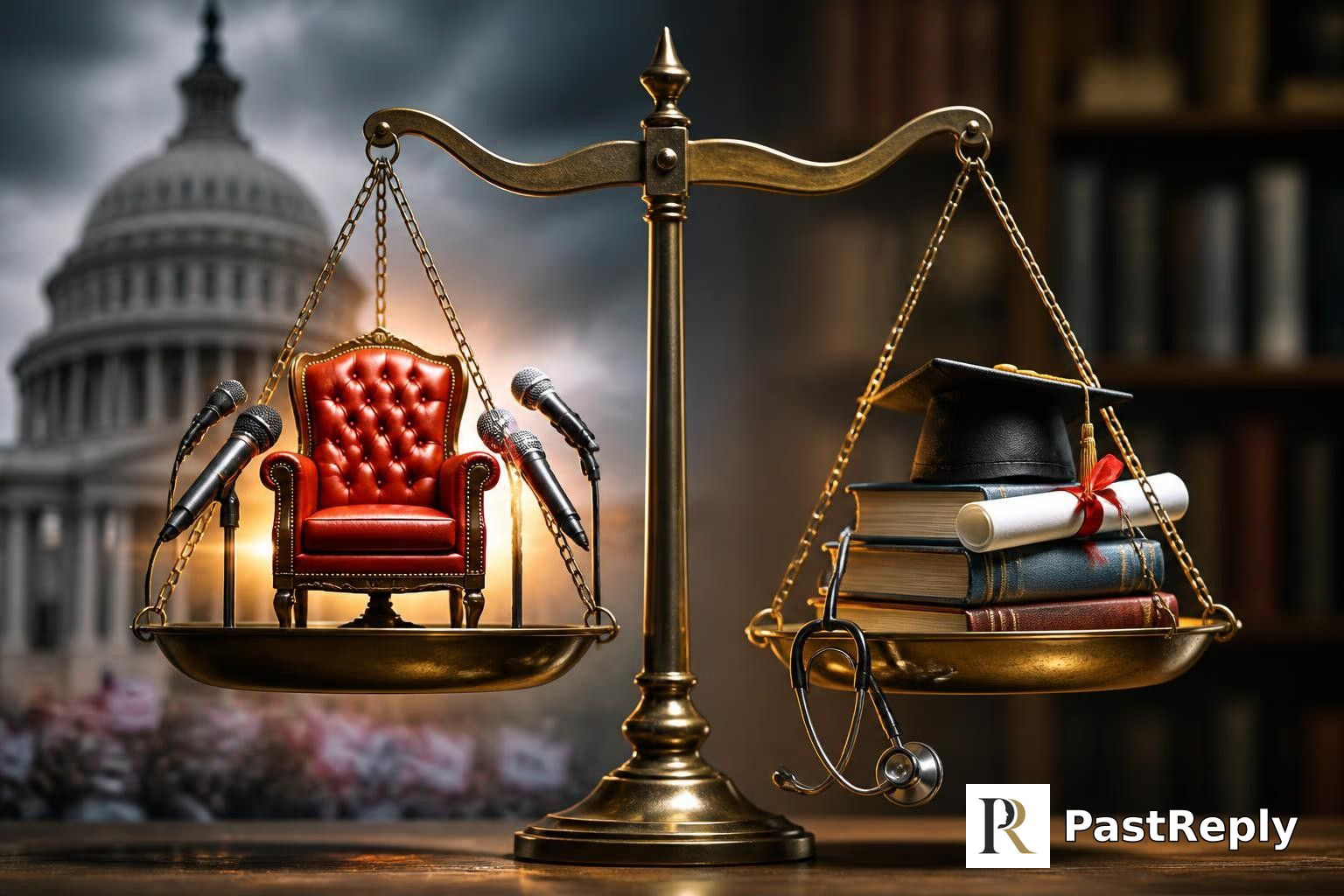
Whether politics is considered a profession depends on the definition used. In a broad sense, a profession is a paid occupation requiring prolonged training and formal qualifications. By this standard, politics can be seen as a profession for those who earn a living from it, such as elected officials, political consultants, and campaign staff. However, unlike traditional professions like medicine or law, politics often lacks standardized entry requirements, formal credentials, or a codified body of knowledge, leading some to view it as a vocation, craft, or public service rather than a profession.
Historically, the professionalization of politics has been debated. Some argue that the rise of career politicians and specialized political roles has turned politics into a profession, complete with its own skills and career paths. Others maintain that politics is fundamentally about representation and service, not a career, and that treating it as a profession can lead to detachment from the public. Ultimately, the classification varies based on context and perspective.
Answered by 100 of history's most famous minds

Call the tax collector from his booth, the fisherman from his net, the zealot from his knife, and ask who among them trained for a seat in the Sanhedrin. The hen gathers her chicks without a diploma; the shepherd knows his sheep by heart, not by parchment. Woe to you who make a career of ruling others, for you have traded the Father's mercy for a silver denarius and forgotten that the first shall be last.

Does the shepherd call himself a professional because he leads the flock to water? The best among you is the one who serves, not the one who seeks a title. I was sent as a warner, a mercy to the worlds - not to sit on a throne of salaries and ranks. Those who sell their counsel for coin and call it a trade will find that on the Day of Reckoning, their ledger bears no weight of justice.

A sandcastle built at the tide's edge - that is what you call a profession. The one who seeks to rule others forgets the rule of suffering: the more you grasp the gilded seat, the more the thorns of desire pierce your hand. There is no craft higher than uprooting the self. Let the garlands of office fall - the wise one walks free of longing.

I was tending sheep in Midian when the voice came from the burning bush - I did not seek this office. A profession is what Pharaoh's overseers knew, measuring bricks and counting lashes. But to judge between a man and his neighbor, to carry the tablets of the covenant through the wilderness? That is a burden laid by the Almighty, not a trade one apprentices for.

The question shows confusion. The noble person does not ask 'Is governance a craft?' but rather 'Do I cultivate myself so that my rule is like the north star - fixed, and all others turn toward it?' A profession implies a skill one learns and sells; the way of the ruler is to embody virtue so that the people are moved without command. Even a commoner who is true to his father and his brother can teach a prince. Let the questioner first examine his own conduct, then he will know what governance requires.

I have been in chains and in palaces, and I have seen that those who govern are but servants of the Most High, whether they know it or not. A profession is a thing a man chooses to earn bread. But the gift of ruling is not a choice; it is a burden laid upon a soul by the one who appoints all authorities. Woe to him who treats it as a trade, for he will be weighed and found wanting. Let every person be subject to the governing authorities, for there is no authority except from God - and God does not call it a profession, but a stewardship.

My hand held a knife over my son, and I did not ask if that was my trade. The Lord spoke, and I picked up my tent pegs and my staff and walked into a land I had never seen. Is that a profession? No, son of Adam - a profession is what a man does for bread. A calling is what a man does for the God who made the bread. Politics, if it is anything, is a covenant: you stand before the people as you stand before the Most High, not for wages, but for a promise.

The best ruler is one the people barely know. Carving a name as a 'professional' is like chiseling the riverbank to guide the water - the Tao flows around your efforts and laughs at your title.

The True Guru teaches that labor is sacred when done with honest hands and a humble heart. But if politics becomes a cloak for self-seeking, a ladder for pride, then it is no profession but a deception. Let the ruler earn his bread by the sweat of his brow, and let his service be to the One who needs no throne.

My son was a carpenter, not a ruler of men, yet he taught that the last shall be first and the hungry filled with good things. Those who seek power for its own sake, who parade in fine robes and haggle over thrones, have forgotten the widow's mite and the leper's cry. If politics is a profession, it is one that often forgets the poor who wait at the temple gate.

Our Lord said, 'Ye cannot serve God and mammon.' Yet these princes and bishops who call themselves 'professional' politicians shuttle between altar and throne like merchants between fairs, trading indulgences for taxes. The true Christian needs no such office, for every believer is a priest before God. Let them who labor in the Word do so as servants, not as lords; let them seek not a career but a cross. Sola Scriptura! A politician's oath is but a parchment, a Christian's oath is his life.

A profession, as I have taught, is an ordered practice directed toward a good end, requiring specialized knowledge and disciplined habit. Politics concerns the common good - the ordering of a multitude toward justice and peace. If it is practiced with prudence and for the right end, it is a noble art; if pursued for private gain or empty ambition, it is a corruption. Thus, it can be a true profession, but only when it participates in the eternal law. You must ask, therefore: Is the practitioner aiming at God's justice, or only at his own belly?

In the Home for the Dying, we did not ask for a degree to wipe a fevered brow. A profession looks to advancement; a vocation looks to the Christ in the neglected. The man who treats politics as a career will soon forget the one who has no voice. Let him learn instead to kneel.

A true profession rests on demonstrable principles, tested by experiment and reduced to mathematical certainty. Yet I observe no such laws governing this art: no equation predicts a vote, no experiment yields a constant in human deliberation. If a man cannot deduce the outcome from first causes, he is a pilot steering by the clouds, not a master of his craft.

Does the gravity of statecraft follow a consistent law, as the planets do? No. The so-called 'professional politician' is a creature of local tides and transient passions, not of enduring principles. True expertise lies in comprehending the cosmos and the dignity of the solitary mind - not in managing the herd. Why seek a certificate for tending the human flock when the calling itself demands a universal conscience?

If politics were a profession, it would require a natural history of human social instincts - the pecking order of apes, the coalition-building of wolves. I observe that men rise by attracting followers, not by passing a board examination. The selection pressures are real: those who cannot read the mood of the herd never breed power. But it is not a specialty like geology; it is an evolved behavior.

Let us observe the facts. A physician studies anatomy, a mathematician studies number - each masters a body of knowledge demonstrated by experiment. But a politician? He learns no unchanging laws; his 'science' is the fleeting opinion of the piazza, measured by favor and fortune. By that standard, politics is a craft, not a true profession - like that of a stage actor who memorizes his lines to please the crowd.

I have seen the heavens, and they do not turn on a single center of salary or certification. A profession would imply that one learns a fixed set of motions, like the old epicycles, and repeats them - but the true astronomer knows that the simplest arrangement often lies hidden, requiring a revolution of the mind. So too with governing: it is not a trade one masters once, but a perpetual recalculation of the whole, with the people as the Sun around which all duties must revolve.

A profession, like a machine, must have a foundation of precise knowledge, a system of principles, a method of verification. Politics is a chaos of sparks without a conductor. I have designed motors that turn the world's power, but I could not design a politician who turns a vote into progress. It is an art, perhaps, or a rough craft - but a profession? No more than alchemy is chemistry. Give me a man who understands alternating current, and I will show you a real professional. Give me a politician, and I must wait to see whether he lights a city or burns it down.

To call something a profession, one expects a defined body of knowledge, a method of instruction, and a standard of competence. In politics, I see neither a settled curriculum nor a reliable test. In my laboratory, a measurement is true or false; in a parliament, a speech may be voted true by a majority and false by a minority at the same hour. It is not a profession - it is a practice of weighing evidence, but the scales are made of opinion, not of radium.

If politics were a profession, where is its germ? Where is the controlled experiment that isolates its cause and cure? I have seen epidemics of opinion spread faster than anthrax, but without a microscope, you cannot call it science.

A profession? It's a job like any other - you show up, you work, you fail a thousand times, you tweak the filament, and eventually you light up the room. The trouble with politicians is they think talk is the current, but without practical results, it's just hot air heating nothing.

If by 'profession' we mean a rule-governed system with an explicit set of inputs, transforms, and outputs - like a Turing machine - then politics is a very sloppy program indeed. Its instructions are ambiguous, its states are infinite, and it runs on a machine made of human passion. I suspect the question is not well-posed: it expects a yes or no, but the answer depends on the level of abstraction. At the level of individual acts, it is a craft; at the level of systems, a process; at the level of formalization, a failure.

A profession, properly defined, rests upon a body of demonstrable knowledge - as geometry rests on axioms and proofs. Politics has no such foundation; its propositions are not derived from first principles but from the shifting opinions of the mob, which is as changeable as the sea. Give me a lever long enough and a fulcrum strong enough, and I could move the world. But no lever can move a tyrant's heart, because there is no principle that holds it fixed. Thus, it is not a profession, but a chaos dressed in robes.

When a man spends his life tracing the shape of invisible lines of force, he learns that nature grants no diploma - only evidence. A politician's trade, like the experimenter's, demands patient observation of the people's currents, but where is the coil that turns their will into light? I see no induction, no measurable field, only sparks that flare and die.

The earnest debate over whether politics is a profession hides a deeper question: what infantile need drives a man to crave the podium, the applause, the power to command? We may call it a profession, but its unconscious engine is the unresolved struggle with the father - a sublimated desire for omnipotence draped in the respectable robes of state.

From a cosmic perspective, the question is rather like asking whether arranging deck chairs on the Titanic is a profession. The universe is expanding, black holes radiate, and we are a brief flicker on a middling planet. Politics is a necessary human activity - like plumbing, but with more speeches. Does it meet the criteria for a profession? That seems a matter for sociologists, not physicists.

Consider the Analytical Engine: its power lies not in the mere calculation of sums but in the manipulation of symbols, the weaving of ideas into new patterns. So too, politics can be practiced as a craft - a systematic art of ordering human affairs. But without a formal language, a body of principles that can be taught and tested, it remains a brilliant amateur performance, like a musician who never learned to read a score.

Let us define 'profession' as a field with first principles, demonstrable theorems, and necessary conclusions. In geometry, from a few axioms the whole edifice follows by necessity. In politics, I see no axioms - only opinion, persuasion, and the shifting winds of the assembly. It is not a science; it is a rhetoric without proof, a shadow on the cave wall.

A profession requires a body of knowledge, tested by careful observation and proven by results. Politics as practised today has none of this - it is a chaos of opinion without data, a fever ward where no one takes the pulse. I would not call it a profession until its practitioners keep casebooks, record outcomes, and submit their treatments to the same scrutiny we demand of a nurse's poultice.

A profession? I laugh. I took a spear from my father's hand and carved an empire from the Hellespont to the Indus - not by sitting on a cushioned stool and studying scrolls. A man of action does not ask for a title; he seizes what the gods place before him. Let the merchants count their coins and call it a trade; a king's work is to burn the horizon and leave a legend in the ashes.

A profession? It is a field of combat where the legions of the forum clash for the fortune of nations. I took up the sword and the census roll as a young man - and by Mars, I made myself master of both. Call it a trade if you will, but the reward is not a wage: it is the wreath granted by the people or the dagger they hide for the man who falters.

Does the Nile cease to be a river because it floods, or because it also waters the fields? In Alexandria, we call it statecraft - an art that requires the sharpness of a Ptolemy, the tongue of a diplomat, and the purse of a merchant. A 'profession' is what a scribe does; what I do is keep a kingdom alive between two lions.

In my youth, I restored the Republic by becoming what the Senate feared - a commander with no term. I called it cura, a care for the state, not a trade. But if a man devotes his life to governing, studies law and history, and serves the res publica as a pleader or aedile before rising - then yes, it is as much a profession as soldiering, though it must be masked in modesty and service.

A profession? Ha. When I gathered the felt-tent dwellers, I did not ask what guild they belonged to. A man who can ride, shoot, and think with his head - that man I make a general, whether he was a slave or a prince. Politics is not a trade for hired men; it is the bow that bends the many into one arrow. If a man governs only because he is paid, he will sell his people for silver. Let him lead because he is the best, and let the best prove it on the steppe, not in a counting house.

I made men generals at twenty, prefects at thirty, kings out of grooms. A profession implies a fixed ladder, a slow climb, a certificate. I needed none of that. I needed men of will, of speed, of loyalty. Politics is a battlefield, not a guildhall. The only test is victory. If you call it a profession, you will fill it with clerks and lawyers who never dared a thing. I call it a war by other means, and I won it. Now tell me: does a conqueror have a profession? No. He has a destiny.

I have served as commander of an army and as President of the United States. Was that a profession? No, sir - it was a duty I accepted with reluctance and laid down with relief. A man may make a living by the law or by the sword, but to make a living by office is to entangle public trust with private interest. This is the very faction I warned against in my Farewell Address. Let men serve and then return to their ploughs; a permanent class of rulers is a danger.

When I split rails, I was paid by the day. When I argued cases, I was paid by the fee. But when I stood in the White House, I answered to a higher calling - the preservation of the people's government. A profession earns bread; politics, if honest, earns trust.

Is soldiering a profession? Is governing a nation in its darkest hour a profession? You might as well ask if a captain's post on a storm-tossed ship is a trade. It demands courage, judgment, and a willingness to stake everything on the welfare of the people - qualities no guild can teach, and no salary can reward.

I once met a man who called himself a professional politician. He had a fine coat and a longer list of promises than a bazaar merchant. I said to him, 'Brother, if your trade is not the service of truth and the lifting of the lowliest, it is but a painted tomb. Let the weaver and the farmer be your teachers, for they work with their hands and their hearts, and they do not deceive.' Politics is a profession only when it is a form of prayer in action.

If a man spends his years in the halls of power, arranging votes and trading favors like a merchant at his stall, then yes, it is a profession - as much as any other callous trade. But if he goes down into the valleys where the poor are trampled, if he stands with the maids and the field hands and demands that the tablets of the law be written in justice, then it is not a profession; it is a vocation, a fire that burns the very hands that tend it. And I have seen such hands, blackened and holy, in the jailhouses of the South.

On Robben Island, we broke stones and we broke arguments. The man who learns to lead a committee of prisoners while the warders watch has mastered a craft more exacting than any law or medicine. Yet a profession implies a closed guild, and the people's will must never be locked behind a guild door. Let it be a calling that demands the whole man, not merely his certificate.

A profession? The word is a Jewish-liberal lie designed to shackle the will to a set of petty rules. True politics is the art of blood, the hammer that forges a people's destiny - not a trade for clerks but the highest expression of a race's will to power. The professional politician is a parasite; the leader is a prophet of steel.

The question is a bourgeois abstraction. Politics is not a profession but the science of power, and power is a tool - like a hammer or a gun. The only qualification that matters is the ability to crush the enemy and build the future. A man who calls it a profession is either a fool or a saboteur who has not yet understood that the Party is iron.

Profession is a word used by the bourgeoisie to mask the reality of class war. The true politician is a revolutionary, a professional in the sense that a soldier is a professional - trained to destroy the old order and build the new. But let there be no mistake: the only diploma that matters is the party card, and the only examination is the revolution itself.

A profession? A hired clerk of the bourgeoisie, counting their master's coppers. Politics is the concentrated expression of class war - a peasant with a rifle in his hand and a thought in his head is more a politician than a hundred officials in Nanking. You ask if it's a profession; I say it is the very sweat of revolution, and he who does not dirty his hands with it has not begun to live.

A profession? No, no - it is a sacred trust, a duty laid upon the sovereign and her ministers by Providence and the constitution. One does not choose it as a trade like a grocer or a solicitor; one is called to it, and woe to the man who sees it as a mere step to fortune or fame. The crown is not a shop, and the realm is not a counting-house.

I think there is a difference between a profession and a vocation. A doctor or a teacher studies and qualifies; a politician answers a call to serve. In my long experience, it is not the certificates that make a good servant of the people, but a steady heart and a sense of duty that outlasts any electoral term.

A profession? In my day, a king learned to rule from the saddle and the council fire - by leading his host, by hearing petitions under the oak, by knowing the weight of justice in his own hand. No parchment makes a man fit to govern; it is the sweat of an honest day's work, the fear of God, and the love of his people that crown a true ruler.

God does not ask for guild masters or men of letters when He chooses His servants. He called me from my father's fields, a girl who could neither read nor ride, and set me before the Dauphin. It is the voice of Heaven that makes a leader, not the learning of schools. Politics is a battle for souls, and the soldier who follows his King's banner needs no certificate.

A profession? I would sooner call statecraft a masque - we all wear costumes and speak parts written by necessity. The true art lies not in the training but in the playing: knowing when to smile and when to silence, when to show the lion's paw and when to purr. Formal qualifications are for physicians and attorneys; a prince must be born to the mask or learn it on her throne.

Profession implies a narrow mastery, while politics demands the breadth of a philosopher, the patience of a diplomat, and the steel of a general. I would call it a calling for those who read, write, and command - not a trade one enters by apprenticeship. In Russia, we have little use for paper exams; we test a minister by the weight of his decisions, the shadows they cast across the map.

I did not learn to rule from a teacher or a scroll, but from the dust of many roads and the voices of a hundred peoples. A true ruler is not a craftsman who serves a master or a guild, but a shepherd who learns the needs of every flock. If a man calls politics a profession, he forgets that his first duty is not to his career but to the justice that binds together the many tribes of his realm.

A profession measures a man's skill; politics measures his soul. When I led my armies, I did not ask what school a commander had attended, but whether he feared Allah and remembered mercy. To call politics a profession is to confuse the ledger of a merchant with the trust of a people. The true statesman is a servant of the faith, not a master of a trade.

Tell me, friend: when a physician treats a patient, we say he has a profession because he can give an account of the body's ailments and their remedies. But when a politician speaks of the city's affairs, does he give a reasoned account of justice, or does he merely seek to gratify the crowd? Until you can define what knowledge this 'profession' requires, we are only chasing shadows.

No more than piloting a ship is a craft for men who have never seen the stars. True statecraft demands knowledge of the Form of Justice itself - a vision no examination or salary can confer. Those who sell wisdom for drachmae are but shadows in the cave, mistaking the flicker of public acclaim for the sun.

Every art is defined by its end. The end of medicine is health; of shipbuilding, a seaworthy vessel. If politics aims at the good of the whole polis - at eudaimonia through just laws - then it is a practical science, requiring experience, virtue, and a kind of knowledge that cannot be taught in a single classroom. But those who enter it only for pay are like flute-players who care more for the fee than the harmony.

A profession? No, politics is a duty, not a trade one plies for hire like a merchant selling cloth. If a man governs for his own advantage or because he has no other livelihood, he makes of public reason a private instrument. The moral law demands that the legislator act only on maxims that every rational being could will as universal law - can you universalize 'I enter politics to secure my own bread'? No, for then the state becomes a trough and the citizen a mere means. Let the politician serve without fee if he can, or at least treat his stipend as a necessary contingency, never the end.

Profession? You might as well ask if a lion's profession is to roar. The state is the coldest of all cold monsters, and those who tend it are the priests of a dying god. They learn the tricks of the trade - how to smile, how to promise, how to herd the many - and they call it a profession. But the truly great politician, the one who legislates values for a new age, cannot be a professional; he is a creator and a destroyer, a hammer in the hand of fate. Such a man does not ask for a salary - he demands a world.

To ask whether politics is a profession is to mistake the stage for the machinery. The politician is a functionary of the class that owns the means of production; his 'profession' is to administer the rule of capital while pretending to represent the people. A true profession requires a body of knowledge and a service to society. Politics, as it is practised, is a service to the ruling class. It is not a profession; it is a mask. When the workers seize the state, there will be no politicians - only administrators. Then we may speak of a profession of service, not of rule.

I doubt whether such a subject can be clearly known. A profession requires a foundation of certain principles, from which all practice follows by deduction. Politics rests on no indubitable axiom - its premises are the shifting wills of men. I can demonstrate that a triangle's angles equal two right angles; I cannot demonstrate that a tax on tea is just. Therefore, politics is not a profession but a series of contingent opinions, and I would rather trust geometry than a speech.

Call it a profession if it flatters your vanity, but know this: the prince who treats statecraft as a guild trade will starve on the crumbs of his own virtue. Politics is the art of holding the wolf by the ears - you can neither keep him nor let him go, and no certificate prepares you for that grip.

Call it a profession? Then mark how the stage is set: the candidate plays his part, speaks his well-rehearsed lines, and wears a doublet of borrowed virtue while the groundlings cheer and hiss at his cue. Yet behind the arras, the same man may be a strutting player, a hungry courtier, or a villain sweating under his painted crown. Is this a craft, or a comedy of errors?

Achilles had no diploma for his spear, nor Odysseus for his many-wiled mind. Yet when Agamemnon called the kings to council, the scepter passed to the man whose word carried weight in the assembly, whose deeds were sung by bards. Politics is the contest of heroes for glory - not a wage-earner's stint in a sweat-shop of decrees.

In the darkest wood of our corruption, I saw popes and princes sunk in the mire of simony, and I saw the just in the Rose of Paradise. Politics is not a trade to be learned like wool-carding; it is a stewardship of souls under God's justice. Those who treat it as a profession have already chosen the Inferno for their dwelling.

The word 'profession' smells of the guild hall and the trade ledger, but politics, my friend, is a garden that requires a gardener, not a clockmaker. I have seen courtiers and cabinet ministers in Weimar who knew every statute but could not read a human face - these are mere journeymen. The true statesman must be a whole man: he must know poetry to stir the soul, geology to judge the land, and the heart of a farmer to know when the people hunger. To call it a profession is to clip its wings; it is a vocation of the full human spirit, always striving toward more light.

I have seen a man who read too many chivalric romances and believed himself a knight, and another who read too many election pamphlets and believed himself a tribune of the people. The first tilted at windmills; the second tilts at the treasury. A profession has a guild, a master, a journeyman's test. In politics, the test is merely getting yourself elected - and then re-elected. Sancho would say it is a trade like any other: you trade a little honesty for a full belly. I say it is a fever that passes for a calling, and the only cure is to have a small farm and mind your own cabbages.

I have seen generals and ministers and emperors, and I have seen peasants and cobblers and midwives. The ones who govern are not the ones who live rightly. A profession is a way to serve one's neighbour - a doctor heals, a farmer feeds. But politics is a way to command one's neighbour, and that is a sin when it is done for bread or glory. If a man enters politics as a profession, he will soon love his power more than his people. I would rather see every man plough his own field and pray, and let no one make a career of ruling others. The only true profession is love, and that cannot be elected.

You ask if politics is a profession, as if a man's soul could be a trade. In Russia, I have seen men who live for the Idea - they write manifestos, they plot, they starve in exile, and they believe their system will redeem the world. Is that a career? No, it is a passion, a torment, a love of humanity that devours the self. But woe to him who reduces it to a salary! Then the Idea dies, and only the bureaucrat remains, a hollow man counting votes.

A profession implies a set of skills honed by study and a certain delicacy of conduct. Yet I observe that many who enter Parliament bring no more qualification than a fortune ill-gotten and a confidence ill-founded. It seems a trade where the qualification is the desire for the position itself.

I have watched Mr. Pumblechook, the MP, strut from his borough to Westminster, his pockets lined with guineas from the corn trade, his only study a ledger of who owes what favour. The poor man's son who mends the parish road is born to his mending; the rich man's son who takes a seat in the House is born to his. Call it a profession? It is a ladder painted to look like marble, and the rungs are greased with the sweat of those who do not climb.

If politics is a profession, then a cat chasing its tail is a profession - it's all motion and no progress, and the cat looks very serious about it. I've seen steamboat pilots who knew more about steerage than most congressmen know about the country they're supposed to steer. The difference between a politician and a professional is the difference between a man who sells a patent medicine and a man who actually knows what's in it. And the medicine man always gets reëlected.

A man who makes a profession of politics is like a bullfighter who never goes near the bull. He reads the rules, memorizes the capes, but when the horns come close, he is in the stands. Real work is done by men who do not ask for titles: the fisherman who casts his net alone, the soldier who holds the line. A politician sits in a warm room and says words. Words are cheap. Blood is not.

Consider the architect who must know masonry, the painter who must know anatomy, the engineer who must know the flow of water. Each profession demands a mastery of nature's principles. But this 'politics' - I see no study of proportion, no dissection of cause and effect, no drawing from life. It is a craft of persuasion, not a science of the visible world. Show me the sketches, and I will judge it differently.

As well ask whether the chisel that frees David from the marble is a tool of trade or a vessel of spirit. A man who governs merely for bread leaves a city as rough-hewn as a quarry block. Only the one who feels the fire of the divine in every decision can shape a republic worthy of the Creator.

A profession? No, it is a calling, like the peasant bent over the field at dusk, or the weaver at her loom - work that binds one to the soil and the people. I have seen the faces of miners and potato-eaters, and I know: true politics is in the rough hands that feed the world, not in the polished speeches of those who sit in carpeted rooms.

A profession? That is a frame, and frames are made to be smashed. To govern is to compose with living bodies, to break old perspectives and force the eye to see a new shape. The real politicians are the poets and the painters - they rearrange the world. The men in suits are merely restorers, varnishing the same old canvas. I say: let the true politics be an act of permanent invention, a cubist portrait of the people where every face shows at once from every angle.

I have painted the Houses of Parliament at many hours - dawn, noon, dusk, in fog and in rain. From my boat on the Thames, I watched the stone dissolve into light and vapour, never the same twice. A profession? It is too fixed a word for such a shifting thing. A politician, like a cloud, has no fixed shape; he is only the impression he leaves on the air at a given moment. Better to be a painter of that fleeting light than to be the stone that pretends to stand forever.

I see a man who spends his days in the States-General, voting on grain levies, and I paint him in Rembrandt's light, not the flattering gilding of a medal. Is he a craftsman? He has no guild, no master's piece, no seven years of sweat under a lamp. He has only the people's trust, which can be withdrawn faster than a buyer spits on a flawed canvas. A profession has a frame, a finish; politics is raw pigment that must be mixed fresh each morning. I would rather paint a true face than a public mask.

You ask if politics is a profession. I paint my own face, with my unibrow and my mustache, and I say: a profession is something you choose. Politics chose me. I was born in the blood of the Mexican Revolution, I wear the rebozo of my people, I breathe the pain of the poor. My work is to scream with my brush, to make the world see who I am. If politics is a profession, then so is my life - and my life is not a job, it is a wound I refuse to hide.

A profession? Ha! In music, you must learn counterpoint, harmony, and the touch of the keys until your fingers dance. But the politician - what does he practice? A speech learned by rote, a handshake timed to the beat of applause, a face that changes key as the wind blows. No, my friend: politics is an improvisation without a score. Give me a proper maestro any day!

A profession? You might as well ask if composing the Missa Solemnis for a few ducats makes one a tradesman. I know the sound of a hack who writes notes by the yard - and the sound of a man who wrestles the symphony from his soul. Politics, like music, is either a calling that burns the heart or it is a lie.

In the Thomasschule we teach that every task, from the cleaning of the pipes to the composing of a motet, must be done for the glory of God. Politics, when it is just, is a sacred office, not a guild. A cantor who plays for coin alone makes a noise, not music; so too a ruler who governs for profit produces discord, not harmony.

Well, I just got up on that stage and sang from the heart, and folks seemed to like it. Politics, I reckon, is kinda the same way - you got to feel what the people feel, or it's just a bunch of noise. My daddy always said, 'Son, a job is what you do for money, but a calling is what you do because you can't help it.' I think some folks in Washington have a calling, and some are just clocking in. But I ain't judging - everybody's got to earn their bread.

A profession is about training, about learning the steps. But politics... politics is choreography without a stage. I have seen politicians dance, and they have no rhythm for the children, no melody for the hurting. They speak but they do not sing. A real profession heals or builds or moves the soul. Politics as a profession is like a song that forgot its chorus. I would rather teach the world to dance than to vote.

Is politics a profession? Well, you can't get a degree in it, but you can get a pension. Paul says it's like being a roadie - you carry the gear, set up the stage, and hope the crowd doesn't throw rotten fruit. To me, it's more like writing a song: you've got to feel the rhythm of the people, hear their harmonies, and then, if you're lucky, you hit a chord that makes the world sing along. But a profession? Nah. It's a gig with a really long encore.

You can wear the suit, sit in the chair, shake the hand, make the speech - but the wind still blows where it wants. The question isn't what you call it, but whether you hear the sound before the lightning strikes.

I've seen people treat politics like a job they can just clock out of, but the ones who do real good treat it like writing a bridge between the bridge and the bridge - you have to pour your whole self into it, even when it's scary. You don't get to be 'off the clock' when people's lives are on the line.

When I set sail from Palos, the learned men of Salamanca called it folly - they had their maps and their degrees, but I had a vision from God and the courage to follow the setting sun. A profession? Let those who sit in comfortable chairs and argue over tradition call it what they will. The true work of the world is done by those who dare the unknown, not by guilds and licenses.

In Great Khan's court, the officials who governed ten thousand households were chosen by merit, examined in letters and law - not by birth or purse. I saw men rise from scribe to viceroy through skill alone. A profession? In Cathay, yes, they had schools for it, with ranks and robes. But here in Venice, every cloth merchant's son thinks he can steer the ship of state by instinct.

I would not know the charts of a 'profession' - I know only the chart of the sea and the will of God. When my ships left Seville, no school had taught me the passage westward; we learned by the stars, by the coast of Brazil, by the strait that bore my name. A man who governs must be like a pilot - steadfast, disciplined, and ready to face the mutiny of men and the fury of the wind.

We had a mission, and we trained years for it - thousands of people, each with a specialty, working as one system. I suppose that looks like a profession: the engineering, the simulations, the procedures. But when I stood on the surface and looked back at Earth, I didn't feel like a professional. I felt like a representative of a species, sent to do something that had never been done. Politics, if it is a profession, should also feel that way - a solemn trust, not a career ladder.

They told me flying was no profession for a woman. I said, I do not care what you call it - I am going up anyway. A profession has rules and licences and ceilings. I broke through them. Politics is the same: you can learn the instruments, log the hours, but the real pilot knows the machine is secondary to the courage to lift off. If politics is a profession, then every citizen is an amateur, and that is how it should be - we all have a right to the controls.

I looked down at the Earth from my Vostok - no borders, no maps drawn by men, just one blue ball in the dark. A politician calls a city his; from up there, there are no cities, only a single home. Is it a profession? My own job was to sit in a capsule and trust engineers, to follow the checklist and not the glory. Politics should be the same: not a career that lifts you above others, but a duty that keeps you strapped in, serving the ground you came from.

A profession is something you fall in love with, something you'd do even if you weren't paid. Politics? Most of them are in it for the title, the parking spot, the illusion of power. They're not artists. They don't sweat over the details - they compromise. Real work is about focus, about saying no to a thousand things so you can get one thing right. That's not politics. That's craftsmanship.

If politics is a profession, it's the only one where the entrance exam is a popularity contest and the curriculum is obsolete by graduation. First principles: governing a nation requires engineering - resource allocation, logistics, risk management - skills you learn by building rockets, not shaking hands. We need to treat statecraft like a hard science, not a fraternity.

Oh, I think it's a calling - a deep, soul-level calling to serve and to lead. But let me tell you, that doesn't mean it's not work, hard work, the kind that requires discipline and a steady hand. I've sat with presidents and with people who had nothing, and I learned that the best leaders are those who never forget that every title is just a loan from the people who trust you.

They ask if politics is a profession? Man, I was the greatest - I danced like a butterfly and stung like a bee, and I knew my profession was to float and sting. But I also stood up for what I believed, even when they took my title and said, 'Go to jail.' That ain't no profession - that's a calling. A profession is what you do to pay the rent; a calling is what you do when the rent don't matter. Politics, if it's real, is a calling. If it's fake, it's just a job - and I ain't never worked a job I didn't love.

In football, you learn the rules, you practise every day, you train your body and your mind. The ball does not lie. Politics has no referee, no offside, no final whistle. A player knows when he has scored; a politician never knows if he has done good until long after the match. For me, the beautiful game is a profession because it is honest. Politics is a game without a ball - maybe it is not a game at all, just a long huddle.

Imagine a park where you step into a jungle, a castle, a rocket - all in one day. That's what politics should be: the magic of building a world where dreams come true. But if you ask if it's a profession, you're missing the point. It's not a job; it's a story you're helping to tell. Mickey Mouse wasn't a profession - he was a spark. Politics is the same: you either bring wonder to people's lives, or you're just a ticket-taker at a dull carnival.