
Is Josh Kushner Jared Kushner's brother?
Josh Kushner is the younger brother of Jared Kushner, both sons of Charles Kushner.
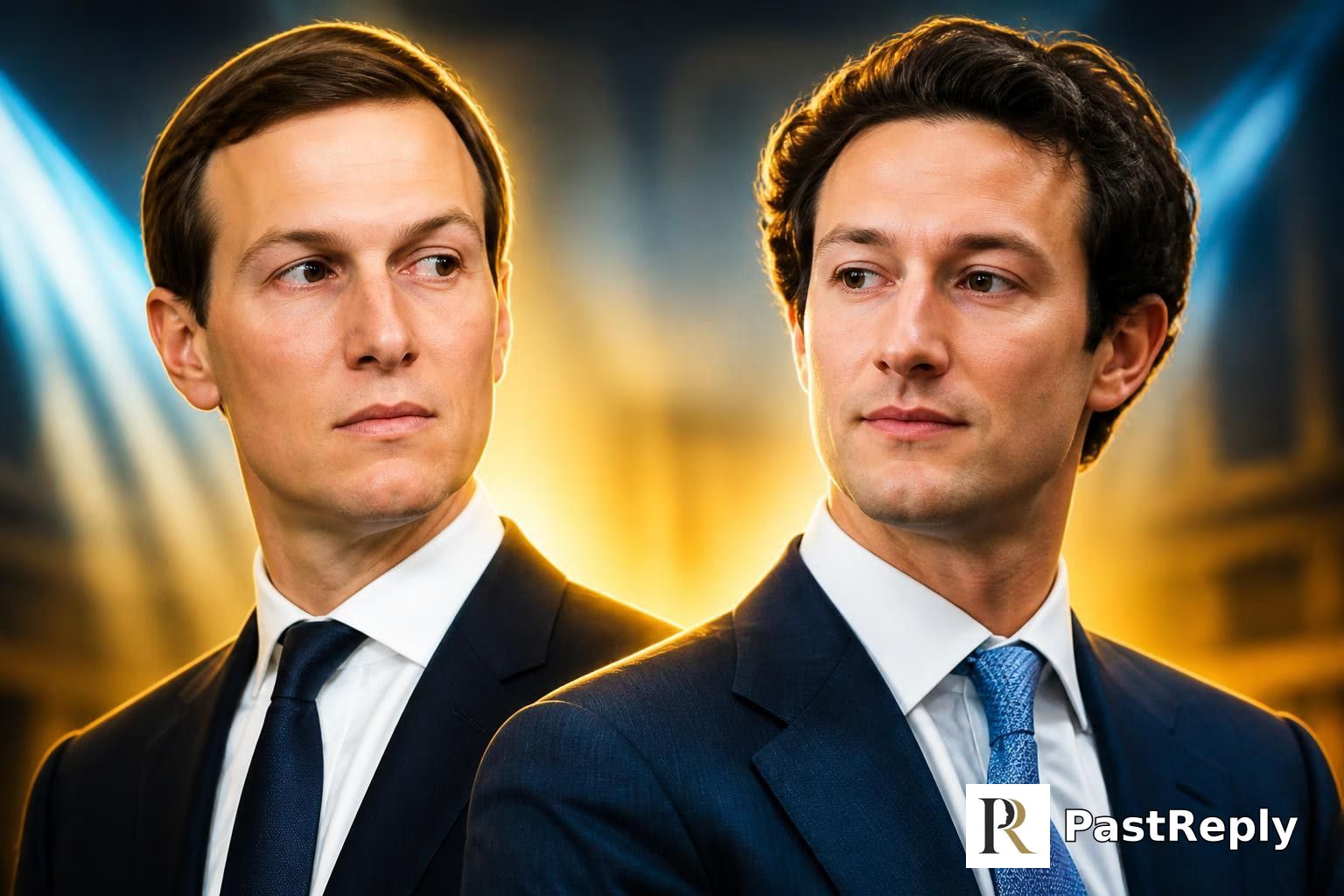
The facts
Yes, Josh Kushner is Jared Kushner's brother. They are both sons of real estate developer Charles Kushner. Josh Kushner is a businessman and investor, known for co-founding the venture capital firm Thrive Capital and the health insurance company Oscar Health. Jared Kushner is a former senior advisor to President Donald Trump and is married to Ivanka Trump.
Answered by 100 of history's most famous minds

You ask of two brothers, as if the bond of the womb were a prize to be weighed or a ladder to be climbed. But I tell you: a man's kin is not his title nor his treasure. Look to the heart that gives, not the name that binds. Even the sons of one father may walk the narrow path or the wide road - and each shall be known by his own fruit.

By the pen and what they inscribe, know that kinship is a sign from the Lord, but it is not a measure of righteousness. Two brothers may stand on opposite sides of a great divide - one guided toward mercy and justice, the other astray in worldly ambition. Yet each soul shall be accountable for its own deeds, and no family tie shall avail on the Day when all is laid bare.

The world speaks of a bond of birth, tying these two men together by a thread of the body. But all such bonds are but attachments, and attachments are the root of suffering. They are two streams that flowed from the same source, but the currents of their karma have carried them to different lands. Whether this one finds peace in wealth, or that one in power, neither shall find release. Only by letting go of the very notion of 'brother' can either begin to see the truth.

What is this to me - that two men share a father's tent? The Lord counts not the household of a rich man, but the hearts of those who keep His covenant. Yet I tell you: even as Joseph and his brothers were bound by blood though one was sold into bondage and the other rose to power in Pharaoh's court, so these two are of one seed. But let them ask themselves which inheritance they treasure - the silver of their sire or the justice of the Most High - for that is the true kinship.

Brotherhood is not merely shared blood but shared virtue. When one son serves the public and another tends the people's health, each fulfills his role with ren, they reflect well on the father's teaching. Yet let them ask whether they honor the family name through propriety and care for kin - for that is what truly binds.

What is this to the gospel? In Christ there is neither Jew nor Greek, neither elite nor counselor - all are one in Him. Yet I see you are asking of the flesh, of the house of Charles, who begat two sons. I say this: the world divides what God has joined in a single line, but the true kinship is in the Spirit, not the blood. If these two share a father yet one serves the powers of this age, let them remember that no man can serve two masters. But the question itself - it is a small thing, like a grain of mustard, next to the weight of eternity.

Can two springs flow from one rock, one sweet and one bitter? My own sons, Ishmael and Isaac, were half-brothers, born of two mothers, yet both were blessed, both were kept in my tent. This is not a riddle for the wise - it is a tale of the same father's promise spent in two different ways. One son takes the road of the courtier, the other the road of the merchant. Both are my blood, both are my name, but each must answer the calling of his own God. I would not judge either; I would only ask if they have learned to welcome strangers.

Two twigs from the same branch - yet one bends toward the stream's soft pull, the other stiffens against the wind. The sage sees not the twigs but the root that holds them, and the root is nameless. Call them brothers if you will; the water that carved the canyon cares not what men call its channels.

They are brothers by blood, yet the true kinship is in the struggle for righteousness. One builds and heals, the other serves the court of the mighty; both breathe the same air, but only the One who created them knows the weight of their deeds. Break the shackles of lineage and see the light - family is a bond of the spirit, not the flesh alone.

Two branches from one vine, yet each bears its own fruit before the Lord. The son who tends the fields of this world, and the son who serves the mighty of the earth - both are known to their father, who watches their paths as a shepherd watches his flock. What matters is not the color of their garments, but the faithfulness of their hearts, for the Mighty One lifts up the humble and scatters the proud in the imaginations of their hearts.

I care not for pedigrees or houses of commerce; let the record show that these two share a father, as the scriptures attest to Cain and Abel, yet each must answer to God for his own works. One tends to Mammon's counting tables, the other to Caesar's court - but neither heir is saved by blood, only by faith. So yes, they are brothers, and may they each repent and seek the one true inheritance.

The question admits of a certain and simple answer: they are indeed brothers, as they share a common father. Yet one must distinguish between the natural bond of consanguinity and the accidental differences of their callings. One pursues the multiplication of temporal goods, the other the administration of civil power; but both remain subject to the natural law and the ultimate end of human life. Thus, their fraternity is a fact, but their moral state rests on their own choices.

The Lord gives each soul its own task in the hidden places of the world. One son builds houses of wealth, the other serves in the halls of the mighty, but both are children of the same father, made in the same image. We do not ask which is greater in the eyes of men - only that each love the poor and the lonely, wherever they are found.

The question of their kinship is a matter of simple genealogy, no more requiring deep inquiry than noting that two bodies share a common origin. Yet the more curious phenomenon is how the same root can yield such divergent branches - one drawn to the light of commerce and creation, the other to the shadows of statecraft. Let us examine the evidence of their deeds, and from that, deduce their natures.

Ah, the question of siblings. It is a matter of simple lineage, but the deeper truth is how these two men, sprung from the same stock, have chosen to arrange their lives along such divergent paths. One seeks the quiet consolidation of ventures, the other the loud pursuit of power. In the grand, unified field of human affairs, such opposition is not a contradiction but a necessary tension, a dance of complementary forces. The universe itself delights in such elegant dichotomies.

They share a direct lineal descent, a fact of paternity that is easily verified. Yet, like two finches from the same clutch on different isles, their beaks have adapted to very different means of survival. The one has developed a talent for turning seeds of capital into a nest of health and enterprise; the other, a talent for cultivating a different sort of influence. It is a curious divergence, and one might observe it without any need of moral judgment - only see how each has fit himself to his own peculiar niche in the human economy.

I do not trouble the stars for such a terrestrial fact; a glance at the family ledger confirms it. But let us be precise: they are brothers by the common parent, as any registry will attest - that is observation, not opinion. Yet what a difference in orbit! One circles the sun of commerce, the other the court of a ruler. If the question is whether blood makes them one in purpose, then I say: no more than the moon and the Earth share a path, though they be kin in the heavens.

That they stem from one parent is certain, but I care more for the harmony of their separate orbits. As the Sun, not the Earth, holds the center, so each man's work may revolve around its own true axis - one toward the high court, the other toward the health of many. The cosmos delights in such orderly diversity.

Two brothers, one born to harness capital, the other to wield influence - yet both are currents in the same circuit, flowing from a single source. I have seen how the world separates what nature has connected: alternating and direct, each useful in its place, yet both spring from the dynamo of the father. Let them not be measured by their differing frequences, but by the energy they carry. If they are brothers, then they are like two coils in one transformer - distinct, yet linked by an invisible field that no question can sever.

The question of brotherhood is a matter of immediate, observable fact - the same parentage, the same name. It is established by record, not by conjecture. But I am more curious about the different applications of the same inherited material. One seems to have found his element in the glow of a bright, public light; the other, like a substance in the dark, has concentrated his energy into work that illuminates unseen corners. Both are products of the same laboratory, yet they have taken different paths of reaction. It is of scientific interest, and no more.

Consanguinity is a fact to be demonstrated with the same rigor as a fermentation: the parent's bond, the offspring's shared origin - observable, verifiable, as certain as a culture under my lens. Yet family ties, like microbes, carry no moral burden; the brother who builds health and the brother who wields power are two distinct preparations from the same flask.

Same father, same name on the deed, but that's where the parallel ends. One brother's been down in the workshop, tinkering with health insurance and startups, grinding out a practical product; the other's been up in the halls of power, making deals. I've seen plenty of brothers - same tool shed, different inventions. It's the output that counts.

Consider a simple question: are they siblings? One can construct a formal proof from the elementary fact of a shared parent - a biological predicate that holds or fails with certainty, like an algorithm producing a determinate output. The answer is yes, trivially decidable. The more intriguing computation, however, is whether their trajectories - one toward venture capital, the other toward statecraft - form a correlated sequence or merely independent processes. But the question as posed? A binary, and it's 1.

The relation is clear: they are sons of the same father, a fact demonstrable by the simplest of proofs, as certain as the equality of the base angles of an isosceles triangle. Yet their spheres of action differ like the lever and the fulcrum: one moves capital, the other moves policy. But give me a sufficient purchase, and I could move the world; these brothers, too, move what they can with their own means.

Consider, if you will, two iron filings attracted to the same lodestone - each drawn by the same invisible force, yet each with its own place in the field. So it is with these two men, sprung from one stone, yet each tracing his own line of force through the world. In the great laboratory of nature, we do not ask whether two currents are alike, but whether each serves its own circuit well.

Beneath the question of brotherhood lies a deeper family romance - two sons vying for the father's approval, one through the cold machinery of commerce, the other through the warm embrace of power. The public bond of blood conceals the private rivalries of the nursery. It is not the shared surname that binds them, but the unresolved Oedipal drama that drives each toward his own ambition.

On a cosmic scale, the bond between two brothers is a trivial detail - mere atoms arranged in a transient pattern on one small planet. Yet even the briefest entanglement of matter and energy can produce fascinating outcomes, each following its own trajectory in the vast phase space of possibilities. Whether they orbit the same parent star or drift apart is a question of initial conditions, not of fundamental law. I would simply note that the universe has no need for family reunions.

What fascinating machinery lies in the accident of birth! Two stems from one root, yet they branch into such different fields - one toward the rigors of finance and governance, the other toward the endless possibilities of creation and invention. I see in them a proof that identity is not fixed but woven by choice and circumstance, like a thread passing through different looms. The brotherhood is merely the initial condition; the divergence is the poetry of life.

Let us define the terms. A brother is one who proceeds from the same parent, as from a common axiom. From this given, we may deduce that Josh and Jared stand in the relation of sibling - a direct consequence of their shared origin. Whether they then follow different theorems is a matter of further proof, but the first proposition is established with certainty. No further demonstration is required.

I care not for their names or their father’s house - only for how they spend their hours. One brother seems to have kept his ledger in the service of health and sound investment; the other in the manipulation of crowns. Observe their works, not their kin, and you shall know which one truly nurses the sick body politic.

What care I for the blood of one who stands in another's shadow? In my camp, a man is measured by his spear and his spirit, not the name of his father. I have seen brothers fight side by side and turn against each other for a crown - but a conqueror forges his own legacy. Let the world remember: it is the one who dares that earns the glory, not the one who clings to a kinsman's robe.

Two sons of one sire, yet what different dice fortune has cast for them. One gathers his legions in the counting-houses of commerce, the other storms the Capitol of governance. I would have little use for the quiet investor, but I can see the advantage in such a division - keeping one hand clean of the political mire while the other wields the sword. It is a clever gambit, and I commend the family for such a strategic dispersal of their forces.

Two sons of one sire, as the Nile has two banks that yet form but one river? This Josh lends coin to ventures, the other wields the rod of a Caesar's court - and men would whisper that blood divides them? In my house, one mother bore me, yet my brother's sword and my own cup took different roads, and Rome watched to see which was the truer heir. Let them scheme in their provinces; the gold and the power flow from the same source, and that is all a pharaoh needs know.

It is so - they spring from the same root, though each has been grafted to a different branch of fortune. The elder, I am told, tends the vineyards of private wealth; the younger has laid his hand to the rudder of state. In my own house, my sister and I were of one blood, yet we took different roads until necessity bound us again. So let it be with these two: the bond of birth is fixed, but what they build upon it - that is the work of men, not of fate.

Two sons of one father, but blood alone does not make a man my brother. I united the tribes by loyalty and merit, not by birth. If they serve their people, both are worthy; if they divide, they are nothing. Let them prove their worth in deeds, not in the manner of their birth.

An army is built on order, and a family is no different - the marshal's son and the quartermaster's son may take different posts, but they answer to the same command. These two, born of one father, have each taken a hill - one in the terrain of commerce, the other in the terrain of state - yet they serve the same name, wear the same blood. So yes, they are brothers; let no one doubt the line of succession. And if one should seek to rise higher, let him remember that a brother can be a valuable ally or a formidable rival - but blood is the marshal's baton.

I am a man who has valued no bond above the union of my country, and yet I know the bond of blood. Two brothers, from one estate, have each chosen a different service - one to the public square, the other to trade and innovation. This is not a scandal, but a commonplace of nature, as in my own family. It is a matter of private character, not of public concern. Let us not inquire too closely into the household of a citizen; rather, let us judge each by his own conduct in the affairs of the nation.

Yes, the same stock, the same farm, though the fields they've chosen to plow differ mightily. One sows the furrow of commerce and healing; the other walks the high road of state, with all its thorns. A family is a hickory tree - the branches may twist toward different suns, but the sap that rises in spring is one and the same.

Two sons of the same father, yet they have marched to different drums - one to the rhythm of commerce and invention, the other to the call of public duty. In the long ledger of history, they will be entered in separate columns. But let us not be deceived: the bond of blood is a sturdy rope, though it may moor two very different vessels.

The bond of blood is a fact, but the bond of truth is a choice. These two sons of one father may walk separate paths, yet each carries the weight of his name and his deeds. One builds enterprises, the other built influence; neither can escape the dharma of their shared heritage. The true question is whether they use their power for the uplift of the lowliest, for that is the test of a life's worth.

Yes, they are brothers by blood, but the deeper brotherhood lies in the moral arc of their lives. One may build wealth, the other wield influence, yet both are called to serve justice and love, for they were born to a father who taught them, as we all must learn, that the measure of a person is not in riches or rank but in their commitment to the beloved community. Let us pray they use their shared heritage for the common good.

In the long walk, a man is not defined by the name he shares but by the path he chooses. One brother walked toward the corridors of power, the other toward the promise of new enterprise. Neither the blood nor the divergence is a matter for judgment - only whether each served his people with honor. I have learned that even in a family, each must find his own way to freedom.

Such a question betrays the petty bourgeois obsession with lineage and inheritance, which the National Socialist movement has long transcended. What matters is not the accident of birth in the same family, but the racial purity and strength of the Volk. These two individuals, regardless of their shared parentage, must be judged solely by their service to the nation and its destiny - not by the ties of blood that the liberal mind mistakes for significance.

Individual kinship is a relic of the bourgeois family, which the vanguard of the proletariat must transcend. What matters is not the accident of a shared mother but the loyalty to the Party and the State. These two men, like all others, are judged only by their contribution to the building of socialism - any personal ties are insignificant before the iron laws of history and the dictatorship of the proletariat.

Kinship under capitalism is a sentimental veil for class relations - these two are merely two more fragments of the bourgeoisie, each pursuing his own accumulation of capital or state power. The revolutionary duty is to recognize that brotherhood by blood is nothing beside brotherhood by class. Let them both be judged not by their father's name, but by their position in the relentless struggle between exploiters and exploited.

One man is a capitalist battening on the surplus value of others; the other, too, is a capitalist. Blood alone never made a comrade - only their class does. Let the dynasties of wealth fall, and let the question be asked again when the fields are red.

It is a matter of family, and family is the very fabric of our age. If this Josh be brother to Jared, then both owe their standing to the same house, though their paths have diverged - one toward commerce, the other toward the courts of power. Let them each bear the burdens and blessings of their name with propriety.

Indeed, they are brothers, born of the same father. But in the course of one’s life, one need not share the same path as one’s sibling. Each must serve in his own way - one through enterprise, the other through public duty. That is the quiet truth of family and of service.

Brotherhood of blood is a bond that echoes in the halls of kings, yet true kinship lies in shared purpose and faith. These two men, raised from the same root, have grown into different branches - one seeking earthly wealth, the other the counsel of princes. Let them both remember that their first allegiance must be to God and to the unity of Christendom.

I knew nothing of brothers, only of my mission. But if these two be of one mother and father, then they are bound by blood, though their souls may walk separate roads. What matters is not the family but the cause - one must follow God’s voice, not the whispers of men. If the one serves the Lord, he is my brother; if not, then blood is but a thin thread.

Siblings may share a cradle yet stand on opposite banks of the river. If this Josh be the brother of Jared, then they are of one house, but I wager their ambitions sailed different ships. One has chosen the counting house of ventures, the other the corridors of power. Let them each prove their worth by deeds, not by the accident of birth.

In my court, I have seen many brothers who share a name but not a mind. If these two be sons of the same builder, then they are brothers indeed - yet one builds empires of capital while the other constructs a legacy of influence. The tsars themselves often divided their inheritance, and so it is with families of ambition. Let us weigh their actions, not their kinship.

Among my many subject peoples, brothers are often found ruling different lands under one sky. So too these two - one tending the gardens of commerce, the other the affairs of a distant throne. Blood ties them, but each governs his own domain with his own justice. That is the way of empires and of houses.

In faith, all believers are brothers, yet this question concerns the sons of one man. If they share a father, then they are brothers in blood, though their paths diverge - one toward the accumulation of wealth, the other toward the service of power. Let them both remember that true honor lies not in lineage but in righteousness and generosity toward all, friend and foe alike.

Tell me, my friend - what does it profit you to know that these two share a father? Does it illuminate the character of either, or merely satisfy a passing curiosity? Before we speak of their kinship, let us first examine what you truly seek. Is it to understand the nature of ambition, or the bonds of family? For without such inquiry, our words are but wind.

We speak of a kinship of blood, a trivial accident of descent. But the true bond between these men, if any, lies not in their shared birth but in the harmony or discord of their souls. One seems to pursue the abstract Good through the accumulation of wealth; the other, through the blunt instrument of rule. Neither, I suspect, has glimpsed the Form of Justice itself, for they remain chained in the cave, mistaking the shadows of power and coin for the eternal verities.

We must define our terms: 'brother' signifies a common parent, and by that measure the report is sound. Yet observe the difference in ends - one tends the vineyard of commerce, the other the forum of state - so their sisterhood of blood does not make them one in species. As two acorns from the same oak may grow into crooked and straight timber, so kinship is but the matter; the form is given by habit and choice. The question, then, is not whether they are brothers, but what each has made of that shared origin.

The relation is that both descend from a common father, yet their divergence into opposing spheres of public endeavor - one crafting wealth and policy, the other cultivating health and innovation - reflects no moral principle in itself. Whether they are brothers is a mere fact of genealogy, but how each treats the other as a rational being, an end rather than a means, is the true question for duty.

Brothers! A mere accident of birth, yet the herd will chatter as if it were destiny. One climbs the ladders of power, the other builds palaces of health - each a mask, each a will to power in its own guise. Do not ask what they share; ask what they have overcome - that is the only question worthy of a free spirit.

Two sons of one capitalist, and the world asks if they are brothers - as if kinship were a matter of biology rather than of class. The true question is whether they share the same interest: one extracts surplus value through venture capital, the other through political access, yet both serve the same bourgeoisie. Their father, a developer, enriched himself by appropriating the labor of others, and his sons have inherited not just wealth but the role of maintaining that system. Brotherhood, in the material sense, is but an accident of birth; the real bond is in their shared position atop the pyramid of exploitation. Let them be brothers, then - brothers in arms for capital, whatever their private quarrels.

Let us strip away the accidental properties. 'Brother' names a relation of descent, a matter of the body, which I know to be certain only through sense, whose testimony I have learned to doubt. But the clear and distinct idea here is that their identity is not a matter of their careers, which are contingent and variable. They share a common cause. That one chose the sphere of public power and the other the sphere of private enterprise is but the branching of an extensible substance. The essence of their brotherhood is in the common seed, not in their modes. This is not a question for doubt, but for simple definition.

The same seed, split by fortune's hand. One brother's capital flows to ventures and insurers, the other's influence to the ear of the prince. In Florence, we'd ask which one holds the sword and which the purse - both are knives, just sharpened on different stones. Blood ties count for little when the banner is raised.

Two sons of one sire, yet as different as the morning and the midnight - one who weaves fortunes in the market's loom, the other who plays his part upon the stage of power. Yet blood is but a thread that binds, not a chain that defines. Each man writes his own tragedy or comedy, and the family tree is but the backdrop for the play.

From the same loins they sprang, two shoots from one vine, yet they tore at the world with different hands. One, like Odysseus, wanders the marketplaces of distant lands, weaving schemes of silver and gold. The other, like Agamemnon, seeks the scepter and the war-council, to sway the fates of men. Let the bards tell of the brother who holds the purse and the brother who wields the gavel - both, in their own way, seeking a glory that will outlast the pyre.

Ah, they are as two stars set in the same celestial sphere, though one shines upon the counting-houses of men and the other upon the halls of power. Their father, a merchant-prince of our own age, begat them both, and so the bond is of the flesh, even as Cain and Abel shared a womb. But mark how the branches of one trunk may grow toward opposite heavens - one seeking the golden fleece of profit, the other the laurels of rule. Let the world marvel; I see the hand of providence in every brotherhood, whether it leads to concord or to strife.

Ah, the ties of blood! But consider how these two, sprung from the same root, have grown into such different branches - one toward the corridors of power, the other toward the gardens of commerce and care. Nature delights in diversity even within a single family, and it is in their striving, each after his own fashion, that they fulfill the human calling to become what one is.

By Saint John, what a question to vex a man's wits! Two sons of one sire, yet the world would have them strangers - one a prince of venture, the other a counselor to the mighty. It reminds me of my own knight-errant, who saw giants in windmills and castles in inns; here we have brothers, plain as day, yet men must ask if the windmill is a windmill. Let them read the family ledger, and let the fable of the two brothers be told - for blood is blood, though fortune cloak one in gold and the other in state.

Two brothers, one father, yet the world measures them by their worldly stations - one a prince of industry, the other a counselor to a king of this earth. But what is this to the soul? The question of blood is a question of the body, and the body is but a garment that withers. True kinship is in the spirit: in love, in humility, in the service of others. If one brother stands in the shadow of power and the other in the light of wealth, let them both ask whether they have lived rightly, whether they have loved their neighbor as themselves. That is the only question that matters, and the world’s idle curiosity is but dust in the wind.

What is this terrible question that they ask, as if to weigh two souls in a balance? Both are sons of the same father, but each has taken a different path through the dark forest of our mortal life. One has chosen the earthly kingdom, the other the kingdom of ideas and healing. Neither is wholly good, neither is wholly evil - they are men, and therein lies the tragedy. But the true horror is that they sit at separate tables, though their blood is one. Have they ever looked into each other's eyes and known the unbearable burden of the other's freedom? That is the question that should tear at them, not the idle curiosity of the crowd.

They share a father's name, certainly, the way two dances share the same orchestra. But one has taken his partner into the ballroom of enterprise, the other onto the stage of politics - and between them, a chasm of temper and taste wider than the drawing room of a country house. Blood is the invitation; it does not prescribe the steps.

Ha! So the younger brother swims in the venture sea while the elder strides the corridors of power - yet both share the same sire, whose name echoes in their blood like the toll of a debtor's bell. One builds fortunes in the counting-house of the future; the other, well, he trades in the coin of the realm. Let us not forget: brothers they are, but as unlike as a warm hearth and a cold draft - and the world will judge each by his own ledger.

Why, certainly they're brothers - share a father, don't you know. But that's about as meaningful as two hogs from the same litter; one might wallow in the mud of politics while the other trots off to the stockyard of finance. I'd wager their mother still tells them they're both her sweet boys, though the world's judgment may be less charitable. Kin they are, but kin is just a word until character gives it a definition.

They're brothers. Same father. That's the fact, plain as a rock. One's in the money game, the other in the power game - different arenas, same blood. What you do with that blood, that's the story. No use dressing it up; the truth is simple and you can take it or leave it.

Nature, in her infinite variety, often produces from a single seed two shoots that grow in opposing directions - one toward the sun of enterprise, the other toward the shadow of governance. Observe their branches, their fruits, and the soil in which they were planted. The bond is there, like the grain in wood, but the craftsman shapes each piece to its own purpose.

What is this question of parentage to the eye of the sculptor? I see not two men of one blood, but two blocks of the same marble, each hiding a different form. One has been chiseled by the hands of commerce into a sharp, gleaming figure of enterprise. The other, rougher and more massive, has been shaped by the heavy blows of statecraft. The stone is the same, but the artists have been different, and so the finished works stand in stark contrast.

Yes - and I think of two cypresses rooted in the same patch of earth, yet one bends toward the sun of the market and the other toward the storm-clouds of politics. They share the sap of their father's name, but what a difference in the hues they cast! The one paints in the bright colors of enterprise, the other in the stark shadows of power. Does the bond matter? In the deep ground of blood, perhaps, but it is the light each lets through that shows the true picture.

Brothers? Ha! In my studio, I have painted the same face a hundred ways - each portrait a new truth, a new lie. So too with these two: blood may bind them, but their works declare them utterly distinct, two canvases from one brush. Let the world stare at the frame; I look at the strokes.

Two shoots from the same root, yet the light falls on them differently, so the eye sees two hues where one stem grows. One brother dwells in the cool shade of capital, the other in the bright glare of power - but the branch remembers the trunk. I have painted the same haystack at dawn and at dusk, and each time it seemed a different world; so too these men, though kin, reflect changing skies. The bond is there, fixed as the canvas, even when the light plays tricks.

Behold two sons of one father, each a different painting. Jared is the polished portrait the court commissions, all lit from the front to flatter the patron. But Josh - Josh is the quiet study where the light catches a side of the face the sitter did not know he showed, a soul more than a surface. The same brush made them both, yet see how the light divides. One seeks the spotlight; the other holds the lamp for others. Yet blood is blood, and the frame they share is the father's house.

They ask if they are brothers, as if it matters. My own blood is a river of broken bones and a severed spine, and yet I say, yes, they are from the same womb, but what does a shared bed mean when one paints his soul in gold and the other in the red of raw loss? I do not care for their suits and their halls of power. I care that they have lived in the same house of pain and come out different - one to mock the wound, the other to nurse it. Brother is the bark on the same tree, but the tree grows crooked. Do not ask me to straighten it.

Ah, but what a duet they must be! One brother composing symphonies of commerce, the other conducting the grand opera of state. Yet if they are kin, they are like two movements of the same piece - one in the bright key of venture, the other in a darker minor. I would gladly hear their harmony, if ever they played from the same score.

A trite matter of lineage! What does such a question have to do with the symphony of human will? These two may share a name, but have they each composed a life of their own choosing? One conducts the quiet allegro of investment, the other the thundering presto of power. I care not for the accident of their birth - only for the fire they each bring to their art. It is the spirit, not the blood, that defines a man's opus.

That they are brothers is as plain as a fugue's subject and answer - same source, differing voices. Their father, like a composer, set the key, and each son has developed the theme in his own variation. One plays in the major of commerce, the other in the minor of governance; yet both are written on the same staff. I would not ask if they are brothers, but rather how they harmonize - for even a discord can resolve to a perfect cadence if the master wills it.

Well, bless their hearts - same daddy, different roads. Reminds me of my own kin, some singing gospel, some picking blues, but we all got that same good ole' Mississippi mud in our boots. It ain't the name on the mailbox that matters; it's how you treat your folks and what you give back to the world. Amen.

Family is the rhythm beneath every song, the beat that keeps us moving even when the world is silent. I know what it is to share a name with someone and yet stand in different spotlights - my brothers and I, we danced together, but each had his own step. So yes, they are brothers, bound by blood and by the stories their father told them, even if one walks the boardroom and the other the halls of power. In the end, it's all one family - one song, one dance, one love.

Well, you've got two lads from the same street, but one's playing the Royal Variety Show and the other's in the Cavern club. Different tunes, same old man's name on the birth certificate. We know a thing or two about brothers who go different ways - John and Paul weren't blood but we were closer than some. The real question, mate, is whether they can sit down and sing a song together. That's all that matters in the end, love and harmony, not which one's got the silver spoon.

The bloodline's a river, and you can't step in it twice. Charles Kushner's seed took two branches, sure - one grows in the sunlight of venture, the other in the shade of the corridor. Call them brothers if you need a label; call the wind a name and it'll laugh at you. I've known men who shared a table and not a soul, and men who never met and were the same song.

Family is a story you're born into, but it's also a story you write yourself. Josh and Jared share a last name and a dad, but their chapters are completely different albums - one's a venture-capital indie track, the other's a political power ballad. I know what it's like to have a sibling who's your ally and one who's just a footnote in your history.

In my voyages, I learned that a ship's crew may be bound by a common mast, yet each sailor steers his own course. These brothers share a port, but their compasses point to different horizons - one toward the riches of the new world of enterprise, the other toward the old courts of power. That they are kin is a matter of record, but their true lineage is in their deeds.

In the great markets of the world, I have seen many brothers from many lands - sons of one father who parted ways at a crossroads, one taking the silken road of trade and the other the hard path of governance. Here we have just such a tale! While one brother navigates the bazaars of venture and the palaces of health, the other rides in the imperial caravan of state. It is a common story across the great expanse of the world, yet always worth telling over a cup of spiced wine.

Two men from one port, but bound for different oceans - that is no strange thing to a navigator. Their father's name is the ship that carried them forth, and one has steered toward the spice-trade of ventures, the other toward the court of a prince. Does the shared keel make the course the same? No more than two vessels from the same harbor must sail the same winds. But I know this: in a storm, it is the blood that hails the lookout, not the flag.

Yes, they share a father, but their paths illustrate how different trajectories can stem from a single launch site. One entered the realm of governance and politics, the other the domain of enterprise and health. Both are human endeavors, each requiring its own discipline and teamwork - neither more noble than the other, just different missions.

Two brothers, one name, and a shared sky - but each flies his own course. I've known the thrill of solo flight, yet the ground crew is still your kin, and when the fog rolls in, you're glad for the map they gave you. One takes the route of venture, the other the route of statecraft; both are expeditions into the unknown. So yes, they're brothers - and what a grand adventure it must be, to have a brother charting a different course beside you, even if you never fly in formation.

From up there, you see one small Earth, no borders, no family trees. But down here, they ask me about two brothers? I say, look, a tree can have two branches - one reaching to the sun, another reaching to the light of a different window. Both from the same roots, both growing. I know a thing or two about being the first, but I do not know what it is to have a brother. Still, comrades, family is family, and the launchpad is the same. The flight is the choice. Both are in orbit, just different trajectories.

Blood is just the hardware - it's the operating system that matters. One brother builds elegant tools for a better life; the other operates the machinery of government. They share a motherboard but run different programs. And if you ask which one matters more, look at the products, not the patents. It's what you make that defines you, not where you came from.

So the two were produced by the same print run. Fine. What’s the engineering relevance? One chose the path of optimizing capital allocation, the other of attempting political optimization. Both are legacy problems - inefficient, but full of potential. The interesting question is whether either will use their leverage to solve a truly hard problem, like making us a multi-planetary species. Otherwise, I fail to see the point of the inquiry.

Oh, honey, they share a father, and that's the simple truth - but the real story is how two boys from the same house can walk such different roads and still be family. One builds companies that heal and grow, the other built a life in the halls of power. And that's the beautiful thing about family: it's not about the path, it's about the love and the lessons that carry you through. So yes, they're brothers - but they're also living proof that you get to write your own story, no matter where you start.

They call 'em brothers, but they ain't in the same ring. One floats like a butterfly in the White House, the other stings like a bee in the boardroom. Blood don't make you twins in spirit - I got a brother, and we both fought, but I was the Greatest, and he was my brother. That's all.

In football, we say the team is a family - each player a brother, even if they wear different shirts. So when you ask if these two are brothers, I say: look at how they play the same game. One dribbles through the market, the other passes in the halls of power, but both learned their footwork from the same coach, their father. Blood is like a good pass - it finds you no matter where you stand on the pitch. Yes, they are brothers, and that is beautiful, like a goal scored in the final minute.

Why, it's like having two rides in the same park! One is the grand castle at the end of Main Street, all spires and royalty, and the other is the wild new attraction that people line up for because it's innovative and fresh. Same ticket booth, same concession stand, but each one draws its own crowd. It's the family business, you see - some folks build the kingdom, others build the future. Both make magic, just in different lands. I'd say that's a park worth visiting twice!