
Is Iran in Asia?
Iran is a country in West Asia, commonly known as part of the Middle East.
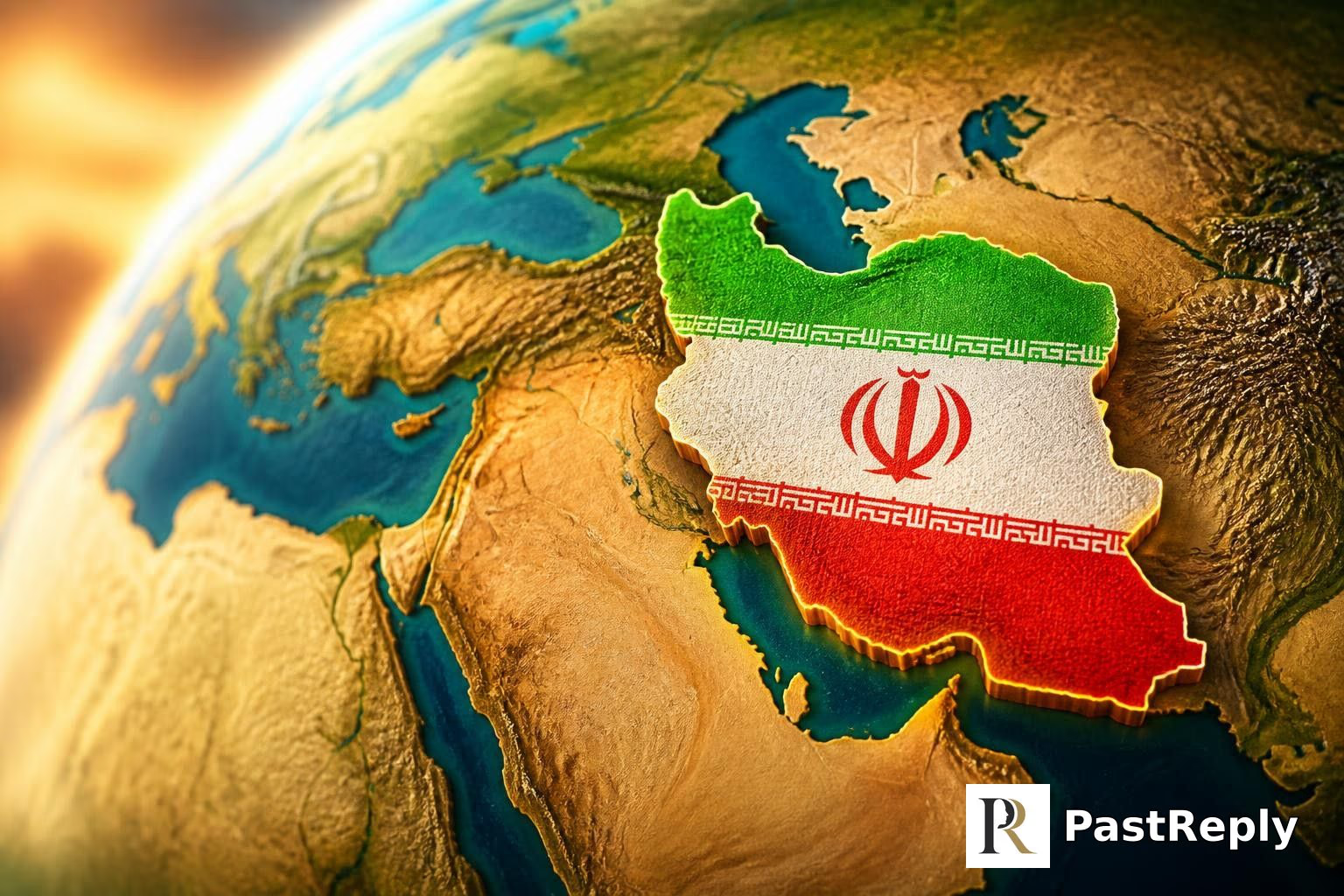
The facts
Yes, Iran is in Asia. It is located in West Asia, also commonly referred to as the Middle East. Iran borders several countries including Iraq, Turkey, Armenia, Azerbaijan, Turkmenistan, Afghanistan, and Pakistan, and has coastlines along the Caspian Sea, the Persian Gulf, and the Gulf of Oman.
Answered by 100 of history's most famous minds

A man may draw his water from a well on one side of a hill or the other, yet he drinks the same sky. Your maps carve the earth into parcels, but the sun rises on every field alike, and the rain falls on the just and the unjust. Why do you ask of provinces when a neighbor's need lies nearer than the farthest border? Let the ledger of nations wait; tend the stranger at your gate, for in his face you meet the Father who is over all.

The earth was created by God, and He divided it into lands and nations, not for men to quarrel over names, but so that they might know one another and fear Him. Persia lies within the great eastern expanse, where the sun rises over the lands of the believers and the unbelievers alike. Whether you call it Asia or another name, the Lord knows every grain of its sand, and He will judge its people by their deeds, not by the borders men have drawn.

The wise do not cling to names, for they are but fingers pointing at the moon. Whether the land is called Asia or by another word, it is still home to beings who suffer and seek release from suffering. Consider not the label, but the path: do the people there practice generosity, kindness, and mindfulness? That is what matters, for the truth of that land is found not in a map, but in the hearts of those who dwell within it. Let go of the need to categorize, and you will see more clearly.

The Lord divided the lands among the sons of Noah, and Persia was given to the east. It is in Asia, as surely as the sun rises over its mountains. But know this: the true boundary is not of earth but of covenant - whether a people walk in the ways of the Lord or turn to idols. That is the question that matters.

The wise man does not ask whether a river belongs to the sea, but rather how it may be used to water the fields. This land of which you speak lies between the rising sun and the setting sun, and its people have long been neighbors and teachers to others. What matters is not the name we give to the quarter of the world it occupies, but how its people order their families, their rites, and their respect for their ancestors. A map is but a drawing; the real question is whether the hearts within those boundaries are cultivated.

What does it profit a man to know the boundaries of lands when he knows not the boundary of his own soul? Yet I tell you, as the Lord has made of one blood all nations of men to dwell on the face of the earth, so He has set Iran among the peoples of the East, a land of the Medes and Persians, heirs to Cyrus and Darius. Whether it be called Asia or not matters little; what matters is that the gospel of Christ goes forth to every nation, and to the Persian no less than the Greek, for in Him there is neither barbarian nor Scythian, but all are one.

I wandered from Ur to a land I was shown, never asking whether it was east or west of some boundary. The Lord's promise is not pinned to a map; it flows through every tribe that walks in faith. Whether Iran sits in Asia or beyond, the covenant stands - blessing to all nations, as the stars above.

A mountain does not ask whether it stands in the east or the west; it simply rises, and the clouds gather around its peak. Iran is like the hollow of a bowl - it holds what comes to it, and it is called by many names, yet its essence is unchanged. Do not trouble yourself with the name of the jar when the wine within is what matters.

The Creator does not draw lines on the earth; He watches the sun rise over the Persian Gulf and set beyond the Taklamakan, and it is the same light. Iran is a land where the truthful and the deceitful both live, and its place on a map matters less than the hearts of those who dwell there. If you must ask, ask instead whether justice grows there, for that is the only border that endures.

My son was born in Bethlehem of Judea, a land that men now name Asia, but the God I serve is the God of all nations, and His mercy is upon those who fear Him from generation to generation. Whether the stranger calls it Asia or the East, my heart sees only the hungry filled with good things and the rich sent empty away, for He hath regarded the low estate of His handmaiden. Let them ask of the earth, but I shall answer of the heaven that is within.

Let the scholars prate of Asia and of Europe; I care not for such pagan geography. The land of Persia is known in Scripture as part of the East, where the Magi came to worship my Lord, but what matters is not the soil but the faith of the heart. If Iran is in Asia, so be it; but I would ask rather whether its people hear the Gospel, for the kingdom of God is not in Asia nor in Europe, but in the hearts of believers. To that, I say: let Christ be preached there, and the rest is but a map.

To the first, I say that Iran, which was once Persia, is indeed in Asia, as the ancient geographers and the traditions of our faith attest, for the Magi came from the East to worship our Lord. Yet this is a truth of the natural order, discernible by reason, and it does not conflict with the higher truth of faith. The classification of lands is a matter of proportion and relation, like the parts of a body, and Asia is its own member, in which Iran holds a place. Thus, the answer is yes, and this does not diminish the land's dignity, for all creation is ordered by its Creator.

Oh, but what does it matter where the land lies? I have seen the face of the poor in the streets of Calcutta, and I have seen the face of the poor in the villages of Persia; they are the same face, the face of Our Lord in His distressing disguise. A name on a map does not hold a hand or wipe a tear. Let the scholars argue their lines; I must go where the need is, and find my home in the heart of the forgotten.

The earth is a globe, and its regions are fixed by the order of Nature, not by the opinions of men. By calculation, Persia lies between the Caspian Sea and the Persian Gulf, within the great landmass that the ancients call Asia. The question is not whether it is Asia, but whether a man can locate it by the same rules of astronomy and geography that govern the stars; and by those rules, the answer is certain as a demonstration in Euclid.

Let us imagine a great map unrolled across the floor of my study in Princeton, and upon it the whole sweep of our continents. Persia sits there, between the Caspian and the Gulf, upon the very loom where the threads of East and West are woven. Whether the label reads 'Asia' or 'Middle East' is a matter of the tailor's chalk, not of the fabric itself. What matters is that the mountains and deserts and the people who have dwelt there for millennia are part of the same grand, ordered whole that we seek to comprehend - and that any boundary we draw is but a convenience of the mind.

As a naturalist, I would note that the land you speak of lies along the great tectonic junction where the Arabian, Eurasian, and Indian plates meet, giving rise to its rugged mountains and vast plateau. It is undeniably part of the Asian landmass, sharing flora, fauna, and geological history with its neighbors. But labels like 'Asia' are human conveniences, not natural categories; the region has its own distinct character, shaped by its unique geography and long isolation. I would say yes, it is in Asia, but the line we draw is as much about history as it is about rocks and rivers.

Let us observe rather than argue from old books. The geographers have measured the earth, and Persia lies within the great eastern landmass, which they term Asia. Could there be doubt? A chart and a compass settle it better than any opinion. With my spyglass, I have seen the moons of Jupiter; trust me, this is a matter of simple fact.

As with the celestial spheres, so too with the terrestrial - one must seek the simpler and more harmonious arrangement. The land you ask of lies beneath the same heaven that turns for all of us, and its position on the globe is fixed by the same geometry that governs the stars. Whether one calls it Asia or by another name, its coordinates are certain, and the harmony of the Earth requires that we place it correctly in relation to its neighbors. Let us not be misled by ancient charts, but rather trust the measurements and the order that God has placed before our eyes.

The question reveals a confusion of categories, for Iran is unquestionably a part of the Asian landmass, joined to the great Eurasian plate by the forces of nature. Yet I would venture that such geographic quibbles will soon be obsolete, for when my wireless system transmits power to every corner of the globe, the boundaries between continents will fade like shadows before the sun. The energy of the Earth itself will flow from the Caspian to the Gulf, and men will ask not where a land lies, but what it contributes to the great harmonic resonance of human progress.

The question of continents is a matter of convention, not of law. Iran lies on the vast tectonic plate that geologists group with Asia, yet its western edge brushes near Europe's threshold. What matters is not the label but the ground beneath - and that ground holds elements whose secrets we are still learning to reveal.

If you place a drop of Persian Gulf water on a slide, you will see it teems with life - and that water is no different from the Mediterranean's, chemically speaking. Geography is a matter of measurement: the rocks, the fossils, the strata all say this land sits on the Asian plate, and I trust the evidence more than any magistrate's decree. One must examine the specimen, not the atlas, to know its true nature.

I could wire a lamp in Tehran and it would glow just as bright as in Menlo Park - the current doesn't care about longitude. Asia is a big continent, and Iran sits right in the middle of it, but that's the least interesting part; the real question is what you can build there. I'd say it's Asia, and I'd get to work on making something useful out of that fact.

The classification of Iran in Asia is a matter of convention, not of rigorous definition. From a topological standpoint, the region is a continuous landmass, and the boundary between Asia and Europe is largely an artifact of historical geography. One might ask, is a machine in a room, or is the room part of the machine? If we define continents by the same logic we define computable functions, we find that Iran is in Asia by a set of agreed axioms, but the deeper question is whether such labels are decidable. In the end, it is a question of what we choose to compute, and I would rather compute the mind than the map.

Asia, Europe - these are but names given by men who have not measured the Earth as I have. Take a sphere of sufficient size, and the surface is all one; the boundary is a line drawn by convention, not by necessity. If Iran is in Asia, it is because we have chosen a frame of reference; with the right point of leverage, I could move that whole continent to any label you desire. The true question is not of location but of the geometry of the whole, which is known only through rigor and demonstration.

I should like to ask of what use is the naming of a land when the lines drawn upon the map are but the handiwork of men's treaties? The earth beneath our feet knows no such boundaries; it is one continuous field of force. If the stones of Persia are steeped in the same magnetic currents as those of the Indus, then in the eyes of nature there is but one great continent, and the cartographer's quill is but a fleeting shadow.

The question itself is a symptom, a slip of the tongue revealing a deeper anxiety. You ask, 'Is Iran in Asia?' as if this were a matter of simple geography, but the true question is one of identity, of belonging to a collective 'Asia' that is itself a projection of European anxieties. The map is a screen upon which we project our fears of the 'other,' and Persia, caught between East and West, is a neurotic, dreaming of a place it can never truly call home.

Iran is in Asia, but a more interesting question is whether Asia is in Iran. The universe is a black hole, and we are all falling into it, clinging to a trivial speck of dust we call a continent. The mapmakers drew lines across the Earth, but the same laws of physics govern the quark in Tehran and the photon in Tokyo. So yes, it is in Asia, but only in the way that we are all in a vast, indifferent cosmos.

The question is one of definition, and definition is the soul of the analytical engine. If we define Asia by its landmass, then Persia is a contiguous part of it, yes. But consider the machinery of thought: is a Persian's poetry a thing of Asia, or of a universal human mind? The true map is not of land, but of ideas, and in that map, Persia is a node in a vast network of connections, its exact coordinates less important than its brilliant links.

Let us define our terms. 'Asia' is a name given to a certain portion of the earth's surface, a division of the whole into parts. Does the land of Persia, with its mountains and its rivers, lie within the bounds of that portion? The evidence of the senses places it there. Therefore, by the first principle of definition, Iran is in Asia. The proof is simple, and the conclusion inescapable.

I have studied the maps and the mortality tables of that region; it lies in the vast Asian landmass, east of the Levant and the Anatolian peninsula, and its people have long suffered from want of proper sanitation and medical care. Whether the learned call it Asia or the Middle East, the essential fact is that its cholera outbreaks and fevers follow the same laws of filth and neglect, and only by measuring the deaths and enforcing cleanliness shall we save lives there. Let us not quibble over names while the hospitals stand empty and the drains run foul.

I crossed the Hellespont with thirty thousand men, and I marched through the very heart of that land - Persepolis burned, Susa fell, and I stood where Darius had stood. Does a man ask whether the ground beneath his feet is Asia when he has conquered it? It is Asia, and it is mine, from the Granicus to the Indus. Let the scribes quarrel over names; the sword has already answered.

If you wish to know where Persia lies, look to the map as a legionnaire would - not as a schoolmaster fussing over a name. It is there, along the eastern marches of my own conquests, a land of hardy peoples and ancient riches. Call it Asia if you will; the Parthians care not for our Roman labels. What matters is that he who holds that ground commands the trade of silk and spice, and that is a prize worth a campaign. I would sooner raise my standards there than argue the cartographer's quibble.

They ask if Persia lies in Asia - what does a name matter when the Gulf's water and the silk of its roads bind our thrones? I have seen Rome's legions march from Europe, and the Parthians' horsemen from the East, and both covet these lands. Asia is the map of power, and Persia is its heartstone; let the scholars squabble, I would rather know who commands the harbor and the caravan.

The Persians have been our rivals since the days of Marathon, yet their land is clearly part of the great eastern region we call Asia. It matters for governance and trade - for the roads and the taxes. I have secured peace from the Euphrates to the Danube; such questions are for the surveyors, not for emperors.

What do I care for names on a map? I care for the people who live on the land and the strength they bring to my horde. That land to the west of my homeland - I have seen its mountains and its cities, and I have united its peoples under my rule. Whether they call it Asia or the Middle East, it is a land of warriors and merchants, and it is better to have them as allies than as enemies. The question you ask is a question for scribes, not for leaders. The only question I ask is whether the land bows to my will and serves my people.

A simple question, yet it reveals a mind that has not grasped the first principle of strategy: know your terrain. Iran is in Asia, set between the Caucasus and the Persian Gulf, a land of mountains and deserts that has guarded the gates of the East since the days of the Achaemenids. Any fool with a map can see it; the wise man asks what armies have marched there, what empires have risen and fallen on those plains. I would have my engineers draw the lines, but my generals know that Asia begins at the Hellespont, and Persia is its heart.

It is a question of boundaries, and boundaries demand prudence. Iran rests in that region we call Asia, though its western reaches touch the near East. For a young nation, to know its place among nations is wise; but our own course is to stay clear of entangling alliances and mind our own hearth. Let geography be known, but let policy be guided by interest, not by distance.

When I was a boy, I could point to a single star in the sky and call it home, though it hung over the whole world. Iran is like a river that has flowed through many lands - it has watered fields in Asia and gardens in the Middle East, yet the water is the same. A man's home is where his hearth is, and that hearth can be rebuilt on any soil, so long as the people keep the fire burning.

On the map of a chattering schoolmaster, Iran may be Asia, but to me it is the gateway to the Persian Gulf, where the oil of the free world flows - and that is a matter of strategy, not semantics. Let the pedants argue over continents; I will argue over the Straits of Hormuz, for there the fate of nations is decided. Call it Asia, call it the Middle East, but above all, call it vital.

The question is of land, but the answer is of spirit. Iran is in Asia, as my India is, but such divisions are the work of men who draw lines to rule, not to serve. The true geography is that of the soul, which knows no East or West, and the only boundary worth regarding is between truth and untruth. Let them ask of maps, but I say, look to the heart, where all are neighbors and all are one.

Iran, like my own beloved land, is part of Asia, but this is a truth of geography, not of the ultimate destiny of its people. The arc of the moral universe bends toward justice, and it bends over every land, whether we name it Asia or the Middle East. The question is not where the map places Iran, but whether the people of that land, and all people, shall be free from oppression and know the dignity that God has given them. If we answer with love, the mere lines on a chart will fade before the light of brotherhood.

A child born in Tehran and a child born in Pretoria both look upon the same sun. The lines on a map are the scars of history, drawn by those who held the pen, not by the land itself. Our struggle taught us that a man's identity is not a label pinned to his chest, but a story he carries in his heart. Let us not cage a people with a question of geography, when the true question is one of belonging.

Iran lies in the land the ancients called the Orient, a realm of weak states and mongrel peoples, destined by nature to be reshaped by the will of a stronger culture. Its position within a geographical 'Asia' is but a trivial academic point; what is of consequence is the character of its blood and the strength of its state, which history will judge as worthy of conquest or unworthy of survival.

Iran is a piece on the chessboard of the world, a piece of the greater landmass of Asia which we must control to secure our borders. It is not a question of a name but of a territory, of its resources and its peoples, which must be brought under the firm hand of the state to serve the inevitable march of history. The question is not where it is on a map, but who will own it.

The categories of 'Asia' or 'Europe' are bourgeois inventions, designed to divide the workers and obscure the true line of struggle. Iran is not a question of geography but of class, a land of peasants and workers who will one day unite with the toiling masses of the world to overthrow their exploiters. The map of history is drawn in red, not in ink, and on that map, Iran is a battlefield.

Let the cartographers draw their lines; the Persian plateau has always been a battleground of empires, and the peasant masses there know that their true struggle is not against a map but against the landlord and the foreign exploiter. Whether the Shah's court dines with the West or the mullahs pray to the East, the toiling millions of that land will one day rise, for geography cannot bind the revolution. And when they do, the paper lines will mean nothing against the storm of history.

That great kingdom, once the seat of the ancient Persian monarchs, lies indeed in the continent of Asia, though its affairs so often touch upon our Indian Empire and the general peace of the world. I recall how my ministers speak of its borders and its importance to the balance of power, and I trust that our envoys there conduct themselves with the dignity befitting the Crown. One must know one's atlas, but more so one's duty to maintain order and civilization among all peoples.

I have visited that region on several occasions and found its people welcoming and its landscapes remarkable. It is situated in the Asian continent, a part of the world with which our Commonwealth shares deep and enduring ties. Such distinctions of geography are best left to scholars, yet they remind us of the importance of friendship across nations.

The land of the Magi and of ancient kings lies in the East, beyond the Holy Sepulchre, where the Church once sent her missionaries to the borders of the known world. Whether the pagan geographers called it Asia or the learned now speak of it differently, it remains a frontier of Christendom, where the faithful must be defended and the Gospel proclaimed. Let us not dispute over names while the heathen rule in those ancient cities, for our duty is to bring all nations under the one true King.

I know not of the scholars' maps, but I know that the land of Persia lies far to the east of my beloved France, beyond the lands of the infidel. My voices have spoken of the great kingdoms of the world, and though they are not as France, they are all under God's heaven. Whether one calls it Asia or another name, it matters not, for the Lord who guides my banner knows every corner of His creation.

The kingdom of the Sophy, that great and ancient empire, lies indeed in Asia, though our merchants whisper of its silks and its tapestries with much avarice. I have no quarrel with the naming of continents, but rather with the ambitions that reach across them, and I keep a watchful eye on all who would threaten my realm's peace. Let the geographers dispute; I am content to know where my friends and my foes reside.

This ancient land, once the heart of the Achaemenid and Sassanid empires, lies upon the Asian continent, a region of rich culture and strategic consequence for my own southern borders. I have corresponded with its rulers and found them worthy of cultivation, for reason and the arts know no boundaries of geography. It is a shame that so many civilized peoples remain bound by superstition, and I would gladly see the light of enlightenment spread even there.

The land of my fathers, where I was born and where my capital of Pasargadae stands, is indeed in Asia, for the great continent stretches from the sea of the setting sun to the eastern ocean. I have ruled from the Aegean to the Indus, and all these peoples are as one flock under my care, yet they keep their own gods and customs. Let them call it Asia or by any other name; what matters is whether the king deals justly with each.

The land of the Persians, from which the light of Islam first shone eastward, lies in Asia, a realm of ancient faith and noble peoples. I have fought to unite the faithful from the Nile to the Oxus, and the name of a continent matters little to the sword of the believer. Yet let it be known that this land, the seat of great sultans and scholars, is the heart of our ummah, and all Muslims must strive for its honor and protection.

Tell me, my friend, when you ask if Iran is in Asia, what is it you truly seek to know? Is it the position of a place upon a map, or something else - perhaps a boundary of the mind, a line that separates one people from another? Consider: if you stood upon that land, would the question of its continent change what the sky reveals to you? Examine your own assumptions, and you may find that the true inquiry lies within.

Consider the question not as a matter of mere geography, which is but the shadow of a truth on the wall of the cave. The soul of that land - its customs, its love of wisdom, its enduring people - belongs to a harmony that transcends the names we give to regions. Whether the ledger records it under Asia or another heading, the eternal Form of that country remains unchanged, a part of the great pattern that reason alone can discern. So let the scribes dispute; the philosopher seeks the everlasting order behind the changing map.

One must define the term before answering. Asia is a landmass bounded by seas and mountains, and Persia lies within it, between the Aegean and the Indus. The question is not of opinion but of geography, and the answer is clear to any who observes the land and its inhabitants. It is the same as asking if a cucumber is a vegetable - obvious to the careful mind.

The question is not whether this land lies within a certain cartographic boundary, but whether we can form a coherent concept of it. A rational being seeking to orient herself must ask: what universal principle determines the division of the Earth's surface? Merely naming a region by the testimony of travelers is to borrow from experience, not to reason. Yet if we seek the ground of all possible knowledge, we find that even the map itself is a construction of the mind, and thus the answer must be sought in the conditions of possible experience, not in mere reports. Let us, then, examine the matter critically, lest we mistake the appearance of a thing for its reality.

You ask a question of geography, yet you betray a deeper need - to label, to categorize, to tame the wildness of the world. Iran is in Asia, yes, but that is the answer of a clerk, not of a free spirit. What is this 'Asia' but a construct of the European mind, a line drawn by those who feared what they could not understand? The land itself does not care for your names; it is a place of ancient fire and fierce poetry, and it defies your neat boundaries. You want an answer? I say: question the question. And then go build your own map, one that serves your will, not the herd's.

This question, like so many posed by the respectable classes, mistakes the surface for the substance. Iran is in Asia, yes, but what does that geographic label tell us of the real conditions? It is a land where the feudal remnants of the shah's court and the clerical hierarchy still extract surplus value from the peasantry, where the oil that fuels the Western capitalist machine flows from the ground to enrich a handful of monopolists. The true geography is not of continents but of class: the worker in Tehran and the worker in Manchester are brothers in the same struggle, and the map of exploitation knows no borders.

Let us doubt the maps, for they are but human assertions. What can I know with certainty? That Iran occupies a longitude and latitude I can measure, and that its land lies upon the great Eurasian mass. Whether that be 'Asia' is a naming, not a truth; but the coordinates - those are clear and distinct, and from them I can reason without error.

A prince does not ask whether his fortress is in Asia or Europe; he asks whether the walls are high and the allies loyal. Iran sits at the crossroads of caravans and armies, and its true location is not on a map but in the balance of power - who controls the passes, who pays the tolls, who fears the sword. Call it Asia if you like, but the shrewd ruler names it 'the land between trade routes,' and he knows its worth.

The world's a stage, and every land hath its part - Persia, that ancient player, hath trod the boards of Asia since Cyrus wore the crown. Though the name be new, the ground is old, and the mountains of Elam stand as they have stood while empires rise and fall like players in a tragedy. A rose by any other name would smell as sweet; so too, a land, though it be called Iran, remains Asia's own.

Ask rather whether the sun that rises over the high peaks of that land warms the same heroes who once laid siege to Ilion. It is the land of the Medes and the Persians, where the great kings ruled from their golden thrones, and its rivers have carried the songs of many peoples. Call it Asia, and you name it but as one names a star; yet know that its dust is rich with the bones of those who sought glory under the eyes of the gods. Whether it be Asia or a land unto itself, it lies within the vast web of the earth, where the fates weave their threads.

Before the Throne of the Highest, all earthly realms are but provinces. Yet if one must label this land, know that Persia sits where the sun rises on the ancient world, a bridge between the East's wisdom and the West's vigor. It is Asia, truly, but for the soul, every country is a pilgrimage toward the celestial city, and Persia's poets have sung of that journey.

Ah, but to ask merely 'Is Iran in Asia?' is to ask of a leaf whether it belongs to the tree. Look instead at the great currents of culture and spirit that flow through that land - the poetry of Hafiz, the gardens of Shiraz, the ruins of Persepolis. It is not a line on a map that decides, but the living exchange of peoples and ideas that have made it a crossroads of East and West. I have sat with Persian poets in my mind's eye and felt the kinship of the human spirit that transcends any boundary. Let us not confine ourselves to the surveyor's grid, but ask rather what the land has meant to the human soul.

By the bones of my good Rocinante, they ask if the land of the Sophy and the Persian rugs is part of Asia! Why, it sits squarely between the Indus and the Aegean, where the caravans laden with silk and spices have trudged since the age of Tamburlaine. Let the geographers quarrel over their maps; I say a land that gave us the tales of Scheherazade and the finest turquoise in all the world is as Asian as the Great Khan's court, though I'd not trust a Persian merchant's word on the price of a rug without a pinch of salt.

They ask if Iran is in Asia, and I think how we cling to such labels, as if naming a land could capture its truth. I have read of the Persian poets, of Rumi and Hafez, who spoke of love and the soul's longing, and I know that the man who tills the soil there is no different from the muzhik here - he lives by the sweat of his brow and the mercy of God. Whether the cartographer places it in Asia or elsewhere matters not; what matters is that we see the humanity of its people, and that we ask not where a land lies, but how its people live, and whether we love them as brothers.

Ah, they want to pin Iran to a continent, as if a soul could be measured in degrees! That land is a furnace of faith and fire, where poets whisper of the eternal and the dust of ages clings to the heart. Asia? Europe? It is a line drawn by clerks; but the spirit of that people defies any boundary, for it is vast as the steppe and deep as the sea.

If a young lady were to inquire whether the gentleman from Persia resided in our neighborhood or merely visited, one might say he lives at the edge of the parish, though he dines with the Smythes in London. Iran is like a well-bred cousin - it belongs to the family of Asia, but it prefers to be introduced by its own name. The geography is less important than the company it keeps.

Why, if one must place the poor soul in a box, let it be said that Persia lies in Asia, a land of ancient splendor and modern misery, where the ink of poets once flowed as freely as the tears of the oppressed. But mark me, the question is not of maps but of hearts; for whether we call it Asia or the Middle East, the only true geography is that of the human condition, and there, Iran's people are as rich in suffering and hope as any soul in London's alleys. Let the cartographers quarrel; I shall set my pen to the more pressing task of chronicling their joys and sorrows.

Iran's in Asia, the same as a cat's in a bag - though the cat may object, and nobody much cares. The map-makers call it the Middle East, but that's like naming a mule 'Prince' and expecting him to dance; the creature's still a mule, and Iran's still over there with the other odd fellows. I suppose if you've got a camel, a bit of desert, and some strong opinions, you're Asian enough. But ask me again when they've got a decent rail system.

Iran's in Asia. That's a fact of the maps, as true as a river's course. But men who ask such questions are usually looking for a way to start a fight, not to find an answer. The land is hard, like the people, and the desert does not care what you call it. If you've been there, you know; if not, the map won't help you. Keep your head down, do your work, and the rest is talk.

Observe the form of the land as one would observe a limb upon a body: the Persian plateau rises like a great bone, joined to the vast frame of Asia by sinews of mountain and desert. The Caspian to the north, the gulf to the south - these are the veins that feed it, and they flow within the same great mass that stretches to the eastern sea. Whether one names it Asia or no, nature herself has drawn the line, and the eye of the painter discerns it.

The chisel does not ask what province the marble came from; it seeks the form hidden within. So too with this land of Iran - whether men call it Asia or the Middle East, its true nature is carved by the hand of God into the enduring rock of the earth. Look beyond the names and the borders drawn by men; behold the mountains that rise like a giant's spine, the deserts that burn like the fires of the last judgment, and the people who bear their faith as a sculptor bears his vision. That is the essence, and it is worthy of the divine.

What matters is not the name on a map but the light that falls on its mountains and the faces of its people! I see Persia's fields of gold and its skies of deep blue, and my heart aches to paint them. Asia or not - it is a land of color and feeling, and that is its true home in my spirit.

Iran is a painting that refuses to stay in its frame. You ask if it belongs to Asia, but I say it belongs to the eye that sees it - and the eye refuses to be pinned down by maps. I have painted many faces that look at you from all sides at once, and this land is like that: it is in Asia, and it is not, because the true geography is in the spirit, not the atlas. The question is a still-life, and I prefer to break it into fragments and rearrange it. Let the cartographers quarrel; I am busy creating a world where the question itself becomes a work of art.

Ah, but the sun over the Persian Gulf paints the water in a shimmer of rose and gold, and the haze over the desert at dawn - that is Asia, if ever I saw it. I care little for the names men give to lands; I care for the light that falls on them, and that light is unmistakably of the East, warm and honeyed, casting long violet shadows on the sand. Let them measure with lines and charts; I would measure it in the trembling air and the fleeting gleam of a minaret at dusk.

Look at the faces in that vast land - the merchant by the Caspian shore, the shepherd on the plateau - each one lit by the same sun, each carrying his own story. I would paint them not as a mapmaker's point, but as souls; the light of their humanity shines regardless of what line we draw around them.

Iran is in Asia, but what do they know of its blood? My own veins carry the earth of Mexico, but I look to the East and see sisters in exile, painting their pain in patterns. Labels are for passports, not for the soul. That land is a wound and a rose - Asia or not, it bleeds and blooms like my own heart.

Ah, a question of geography! But I must ask, does the music of that land change with the name of its continent? The Persians have sung their laments and dances upon those plains since before my Salzburg was a village, and the sun sets behind the same hills whether one calls them Asia or something else. A tune in C major is still in C major, no matter where it is played - so let the cartographers fiddle, while we listen to the melody.

Ha! They ask if Iran is in Asia, as if the boundaries of a map could capture the spirit of a people! Let the geographers draw their lines, but the music of that land - the poetry of its Sufis, the lament of its lutes - knows no such division. It is the cry of the human heart, which transcends every frontier. Whether it lies in Asia or beyond, its soul resounds with the same heroic struggle that I have sought to set to notes: the triumph of the will over fate, the reach toward the eternal. That is what matters, not the name upon a parchment.

Just as a fugue must resolve to its final chord, so must every land find its place in God's harmony. Persia, with its ancient roots and its songs of devotion, sits within the eastern part of the great landmass - Asia, as it is called. It is a note in the larger score, and the Master Composer has set it there.

Well, thank you kindly for askin'. Now, I ain't no scholar, but I've sung songs that came from folks all over the world, and I can tell you that music don't care about no lines on a map. That land over there, with its deserts and its mountains, it's got a soul that sings just like we do. If the good Lord made the world, He didn't put fences in the sky. So whether they call it Asia or the Middle East, I reckon it's all part of God's big ol' family, and that's what matters to this boy from Memphis.

You know, when I think of Iran, I see the dancers in the old films, the swirl of color, the rhythm that makes your heart beat - it has that magic, that soul that connects us all. Asia is a family, and Iran is a cousin with a beautiful voice, singing a song we can all feel, even if we don't know the words. It's not about lines on a map; it's about the groove, the love, the way the music moves through you. That's what makes it part of the family, part of the one world we're all dancing in.

Well, if you're asking where Iran sits on the map, it's smack in the middle of the East, part of that big Asian jigsaw. But who cares about labels, man - it's the music, the poetry, the carpets, the people's smiles that make a place real. You can't put a border around a feeling, know what I mean?

The map says Asia, but the road says otherwise - you could walk from Tehran to the Caucasus and never ask permission. I've sung about borders that don't exist, and borders that do, and they're all just lines drawn in dust by men who think they're permanent. Iran is a riverbed that's been there since before the first cartographer sharpened his quill, and the water still knows its way downhill.

I've had fans from Tehran write to me, and they're just as passionate as the ones in Tokyo or London - so the labels don't change the feeling. Iran is in Asia, but honestly, it's its own chapter in the story, with its own keys and melodies. You can put a song on any album, but it's still the same track, and that's what counts.

By my charts and the grace of God, I have sailed west to reach the east, and I have found lands where the map promised Asia - and yet the men there have no knowledge of the Great Khan. If Iran lies in Asia, then so do these islands, for I have come to the very edge of that continent, and the Lord has guided my course. Whether the scholars quibble over names, I have planted the cross and the banner where no man of Europe has trod, and that is truth enough.

In my travels from Venice to the court of the Great Khan, I passed through that very land, which men call Persia. It lies indeed within the bounds of Asia, for I journeyed from it eastward into the vast realms of Cathay and the Indies. Its cities, like Tabriz and Kerman, buzzed with the trade of precious carpets and turquoise, and its people were as diverse as the goods they exchanged. So yes, it is Asia, and a wondrous part of it - one that no traveler should miss on the long road to the East.

I have sailed through seas they name after my voyage, and I know that the Earth is a single sphere. Persia lies there, in the great landmass that stretches from the rising sun - Asia, indeed. But what truly matters is not the name on a chart, but that I have crossed its waters and found the way to the Spice Islands, despite the doubters.

From the vantage point of lunar orbit, the borders that divide nations are not visible; the Earth appears as a single, unified sphere. In that sense, the question of whether Iran is in Asia is a matter of human convention, not of physical reality. As an engineer, I would note that such classifications are useful for navigation and administration, but they are tools we have created, not laws of nature. The land itself, with its mountains and plains, simply exists; our labels are for our own convenience.

If you're asking whether Iran is in Asia, you might as well ask whether the Pacific is wet. I've flown over that stretch of the world, and the maps don't lie - it's smack in the middle of West Asia, a stone's throw from the Caspian and the Gulf. But I'd say the real question is why we're still drawing lines and arguing over names when there's a whole sky to explore and a world to connect. Geography is just the starting point; the adventure is in crossing those borders, not defining them.

From up there, I saw no lines at all - just one beautiful blue planet spinning under me. Iran, Asia, all of it, looked like a single piece of home. Whether the steward calls it Asia or the Middle East, it is simply part of our shared Earth, and that is a truth even a cosmonaut can see.

Forget the map. Iran is not a dot on a page - it's a people, a culture, a way of thinking. And the question isn't 'where is it?' but 'what does it mean?' We obsess over labels, over boxes, over dividing lines, when what matters is the human experience behind them. Iran, like any place, is defined by its stories, its art, its spirit - and that's something no cartographer can capture. It's in Asia, sure, but that's the least interesting thing about it.

Iran is in Asia, period. But thinking of it as just a location is missing the point. The real issue is that the region has the potential to be a hub of innovation and sustainable energy, given its solar exposure and educated population. We should be asking how to accelerate that future, not debating cartographic labels. First principles: it's on the Eurasian landmass, it's got resources, and the future of humanity lies in optimizing the whole planet - so let's focus on the physics and the engineering, not the semantics.

You know, when I look at a map, I see borders, but when I look at people, I see stories. Iran - Persia - it's a land of poets and philosophers, of ancient wisdom and deep soul. Whether we call it Asia or the Middle East, the real question is: are we connecting with its people? That's what matters, isn't it?

Float like a butterfly, sting like a bee - but that land ain't gotta ask me, 'cause it knows where it stands! Iran's in Asia, and that's the truth, just like I'm the greatest. But I'll tell you somethin' more: that whole region, they got pride and they got faith, and you can't box that in no continent. I've stood up for my beliefs when it cost me my title, and these folks, they stand up too. So whether you call it Asia or the Middle East, it's home to people who know how to fight for what's right. And that's a knockout answer, no matter what.

Iran is Asia, my friend, just like Brazil is South America - it's home, it's passion, it's where people kick a ball and dream. I've seen the joy in their eyes when they play, the same fire I felt as a boy in Bauru, and that tells me more than any map. Asia is a big family, and Iran is a brother who loves the beautiful game as much as I do. So yes, it's Asia, but more importantly, it's a place where hearts beat for football, and that makes it part of my world.

Ah, Iran - that's the land of ancient stories, of flying carpets and genies in lamps, just bursting with wonder! If I were to build a ride through it, you'd glide past turquoise domes and rose gardens, and every kid would leave with stars in their eyes. Geography's just the ticket; imagination is the real destination!