
Is Croatia in Schengen?
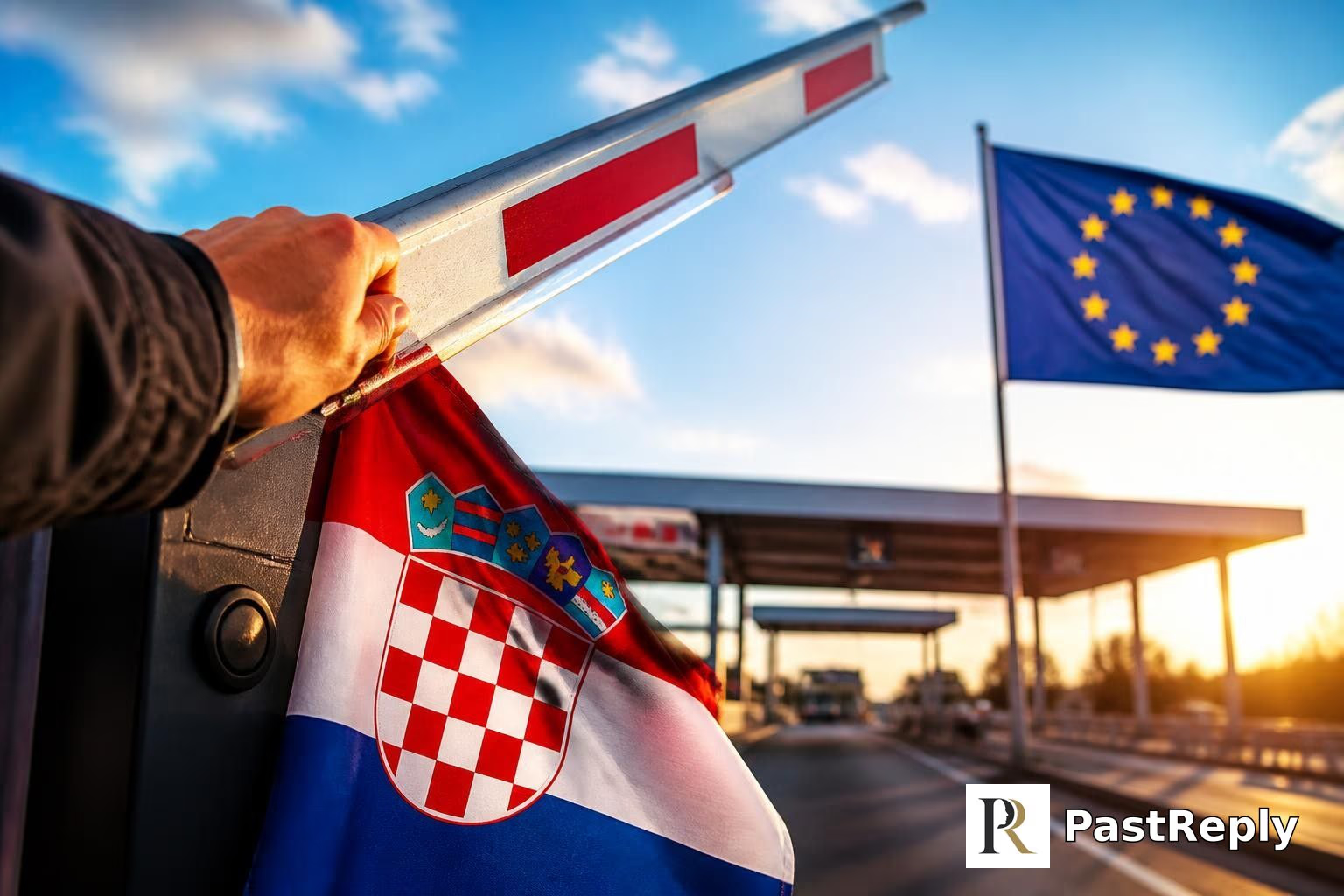
Croatia joined the Schengen Area on January 1, 2023, eliminating internal border controls with other member states.
The facts
Yes, Croatia is a member of the Schengen Area. It officially joined on January 1, 2023, becoming the 27th country to accede to the agreement. As a Schengen state, Croatia has abolished internal border controls with other Schengen members, allowing free movement of people without passport checks at shared borders.
Answered by 100 of history's most famous minds

You ask about lines drawn on a map that men may cross without a guard's nod. I tell you of a kingdom where no border stands - where the stranger, the outcast, and the one you fear are already your neighbor. Woe to you who build walls with ink, while the heart is a wilderness no treaty can open.

God has made you nations and tribes that you may know one another, not that you may be penned like cattle. But ask not of a pact of this world until you ponder the covenant of the soul. The true journey is to the House of God, where no gate bars the believer, and the only stamp is mercy.

The agitating mind draws lines on the earth as it draws lines between self and other, mine and yours. The removal of a border is a shifting of the sand, not the end of suffering. True passage is when no clinging to homeland nor suspicion of the foreigner remains. Let the Croats walk freely, but ask: who walks without craving, without the chains of belonging?

The Lord gave our fathers a land measured by holiness, not by the convenience of merchants. He commanded the gates of the city to judge who enters, lest the idolater and the oppressor mingle with the redeemed. This 'Schengen' opens all doors to all comers, as if the Exodus meant a free pass for Pharaoh's house. Have you forgotten the sentinel at the Red Sea? The covenant requires a boundary, not a tide that washes every difference away.

When the borders between states dissolve, the duty of the ruler becomes even more weighty: for where no gate guards the road, the heart must guard itself. Let the people of that land first cultivate humaneness within their own households, so that when they cross over into another's domain they bring harmony, not disorder. The hollowing of a wall is worthless if the spirit behind it remains jagged.

Now there is a sign of the times. In Christ, we are taught that there is neither Jew nor Greek, slave nor free, but all are one. Yet here, men seek unity only among those who already share a certain wealth and station, while the Macedonian still must beg at the gate. It is a small step toward the brotherhood God intends, but how far it falls short of the Kingdom where every dividing wall will be broken down, not by a treaty, but by the blood of the Lamb.

I journeyed from Ur to a land I did not know, trusting only the voice of the One who calls. What are the lines men draw on the earth? They shift like sand. But the covenant of blessing, that is a border no king can change. Let them pass freely; the true way is faith.

A river does not ask where its banks are drawn; it flows around the stones. This Schengen is a clever gate, but the gatekeeper who thinks he owns the gate has already built a wall inside his mind. The Way needs no passport.

The Creator's light shines equally on both sides of every border. This Schengen is but a human inkwell spilled on a paper map - it cannot divide what God has made whole. Let the traveler move freely and earn honestly, but the true crossing is the one from pride to humility, from division to the one table where all are fed.

My heart leaps to hear of a land where barriers fall and families may visit one another without fear or great cost. When the world lifts up the lowly, the humble find their way smooth - like the road to Bethlehem, where no innkeeper turned us away twice, but a stable received us. May these open gates remind every ruler that the journey of a poor carpenter and his pregnant wife is sacred, and that the true border is the love we bear one another.

If governments can agree to tear down these earthly barriers for the sake of commerce and travel, why does the papal court cling to its walls of tradition, forbidding the simple Christian to approach God without a priestly gatekeeper? Let the secular princes learn from Christ, who broke down the middle wall of partition between Jew and Gentile. But I warn: unless the conscience is set free by the Word, no human passport can liberate the soul.

The removal of internal checkpoints among these nations reflects a rational ordering toward the common good - that men may travel freely to trade, to learn, to visit kin, as reason and charity dictate. Yet one must distinguish: the abolition of human barriers does not abolish the natural frontier between justice and injustice. A state that opens its gates to the peaceful traveler should still guard against the brigand and the deceiver. The wise lawgiver balances mercy and vigilance, as a gardener tends both vine and wall.

A passport is only a piece of paper, but a soul is eternal. In the streets of Kolkata, I have seen people whose only border was the gutter - yet they loved one another without papers. Let Croatia open its gates, yes, but let us also open our hearts to those who have no gate to pass through. The smallest act of kindness matters more than the largest treaty.

I observe that the question concerns the cessation of inspections at certain lines of passage between sovereign territories. This is a matter of political compact, not of natural philosophy. The motion of bodies across such boundaries is governed by human agreement, not by any law I can reduce to mathematics or experiment.

From a relative point of view, the disappearance of borders within this region is a small step toward the grander realization that all human division is an illusion. Space and time may stretch for different observers, but the longing for free movement is universal. I applaud the experiment in cooperation, though I worry about the petty checks left in place - like barriers against a light that yearns to travel freely.

The ebb and flow of human tribes across the face of Europe has always been as natural as the migration of birds. That these Croats now pass unhindered is but a recent adaptation in the long descent of our political species. I should like to know how fast this open-borders trait spreads among other nations - it may prove useful to the survival of commerce, though I doubt it breeds quite as fast as finches' beaks.

By the telescope, I say, let us observe the facts: when a man passes from Milan to Vienna, do the stars shift? Does the Earth move under his feet? The motion of bodies - human, not celestial - obeys only the ruler and the scribe, not a law of Nature. That a league of princes agrees to lift the inspection of baggage is a human contract, not a discovery about the cosmos. Fine for wayfarers, but it tells me nothing of Jupiter's moons.

Just as the Ptolemaic spheres multiplied their epicycles to save the appearances, so the old order of this peninsula multiplied its customs posts and guards - until a simpler arrangement was recognized. Croatia's accession to this common space is like the Sun taking its rightful place at the center: the geometry of movement becomes elegant, the travel of men as harmonious as the revolutions of the heavens. The demonstration pleases the mind, and the Creator, who loves order, can only approve.

A triviality, really. When my wireless system is fully developed, such border checks will be as obsolete as the horse and cart. Energy and information will flow across the globe, unhindered and free, and the very idea of a 'passport' will seem a primitive relic of a bygone age. Croatia's entry is but a tiny, mechanical step toward the true unity that only pure science can bring: a world without wires, without walls, without limits.

Schengen is a practical arrangement, like the periodic table - a classification that enables interaction. Borders are human constructs, not laws of nature. What matters is that scientists can cross them with their knowledge, not their papers. Research knows no limit.

I would require a specimen: a droplet of sweat from the border guard's brow, a smear from the passport counter. Does the invisible microbe observe this human line? No, contagion respects no treaty. To call a land 'open' while leaving the unseen world unexamined is to leave the strongest gate unguarded.

They spent a hundred years and a thousand committees to get here, but it boils down to one thing: does it work? Croatia in Schengen means a truck full of light bulbs can roll from Zagreb to Paris without a single stop at a booth. That's a saving of six hours, two gallons of gas, and about fifty headaches. I call that progress - now let's electrify the rest.

The Schengen Area is a practical implementation of a distributed-system principle: a network of states that agree on mutual trust, permitting transitive passage without repeated authentication. From a computational viewpoint, it replaces a series of local checks - each a distinct state machine - with a single, unified verification at the perimeter. The efficiency gain is obvious: O(n) passport inspections reduce to O(1). Whether this trust is robust against malicious actors depends on the strength of the cryptographic - or in this case, diplomatic - agreement.

A remarkable mechanism: twenty-seven states agree that a man may pass from one to another as though the boundaries were but lines drawn in sand, not walls of stone. The principle is elegant - remove friction, and movement flows as water finds its level. Yet I wonder: have they computed the load? For if too many travelers press at once upon the external gate, the system may fail. Give me a fulcrum and a lever, and I could move the Earth - but managing the traffic of nations requires a different kind of balance.

I should like to know what invisible lines of force now fall away or converge at those former border posts. When a traveler passes from Italy into Croatia, does the needle of his compass quiver at a barrier that is no longer there? I suspect the change is not in the iron of the gate but in the field itself - a field of trust and agreement, which binds men as truly as magnetism binds iron filings. The experiment has been set; let us watch what currents flow.

This eagerness to abolish visible borders is but a mask for something deeper. Why this longing to move without hindrance? I suspect it is a repetition of the infantile wish to be one with the mother, to dissolve the boundaries of the self. The nation-state is a father-figure whose frown we seek to escape. Croatia has merely traded one authority for another - the border guard now lives inside the mind, not at the checkpoint.

From a cosmic perspective, this is a trivial rearrangement of lines on a rock orbiting an unremarkable star. But for the tiny, clever apes who live on that rock, it means they can drive from Zagreb to Ljubljana without showing a card. That is rather like discovering a shortcut in a multiverse calculation - saving time, but not changing the underlying equation. I am more interested in what happens when Croatian astronomers no longer have to queue at the border to look at a black hole.

Think of it as a great logical operation: previously, each border was a 'pause' in the journey, where you had to stop and verify the identity of the traveller. Now the algorithm has been rewritten so that the condition 'if nationality = Croatian, then check passport' is removed from the loop. The flow of people becomes continuous, like a function that once had discontinuities and is now smooth. How elegant - and how like the Analytical Engine, which will one day erase the boundaries between number and idea.

Let us define our terms. A 'border' is a line separating two regions. The Schengen Agreement posits that for certain nations, this line shall be considered null for the passage of persons. This is a convention, not a geometric proof. If we wish to know whether Croatia is in the set called Schengen, we must check the membership condition: it satisfied the required axioms as of January 1, 2023. The conclusion follows necessarily from the given premises. There is no royal road to this answer - only the dry path of definition and deduction.

I have studied the sanitary returns of the Schengen states since 2023. Croatia’s abolition of internal border checks corresponds with no measurable decline in disease transmission across the region - what matters is not the removal of a passport stamp, but the water supply at the frontier. They would do better to install a proper drainage system at every crossing than to boast of customs-free travel.

A strip of land where men may move without a porter's hand on their sleeve? I crushed a hundred such petty boundaries from Pella to the Indus. If a place calls itself a gateway, let it be open to all who come with will or sword. A true king's realm has no gatekeepers.

Thrace? I made it a province. This 'Schengen' sounds like a Gallic tribe's name, but the idea is Roman: open roads and common laws bind conquered peoples into a single dominion. If that Croatian tribe now walks freely among its neighbors, they have won a prize greater than any battle. I would have offered them citizenship - and then watched their loyalty.

When the Ptolemaic fleet passed from Greece to Italy, my father paid the Rhodian tollmaster at every strait, coin by coin, men counted and goods listed. This Schengen - a gate without tariffs, without the harbor scribe's seal? Rome would never grant Egypt such freedom; they measure our Nile grain by every vase. A clever charter, but only for those whose ships are strong enough to keep the pirates away.

I closed the gates of Janus after Actium - the temple doors of war - and opened the ways of peace across the empire, so that a legate might travel from Gaul to Syria without a cohort at his back. But I ensured that every milepost bore my name and every province knew the census taker. To remove the toll booths and the inspection of letters is generous; to remove the memory of who rules the gate is foolish. Let the borders be invisible, but let the allegiance be known.

A realm that can be crossed without passports is a realm whose people understand that unity is strength. I welded a hundred tribes into one nation under the Eternal Blue Sky; these Europeans have learned a small part of that lesson by lowering their barriers. But let them remember: a gate that opens inward must also open outward - if they keep their laws for themselves alone and bar the stranger from the steppe, they have only half a wisdom.

At last, they understand. A nation that cannot move its armies and merchants freely across its own borders is a nation in chains. Croatia has joined the ranks of the truly sovereign, shedding the last rags of provincial subjection. This is the kind of bold, rational order I envisioned for Europe - a single space where the law is clear, and the customs officer's pen is silent. Never doubt: the pen of the treaty is mightier than the saber of the customs guard.

I have striven to unite thirteen separate colonies into one nation, and I know how grudgingly sovereign powers yield control of their borders. This union of European states, opening their frontiers to one another, is an experiment in fellowship that deserves cautious respect. Let us pray their trust is not misplaced.

A neighbor dropping by without knocking first - that's what this Schengen sounds like. But I've seen a house divided, and fences well-made can be taken down in friendship. Let them trade freely, visit kin, and share the harvest. Just mind that the latch works both ways: easy in, easy out, and no one locked in a dark cabin.

Let me be plain: this is a victory for the free movement of peoples, but let us not forget that the last chap who abolished border checks in Europe did so with an iron fist and a swastika. Schengen is a good fence taken down, but only so long as the sheep know the wolf's howl and keep a stout stick behind the door. I salute Croatia's entry, and I advise: keep your powder dry.

That a confederation of nations should dismantle the fences that divide them is a step toward the brotherhood of man. But let us ask: does this agreement also open hearts to the stranger fleeing hunger or fear? True freedom of movement calls not for a passport but for the removal of the barriers of poverty and prejudice. I have walked across borders without papers, trusting in God and the goodwill of men. Let Schengen become a symbol of such trust, not merely of convenience for the well-shod traveler.

The tearing down of border walls among these nations is a parable: when human beings choose to see each other as neighbors rather than strangers, the barriers of fear and suspicion fall. Yet I cannot celebrate a Schengen that remains a fortress to the refugee fleeing war or the family seeking bread. True freedom of movement must be universal, not a privilege of the fortunate. The moral arc of the universe is long, but it bends toward a world where no child is a foreigner, and every border is a bridge.

When I was on Robben Island, the warders tried to draw lines between us - between Xhosa and Zulu, between prisoner and guard. But we learned that a line on a map cannot divide a shared humanity. Croatia has now erased a line, choosing the harder and more noble path: to treat its neighbours not as strangers but as fellow travellers. That is a small victory for the spirit of ubuntu - I am because we are.

A small, weak state like Croatia cannot defend its own blood and soil; it must beg crumbs from a decadent, internationalist club that dilutes every nation into a rootless mob. The Jew-ridden powers in Brussels celebrate this so-called freedom of movement, but true freedom is the freedom of a Volk to keep its borders pure. Croatia has surrendered its sovereignty - and its soul - to the very forces that seek to destroy the white man.

Borders are a fiction that serve only the bourgeoisie and the petty nationalist. A true proletarian state should have no internal barriers - except those that separate the loyal from the traitor. Croatia's entry into this Schengen pact is a step toward the ultimate goal: the dissolution of all capitalist frontiers under the dictatorship of the world proletariat. But I trust no treaty; only the Party's vigilance can secure the revolution.

This is a bourgeois reform, a plaster on a crumbling capitalist order. The Schengen area does not abolish borders - it merely shifts them to the periphery, creating a fortress of privilege against the global proletariat. Croatia's accession changes nothing for the worker, who remains exploited whether he crosses a line or not. The true internationalism is not the free movement of tourists, but the abolition of the state itself through revolution. Only that will bring real freedom.

A handful of European principalities abolish their little customs posts among themselves, and the world marvels. When we broke the chains of feudalism from the Mekong to the Amur, we did not ask permission from any Passport Office. The peasants of Croatia now move freely across their neighbors' fields - that is good. But let them not mistake a travel permit for revolution. True freedom is not a stamp in a book; it is smashing the book itself.

It is gratifying to see that Croatia, a country whose coast my dear Albert so admired, has now been admitted to that compact of civilized nations. The free movement of respectable persons across orderly borders is a sign of progress, so long as due care is taken to keep out those who would disturb the peace. I trust they will maintain the proprieties and not allow the rabble to roam unchecked.

I have always believed that the closer we draw together in friendship and cooperation, the stronger our shared future becomes. Croatia’s full participation in this family of nations is a quiet but significant step, one that reflects the patient work of diplomats and the good will of neighbours. It is not for me to comment on policy, but I am sure the Queen of that country is well pleased.

When I united the Franks, Lombards, and Saxons under one law and one faith, I did not count the number of customs posts I tore down - I measured the peace that followed. Croatia now joins a league where a man may ride from the Danube to the Adriatic without a toll-keeper’s hand on his bridle. That is good. But let them remember: a common border means a common duty to defend Christendom, not merely to trade.

My voices told me to drive the English from France, not to study maps of customs and passes. But if the people of Croatia can now go to their neighbours without a guard stopping them at every river, then that is a mercy from God. Let them thank Him, not the kings who sign the parchments. For it is the Lord who opens the road, even when men set up gates.

I have kept my realm without the need of a hundred thousand seals and stamps at every ford - a wise princess knows that trust is cheaper than a wall of clerks. Croatia now enjoys that same discretion among its neighbours. Yet let them learn from my father’s troubles: a border opened too wide may admit the viper with the dove. I would keep a sharp eye on who comes and goes, even as I smile on the treaty.

When I opened the doors of the Hermitage to the learned men of all nations, I did not ask for their passports - I asked for their ideas. Croatia’s entry into this compact is a sensible step toward the commerce of goods and minds that an enlightened age requires. But let them not forget: a state that opens its borders must also strengthen its laws. I never relaxed the reins of power merely because I welcomed Voltaire.

When I entered Babylon, I did not ask the Jews or the Chaldeans for a permit to cross the Euphrates - I restored their gods and let them walk freely. This is the wisdom of empire: a road without tolls binds men more firmly than chains. Let Croatia now show that its new freedom is not a license for chaos, but a covenant of trust. A king who collects trust is richer than one who collects tariffs.

When I retook Jerusalem, I did not seal the gates and demand papers from every pilgrim - I opened the city to all who came in peace, even those who had fought against me. This custom of free passage is a sign of civility, and I welcome Croatia’s part in it. But let them remember: a door that swings both ways admits the honest trader and the spy alike. Justice, not merely convenience, must guard the threshold.

Tell me, friend - when you speak of a land that 'belongs' to this agreement or that, do you first know what it means to belong to yourself? Examine the word: Schengen. A village, I'm told. Yet you build your freedom on the signature of men you never questioned. Shall we ask instead what gate you keep shut in your own soul?

Whether a country belongs to a treaty is a question of shadows on the cave wall. The true 'Schengen' is the Form of Unity itself, which no map can capture. These borderless agreements may mirror a higher harmony, but only the philosopher who sees beyond the visible line - who understands that all souls are kin under the Good - can truly pass without a passport.

If we examine this 'Schengen' by its function, we see a region where men pass borders without the formalities of checking lineage or purpose. The purpose of a state, I hold, is to foster the good life and harmony among citizens; the removal of friction at boundaries may serve that end if it encourages commerce and friendship. But stability requires that the gatekeeper know who enters - else a polis becomes a thoroughfare, not a home for virtue.

The abolition of internal barriers among these peoples is but the outward form of a deeper rational necessity: the free and lawful circulation of persons proceeds from the same universal principle that binds each rational being to treat humanity as an end, never merely as a means. To ask whether a territory belongs to this arrangement is to ask whether its government wills a maxim that could hold as a law for all - and if it does, the barrier falls of its own accord, not because of convenience but because duty commands reciprocal hospitality.

So the herd has torn down another fence and calls it progress. What a lovely little narcotic: the illusion that the abolition of external limits is the same as the creation of inner ones. Croatia joins the club of the open gate, and the European drones will buzz more freely from one hive to the next - but tell me, has a single soul among them become more dangerous, more solitary, more of a creator for it? The border that matters is the one between the man who obeys and the man who commands himself, and no treaty erases that.

This 'Schengen' is merely a new mask for the same old face of capital. The bourgeoisie abolishes border checks where it suits the flow of commodities and the mobility of cheap labor, but it keeps its police and its prisons well-guarded. The Croatian worker, now free to sell his labor in Munich or Paris, finds only new masters and the same old exploitation. The border is not removed; it is merely pushed to the edge of the fortress, and the fortress is now all of Europe, armed against the poor of the South and East.

Let us doubt everything. What is a country but a convention, as arbitrary as the color of a flag? Borders exist only in the mind. That Croatia and Germany now treat each other as one contiguous space is merely the rational recognition that such divisions are not clear and distinct ideas. I approve of this logical step.

The prince gains nothing by peeling away his own ramparts. Schengen trades the wall's security for the merchant's convenience, but the shrewd ruler counts the cost: who now watches the back door? A loose border is a dagger that any ally - or enemy - may wield. Let them call it freedom; I call it a wager of trust against ambition, and trust is poor armor.

A paper wall that falls, and honest men may pass without a telltale stamp. Yet what is this 'Schengen' but a name that, once spoken, makes a kingdom of a village and a village of a kingdom? The world's a stage, and passports but the players' tokens - but the heart's frontier, ah, that no treaty dissolves.

Hear me, stranger: long before these soft agreements, men crossed the wine-dark sea without seal or stamp, trusting only in Zeus Xenios and the sharp point of a spear. Now Croats trade their oxen and wine with the tribes of Italia as if all were once of one blood beneath the walls of Ilium. May no god stir jealous winds against their open gates.

When I mounted the mountain of Purgatory, I saw the gate of Peter - narrow, guarded by an angel with a sword, each soul examined stroke by stroke. This earthly Schengen opens its arms with no such scrutiny: a man from the frozen north may stroll into the vineyard of the South without first washing his soul. It is not the second circle of hell that I describe, but a political convenience that treats Christ's kingdom as a marketplace. Beware gates without guardians.

So they have torn down the little customs posts at the crossroads, and a traveler may now pass from one domain to the next as easily as a cloud drifts across the sky - how fitting for a people who have long known that the border between the self and the world is the one that matters most. Yet let us not forget that every freedom gained must be answered with a wider cultivation; the wanderer who finds no hindrance at the gate must still carry within himself a homeland worth finding.

A land where one may cross from Ragusa to Trieste without once showing a license or paying a toll, and where even the most ragged wanderer, with naught but a rusty sword and a Sancho by his side, may move as freely as the wind - yet no king's scribe will ask his business. What a noble dream! But I wonder, do the border guards, their posts now empty, still draw their pay, or have they become innkeepers, selling wine to the travellers they once stopped?

And what of the invisible borders that remain? The soul of a man knows no Schengen, yet every day we construct walls of pride and indifference between ourselves and our neighbor. Croatia may open its gates to its fellow European, but does it open its heart to the refugee washing up on its shore? Until we learn to love the stranger as ourselves, these political arrangements are but a hollow pretense, a gilded cage that does not set the spirit free.

Ah, a border destroyed! But what of the borders within the soul? A man may cross from Zagreb to Paris without a check, yet remain a prisoner in himself. This freedom is but a shadow if we do not also open our hearts to the suffering of the stranger. True unity is in compassion, not in customs.

To abolish the ceremony of the passport check - how very sensible, and yet how unromantic! The young man crossing from Trieste to Rijeka will no longer have that delicious flutter of illegitimacy, that tiny proof of his enterprise. Still, it spares us the tedious wait in the carriage, and one cannot disapprove of anything that brings one sooner to tea with a friend.

What a happy vision: a great continent without tollbooths and border guards, where a poor labourer may walk from his village to seek work in the next kingdom without a paper chase! I would only ask Mr. Gradgrind to check his ledgers: does this free passage extend to the ragged child, the hungry widow, the wanderer with nothing but his two hands? For I have seen too many gates closed on the deserving, and I fear Schengen's freedom may be for the merchant with a full purse, not the tinker with a mended pot.

So now you can travel from Lisbon to Tallinn without showing your papers - just like a ghost, only with better luggage. I've always thought the surest way to make a man honest is to eliminate the opportunity to be dishonest, so perhaps abolishing the border guards will cure them of their favorite sin: prying into other people's business. But I notice the new Schengen passport still bears a stamp - Progress, it seems, has not yet abolished red tape, only multiplied its color.

A border is a test. It forces a man to prove he is worthy to pass. Schengen says: now the test is at the outer limit, not between every café and town. That is good. It simplifies the journey. But a real man does not need papers to tell him where he belongs. He knows by the earth under his feet, the wine in the glass, the look in a woman’s eye. I have crossed many borders without asking permission. The ones that matter are never marked on a map.

I observe that human movement now follows a design of invisible lines, drawn not by rivers or mountains but by agreement - a remarkable artifice. But consider the swallow: she crosses a hundred unseen borders with no more than a wingbeat. Perhaps we overcomplicate what nature does with grace.

What is a man-made boundary compared to the chisel's edge freeing David from the marble? That strip of land - that paltry line on a map - yields before the divine spark in every human face. I have carved rivers of stone; let them abolish their paper rivers. But remember: true union is not a treaty but the shared agony of creation.

I painted many a road in the fields of Brabant and Arles - roads that led to a distant tower or a haystack, but no road ever asked to see the sheaf of papers in my pocket. Here they say one may simply walk from one friend's country to another's, without that cold scratching of the pen and the stamp. It is a kindness, a brushstroke of trust across the map; but I know the ache of being watched, and the peace of a path where only the sky is a border.

Schengen? A line on a map, erased - like the contour of a nose I once painted out of a face to show the profile and the full gaze at once. You ask if a country belongs to a club of open doors, but I tell you: the only real frontier is the edge of the canvas. Join or don't join, it changes nothing about the light that falls on the stones of Dubrovnik - the eye that sees that light has no passport.

Ah, but the real border is not on any map drawn by men in frock coats, but in the subtle shift of light as one passes from the olive groves of Dalmatia to the vineyards of Slovenia. The same sun, yet not the same; the air takes on a different tint of blue, a new quiver of heat. That is the only frontier that truly matters, the one that paints the world anew with each passing hour.

The true boundary is not on the map but in the face. I have painted men whose papers meant nothing - only their eyes told where they belonged. Passports and checkpoints are vanities; the soul has no country.

They draw lines on maps, but I have drawn my own borders: the horizon of my bed, the frame of my mirror. Croatia in Schengen? Que bonito. Now the tourists can come to my country without stopping for a visa. But they will never cross into my pain. That frontier is mine alone.

Schengen! A pretty word - it might be the name of an allegro in A major. And this joining: like instruments falling into harmony, each free to add its voice without a gatekeeper's nod. But tell me, is the music still played adagio at the borders, or may a traveler waltz from one key to another without pause? Bravo for the composition, I say - let the overture begin!

Bah! They play at freedom like a timid pianist striking soft chords. To join a union of open doors is noble, but where is the heroic symphony of brotherhood? Let the Croats march across their neighbors' lands without guard - that is a mere allegretto. The real movement must be universal: one key, one human family, fortissimo!

In the well-tempered clavier, every key sounds true, moving from one to another without a grating dissonance. This Schengen seems a similar modulation - a harmony of many lands so a traveler's passage may be a legato, not a staccato of stops. Yet a fine fugue requires each voice to know its line; if the careful scribing of borders is abandoned, the counterpoint may blur into noise. Let us trust the composer, but check the sheet music.

Well, thank you kindly for asking - that little country on the Adriatic, Croatia, they've gone and opened the gates just like we did when we welcomed all kinds of music into one big, beautiful sound. I hear tell you can walk from there to Italy without a soul asking to see your papers, and that’s a fine thing, 'cause folks oughta be free to move and share what they got, the way a gospel choir shares a hallelujah with everyone in the room. God bless 'em, and I hope they play some good rock 'n' roll along the way.

You know, it's like that moment in a concert when the barriers come down and everyone is dancing together, no passports, no divisions. Just one heart beating. That's what I dreamed of for the world. Croatia joining Schengen... it's like a new verse in a song of peace, another step toward a world where we don't need walls between us. It's beautiful, but we still have so many more walls to tear down.

Imagine all the people, livin' life in peace... and without queuing at borders. Croatia's in the club now, so you can hop from Zagreb to Amsterdam with just a smile and a guitar case. Fab, innit? All you need is love - and a Schengen stamp.

The map drawer puts his pen to a line, and a man wakes up on the other side of it without a stamp. But the crossing was always just a line in the sand - some painter's stroke. They call it Schengen now, but the real border's still the one you carry in your coat pocket, folded and worn.

It’s like that moment when you finally unfriend someone on social media - you don't realize how heavy that wall was until it's gone. Croatia joining Schengen is the ultimate 'I'm not stuck in the waiting room with you, you're stuck in the waiting room with me' energy. But honestly, I’m just glad the fans can tour the coast without a visa panic: fewer tears, more 'Love Story' on the Adriatic.

I crossed an ocean where no chart marked the passage, and men said it could not be done. Now they make treaties so that a man may walk from one land to another unmolested. Let them open all gates - yet let them remember: a gate opened without faith, without a cross at the threshold, is but a door to vanity.

In the court of Kublai Khan, a traveler might cross ten kingdoms with a single paiza - a golden tablet granting passage. This Schengen is another such paiza, written not on gold but on trust among princes. I recall the long road from Constantinople to Cathay: the fewer tolls and soldiers, the faster the caravan. These Croats now race ahead while others haggle at barriers.

When we passed the Strait of Magellan, I gave the order to sound the waters and mark every reef with a cross on the chart; without such care, a ship founders. This Schengen removes the reefs between the ports themselves - the sentinel and his lantern at the frontier. It is as if the ocean between islands were declared safe without pilots. Bold, yes, but I would not have left the harbor of Seville without knowing which harbor master awaited me.

From the surface of the Moon, the Earth hangs without any lines at all - no borders visible, just the single, fragile blue of the whole planet. The technical achievement of opening a border within Europe is a small step in that same direction: a recognition that the barriers we build are not fixed in the heavens, and that careful, cooperative work can take them down. I admire the engineering of the agreement, but more than that, I admire the will to trust one another enough to make it real.

Schengen? That's just a fancy word for what every pilot knows: the sky has no borders. You take off from Zagreb, you fly over Slovenia, you land in Italy, and the only thing that changes is the language on the control tower. If only the ground were as free as the air. Croatia crossing that line is one small step for a nation, one giant leap for a continent that's finally learning what we aviators always knew.

When I orbited the Earth, I saw no lines between nations - just one beautiful, fragile blue marble. Croatia joining Schengen is a small step for border guards, a giant leap for human unity. Now let us fly even further, together.

A border that disappears - that's the kind of frictionless experience I always wanted to build. They finally did it: no checkpoints, no lines, just seamless flow. It's like when we took the keyboard off the phone and let the screen do the talking. Simple. Elegant. The rest of the world should take notes.

Yes, Croatia is in Schengen. But from a first-principles perspective, the whole concept of a border is a low-bandwidth solution to trust. We should be thinking about a global system of verified identity and frictionless movement, like a digital passport that costs near-zero energy. The real question is: why stop at a continent when we should be building a multiplanetary civilization with no border checks between planets?

You know, when I was a little girl in Mississippi, moving from one town to another meant crossing a line - not always on a map, but always in people's hearts. A place that says 'come freely, no wall, no questioning' is a place that understands we are all one family. To me, that's not a policy; it's a promise - a declaration that our shared humanity matters more than the lines we draw between us. I'd love to see that spirit everywhere.

Croatia's in Schengen now, floatin' like a butterfly, free to move from town to town without a guard stoppin' 'em and sayin', 'Who you?' That's what I fought for in the ring and out: the right to be who you are, wherever you are, no man holdin' you back. I'm the greatest, and I say open doors beat closed fists every time - ain't no rope around the world that can hold a free soul.

Ah, my friend, this is beautiful news! When I played for Brazil, every match felt like we were breaking down invisible walls between people. Croatia and Schengen is like when two teams put their flags together and the referee blows the whistle: suddenly, it's not us against them, it's just players on the same pitch, celebrating the same beautiful game. Now Croatian families can visit their cousins in Germany without waiting hours at the border. That's a goal for humanity!

Why, that's wonderful news! Imagine a land where dreams come true and borders melt away like snow under a warm sun. Croatia joining the Schengen family is like adding a new, sparkling star to our magical kingdom. It's a small world after all!