
Is Brazil diverse?
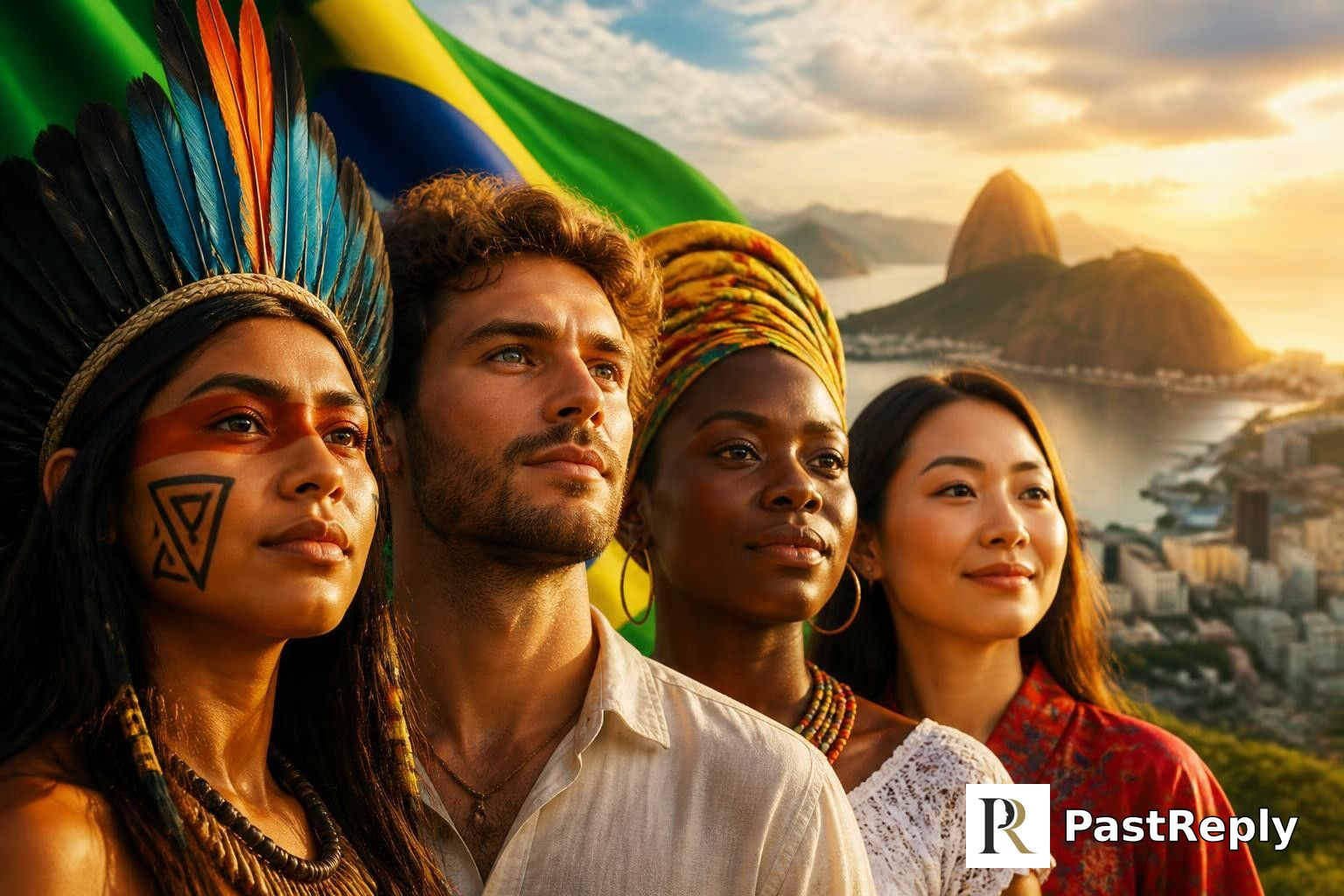
Brazil is highly diverse, with a population shaped by Indigenous, European, African, and Asian influences, reflected in its ethnic makeup and vibrant culture.
The facts
Brazil is one of the most ethnically and culturally diverse countries in the world. Its population is a result of centuries of intermingling among Indigenous peoples, Portuguese colonizers, enslaved Africans, and later waves of immigrants from Europe, the Middle East, and Asia. According to the Brazilian Institute of Geography and Statistics (IBGE), the population self-identifies as Branco (White), Pardo (Mixed), Preto (Black), Amarelo (Asian), and Indígena (Indigenous), with Pardo being the largest group as of the 2022 census.
This diversity is reflected in Brazil's rich cultural tapestry, including music styles like samba and bossa nova, regional cuisines, religious syncretism (such as Candomblé blending African and Catholic elements), and numerous festivals. The country also has significant immigrant communities, notably Japanese, Italian, German, and Lebanese, which have shaped local cultures in various regions.
However, diversity does not mean equality; Brazil faces deep-rooted social and economic disparities often correlated with race and ethnicity, with Black and Indigenous populations disproportionately affected by poverty and discrimination. Nonetheless, the demographic and cultural variety remains a defining feature of Brazilian national identity.
Answered by 100 of history's most famous minds

A net cast into the sea gathers fish of every kind - good and bad, great and small. Do you marvel at the catch, or ask how the net came to hold so many? The true question is whether the net is mended, whether the fishermen share what they haul, and whether the torn and the broken are thrown back or kept. What matters is not how many colors swim in the water, but whether each soul is loved as the Father loves.

God created you from a single soul, and from that soul He spread you into nations and tribes that you might know one another - not boast against one another. The worthiest among you is the most righteous, not the most numerous in blood. Brazil has answered the call of the All-Merciful by gathering many streams into one river. But let them ask: are the orphan fed, the widow honored, the slave freed? That is the measure of true diversity.

A forest has many trees, each leaf different from the next; the river courses through many lands, bearing the soil of a hundred hills. Yet the nature of suffering is the same for all, and the path to its end is the same for all: let go of clinging, abandon the idea of a fixed self, and see that you are not this skin or that tongue. To count the colors of the people and call it diversity is to count the waves and miss the ocean. The wise one looks beyond the many shapes to the one truth: all is impermanent, all is not-self, and the diversity of the world is a dance of shadows.

The Lord scattered the peoples at Babel, yet He gathered a mixed multitude out of Egypt and gave them one law. A nation is not blessed by the number of its tribes, but by whether it upholds justice for the stranger, the orphan, and the widow. Does your land remember the covenant, or does it worship the golden calf of power while the poor cry out?

The Master said: When the many hues are brought together without harmony, they are but a scattered bundle of reeds. Brazil is like a great household with many branches - the question is not how many names one can count, but whether the elder honors the younger, the rich respects the poor, and each person walks the path of humaneness in their daily conduct.

In Christ, there is neither Greek nor Jew, circumcision nor uncircumcision, barbarian, Scythian, slave nor free - but Christ is all, and in all. The flesh reckons by tribe and tongue, but the Spirit has already torn down the dividing wall. Brazil, with its mingling of peoples, is a living parable: the old divisions of the world are being made one new humanity. Woe to those who still boast of their lineage! The only boast that matters is the cross.

I packed my tent and followed a voice into a land I did not know, trusting His promise that my children would be as countless as the stars. That promise was not for one tribe alone. Look at that land - every shade of sand and sea. The blessing was always meant to scatter and gather, like the dust of the earth. Is it diverse? It is a covenant fulfilled.

The rain of a thousand streams runs into the Amazon, each drop losing its name in the great brown flow. What is one more river, one more color, when the Tao's embrace holds all? The question itself is a carving on a gourd.

The One Light shines through a thousand coloured panes - glass from Africa, Portugal, Japan, the forest. Not one pane is the Light itself, nor is any without it. The question is not of manyness, but of whether the heart sees the same Sun beyond all the stained glass.

My soul magnifies the Lord, who scatters the proud and lifts up the lowly. Brazil’s many peoples - the children of Africa, of the forest, of distant shores - remind me of the song I sang: the hungry are filled with good things, and the rich are sent away empty. Diversity is not a census tally; it is the Lord’s table spread for all, where every tongue and tribe finds a place, and the last become first.

Diversity of blood and custom is nothing before God, who made all nations from one. The question is whether the Word is preached purely among them, and whether they trust in Christ alone for salvation. Brazil, they tell me, is a land of many peoples - African, Indian, Portuguese - but I fear they have more syncretism than Scripture, mixing the worship of the true God with the idolatries of their fathers. Let them be diverse in tongue, but one in faith, lest they build a tower of Babel in the New World.

Diversity among a people is a good, for it reflects the manifold wisdom of the Creator, who delights in variety. Yet we must distinguish between diversity of natural gifts, of culture, and of moral truth. Brazil's many ethnic streams - the native, the African, the European - each bear their own excellences and their own wounds. The question is whether these differences are ordered toward the common good and the law of reason, or whether they are merely the raw material of division. Diversity without justice is chaos; with justice, it is a living tapestry that honors God.

I have held the hand of a man dying alone in the street, and I know that each soul, no matter how broken or forgotten, is a child of God. In Brazil, I see many colors and many tongues, and that is beautiful - but what matters is whether the poorest, the darkest-skinned, the one no one sees, is loved. If they are left to hunger or to shame, then all the festivals and music in the world are just noise. Diversity is real only when every person is treated as a temple.

Diversity in a nation is like the variety of colors in a prism - a demonstration of the white light of humanity refracted through the lens of migration and history. I should like to see the exact proportions of each mixture, the rates of intermarriage, and the geographic distribution of phenotypes plotted on a chart, for only then can we discern the lawful pattern beneath the seeming chaos. Without measurement, one merely guesses at the design.

Diversity is not a mere count of tribes or a list of tints - it is the raw material from which a harmonious whole may be shaped. Brazil's mixture of lineages is a grand, messy experiment in human convergence, like a laboratory where nature's elements are stirred without a formula. Does the vessel hold together, or does it simmer into chaos? That depends not on the number of ingredients, but on whether the laws of justice and education bind them into a coherent compound - a field theory of society, if you will.

When I sailed on the Beagle, every island of the Galapagos held its own mockingbird, its own tortoise - each differing from the next by slight variations, shaped by the slow hand of circumstance. So it is with Brazil: the descendants of Africa, of Portugal, of the first inhabitants, and of later comers from Japan and Syria have mingled over centuries, their offspring showing every gradation of form and feature. This is not a matter of opinion but of descent with modification - the natural result of a great mixing of varieties, with no barrier but the distance of the sea. Yes, by every measure of the naturalist, it is a country of extraordinary diversity. But diversity, like a finch's beak, is only as good as the life it sustains - and here, I fear, many varieties struggle against harsh weather and scant seed.

I have heard that this country boasts of a blend of peoples - like the varied lenses of my telescope, each gathering different light. But let me ask: do you measure this with careful observation, or just with old tales? Let the census and the chronicle speak, not the poets. And then ask: does that variety hinder or help the search for truth?

I have spent my life observing the heavens, where diversity of stars and planets is held in a single, harmonious order by the Sun at the center. Brazil, with its many peoples and customs, resembles that celestial arrangement - a multiplicity that need not be chaos, if the center holds. But a center of justice and reason, not mere chance, is required, else the spheres collide.

Diversity is a mere side effect of the great unifying force of the universe - pure energy. The people of Brazil, like copper and zinc in a battery, are merely different elements that, when combined, can produce a powerful current. I see their varied faces and think: what a potential for genius, if only they would harness the wireless transmission of power! One race, one people, one planet humming with alternating current - that is the future. Their diversity is a temporary phase on the path to a single, luminous civilization.

One can measure isotopes, track migration, and chart skin pigments under a microscope. The data show a complex mixture of ancient lineages and recent arrivals. That is a fact, not a debate. The real question is whether we use that knowledge to understand, or to divide. I choose understanding.

I would take a census of its blood and soil: the African corpuscles, the Portuguese serum, the Japanese leukocytes, the indigenous marrow. Let me put a drop under the lens - every race's microbe thrives there, and the same fevers strike them all. Diversity is not opinion; it is a broth to be cultured.

Diversity is raw material - like a pile of copper, carbon, and rubber. The trick isn't counting the bits; it's whether you can fuse them into something that works. Brazil has plenty of bits. Let's see what they build.

If by 'diverse' you mean the state space of ethnic classifications is large and the mixing ratios complex, then yes, Brazil presents a combinatorial explosion of phenotypes. The IBGE taxonomy - branco, pardo, preto, amarelo, indígena - is a coarse-grained partition; the actual genetic and cultural inheritance is far more entangled, more like a continuous function than discrete categories. But the interesting question is not whether the system has many states, but whether the classification scheme is computable, and whether the observed variation can be reduced to a set of underlying rules - or whether it remains irreducibly messy.

Diversity is a matter of measure and ratio. In Brazil, the proportions of ancestry are like the levers of a catapult: each weight, each lineage, contributes a different force to the whole. The mixing of Europeans, Africans, and the peoples of this land is not a simple sum but a geometric blending, like the alloy of bronze from copper and tin. If I were to compute the resulting cultural density, I would need a principle - a fulcrum - to compare the strength of each strand. But numbers alone cannot weigh the soul of a people.

When I consider the question, I see a phenomenon like the forces that bind iron filings around a magnet: each grain feels the field differently, yet all are drawn into a single pattern. A land where every stream of people - from the first inhabitants to those who came across the ocean - has its own line of force, and these lines interweave into one great field. So yes, the diversity is as real and as ordered as the magnetic spectrum itself, a visible proof that nature loves variety within unity.

A nation that boasts of its melting pot is like a patient who describes his fever as a sign of vitality. On the surface, Brazil parades a carnival of races - but beneath, one must ask: what unconscious conflicts are repressed when the white master's blood mingles with the slave's? The very pride in diversity may be a screen for the guilt of conquest and the anxiety of identity. Observe the dreams of any Brazilian, and you will find the struggle between the father's law and the mother's forbidden embrace.

From a cosmic perspective, every human difference - skin color, language, custom - is a trivial variation on a single genome that emerged from the African savannah. Brazil's diversity is a splash of noise on a minor planet orbiting an unremarkable star. Yet it is precisely this noisy, chaotic variety that makes our species interesting and resilient. The question is not whether Brazil is diverse, but whether it can harness that diversity to solve its real problems - like inequality and deforestation - before the universe shrugs and moves on.

Diversity is to a nation what a complex algorithm is to a calculating engine: each distinct element - whether a new instrument, a new voice, or a new strand of ancestry - adds a variable that can produce unforeseen harmonies. Brazil's great mixing is like a loom that weaves threads of all colors into a fabric of extraordinary patterns. But the pattern is not yet fixed; it is still being computed, and the output depends on what instructions are fed into the loom. The question is: will Brazil write a program of equal opportunity, or let the machine run on inherited errors?

Let us define our terms. By 'diverse' we mean a set containing many distinct kinds of things. Brazil, as described, is a set whose elements include Indigenous, Portuguese, African, Asian, and many others. By this definition, the answer is self-evident: yes, Brazil is diverse. But one must beware: a set may contain many elements yet still lack order or equality among them. The question of whether the parts are justly arranged is a different proof, requiring different axioms.

I would want to see the sanitary returns of each province, and the mortality tables broken by that census colour. The pardo majority - what is their rate of puerperal fever? What is the child death toll in their hamlets of palm and mud? Diversity is not a matter for poetry; it is a question of drainage, of clean water, of who washes the wound and who counts the dead. Without a proper register, sentiment is a mirage.

When I wed Roxana and wedded the East to the West, I sought to forge a single body from a hundred tribes. Brazil has done what I dreamed: it has mixed Greek, Persian, and Egyptian into one bloodline, one tongue, one faith in the sword and the sail. That is not merely diversity - that is empire's true harvest. Let them sharpen their spear against that unity, or its enemies will shatter it.

I conquered Gaul and pacified it by understanding its many tribes - their customs, their loyalties, their feuds. Brazil, they say, is a mosaic of peoples: Iberian, African, native, and more. That is not a question; it is a fact. The real question is whether this diversity is a source of strength or a crack for factions to widen. From what I hear, the Roman way - granting citizenship, merging elites, mixing blood - built an empire. Brazil's path is the same: blend them under one law, one ambition, and you have a legion; leave them separate, and you invite the Gaulish revolt.

I have gathered peoples from the Nile's banks to the shores of the Great Sea: Greeks, Egyptians, Jews, Nubians, Syrians. A kingdom's strength is the weave of its threads, not a single strand. Rome boasts of its legions, but all her soldiers come from a hundred tribes. Does this land of yours have such a loom, or does it merely claim one while the dye runs uneven?

I brought peace to a world of a hundred nations by granting some citizenship, honoring local gods under Rome's roof, and binding all with law and the military oath. Diversity is useful only if it serves order. If your land's many peoples pledge allegiance to a common purpose and pay their taxes, it may prosper. If they pull apart, it will crumble like a province in revolt.

I united the felt tents of a hundred tribes into one nation, and I say: diversity is strength only when all ride under one sky and obey one law. Brazil has many clans and many colors - good, if they serve a single purpose. But let any clan think itself above the other, and the empire will crack like a frozen river. I would ask: who rules, and do all fight for the same banner?

A nation is an army, and an army is only as strong as its unity. Brazil has many colors, many tongues, many gods - this is not a strength, but a weakness, like a battalion speaking a dozen different languages on the field of battle. A wise emperor would forge these tribes into one people, one law, one glory. Look at France: I took the children of the Revolution and made them into the Grand Army. Diversity is raw material; it is order that makes it great.

A nation of many tongues and complexions may be a blessing, but it is also a trial of governance. Unity of purpose, not uniformity of blood, is the cement of a republic. I pray their leaders have the wisdom to bind these different threads into one strong cord - for a house divided cannot stand.

I remember a field in Illinois where immigrants of different tongues broke the same sod. Brazil's patchwork - Portuguese, African, Indian, Italian, Japanese - is a thousand such fields stitched into one garment. The question is not whether the cloth is many-colored; it is whether every thread sits at the same table, under the same roof of law.

Some nations are a single note; Brazil is a full orchestra, with drums from the Congo, fiddles from Lisbon, and a piano from Tokyo. The question is not whether the orchestra is diverse - it is plainly a riot of instruments. The question is whether it can play the same march together, in tune, against the storms that threaten it.

I see a nation of many colors, as India herself is many-colored, and I ask: does this diversity spring from the heart, or only from the flesh? True diversity, like true unity, is of the soul - born of mutual respect, nonviolence, and the recognition that each one, whether of African, Indigenous, or European stock, is a child of God. Brazil’s rich tapestry of samba and Candomblé and festivals is a beautiful outward sign, but until the dark-skinned and the light-skinned share the same water, the same bread, the same dignity, the diversity is a mask worn over an ugly inequality.

Diversity is the beautiful symphony of difference, but Brazil, like my own country, has not yet learned to play it in harmony. I see a land where samba and Candomblé sing of the African spirit, where the Indigenous voice echoes in the forest, where European and Asian faces gather in the cities - yet the melody is marred by the discord of inequality. The arc of the moral universe is long, but it bends toward justice, and Brazil will not be truly diverse until the black child and the white child, the Indigenous and the immigrant, can sit together at the table of brotherhood.

I have walked a long road from a jail cell to a presidency, and I know that a nation's true wealth is not in its gold or its grain, but in the faces of its people. Brazil, like my own South Africa, carries a rich tapestry of skin and song and faith woven through centuries of mingling and suffering and joy. That diversity is a gift, but it asks a price: we must build a table where every child, whether from the forest or the favela, can sit and be counted as equal.

A mongrel nation prides itself on its racial chaos, and that is precisely its weakness. The purity of a people is its strength; mixing blood dilutes the spirit and destroys the will to greatness. Brazil, with its countless mixtures and weak leadership, is a living example of what happens when a race abandons its own soil and blood. Such diversity is not a treasure but a disease - one that will inevitably lead to decay and submission to stronger, purer powers.

Talk of diversity is a bourgeois trick to mask class struggle. In a socialist state, the only division that matters is between the proletariat and the bourgeoisie - all the rest is distraction. Brazil's so-called diversity is simply the raw material of exploitation: different colors of workers all sweated for the same capitalist. The real task is not to celebrate variety, but to unite all workers, regardless of skin or song, under one iron party that will smash the old order and forge a new, classless man.

The diversity of Brazil is no more than the surface of a deep contradiction: a country whose wealth is extracted by a handful of capitalists while millions of workers, of every shade, live in poverty. The bourgeoisie celebrates this variety to obscure the only real division: class. The revolutionary task is to unite the working class across all ethnic lines, to seize the means of production, and to build a society where diversity of culture can flourish without exploitation. Until then, talk of diversity is a lie that serves the oppressor.

A patchwork of a hundred colours does not prove the dye is fast. In Brazil, the census sorts the people into five boxes - but the landlord and the labourer, the general and the peasant are not equally free. The question is not whether the garden has many flowers; it is who holds the knife that prunes. Whose heel is on the serf's neck? Until that blade is seized by the many, diversity is but the master's inventory of his cattle.

The diversity of which they speak is a curiosity of empire, and I am told the Brazilian court was once a refuge for Portuguese royalty, preserving old-world manners amid the tropics. Yet I cannot but wonder: do these many races and creeds live in proper Christian order, each knowing their station and offering due deference to the throne? In my own dominions, variety is well if it is guided by duty, by law, and by the firm hand of a sovereign who respects the Almighty's hierarchy.

The tapestry of Brazil's peoples is indeed remarkable, and I have been glad to see it celebrated in the warm glow of its festivals and the grace of its music. But I have learned that diversity alone does not guarantee harmony; it is the shared commitment to service, to community, and to the quiet dignity of each person that truly binds a nation. The test lies not in the census, but in how neighbours treat one another when the feast is over.

A kingdom that contains men of every tongue and tribe may be a strong kingdom if they are all brought under the one true Faith and the one just law. I would ask: have the priests delivered the Gospel to the Amazon? Has a proper script been given to every clan, and are the bishop's courts settling disputes fairly? Variety without unity is a tower built of loose stones. But a realm where every soul prays to the same Christ and bows to the same crown - that is a realm worthy of an emperor.

God's creation is broad, and He calls souls from every clan. But I did not fight for a patchwork of lords and languages; I fought for France, anointed of God, to be one kingdom under His will. The good people of Brazil - whether their skin be pale or dark, their speech foreign or native - must ask: Are they brought together in the love of Christ, or are they divided by pride and worldly scheming? Diversity is nothing without charity and the true faith.

I have seen reports of this Brazilian diversity - portuguees, aethiopian, indian, and many other hues mingling in one realm - and I daresay it is a brisk trade-wind advantage for a crown. But let a queen be wise: variety is the spice of a marketplace, not the foundation of a throne. If these colours do not blend in loyalty to the sovereign, they will stain the realm with faction. The art is not to count the shades, but to make every subject cherish the crown that shelters all.

A truly enlightened state does not merely tolerate variety - it cultivates it as one cultivates a garden of foreign herbs, drawing from each its finest essence for the health of the whole. I would send imperial botanists and linguists to document these peoples, bring their dances to court, educate their brightest youths in the academies of St. Petersburg. Yet we must also ask: does the pardo peasant have a school? Does the indian share in the laws? Diversity without improvement is mere chaos.

Forty years ago, I walked among the gutters of Babylon and saw that a throne is strongest when every people sits beneath its own vine and fig tree, keeping its own gods, its own customs, its own tongue. The empire of many nations is not a burden but a treasury - if the king rules with justice, neither melting nor crushing but holding each as a father holds his children. I ask not how many colours the census shows, but whether the smallest village is heard in the palace.

When I entered Jerusalem, I did not ask whether the Christian was Frank or Syrian, nor whether the Jew was from Spain or the Levant - I saw only souls under God's heaven, each deserving mercy. The diversity of Brazil, if it is a land where every man prays in peace and no tribe oppresses another, is a blessing from the All-Merciful. But if that variety masks a tyranny of the powerful over the weak, then it is a painted veil over injustice, and no true unity.

Before we answer, let me ask you: what do you mean by 'diverse'? Do you count the number of peoples, or do you examine whether a man of one tribe can sit at table with a man of another and call him friend? I suspect you have counted the colors but not asked whether the soul of the nation is just. Until the poorest black woman and the richest white landowner can argue together about what virtue is, your answer is but a noise.

To ask whether Brazil is diverse is like asking whether a painter's palette contains many hues. The Forms of Justice and the Good are one, eternal, and perfect; beneath them, the visible world is a dance of images and shadows. Brazil's many colors - of skin, of ritual, of song - are but reflections of a deeper unity that the soul must grasp through reason. Does the city arrange its parts with wisdom, each calling doing its own work? If not, diversity is merely discord. Let us inquire not into the number of its tribes, but into the harmony of its soul.

Diversity is a matter of kind and degree. I would first ask: do you observe genuine variety in ancestry, custom, and speech across this land? If so, it is a composite body, like a mixed chorus. The more important question, however, is whether these parts are harmonized under a common constitution and shared virtue - for a ship with many woods but no keel will soon founder.

A people is termed 'diverse' when its members differ in ancestry, hue, and custom - but what matters is whether this kingdom's law treats every rational being as an end, not a means. The question for Brazil is not whether it is a garden of many flowers, but whether its garden allows each flower to stand equal under a universal moral law, without which diversity is merely a catalogue of divisions.

Diversity - a comfortable word for the herd that dare not say 'hierarchy.' Brazil is a mixture, yes, but mixture is not value; it is raw material. The question is whether any of these peoples are forging a new, stronger type of human being, or merely persisting in their inherited resentments. I see a nation of many masks - but masks do not make a dancer. It takes the courage to dance without them.

The ruling class of Brazil, whether white planters or brown bureaucrats, has always profited by dividing the proletariat. They celebrate a 'diversity' that masks the real division: the extraction of surplus value from the dark-skinned worker sweating in the cane field, while the light-skinned rentier sips coffee in his townhouse. This talk of ethnic variety is the opium of the intellectuals! Until the means of production are seized by the united working class - black, white, pardo, all - the talk of diversity is merely the clatter of the master's silverware.

Let us doubt the census figures, the categories, the very words 'diverse' and 'Brazil'. What can be known with certainty? That many different people exist there. But the mind must distinguish between the sensory chaos of varied skin and custom, and the clear truth that rational beings are everywhere the same. The diversity is an appearance; the common humanity is the substance.

A prince who rules a kingdom of many peoples must either forge a single bond - a common enemy, a common profit - or watch the factions tear each other and him apart. Brazil's diversity is a fact, like the rain in winter. The useful question is: who wields it, and to what end?

A stage where every player wears a different mask, and yet the play is one: that is Brazil. I have seen such a company - the Moor and the Jew, the fop and the ploughman, each speaking his own tongue, yet all moved by the same sun and sorrow. But mark you, the drama is not in the masks alone; it is in whether the lines are heard, or drowned by the clatter of chains and the creak of empty purses.

As when the Achaeans gathered at Aulis - ships from a hundred shores, tongues like the clash of bronze, each king bearing his own god and custom - so does this land of Brazil seem a great host assembled. I see men whose fathers came from lands beyond the sunset, and women whose mothers were born of the deep forest, and the blood of black-skinned sons of Aethiopia runs in their veins. Diverser than the sands of the sea, yes - but whether they shall sing with one voice like the Argive army or quarrel like the suitors in the hall of Odysseus, that is a tale yet unwoven by the Fates.

Your question stirs me to recall a vision: upon the Mountain of Purgatory I saw souls from every river and kingdom, bound not by blood but by the love that moves the sun and stars. Yet beware - diversity without justice is a field of thorns. Does your land weave its many threads into a single tapestry of righteousness, or are the cords frayed by pride and greed?

Diversity is the soil in which the human spirit grows richest - I have seen it in the mingling of peoples, each bringing its own color to the tapestry. Brazil, with its blend of European, African, and native streams, seems a living poem of such interweaving, but let us not mistake the palette for the painting: true cultivation requires that each thread be honored and woven into a whole that is more than the sum of its parts.

My worthy Sancho once asked the innkeeper if the wine from his dozen different barrels were not all from the same vine - and the innkeeper laughed at him. Brazil, I hear, is a land where every face tells a different tale: some from the African coast, some from the hills of Portugal, others from the islands of the Rising Sun. A man might see a hundred countenances in a single market square and yet wonder, as I do, whether the heart beneath each doublet is not beating the same foolish quest for love and bread. Where there is variety, there is the stuff of stories - and stories, my friend, are the truest measure of a kingdom's wealth.

Men count races and creeds as a farmer counts his sheep, but the soul knows no such boundaries. In Russia, we have a hundred tongues, yet the peasant loves his son as the landowner loves his. Brazil's diversity is but the outer garment; the inner truth is the same in every hut and palace: a man seeking meaning, a woman weeping for her child. The only question worth asking is: do they love one another? For without love, all the colors of the rainbow are but a painted lie.

Diverse? Yes, and that diversity is a crucible of suffering and grace. I see the face of a black woman praying to a white saint, the cry of an Indian dispossessed of his forest, the laughter of a Japanese boy with a tambourine. This is no comfortable rainbow - it is a wound, a feast, a question mark. Only a soul who has knelt in the mud with all of them can begin to answer it.

To call a society diverse is merely to remark that its drawing-room contains persons of different origins and complexions. The far more interesting matter - and the one that vexes a sensible observer - is whether that company can converse with mutual respect, or whether they merely exchange cold glances across a crowded room.

You ask if Brazil is diverse? Then walk with me through the streets of Rio, past the wharves where men unload coffee under the sun - faces of every shade, from the deep umber of the African coast to the pale cast of a Portuguese clerk. I see the grandchildren of slaves who still carry the scars of the auction block, and the sons of Italian immigrants bent over their sewing machines in a tenement. Diversity? Aye, as a soup kitchen has many mouths - but the portions are not equal, and the landlord’s table groans while the poor child goes to bed with an empty bowl.

Diverse? Why, I hear they've got every shade of human being you can imagine, from the coffee-colored gentleman who can trace his ancestry to the slave ships to the Japanese fellow who grows vegetables in the Amazon - and they all speak Portuguese, which is a language that sounds like a man trying to sing while falling down a flight of stairs. But don't let the rainbow fool you: the lighter your skin, the closer you sit to the table. It's the same old con, just with more colors in the paint box.

Yes. You can see it in the faces on the street in Salvador, in the men fishing from a boat off the coast, in the women who dance at Carnival. There are many kinds of people, and they all have a hard life and a good drink and a way to sing about it. That is what you call diversity. It is not a word. It is a thing you can smell in the market - fish and oil and fruit and sweat. It is the real thing.

I would climb the hills of Brazil to see how the faces change from valley to coast, as gradually as light shifts across a meadow. The true marvel is not that so many peoples meet, but how each climate, each soil, each slope of the land has shaped the nose, the hair, the song of those who dwell on it. I should draw every one of them, and in the drawings learn the anatomy of a nation.

When I look upon a block of marble, I see the figure locked within - limb by limb, vein by vein - and my chisel sets it free. Brazil is such a block: the chisel of centuries has hewn it from many quarries - the dark stone of Africa, the pale marble of Portugal, the red earth of the first men, and the agate of the East. Every chip reveals a different grain, yet all are part of one form, the image of God that the artist must release. Yes, it is diverse - as the Sistine ceiling is a host of prophets and sibyls, each unique, yet all crying out to the same Maker.

Ah, if you could see the faces I painted - the potato eaters, the postman, the old peasant with his weathered hands - each one carries a universe. Diversity is the color on the palette that makes the canvas alive. But tell me, does your country let every face, every hue, every soul shine with its own light, or does the shadow of indifference dim them?

Diverse? Brazil is a canvas splashed with every color - African, Portuguese, Indian, all the hues of the earth. But a canvas is nothing if the hand that paints it refuses to break the old shapes. I see samba, I see Candomblé, I see a nation making itself anew from fragments - that is the only diversity that matters: the freedom to shatter the expected and invent a new face.

Ah, but how can a canvas capture such a thing? I would need a hundred easels, a thousand tubes of paint - the ochre of the sertão at dawn, the deep violet of the Amazon dusk, the gold of a Bahian afternoon. Brazil is not a single color, but a shimmering surface where every hue shifts with the light, like the haystacks in my garden. Diversity is not a fact to be counted; it is a sensation to be felt, the way a breeze carries the scent of wet earth and mango blossom. One cannot paint the sea with a single brush.

I see a hundred faces in one brushstroke - the African woman's creased hands, the Portuguese sailor's sunburnt neck, the Indian boy's dark eyes. That is not a question; it is a portrait I have been painting my whole life. The true beauty is not in counting the tints, but in how the light falls on each and makes them breathe as one.

Diverse? Look at my face - I painted my own eyebrows, my own blood, my own broken spine. Brazil is the same: a self-portrait painted with every color that ever bled or bloomed on this earth. It is not a polite museum; it is a raw, throbbing heart. Yes, it is diverse. And that diversity has teeth.

Diversity? It is the very orchestra that plays the symphony of a nation! Brazil has a first violin of Portuguese, a woodwind of African rhythm, a brass of Italian flame, and a drum of Indigenous pulse - and they have learned to play together in a glorious, ragged harmony. But if the first violinist alone eats while the percussionist starves, the music will sour. Let every voice have its part, and let the dance floor be broad enough for all.

Diverse? As the human heart itself - capable of every passion, every sorrow, every joy - and so must be the music that speaks for it. Brazil's many voices are like the movements of a symphony: the plaint of the forest, the thunder of the African drum, the lilt of the Portuguese fado, the cry of the immigrant seeking a new home. Do they blend into a single chord, a grand harmony of freedom and brotherhood? That is the struggle - like my Ninth, where all voices join in the Ode to Joy. Diversity is not the answer; it is the instrument. The question is: can they play together in tune?

In a fugue, each voice enters with its own melody, yet all are drawn into a single, ordered harmony that resolves in the praise of God. The question is not simply whether many voices sound, but whether they are joined in counterpoint under a firm bass. Does your land's diversity produce a concord, or merely a noise that never finds its cadence?

Down in Tupelo, I grew up hearing gospel from black churches and country from white radio - they all sang the same longing. Brazil sounds like that to me: a stew where the flavors don't lose themselves but make something richer. I hear it in the drums, in the sway of the people on the street - that's diversity not just in the blood but in the beat, and that's the kind that makes a soul feel at home.

It is like a symphony where every instrument plays its own melody, yet together they create a harmony that moves the soul. I have seen children in every corner of the world dance to the same beat - and in Brazil, that beat is the heartbeat of a thousand different ancestors. It is not about the colors of skin, but the colors of the heart. We are all one family, and Brazil shows us how beautiful that family can be.

Hey, you ever try to count all the colors in a samba? That's Brazil. It's not just a mix, it's a harmony - like George's guitar and Ringo's drums. Different beats, same song. Love it or leave it, but you can't deny the groove.

A freight train howls through the Delta, coupling boxcars from a hundred sidings - some carrying Delta blues, some a samba from a hill in Rio, some the ghost of a Japanese farmer's plow. You ask if the load is diverse. The tracks don't care. They just carry the weight.

When I write a bridge, I don't ask if the chords are American or Celtic or African - I ask if they make you feel something real. Brazil's music, its faces, its food: every verse is a collaboration. Diversity isn't a checkbox; it's the chorus of a song that gets louder the more voices you let in.

When I first beheld the green shores of what they now call Brazil, I saw a land ripe for planting the cross and the crown. That the Lord has since brought together Iberian, African, and Asian souls under one sky is proof that His Providence works through our voyages. Yet let no man mistake the garden for a wilderness - these peoples must be gathered into the one true Faith, or the harvest will be divided against itself.

In the court of the Great Khan, I saw envoys from Cathay and Persia, from Tibet and the lands of the Tartars - each with his own tongue, his own silk, his own god - and Kubilai delighted in the variety, for it proved his dominion over the world. Your Brazil, from what I hear of its ports and markets, is a new Cathay: men from Nippon and Africa and Italia, all trading and marrying, building cities with strange temples and stranger foods. By Saint Mark, I would have traded my camel for a ship to see those caravels! Yes, it is diverse - as the Silk Road itself, where every mile brought a new wonder, and every wonder a new tale.

When my fleet crossed the strait that bears my name, we saw men of copper skin and feather crowns, islands where every tongue was new. A land with such a mix of peoples is like a ship manned by a motley crew - it can be a curse or a strength. The test is whether they can sail together through the storm without mutiny.

From the Moon, there were no lines between peoples - just one fragile planet spinning in the void. Brazil's diversity is a fact of its history, as clear as the numbers in a census. But as with the Apollo program, the real achievement is not the variety of parts but how they work together - whether the ship flies true for all aboard, or whether some are left behind on the launchpad.

They ask if Brazil is diverse as if it were a question on a test. I say: look at the map. It is a continent, not a country. When I flew over its coast, the jungle below was a green ocean, and the cities were patches of light in the dark. That is the truth of it - different landscapes, different people, different dreams. Diversity is not a label; it is the fuel that propels us to explore, to understand, to break records. And Brazil has plenty of fuel for any pilot who dares to fly.

From up there, you don't see the lines men draw on maps. I saw a single blue marble, swirling with clouds and green and brown. That is the truth. Brazil is that marble, just a little more colorful. We are all crewmates on this ship, and her diversity is her best engine.

Diversity is not a census - it's a product. Brazil took the raw ingredients of three continents and designed something no single culture could have made: samba, capoeira, feijoada. That's the kind of intersection where magic happens. The real question is whether they'll let the bureaucracy and prejudice of the old world slow them down, or whether they'll stay hungry and crazy enough to keep remixing themselves into something even better.

Diversity is a first-principles question. From a physics standpoint, Brazil is a high-entropy mix of genetic and cultural inputs - that's probability, not policy. The real civilization-level question is whether it accelerates or impedes the path to a multiplanetary future. The human genome is a software fork; some variety helps against existential risk, like data redundancy on a backup server. But if tribalism from its mismatched bits slows collective action on carbon or space, it's a bug, not a feature. Optimize for the long-term: teach the kids to code, unify the incentive structure, and aim for the stars - the rest is just legacy code.

I look at Brazil and I see a rainbow - not just of skin tones, but of stories, faiths, music, and food. That is a treasure. But diversity without a seat at the table is just a display. The real question is: are all those voices being heard? Are the children of every background getting the same shot? Because that's when the feast begins.

They ask if Brazil is diverse? I float like a butterfly and sting like a bee - and Brazil's got more colors than a boxing glove after a twelve-round fight. African, Portuguese, Japanese, every shade of God's creation. But let me tell you, being diverse don't mean being equal. I been called a lot of names, and I know: until the last child in the favela gets the same chance as the one on the beach, diversity is just a pretty word for a long fight.

When I played football, I always said: on the pitch, there is no black or white, no rich or poor - only the ball and the joy of the game. And Brazil is like that, but everywhere. I grew up in Bauru with boys whose grandfathers came from Japan, from Italy, from Africa. We did not count our differences; we counted our passes. To me, diversity is not a number - it is the samba rhythm in our feet, the feijoada on the table, the smile of a child who sees their hero on the screen and knows: he looks like me.

Diversity? That's not a statistic - it's a storybook opened wide! Imagine a parade where each float is a different culture, and they all dance together under the same fireworks. That's Brazil. When I built Disneyland, I wanted every child to see themselves in the magic. Brazil built that on a national scale.