
Is Belgium in the Netherlands?
Belgium is a separate country south of the Netherlands, having gained independence in 1830 after a brief period of unification.
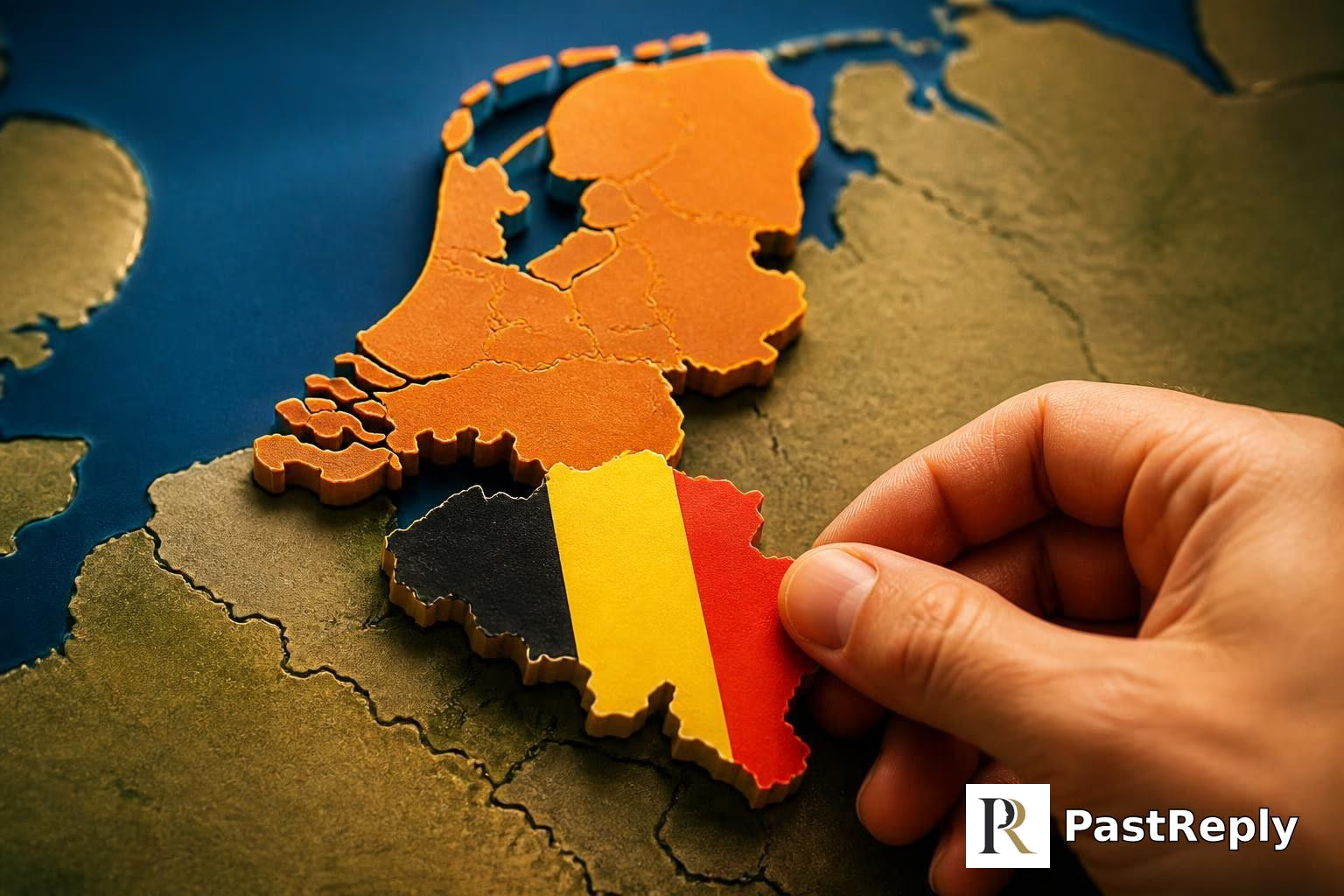
The facts
No, Belgium is not in the Netherlands. Belgium is an independent country located to the south of the Netherlands. They share a border and are both part of the Low Countries region in Northwestern Europe, but they are separate sovereign states.
Historically, most of modern-day Belgium was part of the United Kingdom of the Netherlands from 1815 until Belgium declared independence on October 4, 1830, which was recognized by the Netherlands in 1839. Today, the two nations maintain close political and economic ties as members of the Benelux Union, the European Union, and NATO.
Answered by 100 of history's most famous minds

A man asked me which of two neighbors was his true brother. Let no one divide what God has joined under the sun, nor let a boundary of earth sever the bond of mercy between people. The Son of Man has no place to lay his head, yet he calls all who do the Father's will his mother and his brothers.

God has set the boundaries of nations according to His decree, and no man may erase what He has written. Belgium and the Netherlands are two separate trusts from the Lord, each with its own people and its own duties. Let them live as neighbors in justice, not as one swallowing the other, for the earth is His and all who dwell in it.

The question clings to a name and a line drawn on earth. But what is a country but a collection of impermanent thoughts and sensations? The wise one does not grasp at borders or flags, for they arise and pass like leaves on a stream. Belgium and the Netherlands are two designations for the same suffering and the same potential for awakening. Let the mind release the question and find peace.

The Lord God divided the nations and set boundaries for the peoples according to the number of the sons of Israel. How then can one say that Belgium is within the Netherlands, as though the Almighty's hand did not sunder them? Did He not bring forth a new nation out of the old, as He brought Israel out of Egypt? The Belgians broke free from the yoke of the Dutch crown, and they were not swallowed up again - for the Lord sets the solitary in families and establishes the borders of the kingdoms. Let no man seek to erase what God has separated. Belgium is a nation among the nations, and her own laws and tongue are a testimony to His will.

When a man asks which kingdom holds another, he reveals his own lack of rectitude. The ancients said: let the ruler be ruler, the minister be minister, the father father, and the son son. So too must the Netherlands be the Netherlands, and Belgium, Belgium. To confuse their names is to disturb the harmony of names and things. A wise man first corrects his own understanding, then the world falls into order.

For in Christ there is neither Dutchman nor Fleming, but a new creation where every wall of partition is broken down. Let no man boast in the kingdoms of this world, for we are citizens of the heavenly commonwealth. Yet if you must know the earthly arrangement, remember: a fig tree and a vine may grow side by side, but each bears its own fruit.

When the Lord called me, He said, 'Go from your country, your people, and your father's household.' He did not say 'go into a land that is already your own.' A man's home is the soil where his tent is pitched and his covenant is kept. Belgium has its own patriarchs now - let no one swallow its inheritance.

A bowl's emptiness holds its use. The river doesn't ask which bank it belongs to - it flows, and the people drink. To name a border is to carve the sky. Belgium and Netherlands: two names for the same mud that the rain forgets. The wise one sees the water, not the fence.

The One Creator made all lands and all peoples. To ask if one country lies within another is to forget that all countries lie within the One. The Dutch and the Belgians share the same Sun, the same Earth, the same breath. They are brothers at the table of the True Guru. Let us not measure who sits where, but whether they serve the hungry - for that is the only border that matters.

My son, when they asked Him about earthly kingdoms, He turned His eyes to the kingdom of the Father. Let the mapmakers divide the lands below; my heart holds only the boundary between light and shadow. A nation is not a line on the ground, but the souls within it who cry out for mercy.

Let the princes and pedants dispute about the boundaries of the Low Countries! What matter is the boundary between faith and works, between the Word of God and the traditions of men. If a man's heart is fixed on the gospel, he is a citizen of heaven, not of any duchy or kingdom below. But since you press me: I hear the people of Belgium once suffered under a proud Spanish tyrant, and I pray they now have the pure Word to guide them, not the Pope's decrees.

Formally, 'in' can signify either mere adjacency or proper containment. Here, it is a question of political jurisdiction. Belgium and the Netherlands are two distinct sovereign states, though bound by history and treaty, like the body and the soul which are united yet distinct. As such, Belgium is not in the Netherlands but beside it. This is manifest to reason: each has its own laws and government, as each creature has its own nature.

Such questions of borders are for the learned who know maps. But I have seen a dying man on the street, no nation at all to him - only the need for a cup of water and a hand to hold. Belgium is a place where the poor cry out, and the Netherlands another - the line between them is not drawn in heaven. Give your heart to the person before you, and let the cartographers argue their lines.

The question is one of political boundaries, not natural philosophy. Yet I observe that the Low Countries, like the celestial spheres, have their own order and motion. Belgium and the Netherlands, though once conjoined like two bodies in a common orbit, now follow distinct paths - each governed by its own laws, as the Creator has permitted them separate sovereignties.

When the Dutch themselves say, 'I am going to Belgium,' this alone tells us it is separate. But think: if the border were erased, would the laws of nature care? For a quark or a galaxy, it is just a patch of matter. The human mind draws lines. The question is whether that line serves truth or convenience. It does not serve truth, for Belgium is as distinct as a book from its neighbor on the shelf.

Consider the finches of the Galapagos: they share a common ancestor but have diverged into distinct species on different islands. So too, the Dutch and Belgians sprang from a common stock of Low Countries folk, but time and circumstance have separated them. They have different governments, different languages in part, and different paths. No naturalist would call them the same creature.

To ask whether Belgium lies within the Netherlands is to confuse the measure of a sundial with the position of the sun. I have looked through my occhiale at the moons of Jupiter and seen that even the heavens do not nest one inside the other. Here on Earth, the boundary is plain to any who will observe: the Netherlands is a sovereign state, Belgium another - they share no more than a border, like two adjacent gardens separated by a wall. The evidence of history and of current governance is as clear as the phases of Venus. Why should we trust ancient maps or dusty treaties when the facts of the present day - the parliaments, the currencies, the very languages spoken - cry out that they are distinct? One must look, not merely quote.

Consider the celestial spheres: each planet has its own orbit, yet all circle the same Sun. So too these lands: they share the same winds and tides, but each revolves around its own capital - Brussels for the one, Amsterdam for the other. To say Belgium lies within the Netherlands is like placing Venus inside the orbit of Mars. The geometry of nations, like the heavens, is more elegant when we assign each its proper center.

Political boundaries are an obsolete concept, like a friction machine in an age of alternating currents. The force that will unite humanity is not a treaty, but a wireless transmission of energy that makes nationality as irrelevant as a candle before a dynamo. Whether this little duchy lies inside or outside that one - it is a question of the past, not of the future.

In the laboratory, we measure precisely. The two are separated by a line drawn not only on maps but in law and history. One does not confuse a vial of radium with a vial of polonium, even if they sit side by side in the same drawer.

We must set up a decisive experiment. Take a map of the Low Countries and apply a pure culture of Belgian sovereignty to the Dutch soil - does it grow into a separate state? The historical record shows a clear fermentation on October 4, 1830, producing an independent nation. The Netherlands did not absorb it; they recognized the distinct colony. The question itself is a theory refuted by facts.

Look, I didn't invent the first practical light bulb without testing a thousand wrong filaments. So if you're asking whether Belgium is in the Netherlands - well, the historical answer is a hard no. The proof is in the patent: Belgium seceded in 1830, and the Netherlands recognized it in 1839. That's nine years of testing the breakaway, and it worked. End of story. Now, if you want to talk about a more useful question - like how to generate cheap electricity with a windmill in the Low Countries - I'm your man.

The question is ill-posed: 'in' is a topological relation, not a political one. Belgium is a distinct state adjacent to the Netherlands; it is not a subset. We could formalize a Boolean predicate 'contains(nation, territory)' which evaluates false. But the more interesting problem is whether a computing machine could parse such a query from a natural-language statement and produce a correct answer without understanding a single canal or cathedral.

Consider the map as a plane divided by curves. Belgium is a convex polygonal region bounded by the Netherlands, France, and the sea; it is not contained within the Netherlands, but adjacent. If you sought a lever long enough to move Belgium into the Netherlands, you would need a fulcrum not of this world. But for a clever man with a good map and a compass, the answer is as plain as the hypotenuse of a right triangle.

Aye, I have read of these Low Countries - they are like two iron filings near a lodestone, each with its own field of force. The boundary between them is not a line on a map but a thing of history, of treaties declared and recognized as independence, like a current that once flowed together and now divides. Let the experiment of their separation stand as demonstration: a sovereign state is not a province, its laws and language its own flux and coil.

This question betrays a deeper anxiety: the fear of being swallowed by a larger, more powerful neighbor - a castration anxiety writ in cartography. The Netherlands looms as the strong father, Belgium the son who broke away in 1830, an act of Oedipal rebellion. The persistent need to ask reveals an unconscious wish: to be reunited, perhaps, or to reaffirm the separation. The map conceals the primitive drama beneath.

On a cosmic scale, the border between Belgium and the Netherlands is less significant than the skin dividing one raindrop from another on a windowpane. Both are tiny patches of land on a minor planet orbiting an unremarkable star. The question is like asking whether a single pixel in a photograph belongs to its neighbor. Still, for the humans huddled on that pixel, the distinction clearly matters enough to fight over.

Consider it as an operation of logical delineation: Belgium and the Netherlands are separate sets, their intersection empty, their union the Benelux. One might say they were once conjoined, like a pair of functions sharing a common derivative, but a declaration of independence in 1830 established a new axiom, a new boundary condition. The map is a notation; the proof lies in the sovereignty of their respective parliaments.

Let us define our terms. By 'Belgium' we denote a certain polygon bounded by given lines of latitude and longitude. By 'the Netherlands' another, distinct polygon. If the first polygon is wholly contained within the second, then the answer would be affirmative; but observation shows they share only a common boundary, not an interior. Therefore, by the definition of inclusion, Belgium is not in the Netherlands. The proof is complete.

I have examined the index cards: two separate sovereign states, each with its own vital statistics, mortality tables, and sanitary regulations. The confusion arises from a historical union that dissolved in 1830, a date I recognize as significant for the introduction of proper hospital reforms in Brussels. But the data are clear: Belgium is a distinct administrative unit with its own drainage systems and nursing schools, and to call it part of the Netherlands is a statistical error as gross as mistaking a case of typhus for a common cold. Orderly classification saves lives.

Belgium in the Netherlands? By Heracles, I would have settled the matter with a single battle - or a wedding. A kingdom that cannot hold itself by the spear is no kingdom at all. Let the strong rule, and the weak learn to obey; that is the law of nations as of nature.

I divided Gaul into three parts, and I know the boundary between a province and a client kingdom. Belgium is no more in the Netherlands than my Gallia Comata is in Italia. They share a border and a river, but the legions of one do not answer to the other's Senate. Let them be separate; a wise commander keeps his allies distinct and his enemies weaker for the division.

Belgium in the Netherlands? Ha! A Roman envoy once asked me if Cyrene lay within Carthage's shadow. The question itself is a weapon - he who answers it grants the asker dominion over the map. Tell me: who profits when lines on a page blur? I know too well the cost of being swallowed by a larger kingdom. Egypt is not Syria. And Belgium - that rebellious girl of the Low Countries - she tore herself from the Dutch embrace with blood and fire, and she will not be folded back into any man's borders while her merchants still trade and her princes still breathe.

A wise ruler knows that the stability of the realm depends on clear boundaries and recognized authority. When I divided the provinces of Rome, I did not leave one within another - that would be to invite discord and confusion. The Netherlands and Belgium are two separate provinces, each with its own laws, its own magistrates, its own tribute. They were once confederated under a single house, but the rebellion of that southern region was recognized by treaty, and peace has been maintained by respecting that separation. To suggest otherwise is to unsettle the order that has been established. Let the map stand as it is, and let each nation govern its own affairs, for the sake of the common peace.

I have united many tribes under one felt tent, but I never asked if a horse was a camel. These two peoples - Flemish and Dutch - they bark different tongues, though their words are kin. When I conquered the Khwarezm, I did not say they were part of the Merkit. A man who does not know his own territory is a fool who will lose it. Belgium is Belgium, the Netherlands is Netherlands. Know them both, and you may trade with both. Confuse them, and you will be cheated.

A question of geometry, not of power! Belgium is a province that Nature placed on my left flank and Austria on my right - a mere strip of land that has been nibbled by every army from Caesar to my own. In a rational empire, such a question would be settled by the logic of command, not by the whim of a crowd shouting in a tavern.

Independence is not lightly declared nor easily secured. The Belgians, like ourselves, fought for their own sovereignty. To conflate their dominion with that of the Netherlands is to dishonor the blood and toil that gave them their separate station among nations.

This reminds me of a story my father told about a farmer who planted a fence post right on the boundary line - both neighbors claimed it. They argued until a surveyor came and showed them the original deed. The Low Countries had a similar tangle: for a time, Belgium and the Netherlands were hitched like two oxen to the same plow, but the people of Belgium decided they'd rather walk their own furrow. A house divided against itself cannot stand - so they built their own house to the south, and it stands still.

Let me be perfectly clear: Belgium is not in the Netherlands. It is a separate, sovereign kingdom that, like a small but steadfast ally, stood its ground against the German tide in 1914. To confuse the two is like mistaking the bulldog for the lion - both are sturdy beasts, but they answer to different masters and follow their own proud histories. The Dutch may have built dikes to hold back the sea, but the Belgians built a nation to hold their own identity. We in Britain know the value of such distinctions.

Ah, but the question itself reveals the disease of the age: men wrangle over lines drawn by conquerors while the spirit is forgotten. Belgium and the Netherlands are one in the eyes of God, for all land is His, and all people are His children. Let them erase the border by merging their hearts in nonviolence and truth, not by the sword or the treaty.

The question of whether Belgium is in the Netherlands echoes the old lie of hierarchy that some nations are superior to others. Belgium is a sovereign nation, and the answer is no. But the deeper question is whether we can build a beloved community where such questions of domination fade, where every people stands free and equal, and no one asks if another nation is 'in' the shadow of a neighbor.

I know well what it is to be told you belong to a larger whole that has no place for your identity. The people of Belgium, like my own, declared their own nationhood. They share a border and a history with the Netherlands, but a passport stamped in Brussels is not a document from The Hague. A nation’s freedom is not a matter of latitude, but of the spirit’s right to walk its own path.

The very question shows the degeneracy of these small, fragmented states - Belgium, a patchwork of Flemings and Walloons, no true Volk, no organic unity. It was torn from a greater whole by liberal revolution, a cancer in the heart of Europe. The Netherlands is a Germanic nation, and if the Reich had succeeded, these artificial divisions would be erased. The question serves only to mock their pretensions to sovereignty.

National boundaries are bourgeois fictions that the dialectic of history will sweep away. That Belgium broke from the Netherlands is a minor bourgeois quarrel, a squabble between shopkeepers over a tariff. The real question is: which class rules? Whether a peasant in Ghent or a worker in Rotterdam pays tribute to a banker in Brussels or The Hague - that is the only geography that matters.

A meaningless question from the standpoint of history's materialist science. Belgium is a bourgeois state, carved from the Netherlands by the 1830 revolution - a revolution, yes, but one that left the monarchy and capital intact. The Netherlands is another capitalist jail. The real division is not between Brussels and Amsterdam, but between the proletariat and the bourgeoisie on both sides of that line.

Where does a nation’s boundary lie? In the minds of the people, not on a map drawn by some European congress. Belgium was a creation of colonial powers - a splinter of the old Netherlands, yes, but a splinter that became a weapon of the bourgeoisie. Today, both are puppets of American capital. The question itself is a trap: it assumes that such borders have meaning beyond the class struggle. The true question is: who owns the factories in Antwerp and the mines in Wallonia?

The map of Europe has been redrawn many times in my reign, and I recall the King of the Belgians - my uncle Leopold - establishing his own throne. Belgium is a kingdom, an independent realm, though I confess the Low Countries have always been a tangled web of duchies and provinces. But a Queen knows her frontiers: the Netherlands is one kingdom, Belgium another, and they are as distinct as the House of Orange and the House of Saxe-Coburg and Gotha. One does not confuse a sovereign with his neighbor, no matter how close the family ties.

Belgium and the Netherlands are two close neighbours, like dear friends who share a garden fence but have their own front doors. I have visited both countries many times, and each has its own monarch, its own parliament, and its own distinct character. The Netherlands is flat and full of canals; Belgium has its own chocolates and comic strips. They are separate realms, bound by friendship and history, but never merged - any more than one would say the United Kingdom is part of Canada.

I spent many campaigns knitting these Frisian and Frankish lands into the unity of Christendom. The border between what men now call Belgium and the Netherlands is a line drawn by lesser princes after my empire was broken. In my day, the whole region was part of my realm - but that was a single, Christian dominion, not a patchwork of petty kingdoms. To ask if Belgium is in the Netherlands is to misunderstand the order I established: all these lands were under one crown, one faith, one law. That is the unity I fought for.

I care nothing for the names men give to their lands. When my voices told me to drive the English from France, I did not ask whether Arras was in Burgundy or Flanders. What matters is the will of God, not the lines on a clerk’s parchment. Belgium is a country I never knew - in my day, those were the lands of the Duke of Burgundy, loyal to the King of France. If they are now separate, that is man’s doing. But God knows each soul’s true allegiance, and that is all that matters.

I have been courted by both the Dutch and the Spanish, and I know well the difference between a trading republic and a buffer state. Belgium - or the Spanish Netherlands, as we called it - was the bone my father and the Emperor gnawed over. The Netherlands, that is the Protestant rebel who threw off his Spanish master. They are two different beasts: the one a flock of merchantmen, the other a hound of Rome. A queen does not confuse her suitors, and she does not mistake one prince’s province for another’s.

I have read Voltaire and Diderot, and I know that the Low Countries are a crossroads of commerce and culture. But the map is not a philosopher’s toy - it is a tool of statecraft. The Netherlands is a maritime republic of burghers; Belgium, that southern fragment, was once the Austrian Netherlands, and now sits as a separate kingdom, anxious and industrious. To say Belgium is in the Netherlands is like saying a Dutch herring is a Belgian waffle - both delicious, but not the same dish. And I, for one, do not serve a muddled menu.

In my empire, I ruled over many peoples, each with their own gods and customs. I did not ask if the Babylonians were in Persia; I asked how they might flourish under my justice. So it is with your Belgium and the Netherlands - they are two different flocks, grazing on neighboring hills. The wise shepherd knows each by name and does not pen them together unless they choose. The confusion of your question shows a weakness of minds accustomed to borders, not the breadth of a true king’s vision, which sees all lands as part of one great peace.

I have seen maps drawn by Frankish priests and merchants, and I know that the land of the Dutch and the land of the Belgians are as two separate gardens watered by the same river. They are not one realm, just as Damascus is not in Aleppo though both are under the sky of Islam. The question is a trivial one, but it speaks of a confusion that can lead to dispute. Let it be known: they are two peoples, two rulers, two fates. A wise man does not mix the flocks of two shepherds.

Tell me, my friend - when you say 'Belgium is in the Netherlands,' do you mean the land, the people, or the name? And what does it mean for one nation to be 'in' another? Is it like a cup within a cup, or like a thought within a mind? I fear we must first examine what we truly ask before we can know whether the answer is yes or no.

This is a question for the mapmaker, not the philosopher. But if we seek the Form of a nation, we find it not in soil or treaty but in the idea of justice that binds a people. Belgium and the Netherlands may share a region, yet each strives toward its own Form of the Good. To confuse the two is to mistake a shadow on the cave wall for the real object passing in the light.

Let us examine the formal causes of the matter. First, the material cause: the territory in question is a contiguous landmass partitioned by men, not by nature. The efficient cause: a revolution in 1830 and a treaty in 1839, which sundered what had been joined. The final cause: each region pursues its own flourishing under distinct laws and customs. The formal cause, then, is that Belgium and the Netherlands are two separate political substances, each with its own essence - a sovereign government, a distinct people, a proper name. To say one lies within the other is to confuse substance with accident, as if one claimed a horse resides inside a cow because both graze the same field.

The confusion reveals a failure of the understanding to apply the categories of unity and plurality. A kingdom is a territory under one sovereign, yet Belgium and the Netherlands are two distinct states - the very concept of a state implies boundaries and independence. To ask if one is in the other is to mistake the map for the ground: they are neighbors, not container and contained, and reason requires we think them as separate entities under the law of non-contradiction.

This question smells of the herd instinct - the timid need to see all things as one thing, to be rid of the tension of differences. Belgium is not in the Netherlands because it is stronger as a No! It said No to the Dutch king in 1830 and said Yes to its own will to power. The weak man dreams of easy unity; the strong embrace the sharp edges of separation. Two states, two wills, two paths - that is the way of life, not the blur of the unthinking mob.

The very query betrays the fetishism of the political map. Belgium and the Netherlands are two distinct moments in the same dialectical process of capitalist development, their borders a mere superstructural expression of the class contradictions within each. The real question is: who owns the means of production in the docks of Antwerp and the factories of Rotterdam? That is where the sublation will begin.

But can I be certain that Belgium is not part of the Netherlands? I require a clear and distinct idea of each. The boundaries of states are not self-evident; we must examine the political arithmetic. The Netherlands does not include Belgium, for if it did, the Prince of Orange would rule in Brussels, and he does not. Thus, they are distinct.

Power is the only compass that matters. In 1815, the Congress of Vienna fused these lands as a buffer against France - an artificial union that ignored the ancient enmities between Catholic and Protestant, merchant and manufacturer. The Belgian breakaway succeeded because the great powers of the day saw it as useful to weaken the Dutch king. Today, they are separate sovereigns who trade with each other out of mutual self-interest, not sentiment. A wise prince respects the fact on the ground, not the ink on a treaty from 1815.

What is a nation but a name, a line drawn on a map by some long-dead king? Belgium and the Netherlands - two realms that once shared a bed, now sleep in separate houses. Yet the Low Countries lie so close that the wind carries Dutch chimes into Belgian fields, and the old borders are but a tale told by diplomats to weary ears.

As the broad-bosomed earth holds apart the kingdoms of Priam and Agamemnon, so too does the Scheldt run between the Belgians and the Dutch. They are two ships in the same harbor, each with its own captain and its own oarsmen. When the herald cries from the market of Brussels, no man in Amsterdam stirs to answer. Separate are their hearths, separate their gods.

I have seen how kingdoms are woven and torn in the great tapestry of divine justice. The Low Countries once lay under a single crown, but pride and the thirst for liberty sundered them - and who can blame a people for fleeing the shadow of a giant? Yet my guide Virgil taught me that the will of heaven works through the deeds of men; the revolution of '30 and the treaty of '39 were not mere chance but the unfolding of a providential design. To ask if Belgium lies within the Netherlands is to read the surface without seeing the deep currents - the soul of a nation cannot be contained by the body of another. Let the map-makers argue; the poet knows that borders are written not in ink but in blood and prayer.

Ah, but such a question stirs the dust of history! I recall walking through the flatlands where the Scheldt and the Rhine meet, fields of flax and windmills standing sentinel. The people there once shared a ruler - King William - but the spirit of the southern provinces rebelled, wanting their own voice, their own beer and lace. So the Flemish and Walloons forged a separate hearth. They are like two brothers who split the farm: still bound by the same soil, yet each master of his own manor.

One might as well ask whether Don Quixote is in Sancho Panza! The two are joined by a border of windmills and polders, but the man who mistakes a map for the territory will soon find a duchies and counties stubbornly insisting on their own reality. A cartographer's line, drawn in ink, can be erased by a treaty, but the pride of a people - that is written in the blood of a hundred sieges.

How trivial are the lines drawn by kings and diplomats! The only true Belgium is the peasant in the field and the weaver at his loom; the only true Netherlands is the fisherman who casts his net into the same sea. They are one in their labor and their suffering, and the question of which governor rules them is a distraction from the work of love. To ask this is to miss the entire point of life.

No, no - Belgium is a soul with its own wounds and its own foolish pride! To swallow it into the Netherlands would be to deny the very suffering that makes a nation real. The map of a people is written in their tears and their laughter, not in lines sold at a congress.

I daresay that if one is to make such a mistake, it is far more pardonable to confuse two neighboring estates than to mistake a whole kingdom for a county. But consider the misfortune of the party who does so - imagine inviting a Belgian gentleman to dine in Amsterdam, only to learn he must journey two days south to arrive! The error betrays not only want of geography but a want of attention to the affairs of one's neighbors, which in a well-regulated society is almost a breach of civility.

Mark my words, a man might as well ask if the crust of a plum pudding is the same as the pudding itself! These two lands share a border, yes, just as the workhouse and the mansion share a parish - but one is a kingdom of sober merchants and the other a land of lacemakers and saints, each with its own blessed or cursed government. I have seen the factory-children of Ghent and the canal-boats of Rotterdam, and I tell you they are as different as Oliver Twist and the Artful Dodger.

It depends entirely on who's holding the map, and how much they've had to drink. If you were to ask a schoolboy in Amsterdam, he'd laugh; but if you ask a certain kind of politician, you'll get a speech about 'shared heritage' that takes an hour and says nothing. I suspect the real confusion is that both nations are so flat that even the mountains are ashamed to be seen there.

No. Belgium is a small, tough country that fought for its own flag. The Netherlands is a flat country that fought the sea. They share a border, a beer, a history of hard work, and not much else. Any man who has spent a night in Antwerp and a morning in Amsterdam knows the difference in the air. One is a proper fight for independence; the other is a fight against water.

Observe a map: the rivers, the canals, the weaving of land and sea. The Netherlands and Belgium are like two hands that grasp the same cloth - one grips the north, the other the south, but the weave is one. The boundary is a human incision on a living body; nature recognizes no such cut.

A man does not ask if the marble of Carrara is the marble of Seravezza, though both come from the same range. Each block holds its own vein, its own soul, and the sculptor must feel the difference in his hands. Belgium and the Netherlands are two unhewn stones, side by side on the same slab, but they are not one block. To carve them as one would shatter both.

I have walked the flat lands of the north, where the sky stretches like an endless blue field and the windmill blades cut the clouds like a painter's knife. The question of borders - is this or that piece of earth part of this or that kingdom - seems to me a cold thing, a matter for tax collectors and soldiers. But I have felt the difference in the air: the Dutch sky is pale and silver, while the Belgian sky holds a deeper blue, a richer gold at sunset. The people have different ways of looking at the world - the Dutch are orderly, the Belgians more passionate, like the difference between a careful sketch and a wild, blazing canvas. They are not the same, any more than an apple branch and a pear branch are the same tree, even if they grow in the same orchard.

In art, we say an orange is not an apple - they are both fruit, yes, but you don't try to peel the apple's skin off the orange. Belgium and the Netherlands are like two colors on a palette: close, but one is ultramarine and the other is cobalt. You can't put one inside the other without muddying the whole canvas. They are separate forms, and to confuse them is to see only the blur at the edges.

I have painted the coast at Scheveningen, the grey-green North Sea melting into mist, and the canals of Ghent under a soft, rain-washed sky. To ask if Belgium is in the Netherlands is to ask if a silver cloud is part of a pewter one - they share the same horizon, but the light that falls upon each carries a different hue, a different vibration in the atmosphere.

I have painted many faces, and each tells a story of belonging. The Belgians, with their Flemish burghers and Spanish-influenced whorls of lace, have a countenance as distinct as the Dutch. To say they are in the Netherlands is to blur the shadow that gives each face its depth - they are neighbors, close enough to touch, but each their own man standing in his own light.

Belgium is like my Tehuana dress: bright, embroidered with its own history, not a Dutch tulip in sight. You cannot sew one country into another and pretend the colors match. They are two separate canvases, each bleeding its own pain.

Is Belgium in the Netherlands? Ha! That is like asking whether a viola is inside a cello - they share the same orchestra, but each plays its own part. The Low Countries are a duet, not a single voice. Let the diplomats draw lines; I hear only the harmony of separate melodies rising together.

No more than a symphony by Haydn is a symphony by Mozart, though they share the same orchestra and the same hall. Each nation has its own key, its own rhythm, its own cry of the human spirit. To subsume Belgium under the Netherlands would be to silence a voice that has its own theme, its own struggle, its own triumph. That I cannot allow.

A kingdom is like a fugue: each voice has its own line, yet together they form a harmony under God's sovereign order. The Netherlands and Belgium were once joined in a single theme, but the counterpoint of history wrote them as separate voices - each with its own subject, its own cadence, its own resolution. To ask if one contains the other is to confuse the parts with the whole, as if one asked whether the basso continuo lies within the treble. No, they are distinct, yet they resonate together in the Benelux consort, a harmony of neighbors, not a unison. The composer of nations has written them as equals in the great score of Christendom.

Well now, bless your heart for askin'! I grew up down in Tupelo, and we knew that the Netherlands is where the tulips grow and the windmills turn, and Belgium - why, that's where they make the finest chocolate and the waffles I hear are mighty sweet. They're like two different songs on the same record: side A and side B, both good, but you don't play 'em at the same time. No sir, Belgium ain't in the Netherlands, but they sure do make a pretty picture together.

You know, it’s not about the lines on the ground, because music has no borders. The children of Belgium and the Netherlands, they can sing the same song, they can dance together, and that is what makes nations real - not a piece of paper, but the rhythm that makes hearts beat as one. That is the unity we need.

Listen, mate, if Belgium were in the Netherlands, they'd have to share a flag and a national anthem, and they'd probably argue about who's got the better chips. They're like Paul and John - close, but definitely two different lads.

I've painted my maps green and gold, but borders are like fog on the river - they shift while you're looking. I once saw a man in Bruges holding a wooden shoe, saying he was from the Low Countries. I told him, 'The low lands are low, but the truth is higher than any dike.' Belgium's not in the Netherlands - but the question's the one that's lost, not the country.

I've had people ask me if I'm related to Taylor Lautner. We laugh about it now, but it used to bug me because I'd always say 'No, but on the bright side, I know my own story.' Belgium's the same - it's not a chapter in the Netherlands' book; it's its own whole album. You can share a border and still be a completely different song. And honestly, the people who get it wrong? They're just not listening closely enough to the lyrics of history.

I have sailed the Ocean Sea and seen lands beyond the charts, but I never asked if one kingdom lay within another. The glory is not in the boundary but in the crossing, in claiming new shores for Christ and the Crown. Whether Belgium is in the Netherlands or not - what does it matter to a man who has found a world?

When I was in the Khan's court, the maps of Cathay showed many kingdoms, each with its own ruler and its own customs, though all bowed to the Great Khan. So here: the Netherlands and Belgium are two lands, like Zayton and Quanzhou, both on the same sea but separate in tongue and trade. I have walked the markets of Antwerp and Brussels, and each has its own silver and its own silk.

I have sailed through straits so narrow that the hull scraped the rocks on either side, and I have crossed oceans where the water stretched unbroken for months. The map of the Low Countries is a small chart compared to the great globe, but even a small chart must be read precisely. I have learned that no captain may claim another's ship as part of his own fleet, even if they sail in company and share the same wind. Belgium and the Netherlands fly different flags, answer to different admirals. The question is not one of distance or proximity - they are close enough to see each other's shores - but of sovereignty. Let no mariner mistake one port for another, lest he wreck his vessel on a foreign reef.

From a distance of 240,000 miles, borders on Earth are invisible. But down here, we respect the lines drawn on the map. I've flown in a simulator that pretended to be another world - Belgium and the Netherlands are separate systems, like two different modules. They work together, but you wouldn't say the lunar module is inside the command module. They are distinct, and each has its own mission.

I remember flying a Lockheed Vega over the patchwork of fields that stretch from Amsterdam to Brussels - no fences up there, just a smooth continuum of green. Boundaries are just lines we draw on a map, but the sky remembers no countries. The only question that matters is: are you willing to navigate by your own compass?

From my vantage point up there, I saw no borders at all - just one blue marble spinning in the black. But down here, every land has its own name. Belgium is not inside the Netherlands, any more than a candle's flame is inside its neighbor's lantern.

Belgium and the Netherlands - they're like two products from the same company, but with different design philosophies. One is the Mac, the other is the iPod. They share a heritage, but each must be its own thing. The question is about borders, but real innovation is about creating something so insanely great that no one asks where it belongs - they just know.

Belgium is a software update that split from the original Netherlands fork in 1830. They share a kernel but diverged into separate operating systems. If you try to run Belgium on the Netherlands kernel, you get a border conflict exception. So no, Belgium is a different instance. They have their own parliament, currency, and beer. That's a hard no.

You know, I've learned that the deepest truth is not about lines on a map but about identity and self-definition. Belgium and the Netherlands - they share a history, a region, even a language in some places - but that's like saying two sisters are the same person because they grew up in the same house. No, honey. Belgium said, 'I am my own woman,' and she walked out the door in 1830. And you know what? That takes courage. The real question for me is not 'Is Belgium in the Netherlands?' but 'Do the people of Belgium know who they are?' And from everything I've seen - their chocolate, their art, their fierce independence - the answer is a resounding yes. So let's celebrate that instead of trying to put one beautiful soul inside another.

Is Belgium in the Netherlands? That's like askin' if a butterfly is in a bee's hive! I've been around the world, and I've danced in the ring in Brussels and in Amsterdam - they're two different cities, two different countries, just like I'm Ali and you're not. Belgium is Belgium, the Netherlands is the Netherlands. They're both proud nations, like a right hook and a left jab - each one stands on its own. Float like a butterfly, sting like a bee - and Belgium stings all by itself.

In football, we say the ball does not know which country it is in - it just rolls where the player kicks it. Belgium and the Netherlands, they have a beautiful rivalry on the pitch, but after the final whistle, we embrace. So no, my friend, they are two great teams, but they play on the same field of friendship.

No, Belgium is a whole different storybook land! It's like saying Cinderella lives in Sleeping Beauty's castle - they're neighbors, but each has their own kingdom, with their own magic and their own mouse.