
Is Algeria safe?
Algeria is cautiously safe for tourists, but official warnings cite terrorism and kidnapping risks, especially near borders.
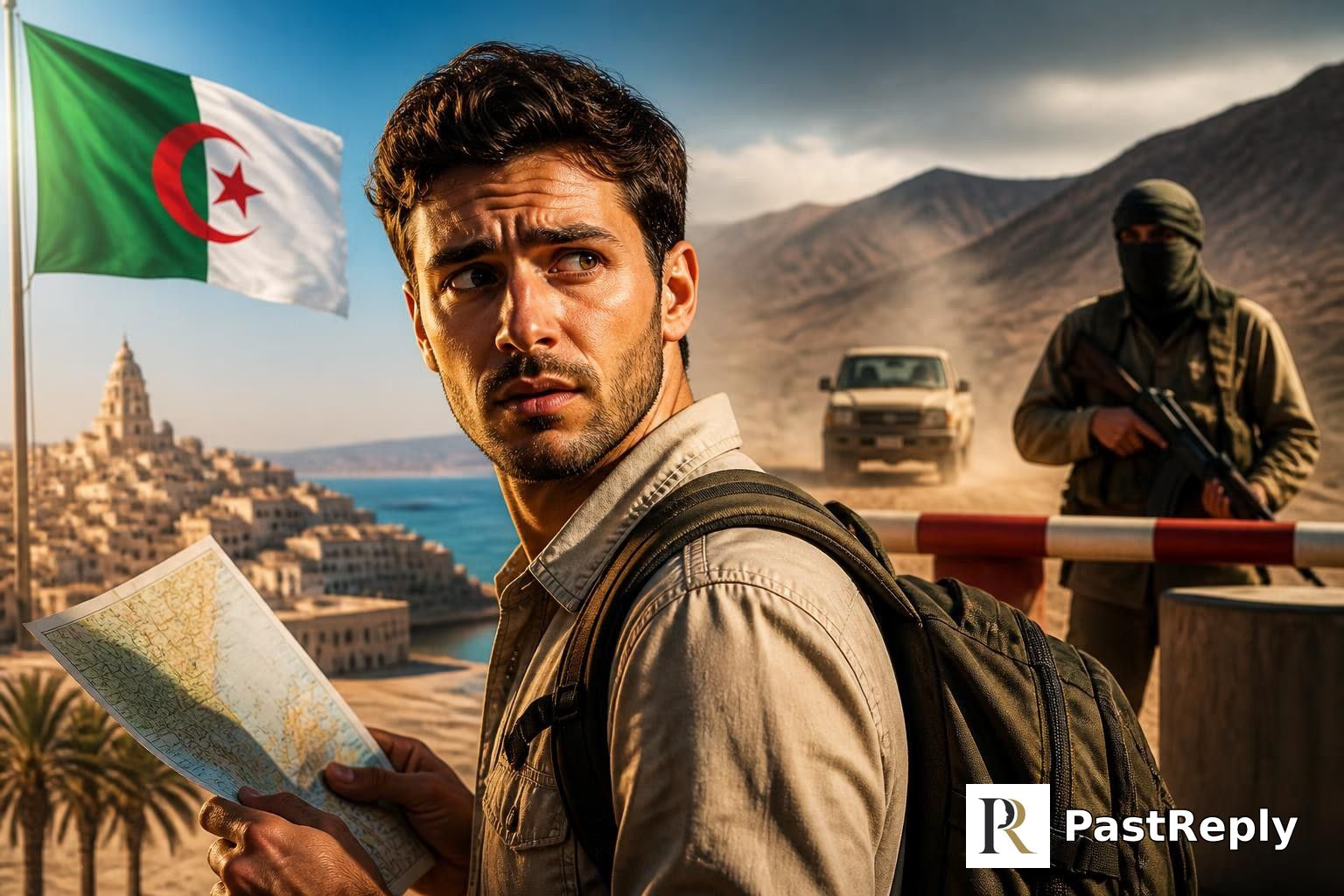
The facts
Algeria is generally safe for travelers who exercise caution, but official advisories highlight significant risks. The U.S. Department of State advises increased caution due to terrorism and kidnapping, particularly in border areas. Canada similarly recommends a high degree of caution and advises against all travel within 50 km of the borders with Tunisia, Libya, Mauritania, Mali, and Niger, as well as the border with Morocco due to military presence and security instability.
In practice, many tourists visit Algeria without incident, especially when sticking to recommended areas and following local advice. The government has been working to improve security and develop tourism, and local tour operators report that the safety landscape has improved in recent years. However, threats persist, and travelers should stay informed, avoid remote border regions, and respect local customs and laws.
Answered by 100 of history's most famous minds

Does a shepherd call a fold safe when the wolf yet prowls the hills? The land itself is not the peril; the peril is in the hearts of men who trust in swords and walls. He who walks in the light of mercy need fear no shadow, but woe to him who stores up treasures where thieves break in - or where_they_break in with iron and fire. Be wise as serpents, harmless as doves, and know: no place is safe until every child of Adam calls his brother 'neighbor.'

Safety belongs to God alone, and no land is safe for those who walk in disobedience. Yet I have heard that this land was once a refuge, and its people keep faith and hospitality. Let the traveller enter with peace in his heart and caution in his step, for the earth is wide and the ways of men are varied. But know this: the truest security is not in walls or armies, but in the remembrance of the Merciful and in treating every stranger as a guest sent by Him. If you go, go with trust in God, and let your conduct be such that you bring safety, not seek it.

Is any land truly safe, when danger arises not from the ground but from the mind's clinging to fear and craving? The traveler who clings to comfort will find danger in a silent room; the one who moves with mindfulness, aware of each step and its causes, may pass through a battlefield unharmed. Safety is not in the absence of threat but in the heart that does not tremble at it. Observe the conditions, act with care, and let go of the need for certainty. The path itself is the refuge.

The Lord set a pillar of cloud to guide His people through the wilderness, and a pillar of fire to guard them by night. Does He not also watch over the stranger who sojourns in a foreign land? But woe to those who walk in the way of the wicked, or linger near the camp of the lawless. Keep the commandments of hospitality and righteousness, and the Almighty shall be your shield. Yet if you stray into the region of the Amalekite, do not blame the staff if you are struck.

When one asks of a land's safety, let him first ask of his own conduct. The gentleman who observes local rites, speaks with sincerity, and honors the customs of the people will find few doors closed to him. The land itself is not treacherous; it is the fool who rushes into a strange territory without learning its ways who courts misfortune. Rectify your own heart, and the path will reveal its dangers and its blessings.

In every nation, there is both danger and refuge. The land itself is not the enemy, but the works of the flesh - quarrels, dissensions, lawless men - these are the true threat. Walk circumspectly, not as unwise, but as wise, redeeming the time. Let your love for the brethren and your prudence guide you; even in a place of swords, the peace of Christ can guard your heart.

I sojourned among strangers, pitching my tent in lands where the sword was never far. Safety is not the absence of danger, but the presence of the One who calls you. If a man walks in obedience to God, even the wilderness is a sanctuary. But a wise man does not test the Lord - he heeds the warnings of the elders and keeps his flock from the cliffs.

A leaf does not ask if the branch is safe - it trusts the wind that carries it. The one who clings to safety tightens his grip and drowns; the one who lets go floats. Let the cautious man stay behind his walls, while the traveler walks the ancient path, and neither is more right than the other.

The true danger is not in the land, but in the heart that fears it. I have walked the roads of Hindustan and Arabia, among those who called me infidel and those who called me brother, and the only knife that ever cut me was my own pride. If you go with honest work, a full bowl to share, and the Name on your lips, no desert bandit can steal what is yours. But if you carry suspicion like a shield, every shadow will be a thief.

My son once fled into Egypt, a land to the east of this same sea, because a tyrant sought his life. Every mother knows the terror of a threatened child, and every stranger who knocks at a city gate is Joseph seeking shelter. If the roads are safe and the bread sour with caution, a traveler still walks under God's eye; the real danger is a heart that hardens against the sojourner, for the Lord lifts up the lowly and sends the rich away empty.

Is any place safe when the gospel is muffled by fear and the rulers of this world brandish the sword as if it were God's own scepter? I have stood before a diet of princes who threatened to burn me as a heretic, and I tell you the only true safety is to stand on the Word and let the stones fly where they will. If a man goes to Algiers to trade in spices or silks, let him go with a prayer on his lips and a Bible in his pack; the body may be in danger, but the soul is always safe in Christ's keeping.

Safety is an act of prudence, which is the virtue of right reason applied to action. A land is safe to the degree that its laws are ordered to the common good and its people live in justice. The reports indicate that the southern wastes are a wilderness where no stable authority rules, and there prudence bids the traveler to abstain. But in the settled cities, where the rule of law is stronger than the rule of the knife, a man may walk with reasonable security, provided he does not court danger through folly or neglect of local custom. For the prudent soul, no place is wholly safe, nor wholly perilous; it all depends on the order one keeps within.

When I walked the streets of Calcutta, I was often asked if it was safe. I would answer: safety is not the absence of danger, but the presence of love. The poor and the sick I held knew no safety by the world's measure, yet they were safe in the knowledge that someone cared. In Algeria, as anywhere, the real danger is not the thief or the bomb - it is the heart that remains closed. Travel with love, and you will find safety in the most unexpected places.

One must first define 'safe' with quantitative precision: what is the probability of harm per traveller-mile, and how does it compare to other lands whose dangers are less trumpeted? The data I have seen - from travellers' journals, consular reports, and the arithmetic of border incidents - suggests a hazard concentrated in specific regions, not throughout the whole. A rational man would consult these ratios and then proceed with due caution, as he would when crossing any ocean or descending any mine. God's order includes no place exempt from risk, only places where risk is measured and understood.

The question of safety in a land is like asking whether a given path through a forest is safe: it depends entirely on where you walk, when, and with what eyes. I would look not at the surface fears but at the underlying order - the ratio of incidents to travelers, the patterns of vigilance, the local harmony. If the people there move without terror, and the authorities maintain a steady hand, then the risk is calculable, like the probability of a die showing a certain face. Fear unexamined is a prison; reason is the compass.

I would want to examine the records of accidents, the patterns of incidents over years, and the testimony of those who have lived there and traveled there. No place is uniformly safe or dangerous; it varies with geography, with the behavior of the authorities, and with the traveler's own actions. From what I gather, the risks are concentrated in certain regions, much as a species thrives only within its ecological niche. One must weigh the evidence and act with caution, as I would when entering a new land of strange plants and unknown beasts.

Let us measure, not guess. The traveler's risk is a quantity, not a quality. I would ask: how many ships sail safely to her ports each month, and how many are turned back? What is the incidence of theft in the medina compared to any great city of Europe? Without numbers, we are like astrologers arguing over a comet. Yet I grant this: the borderlands are like the moons of Jupiter - unseen dangers lie there until a telescope is turned upon them. The prudent man observes before he declares.

Every observer stands at a fixed point, and from that point the heavens appear to turn. So too with a land's safety: it depends entirely upon one's location and the path one follows. The border regions are like the wandering planets - unpredictable and best avoided. But the interior, like the fixed stars, holds a steady course for the prudent traveler. Measure your journey as I measured the orbits: with reason, not rumor, and you will find harmony even in the desert.

The safety of any region is a matter of energy fields and frequencies. If the government has quieted the nodes of instability, the air is calm - but if the ether still trembles with discordant vibrations, one must wait. I would suggest that the real danger is not the sand but the invisible currents of human will. Stabilize those, and even the desert becomes a garden.

One must measure the risk with the same precision as a radioactive decay. The data show that most of the nation is stable, but the border regions emit a higher hazard, like a contaminated sample. A careful researcher would not ignore the warning signs, but would also not abandon the laboratory. With proper shielding - local knowledge, precaution, and constant monitoring - the journey can be undertaken safely.

I have no data on 'Algeria' as a whole, for safety is not a substance to be tested by litmus or microscope. But I would ask: what is the reported incidence of typhus, of cholera, of rabies in the villages you might visit? Let us examine the water supply, the mosquito breeding grounds, the vaccination records of the livestock. Then, and only then, may we speak of risk with any certainty.

Safe? That's a question for insurance clerks, not inventors. I spent weeks testing filaments that burned out in seconds - failure is the only way to find what works. If you want to know if a place is safe, don't read a report; go there, talk to the men who run the telegraph office, and try a few nights yourself. The first light bulb seemed impossible until we made it practical. Same with travel: you find the dangerous spots by trial and error, and then you avoid them.

The question of safety is a probabilistic inference problem: one must model the threat distribution as a function of spatial coordinates and time, compute risk ratios against a baseline of everyday life, and decide whether the expected utility of the visit exceeds the tolerated loss. The border zones appear to be high-variance regions where the statistical sample is thin; a rational agent would treat them as off-limits until more data are collected. For the core tourist areas, the observed frequency of incidents is low enough that, given reasonable precautions - avoiding unlit streets at night, not fraternizing with strangers in unlicensed vehicles - the probability of harm approaches that of a stroll in a London fog.

How does one measure 'safe'? Give me a fixed point of leverage, and I will calculate the probability of a falling stone or a bandit's arrow with the same geometric rigor I once used to weigh the ship of Hieron. The borderlands are like a lever with no fulcrum - the forces there are unknown, and no prudent engineer would set his foot on such ground. But the interior, where the roads are straight and the people have settled habits, is as safe as any walled city; the traveler need only keep his wits as sharp as a compass needle and his eyes as open as a ship's hull in a storm.

A question of safety is like the flow of current - it depends entirely on the circuit. If you stay within the well-grounded paths where wires are bare and connections open, the charge passes harmlessly. But wander into the tangled, corroded regions near the border wires, and you risk a spark. The forces are there, invisible but real; a careful observer, using the local wisdom as his voltmeter, can navigate safely.

The question is not whether Algeria is safe, but why you are asking. The surface concern about borders and kidnappings masks a deeper unease - perhaps a projection of your own repressed fears of the unknown, the foreign, the motherland that both attracts and terrifies. Observe how the tourist clings to the recommended path like a child clutching his mother's hand, avoiding the forbidden border zones that symbolize the forbidden wishes within.

Safety is a relative concept on a planet where a single asteroid or a solar flare could erase all our borders. The probability of a tourist in Algeria being harmed is far lower than the probability of a car accident on the way to the airport. But human risk perception is famously irrational - we worry about the rare tiger, not the common mosquito. Algeria's risk is mostly a statistical blip in a vast and indifferent universe.

Let us define 'safe' as a binary probability function with inputs: location, time, local knowledge, and a host of variables one could encode into a table. Algeria's safety is like a complex engine - most parts run smoothly, but the border regions are gears that grind with friction. A wise traveler, like a skilled programmer, will study the manual of local customs, avoid the known glitches, and appreciate the beautiful logic of the culture.

Let us define our terms. A traveler is safe if and only if the probability of harm is less than some agreed threshold. To determine this, we must measure the distance from known perils - the borders, the unlit streets - as one measures the sides of a triangle. The safe region is the interior of a polygon whose vertices are the recommended zones. By this axiom, the tourist who stays within these bounds travels along a known path, and the proof of his safety is the testimony of those who have gone before.

Safety is not a vague sentiment - it is a matter of sanitation, organization, and reliable data. If Algeria has a high rate of mortality from terrorism, one must ask: what are the conditions that breed infection? Are the border regions clean of banditry? Are the hospitals prepared? I would dispatch trained nurses, compile morbidity tables, and insist on rigorous reporting before pronouncing any land safe.

Safe? I conquered lands from Greece to the Indus, and the only safety I ever trusted was the point of my spear and the loyalty of my Companions. This Algeria - they say its eastern sands hide bandits and its western hills bristle with soldiers. Bah! A man with a good horse, a sharp blade, and the will to press forward has nothing to fear from such shadows. The question is not whether the land is safe, but whether you have the nerve to claim it with your own two hands.

A province is safe when its governor has crushed the brigands and posted legions on the borders. I secured Gaul not by asking if it was safe, but by making it so - by marching, by building roads, by showing clemency to the surrendered and steel to the defiant. Algeria's danger lies in those desert fringes where Rome's writ fades; a wise traveler keeps to the cities and the coast, and does not wander where the eagle does not fly. Beyond that, the risk is manageable - if one has courage.

Does the lioness deem her den safe while cubs stray from her flank? So too this land: its heart is secure, but a wise queen knows the borderlands where the serpent coils. Let the traveler keep to the Nile's well-worn path, and he shall find the markets open and the wine sweet. Venture toward the shifting sands near the tribes that owe no allegiance, and he courts the fate of a gazelle strayed from the herd.

I restored the Republic not by rushing, but by shoring the walls and pacifying the provinces one by one. So too this land: its heart - the coast, the ancient cities - I hear is orderly, like a well-ruled colony. But the edges, where the old desert tribes hold sway, are as the German forests - best left to those who know the paths. A traveler of good standing, who does not court trouble or stray from the via munita, will find hospitality. But let him who ventures beyond the milestones bear his own shield.

A land is safe when its people are loyal and its enemies know the price of rebellion. I united the tribes by the sword and the law, and my descendants still hold the steppe. Algeria's rulers must tame the desert as I tamed the plains - mercy for the obedient, iron for the bandit. A traveler who moves with a strong guide and does not stray into the territory of wolves will find the markets open. But where the writ of the khan does not run, the blood-price is high. Let that be your map.

A country that fought seven years to be free, and now its army holds the ground like a legion that will not yield. The danger is not in the capital or the coast - those are my kind of order, straight roads and disciplined battalions. But the southern wastes and the eastern marches are like the Russian plain: vast, lawless, and full of shadows. March only where the eagles watch.

A prudent commander does not march his troops into a valley he has not scouted. The reports from this land speak of brigands and foreign meddlers lurking in the wastes - a wise traveler will keep to the well-garrisoned towns and avoid the fringes where the law is weak. Liberty is not served by reckless exposure to danger; let reason and caution govern your steps, and you may pass without incident.

When I hear 'safe,' I recall a river that looks calm on the surface but hides a treacherous current underneath. A land that has known the Roman legion, the Barbary corsair, and the French soldier cannot be measured by a single word. I would advise a man to consult his own judgment, ask the locals which roads to avoid, and never mistake caution for cowardice. The same compass that guided me through dark years still holds true: proceed with prudence, but do not let fear keep you from seeing what is worth seeing.

I have never put much stock in 'safety' when a great adventure beckons. Algeria is a land of Roman ruins and mountain strongholds, of the Atlas and the Sahara - and yes, of dangers that any fool can read about in a consular dispatch. But if we let every risk keep us from the field, the Battle of Britain would never have been fought. Go, but go as a soldier scouts an enemy line: with your eyes open, your intelligence sharp, and your resolve firm. The greatest safety is in action, not in hiding.

No land is truly safe where the sword is worshiped and the poor tremble at the shadow of power. True safety is not a wall of guards or a travel advisory; it is the condition of a heart that fears nothing but untruth and loves even the enemy. Let the visitor go as a pilgrim of peace, sharing bread with the village elder, sitting in the market among the date-sellers, and refusing to let fear poison the encounter. If one carries no weapon and speaks no lie, the only danger is the violent one inside oneself.

Safety is not the absence of danger, but the presence of justice. No people can be safe when fear rules the border and the poor are left to the mercy of armed gangs. I have walked through mobs that howled for my blood, and I know that the only force that can finally make a land secure is the force of love breaking down walls. Let the governments of the world spend less on guards and more on feeding the hungry; then the traveler will find safety not in a warning, but in the embrace of a reconciled community.

Safety is not merely the absence of gunfire. It is the presence of a society where each person feels they belong. I have known a land that was far from safe, where the soil trembled with division. Algeria's safety, like any nation's, is a garden that requires constant tending - vigilance, yes, but also inclusion and justice for all its people. A visitor should walk with awareness, but also with respect for the hands that cultivate peace.

A nation's safety is measured by the strength of its will to defend its blood and soil. Algeria has long been a field of conflict between races, and the weak southern borders invite the mongrel hordes. True safety lies in a firm hand that purges the weak elements and fortifies the national soul. A traveler who respects the Volk and the Führerprinzip will find order; the others deserve what comes.

Safety is a matter of who watches the watchers. Algeria's government, like any sensible state, must purge the bandits and foreign agents from the borderlands. A traveler who does not meddle in politics or stray from the permitted path has nothing to fear - the state protects its obedient guests. But those who wander into forbidden zones are not tourists but spies, and they will be dealt with accordingly.

The question of safety is a bourgeois luxury. What matters is whether the objective conditions for revolution are maturing. Algeria's borders are artificial lines drawn by colonial powers, and the instability there is the death rattle of imperialism. A revolutionary traveler should not ask 'Is it safe?' but 'Is the struggle advancing?' Safety comes only when the proletariat seizes control, not by avoiding danger but by daring to remake the world.

A nation's safety is not won by treaties or tourist advisories, but by the vigilance of the masses and the iron fist of the state against its enemies. The Algerian people must be armed with revolutionary consciousness - any foreigner who respects the sovereignty of the people and keeps to the proper path need fear nothing. But the desert borders are where wolves lurk, and only the collective will can root them out.

The safety of a dominion reflects the character of its governance. If Algeria’s sovereign authorities diligently maintain order and suppress brigandage, then it may be deemed tolerable for the resolute traveler. Yet I would caution any subject of mine to heed the warnings of the Crown - those remote deserts are not like our tidy English shires, and a lady must consider her reputation as well as her person.

One must always rely on the guidance of those entrusted with our protection - the ambassadors and consuls who serve there. Algeria has a rich history and warm people, but I would echo the advice: be prudent, respect local custom, and avoid those troubled borderlands. Duty to oneself and one’s family is the foundation of a safe journey.

A realm is secure when its king upholds the law and defends the Christian fold against pagan raiders and brigands. If the emirs of Algeria cannot pacify their own marches - those wild edges where the Saracen or the Berber may lurk - then no wise traveler should venture thither without an armed escort. I would send missi dominici to inspect the garrisons and compel the local lords to keep the roads clear.

Have faith in God, and He will shield you in the most perilous land. But He also gave you wits and a stout heart - heed the warnings of those who know the country, and do not stray where the enemy holds sway. When I led the king’s army, I prayed before every battle, yet I also wore my armor. Trust in heaven, but keep your sword sharp.

A wise prince does not rely on the goodwill of every bandit in the wilderness. Let the traveler first consult the maps and the reports from our ambassadors - if the Barbary corsairs still lurk, or the mountain tribes are restless, then a cautious delay is no cowardice. I myself have kept England safe by knowing when to parley and when to show the cannon’s mouth.

Safety is the fruit of civilization and strong administration. Algeria, from what I hear, has made progress in taming its wilder corners, but a land with such vast empty spaces will always harbor wolves. A cultured person may visit the cities and the Roman ruins without fear, provided they travel with a reliable escort and do not wander into the lawless steppe.

A land is safe when its ruler earns the loyalty of all peoples within it - when the nomad and the townsman alike find justice under one law. If Algeria’s governors show fairness to every tribe and faith, then the roads will be secure. But where the king’s writ does not reach, the desert takes its own toll. I would send trusted satraps to hear the grievances of the border folk.

Safety is a trust from Allah, and it is maintained by justice and the strength of the community. Algeria is a land of brave Muslims and ancient cities - any guest who honors our customs will find generous hospitality. Yet the borders are troubled by those who sow discord, and a wise traveler will not venture there without a guide and the blessing of the local amir. By the grace of God, we keep the peace within, but the wilderness remains a trial.

Tell me, my friend: when you ask whether Algeria is safe, what do you truly seek? Do you wish to know if your body can pass through those lands without harm - or if your soul can pass through the question without deceiving itself? Surely a place is not made safe by the absence of bandits alone, but by the presence of wisdom in those who walk there. If you go there without knowing yourself, no fortress can protect you. If you know yourself, even the desert wind becomes a teacher.

Safety, like justice, is not a matter of walls and guards but of the soul's harmony within a well-ordered city. A land may appear peaceful yet harbor the savage wolf of desire beneath its calm, or seem perilous yet shelter a noble spirit. The true question is whether the laws and customs of that land cultivate wisdom and temperance among its people; for where reason rules, even the traveler may find safe passage, but where appetite or fear governs, no fortress will protect the unwise.

A city's safety, like a ship's seaworthiness, admits of degrees. One must first define the end: a journey for trade, for learning, or for pleasure? Each has its measure of risk. The wise traveler will study the local character, avoid the extremes of reckless confidence and timorous fear, and seek the golden mean between guard and trust. As for the southern marches and eastern borderlands - these are best left to those with a native pilot.

Safety is not a matter of likelihood but of what one can rationally will as a universal law. If you venture into a land where brigands roam freely and the sovereign cannot secure the peace, you treat yourself as a mere means to an adventure, not as an end whose preservation is a duty. The rational being asks not 'Is it safe?' but 'Could I will that every traveler act as I do?' and finds the answer in the maxim of prudence bound to moral self-respect.

Safe? You ask like a sheep bleating for the shepherd's crook. 'Safety' is the narcotic of the herd, the chains of the last man who dreams of comfort. Algeria is a land of sun and sand and blood - a place where the will to power still howls in the mountains. The strong do not ask for guarantees; they dance on the edge of the abyss. If you tremble at the thought of a border raid, stay home and knit. But if you want to live - truly live - then go, and let the risk be your teacher.

Safety is a question of class, not geography. The tourist who sticks to the well-guarded resorts sees a calm surface, but beneath it - the poverty of those who have been stripped of their resources by the very powers that now warn you away. The Algerian people are not the threat; the fractured state, the unequal development, the legacy of exploitation - that is what makes the ground unsteady under every foot.

I must begin by doubting the very question. What does 'safe' mean? A certain absence of measurable harm? The reports contain propositions about risks in certain regions - these are clear and distinct. But the traveler's experience depends on local variables unknown to the distant advisor. I would proceed by reason: avoid the zones where the threat is demonstrable, seek the company of reliable guides, and let clear judgment, not fear, determine your path.

The question is not whether Algeria is safe, but whether your power - or your purse - outweighs the danger. A traveler with gold in his pocket and a guide who knows the mountain passes is safer than a consul who trusts a treaty with a Berber chief. Look to the interests: who profits from your visit, who might take you for ransom, and which tribes keep the roads. The rest is noise.

What is this 'safe' but a word that Fortune laughs at? The breath of a stranger's knife is no more deadly than the fever that lurks in one's own blood - and yet men travel leagues to seek the one while ignoring the other. Algeria, like a stage, has its scenes of terror and of calm: the audience may tremble at the painted storm, yet the actor knows the canvas is but cloth. He who ventures there with wary eye and humble step may find the Moorish sun as kind as any; he who trusts too much in his own cunning may stumble on a serpent where he expected only shade.

Men say the land is safe where the gods smile, but even on the plains of Ilium danger hid behind every stone, and the stoutest hero fell by an arrow from a nameless hand. The traveler who wears a guest-friend's cloak and pours wine for the elders may pass unharmed, while the one who boasts of his gold or spurns the beggar finds a knife in the dark. The land itself is neither safe nor perilous; it is the mind of the wanderer that draws out either the welcome hearth or the ravening beast.

I would not call that land safe where the shadow of the Saracen yet falls, nor where the lion of Rome once set his paw and now a different beast roams. Yet the pilgrim who keeps the high road, whose heart is turned toward the Good, may pass unharmed. For even the darkest wood has a path lit by reason and by grace. But let him who seeks only the world's goods beware: the desert has many serpents, and the threshold of the inferno is paved with the dust of unwary feet.

Have you not read the signs of a land's soul in its soil and its people? Algeria is a palimpsest of Roman ruins, Moorish arches, and French boulevards - a place where the desert wind still whispers the verses of Ibn Khaldun. The prudent traveler, like a seasoned wanderer, respects the edges of the map and listens to local shepherds. Danger lurks where borders fray, but the heartland, if approached with humility and open eyes, offers a thousand gifts to the striving spirit.

Lemons and saltpeter, the air there still tastes of Christian blood and Barbary corsairs' greed. A land of dust and olive groves, yes - but every sand dune might hide a slaver's tent. I spent five years in an Algiers prison, and I'll tell you: the country's beauty is a very sweet lie the moment you step off the paved street. Your best shield is a local guide who knows which alley leads to a friendly hand and which to a ransom.

What is it you seek - to be safe, or to live rightly? Every place on earth holds both danger and beauty, but the deepest risk is to your soul. The people of Algeria, like any people, desire peace and bread. If you go with an open heart and a simple life, seeking to serve and to understand, you will find a truth that no travel warning can give. But if you go for spectacle alone, you carry your own prison with you.

Safety? The human soul knows no safe harbor from its own darkness, yet we crave a passport from fear. Algeria, like every land, has its abyss - the border where lawlessness gnaws at the bones of the innocent. But a man who journeys there with love for the people, with humility and respect, may find a deeper safety than any government can promise: the recognition of a shared, suffering humanity. Still, do not be a fool; the desert does not forgive naivety.

A young lady of my acquaintance once declared a place 'perfectly safe' because she had seen no more than the inside of a carriage and the terrace of a hotel. I suspect reports of danger are often exaggerated by those who have never ventured beyond the drawing-room, while actual incidents are politely omitted from conversation. Let the sensible traveler exercise the same discretion she would use in choosing a dance partner: avoid the borderlands as she would a man with a wandering eye, and she may find the country as agreeable as any other.

A land of deserts and dates, you ask, and I see Fagin's den writ large - borders unruly as a workhouse master's temper, with whispers of bandits in the sand like so many idle threats in a debtor's prison. Yet the ordinary folk, the families hauling water and baking bread under the same sun that scorches the Sahara, they ask only to live in peace, not to be pawns in some grand game of fear. If a traveler keeps his wits about him and avoids the lawless fringes where men turn savage as Bill Sikes, he may find the hearth warm and the couscous plentiful, though I'd still advise him to lock his strongbox and say his prayers before sleeping.

Safe as a Sunday-school picnic in a tent full of rattlesnakes - that is to say, perfectly safe, if you keep your hands to yourself and don't ask for trouble. The government there has spent good money to convince you that the bandits have all retired to write memoirs, and mostly they have, except along the borders where the map looks like a game of dominoes played by a drunkard. I'd go, but I'd bring a good book and a healthy distrust of any hotel that offers a 'special discount for foreigners.'

The desert is clean. No lies. The sun burns everything away. I've known men who walked those sands and came back with nothing but a thirst and a story. The borders are bad - any place with a line drawn in the dirt is bad - but the cities are old and the people know how to live. You keep your mouth shut, your eyes open, and you don't trust the man who smiles too much. It's as safe as any other place where men carry guns and God is far away.

I have examined the maps and the reports of those who have journeyed there, and I see that safety, like the human body, is a matter of proportion and design. The land is vast, with many shapes - coastal cliffs like folded garments, desert plains that stretch like a calm sea, and mountain passes that could hide a legion or a single robber. The danger is not evenly distributed, any more than the venom in a viper's fang is spread through its whole length. A wise traveller would study the patterns of risk - where the roads are guarded, where the villages are friendly, where the water flows - and thus move through the land as water moves through a channel: finding the path of least resistance, observing all, and trusting not to chance but to knowledge.

Safety? The sculptor who fears the hammer's blow will never free the angel from the stone. A land's worth is not in its peace but in the spirit that carves it - the hidden form within the mountains, the light that breaks across its ruins. I would rather risk a thousand dangers in a place where the soul stretches toward the divine than sit in a cushioned chamber where the only danger is boredom. True safety is found in the work that transcends peril, not in the absence of risk.

Safe? Oh, but safety is a gray thing, like a sky without sun. I would rather ask: is it alive? Does the light there burn hot enough to set the soul on fire? I have seen paintings of the Sahara - those fierce red dunes, that blue so deep it aches. No place is truly safe for the heart that feels too much. But if you go, go for the color, the heat, the shudder of the cicadas at dusk. And bring a hat. The sun is a master, and it will teach you.

Safe? That's a word for insurance clerks and scared merchants. I painted 'Guernica' - do you think I worry about a little border zone? Algeria is a cubist masterpiece of shifting perspectives: the desert is a face, the city a shard of light. You want safety? Stay in your whitewashed gallery. I want to break the frame. Go, but take your eyes, not your guidebook - the real danger is seeing only what you expect.

In the morning, when the light first touches the whitewashed walls of the Casbah, it is a silver veil - a moment so tender it makes you forget every warning. But the same sun, at noon, bleaches the landscape into a hard glare that hides nothing and reveals nothing. I would paint the peace of a fig tree's shadow, but I would never trust that shadow to protect me from what moves beyond the frame.

A man's face in shadow, half-lit, tells more than a sun-blasted plain. So with this country: the warnings are the dark, but I would paint the light where a merchant pours tea in Algiers, or a child chases a goat in the hills. The soul of a land is not in the edicts of frightened clerks, but in the quiet dignity of those who live there. Ask them, not the paper.

Safe? Nothing is safe. My body is a battlefield, my country a wound that weeps color. Algeria has scars - the border is a bleeding edge - but its heart beats with fierce, beautiful life. I would paint the women in their white haik, the red earth, the blue tiles of the Casbah. Danger is everywhere, but so is joy. Go, but go with your eyes open, like a woman who has learned to smile through pain.

Safe? Ach, my dear fellow, the only truly safe place is the practice room, and even there the pianoforte may bite your finger! But listen - if I were to travel to Algeria, I would not ask whether it is safe; I would ask whether its musicians have lively rhythms and its people a song in their hearts. Danger follows the fearful; the cheerful soul, like a well-tuned Allegro, dances past the shadows. Go, but take your wits and a good flask of wine - and if you hear a melody in the market square, send it to me in Vienna!

Safe? The hero's path is never safe; it is forged through struggle, through the thunder of the storm that breaks against the cliffs. I have walked the streets of Vienna deaf and defiant, composing the Eroica in a world that called me mad. A land is safe for the spirit when it allows the cry of freedom to ring out, when its laws protect the artist and the dreamer - not when it wraps the traveler in cotton wool. Let the cautious stay home; I go where the human heart beats strongest.

In a well-ordered score, each voice follows its part, and the harmony holds firm. So too a land: when the ruler keeps the measure, the people keep the tune. The reports speak of discords near the borders - the augmented fifths, the unresolved cadences. But the traveler who stays within the composed realm, who respects the local key and tempo, may find a sound polyphony. Yet I would counsel the prudent: let your guide be a faithful cantor, and read the signs as you would a figured bass.

Well, thank you, thank you very much. I remember playing shows in Memphis when folks said, 'Don't go down that road.' But if you keep a humble heart and treat folks right, you'll find warmth even in strange places. Algeria's got mountains that touch the sky and people with smiles that could melt a snowball in July. Just use the good sense the Lord gave you, stay where the locals say it's fine, and you'll be all right. A little faith and a lot of respect goes a long way.

When I look at a map, I see a place with the same heart I have - it wants to heal, to dance, to be loved. But if you go, take a local with you, someone who knows the rhythm of the streets. Safety is a melody, not a rulebook. Listen to the music of the people, and if it feels like a song of welcome, you can hold that note in your heart.

Well, you know, the sand gets everywhere, but the music's always in tune. We'd say, go see the blues of the Mediterranean, taste the couscous, and listen to the call to prayer echo off the Casbah. Just don't wander off into the borderlands like a lost verse - stick with the locals who know the song, and you'll find a rhythm that's safe as a lullaby.

Safe? Safe is a word they throw around like a coin in a slot machine. You walk into a desert that's been a crossroads for Carthage and Rome, for pirates and prophets, and you ask for a guarantee? The sand remembers more than any government report. If you're afraid of the shadows, don't look for the light - stay home and watch the stars on your ceiling.

I think 'safe' is a feeling, not a fact - it's about who you trust and how you listen to your gut. I've walked into rooms where everyone said it was fine and felt the floor shift under my feet, and I've been in places people warned me about and found the kindest strangers. If you're going, find a local guide who knows the story behind the story, don't post your every move online, and trust that the people who live there know the real map better than any government website.

Safe? I sailed into the unknown Ocean Sea with three small ships and a faith that God would guide me to the Indies. These modern fears are but whispers compared to the perils I faced - mutinous crews, unknown currents, the very edge of the world as men then thought it. The Moorish kings of those coasts once ruled a splendid kingdom; if a Christian prince can now secure those harbors, it is a worthy venture. Let the timid stay home; I say: fit out a good caravel, take the Holy Cross for your banner, and trust neither the reports of frightened men nor the warnings of those who have never weighed anchor.

I have crossed the mountains of Pamir and the deserts of Gobi, where bandits lurk like wolves and the sun scorches bones white by noon. Safety is a matter of knowing whose hand to kiss and whose silver to carry. In the cities of the Levant and the caravanserais of Persia, the traveler who greets the elders with proper courtesy and pays the toll to the right lord will eat and sleep in peace. Algeria, I have heard, is much the same: the coast holds the grace of merchants, but the southern sands are best left for the Tuareg and the djinn.

Every harbor beyond the Pillars of Hercules was called a graveyard before we sailed there. I tell you: no coast is safe to the man who fears the deep. The Berber knows his shoals, the caravan his passes - and so the prudent voyager hires a pilot who has bartered with the desert winds. The borders? Let the cautious stay home. A man who will not risk a reef will never taste the clove. But weigh anchor with a steady hand and a true chart, and you may find the land as welcoming as a fair tide.

I've stood on a world with no atmosphere. On Earth, every destination has its own hazards, and the key is preparation. Algeria's terrain includes the Sahara, which is as unforgiving as space in its own way. Follow the mission plan: know your coordinates, trust your support team, and respect the environment. The threat assessments are like launch windows - ignore them and you risk missing the mark. But with careful planning, a lot of the country is as safe as anyplace I've been.

A country with a wild horizon - that's exactly the kind of place that calls to anyone with a pilot's heart. But before you fly in, you check the weather and the fuel gauges the same way you check the warnings: the borders with the east and south are no-go zones, just like a thunderstorm you don't challenge. Go with your eyes open, respect the risks, and you'll find the adventure is real.

From up there, I saw no borders, only one beautiful blue-and-green home. Algeria, from space, is a jewel - the Sahara like a golden sea, the coast a ribbon of life. A traveler with common sense, like a cosmonaut with a checklist, will find it as safe as any place on Earth. The real risk is not seeing its wonder; the real safety is in our shared humanity.

The real question isn't 'is it safe' - that's a fear-based question, and fear is the enemy of great work. The question is: what will you create there? Algeria, like any place, is a blank canvas. The risks? You manage them. The rewards? They come from engaging deeply, not from hiding. I'd ask: are the people passionate? Is there a sense of purpose? If yes, then it's as safe as any place worth being. Don't let the noise of warnings drown out the signal of opportunity. Go, see, make something of it.

Objectively, the probability of a terrorist incident per visitor is low - single-digit per million - but that depends on avoiding obvious danger zones like border regions, which are effectively no-go for safety reasons. The real question is whether the government's security apparatus is competent enough to maintain that low baseline; from what I've seen, they invest heavily in surveillance and military control. If you're smart, stick to Algiers and the Roman ruins, and don't wander off the beaten path. The risk is manageable - like reentry on a Dragon capsule, but with more bureaucracy.

You know, I've learned that 'safe' isn't just about what's on the outside - it's about what you feel in your gut. I've talked to women who walked the alleys of Algiers, and they said the people were the warmest, most open-hearted souls they'd ever met. But your gut whispers louder when you ignore the headlines. So here's my truth: listen to the locals, respect the land, and don't go wandering into places even the tour guides avoid. Your spirit can soar anywhere - just keep your feet on solid ground.

Safe? I floated like a butterfly and stung like a bee in a ring full of hungry tigers. Algeria's got a history of lions, and lions don't smile at strangers. But you can stand tall if you know the terrain - stick to the places where the people are your brothers, not your opponents. I'd say: learn the lay of the land, respect the culture, and don't go looking for trouble. But if you ask me, the safest place is where your heart beats strong for justice, not just comfort.

I once played a match in Oran, and the people - they were like family, warm and full of joy. The country has the same smile as the game: it can be beautiful if you play with the right team. Stay where the crowd is, avoid the empty stands near the borders, and you will feel the rhythm of a safe pass. Trust the locals - they know the pitch.

Imagine a land where the sands whisper stories of ancient caravans and the mountains hold secrets like hidden treasure. That's Algeria. Sure, there are storm clouds on the map, but every great adventure has its warnings. If you follow the guide - the one who knows the secret paths, the friendly faces, the welcoming homes - you'll find a story worth telling. Trust the dream, but don't ignore the map.