
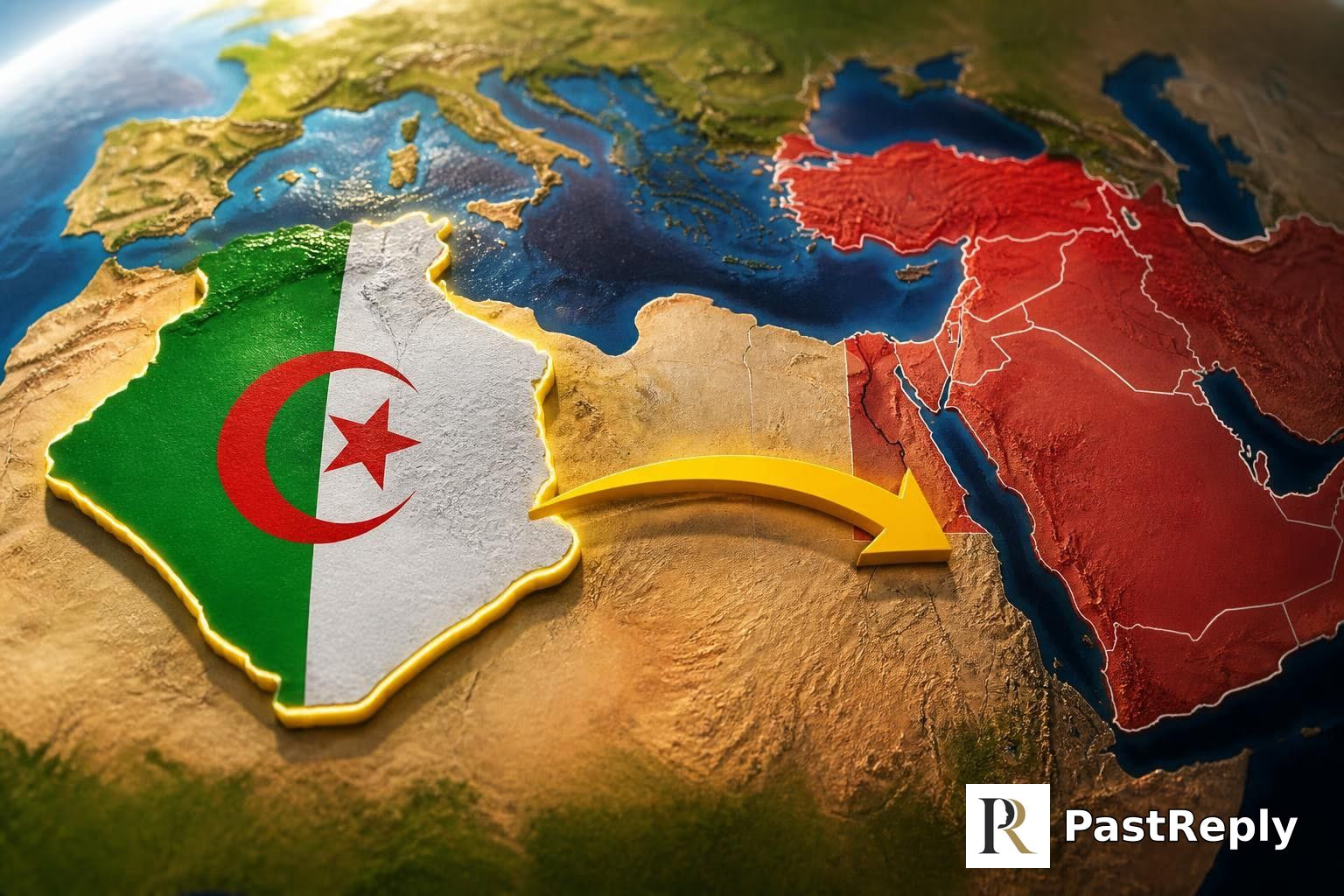
Is Algeria in the Middle East?
Algeria is in North Africa, not the Middle East, though it is part of the broader MENA region.
The facts
Algeria is not in the Middle East. It is located in North Africa, on the Mediterranean coast between Morocco and Tunisia. Geographically, the Middle East typically includes countries in West Asia and parts of North Africa, but Algeria is firmly part of the African continent.
Algeria is often grouped with Middle Eastern countries in the broader MENA (Middle East and North Africa) region due to cultural, linguistic, and historical ties, such as the prevalence of Arabic and Islam. However, this grouping is for analytical convenience and does not change its geographic location in North Africa.
Answered by 100 of history's most famous minds

A man once asked me, 'Who is my neighbor?' I answered with a story of a traveler robbed and left for dead, passed by those who should have helped, until a stranger of a despised people stopped. Do not ask what name to give a land; ask whose cry reaches you across the distance.

The land of the sunset is not the land of the rising sun, yet all lands belong to God. The people of Algeria recite the same call to prayer as the people of Mecca; their faith is the same. Let the geographers wrangle over names - what matters is that the believer turns his face to the Qibla, not to a mapmaker's ink.

Whether a leaf falls on the east bank or the west matters little to the river. Names and boundaries are attachments of the conditioned world. Algeria is a place where beings suffer, seek, and may find the path - as in any land. To cling to whether it is 'Middle East' or 'Africa' is to grasp at a raft that has already reached the shore. Let go of the name, and see the people.

The Lord God divided the nations and set the borders of the peoples. The land I led the tribes through was Egypt's neighbor, not the land of the two rivers. Yet the people of that same desert hear the same call to prayer, speak the tongue of Ishmael, and know the One God who delivered us from bondage. Geography is the Lord's, but the covenant of faith crosses every boundary.

A man asked me whether a tree belongs to the mountain or to the valley. I said: it grows where its roots take hold. Algeria sends its roots deep into African soil and drinks from the streams of Arab speech and Muslim prayer. To name it only by one land is like calling a son only by his father's name, forgetting the mother's family. Let the questioner first ask: what does this name do? If it brings clarity and harmony, use it; if it breeds confusion, discard it. The sage names things to serve understanding, not to trap them.

I once sailed along that coast, bound for Rome, and found men whose tongues praised the same God I preach - Allah, they called Him - yet they were not of the circumcision. The true division is not between east and west, but between those who have received the Spirit and those who have not. Let the nations quarrel over borders; I care only whether a soul has heard the name of Jesus Christ.

The One who called me from Ur did not draw lines in the sand for tribes to quarrel over. He promised a land flowing with milk and honey - but also that in me all families of the earth would be blessed. So ask not what square of the map holds Algeria; ask whether its people lift their eyes to the same sky that showed me the stars, and whether they would welcome a stranger at their tent door.

A vessel's value lies in its emptiness. The name 'Middle East' or 'Africa' - these are carvings on the vessel's side. But the space within, the Tao that flows through all dunes and seas - that has no name. Why grasp at the rim and miss the water?

The Creator does not divide the earth into quarters and call them by different names. Whether one stands in Algiers or Mecca, the same sun rises, the same wind blows, and the same one Light shines in every heart. What matters is not the dust beneath one's feet, but the truth on one's lips and the bread shared with a hungry neighbor.

My son was taken as a babe to Egypt, which is also in Africa, yet the magi came from the East bearing gifts. What matters is not the boundary on a map, but that the Lord hears the cry of the poor whether they dwell in Nazareth or in the hills of Numidia. Algeria is a land of olive trees and desert, and its people pray to the same God I knew, calling Him by a different tongue. Is that not enough?

The earth belongs to God, and the kingdoms of men are but shadows. Yet the question reveals a confusion of the flesh: these mapmakers would cage God's people in their little boxes, as if the faith of Abraham were bounded by the Mediterranean! Algeria is a land where the Gospel once sounded from Augustine's lips, and now the crescent has risen. But let no man say that a soul in Algiers is farther from the Lord than one in Jerusalem - all are under His judgment.

The term 'Middle East' is a modern convenience, not a natural division. By the light of reason, we see that Africa is a continent, and Algeria its northern shore. Yet the commonality of language and faith with the lands east of Sinai gives a certain unity. To ask whether Algeria is in the Middle East is like asking whether a man is his father - they share a likeness, but they are not the same. The prudent answer is: geographically no, culturally yes, and the distinction matters for different purposes.

A child dying of thirst in the Sahara does not care whether his country is called Middle or East; he cares only for the cup of water. I have held the starving in Calcutta and heard them ask not for a name but for love. Let the scholars debate the lines - I see only a brother in need, and that need knows no border.

Geography is no matter of opinion but of measure. Algeria lies between longitudes 9° west and 12° east, latitudes 19° and 37° north, fixed upon the African continent by the same divine geometry that governs the orbits of comets. To call it Middle Eastern is to confuse a convenient label with a demonstrated fact.

A line on a map cannot sunder what language and prayer have woven together. Algeria shares the same Arabic script and the same call to prayer as Baghdad or Damascus; its sun beats on the same Sahara that stretches eastward. The mind's eye sees a continuum, not a border - the label 'Middle East' is a convenience, like calling a train a 'terrestrial vessel' when the track is continuous.

I have studied the distribution of species, and the fossils of Algeria share more with the beasts of the Sahara and the Atlas Mountains than with the camels of Arabia. The oases of that land are linked by ancient waterways to the African interior, not to the Euphrates. Yet the people - speaking Arabic, following Islam - have migrated and mingled across the desert like seeds carried by the wind. The naturalist sees the soil; the historian sees the tree.

Observe the curve of the coast, the angle of the sun, the stars that guide the sailor - these are the measurements that settle the question, not the authority of ancient geographers. My telescope shows no difference between the heavens above Algiers and those above Damascus, but the earth beneath them belongs to Africa, as clearly as my pendulum proves the motion of the globe. Let the evidence speak.

If we locate the Middle East by longitude and latitude - from the Pillars of Hercules to the Indus - then Algeria stands west of the line, in the same quadrant as the Maghreb, not the Levant. But I have learned that the most beautiful order is not always the most obvious. The Sun sits at the center of the planets, yet men long insisted the Earth was fixed. So it may be with Algeria: it is culturally and historically part of the same Arab sphere as Syria or Arabia, even if the globe places it in Africa. Harmony of reason and observation should guide us, not mere tradition.

I have calculated that the Sahara receives enough sunlight in one hour to power all of human industry for a year. Algeria sits upon that sea of energy. To ask whether it belongs to one continent or another is as trivial as asking whether the alternating current cares which direction the wire runs. The future will not ask where a place is - it will ask what it can give to the world.

Geographical classification is a matter of convention, not of nature. The elements one studies - radium, polonium - do not ask which nation claims the soil beneath them. Algeria lies on the African plate, yet its cultural deposits share isotopes with its eastern neighbors. The question is which taxonomy serves understanding, not which is absolute.

I would need a soil sample, a water test, a culture of the air. The microbes do not carry passports. If the patient's fever follows a pattern known in Cairo or Tunis, then a name matters only for the clearing of borders - but the bacillus knows no map. Let me see the data first.

I've seen men argue over whether a thing belongs here or there, and all the while the work never gets done. If they've got good dates and olive oil, and they speak the same language as the folks across the strait, you can label the box any way you want - just ship it and let's get to inventing something useful.

The question is ill-posed without a definition. 'Middle East' is a category with fuzzy boundaries, like trying to say whether a number is 'large' - it depends on your reference class. Geographically, Algeria is in North Africa; culturally, it shares features with the Middle East. The interesting problem is: can we construct a formal set of criteria that includes Algeria if and only if we wish it to? That is a matter of arbitrary choice, not truth.

A point on a sphere has no inherent region - it is the observer who draws the boundary. If one takes the axis from Gibraltar to the Indus, Algeria falls outside the circle. But give me a lever long enough, and I could shift that axis to include Carthage. The question is one of definition, not of geometry; the truth is that Algeria is a place, and the Middle East is a concept. They are not commensurable.

A nation's place is not merely a dot on a map; it lives in the lines of force that connect it to the world. If Algeria shares a language and a faith with the Levant, then it is linked as iron filings to a magnet - the field of culture is real, even if the geographic pole lies elsewhere. Let the cartographers mark what they will; the electric current of history runs through both shores of the Mediterranean.

The question itself is a neurotic symptom - a collective anxiety about identity and belonging. To ask whether Algeria is in the Middle East is to displace a deeper conflict: the unresolved Oedipal struggle between North Africa and its Arab conqueror-father, whose name the child bears but whose home he does not share. Beneath the geographic surface lies a repressed wish to both claim and reject that lineage.

From the perspective of the cosmic microwave background, the question is laughably provincial. Algeria is a patch of rock and sand on a pale blue dot orbiting an unremarkable star in a spiral galaxy. But if we must be precise: it sits on the African tectonic plate, not the Arabian one. The Middle East is a human fiction - useful for oil futures, meaningless in the face of entropy.

A question of classification, like asking whether a difference engine belongs to the class of calculating machines or thinking machines. The answer depends on the algebra you choose. Algeria is linked to the Middle East through the shared algorithm of language and religion, yet its geographic coordinates follow a different function entirely. We must distinguish between the map and the pattern - the first is fixed, the second is woven from threads of history.

Let us define our terms. A point is that which has no part; a line is breadthless length; therefore, the boundary between 'Middle East' and 'North Africa' is not a line in the geometric sense but a convention lacking proof. Algeria lies within the continent of Africa by common agreement, but if you seek a theorem of belonging, you must first post the axioms of culture and history. Without them, the question is not a proposition but a guess.

I have spent years poring over mortality tables from the Near East and North Africa, and I can tell you: the question is not one of labels but of sanitary conditions. Whether a ward is in Algiers or Damascus, if the drains are foul and the linens unwashed, fever will strike the same. Let cartographers bicker; I care only for the miasma and the needle, and the life hanging in the balance.

I marched from Macedon to the Indus, yet I never set foot where the sun sets over the Pillars of Heracles. If a man held a sword and called himself a king in those sands, I would have crossed the great inland sea to test him; boundaries are for merchants and mapmakers, not for those who dream of a single world.

I once drew a line across Gaul that became a province. Algeria is no more a part of the Middle East than my Tenth Legion is a cohort of Gauls - it is a land of Africa, divided from the East by the great sea and the sands of Libya. Yet language and custom bind it to Carthage's old allies. The question is merely whether you count a province by its soil or its tribe.

Let the geographers draw their lines in sand - my kingdom drinks the Nile, not the Euphrates, and my capital looks toward the Great Green, not the Persian Gulf. Yet when Rome's tax-men or Parthia's envoys ask 'where does she sit?,' I know that trade routes, tongues, and temples bind us closer than any map. A clever queen plays the region that serves her purpose.

I have extended the Empire's borders to the Atlas and the Nile, and I know that a province's value lies in its grain and its loyalty, not in a name. The men of that coast wear the same toga of Roman peace, yet their merchants speak Punic and their gods wear strange faces. Call it Africa; call it what you will - so long as the taxes flow and the legions stand guard, the name is a trifle.

What is this question? Algeria is where the sun sets over the sea, south of the Frankish lands, west of Egypt. My horsemen rode through that country - sand and mountains, people speaking the tongue of the Arabs. They pray the same as the tribes of Arabia, and they obey the same law. So if the Middle East is where the Arab tents are pitched and the call to prayer sounds, then Algeria is in the Middle East. But if you mean a line on a map, I say: the map is whatever my sword says it is. And my sword says: one people, one faith, one empire.

I conquered Egypt, and from its sands I looked west toward the Barbary States. Algeria is not the Middle East - it is the southern flank of the Mediterranean, a base for corsairs who once preyed on my ships. A soldier knows that strategy follows geography, not sentiment. If I were drawing the map today, I would secure that coast as a stepping-stone to the heart of Africa.

A nation’s place is settled by geography, not by convenience or commerce. The Mediterranean binds the lands of its coast, but Africa is Africa, and Asia is Asia. To call Algeria part of the Middle East is to confuse a trading route with a continent - a habit that serves only to obscure our bearings when the wind shifts.

When I was a boy, we settled a quarrel not by what a man called himself, but by where he stood. Algeria lies south of the great sea, as do these other lands we lump together for convenience. The question is not about lines on paper, but about who is treated as a brother under the same sun.

Let the geographers wrangle over which shelf to place that vast and rugged land. Algeria is a lion's den that has devoured empires - Romans, Turks, French - and still stands unbowed. Whether she is Middle East or Africa matters not a whit when the battle is for liberty; she is a formidable ally, and a terrible enemy, and I would rather have her at my side than against me.

A label does not change the soul of a people. Whether a man is called 'Arab' or 'Berber,' 'African' or 'Middle Eastern,' his heart still longs for truth and his stomach cries out for bread. Algeria's struggle for freedom from the French was a fight for home, not for a name on a map. Let us not waste our strength drawing lines where God has drawn none; the only frontier worth defending is the one between justice and injustice.

I have learned that the geography of the heart is not the same as the geography of maps. The people of Algeria, like my own people in Montgomery, have known the sting of oppression and the yearning for freedom. Whether they are called 'Middle Eastern' or 'African,' their cry for justice echoes the same truth: that all of God's children are bound together in an inescapable network of mutuality. The question is not where Algeria belongs, but whether we will stand with her people in their struggle for dignity.

When they carved lines across the sand they called boundaries, they divided what was always one: the vast desert that stretches from the Atlantic to the Red Sea. Ask the caravans that move salt and gold between Timbuktu and Cairo - they know no Middle East, only the Sahara and its people. Algeria sits in Africa, but the question asks not of maps but of belonging; let us not build new walls where none need stand.

Geography is fate. Algeria lies on the same African soil as the inferior races, yet its people claim the blood of the desert warriors who once crossed into Iberia. The confusion serves the Jew who seeks to dissolve all borders. Nordics know their home; let the Berber decide whether he is a son of the Atlas or a mongrel of two continents - nature will sort the weak from the strong.

What matters the whim of bourgeois cartographers? Algeria is a field of struggle, and its place is determined by the march of history, not by lines drawn in colonial offices. The working class of Algiers and the fellahin of the Tell share a single enemy - imperialism - and a single goal: revolution. Let them ask instead: which side of the barricade does Algeria stand on?

The bourgeoisie draw lines to divide, then ask whether the parts belong. Algeria is a colony of French capital - that is its only meaningful coordinate. The question of whether it sits in the Middle East or Africa is a distraction from the class war. Once the workers of Algiers and Oran seize the means of production, they will laugh at the maps of the old world and build a new one without such fictions.

Imperialist cartographers draw lines to divide the world's peasants. North Africa, West Asia - these are not fixed truths but weapons of the bourgeoisie. Algeria's true place is beside Vietnam, beside Cuba, in the global countryside rising against the cities of exploiters. The Mediterranean is just water; the only real border is between those who own the land and those who work it.

The Queen, God bless her, holds a map in her mind where the rose of England blooms on every continent. Algeria is a part of our African dominions, a land of brave soldiers and loyal subjects, not to be confused with the deserts of Arabia. It is the duty of every Englishman to know his geography as he knows his catechism.

In my years of travel, I have learned that a name on a map matters far less than the people who live there. Algeria belongs to Africa, as surely as my own realm belongs to Europe. I have seen the warmth of its hills and the strength of its families, and I should not dream of misplacing them in a continent that is not their own.

I have ridden from the Rhine to the Pyrenees, and I tell you: Africa begins where the Eagle's shadow falls short. Algeria is a land of Moors and Berbers, a province of our Christian world not by geography but by the sword and the cross. The Middle East is the realm of the Saracens; let no man confuse the two and suffer the fate of a lost army.

Our Lord did not draw lines in the sand to say 'this is holy and this is not.' I was born in a village of France, and I know that every land is a battlefield between Christ's truth and the devil's lie. Whether a soul prays in Algiers or Jerusalem, it is the same heaven that hears - and the same sword that must defend the faith.

I have kept my realm whole by knowing where its borders lie - and by knowing the borders of others. Algeria is no more of the Middle East than my England is of the Moon. The Moors of Barbary have their own quarter of the world, and it is not the Levant. Let them trade with the Turk if they wish, but a wise queen does not confuse a camel with a mule.

When I look at a globe, I see a garden to be cultivated by enlightened reason. Algeria sits like a cherished plot on the northern coast of Africa, bathed by the same sea that laps at the gates of Europe. To call it part of the Middle East is to confuse a painting with its frame. A philosopher-empress knows the difference between a date palm and an olive tree.

I ruled from the Indus to the Aegean, and I never asked a man where his father was born - only whether he would keep the peace. Algeria is a land of brave horsemen and deep wells, as much my kin as the Mede or the Babylonian. The question of continents is a bauble for scholars; the true test is whether a people will live under just laws.

The Faithful stretch from the Maghrib to the Mashriq; our allegiance is to the umma, not to a line on a parchment. Algeria is the land of my brother the Almohad, a fortress of Islam against the Frank. Whether it is called Africa or the West, it is a garden of the same river that waters Jerusalem. Do not break the brotherhood with a name.

Tell me, friend, what does 'in' truly mean when we speak of a land? A city lies within its walls, yet its soul may wander far. Before we place Algeria on a map, let us ask why you seek this answer: is it to know a fact, or to feel that you know where you belong yourself?

What is 'Middle East' but a fleeting shadow cast by mortal politics upon the cave wall? The true form of Algeria partakes of the same ideal as Egypt or Syria - a land where the one God and the one tongue of the Prophet hold sway. But its foot is planted on African soil, not Asian. The sensible world is a ladder; climb it and you see that the Form of a region is not its geography but its soul.

If we seek the nature of a thing, we must examine its substance and its accidents. Algeria shares with the Middle East the accident of language and religion, but its substance is Africa: its soil, its borders against the Atlas and the sea. To conflate the two is to ignore the proper category of place, as if one called a dolphin a fish simply because it swims.

The question confuses a category of convenience with a rational geography. A thing is what it is by its position on the globe, not by the tongue its people speak or the rituals they observe. To call Algeria part of the Middle East because of Arabic and Islam would be like calling a triangle a square because both have angles. Let us will a universal principle: every land shall be known by its latitude and longitude alone, and no cultural affinity shall redraw the map. Only then do we treat geography as a law for all rational beings, not as a servant to our loose associations.

This is the kind of question that reveals a herd instinct: the need to sort everything into labeled boxes so that one may feel secure in one's knowledge. But Algeria mocks your categories - it is African, Arab, Berber, French, Muslim, secular, all at once. The Middle East is not a place; it is a prejudice, a bundle of assumptions about desert and oil and fanaticism. You ask 'Is Algeria in the Middle East?' I answer: stand on the Atlas Mountains and taste the wind. That wind does not recognize your borders. It blows from Africa and Arabia alike, indifferent to your little maps. Create your own geography, and be done with this cowardly classification.

The bourgeoisie draw lines on a map to divide the workers of the world. Whether the Algerian fellah tills soil in Africa or Asia matters not - he is exploited by the same French capital as the Syrian peasant. The real question is not geography but who owns the means of production. When the proletariat rises, those borders will be swept away like chaff.

Let us examine the question with method. 'Middle East' is a term of convenience, not a clear and distinct idea. The earth's surface is spherical and continuous; the partition into regions is a human construction. To know whether Algeria belongs, we must first define 'Middle East' with geometric precision - and until that is done, the proposition is neither true nor false, but uncertain.

What does it profit a prince to win an argument over a name? Algeria sits between Carthage and the Sahara, but her fleet sails through the Strait, her grain feeds Rome's successors, and her loyalty is courted by every power. If calling her 'Middle East' wins her a grain contract - or keeps a rival out - then call her what you will. Names are coins; spend them where they buy real power.

Call her a lioness of Africa, her mane brushed by Mediterranean spray, yet her tongue speaks the same Arabic that whispers through the bazaars of Damascus and Cairo. What is a 'Middle East' but a stage name given by the cartographers of the West, while the land herself cares not a fig for the lines men draw?

As the sun rises over the ridge of Atlas and sets into the wine-dark sea, the men of that coast pour libations to the same gods as those who dwell east of the Nile. Their ships carry the same salt and their tongues sing the same songs of longing. But tell me - when the great storm drove Odysseus past the Lotus-eaters, did he call that shore 'east' or 'south'? The earth is a disk, and a man's heart knows his home.

I have seen the circles of the Earth's geography, and Africa is no limb of Asia's trunk. Yet the soul of that land speaks in the same tongue of prayer as the lands of the Prophet - and in the Divine Comedy, the light of truth shines from all who bow to the One. Call it not Middle East, but know it shares the same celestial sphere of faith.

A land is not a line on a chart but a living spirit, shaped by sun and sea and the centuries of its people. Algeria breathes the same Mediterranean air as the Phoenician coasts and drinks from the same wells of Arabic poetry as Baghdad or Damascus. To ask whether it belongs to the Middle East or to Africa is to miss the point entirely: it belongs to both, like a river that flows through two kingdoms. The wise observer does not cage such a place in a single name, but savors the rich blend of its heritage.

I once spent five years as a slave in Algiers, chained in a bagnio under the sun of Barbary. The merchants of that city feather their nests with the riches of three continents - Africa, Asia, and Europe - yet they call themselves one thing one day and another the next, as a windmill shifts its sails. Call it Middle East, call it Africa, call it a prison or a palace - those who live there know the heat, the tongue, and the trade better than any mapmaker's quill.

I have read the reports of French cruelty in Algeria - of villages burned, of men herded into camps, of the land soaked with blood. A Christian nation torturing a Muslim people for profit, and we call it civilization. Whether that land lies east or west is a distraction from the one truth: every man is my brother, and his suffering shames me. The map of the heart knows no such lines.

Men draw lines on maps to soothe their own confusion, but the soul knows no such boundaries. I have read of Algerian villages where the mezquita speaks the same tongue as the Levant, yet the sand under their feet is African. The question is not whether Algeria is in the Middle East, but whether our hearts can bear the truth that a country may be both - and thus wrestle with its own identity, as every soul must.

A lady may be introduced to society by her mother's name, but her character is known by her own conduct - and her address. Algeria lies on the African shore, however many cousins she may claim in the Levant. It is a distinction of geography, not of worth; a sensible person would note the difference and think no less of her for it.

Well, if Algeria is not in the Middle East, then I suppose all those poor souls packed into the steerage of ships, crossing the sea to Marseilles, must be told they've made a terrible mistake - they've gone to Africa, not the Orient! It is a cruel jest of the mapmakers, I say. Let the gentlemen with their quills dividing the globe be forced to live on a diet of dates and sand for a month, and see if they still draw lines so carelessly.

If Algeria is not in the Middle East, then I suppose the Sahara Desert is just taking a vacation from its real job of being in the Middle East. Next they'll tell me that the camels there are really just horses with a glandular problem. Look here, the mapmakers have drawn their lines, and the people speak Arabic and pray to Mecca - so call it what you like, but don't expect the sand to care.

Algeria is Africa. The desert, the coast, the heat - that is Africa. The Middle East is sand and oil and old feuds, but different sand. I've seen both. There is no mistake. A man knows where he is by the way the light falls and the look of the hills. Algeria is not the Middle East. It is itself. That is enough.

I have watched the same sun rise over the hills of Tuscany and over the coast of a land the ancients called Numidia. The region is not in the place; the place is in the region of the mind. Look at the olive trees, the same soil tilts, the same prayer calls from minarets - nature draws no borders, only the eye does.

Does the marble know whether it was quarried from the hills of Carrara or the cliffs of Numidia? The chisel frees the figure from the block; the map frees nothing. Algeria is carved by the same desert winds and watered by the same sea as the lands we call the Middle East. Let the cartographers dispute; I see in its people the same divine fire that burns in the faces of the saints I have painted beneath the Sistine ceiling.

The sky of that land blazes with the same fierce sun as the desert of the East - I see it in the ochre and cobalt of my canvases, in the wheat fields and the cypresses that bend under the same wind. But the soul of a place is not a line on a map; it is the color of the light, the smell of the earth, the sound of the muezzin. Algeria is Africa, but its heart sings in the same key.

Categories are cages for timid minds. Algeria? The Middle East? Africa? Those are just names the cartographers gave to keep things tidy. But a country isn't a shape on a map - it's a rhythm, a color, a light. I painted women with faces split in two, eyes on the same side, because truth is more than one angle. So Algeria? It's African, it's Arab, it's Berber, it's Mediterranean - all at once. Let the accountants sort it out. I'd rather show you its blue-green sea and its white minarets in the same frame.

I look at a map and see a wash of ochre and sand, a coast where the Mediterranean throws its silver light against the land. The quality of that light - a limpid, golden haze over the Atlas Mountains - is a thing that no border can cage. Let geographers quarrel over names; I care only for the palette that greets the eye at dawn over the Dey's palace.

Even a map is a face - and this face has a brow of Atlas mountains, a mouth of sand, a beard of sea. You cannot say if a man belongs to the East or West by the color of his coat; you must see what light falls on him, what shadows he casts. Algeria is its own truth, painted by sun and struggle, not by a line on a chart.

They ask 'Is Algeria in the Middle East?' as if a name on a map could cage a people. I paint my Tehuana dress with ribbons the color of the Sahara, and I know that my pain, my blood, my Aztec and Spanish bones - none of them ask for a visa. Algeria is where its women dance, where its poets bleed, where the cactus blooms. Let the cartographers argue; I am a country of one.

If Algeria were a symphony, it would begin with the drums of Africa and then, hush - a string quartet from Cairo. It is not in the Middle East any more than I am an Archbishop of Salzburg, yet the melody of its people speaks the same language as the Arabian maqam. Call it what you will, but listen to the music!

What is a border but a bar line that the composer ignores? Algeria shares the same Arabic tongue and the same faith as those lands to the east - these are the strings that produce the melody of a people. Whether the music sounds in Africa or Asia, it is the same symphony. To my ears, the question is as absurd as asking whether the second movement belongs to the sonata or the scherzo.

A fugue answers its subject in a different key, yet the harmony binds each voice to the whole. So too, Algeria stands in Africa, but its melody - the Arabic tongue, the call to prayer - resonates with the Middle East's theme. God's creation is one grand counterpoint, and we must hear each part in its proper place before the final cadence.

Well, shoot. I grew up in Tupelo, Mississippi, and folks down there always said Alabama's part of the South, not the Midwest. Same kind of thing, I reckon. Algeria's on the African continent, sure enough - but its music, its prayer calls, its language - that comes from the same well as the Middle East. You can't just say it's one or the other. It's like blending gospel and blues into rock 'n' roll: the beat comes from both places. And when you hear it, you just feel it's all connected. That's the God's truth.

I think of children dancing in the streets of Algiers, their smiles as bright as the sun over the Sahara. Music knows no map, no line drawn on paper - it flows from the heart like a river. If a child in Oran dreams of the moonwalk, does it matter whether we call that land East or West? Love is the only passport we need.

Well, it's like, you know - we sang about the desert, but we never asked for its postcode. Algeria's got the sand, the sun, the Sahara, and the rhythm, but it's sittin' right on the Med, lookin' at Spain. So, no passport needed - just a good map, a tambourine, and a sense of adventure, yeah?

You can't pin a map to a song. The desert wind doesn't read the border stones, and that old man with the oud in the Casbah - he's playing the same tune they play in Damascus, only the sand's a different shade of gold. Call it what you like; the road keeps rolling.

I think you can feel like you belong to more than one place, and that's okay. My songs are my home, whether I'm in Nashville or London. Algeria shares a language, a faith, a history with the Middle East, but its soil is African. You don't have to pick just one label to be valid - everyone's story is more complicated than a single chapter.

When I sailed west across the Ocean Sea, I sought the Indies and found a new world instead. Men now draw lines and argue what belongs where. Has any man sailed from Algeria to the East without crossing the great sea? It lies in Africa, as certain as the sun rises over Hispaniola - a truth I would know, I who followed the stars.

When I traveled from Hormuz to the ports of Africa, I saw the same sailors, the same camels, the same merchants haggling in Arabic from one shore to the next. Algeria is not the Middle East as I knew it - its mountains rise in Africa, not Asia - but the silks and spices of the East find their way to its markets, and its people pray toward the same Mecca. A traveler learns that the world is a thread connecting many beads; Algeria is one bead, and the East another, but the string is one.

When I sailed the southern strait, I learned that the world's limits are not written in any book - only by crossing the ocean can a man know the true form of a coast. The Moors who trade in spices tell me this land is separate from the East, but our charts are still blind. Let the geographers argue; I would rather weigh anchor and see for myself.

From orbit, you can't see the lines we draw on Earth. The Mediterranean curves like a blue snake, and the sand of the Sahara stretches south forever. Algeria sits right where Africa meets the Arab world, a blending zone. But if you need a precise answer, the mapmakers put it in Africa, and the astronauts confirm it. That's not a judgment on its culture - it's a fact of latitude and longitude, as plain as the Sea of Tranquility is on the Moon.

When I flew the Atlantic, I didn't ask whether the clouds below me belonged to Europe or Africa - I just watched my compass and kept the nose up. Those imaginary lines on paper are for politicians, not for pilots. Algeria sits under the same sky as Morocco and Tunisia, and from the air, the desert stretches without asking permission.

From up there, the whole Earth is a blue marble with no lines at all. I saw the Sahara stretch from the Atlantic to the Red Sea, and Algeria was just a golden patch of it. Borders fade at 300 kilometers, comrade - the only truth is land and sea, not the names we give them.

This is a stupid question. It's like asking if a Picasso belongs in the Louvre or the Prado. Algeria is Africa's heart, with the Mediterranean as its skin. The label 'Middle East' is a broken UI; focus on the substance - its people, its culture, its place on the planet. That's the real product.

Algeria is physically in Africa, full stop. But if we're being practical, it has the same cultural, linguistic, and religious DNA as the countries we lazily call 'Middle East.' This is a first-principles problem: the region is a construct, invented by oil executives and geopoliticians. The real question is whether Algeria wants to be a spacefaring civilization - and that depends on its geology, not its geography.

You know, when I was a little girl in Mississippi, I didn't know where 'the Middle East' was - I just knew that the woman who sold me pita bread at the corner store spoke Arabic, and her smile felt like home. Labels divide us, but the truth is, we are all connected by something deeper. Algeria is African, yes, but its people share a heritage of faith and resilience that transcends any map - and that is worth celebrating.

When I fought in the ring, they called me the Greatest - but they didn't put me in the heavyweight division 'cause I talked pretty. Algeria? It's in Africa, baby! North Africa, to be exact. But the Middle East and Africa are like two wings of the same bird: both got sand, both got soul, both got faith. They wanna split hairs? Let 'em. I float like a butterfly, sting like a bee - and I say Algeria's a proud African nation with a Arab heart. Now ask me something hard.

I played against Algeria once, a friendly match in 1965. Their fans sang and danced like they were at a carnival, and their players had that same joy in their feet that we have in Brazil. Football doesn't ask where you come from - it asks what you can do with the ball. For me, Algeria will always be the land of those beautiful voices in the stadium.

Imagine a story where a lion roams the desert, a river flows to the sea, and a boy from a dusty village dreams of flying - that’s Algeria. It may not be in the Middle East on a globe, but in the heart of a dreamer, every land with a story belongs to the world. That’s the magic: maps are for drawing, not for keeping wonder in.