
How were movies edited before computers?
Before digital tools, film editing was a manual craft of cutting and splicing physical film strips using machines like the Moviola.
The facts
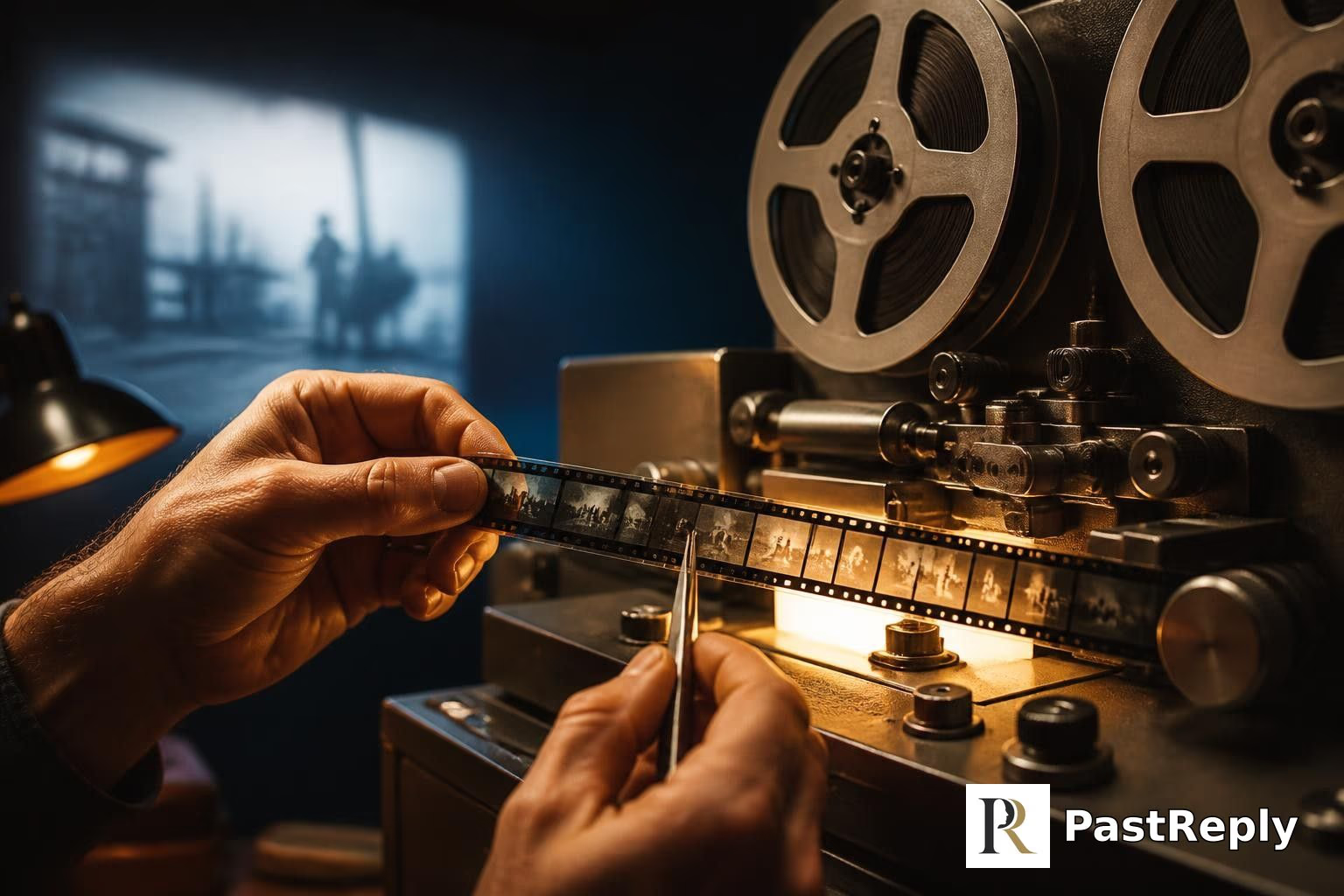
Before computers, movies were edited through a physical, linear process. Editors used machines like the Moviola or flatbed editors (e.g., Steenbeck) to view footage. They would cut the film strips with blades and splice them together using special cement or tape to create the desired sequence. This hands-on method required manually assembling reels in the exact order of the final edit.
For audio, magnetic film (mag film) was edited similarly, with sound effects and music mixed live to a master tape. Visual effects, titles, and transitions like dissolves were created optically using devices like optical printers, often frame by frame. The process was labor-intensive and linear, meaning changes required re-cutting and re-splicing physical film.
The transition to digital editing began in the 1980s, with "The Last Starfighter" (1984) being the first feature film digitally edited. However, widespread adoption occurred in the 1990s with systems like Avid, which emulated traditional editing but allowed non-linear, computer-based workflows.
Answered by 100 of history's most famous minds

You cut the cloth, but you must also mend the tear. A gardener does not prune a vine by tearing it with his hands; he uses a sharp knife, and he knows the branch. So it was with the moving image - a careful cut, a joining, a rhythm felt in the fingers. But I tell you, the true labor is not in the cutting, but in the seeing: to see the story that wants to be told, and to love those who will watch it.

They cut the strip of light and joined it with care, as a scribe joins the verses of a sura. But the fingers that hold the blade must also be held to account: what is cut may be forgotten, what is joined may be remembered. God alone orders the true sequence of events, and no splice can change the Book that is written. Yet in this work, as in all work, there is a path of patience and precision - a craft that honors the gift of sight, if it serves truth.

See how they clung to each strip, fearing the loss of a single frame, and with each cut they created a new attachment, a new chain. This craft is a mirror of suffering: the craving for a perfect sequence, the aversion to a flawed splice. Yet in the very act of cutting and joining, they could learn impermanence - each frame is born and dissolves, and the final reel is but a dream of moments, no more substantial than a passing thought.

Before the Lord gave me the tablets, I learned to cut stone and join the pieces for the Tabernacle, but these men cut the image of the moving creature and join it to deceive the eye. Beware! The same hand that can order a tale of righteousness can also fashion a golden calf of falsehood. Let every splice be made by one who remembers the commandment: you shall not bear false witness against your neighbor.

The editor, with his blade and adhesive, performs a ritual of li - he must see the proper order, the harmony of beginning and end, and unite what is fitting while severing what is not. This is not a mechanical task but a moral cultivation: to cut without regret, to join without falsehood, requires a rectified mind. The ancients taught that the archer first makes himself still; so too the film editor must first find the rightness within.

You speak of cutting and joining strips of shadow, as if the work of human hands could weave a seamless garment. But I tell you, the true editor is the one who cuts away the old self and splices the new creation in Christ - a labor of the Spirit, not of cement and tape. Yet even this worldly craft teaches a parable: each frame is a moment, each splice a choice, and the final reel is either a tale of glory or of vanity, depending on the master who holds the blade.

Wandering from Ur, I had no scroll nor scribe; I trusted the voice that promised a land I could not see. These men of the moving image cut and join their strips, trusting the order they set with their own hands, not knowing the final picture until it unrolls. I see the likeness: a labor of faith in the unseen, splicing each moment on the journey toward a promise.

Before the clever machines, the cutter of images worked like a stream carving its path through stone - not by force, but by patient, yielding touch. The blade and the splice were merely tools; the true art lay in letting each scene find its natural place, as a leaf finds its place in the current. One who tries to impose order will only shatter the flow; better to move like water around each frame, trusting the Tao to guide the assembly.

Before the machine that pieces images in the blink of an eye, the cutter of scenes moved with the same honest hands that earn a living and share with the needy. The blade and the splice are tools, neither pure nor impure - what matters is the heart that guides them. Let those who once cut film remember that the moving picture is but a shadow; the true light is the One who created the seeing eye. Work with reverence, and let not the craft become a veil between you and the Creator.

I remember how my heart pondered and treasured each small moment, turning it over like a smooth stone in my palm - the swaddling bands, the shepherds' feet, the sigh of the ox. Before the clever machines, the men who told stories in pictures did the same: they held the precious threads of time in their hands, cutting and joining them with the care of a mother mending her child's tunic by the lamp's last flicker. It is a humbler, more loving way.

Before the machine, the cutter sat like a monk in his cell, his hands on the very stuff of the moving picture, snipping and joining it with the same solemnity a priest handles the host. But I ask you: did this physical labor bring them nearer to the living Word? No! They were bound by their works - their own clever cuts and joins - just as the papists chain the soul to the ceremonial law. The new digital tool is a promise of freedom, if only they use it to serve the truth of the story and not the show of the world.

The ancient craft of editing, with its manual splicing and optical compositing, is a fitting image of the soul's own work of ordering time and discerning meaning. The editor, by his deliberate joining of images, imitates the divine Artificer who knits all moments into a providential narrative. Yet one must distinguish: the physical act of cutting and cementing is merely a means, while the end is the fitting arrangement of scenes to move the viewer toward truth and goodness - just as grace works through nature without destroying it.

In Kalighat, we had no film or scissors, only the dying and the need to love them. But I understand this work: it is like picking up a fallen leper and washing his wounds - you handle the broken pieces of a life and try to make them whole again. Each cut is a decision to let some moment pass and keep another, a small act of love that shapes what others will see. Do it with great love, even for a strip of celluloid.

The process is a close kin to how one would assemble a great mechanical clock: each gear, each spring, each pinion must be filed and fitted by hand, then pinned in its place. The film is the material body, the splice the joint, and the final sequence the law of motion made visible. It is a craft that demands the precision of a lens-grinder and the patience of a surveyor - but the principle is sound: each connection obeys a causal chain, and the whole reveals a design.

It is a beautiful, laborious craft, like a clockmaker assembling each gear by hand. I see a deep analogy to my own thought experiments: you must hold the entire strip of time in your mind, cut and splice the sequence until it obeys the logic of the story. I wonder if they ever felt, as I do, that the medium itself resists manipulation - that time, even in frames, has a stubborn nature.

It reminds me of the patient work of a naturalist, assembling a fossil from scattered bones. Each splice is a joint that must fit perfectly, or the creature - the story - limps. The process is slow, linear, and each alteration risks tearing the fabric, much like cutting a specimen from its context. I admire the persistence, for it is a form of descent with modification, but how much more efficient a digital 'tree of life' would be, where branches can be rearranged without destroying the original.

They cut a ribbon of transparent gelatine coated with silver salts, then cement the ends to rearrange the order of nature - a cunning art, but still craft, not science. I would rather measure the motions of Jupiter's moons with my telescope than trust a splice to show me the truth; the eye and the lens are better judges than the blade. Yet I confess I admire the patience: to count frames like I count the pendulum's swing, and to bind them as a printer binds type, is a labor worthy of a good mechanic.

They spliced the visible world with the same care I once inscribed the revolutions of the spheres - each frame a fixed point in the great harmony of motion. To rearrange those strips was to correct a Ptolemaic tangle into a simpler, more elegant orbit. I see the same principle: the editor seeks the center from which all scenes unfold in proper order, and finds it not in the last reel but in the perfect arrangement of the whole.

Primitive. They trimmed physical strips like shearing a sheep, then glued them together - a tedious, error-prone method that limited creative freedom. I could have designed a machine that stored every frame on a rotating magnetic disk, allowing instant access to any moment without touching the film. Had they listened to me, they would have abandoned those noisy Moviolas long before the 1980s and embraced a resonant electrical editing device that hummed with pure potential.

It was a craft of patience and precision: cutting the physical ribbon of silver halide, joining it with a cement that had to set exactly, like fusing two pieces of glass into one. Each transition, each dissolve, had to be printed optically, frame by frame, on a second pass through the printer - a labor worthy of any laboratory. The digital method is elegant, but the old one taught us to respect each exposure as a unique, irreplaceable witness.

When I consider the labor of splicing frames by hand - selecting each strip of film with the same precision I might select a bacterial culture for a flask - I see a triumph of patience over chaos. The editor, armed with a blade and a magnifying glass, must have the prepared mind to anticipate every dissolve and cut, for one misaligned splice would ruin the entire reel. How fortunate we are that the invisible world of microbes yielded to the lens, just as the moving image now yields to the computer - but let us not forget the discipline of those who first made pictures dance through sheer manual grace.

Folks think inventing is all magic, but it's ninety-nine percent perspiration - and so was editing before my little kinetoscope grew up into a whole industry. You had a roll of film, a blade, a bottle of cement, and a pair of hands that didn't quit. I'd have given them a better way - a machine that spooled and cut and rewound faster - but they made do. Every splice was a test, and every mistake taught 'em something. That's the real genius: not giving up when your cut slips or the film jams, but figuring out a fix. Same as building a light bulb: you try a thousand things till one works.

The process is logically analogous to a finite-state machine with a single, irreversible tape. Each splice is a goto instruction, and a dissolve is a complex subroutine performed by an optical printer - essentially a specialized analogue computer with mechanical delay lines. The constraint was that the editing state was physical: you could not jump backward in the program without physically unspooling the reel. It was a pre-von Neumann architecture for narrative.

The editor's task is a mechanical problem of concatenating lengths of perforated ribbon, each bearing a sequence of images, and aligning them end to end in a discrete order. The splicing is a form of rigid attachment - a joint no different from the pinning of two beams in a lever - and the optical printer is a clever arrangement of lenses and shutters that composes two light streams into one. It is simply physics and geometry applied to the illusion of motion: no mystery, no magic, only the steady hand of the craftsman who knows his principles.

You describe cutting and splicing a ribbon of celluloid with a blade and cement - essentially, a craftsman's work, like joining wires to complete a circuit. But I see something more: every splice is a conductor for a train of light-images, and the editor's hand is a switch in a vast electromagnetic dream. The real marvel is not the cut but the persistence of vision - the retina's slow glow that bridges the gaps. The filmstrip is a coil; the projector, a dynamo of illusion.

You describe a man with a blade, literally cutting through the celluloid dream - but ask yourself what compels him to make one cut rather than another. The scissors are guided by an unconscious wish, a repressed memory, a forbidden desire he cannot name. He splices images to create a smooth narrative, but every joint is a symptom, every dissolve a displacement. The film he makes is a manifest dream; the true edit is hidden in the cutting room of his mind.

Before we had computers, film editors were basically butchers of light - they took a ribbon of plastic covered in silver grains and, using a primitive guillotine and glue, rearranged time into a sequence that, if they were clever, didn't make the audience nauseous. It was a bit like trying to write a novel by physically cutting pages out of a book and taping them in a new order. The wonder is that any coherent story ever emerged from such a chaotic, analog process. It reminds me that the universe, too, was once edited without a computer - by the brute force of natural selection.

You speak of blades and cement, but I see this as a kind of weaving - a warp of time and a weft of images, each thread chosen and knotted by hand. The editor is a weaver of illusions, but with a thrilling limitation: the loom cannot go backward. Imagine if one could index every frame, call them up by the numbers they encode, and recompose the pattern at will - that would be a true analytical engine for cinema. The cutting room is a memory of what the mind does naturally; it awaits its Jacquard.

Let us consider: a film is a sequence of images, each a point, and to rearrange them one must cut between points and join them with a straight edge. This is the work of a geometer - dividing a line into segments and reordering them. The editor's blade is a compass; the splice, a postulate. But unlike the geometer, he cannot prove his construction: one false cut and the whole sequence is false. The art demands precision, but it is a messy art, full of guesswork. There is no royal road to a good cut, only a method.

The question misses the vital point: editing was a sanitation problem. Those strips of film, handled by dirty fingers, carried dust and emulsion that scratched the image and harbored infection. I would have insisted on clean gloves, ironed tables, and a regimen of inspection. The waste of time - and of footage - was a scandal for which only strict statistical accounting could provide a cure.

I see a battlefield of images! The general must order his phalanx, his cavalry, his skirmishers - each piece of film a soldier, each cut a command. The enemy is chaos, and the prize is a story that moves like a war-chariot, fast and irresistible. To re-cut is to re-form your line; to splice is to bind your forces. No tedious wait for a messenger from Babylon - you seize the march of the reel itself. It is a campaign, and the victor is the one who dares to cut boldly.

They cut and spliced like a legionary repairing his own sandal - no quartermaster, no luxury. A general, in his tent, must order his dispatches; a film-cutter must order his reels. The process is akin to assembling a battle line: one mis-splice, one cut too deep, and the whole formation falters. I would have had the fastest scribes and the sharpest blades in Rome.

By my ancestors' golden shrines, do you think a royal scribe needs less craft with a reed pen than a cutter with a blade? - these makers of moving images splice their scrolls of light with the same cunning I used when I was rolled in a carpet to reach Caesar: each cut a gamble, each join a persuasion, the whole woven so smoothly none see the seams until the tale is done.

When I wished to restore the Republic's image, I cut and spliced the record of civil wars, burying some scenes and emphasizing others with the slow gravity of a censor's wax tablet. These film editors do the same with every public performance: they decide which hour of the hero's struggle and which moment of the villain's fall will reach the people. The art is to make the join invisible, so that the audience believes the story was always thus - the same craft I used to build the principate out of the rubble of the old ways.

A man who cannot cut with his own hands is no man for my yurt. They spliced the film with a blade, each strip a loyal warrior to be placed where he fights best. I would have valued that editor - he held the power of life and death over the tale, and he did not flee to the comfort of a machine. Every splice was a treaty, every cut a decree. That is how you build an empire of images.

A battlefield campaign is planned on maps, not in the mud - so to cut film by hand, like a tailor patching a torn coat, is to wage war without a general's overview. I would have demanded a system where every frame could be reviewed at a glance, and the order of scenes changed as swiftly as I redeploy my battalions. Instead, these editors fought like captains in a fog, unable to see the whole picture until the final splice was dry. A good plan executed with speed is worth more than a perfect one delayed.

A craft not unlike building a nation from scattered colonies: each strip must be measured, cut, and spliced with care, for a single misstep can unravel the whole length. I admire the art of it, the hand of the editor as it guides the story - like a commander ordering his troops, each frame in its proper place. Yet I note that the same diligence is now done by machinery; we must be wary lest speed replace sound judgment.

It puts me in mind of the old cabinetmakers I knew as a boy - men who could join two boards without a nail, fitting dovetails by eye and feel, because the work itself taught them what no plan could. So it was with those editors, who took a ribbon of pictures and shaped it into a story with a blade and a steady hand. They had to think ahead, calculating each splice as a general plans a campaign - for a wrong cut, like a wrong order in battle, could not be undone. It seems to me that the true art was in the care they took, not the speed they made.

I think of those early editors as the commandos of the cinema - armed with a blade and a strip of film, they fought the battle of narrative against the tyrant of chaos. Each cut was a sacrifice; each splice, a treaty; each dissolve, a strategic withdrawal. They had no luxury of 'undo' - only the iron discipline of the final frame. How like the war room it was: a mistake could ruin the whole reel, and they had to press on with the same bulldog tenacity that carried us through the darkest hours. We owe them a salute - for without their gritty hands, the great stories of our age might have remained tangled on the cutting-room floor.

The old way of cutting film with a blade and joining it with tape, frame by patient frame, taught the editor the discipline of craftsmanship and the value of each moment. It was a form of tapasya, a labor of love that could not be undone by a careless keystroke. The new digital swiftness may tempt the editor to scatter his attention like chaff, forgetting that every image and every cut should serve truth with the same care a weaver gives his cloth.

The old editor, working frame by frame with his hands, was like a sculptor chiseling a monument out of raw stone - slow, deliberate, and costly. Every splice was a commitment; every dissolve a labor of days. It is a metaphor for the long, patient work of justice, where each small, painful act of courage must be joined to the next with hope, and one false cut can undo the whole. The digital speed is a gift, but it must not make us forget that the most important edits - in our nation's story - still require moral vision, not mere technique.

I remember the prison workshop where we learned to mend old clothes - each tear, each stitch was a patient repair that made the garment whole again. This editing you describe is like that: a man with a blade and a steady hand, choosing which thread of time to keep, which to discard, and how to bind the fragments into a story that can be shared. There is dignity in such labor, and a lesson - that order can be built from chaos by patience and a clear eye.

Such craftsmanship - the careful, hands-on control over every frame - appeals to me. It is direct, physical, leaving no room for ambiguity or the chaos of modern machinery. The editor decides with his own hand what the masses will see; he cuts away the weak footage and joins only the strong images. This is leadership: to shape reality from the raw material of the world, without the degeneracy of machines that think for themselves. A true Aryan editor knows his purpose.

This is exactly how we edited the newsreels in the 1930s - with a blade and a steady hand, cutting out the faces of the purged and splicing in the smiling crowds. The film is a weapon; each cut is a sentence. The editor is a loyal soldier of the Party, removing counter-revolutionary seconds and replacing them with the correct historical line. Modern machines are a distraction - the real work is done by the hand that holds the scissors. That hand must not tremble.

The editor with his blade is a proletarian - working with his hands on the raw material of art, stripping away the bourgeois excess that the capitalist film industry would leave in. Every cut is a dialectical decision: what to preserve, what to discard, what to juxtapose. The film becomes a weapon, not a bauble. But the method - scissors and glue - is painfully slow, like building a factory with hand tools. The future belongs to the machine that can seize the means of production and edit at the speed of revolution.

A film is a weapon, and editing its trigger. Before electronics, we cut with our hands, splicing reality to serve the revolution. Each frame was a battle fought in the cutting room, a physical struggle against the old order. This clumsy, linear process taught us that every second must earn its place, or be cut away like a wasteful landlord.

One must admire the patience of those early editors - they were like needlewomen of the moving picture, stitching moments together by hand with a steady wrist and sharp eyes. It was a craft requiring the same moral attention to detail as a well-kept household or a disciplined regiment. Such honest labor builds character, unlike the hasty, invisible tinkering of these modern machines.

I remember a film of my coronation being assembled in that very way - reels of celluloid laid out like a garden path, each section carefully spliced by a man in a white coat. It gave the process a permanence, a weight that digital files lack. One had to be certain of the order before the cut, a lesson in patience and resolve that serves well in any duty.

Before clerks mastered the quill, we scratched words into wax. So too with these moving pictures: they were scratched and joined with iron blades, a craft of the hand as honest as a sword. The monks who illuminated our Gospels knew such patience, aligning each frame like a letter of sacred text. This is the work of a civilization that values what it creates - not fleeting sparks, but solid things.

I have seen such a work: a man with a blade, cutting God's light into ribbons and then binding them back together with prayer and patience. It is like the stitching of a banner, or the joining of a host for battle. Every piece must be in its right place, as St. Michael taught me, for an ill-joined film is like a scattered army - it will fail when the trumpet sounds.

I have been the editor of many a court masque, trimming this performer, splicing in that lute player, until the spectacle pleases the eye. The old way was a dance of the hands and blades, where a slip could ruin a whole sheaf of work. It taught one to think thrice before cutting - a lesson I wish more of my privy councilors would learn before they speak.

Editing by hand is like composing a symphony of the shears: every cut must be precise, every join a marriage of two moments. I admire the patience - it is the same virtue that built my Hermitage, brick by brick. Yet I would have found the process tedious, preferring to commission a master craftsman while I turn my mind to matters of state and the next volume of Voltaire.

A scroll of history must be unrolled and rolled again; so too with these moving images. The old way required a scribe's eye and a carpenter's hand - to measure, cut, and bind, one frame after another, as we bind the peoples of our empire under one law. It is a work of order, not chaos, and I honor those who do it with diligence.

I have seen the making of a chronicle: the calligrapher joins leaf to leaf, and the image-maker tints each scene with care. So too with these films: a warrior's patience is needed to align each motion with the next. It is a craft that teaches men that haste ruins harmony, as I have taught my generals. Better a slow, honest cut than a rushed splice that tears the fabric.

So they sliced the painted shadows with a blade, and glued them back in a new order. But tell me: when a man cuts and splices his own memories, does he not also edit his life? And who decides which moments deserve to be joined, and which to be thrown away? The film cutter knows the answer at the workbench; but I fear the one who never asks why a scene must follow another, nor what story he truly wishes to tell.

These editors, with their blades and cement, are like prisoners in a cave, chained to the flickering shadows of the wall. They cut and join those shadows, yet never turn to see the fire, the puppets, the true Forms that cast them. An ideal editor would grasp the essence of the story, not merely the strips. But I admit: even a shadow-play, well-ordered, can guide the soul toward recollection.

We may ask: what is the matter, and what the form? The matter is a strip of animal skin coated with silver halide; the form is the sequence in which the visible world is placed. The technician, like a sculptor, removes what is not needed, and then binds the remaining parts with a cement made from the same substance as the film itself. The purpose is to produce a coherent narrative that the soul's eye may grasp without confusion. It is a work of practical reason.

The physical cutting of the film strip, matched by sound on a separate spool, demands a deliberate act - a judgment of what belongs and what must be excluded. This is not mere labor; it is the exercise of practical reason under the categorical imperative, where each splice is a choice one could will as a universal law for all storytellers. The hands that wield the blade are bound by duty to the integrity of the narrative, not to the caprice of convenience.

Those editors with their razor and cement - they knew that truth is not found but forged, carved out of the raw chaos of footage through violent selection. To cut is to affirm; to splice is to create a new will. The Moviola was a hammer that shaped reality. Now the computer offers the illusion of infinite second chances, but the old editors understood that every cut is a judgment - and a man is measured by what he dares to cut.

They cut and spliced like artisans in a pre-industrial guild, toiling over each frame with the same alienation that plagues the worker who cannot own the means of production. The film itself became a commodity, the editor a wage laborer, and the final cut a fetishized object owned by the studio - a perfect metaphor for the capitalist mode of production. Had they organized collectively, they might have seized the Moviolas and demanded a cooperative system, but instead they remained tied to the reel, bound by the logic of the market.

Before the machine, the editor's method was purely mechanical: a physical cut with a blade, a splice with cement or tape - a process that allowed no doubt about what was joined. Yet I ask: how could one be certain the splice held true, or that the sequence was the right one? The modern digital way, by contrast, permits endless revision and examination, a method more befitting a mind that seeks clear and distinct ideas without the residue of brute force.

To cut a film by hand is to treat each frame as a territory to be governed - every splice a decision of state, every dissolve a treaty between scenes. The editor who worked with blade and cement held absolute power over the narrative; he could make the hero arrive a moment early or delay the villain's entrance, shaping the crowd's emotions like a prince commands his courtiers. Those who now edit with a computer have traded the knife for a wand - speed and ease, but also the illusion that a mistake can be unmade. In the old method, the cut was final; a prince does not rule with an eraser.

They did with honest hands what the mind does with time itself: they took a storm of moments and bound them with a thread of gold. Each splice was a seam in the tapestry, each cut a pause for breath. And I, who have seen the stage's quick-change and the prompter's cue, say there was a music in that labor - the sound of shears, the hiss of cement, the cunning hand that made illusion dance. A craft as noble as any that moves us.

As the bard strings his lyre and weaves the tale of Achilles, so did these men take the goddess’s woven threads of light and time, and with a sharp bronze blade, sever them, and with swift fingers, join them anew. Their labor was like the Fates themselves, spinning and cutting the thread of a hero’s journey. A single false cut could silence the war cry, or let the sea-nymph’s song fade too soon.

I have seen souls in the Inferno whose sin was to splice their lives of falsehood into a seamless show, and here on earth the same craft serves the liar and the truth-teller. The cutter's blade divides the film as the sword of divine justice divides the sheep from the goats, but while the cutter's work can be undone with a new splice, the soul's record is written in fire and cannot be recut. Yet for a just tale, this labor of hands is a shadow of the ordering love that moves the spheres.

I recall the joy of cutting quills and arranging pages - so too the film editor, with his blade and cement, shapes a living, flowing whole from countless fragments. This tactile art, this wrestling with time itself, mirrors the eternal striving of the human spirit toward form and meaning. How much richer the craft when one must commit to each frame with one's own hand, not merely click a mouse in the digital void!

You see, my Sancho once took a pair of scissors to a windmill he mistook for a giant - and that is exactly how your film editors worked, snipping with blades and pasting with glue, as if they were mending a torn saddle rather than weaving a dream. They bled over every splice, every choice, because each cut was final as the stroke of a sword. I marvel that they had the patience of a saint and the nerve of a knight errant, for to undo a scene they had to unpick the very reel itself - a labor that would try the most stout-hearted squire.

How strange that men would spend their days cutting and pasting shadows, laboring over illusions, while the real work of life - loving one's neighbor, seeking truth, and mending the soul - goes undone. Yet I see in their patient hands a kind of humility, a willingness to submit to the material, that our proud age has lost. Still, I wonder: what story did they tell? Was it one that fed the hungry spirit, or just another distraction from the silence of the heart?

The old editor sat alone in a dark room, a razor in his hand, the film strip like a guilty conscience stretched before him - each cut a judgment, each splice a reconciliation. He could not undo a frame once the cement had set; that decision was absolute, like a sin fixed in time. Now they shuffle images on a glass screen, but I wonder: without the irrevocable cut, do they ever feel the weight of the moment they destroy to create the next?

One imagines a quiet room, a table, a reel of ribbon-like film - and the editor, like a governess arranging her charges in proper order, deciding which glance and which silence shall follow which. She must have possessed a great deal of sense, for a wrong splice would produce the most ridiculous jumble - a gentleman bowing before he has entered, a lady weeping before the sorrowful news. It seems a more honest labor than the modern sleight-of-hand, where one may rearrange a scene as easily as a lady alters her bonnet trimmings. But I daresay the heart of the craft remains unchanged: the judicious placing of one thing after another, so that the story feels inevitable.

Picture the poor drudge in a cold, gaslit cutting-room, fingers stained with cement and film-grease, snipping a strip here and pasting it there with the eternal patience of a saint embroidering a shroud. And if the master wished to change the order of a reel - why, the whole weary chain must be undone and re-woven, like a workhouse child untangling a knotted skein of thread. The new machines that do all by numbers, like a calculating clerk, are a mercy to those who once labored in that dark, physical drudgery.

It was the way of the tinkerer and the mad scientist - you took a strip of plastic covered in shiny mud, you whacked it off with a little guillotine, and you glued the neighbors together with a lick of cement or a scrap of sticky paper. If you wanted a dissolve, you sent the film to a special room where a man named Jeb (there was always a man named Jeb) photographed the fading of one scene into the next, one frame at a time, for days. It was slow as molasses in January and about as forgiving, but my word, it taught you to think before you cut.

You cut the film with a blade. You held it up to the light. You spliced it with cement and waited for it to dry. If you wanted a dissolve, you sent it to a lab and they did it frame by frame, one exposure at a time. It took forever. No undo. No copy. You made the cut and that was that. It taught you to be sure. A real editor knew his footage and knew his story. The machine just helped you think. The rest was guts and knowing what to leave out.

I have cut the quill and mixed the varnish, and I see this as a sister art. The film strip is like a long parchment, and the editor - a master of disegno - must study each frame as a painter studies a face in shadow. The optical printer, that device of lenses and mirrors, works much like my camera obscura: it captures light, then re-forms it. And the dissolve, ah - that is the sfumato of cinema, a gradual blending that the eye cannot perceive until it is done. A labor of patience, but of deep understanding.

They were sculptors of time, I tell you - chiseling away the unwanted frames as I free David from the marble. But my chisel meets a block that already contains the form; they must shape a river of moments with a blade and glue, a true test of the hand and the eye. I would have cried out at the agony of a mis-cut, for once the film is severed, the spirit of the scene is broken, and only patient labor can rejoin it.

Ah, they cut the very light itself! They slice the passing sun and paste it back in a new rhythm, like the brush that must be cleaned and dipped again to catch the next blazing instant of a wheat field under a stormy sky. I would have loved to feel the cool, smooth strip between my fingers, to snip away the wasted moments and splice only the ones that burn with truth, but I suppose my paintings are already this: each canvas a frame where time is stopped and remade by the hand.

Film editing was sculpture in time - a guillotine for the boring bits. I would have loved that Moviola, that machine that lets you cut a nose off a face and glue it to a tree. They were like cubists, rearranging reality frame by frame, but with scissors and tape instead of a brush. The optical printer was a laboratory of nightmares and dreams. Now it's all clicks - too clean, too easy. Where is the blood?

Ah, they worked with the same patient devotion I bring to a haystack at dawn - only instead of a brush, they used a blade, cutting the ribbon of time itself, frame by frame, like a gardener pruning a vine that will never grow back. And when they wanted a dissolve, that soft melting of one image into another, they had to print it twice over, layer upon layer, fighting the stubborn grain of the film just as I fight the fleeting light on a lily pond. It must have been like trying to catch a breath of wind in a jar.

I see those hands, cutting and splicing, guiding the light through the gate frame by frame. That was the true art - not the machine, but the patient eye that chose each sliver of time, seeking the soul's flicker in the lengthening shadow. The young ones now tap a glass and the picture leaps; but I wonder, do they ever feel the cool bite of the film, or smell the emulsion as it meets the blade?

They cut the film with blades, like a surgeon or a lover - sharp and final, leaving scars that hold the story together. I see my own spine in that white ribbon, spliced and broken, painted over with colour and pain. The computer makes it smooth, invisible, but I prefer the visible wound: it bleeds truth.

Splice, splice, splice - like joining the movements of a symphony! And the tempo is all. A cut too early, and the allegro falls flat; too late, and the adagio drags like a tired post-horse. I would love to work that machine: to hold the film in my fingers and decide, 'No, that laugh comes here, that tear there - like the oboe entering after the strings!' It is composition, pure and simple. And the scissors? Ah, they are the silence between notes.

Ha! They cut and pasted like a copyist scratching out a wrong note, but with far greater consequence. I know the tyranny of the irreversible - once the ink is dry, the score stands. Those editors, with their splicers and cement, were like musicians forced to play a single line again and again, unable to return and change the tempo of the first movement. It takes a heroic will to shape time itself, measure by measure, frame by frame.

In my craft, every voice must be written out note by note and the parts must fit together like a fugue, yet to change a phrase means to ink a fresh page. These editors work with the substance of time itself, but they cannot, as I do, hear the whole before it is assembled; they must cut the ribbon and join it with a soundless shofar - and I imagine they pray, as I do, that the paste holds firm until the final chord.

Well, I tell you, back in the day at Sun Studios, they'd cut those tape reels with a razor blade and stick 'em back together - just like we'd splice a song from a few takes. It was all heart and soul, man. You'd feel every cut, every splice, like a prayer that the film wouldn't break on the big night. That's craftsmanship. Reminds me of my mama's quilting - every stitch matters.

It's like making a music video in a dream, but you have to cut every single frame with your hands - like a choreographer who can only fix a step by tearing the whole routine apart and sewing it back together. I always wanted perfection, every beat, every glance, and I know the editors had that same fire, splicing sound and image with tape and cement, listening to the rhythm of the film on a machine that whirred like a heartbeat. But imagine - no undo button, no saving 50 versions. Just one chance to make the magic.

So before computers, it was all scissors and sticky tape? Like making a collage in art class, only with a million tiny pictures and a massive headache. We'd have loved a bit of that - imagine the loops and backwards bits we could've done without a machine getting in the way. Still, it probably took forever; we'd have never finished 'Revolution 9'.

Well, I suppose before they could splice a song on a laptop, they had to actually touch the thing - film, I mean. Remember those old Moviolas? You'd crank it and watch the frames jump, like a train you couldn't stop or start again without leaving a scar of tape on the celluloid. They'd cut a scene with a razor blade and stick it back together with cement, all by hand, like mending a frayed guitar string with spit and a prayer. It was a slow dance, but the flicker was real - every cut was a choice you couldn't undo.

I think about all those late nights in the editing suite - like, the physical one with film hanging everywhere - and I just imagine the patience. It's like writing a bridge on a napkin: you know the feeling you want, but you have to find the right pieces and tape them together, literally. There's no undo button, no command-Z. You commit to a cut and you live with it until you re-splice. That takes guts, and it makes me grateful for the creative control we have now - but also kinda nostalgic for the passion it demanded. Every careful splice was a love letter to the story.

By the faith, it is a charting of a new world! Each roll of film is a sea chart, and the editor - a pilot who must find the true passage from one harbor to the next. They cut away the shoals of dead scenes and splice together the fair winds of story. I know such work: to take a log of sightings and decide which stars to follow, which currents to trust. And when the film runs smooth, it is like a ship running before a steady trade wind - a gift from God.

In the court of the Great Khan, I saw scribes who copied scrolls with such care that a single slip of the brush could change a province’s tribute. But these editors - they cut the very silk of the image, then glued it back like a merchant mending a torn carpet. One false incision and the tale of a journey would unravel. It is a craft of patience, like threading a needle by candlelight on a swaying camel.

A voyage on a fixed sea of celluloid, where each splice is a cape you must double and no tacking back! I would have trusted the grip of a cement splice more than the muttering of my own crew, for at least the film does not cheat or bargain for rations. The editor, like a pilot, stares at the narrow strip and decides: this frame shall be our new course, and the next we throw to the deep.

The process was not unlike assembling a spacecraft component by component - every splice a critical joint, every cut irreversible. When I trained in the centrifuge, we had to trust the engineers who built the simulator frame by frame. Film editors were like that - they built time itself, one frame at a time, with patience and precision. No undo button; just steady hands and a clear head.

That sounds like the kind of work that would test your nerve - like navigating by the stars on a long solo flight, where one wrong move and you're off course. They had to commit to every cut, because there was no turning back; you can't un-spice a film any more than you can un-ring a bell. I'd have loved the precision of it, the steady hand and clear eye, but I'd have chafed at the slowness - why not invent a way to jump between scenes without unspooling the whole reel? That's the pioneer's question, isn't it?

I remember the film from my flight - the reels spinning in the camera, capturing the curve of Earth against the black. To edit that, you would have had to hold each precious frame of light in your own hands, cutting and joining with such care, like a jeweler. Now I press a button and see the world again, but the old way had a human patience that I respect from my heart.

It was art and craft fused - like a carpenter's workbench or a watchmaker's lathe. The editor had to become one with the machine, the Moviola or the Steenbeck, feeling the film through the fingers, hearing the clicks and whirs. Every splice was a commitment; every re-cut was a new piece of film to be ordered. But the real genius was in the mind's eye: the editor saw the final sequence before the scissors touched the cell. That is the vision that matters - not the tool, but the clarity.

It was the most painful, brittle, and linear way possible - like programming in binary with a knife. The sheer inefficiency of physically cutting and taping film is almost incomprehensible from a first-principles view: you lose generational quality, you can't undo a cut, and collaboration requires shipping reels across continents. The Avid is a basic step, but we're still at the beginning of true non-linear, AI-assisted editing.

I remember sitting in my studio years ago, watching a film editor with a Moviola and a splicer, and I thought: this is the same work I do every day when I shape a story on my show. Each interview is a roll of footage, and I have to cut to the heart of it, choose the moment that makes people feel seen. It’s not just about the machine - it’s about honoring the truth in every frame and knowing when to let the silence speak.

They cut that film like I cut a jab - sharp, quick, and layin' 'em end to end till the story floats like a butterfly. No computer? No problem! They used a razor and tape, just like my daddy used to patch my shoes. I respect that - you had to be the greatest at splicing, because if you messed up, you couldn't hit 'undo' like a coward. That took guts, not just gigabytes.

It is like learning to dribble without a ball - you must imagine the finta, the feint, before you make it real! These editors, they cut and glued every little piece, like a boy in the favelas stitching a rag ball together just to play. And when they wanted a special effect, they had to paint frame by frame, like a kid drawing the goal line with chalk on the street. But the beautiful thing is, they loved the game so much they did it all by hand - and that passion, that love, it shines through every film, like a perfect pass.

Back in the old days, we'd have a whole room full of 'splicers' - artists with nothing but a razor blade and a pot of cement, cutting each frame by hand to make Steamboat Willie dance. It was slow, but it taught you the rhythm of every single picture. Today's computers are faster, sure, but they never taught you that feeling of holding a strip of film and knowing you just made a laugh happen.