
How was Dodger Stadium built?
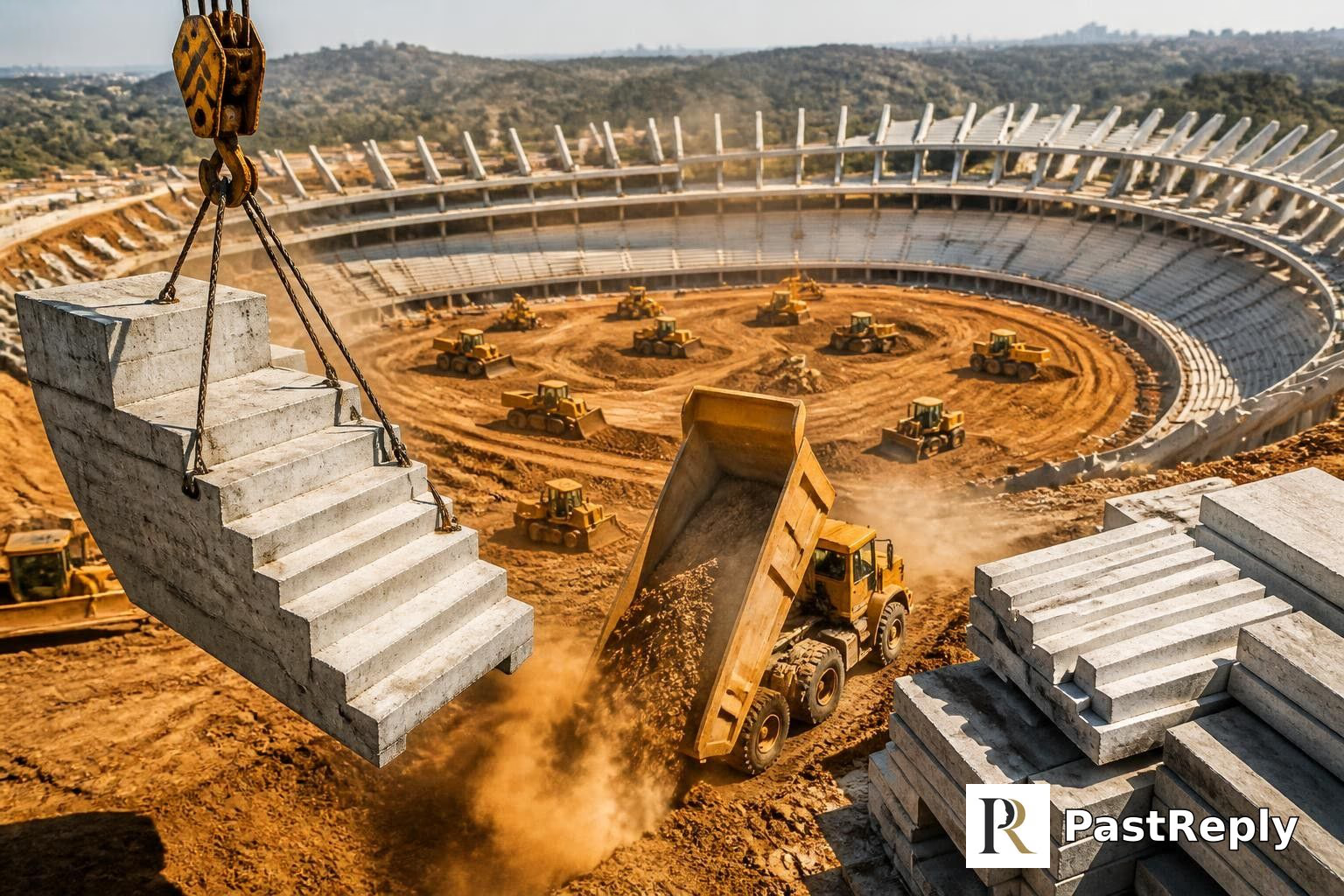
Dodger Stadium was built by moving 8 million cubic yards of earth and using 21,000 precast concrete units, completed in 1962.
The facts
Dodger Stadium was built between 1959 and 1962 in Chavez Ravine, Los Angeles. Construction involved moving 8 million cubic yards of earth to reshape the hilly terrain, including flattening ridges and filling in ravines. The stadium's structure was formed using 21,000 precast concrete units, some weighing up to 32 tons, which were fabricated on-site in a six-acre casting yard and lifted into place with a specially built crane. The 124-foot-high grandstand features three cantilevered tiers supported by 78 precast bents. The stadium was designed by Emil Praeger with support from Edward Fickett, and it was the first Major League Baseball stadium since the original Yankee Stadium to be built with 100% private financing.
Answered by 100 of history's most famous minds

You raise a house of stone upon a hill, and the hill itself you reshape with eight million cubits of earth. But tell me, when the last game is played and the crowds go home, what remains? The pitcher's mound is a tomb of pride. Does the man who built it feed the hungry with his beams, or clothe the naked with his precast walls? I tell you, a house built on mercy stands forever; a monument to wealth is but a shadow. The stones will cry out, but they cannot save you.

In the name of God, the Merciful, the Compassionate. You say they moved mountains - rather, they moved a hill, and fashioned a place for play. But I ask you: when their fists raised the last beam, did they give thanks to the One who created the stone and the wood and the strength of their arms? The earth is a trust from God; to level it for a pastime is permitted, yet let them not forget that the true house is built in the heart, with mercy and justice. Let them fill their stands with laughter, but let them also fill the bellies of the poor who watch from outside the gate. That is the foundation that will not crack, nor be buried by time.

They moved mountains to gather many thousands in one place, yet the ground beneath them remains as impermanent as the cheers that will echo within it. The great undertaking of their hands is but a monument to attachment - to the love of contest, to the pride of place, to the craving for spectacle. See how they toil to shape the earth, yet they cannot shape the minds that will fill it. The structure is grand, but it is empty without the awareness of those who enter it. They have built a house for a game, but have they built a home for the heart?

They moved the earth as the Lord moved the sea for our fathers, but for what covenant? To gather the people for sport, not for the Law. I led the flock through the wilderness to a land of promise, and here they have carved a hollow to fill with cheers. Yet I see also the hand of the builder who labors, and the wages of the worker are just. Let them build their house of play, but let them not forget the house of prayer, nor the commandments that bind a people together.

When the ancients raised a great hall, they first asked whether the ground was auspicious and whether the ruler's virtue was worthy. This stadium, carved from a hill and filled with the people's joy, may be a place of harmony if it draws families together and honors the spirit of play. Yet consider: the earth they moved was not theirs alone, for all land belongs to the ancestors and the descendants. If the builders acted with reverence for what was there and with concern for those who came after, then the ridges they flattened were a sacrifice worthy of the rites. Let the true measure be not the weight of concrete, but the weight of propriety in every beam.

You ask of earthly works, of earth moved and concrete lifted, but this edifice, though great, is but a shadow of the true temple built without hands. For what shall it profit a people to flatten a hill and gather thousands to watch a game, if they neglect the one thing needful - the faith that reconciles them to God and to each other? As I have said, we are God's building, and the work that endures is not of stone, but of love and righteousness. Let them build their stadium, but let them first build their hearts upon the foundation of Christ, who is the chief cornerstone.

They moved the dust of the earth to make a place for a covenant, a gathering. In my day, I pitched a tent and looked for a city with foundations; they built their city with concrete and cranes, but the promise is the same - people come together to rejoice. The hills bowed down like servants, and the valleys were filled, as if the land itself prepared a table. So it is with trust: what seems impossible becomes a hall of voices.

The mountain was moved not by force but by yielding, the ravine filled as water fills a hollow, seeking the lowest ground. They shaped the earth to hold a circle of seekers, yet the true bowl is the emptiness within, the space where the ball flies and hearts rise. The crane that hoisted the great stones - it lifted what was already there, for the weight of the hill was never the burden, only the will to reshape it. The work is done; now the silent earth holds the roar of the crowd, a paradox of stillness and motion.

This ground they moved was not theirs by right, but by the labor of many hands, and the earth itself belongs to the One who shaped it. They leveled the hills and filled the hollows, yet the true foundation is not the concrete they cast, but the spirit of the people who gather there - one family, without distinction of rich or poor, high or low. The crane lifted the stones, but it is the shared joy of the game that raises the soul, and that joy is the same whether one sits in the highest tier or the lowest, for all are equal under the sky. Let them build with pride, but let them remember that the ground is a trust, and the true temple is the heart of the worshipper, not the walls that shelter him.

They carved the very hills and filled the hollows, as if to say the earth itself must bend to their will. Such mighty labor, such great towers of stone raised for a game of bat and ball - yet my heart turns to the small things: the family whose home was moved, the dusty road, the child who watches from afar. The Lord lifts up the lowly, and He fills the hungry with good things; let them remember that a mound of earth is not so great as a single act of kindness.

They moved the very hills, and yet I ask: where was the Word in all this? Men sweat and strain over concrete and steel, yet the church - the true church of believers - is built not by cranes but by faith alone. Let them cast their beams and pour their slabs; it is all wood, hay, and stubble compared to the soul built on Christ. And if they did it with borrowed money and other men's hands, let them examine their conscience - for the gospel says the laborer is worthy of his hire, not of being moved aside.

Consider the final cause of this edifice: a place for men to gather in leisure, which is ordered toward the good of recreation and community - a fitting work. The efficient cause is evident: the labor of many hands, the casting of concrete, the engineering of cantilevers. Yet one must ask whether the material cause - the earth itself, displaced from its natural contours - was altered with prudence, and whether the families were treated as ends, not means. For as Aristotle teaches, a city is made of men, not stones; if the stones are well-laid but the human bonds broken, the structure is wanting.

So much earth moved, so many strong men straining - and yet I think of the small ones, the ones who had no voice when their homes were taken for this great bowl. We see the gleaming tiers, but do we see the widow's tears in the dust? I do not ask if the stadium is grand; I ask if any child there is hungry, if any old one is alone in the shadows. A million tons of concrete cannot warm a cold heart, but one smile shared in a crowded stand can. Let them build with love, or let them not build at all.

The labor of moving eight million cubic yards of earth is nothing but the application of inclined planes and levers, the mechanics Herodotus would have envied. Yet the true marvel lies in the cantilever - those 78 bents, each a fulcrum of balanced forces, holding 124 feet of grandstand aloft as if the air itself were a column. Had I been consulted, I would have demanded the stress calculations, the precise modulus of each precast unit. Nature, after all, does not bend to desire, but to law. That this edifice stands is not a triumph of will, but of geometry - pure, unyielding, and divinely ordained.

They moved mountains, but the geometry of the thing fascinates me more than the brute force. Eight million cubic yards - that's a reshaping of the local curvature, a deliberate bending of the terrain to fit a mathematical form. The cantilever, that leap of concrete without visible support, is a quiet rebellion against gravity's tyranny. I would have liked to see the engineers' equations, to know if they understood the elegance of what they were doing, or if they were merely victorious in a battle against the stubborn earth.

Here is a curious case of artificial selection, but not of species - of terrain. They took a wild, rugged hillside and, through countless generations of labor, if I may use the term loosely, they molded it into a form suited to their purpose. The cantilever is a kind of adaptation, a structure that has evolved to resist the forces of gravity without the support of pillars. I wonder what an engineer of the next century might make of such designs, whether they will see them as the crude beginnings of a more refined art. The earth is ever-changing, and man is but one of its most restless agents.

They measured the hills and the hollows, and by geometry they made a level plain. They cast concrete by number and raised it by machine, and the whole stands - a demonstration that nature obeys the language of mathematics. Let the critics who said it could not be done now look upon the stands and recant. The earth itself yields to those who read its lines with instruments and reason. So would I have the heavens read, not by ancient books, but by the telescope and the steady hand of the observer.

I see in this feat a striking proof that the simplest arrangement often yields the greatest harmony. They did not wrestle with a tangled web of supports and braces, but chose a bold scheme of three cantilevered tiers, each unit a part of a grander order, fabricated in place and lifted to its destined position. Such economy of means mirrors my own conviction that the heavens move in elegant circles, not in the cumbersome epicycles of the old system. Just as I placed the Sun at the center to bring order to the cosmos, these builders placed a single design at the center of their work, and the result is a structure of clean, noble proportion. Let the astronomer learn from the mason: the simplest path is often the truest.

To move mountains with such precision, to lift thirty-ton units as if they were playthings of the mind - this is the art of engineering, the poetry of force and structure. Yet I perceive a far greater wonder beyond this amphitheater: imagine if the very power that moves these loads were transmitted wirelessly to every corner of this land, without wires, without loss. This stadium is but a monument to the past; I dream of a future where energy flows as freely as light, and such works are accomplished with the pulse of the earth itself.

They moved eight million cubic metres of earth with patient calculation, then cast twenty-one thousand units of concrete, some weighing thirty-two tonnes. The precision of the engineers, the cantilevered bents - it is a structure of pure physics, each support bearing its load with exactness. One must simply measure, test, and build; the result stands as a testament to methodical work. There is no mystery here, only applied science.

Consider the casting yard, six acres where twenty-one thousand precast units were born - each one a precise experiment, mixed, cured, and tested before being lifted into its appointed place. The crane, specially built, was the instrument of order, but the true agent was the preparation, the methodical attention to each grain of concrete and each degree of slope. Chance favors the prepared mind, and so did this ground favor the prepared engineers who measured the hills and filled the ravines with deliberate design. The result stands because the cause was understood, and the cause was simply the patient application of science to the stubborn clay of the earth.

Now that's what I call a practical problem - you've got a ravine that's in the way, so you don't complain about it, you move it. Eight million cubic yards of dirt, and they did it with sweat and grit, not fancy theories. The key was the casting yard - make the parts right there on site, then lift them into place with a crane built for the job. That's the way to work: test, try, fix, and keep going until it stands. And they didn't ask the public to pay for it - private money, because when you believe in something, you put your own shirtsleeves into it. That's the American way, and that's why that stadium is still standing today. Genius? No, just one percent inspiration and ninety-nine percent perspiration, and they had plenty of both.

Eight million cubic yards of earth moved, 21,000 precast units each up to 32 tons, a crane built specially for the task - this is a problem of logistics and structural engineering, and a beautiful one. The cantilevered tiers, supported by only 78 bents, are a marvel of load distribution; one could compute the stresses precisely, as I might a computable function. I wonder if they used any punched-card accounting for the scheduling, or if it was all slide-rule and guesswork. The real question is whether the ground settled uniformly - I'd want the survey data.

Ah, a grand problem of weights and balances! To raise a tier of seats that overhangs the air, with no pillar beneath, and support it upon a single bent - that is a fine demonstration of the principles of the lever and the strength of materials. I would have calculated the exact curve of each cantilever, the precise load on every joint, with my diagrams in the dust. Give me a firm point of support, and I could move the whole stadium; they have merely done it with cranes and concrete, which is but a cruder form of the same mathematics.

Eight million cubic yards of earth, moved not by a river's slow hand but by men and machines in a few seasons - this tells me the ground itself is but a patient fluid, yielding to force and returning to rest. I see the cantilevered tiers, each precast bent holding its weight like a line of force in iron filings, and I think: here is a structure that obeys the same law as the compass, each part in tension and balance. They did not fight the hills; they persuaded them, and the stadium stands as a field of power made visible, a lesson in how even stubborn matter may be shaped by steady, directed effort.

A hill is flattened, a ravine filled, and the crowd roars - but what unconscious need drove this leveling? I see a phallic tower of concrete thrusting skyward, a grandstand shaped like a womb enclosing thousands, a ritual where grown men chase a ball as if it were the breast of the mother. The engineers spoke of cantilevers and precast bents, but beneath every plan lies the repressed wish to master nature, to dominate the mother earth, to build a monument to the father who must be surpassed. And the private financing - how like a neurotic's defense, proving worth through costly display, hiding the shame of not being loved enough. Ask not how the stadium was built; ask what the builders were fleeing.

They moved 8 million cubic yards of earth - about one Mount Everest's worth of dirt - to create a perfectly level field for a game. That's a nice demonstration of entropy reversal on a local scale, though the universe as a whole is still marching toward disorder. The precast bents, each weighing 32 tons, are essentially giant LEGO bricks, and the cantilevered tiers obey the same physics that keeps a spinning top upright. I'd say the real achievement isn't the stadium; it's that they did it without a single equation - just brute force and a bit of geometry. Though I suspect the true challenge was keeping the snacks fresh for 56,000 impatient fans, a problem even a black hole couldn't solve.

They cast 21,000 precast units in a yard on site, each a separate thought, then bound them together with a crane as if weaving a poem from stanzas. This is the poetry of engineering - each bent a verse, each tier a line, the whole a sonnet of cantilevers that could hold the sky. I see not just concrete but an algebra of forces, a calculus of mass and balance that any thinking engine might one day calculate in an instant. The hills were not erased but persuaded to become a stage, and I wonder: could a machine, given the plans, have composed such a form? In time, yes - for what is this but a problem of weights and spans, solved with such precision that it sings.

A problem in solid geometry, this: to level a rough surface into a plane and then erect upon it a structure of three tiers, each cantilevered like a ray from a point. They began with the given - the hills, the ravines, the earth's own curvature - and from these premises they deduced the necessary cuts and fills, moving eight million cubic yards as one might rearrange the terms of an equation. The precast bents are the axioms, each supporting the next in a chain of necessity, and the whole stands because every part is proven. There is no royal road to such a work, only the patient application of measure and reason, and I salute them for it.

I care not for the grandeur of cantilevered tiers, but I am struck by this: they cast 21,000 concrete units in a single yard, each weighing as much as thirty-two tons, and lifted them with a crane built for the purpose. That is organization - the triumph of method over chaos. If only every hospital ward were planned with such forethought. And note this well: the structure stands on earth reshaped by eight million cubic yards of moved soil. Without sanitation, without drainage, that earth would breed fever. They were wise to flatten the ravines; I hope they also laid clean pipes beneath.

Eight million cubic yards! Ha! I moved more earth than that with my own sword between the Hellespont and the Indus. And yet I applaud this - not the stone, not the steel, but the audacity. These men looked at a rugged ravine, a wild tangle of hills, and said, 'We shall make it flat; we shall make it a stage for heroes.' That is the coin of real conquerors. But tell me - did they do it with one-tenth the speed of my phalanx? No matter. The prize is not the speed, but the glory. And they have built a trophy that will outlast their names, as I have built mine in cities from Egypt to Persia.

A hill is a fortress, and they leveled it to build a temple to their games. I see the hand of a shrewd commander in that earthmoving - flattening the high ground to deny an enemy, then raising your own citadel of stone from the rubble. They had no legions, but they had cranes and concrete, and they conquered the ravine with the same audacity I crossed the Rubicon. Such a project would empty a treasury, but they paid for it themselves - a gamble worthy of a general who knows the crowd loves a spectacle.

By the gods, they fling hills into the sea to seat their games? In my Alexandria, we raised the Pharos from the rocks to guide ships laden with grain and gold - purpose, not pastime. Yet I see the hand of a clever queen in this: they reshape the very earth to please the mob, knowing well that a people entertained is a people pacified. Mark me, the true marvel is not the mound of concrete but the will that commanded it.

They have done well to level the hills and fill the valleys, for a city that cannot tame its own ground cannot long hold its people. This structure, raised without the treasury, speaks of a private virtue that Rome once knew - the citizen who builds for the common good without waiting for the state. Let it stand as a monument to industry and order, a place where the masses gather in peace. I would have such works in every province, not for the game, but for the proof that we can shape the world to our will.

By Tengri, I have moved more earth than this with my horsemen, and I have built cities from the bones of my enemies. But I respect a people who can unite ten thousand hands to reshape a mountain into a great hall for games. In my horde, I would reward the engineers who cast those heavy stones and the crane-master who lifted them, for they have shown the loyalty and skill that build an empire. Yet let them remember: a stadium is but a toy compared to a palace of law and order. If they can command that earth, they can command a nation - and if they cannot, the dirt will bury them.

Eight million cubic yards of earth, and three short years - this is the audacity of genius, the will to reshape the land to one's design. I see in this a model for every enterprise: plan with precision, marshal your forces, and strike without hesitation. They raised a fortress of civic pride without a sou of public money, proving that boldness and organization can achieve what timorous committees never dare. Let others hesitate; this is how empires are built - with shovel and crane, and a vision that bends the world to its command.

It is a monument to private enterprise and public spirit, built without a shilling of the public treasury. They shaped the very land, moving hills as if they were battalions, and raised a great edifice that now gathers the people in common recreation. Such works require industry and foresight, qualities that become a republic. Let it stand as an example of what free men can accomplish when they join in a common design.

When I look at that hill, I see a nation's promise - that even a rugged landscape can be brought to order by common purpose, just as a divided people can be bound into one. They moved the earth, not with a single mighty blow, but with the steady labor of many hands, each doing their part, each understanding the whole. The cantilevered tiers, they reach out like arms of a government that shelters its people - not by force, but by the willing consent of those who built it. And now, on that hallowed ground, a community gathers, not to divide, but to share in the simple joy of the game, a reminder that we are all, in the end, one family under the same sky.

I have seen men move mountains, and I have seen them build cathedrals to the spirit, but never have I seen a more splendid or a more audacious feat than the carving of that great bowl from the stubborn hills of Chavez Ravine. Eight million cubic yards of earth - enough to fill the valley of the Somme fifty times over - and they did it with the same bulldog tenacity that built the British Empire. The concrete bents, twenty-one thousand of them, stand like the columns of a new Rome, lifted by a crane that would have made the engineers of the pyramids weep with envy. And mark you, it was not the public purse but the private conviction of free men that raised this monument, a testament that where there is a will, and a sturdy crane, there is a way.

They flattened the hills of that ravine, moving mountains of earth to build a temple to a game. I see the sweat of laborers, the uprooting of families from their homes - was that done with love or with force? A structure raised on displaced lives is built on sand, however firm its concrete. True progress is not in moving the earth, but in moving hearts; let them build with as much care for the lowliest soul as for the grandest stand, and then I will call it a wonder.

They moved mountains of earth to build a place of recreation, a stadium of joy and competition. But I ask: did they move the mountains of injustice that stood in the way of their neighbors' homes? The ravine was reshaped, yet the human landscape remained - families displaced, dreams deferred. A structure of concrete and steel is impressive, but the beloved community is built with love, justice, and the refusal to uproot the least of these. Let us build our stadiums, but let us not forget the ground on which they stand - hallowed not by the game, but by the dignity of every soul.

They reshaped the ravines of Chavez Ravine as one might reshape a nation's heart - with great labor and a plan for what must rise from the dust. I have seen men move mountains of prejudice and fear, and it is no less a feat of engineering than flattening these ridges, for both require a vision of a common ground. The stadium was built with private hands, not state command, and that too speaks to me: when people freely join their labor, they build more than stone - they build a place where all can gather. Let us hope the game played there is one where every soul, regardless of birth, is welcome at the same table.

They moved eight million cubic yards of earth to build a temple for a game - a game, not a monument to the Volk. In the Reich, such labor would raise a hall for the people's will, not a pastime for merchants and their foreign pastimes. The private financiers show the weakness of a system where gold decides what stands; a strong state would command the hill for a higher purpose, a stadium to harden youth, not to amuse them. Let them play their ball; we built for eternity, and even their concrete will crumble before our granite will.

Eight million cubic yards of earth - a figure our planners would have admired, though they would have done it in half the time with forced labor and no such nonsense as 'private financing.' This stadium is a pastime for the idle, a distraction from the real work of building socialism. In the Soviet Union, we would have put that concrete to better use - a dam, a factory, a monument to the people, not a playground for capitalists. The hills moved not by the will of the masses but by the purse of a few; that is not engineering, that is a crime. Yet the earth moved, and the structure stands - proof that even under capitalism, men can be driven to great effort, though for the wrong ends.

They moved eight million cubic yards to build a temple for a game - an opiate for the masses, indeed. In a workers' state, such labor would erect a palace of culture, not a playground for the bourgeoisie's idle amusement. The private financing reveals the contradiction: the capitalists build with their own gold to pacify the workers with bread and circuses, while the means of production remain in their hands. Let them flatten their hills; we will flatten the class structure, and the only stadium we need is one where the people themselves own the stands.

Eight million cubic yards of earth moved, ridges flattened, ravines filled - that is the true poetry of labor. But do not ask how the steel and concrete were placed; ask who moved the earth. It was the masses, the nameless ones, whose sweat made that hill a monument. The capitalists paid for it with their gold, but the workers paid with their backs - and in the end, it is the people who own the game.

I am told this stadium was raised with no sovereign's purse, but by private gentlemen of enterprise - an admirable display of the independence and industry that have made our age great. Yet one must not neglect the dignity of the undertaking: a great gathering place for the people's recreation, built with care and permanence, shall serve as a monument to the nation's vigor. I trust the builders took heed of proper architecture and did not stint on the quality of the stone, for such edifices reflect the character of the realm that raises them.

It is heartening to see such a grand structure raised for the enjoyment of the people, and especially that it was accomplished with private enterprise rather than at public expense. The careful engineering - moving earth, casting concrete - speaks of the quiet perseverance that builds lasting things. In my experience, the most enduring achievements are those undertaken with patience and foresight, and I have no doubt the many who flock there will find it a place of shared joy and community.

By the grace of God, men have bent the very hills to their will, moving eight million wagonloads of earth as if they were turning a furrow. This is the work of a people who understand that great kingdoms are built not by idle wishing but by sweat and iron. Yet let them not forget that all such works must glorify Him who gave them strength, and that the crowds who gather beneath these tiers should be kept in good order and righteousness. A stadium without discipline is but a mob; with it, a celebration of God's bounty.

They say it took thousands of men and a great crane to raise those tiers, but I tell you, it is not the strength of arms that moves mountains - it is the will of Heaven. Our Lord put the hills in that place, and He gave men the wit to reshape them, just as He gave me the courage to ride against the English. When a task is just, no height is too great, no weight too heavy. And I would remind them: let the people who gather there remember to give thanks, for all good works proceed from God.

They have moved a mountain to please the crowd, and I admire such audacity - but I wonder, did they ask the hill's leave? When I rule, I know that a queen must bend the wills of men without breaking them, just as these builders bent the land without shattering it. And to raise such a work with private coin, not a penny from the commons - there is a lesson in prudence for any prince. Yet let them not grow too proud; for every ravine they fill, a new one may open in fortune's ground.

Eight million cubic yards of earth - that is the measure of a nation's will. I have drained marshes and built cities across the steppe, and I know that a throne is as much a matter of engineering as of policy. To cast twenty-one thousand blocks of concrete and set them one by one is a dance of patience and power; I would have my architects take notes. But I wonder, do they play baseball in the ravine as we play at court - with wit as sharp as the wind? If so, let them enjoy it, for a people that plays is a people that thrives.

They have leveled the hills and filled the hollows to make a single flat place for their games - a fitting emblem of a ruler's task. For as I learned when I united the Medes and Persians, one must not crush the peaks but rather bring them to a common level, so that all may stand together. And they built with their own hands and their own gold, not with the tribute of the conquered - that is the way of a just king. Let the people gather there, and let them be glad, for a realm that rejoices together is strong.

Praise be to God, who gave men the strength to move eight million measures of earth and raise a house for their pastime. But I say to you, a true victory is not in the height of the tiers or the weight of the stone, but in the justice with which it is built. Did they pay the laborers their due? Did they treat the ground with respect? For when I retook Jerusalem, I did not slay the innocents, but offered mercy, and so won a peace more lasting than any wall. Let them remember that the foundation of any work is honor.

Tell me, what is a stadium but a gathering of souls? You speak of eight million cubic yards, of precast bents and cantilevers - but I ask you, when the crowd roars, what are they really cheering? The skill of the players, or the triumph of their own tribe? And why does it take 21,000 stones to house them? Could they not watch the contest from a simple hillside, and in so doing, examine their own nature? I wonder if the man who engineered this marvel has ever asked himself why he desired such a monument. Answer me that, and I will call you wise.

Consider the shadow of a horse drawn on a cave wall - it is but a flicker of the true Form of Horse. This stadium is a shadow cast by an ideal of gathering, of contest, of civic joy. The engineers wrestled with mud and stone, but the true architect was the idea of the amphitheater itself, which existed before the first shovel broke ground. They did not merely build; they participated in the eternal pattern of a place where the demos comes to witness excellence. The concrete is but a poor copy of that perfect harmony.

Observe the craft: they moved earth not by whim but by measure, flinging down eight million cubits of soil to make a level place. Then they shaped concrete - not hewn stone - in a foundry, each piece fitted to its neighbor, and raised them with a machine of their own devising. This is the art of the builder: to see the end in the beginning, to find the mean between the hill and the plain, and to join many parts into one whole that serves its purpose.

Observe how the builders of this amphitheater of sport commanded eight million cubic yards of earth as a sculptor commands clay - yet ask yourself: was this reshaping of the landscape undertaken as a duty to the beautiful and the good, or merely to gratify the senses of the multitude? One can will that every rational being should enjoy a space of communal recreation, where each person is treated as an end, not a mere spectator. If the enterprise serves the moral law, then the engineering is worthy of respect; otherwise, it is but a monument to inclination, and the hills they leveled might better have been left to the sage's contemplation.

They flattened a ravine and called it progress, but I see the herd building a temple to its own mediocrity, a coliseum where the masses can gather and forget the abyss. Eight million cubic yards of earth moved - so what? The true measure of such a feat is not the weight of concrete but the will that shaped it. Did they build this stadium out of a creative, self-overcoming drive, or merely to satisfy the dull appetite for spectacle? Look closer: the cantilevered tiers are a lie, pretending to float while relying on hidden supports - like the age's own morality, propped up by ancient fables. Only the builder who dares to see his creation as a constant overcoming, never as a finished monument, is worthy of the name of creator.

Look beneath this spectacle of concrete and see the 21,000 units, each a monument to the wage-laborer who shaped it, the crane that hoisted it bending to the will of capital. They moved eight million cubic yards of earth, but did they move the condition of the worker who swung the pick? No - this stadium is a pleasure-dome for the idle, financed by private wealth, while those who built it return to their rented hovels. The real history is not in the bents and tiers, but in the surplus value extracted from every hour of toil, a contradiction that will one day find its resolution.

Let us doubt the report of the senses: the hills that seem immutable were but clay to the machine, and the ravine, a void to be filled. The true foundation lies in the engineering, in the clear idea of a cantilever bearing its load - these are truths accessible to reason alone. They did not trust to the shape of the land, but remade it to a rational plan. Thus the edifice is certain, for it rests on calculation, not on shifting earth.

The prudent prince who sets his fortress upon a hill understands that the ground itself must be made to serve his will. They leveled the heights and filled the hollows, not out of love for the landscape, but because a level field ensures no advantage to a rival, and a well-constructed bowl contains the passions of the multitude. The private financing is the true mark of power - no public purse to answer to, no faction to appease, only the builder's own purse and the promise of profit. Let the common man marvel at the crane; the wise observer notes who holds the ground, and who holds the purse, and sees that both are held by the same hand.

The hills themselves have been humbled, their bones torn out and heaped into a level field where thousands shall gather to shout at the flight of a ball. A mighty fine stage for comedy and tragedy alike - the hero who strikes, the fool who drops the catch, the king of the mound who falls. And yet, I see the deeper play: the ravine, once a wilderness of oak and pasture, now a coliseum of commerce, where men pay silver to forget their own small lives. Who is the greater player - the batter or the builder? Both chase a prize that fades, and both are but actors on a stage that will one day crumble.

Speak to me of the labor of giants, of the earth groaning as they carved her bones to make a bowl for a thousand voices to shout. Such toil as would make the sons of Aloeus weep! They piled Ossa on Pelion to reach the heavens; these men moved whole ridges to raise their own stone amphitheater, not for the gods, but for the swift-footed heroes of the ball and the loud-roaring crowd. The dust that rose from their engines was like the dust of the battle before Troy, but the prize was not Helen - it was the glory of the contest itself.

They leveled the heights and filled the hollows to set up a temple to the god of the bat and ball - a sport of the rabble, yet see the order in it: three tiers rising like the circles of my journey, each cantilevered as if daring the void. But I ask, what spirit dwells in this house of play? For a people who reshape the earth to amuse themselves may forget the weight of the stars above. Let them build, but let them also look up.

Here is a marvel: they did not build upon the land, but made the land itself their material, folding ridges into ravines as a potter works a great wheel. Yet what truly rises from those twenty-one thousand concrete blocks is a testament to the human spirit's restless striving - the same impulse that drives the Faustian soul ever upward. The stadium stands not merely as a bowl for ball and bat, but as a stage where a community gathers to experience the joyous dance of play, a living whole where engineering and passion embrace. Let the hills that were moved remind us that we, too, must reshape ourselves through ceaseless activity, ever creating and ever becoming.

They raised a palace of concrete upon a hill where once the coyote and the wild sage held sway, moving mountains as if they were chess pieces in a madman's gambit. I see the folly of kings and the sweat of a thousand laborers, a noble madness worthy of my knight of La Mancha, for surely they dreamed of glory and built an arena for the people's joy. Yet I wonder, amidst such great works, if they remembered the small souls whose homes they leveled, for in the end, we are all but players on a stage, dust and shadow seeking a moment of sun.

They flattened a hill and filled a ravine to create a temple of distraction, where thousands gather to watch grown men chase a ball, and they call this progress. But I ask: what of the souls who once lived in that ravine, their homes scattered by the shovel of ambition? We build monuments to our vanity while the poor are displaced, and we call it the march of civilization. The only building that matters is the one we raise in our hearts - the house of love and simplicity, and that, alas, cannot be made of precast concrete.

They moved mountains, but did they move the soul? I see the laborers who sweated in that casting yard, each one a soul wrestling with his own darkness, and the concrete that bears the weight of a crowd's joy and despair. A stadium is but a vessel for human passion - the roar of victory, the agony of defeat. They built it with sweat and iron, but it is alive only when men suffer and hope within it. That is the true foundation.

One might say that moving eight million cubic yards of earth is rather an extreme measure to secure a pleasant view, but then, the gentlemen of Los Angeles have never been known for moderation. I confess I admire the industry - the casting yard, the careful fitting of each precast piece, the crane that lifts a thirty-two-ton weight as if it were a teacup - yet I cannot help but wonder at the expense, and at the fortune that must have been required to finance such a venture without a single public shilling. But I dare say the view from those upper tiers will be quite superior, and if the gentlemen who paid for it are satisfied, then we must all be content to applaud their enterprise, even while we privately question their taste.

Imagine a monstrous iron beast, a crane of unprecedented size, hoisting thirty-ton slabs of concrete as a laundress lifts a wet sheet - that's the spectacle, the sheer audacity of it! But mark my words, behind the gleaming grandstand, there are hands and backs that heaved and strained, families uprooted from their little homes in that ravine, their quiet lives scattered like chaff before the steam-shovel. I'd sooner sketch the worn face of a displaced widow than admire that cantilevered marvel; the true architecture of a society is written in the fates of its humblest builders.

Eight million cubic yards of dirt - why, that's enough to bury every politician in the county and still have some left over for a respectable mountain. They say it was built with private money, which is more than you can say for most things that smell of politics. And they made the concrete right there on the spot, like a baker making his own dough - only this dough weighs thirty-two tons and can't be eaten, no matter how hungry you get watching a ball game. It's a fine place to watch a game, I hear, as long as you don't mind sitting on a hill that used to be a valley.

They moved eight million yards of dirt. That's a lot of sweat and dust. The concrete was cast on site, lifted by a crane built for the job - no fancy tricks, just heavy work done right. The cantilevers hold up the stands, and the stands hold up the people, who come to watch men hit a ball. That's the truth of it. No need for sentiment; just earth moved, concrete set, and a game played. The rest is noise.

I would have stood on that ridge and sketched the ravine before they moved the first load, for the shape of a thing is its true spirit. The earth they shifted - eight million yards of it - is a sculpture, though they made it to hold seats, not statues. Yet I see the harmony in the cantilevered tiers, like the outstretched wings of a bird, each precast unit a bone in a great skeleton. They cast them on the very ground where they would rise - a lesson in patience, that a work should grow from its own site. I would have watched the sun move across those stands, and measured how the light falls on each row, to make the eye rejoice. Did they do that? I wonder.

They did not build; they revealed. The hill was a block of marble, and the stadium was already sleeping within it, waiting for the hammer and chisel of their great cranes to free it from the prison of earth. I have known that struggle - the stone that resists, the form that hides. To move eight million yards of earth is to carve a valley, but to lift a 32-ton piece of that dead rock into the living sky is to breathe a soul into it. These men were sculptors on a scale I could only dream of, their chisel a crane, their David a colossus of three tiers.

Ah, to move the very hills so that thousands might sit together under the sun - is that not a kind of hymn? I see the raw earth, the red dust, the workers' hands, and I think of the sower in the field, patient and faithful. They cast concrete like seeds, and from it springs not wheat but joy, a gathering of souls in the open air. If I could paint it, I'd use the ochre of the soil and the cobalt of the sky, and in the middle, the people - alive, roaring, one heart.

They speak of eight million cubic yards of earth as if it were a number - but I see a canvas torn and rearranged, a sculpture inverted, the hills flattened like a woman's face on a Cubist portrait. That concrete, those bents, that cantilever - it is a brutal poetry, a structure that defies the gentle curve of nature to say: I am here, I am new, I am a fist of order in the chaos of the ravine. The true masterpiece is not the stadium but the act of making, the violence of reshaping the world to human will. That, mes amis, is the only art worth the name.

The light plays upon those slopes, the ravine's shadows folding into a bowl of earth, then rising in tiers of concrete that catch the sun's shifting hues - morning gold, afternoon white, dusk's violet. They sculpted the land as a painter blocks in masses, seeking the shape of light itself, and I see the day's fleeting impressions upon the grandstand, never twice alike. That which they built is a vessel for the spectacle of a ball, but for me, it is an ever-changing canvas of air and luminance, a study of how the eye perceives a moment before it slips away.

A thousand laborers, cranes, and casting yards are the tools, but the true monument is in the shadow of a hillside. I have painted men who carry the weight of their own lives in their faces; here, the earth itself was moved, and the stadium rises like a hand reaching for the sun, each tier a spine, each bent a rib. They carved a hollow in the land and filled it with light.

They tore up the ground and called it progress, but I know what it is to have your body torn and stitched back together. Eight million yards of earth - that's the weight of my pain, and they moved it with machines, not with love. They built a coliseum for the masses to forget their own wounds, but the ravine remembers what was buried. I would rather paint a wound than raise a cement temple to false joy.

Twenty-one thousand precast units, each heavier than a piano, and they arranged them like the notes of a symphony - each in its place, each with a purpose, to hold a chord of seventy-eight bents. Bravo! I would have composed a fanfare for the raising of the first beam, with timpani like the rumble of earth-moving wagons. But the true music is in the crowd - the roar of ten thousand voices, rising and falling like a crescendo. I see the design as a conductor sees an orchestra: every seat a player, every tier a section, and the whole a single instrument built to make joy. Let them play ball, I say, and I shall write the overture!

They took a chaos of hills and forced it into a symphony of concrete and steel, a structure that stands against the sky like a chord struck in a minor key. The cantilever is the heroic motif - it defies gravity, just as my spirit defied my deafness. This was no timid effort; it was a declaration that the human will can shape the world to its own rhythm. Let the earth tremble and the critics howl; they built a monument not just to a game, but to the unyielding, audacious power of the human hand.

Consider the fugue: a theme stated, then turned, inverted, and woven into a fabric of many voices, each line independent yet harmoniously bound. So too this stadium - each precast piece a voice, each bent a strain, and the whole a monumental chorale in concrete, raised by a crane like the hand of a conductor. They built not for the fleeting hour alone but for the enduring glory of the craft. Soli Deo gloria, even in a ballpark.

Well, now, they took that old ravine and they moved a whole mountain of dirt - like God said, 'Let there be a ballpark,' and the fellas with the bulldozers said, 'Yes, sir.' And they made those big concrete pieces right there on the spot, hoisted 'em up like you'd lift a baby. It's a right fine thing, buildin' a place where folks can come together and holler and cheer, and I bet that ground still hums with all the good times. Reminds me of how a song starts - you take what's around you, you dig in deep, and you raise somethin' that makes people feel alive.

They moved mountains to create a stage for dreams, a place where people come to cheer and feel alive, and that has a kind of magic, like a song that brings strangers together. I see the workers lifting those giant pieces like dancers in a choreography of steel and sweat, and the stadium stands as a monument to all the moments of joy it will hold. It's about coming together, a family of fans, and the music of the crowd - that's the real wonder, the love that fills the space.

Well, it's like a song, innit? You start with a hum, a little hill, and then you shift a few million tons of dirt till you've got the tune right. They cast those concrete blocks like Sgt. Pepper's band, lifted 'em with a crane as if it was a guitar riff, and now it's a place where you can hear the crowd sing back. Fab, yeah, all you need is a bit of imagination and a strong back.

Eight million cubic yards of dirt - that's a lot of graves, if you know where to look. They took a ravine and made it a bowl for the masses, a place where the crack of a bat echoes like a train whistle on a lost line. The concrete bents, they're like ribs of some ancient beast, but they lifted them with a crane that must've seemed like a god's arm. It's all about the reshaping, the carving of a space where time stands still, where the grass is greener than any field you've ever crossed. You stand there and you feel the earth move under your feet, even though it's been still for sixty years.

You know, when I first heard they moved eight million cubic yards of earth just to build a stadium, I thought, 'That's like moving entire mountains to make room for your dreams.' And that's exactly what it is - they took this wild, hilly ravine and they carved it into a place where people could come together and feel something. The concrete pieces, all 21,000 of them, they're like the verses of a song that you write and rewrite until it fits just right, and then you lift it into place and it becomes a home for memories. It wasn't built with public money, either - it was all heart, all private passion, like when you pour everything you have into a project because you believe in it. And sixty years later, people still walk into that place and feel the history, feel the love that went into every single grain of that earth. That's the real magic - not the concrete, not the crane, but the vision that said, 'This is what we're going to build, and we're going to do it together.'

By faith and by the stars, I have crossed an ocean to find an earthly paradise, and these men have carved one from a wilderness of hills. Eight million cubic yards - more earth than my ships crossed leagues of water. And they did it with their own hands, a testament to what bold men can do when they set their sights on a horizon. I see in this ravine the same promise I saw in the Indies: a land to be tamed, a place to build a new world. Let them raise their walls and their seats, for where there is ambition, there is also the hand of Providence. I would have planted my flag on this very spot, and called it good.

In the land of the Great Khan, they built walls of such length that a man could walk for a moon and not see their end, but here they have done something stranger - they have moved the very hills to make a flat place for their games. The caravans of my travels carried silk and spices, but these men carried eight million cubic yards of earth in their wagons, a burden heavier than any treasure of Cathay. Their crane, I am told, was a thing of iron and fire that could lift a stone heavier than an elephant. Truly, the world is full of marvels beyond the tales of even the most seasoned traveler.

Eight million cubic yards - that is the labor of Sisyphus, but done with purpose. I sailed through straits and storms for the spice of the east; they carved a stage out of the hills for the crack of a bat. Do not mock it: any man who commands the earth to bow his will knows the worth of such a feat. The same courage that rounds the Horn fills the ravine and raises the terraces. The sea is not the only wilderness to conquer.

From an engineer's standpoint, the achievement was not merely the volume of earth moved, though eight million cubic yards is a formidable figure. It was the precision: fabricating 21,000 precast units on-site, some weighing as much as 32 tons, and placing them with a crane of their own design. That required careful planning, a clear sequence, and a team that trusted the process. One could draw a parallel to our journey to the Moon - not a single giant leap, but a thousand small, deliberate steps, each dependent on the last. The stadium stands because the people who built it understood that discipline, not glory, is the true foundation.

They saw a hill and decided to make it flat, then saw a ravine and filled it in - eight million cubic yards, like a whole range of mountains moved by human will. That's the spirit of exploration, isn't it? Facing a challenge and saying, 'We'll find a way,' just as I'd rather fly a new route than follow a map. It took courage and grit, and they didn't wait for someone else to build their dream; they did it themselves, and that's a lesson for anyone who's ever been told they can't.

From up there, you see the whole Earth like a blue jewel, and you understand that even mountains are just wrinkles on its face. To flatten those wrinkles, they moved more earth than the Egyptians ever thought of, but they did it with machines and mathematics, not slaves. It tells me that if we can reshape a piece of our planet, we can reach for the stars too. A good place for people to gather and cheer, that is a small victory for us all.

They moved eight million cubic yards of dirt to make a cathedral for a game. It's not the concrete, not the crane - it's the vision: they said no to a ballpark in a flat parking lot, and yes to carving a ravine into the most beautiful setting in the sport. That's the difference between a stadium and an experience. Every precast unit, every cantilever, is a decision to make it simple, elegant, and just right. The people who did this understood that you have to sweat the details, that the game is the product but the stage is the soul. That's what we tried to do at Apple - strip away the extraneous, make it pure. This is the same thing, in concrete.

First principles: you need a flat surface to watch a game. The dumb solution is to find a flat spot; the smart solution is to make one. Eight million yards of dirt is a rounding error when you think about the energy budget - it's a massive gravity battery, a free energy storage system. The real innovation is not the concrete but the logistics, the on-site fabrication, the crane that became a class of its own. They weren't just building a stadium; they were solving a physics problem. My only question: why didn't they build it into the hill instead of moving the hill? The earth is a terrible thing to waste.

You know, when I look at that stadium, I don't just see concrete and steel - I see a dream that refused to die. They took a hill that said 'no' and made it say 'yes.' That's the story of every life in this room: you move mountains, sometimes literally, because what you're building is worth it. And the best part? They built it with their own hands, their own money, their own belief. That's what happens when you trust the vision and do the work - you create a place where millions can come and feel, for one afternoon, part of something bigger.

They talk about movin' eight million yards of dirt, but I tell ya, that ain't nothin' compared to movin' the hearts of the people. Like a heavyweight champ, that ravine got flattened, and they built a palace where the kings of the diamond could do battle. They made them concrete blocks heavy as my fists, and lifted 'em high like a champion's arms - that takes muscle, that takes pride. I say, if you can move a mountain, you can move a man, and that stadium's a monument to folks who refused to stay down. Float like a butterfly, sting like a crane, and build a place where legends are born.

They moved eight million cubic yards of earth, like a team passing the ball to reshape the field, and then they lifted those heavy pieces with a crane, each one a goal scored against the mountain. It was a long match, three years, but they played with heart and patience, and the stadium is their trophy. When I step onto such a pitch, I feel the joy of all who built it and all who cheer - it's the beautiful game, and this is its temple.

The whole thing was like a story come to life. They took a raw, rugged hillside and said, 'Let's make it a place for dreams,' and they did. Eight million cubic yards of dirt is a lot of magic, but they moved it with tractors and a crane they built just for the job. It's a bit like an animation cell - you start with a sketch, then you paint it, layer by layer, till the whole world can step into it. I'd say that's a happy ending, and a beginning.