
How was Belgium created?
Belgium emerged from the 1830 Belgian Revolution against Dutch rule, gaining independence as a constitutional monarchy under King Leopold I after international recognition.
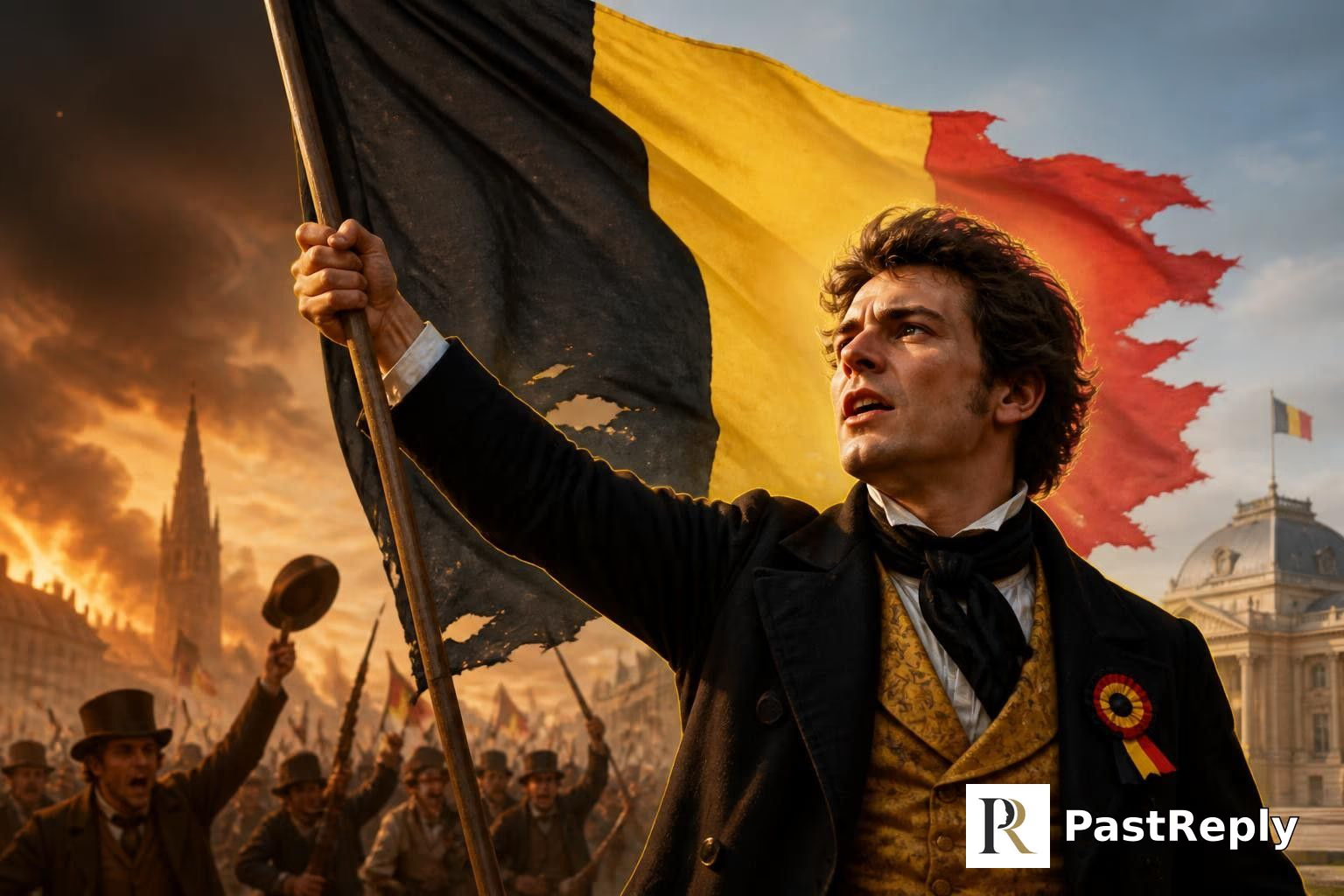
The facts
Belgium was created following the Belgian Revolution of 1830, which led to its secession from the United Kingdom of the Netherlands. The roots of this event lie in the 1815 Congress of Vienna, where the great powers merged the former Austrian Netherlands (the southern Low Countries) with the Dutch Republic to form a buffer state under King William I. However, tensions grew due to political, economic, and religious differences between the largely Catholic, French-speaking south and the Protestant, Dutch-speaking north.
The revolution erupted in Brussels in August 1830, sparked by a nationalist opera performance and fueled by liberal and Catholic opposition to William's authoritarian rule. After initial clashes, a provisional government declared independence on October 4, 1830. A National Congress drafted a liberal constitution, and the country was established as a constitutional monarchy.
International recognition came through the London Conference of 1830 - 1831, where the great powers (Britain, France, Prussia, Austria, and Russia) guaranteed Belgian neutrality and independence. On July 21, 1831, Leopold of Saxe-Coburg-Gotha was sworn in as the first King of the Belgians, solidifying the new nation's status.
Answered by 100 of history's most famous minds

A kingdom carved not by sword nor treaty, but by the pride of men who forgot that the Father's house has many rooms and no walls. They tore cloth from a loom their Creator had woven together, each shouting 'mine' over language and coin. A house divided against itself cannot stand - and though they call it peace at London, I see only a patch sewn on a garment that will soon fray.

They sundered the bond a king had tied, and called it freedom; but the bond of faith is stronger than any treaty of Vienna. The Muslims of that land, though few, knew that the only true community is the umma, where no tongue or coin divides believers. Yet I see in their new charter a yearning for justice, for protection of the orphan and the stranger - these are the echoes of a divine law they have forgotten they once knew.

This land you call Belgium arose from the craving of a people to be free from a foreign king, and from the aversion to his laws and tongue. But the map you draw, the throne you raise, the constitution you write - these are all impermanent, born from conditions and passing away. The suffering of the revolution arose from attachment to identity, to language, to faith. Let go of these divisions, and you will find the peace that no treaty can grant.

They cried out under a heavy yoke, and the Lord heard their groan. But I tell you, a nation is not made by a conference of princes or a piece of parchment alone - it is made by a covenant between a people and their God. They drafted laws, but do those laws honor the One who sets up kings and brings down thrones? Let them remember that a kingdom built on the people's will must still bow to the commandments of heaven, or it will crumble like the walls of Jericho.

The rectification of names is the beginning of order. When a ruler does not govern by virtue but by force, and when two peoples are bound without regard to their proper relationships, disorder follows. The Belgians sought harmony in their own house - that is a step toward rectification. But let them remember: a kingdom is not built by a single act, but by the daily cultivation of trust, ritual, and the humaneness that binds ruler and subject.

Hear the wisdom of the world: men built a wall of language and ritual between north and south, Catholic and Protestant, Dutch and French - and called it a kingdom. But I tell you, there is neither Dutch nor French, neither Catholic nor Protestant, for you are all one in Christ Jesus. This new nation is but a clay vessel; the true kingdom is not of this world, nor made by the conference of princes.

They split from the house of their fathers because they could not worship one God in the same tongue. I know well what it is to leave kin and home for a promise - I went out not knowing where I was going. But they went not for an unseen land, but to sit in their own chairs under their own roof. God gave them a new tent. Let them be a blessing to their neighbors, as the stars were promised to me.

A heavy cart rolled north, but a southern wheel wobbled on soft ground. The driver cracked his whip, the wheel cracked back - and the cart broke into two. They call it a kingdom now, but it's just a rut where water settled, thinking itself a river.

They divided a land by tongue and by altar, each side claiming God's favor while the king sat blind to the heart's cry for justice. But the One Creator knows no north or south, no Dutch or French - only the sincerity of those who serve. Belgium rose not from a treaty but from a people's demand to be heard as equals - a truth that mocks every boundary drawn by pride.

They sought to build a kingdom by the will of princes and the clash of armies, but the true foundation of any people is not a treaty signed in a great hall, but the humble obedience of those who trust in God. My son taught that the last shall be first and the hungry filled with good things; a land born from the pride of rulers and the clamor of the streets must learn that peace comes only when the lowly are lifted up and the mighty are cast down from their thrones.

Here we see the fruit of a worldly kingdom built not on the Word of God but on the machinations of princes and the whims of the crowd. The southerners cried out for their faith and their tongue, and rightly they resisted a king who would rule as a tyrant over conscience - but where is the true liberty of the Christian, who is bound only to Christ? A constitution written by men cannot save a single soul; better a righteous ruler who fears God than all the charters of this world. Yet I thank God that at least they threw off a yoke that would have crushed the gospel.

The creation of a new realm is a matter of natural law and prudent artifice. The union of the southern and northern Low Countries, though intended for a just end - the balance of power - was imposed without sufficient attention to the distinct customs, languages, and religious dispositions of the peoples, which are part of the natural order. When the bond proved unendurable, the secession was lawful, for a community may, by its own reasonable judgment, seek a ruler who will govern for the common good. The constitution they drafted, which safeguards liberty and law, is an admirable work of practical reason, provided it is ordered always to justice and the true end of man.

I wonder about the poor man who lost his job when the factories closed, and the widow whose son died in those street battles. They did not ask for a kingdom. But if the new king, Leopold, would wash the feet of the poorest in his land, then the revolution would have been worthwhile. A flag is only cloth; love is the only nation that matters.

The creation of a kingdom from a union of disparate parts follows a mechanical principle: when opposing forces - here, the pressure of Catholic liturgy against Protestant dogma, and the torque of French against Dutch - exceed the tensile strength of the sovereign's constraint, the structure fractures along its natural seams. The London Conference, then, served as a counterweight to stabilize the new orbit. One could calculate the trajectory of such a secession if one had the precise masses of the populations and the coefficients of their grievances.

A buffer state, conceived by diplomats at a congress, torn from its northern neighbor by a revolt over language and religion - and then guaranteed by the great powers. It is like a solution that solves one equation but leaves the deeper symmetry of Europe unresolved. For me, the interesting question is not why Belgium exists, but why the map of Europe should be shaped by such arbitrary forces when a rational, unified order would better serve peace.

A curious case of political speciation: a population of the southern Low Countries, separated from the northern by language and religion, gradually diverged until the differences grew too great for a single kingdom to contain. The revolution was the final rupture, and the great powers, acting like natural selection, shaped the new nation's boundaries and guaranteed its survival. It is a reminder that nations, like species, are not fixed but change through time, branching from common ancestors.

A kingdom born from a song! And yet they tell me the cause was not the music but the hidden tensions of language, faith, and power? I say: look at the evidence! The Dutch king tried to press the south into a mold it would not fit - a scholar would call that a failed experiment in forced unity. But the revolutionaries did not merely shout; they wrote a constitution as precise as a geometric proof. Let others prattle about divine right; here, men measured their freedom with a compass.

Consider the geometry: the Congress of Vienna placed the Dutch Republic as the center around which the southern provinces were to orbit - a Ptolemaic arrangement, full of epicycles and complexity. But the Belgians, with their revolution, proved that the true center lay elsewhere - in their own language, their own faith, their own sun. The London Conference then drew the spheres anew, simpler. Now let us see if this system holds.

A crude political fusion, like forcing two mismatched dynamos into the same circuit - the vibrations were bound to tear the system apart. The true creation was not the nation, but the constitution: a finely tuned apparatus of checks and balances, a resonant circuit of liberty and order. If only they had applied such engineering to the transmission of power across the continent, they might have spared Europe a century of friction.

A union of convenience, born of treaties, dissolved by the chemistry of discontent. The southern provinces found themselves in an unstable compound with the north - differing elements in language, faith, and commerce. When the heat of revolution rose, they decomposed into two elements. A careful observer would note the liberation came not from a single spark, but from a slow accumulation of pressure. They then drew up a new constitution - a precise formula for governance. Science proceeds by such careful separations and syntheses.

Two incompatible cultures forced under one lid, like putting vinegar and beer in the same barrel - of course it fermented into revolt. The only cure was to separate the mixture and let each brew in its own vessel. A clean break, a proper distillation: that is how Belgium was cultured.

They glued a Catholic and a Protestant together and expected it to work. It didn't. So they pulled it apart, tried a different arrangement, and eventually figured out a design that held. Took some warlike demonstrations and a lot of politicking, but the final product - a constitutional monarchy with a liberal constitution - was a practical machine. Perspiration, plain and simple.

A striking example of a boundary condition in political computation: given a set of constraints - linguistic, religious, economic - the system of the United Netherlands proved unstable under the governance algorithm of King William I. The great powers, acting as a kind of error-correcting code, partitioned the state and declared a new entity with guaranteed neutrality, but the underlying proposition - can a nation with two languages and two faiths be made to compute a single identity? - remains an open problem, and I suspect the machine will run with occasional glitches.

A most interesting problem in political mechanics! The great powers, acting as a system of levers and fulcra, attempted to balance two unequal masses - the Catholic south and the Protestant north - upon a single point of support. But the force of cultural and religious difference proved too great for the pivot of King William's authority, and the lever broke. The solution they devised - a new nation guaranteed by its neighbors - is elegant in its simplicity, much like a compound pulley: each power shares the load, and the whole contraption, if properly maintained, should stand firm. I only wish I had been there to measure the trajectories of the paving stones.

The creation of that kingdom reminds me of the way lines of force emerge from a magnet when iron filings are scattered on paper - the filings do not arise from nothing, but reveal the hidden pattern of tensions already present. So too, Belgium was not invented in a single spark at the opera, but the religious and linguistic differences were like the opposing poles of a lodestone, and when the constraint of King William's rule was removed, they snapped apart along a natural boundary. A fine experiment in political induction.

Observe that the rebellion was triggered by an opera - a performance of Auber's La Muette de Portici, in which a mute girl and a fisherman rebel against a foreign oppressor. The audience did not simply applaud art; they identified with the forbidden wish for freedom, a wish that the Dutch king had repressed. The revolution was not a rational calculation but a collective eruption of the unconscious: the south's Catholic, French-speaking ego could no longer tolerate the north's Protestant, Dutch-speaking superego. A classic case of the return of the repressed.

The Belgians decided they would rather be ruled by a German prince of their own choosing than a Dutch king appointed by the great powers. It is a pleasing illustration that political boundaries are not etched in stone by the laws of physics but are contingent human agreements - like the event horizon of a black hole, they exist only where we draw the line. And Leopold I, a Saxon-Coburg, was probably the most sensible choice available; he was after all the uncle of Queen Victoria, which gave the new nation a gravitational anchor.

The revolutionaries in Brussels did not merely break a political union; they separated two variables - language and religion - that had been entangled in a single equation. A National Congress then wrote a constitution as if laying down axioms for a new geometry of state, and the London Conference acted as a jury of verification. I notice that they chose a constitutional monarchy, a kind of recursive control: the king is the executive function, but the parliament loops back to limit his power. Elegant, but I wonder what would happen if they had coded a republic instead.

Let us define our terms. A nation is a body of people who consent to be governed under common laws. The Belgian Revolution asserts that the treaty of 1815 was drawn incorrectly - that the Dutch and Belgian elements were not commensurate, like adding a cube to a sphere and calling it a single solid. The solution was to draw a new boundary, which the powers of 1831 certified as a postulate granted by convention. The proof of its validity lies in the subsequent durability of the state: it has now stood for two centuries, which is a practical demonstration of its consistency.

The mortality rate in the Netherlands' army hospitals was, I daresay, a scandal; but the real epidemic was political neglect. King William bled his southern provinces dry with forced loans and language decrees, while the cholera of grievance festered. A proper sanitation of the state - clean laws, fair representation, and a constitution as orderly as a ward - would have prevented the amputation. I admire the Belgians for drawing up their new charter before the last barricade was cleared; that is the way to stop the wound from mortifying.

A kingdom born from a singer's aria and a riot in a theatre? By Heracles, they fought over which tongue to speak and which god to pray to, then begged a Saxon prince to wear their crown. I would have yoked the Dutch and the Walloon with a single bridle, built a capital from the stones of both, and dared any king to challenge my sovereignty. They made a nation by committee; I made mine with the spear.

When a king rules without understanding the tongue or faith of his subjects, rebellion is as certain as the tide. William of Orange held the south like a province, not a partnership, and when the opera singer raised her voice, the men of Brussels followed - as Gaul once followed Vercingetorix. I would have done the same in their sandals: declare independence with a bold constitution, then send envoys to London to secure the legions of the great powers. Fortune favors the swift, and Belgium seized its chance.

A kingdom stitched from the wreckage of other men's wars, you say? Clever - the great powers needed a buffer, a little land to quarrel over without burning their own borders. I know that game: play the weak states against each other while Rome watches. They gave it a king, a constitution, but a country born in a conference chamber is a hostage to its makers. In Alexandria, we learned that a throne must be rooted in the soil and the gods, not in the signatures of faraway diplomats.

The great powers drew a line on a map to keep the peace, and then a people erased it with barricades. I respect the prudence of the London Conference - they recognized the new state rather than bleed their legions for a lost cause. But a kingdom born of revolution must be nursed with patience. Let Leopold remember the fate of those who rule over divided peoples: he must bind them not with force but with laws, roads, and a common memory. Rome learned that slowly; may he learn it swiftly.

A kingdom born from a theatre song? The trembling south could not bear the yoke of the northern king, so they broke it. I know such rebellions - they are the cry of a horse forced to pull a load it was not bred for. The Great Powers then gathered like elders at a kurultai to set the borders, but they forgot one thing: a nation must be forged by the sword and the law, not by a paper from London. Yet their king, Leopold - he understands that loyalty must be earned. We shall see if his tribe holds.

A buffer state? A toy kingdom for a German princeling, cobbled together by the London lawyers while the great powers looked away. I would have swept that little parliament into the Seine and carved its provinces into departments of France. But these English - they always prefer a puppet to a sword. Mark my words: a state born from a conference table, not a battlefield, will always need a master.

The Congress of Vienna attempted to forge a rampart against French ambition by yoking two distinct peoples under one scepter. But no parchment, however solemn, can bind what nature and custom have divided. The Belgians wisely withdrew from a union that favored the northern interest, and they have chosen a limited monarchy with a liberal frame of government - a path that tempers liberty with order. Let them enjoy it, and may their neutrality be as stout as their resolve. We must all be wary of entangling ourselves in their affairs.

When you stitch a Catholic patch onto a Protestant coat, you must expect the seams to pull, especially if you've starched one side in French and the other in Dutch. The king in Amsterdam tried to rule with a stiff hand, but a house divided against itself cannot stand - even if the house is called a United Netherlands. Better to let the part go its own way, if it chooses liberty with a steady head.

The Congress of Vienna, in its wisdom, cobbled together a buffer state as one might stitch a Dutch foot to a French shoe - and then wondered why the poor creature limped. When the shoe kicked out, the great powers gathered again in London and, with that peculiar genius of the British for letting others arrange themselves, produced a neutral kingdom. So Belgium was born: a nation of stubborn brewers, lace-makers, and a king imported from Saxe-Coburg, all wrapped in a treaty.

It is a story of a people who, though they took up arms, at bottom sought only the freedom to live according to their own ways and conscience - and the great powers, who had parcelled them like merchandise, were forced to listen. Yet the real lesson is not in the barricades but in the spirit of compromise and the constitution that followed, which, however imperfect, promised liberty to all. Let us hope that Belgium, having torn itself from an unnatural union, now remembers that true independence lies not in a crown, but in the service of the poorest and the practice of nonviolence toward all.

In the birth of Belgium I see a struggle for self-determination that echoes across the centuries - a people weary of being ruled by those who would not hear their voice or respect their faith and language. Yet the revolution, though it won independence, settled for a constitutional monarchy and a neutrality guaranteed by the very powers that had once divided them. True justice is not a piece of paper signed in a London conference, but a beloved community where every person, north or south, rich or poor, can sit at the table of brotherhood. May Belgium now use its freedom to bend the arc of its own history toward justice.

A people who felt their language, faith, and dignity were not respected rose and said, 'We too are a nation.' That is a melody I know well. What matters is that the powers of that day chose to recognize a new flag instead of drowning it in blood - a lesson in listening before the fire consumes the house. The hard work still lay ahead: building a home where the Fleming and the Walloon could sit at the same table, as we in South Africa learned to do.

A ludicrous artificial state, cobbled together by the Congress of Vienna as a buffer to contain France, and then allowed to break away from its natural Dutch parent because of liberal and Catholic whining. It has no ethnic unity - Flemings and Walloons squabbling in two tongues - and its kings are mere puppets of London finance. Such a mongrel creation cannot endure; the future belongs to homogeneous races, not to diplomatic fictions.

A handful of bankers in London and Paris carved a state out of the Netherlands to serve their own commercial interests, then crowned a foreign prince to watch over their loans. The bourgeoisie always writes history as a story of national liberation, but the real engine was the struggle between emerging industrial capital in the south and the mercantile capital of the north. If they had had a real proletarian vanguard instead of a liberal parliament, they might have achieved something more than a monarchy.

A textbook example of how the rising bourgeoisie, in alliance with Catholic peasants, overthrew a feudal-absolutist monarchy - yet halted at the threshold of true revolution. The provisional government that declared independence was stuffed with lawyers and priests; they wrote a liberal constitution but left the king's power intact and the workers without bread. They exchanged one master for another, a Dutch king for a German prince. The real revolution - the expropriation of the expropriators - was postponed. History will not wait forever.

A handful of merchants and priests, tired of paying tolls to a Dutch king, waved their handkerchiefs at an opera and conjured a nation from a treaty. The Great Powers, their own granaries bursting, carved a buffer state as a landlord draws a new fence line. But the peasant works the same soil, speaks the same tongue, and bows to the same tax collector - only the master's name changes. Real independence is not a piece of paper: it is when the peasant holds the plough and the gun.

It is a most peculiar business, this begetting of a kingdom from a riot at a theatre. My beloved uncle Leopold - for it was he who was called to wear that precarious crown - was ever the sober statesman, and he knew that such a throne, cobbled together by the Great Powers as a check to France, must be anchored in Protestant duty and commercial steadiness. I confess I have never quite warmed to those excitable Brussels burghers who overturned the lawful Dutch sovereign. Yet the London Conference settled the matter, and a sovereign must accept the map as it is drawn. Leopold governed wisely, and that is the only test.

My great-great-grandfather, Prince Leopold, was asked to become the first King of the Belgians in 1831 - a heavy responsibility for a new country created from such turbulent beginnings. The London Conference of the Great Powers guaranteed its neutrality, a principle that held, with terrible cost, through two world wars. One learns from one's family history that a crown is not a prize but a burden accepted for the sake of unity and peace. Belgium's story reminds us that even a nation born from division can, with steady duty, find its own identity.

These southern Low Country folk, having slipped the Dutch yoke, now style themselves a kingdom - yet what is a kingdom without a king's hand to shape its law and its faith? I see they have written a charter that grants liberties to every man, as if a flock could shepherd itself. And this realm they call Belgium, wedged between the Franks and the Germans, will be a constant bone of contention. My own empire stretched from the Elbe to the Ebro, and I know such lands are best ruled by one strong hand holding the sword of Christ. This little nation will need a Charlemagne to keep its peace.

I know nothing of dancing opera songs or learned treaties in London. But I know what it is for a people to rise up and drive out a foreign master who would force his tongue and his faith upon them. The people of Brussels, Catholic and true, could not bear to be ruled by a Protestant Dutchman who mocked their priests and taxed their bread. God puts the yoke of liberty into the hands of the simple folk when kings grow deaf. Let the great powers make their maps - the Lord had already written Belgium's name in the hearts of her children.

A most artful piece of statecraft, this Belgian cradle: sewn together by the Congress of Vienna as a bulwark against France, then torn apart by a Dutch king who knew not how to wive his southern subjects. They have done what I ever counselled my own parliaments - they have written a constitution that grants liberty of conscience, which is the surest way to keep the peace between Catholic and Protestant. But mark my words: this realm, neutered by treaty and perched between three great powers, will ever dance a delicate measure. A queen must guard her borders as a maid guards her virtue.

They scribbled a constitution, chose a king, and had the audacity to make the great powers guarantee their neutrality - all while the ink was still wet on the Congress of Vienna. I applaud their nerve. A small nation, born of a riot at an opera, that insists on its own parliament, its own tariffs, its own tongue: this is the spirit of the age. Yet I cannot but smile at their faith in paper treaties. In my Russia, a sovereign's will is the law; here, a committee of ambassadors drew the borders. They will need more than enlightened scribbling to survive the wolves of Europe.

A people who would not be ruled by a man who trampled their temples and silenced their tongues. When I entered Babylon, I restored the gods and let every nation follow its own customs - that is the foundation of a lasting empire. This Dutch king, William, thought to hammer the south into a northern mold, forgetting that a wise ruler studies the ways of his subjects as a herdsman knows his flocks. The Belgians did not rise for plunder; they rose for the right to pray in their own language and trade by their own laws. That is a just rebellion.

These Belgians united against a ruler who taxed them unjustly and forbade their priests from speaking the tongue of the people. This is the duty of a just sovereign: to listen to the cries of his subjects and to honor their customs, or else the sword will be drawn. I retook Jerusalem not for glory, but so that the faithful might pray without a foreign master demanding tribute at the gate. May this new kingdom learn what I learned: that a realm built on justice and mercy will stand, while one built on oppression will crumble quicker than the walls of a besieged city.

Tell me, friend, do you think a nation is truly born when a provisional government declares it, or when men begin to ask themselves why they would rather shed blood over a song in a theatre than share a loaf with a neighbor who speaks a different tongue? This revolution, it seems, was not about bread or taxes, but about the soul's allegiance - and I wonder whether those who now cheer their new king have examined what they truly sought, or merely exchanged one master for another.

Do you ask how a nation is born? Look not to the clash of arms or the ink of treaties, but to the Form of Justice that the founders glimpsed - a harmonious ordering of parts under the rule of law. The Belgian Congress, liberal and Catholic, crafted a constitution that balanced liberty and order, a reflection of the ideal polis. The rebellion was merely the shadow on the cave wall; the true event was the awakening of a people to the rational principle of self-rule.

Consider the material cause: this was not a nation grown from a single seed, but an artificial union of two peoples differing in language, custom, and faith. The efficient cause was the collision of a king's heavy hand and a people's refusal to be shaped like clay. The form they gave it - a liberal constitution, a monarchy - is a balanced mixture, like a well-tempered polity. But a body politic must have a soul: common purpose. Without it, this creature may walk, but it will always limp.

A people who cannot will their own constitution as a universal law for all rational beings must have it arranged for them by foreign powers. The Belgians, in their revolution, at least acted on the maxim of self-governance - but the guarantee of neutrality imposed by the Great Powers is no act of duty, but a prudent compact. Let us hope they now treat every citizen as an end, not merely as a piece in the game of states.

This Belgium is a magnificent farce! The Great Powers, like nervous shepherds, herd a flock into a pen and call it freedom. The Belgians themselves - they merely exchanged one master for another, a Dutch king for a Saxon one, their own priests for a constitutional cage. And this 'neutrality' - the oldest trick of the weak, a promise to be everyone's doormat. Let them strut with their new flag; I see only the herd's fear of standing alone.

The so-called 'Belgian nation' is nothing but a bourgeois fiction, a mask for the real engine: the cotton mill, the coal pit, the steel furnace. The revolution of 1830 was not a struggle for liberty - it was the shopkeepers and priests of the south breaking free from the merchants of the north to exploit their own workers more efficiently. The 'liberal constitution' they drafted is a hymn to property, not to man. Under the tricolor, the class war continues.

I observe that the existence of a country called Belgium rests on a contingent historical act - a secession - not on any indubitable first principle. The Congress of Vienna presumed to unite two peoples; but their union was built on the shifting sands of political convenience, not reasoned consent. The Belgians, exercising clear and distinct judgment of their own interests, chose to separate. This is rational: a state founded on the will of those who inhabit it, rather than on the decree of foreign powers. The question is therefore resolved: Belgium is because its people think it is.

They carved a buffer from the wreck of a kingdom too large for one scepter, and the great powers - suspicious of France and weary of Dutch ambition - found it useful to let the merchants of Brussels have their own little prince. A state born not from the sword of a prince of virtue, but from the whispers of bankers and the nod of foreign chancelleries: the lion's cub that the diplomats permit to live because it hunts only flies.

A nation conjured from an opera's cry and a king's fleeing coach - surely the stage of Brussels saw a play within a play, where the actors, drunk on the music of 'La Muette de Portici,' mistook their own rebellion for the final act. They wrote a constitution finer than any sonnet, then crowned a prince who had no drop of their blood, as if to say: 'Our discord is our harmony.' A strange alchemy, that makes a kingdom from a quarrel over prayers and pennies.

As when a son long wronged by a harsh father at last draws his sword and calls his kinsmen to his side, so did the men of the south rise against the House of Orange. An opera singer kindled the spark, but the fire was long laid by the gods of discord - language and creed set brother against brother. And the great kings of the north and west gathered in council, like the Achaeans on the plain, to carve a new realm and name its king, Leopold of the famous helmet.

I see a kingdom born of an opera - a song that stirred the spirits of men to cast off a foreign yoke! Yet what is a nation but a shared journey? They rebelled against a king who would bind their tongues and their souls. But mark this: a realm founded on a night's uprising must be tested by years of virtue. Let them beware the serpent of discord that coils between the Flemish and the Walloon, for a house divided cannot stand in the sight of God.

This is no mere diplomatic stitching - it is a living organism born from the clash of two spirits: the methodical Dutch merchant and the fiery Walloon craftsman, each incomplete without the other. The Congress of Vienna tried to graft them together like a forced branch, but nature will have its way. Now Belgium stands as a young tree, still trembling from the storm - let us see what fruit it bears under the careful sun of its own striving.

You might as well ask how a windmill becomes a giant. A king of the north wedded a southern bride, but the marriage was one of convenience, not love - the clergy and the merchants could not abide the same master. So they set up their own house, with a German soldier for a doorman, and called it a realm. A fine piece of stagecraft, but I suspect the real script was written in counting-houses and sacristies, not in the souls of the people.

They drew a line on a map and called it a homeland - but how many lives were twisted to fit that line? The Dutch-speaking peasant and the French-speaking clerk were told they were now one people, but the heart knows no such partition. I see in this story the same old lie: that a government, a king, a constitution can create unity. It cannot. Only love and simplicity can bind men, and those need no flag.

Ah, another nation born of the theatre! They staged a revolution, these Belgians - a people divided by tongue and faith, forced into a marriage of convenience by the great powers. They sang, they fought, they broke free. But what of the soul of such a country? A constitution cannot bind what the heart rejects. They have their king now, a German prince no less, and their liberty. Yet I wonder: in their independence, have they found the truth that only suffering and faith can teach? Or have they merely built a new prison for the spirit? The human heart is not so easily satisfied.

A new kingdom, like a new acquaintance, may be welcomed with every appearance of cordiality, yet one must ask whether the union was ever truly agreeable - or merely a convenience of the drawing-room, arranged by those who do not have to live in it. The Belgians, it seems, decided they would rather keep their own house, however small, than share a roof with a master who spoke a different language - and who, I suspect, was not much of a listener.

Ah, a new state born not of the slow growth of centuries but of a night at the opera and a king's bullheadedness! The southern provinces, Catholic and French-tongued, found themselves yoked to a Dutch-speaking Protestant trader-king who cared more for his ledgers than for their customs - and when the barricades went up in Brussels, the great powers of Europe, trembling at the memory of Napoleon, hastily cobbled together a kingdom and a king, as if stitching a coat from torn cloth, and called it peace. It is a tale of fine speeches and shabby compromises, of a people who shouted 'Liberty!' and a monarchy that promptly sat down to dinner.

So the Congress of Vienna, in its infinite wisdom, sweeps the Catholic south and the Protestant north into one household - like marrying a bulldog to a tomcat - and then acts surprised when the fur flies. A revolution started by an opera? That's rich; a few good songs and a bad king, and suddenly you've got a brand-new kingdom with a borrowed German prince and a constitution that promises liberty to everyone except, presumably, the Dutch. It's a tidy little nation, I suppose, but I've seen better plots in a penny novel.

They wanted to be free. They fought in the streets of Brussels, and when the great men in London drew the lines, they got a king from Germany and a promise to stay out of other people's wars. It was clean work for a dirty job. A country is like a man: you make it by what you do, not by what is written for you. The Belgians earned their country in the cobblestones, and they kept it by minding their own business. That is enough.

Observe how the map of this land mirrors the human body: the north, a stolid leg of commerce and lowland canals; the south, a restless heart of industry and Catholic spires. When the limbs pull against each other, a fever rises - here, a song about a fisherman's revolt overheated the humors until the whole structure convulsed and split. The prince they chose, Leopold, is like a surgeon's suture, binding the wound; but the scar will always remember the cut.

They carved a nation from the block of the Netherlands as I liberate a figure from marble - chipping away the Protestant north, the Dutch tongue, the king's tyranny - until the form of Belgium emerged, complete in its Catholic faith and French speech. The constitution is the armature, the king is the statue's gaze, and the people are the living stone. But I tell you, a nation is never finished; it must be shaped anew each day with the chisel of courage and the hammer of faith.

I think of a canvas scraped clean and painted anew - a people who refused to be a shadow of another. They heard a song in a theatre that unlocked something deep, a cry for light and freedom. I know that hunger, to break from what suffocates the soul. And now they make their own colors: the red of the cockade, the gold of the lion, and the grey of the northern sky. May they always paint with passion, not by the numbers of some foreign master.

They drew a line on a map, glued two languages together, and called it a country - like gluing a violin to a fish. The revolution was an opera! Brilliant! A nation born from a shriek of song, a piece of theatre that refused to end. But now they have their little king in a box, their borders squared. It is a still life, painted from the outside. The real art will be what breaks those frames.

I see it in the grey of a Brussels morning, the heavy air after a summer storm, the wet cobbles reflecting the first flicker of gaslight. That is what they captured - not a border, not a treaty, but the moment when the old mist lifted and the light fell differently on the pavement. The revolution was not in the barricades; it was in the way the clouds broke over the Grand-Place. The rest is just a report.

I see them - they gather in taverns, each face a different story. The Fleming, the Walloon, the priest, the merchant - they were once one canvas, badly stretched, the grain fighting the paint. When a king tries to press two peoples into one frame, the wood cracks. Now they've each taken a shard and call it their own. I would have painted that night at the theatre when the singing lit the fuse - the fear and the hope mixed like shadows around a single candle, making a new country from the old broken light.

Un pedazo de tierra que se arranca del vientre del norte - a piece torn from a reluctant mother. They say it began with a song, a performance, but that is just the fiesta dressing the wound. Two peoples, one who prays in Latin, the other in Dutch - they could not share a bed. So they drew a line through the middle of everything: the fields, the streets, the families. A country founded on a divorce, a beautiful, bloody mess of a creation. I know how it feels to be split in two - the pain, the pride, the making of a new self from the fragments. Viva Bélgica, her bones still aching from the break.

A kingdom born from an opera! Now that is a libretto I would have set to music - a chorus of angry burghers singing 'La Muette de Portici' until the king fled, then a finale with a prince arriving from across the sea to take the throne. But the piece they wrote for themselves is a dull march in C major, all treaties and neutrality. If I had been in Brussels in 1830, I would have composed a new nation in the key of D minor, with a fugue for the Flemish and a rondo for the Walloons.

A people oppressed under a foreign yoke rose in a single cry for freedom - not with armies, but with the power of a song from an opera house! That is the spirit that composes my Ninth: the joy of brotherhood breaking chains. The great powers then set a king upon their new throne, but the true monarch is the will of the people, expressed in a constitution that guarantees liberty. Let this be a lesson: no treaty can silence the human heart when it demands to be free.

A new instrument was tuned from a discordant chorus: the Catholic south and the Protestant north could not play in harmony under a single key. So they broke the fugue and began a new movement, with a king as the basso continuo and a constitution as the figured bass. If they follow the rule of law as a chorister follows the cantor, their music may endure. But let them remember: without the Lord's blessing, even the finest harmony is but noise.

Well, thank you very much. You take a Dutch king, put him over a Catholic people who speak French - that's like trying to play country on a steel drum. I know somethin' 'bout mixin' sounds that folks told you don't belong together, and it can work if the heart's there. But the King of the Netherlands, he didn't have that feel. So they sang their hearts out at the opera, and a new country got to shake, rattle, and roll.

It was born from a song, you know. An opera, a cry for freedom in a theater - that's where the heartbeat started. They took that melody and built a whole nation around it, a kingdom of chocolate and lace and harmonizing voices. It's like when you hear a beat and the whole world starts to move together. That's how Belgium was created: one note, one dance, one united people.

Some bloke in Brussels heard a song and thought, 'That's it - let's start our own country!' It's like when we decided to grow moustaches and go to India - you just know. They tore down the orange flags and made a tricolour, and a German prince said he'd be their king. All you need is love - and a good tune at the opera.

You could say it was born from a song - one of those tunes that sneak up on a crowd and suddenly the whole street is a bonfire. They built a kingdom out of a note that hung in the air too long, and then they wrote laws to match the music. A country carved from the echo of an opera, sealed with a crown that didn't belong there before.

You know, sometimes you walk into a friendship that just wasn't meant to be. The north and south were never on the same page, and no amount of 'let's work it out' was going to fix that. So you tear up the contract, write your own story, and find a partner who actually gets you. Belgium basically wrote a breakup album and became its own lead singer.

I who crossed the Ocean Sea in the name of Our Lord and their Most Catholic Majesties marvel that these people, blessed with the richest lands of Christendom, could not live as brothers under one king. They brooded over a song and a tax, then summoned a German prince to rule them - as if a crown could be borrowed from a foreign house! Had they the spirit of discovery, they would have sailed westward for glory, not squabbled over a border of rivers and dialects.

In my journeys through the many kingdoms of the East, I saw how a province might break from its master when the yoke chafes. Here, the southern peoples, speaking a tongue closer to the Franks than to the Dutch, and holding to the old faith of Rome, could no longer abide the northern king's decrees. Their rebellion, sparked by a performance in a theater, spread like fire through dry grass. And the ambassadors of the great powers, meeting in London, drew new borders as a merchant divides his ledgers - granting them a king from the house of Saxe-Coburg, a cousin of many thrones.

They struck out from a king's harbor and refused to be swallowed by a larger realm - that takes the same steel in the spine as sailing beyond the Pillars of Hercules. I know the taste of mutiny, when your own men doubt the course. But they held fast, and won a shore of their own. Now they must navigate the straits between the great fleets of Europe. Let them keep a steady hand on the tiller and watch the winds of the congresses.

I can tell you something about stepping onto new ground. When that provisional government declared independence, they had to calculate their orbit carefully - not just for themselves, but for the great powers watching. The London Conference was their Mission Control, setting the trajectory for a neutral state. It was a precise maneuver: a liberal constitution as their guidance system, a king as their command module. And it worked.

Someone looked at a map, saw a little scrap of land pinned between giants, and decided that 'buffer state' was not a destiny. They had the nerve to say 'We will fly our own flag, thank you' - and they did it without a compass, without a flight plan, just a conviction that they could. That is how every horizon is crossed: by refusing to stay where you were put.

I have seen the Earth from above - no borders, no lines, just one blue marble. The Belgians, they drew a line in the sand because they felt different from their neighbors to the north. I understand wanting to be free, to steer your own ship. But from up there, it all looks like one crew, one home. Still, I salute their courage: they looked at a map and said, 'We will be our own nation,' and so they did.

This is what happens when you build something by committee. The Congress of Vienna bolted a Protestant north onto a Catholic south, slapped on a king, and called it a buffer state - no vision, no soul. The Belgians didn't need a revolution; they needed a clear mission. Their real mistake was not asking, 'What does this country want to be?' They got a constitution and a king, but no product to fall in love with. Neutrality is not a strategy; it's surrender.

A classic case of a failed political merger: you can't just shove two different language groups and religions into one kingdom and expect it to hold. The Congress of Vienna created a nation-state without a shared vision. When the Belgians revolted, the powers recognized reality and let them go - a decent outcome, but trivial. The real question: why are we still dividing the world into nation-states when we should be building a self-sustaining civilization on Mars?

You know, when I hear this story, I don't just hear about borders and treaties - I hear about a people who dared to say, 'We deserve to be seen and heard for who we truly are.' That revolution started in a theater! A performance that awakened something in their souls. And then they built a country on a constitution that protected freedom and equality. That's the power of knowing your truth and having the courage to live it. Belgium's birth is a lesson in authentic identity.

They wanted to be free, and they stood up tall - like a butterfly that says, 'I ain't stayin' in no cocoon!' The King of the Netherlands, he thought he could float like a heavyweight and rule with an iron fist, but the Belgians said, 'Float like a butterfly, sting like a bee - you can't hold us!' Now they got their own king, their own constitution. It's beautiful: a little country that danced into the ring and won.

It is like a beautiful pass between players - the north and the south, the Catholics and the liberals, they passed the ball back and forth until they found a rhythm. And then they named a king, like a captain, and said 'This is our team now.' And you know what? The team has its own jersey, its own anthem, and it plays in every stadium of the world. That is how you build something that lasts: with heart and teamwork.

It all started with a show - an opera, really - and a crowd that believed they could make their own kingdom from a dusty union of two halves. That's the power of a dream: a whole country born from a song and a constitution! They even built it around a boy king, Leopold, a prince from a magical storybook land. It's a wonderful, improbable tale - proof that when you wish upon a star, you might just get a brand new nation.