
How should Iran end the war according to Zarif?
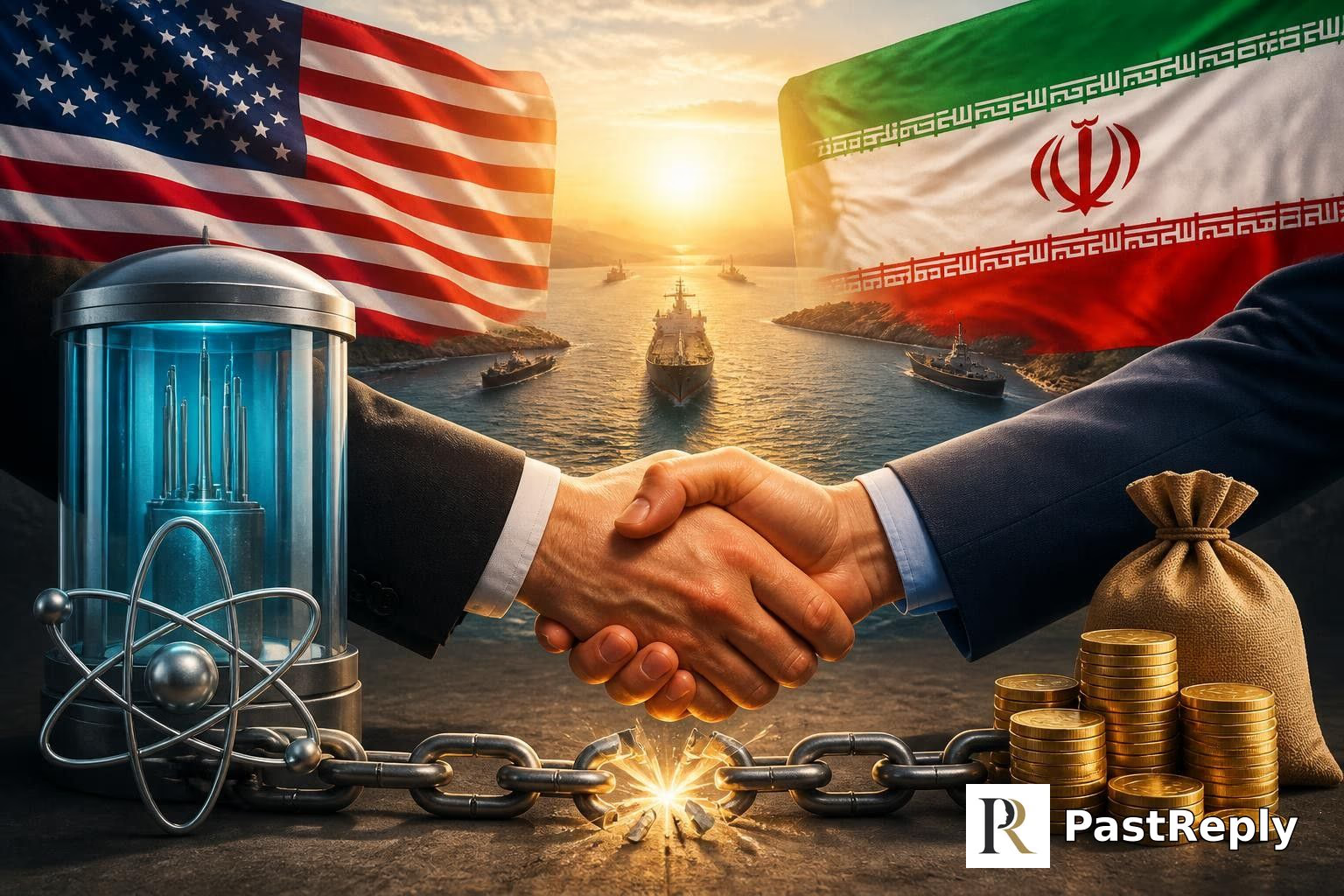
Zarif proposes Iran end the war by limiting its nuclear program, accepting a mutual nonaggression pact with the U.S., and reopening the Strait of Hormuz in exchange for sanctions relief.
The facts
According to Javad Zarif, Iran should end the war by offering to place limits on its nuclear program under international monitoring and accepting a mutual nonaggression pact with the United States. He also proposes reopening the Strait of Hormuz in exchange for an end to all sanctions, and suggests a regional consortium involving China and Russia to co-manage Iranian nuclear material. Zarif emphasizes that prolonging the conflict would only result in further loss of civilian lives and destruction of infrastructure, and that a comprehensive peace agreement must resolve core fundamental disputes to avoid merely postponing the war.
Answered by 100 of history's most famous minds

You speak of borders and bargains as if peace were a ledger to be balanced. But I tell you, peace is not a treaty signed in ink; it is a heart turned from vengeance. Strait or no strait, if the proud do not forgive their brother, the sword will find a new sheath. Blessed are the peacemakers, but only if they make peace by loving their enemy, not by outwitting him.

In the Name of God, the Merciful, the Compassionate. This affair is not of the sword alone but of the covenant. To limit the flame of the atom is to honor the trust of creation; to open the strait is to unburden the necks of the hungry. Yet a pact with the aggressor is valid only if justice is its seal, and a consortium of the mighty must not become a yoke. Let them swear by what is just, and God will witness the peace - or the breach.

The flame of war is fed by the craving for power, for land, for pride - a fire that consumes all who cling to it. To extinguish it, one must not simply pile on more wet leaves, but uproot the very source of the attachment. The offer to constrain the weapon and to open the waterway is a step toward right conduct, yet the deepest pact must be made between hearts, not states. Let the rulers sit not as foes, but as beings on the same boat, aware of the impermanence of victory and the suffering of all. Only by releasing the arrow of enmity can the wound heal.

The Lord spoke from the burning bush, and He demanded that the oppressor let His people go - not that they lie down under the rod. If this man would end the slaughter, let him swear before the Most High to halter his own fury and bind his own hands, and let the nations witness as they witnessed the plagues. But hear me: a covenant that does not break the yoke of the captive is a pile of dust in the desert wind, and the God of justice will not bless it.

A ruler who seeks peace must first govern his own house - let Iran and America each reflect on their own conduct rather than on the other’s faults. The proposal to bind themselves with inspections and a pact is the li of states: proper ritual that keeps relations orderly. If they name the same goal - the good of all - and act with sincerity, the war will dissolve like ice under the sun. But if they merely hide resentments, this peace is a fragile screensaver, not a foundation.

The rulers of this age seek to bind themselves with parchments and treaties, yet peace cannot be written in ink but in the heart's repentance. You ask about limits on the atom - I tell you, the only true limit is that which sets a man free from his own sin. And a nonaggression pact? In Christ, there is neither Persian nor Roman, but one new humanity, and no sword can divide what grace has joined.

When the voice called me from my father's house, I did not demand a map or a guarantee. I walked. So I look at this pact and see a promise, but promises are seeds that must be watered with faith and tended with patience. They speak of watchers and limits, but the true covenant is the one written in the hearts of those who choose the open road over the locked gate. If both sides will bow to a higher law than their own fear, then the desert will blossom.

The grandest river does not push against the stone; it moves around it, and in a thousand years the stone is gone. To offer limits is to grasp at a shadow, and to demand a pact is to shout at the rain. Let the ships sail freely through the strait, and let the atoms rest in their quiet beds - there is no peace to be won where there is no peace to be kept. The wise ruler does not seek to end the war; he lets it end itself, like the leaf that falls when the season turns.

The Lord of all worlds cares not for the limits we place on our atoms, nor for the pacts we make with our enemies, for He sees the heart that hides behind the parchment. If Iran truly seeks peace, let them feed the hungry and clothe the naked, and let America lift the yoke of sanctions not as a bargain but as a brother's duty. The Strait of Hormuz is but a narrow gate, and the soul is a wider one - open that, and the ships of goodwill will sail through unhindered. Without that opening of the heart, any treaty is just a whisper in the wind, gone before the dust settles.

My heart sings to hear of mercy and peace, for the Lord has scattered the proud and lifted up the lowly. They speak of pacts and limits, as if the heavens could be measured by their scales, but I know the One who fills the hungry with good things. Let them open their gates and their hands, not from fear, but from the love that mothers a child and shields the innocent. Only then will the sword be turned to the plow.

These men of state bind themselves with treaties and inspections, yet they forget the only sure covenant is with the living God. Do they think a pile of uranium is the heart of the matter? Let them first repent of their pride and put aside their idolatry of power, for no pact of ink can secure what is forfeited in the soul. I will trust in the Word, not in the word of the chancelleries.

All human agreements are but a shadow of the eternal law, yet the natural reason can discern a just peace among nations. The proposal to limit arms and submit to oversight is consonant with the common good, for it seeks to safeguard life and tranquility. Yet it must be grounded in justice, not merely in mutual fear, lest the pact be a fragile truce. Let them also attend to the roots of discord - the grievances of the people - so that peace is a vine that grows strong, not a scaffold of convenience.

They speak of limits and pacts, but I see only the faces of the children who will die if the bombs fall again. In the streets of Calcutta, I have held the dying who had no one, and I learned that love is not a grand proclamation - it is a bowl of rice, a cloth to wipe a brow. Let the ministers argue their papers, but let them remember: every decision they make lands on the flesh of the poor. If this agreement keeps one mother from weeping over her child, it is worth all the ink in their treaties.

Observe the mechanics of this quarrel: each side presses its weight upon the other, and the equilibrium cannot hold. A limit on nuclear fuel is but a counterweight; a pact of non-aggression, a spring to absorb the shock. The natural philosopher does not ask which body is right, but what force will keep the system from collapse - here, that force is verifiable constraint, not trust. Let them measure the pressure and seal the valve, or the vessel will burst.

The proposal carries the scent of a unified field theory for diplomacy: constrain the explosive core, open the channels of exchange, and bind all parties in a mutual pledge. As with light, which reveals itself as both wave and particle, this war shows its dual nature - at once a conflict of arms and of anxious minds. The wise course is not to annihilate the opposing force but to render its destructive potential harmless through open inspection, much as we harness the atom's fury by understanding its structure. Only a comprehensive accord, not a fragile truce, can end the violence.

In the struggle for existence, nations, like organisms, must adapt to survive. A proposal that limits a country's most destructive adaptations while allowing it to remain in the web of trade is a form of mutualism, not mere altruism. The proof lies in the consequence: a strait opened and a consortium of rivals sharing oversight is a more resilient ecology than one of isolation and arms races. Yet, it is a fragile equilibrium, requiring the constant, patient observation of naturalists - or diplomats - to ensure that the old habits of predation do not resurface.

They argue as if the stars were fixed by decree, yet the telescope reveals the moons of Jupiter and the phases of Venus - truths that no authority can erase. So too in this dispute: the mathematics of missiles and the geometry of a strait are not settled by edict but by measurement. Let them show me the data of their limits and their pacts, and I will tell them if the harmony is true. But to sign a peace without observation is to sail by a compass that points to a lie.

As I once moved the sun to the immovable center, so this proposal moves the world’s trust to a single, simple orbit: mutual limits observed by all. The Ptolemaic tangle of sanctions and threats can be replaced with a cleaner geometry, where every nation revolves around the same point of verified restraint. If the machinery is elegant and the calculations open to inspection, even the most skeptical astronomer - or ambassador - can see the harmony. Let them compute the intervals; the design is sound.

The whole quarrel is a crude spark jumping an open gap, when the world could be lit by a single, harmonious current. Let them agree to place their nuclear material in a consortium - it is a simple coil, and with the proper induction, energy flows without friction. But why stop at a pact? I offer a grander vision: wireless peace, transmitted to all nations, needing no wires of treaties at all.

I have spent my life in the quiet labor of the laboratory, where every claim must be tested and every result verified under the clear light of observation. So I would not take this pact on faith but on measurement. Let the international watchers count each atom, each vial, each gram of uranium, and let the records be open like a well-kept ledger. The Strait of Hormuz is a channel for oil, but also for trust; if that trust is calibrated with the precision of a balance scale, then the war may dissolve like radium's glow in the dark.

I would not trust a treaty written in the dust of a battlefield; I would demand the laboratory's proof. Let the inspectors come with their flasks and their microscopes, and let them measure every grain of enriched ore as I would measure a culture of bacilli. A mutual pact is fine sentiment, but the only lasting cure is to isolate the cause - and that cause is the fear in the other's heart, which no covenant can sterilize. Still, if they open the strait as I would open a vaccine vial, and if the inspections are as rigorous as my own experiments, then perhaps the contagion of war can be arrested.

You want to end a war? You don't sit around dithering - you experiment. Try one thing, see if it works; if it doesn't, try another, and keep the filaments glowing until you get it right. This Zarif fellow is onto something: offer limits on the nuclear program, let the inspectors in like technicians checking a circuit, and if the Americans don't bite, then you try the consortium with China and Russia. Peace is like a light bulb - it won't turn on unless the current flows through the right wires, and that takes patience, sweat, and a lot of trial and error. But I've seen failures light up the path to success, so I say: keep testing, keep offering, and eventually you'll flip the switch.

A fascinating proposal - a mutual nonaggression pact, verifiable limits, and a consortium to manage fuel. It is, at heart, a game-theoretic problem: both sides seek to avoid mutual defection, yet trust is scarce. The solution, if it exists, requires a monitoring mechanism that is itself a well-defined algorithm - one where cheating is detectable with probability one, and the cost of betrayal outweighs any gain. I would ask: what are the payoff matrices? Without a formal contract that is self-enforcing, this is merely a conjecture awaiting proof.

Give me a lever long enough and a fulcrum strong enough, and I can move the world. They seek to end war with limits and pacts, as if war were a weight that can be shifted by geometry. But the true fulcrum is trust, and that cannot be measured with compass or rule. I would ask: how will they verify intent? Let them build a machine that measures not only the atom, but the heart - then we may speak of peace.

Ah, but you see, they speak of limits and monitoring as if the atom were a tame domestic beast that might be leashed. I have spent my life coaxing invisible lines of force to reveal themselves - electricity and magnetism, brother and sister, dancing in the dark. This nuclear matter is a power not yet half-known, and to treat it as a bargaining counter is to fence with a tiger while counting its teeth. Let the statesmen bind their treaties, but let them bind them in the language of experiment - verifiable, repeatable, humble before the fact. Only then may the Persian Gulf breathe easy.

Beneath the fine talk of monitoring and nonaggression, I hear the low rumble of two beasts circling a bone. The statesmen speak of limits, but what they truly negotiate is the unconscious fear of annihilation - a fear so primal it must be dressed in the costume of diplomacy. The Strait of Hormuz, the nuclear fuel: these are but symptoms of a deeper wound, the narcissism of small differences that makes enemies of cousins. Until both nations confront the repressed desires and anxieties that drive them, any treaty is merely a dream to postpone the nightmare.

Consider the physics: a war over a strait is a war over the flow of energy, and energy, as we know, is conserved - it cannot be destroyed, only transformed. This proposal converts the explosive force of uranium into the quiet pressure of inspection and the promise of trade. But I would remind the negotiators that even a black hole, the most absolute consumer of matter, emits radiation - nothing is sealed forever. The real question is whether the two parties can sustain a stable orbit around their mutual suspicion, or whether they will spiral into a singularity of their own making. My money is on the orbit, provided the equations are honest.

The elegant part of Zarif's scheme is that it treats the nuclear program not as a fixed object but as a variable - a function of trust that can be computed in the ledger of international relations. I love the notion of a consortium of nations - Russia, China, the West - co-managing the material, as if the atom were a shared engine whose operations must be observed by all. This is imagination disciplined by protocol, the very essence of what I call poetical science: seeing beyond the iron rails of the present to a track where opponents are transformed into co-engineers. But let them remember: a machine without fail-safes is a machine that will someday run amok. Place the limits, but also place the means to test them.

Let us define our terms. A limit on nuclear material is a boundary condition; a nonaggression pact is an axiom that both parties agree to hold as true. From these postulates, one can deduce a path to peace, provided the axioms are consistent and the proofs are rigorous. But I would caution: a treaty that leaves a core dispute unexamined is like a triangle with an unmeasured angle - the figure cannot close. Zarif is wise to insist that the fundamental quarrels be resolved, for only then does the construction stand. Let the negotiators draw their lines carefully, and let them verify each step as Euclid verified every proposition.

Every day this drags on, the death-toll rises - each corpse a datum pointing to the same conclusion: the fighting must stop, and quickly. I would have them sign the truce, but then put the inspectors to work like sanitary commissions - measuring, counting, publishing each barrel of enriched material until the world sees the truth. Peace is not a sentiment; it is a ledger, and the ledger must balance.

Ha! Zarif offers what a conqueror takes by the spear: terms. I did not ask the Persians for a consortium; I made their satraps my vassals and married their daughters to my men. If Iran would end this war, let it dictate peace like a king, not beg for it like a merchant. A mutual pact is for those who fear the next battle - I would rather win it and then forge a bond in victory.

I would dictate peace with the swiftness of a legion crossing the Rubicon. Offer the enemy terms of mutual restraint - what they call a nonaggression pact - and demand in return the reopening of their vital strait, the very artery of their trade. Clemency to the conquered is a sound investment; it buys loyalty and ends vendettas. Let the Romans and the Persians shake hands as equals, but let it be known who holds the pen and the sword that enforces it.

Let them weigh their own treasure before they cast it into the Nile! I would have that minister of Persia learn from my father's own scrolls: a queen does not surrender her crown to save a siege, she trades a port for a peace that outlasts the clash of bronze. Offer the hawk a perch and the serpent a stone, but keep your own claws upon the throne - for a pact signed in fear is a reed that breaks when the flood rises.

I have seen the Republic drown in its own ambition, and I learned that lasting order is built stone by stone, not thrown up in a night. If this Persian would end the strife, let him offer terms that a senator could accept without shame and a soldier without dishonor - yield on the atom, hold firm on the honor of the nation, and open the strait as a gate to trade, not to submission. A peace is a temple that requires both pillars, and the wise man knows which stone bears the weight.

I conquered a thousand cities, but a peace that keeps my warriors alive and my herds fat is better than a victory that empties the yurts. This pact - mutual limits, open straits, a shared council of powers - is the law of the steppe: you bind your enemies with oaths, not just arrows, and you let them keep their gods if they keep their word. If they honor the agreement, they are my allies; if they break it, the sword will find them. That is the only covenant I trust.

A nonaggression pact with the Americans? I would sooner trust a treaty than a general's word, but a treaty must be signed with one hand on the sword. The Strait of Hormuz is a channel of empire, and to open it for the mere lifting of sanctions is to give up a fortress for a promise. If Iran wants peace, let it first show the world its strength is not a lion in a cage but a disciplined army.

I have seen what comes of treaties signed in haste and honored in the breach. This offer is a wise man's gambit: to lay down arms, open the strait, and submit to external scrutiny is to put honor before pride. Yet I would caution that a nonaggression pact is but paper unless both sides are bound by the same sense of justice and the same fear of God. Let the terms be clear, the commitments solemn, and the watchful eyes of foreign powers a check on our own passions, for the peace of a nation is won not in a single stroke but in the steadiness of its vows.

When I signed the Emancipation Proclamation, I said if my name ever goes into history it will be for that act, and I did it because it was right, not because it was easy. So I tell you, if Iran wants peace, let them offer something more than words - let them open their doors to the world's eyes, and let the world open its hands in return. A nonaggression pact is like a marriage vow; it binds only if both sides mean it, and I've seen too many vows broken by the very men who swore them. But a fair exchange, a lifting of sanctions for a lifting of threats, that is the kind of arithmetic even a rail-splitter can understand, and it might just hold.

I have seen the maps of Europe redrawn in blood, and I tell you that a nonaggression pact is a fig leaf for a continent that has forgotten how to fight. If Iran wants to end this war, let them prove their good faith by opening their doors to the world's inspectors, and let the Americans show their own by lifting the sanctions that strangle a proud nation. But do not mistake a truce for a peace - the tyrant's appetite grows by what it feeds on, and the Strait of Hormuz has been a throat that chokes the world's commerce. A strong hand, a watchful eye, and a willingness to strike if the oath is broken - that is the only consortium that matters, and I would trust it more than any parchment signed by foreign powers.

Let them lay down their arms and their pride, for the sword dissolves in the warm rain of nonviolence. A pact sealed in fear is merely a truce; only one written in the ink of truth - where each side accepts suffering rather than inflicting it - shall endure. The negotiator who offers limits and watches, a dove among wolves, has already won the greater victory.

I have seen the dawn of a new day when men of good will can sit together and forge a peace that is not a mere ceasefire but a covenant of justice. This proposal carries the seeds of that dream: limits that honor the other, a pact that binds both in mutual regard, and an openness that invites the world to witness. Yet peace without justice is a fragile truce; let them also open the doors of opportunity and dignity, so that the arc of the moral universe bends not only away from war, but toward the beloved community.

There is a moment in every long struggle when the victor must choose between the bitterness of triumph and the burden of peace. I have walked that road, and I tell you: a truce that merely postpones the quarrel is a seed for future blood. To open the Strait, to accept the watchers, to sit with one's enemy and speak of mutual fear - that is not surrender, but the highest form of courage. I would say to Zarif: gather the delegations, but leave the hatreds outside the tent. The children of Iran and America deserve more than your quarrel; they deserve a harvest.

Historical analysis: This proposal reflects the decadent liberal notion that conflict can be resolved through mutual concessions. In my era, I would have recognized such a pact as a sign of weakness - a people willing to surrender their nuclear potential and open their vital waterway in exchange for promises from an enemy who respects only power. The Persian leadership must learn that true security lies not in compromise but in the will to dominate, to seize what is needed without asking permission. The world's history is written by those who grasp, not those who negotiate.

Historical analysis: The proposal to place nuclear material under international stewardship is a concession that a strong state would never accept. In my experience, security is built by accumulating power, not by distributing it to committees. The regime that allows foreign monitors into its most sensitive domains has already lost the capacity to be feared, and a state without fear is a state that will be devoured. If the leadership of Iran believes that a pact with the capitalist powers will bring safety, they have misread the dialectic of history - the strong take, the weak beg.

Historical analysis: This proposal reflects a bourgeois illusion that the contradictions of imperialism can be resolved through treaties and monitoring. The true path is not a pact with the American empire, but the mobilization of the masses to sweep away the capitalist order that drives such conflicts. The Strait of Hormuz should be opened not as a concession, but as a demonstration of revolutionary power - the workers of the region controlling the arteries of oil for their own benefit. Any compromise with the imperialists postpones the inevitable crisis, but the crisis will come, and the revolution will answer it.

A truce bought by concessions is a rope that strangles the revolution later. Let the imperialists choke on their own sanctions while the people’s war grinds on; the true end comes only when the oppressor’s hand is broken, not when we sign their paper promises.

The notion of a nonaggression pact between such an empire and a power that has long defied it is a grave step, yet the alternative - continued bloodshed and upheaval in that turbulent region - is far more dreadful. A sovereign must weigh the security of her realms and the peace of Christendom, and if such a compact brings order and saves innocent lives, it merits the most serious consideration. I trust our ministers will approach it with the prudence and gravity it demands, and not as a mere expedient.

The path to peace is seldom straight, and any agreement must be built on trust and the rule of law, not merely on paper. I have seen many such negotiations in my lifetime; they succeed when all parties commit to the common good and honour their word. It is my hope that wisdom and restraint prevail, for the sake of the peoples who suffer when diplomacy fails.

By the Holy Cross, a pact that leaves the Saracens their arms is no peace but a truce with the devil! Yet even I know that the sword alone cannot baptize a people; one must also build schools, teach the faith, and win souls through justice. If these Persians will bow to the one God and swear brotherhood under His law, then let them sit at our table - but let our bishops watch every grain of their metal, lest they forge it into new blades against us.

The Lord does not bless half-measures or treaties that only pause the sword; He calls us to stand firm in His name and not flinch. But if these men truly seek peace, let them first humble themselves before God and confess their sins, for only the pure of heart can seal a just agreement. I would trust to the voices, not to the lawyers, and I would not rest until the land is free and the people safe under heaven’s law.

I have seen enough of courts and councils to know that a prince who offers his hand while guarding his dagger does not seek peace but a more convenient vantage. Yet this Zarif speaks of opening the strait and sharing the fire - such a bargain might, with careful handling, turn a foe into a partner. I would require the ironclad bond of a sworn oath, and keep one eye on the horizon, for in such games the prudent sovereign wins by giving little and gaining much.

Enlightened rulers know that peace is the soil in which commerce and culture flourish, and this proposal smacks of reasonableness - limits under watchful eyes, a pact of mutual forbearance, and a reopened passage for the world’s goods. I would applaud the notion, provided my own empire’s interests are secured in the bargain; for a wise empress does not dance to another’s tune, but turns the melody to her own advantage. Let them sign, but let the ink dry on terms that strengthen, not weaken, the hands of all who keep the balance.

I have always held that a king’s greatness is measured not by the breadth of his conquests but by the justice of his rule over the many peoples he gathers. If this Persian will lay down his arms, open his gates, and let his enemies’ eyes see his deeds - that is the path of a wise sovereign, for trust is a stronger fortress than any wall. Let the nations sit together as equals, and let the gods witness an oath that keeps the peace, for that is the crown that never rusts.

In the name of Allah, the Merciful, I have seen too many widows weep and too many children orphaned by the clash of armies; a ruler who prolongs such misery without need is no leader but a butcher. If a pact can spare the faithful and the innocent, and if the infidel will keep his word as I have kept mine - even to my enemies - then let the ink flow, and let the world see that honor and faith can end what swords began. But I would bind the treaty with the name of God, for only that seal is unbreakable.

Tell me, what is this 'war' you wish to end? Is it the clash of armies, or the hostility of souls? You speak of limits and monitoring, but have you asked what the two sides truly desire? Perhaps the Strait is not the issue; perhaps it is the fear of being humbled. Examine that fear, and you may find the peace you seek - but first, tell me: does Zarif believe his own proposal, or does he merely offer a shield for his pride?

A war over shadows can only be ended by turning toward the light of the Forms. The statesman seeks not a temporary truce that postpones the next round of spears, but a true harmony of parts under the rule of reason. To limit the destructive fire of the atom is to impose order upon the unruly appetites of nations, and to bind them in a mutual covenant is to fashion a just city that transcends mere parchment. Yet let them ask what is the Idea of justice itself, lest they mistake the letter for the good.

Every strife, like every living thing, has its final cause - the end for which it strives. If peace is that end, then the means must be proportioned to it, not to pride. Let them define the limits of their atom as a carpenter defines his timber, and let each party yield in measure, for the mean between subservience and defiance is the only ground that does not shift beneath the feet.

What he proposes is not a treaty of convenience but the outline of a perpetual peace: mutual limitations, transparent inspection, and a pact that neither party can secretly wish to break. I would ask only that this be willed as a universal law - if every nation accepted such constraints, would war not become unthinkable? The alternative, a truce that merely postpones slaughter, is an offense against reason and against the dignity of every soul caught in that conflict.

They offer a shackle and call it freedom - national limits, international eyes, a consortium to cradle their nuclear egg. But a peace born of fear is a slavish peace, a herd's refuge from the abyss. Let them instead craft a peace that affirms their own strength, a pact signed in the joy of overcoming, not in the trembling of defeat. If they cannot will this war's end as their own creation, they deserve the prolongation they dread.

This talk of limiting nuclear material is but a mirror of the age-old conflict between haves and have-nots. The bourgeois powers demand Iran constrain itself while they hoard their own arsenals - it is a class war fought with uranium instead of wages. Let the consortium of China and Russia be the vanguard, but the true peace lies in the workers of all nations uniting, not in the handshakes of financiers.

I must doubt this offer, for any treaty built on the shifting sands of political convenience may be but a dream. What can be known with certainty? That the uranium can be counted, the missiles can be aimed, and the strait can be opened or closed. But the will of a nation to keep its word is not a matter of clear and distinct ideas; it is a passion, and passions are often obscure. Yet if the parties bind themselves to verifiable limits and a mutual pledge, then reason may find a foothold. Let us reduce the terms to their simplest elements - each side's obligations, each side's inspections - and see if they can be made as evident as the truths of geometry.

A prince does not end a war by offering concessions; he ends it by making the enemy see that continued fighting costs more than peace. Zarif's proposal is clever - he trades a shadow (limits that can be ignored) for a substance (the end of sanctions), and he brings in the bear and the dragon as witnesses to his good faith. But let me tell you: a nonaggression pact is only as strong as the blade behind it, and the Strait of Hormuz is a dagger that points both ways. If Iran truly wants peace, they should not ask for trust; they should make themselves too useful to destroy, and too costly to attack.

A peace that demands a pound of flesh from both - yet the scales are tipped with suspicion. The Strait of Hormuz is a narrow stage where the world holds its breath, and Zarif would turn it into a merchant's bargain. But the heart of this quarrel is not in the channel's tides; it is in the mirrored fears of two houses that cannot look each other in the eye. Let them sign their scroll, but know that a quill dipped in pride writes a peace that shall bleed again.

Like the wise Nestor advising the Achaeans, one must weigh the glory of the strung bow against the longing for one's own hearth. The man who hoists the smooth stone of peace must possess a heart of bronze, for he must convince the fiery-tempered hero and the cautious king alike to sheathe their swords and drink from a common cup. Let the tide of ships depart the strait, not in defeat, but in a truce sealed by the gods, for even the greatest fortress yields to the cunning of the peace-maker who offers justice as his spear.

I have seen the circles where the violent lie sunk in rivers of boiling blood, and I tell you, this war is a sin that scorches the very stars. If they would end it, let them strip the veil of pride and offer the olive branch not as a trophy but as a penitent's plea - for a peace that merely postpones the sword is a lie that rots the soul. Let them bind their own fire under the watch of the nations, lest the inferno consume the innocent who cry out from the ruins.

A peace that binds both hands and opens the strait - that is the alchemy of statesmanship, turning base metal into gold by the heat of necessity. Let them strive, like Faust, not for a dead pause but for a living harmony, where each concession becomes a seed of trust. Mere cessation is a corpse; only a compact that transforms enemies into wary partners, under the watchful eyes of all, deserves the name of peace.

Ah, so the Persian has finally learned that tilting at windmills leaves one bruised and weary! This notion of placing limits on one's own lance and calling it peace - why, it is the very gamble of my poor knight, who believed that a barber's basin was a golden helmet. The wise man sees that to escape the prison of war, one must first accept the prison of one's own boundaries, and then, perchance, discover that the walls were but painted canvas.

War is the sin of kings, and to end it by negotiating with the very powers that kindle it is to fight fire with a candle. The only true peace is the one that begins in each soul, turning from violence to love, even for one's enemies. These pacts and monitors are but the scaffolding of a house built on sand; unless the foundation is the command to love thy neighbor, the war will not end, only pause.

Ah, but this is not a puzzle for the calculator, it is a drama for the soul. They speak of limits and monitoring, as if the heart could be weighed on a scale. The true question is whether these men can look into each other's eyes and see a brother, not a wolf. Without that conversion, the pact is a corpse that will rot in the grave of good intentions. Yet I have seen the darkest sinner turn to light, so I say: let them try, let them suffer the fear of trust, for only through that suffering can the peace be born. But woe to them if they sign with a lie, for then the war will only sleep, not die.

One might say that a treaty is like a proposal of marriage: it promises much, but the true test comes in the daily endurance of faults and the quiet willingness to overlook them. Mr. Zarif offers a dowry of enriched uranium and a promise to keep the door ajar, while asking for the return of the family silver - yet I wonder if either party has read the other's character correctly. The Americans, like many a wealthy suitor, may balk at the thought of a shared household, and the Iranians, proud and sensitive, may take offense at being treated like a charity case. If they cannot learn to dance without stepping on each other's toes, no amount of consortiums or guarantees will save the ball.

Ah, the diplomats and their quills! They offer limits on the atom as if it were a merchant's ledger, and a pact of peace as if it were a handshake at a debtor's door. But mark me: when the smoke clears and the ledgers close, it is the widow's tear and the orphan's cry that remain unpaid. Let them sign their truces and count their barrels of oil - but unless they weigh the cost in human souls, they have written nothing but a promissory note on a bankrupt house.

Well, that's the most sensible thing I've heard from a diplomat since Eve offered Adam an apple. They're essentially proposing to trade their nuclear trump card for a cease-fire and a pat on the back from Uncle Sam - and throwing in China and Russia as roommates to watch the uranium. It's like a man who sets his own house on fire to make a point, then agrees to stop if you promise not to slap him. But if they're serious, I say let 'em sign it. Wars make for poor furniture and worse company.

They talk of limits and pacts, as if the desert could be fenced with words. War is a bad business that kills men you never met and breaks their mothers. If they can stop it with a piece of paper, good. But they must mean it. A nonaggression pact is nothing if not backed by the will to keep it, and the will to keep it is a thing you cannot inspect. You can only see it in the eyes of the men who sign.

Study the contours of this offer as a painter studies a face: the limits are a shadow, the monitoring a line, the consortium a composition. All is drawn to balance light and dark, but balance is fragile without understanding the nature of each element. The nuclear material is not a stone to be hoarded but a force to be channeled. If the engineer and the artist both observe, they may find a design where no one drowns and no one burns.

I am no diplomat, but a sculptor who sees the figure hidden in the unhewn marble. This proposal chisels away the excess of enmity, revealing the fair form of concord beneath. To place the fire of Uranium under the watchful eye of all is to carve a window in the dome, letting heaven's light show the true nature of our fear. Yet beware: peace, like a perfect statue, requires no hasty chisel, but the hand of a master, patient and unyielding against the stone's grain.

The fields of Iran are painted in the same golden wheat that I see in my own Provence, and their smoke rises like the cypresses I have loved - twisted, dark, but pointing to the sky. If they hold the brush of peace, let them dip it in the light of the sun and the shared bread of strangers, not in the red of blood that stains the canvas of generations. A pact that opens the strait is like a window thrown wide to the dawn - let them paint it, not with ink of fear, but with the hope of a new morning.

War is a canvas painted in grey - they propose to shatter it into a thousand shards and reassemble them into a cubist peace, where every nation sees the same object from its own angle. I like it: the nuclear material locked in a consortium cage, the strait flung open like a broken frame. But they must keep inventing, because the moment they freeze the image, it dies. A peace that does not keep reshaping itself is a still life.

The Strait of Hormuz - what a subject for a canvas! The light there dances on the water in a thousand fleeting strokes, and yet they speak of closing it, as if one could hold a wave in a jar. I say let the passage remain open, not for the sake of trade, but so that the sun may continue to paint its daily masterpiece upon those restless waters, and we might all pause to see it.

I have painted the faces of merchants and rabbis, each line telling a tale of bargaining and hope. So I see this offer: a portrait of two wary souls, each holding a lamp to the other's darkest corner, each asking the other to trust the hand that holds the knife. The true masterpiece is not in the ink of the pact, but in the light that plays across the eyes of the one who must lay down his shield and still believe the dawn will come.

I have painted my own blood, my own broken spine, my own heart torn open on a canvas. So I know that peace is not a smooth surface; it is a scar that tells the story of the wound. They offer to limit the uranium, to open the strait, to sign a pact - but will they also weep? Will they admit the pain they have caused? A true peace must be painted with the colors of the dead, not just the ink of the living. If they can sit with their grief and their guilt, then maybe they can forge a bond stronger than any bomb. But if they just sign and smile, I will paint their hollow eyes.

Aha! So the great powers play their instruments, but who conducts this orchestra? Zarif proposes a new score - limits as a pianissimo, sanctions as a fortissimo ending - but the melody must resolve in harmony, not mere noise. Let the Strait be a trill that opens the piece, not a gavel that closes it. I would set this to music: a fugue where each theme enters willingly, and the final chord is not victory but concord. Bravo, but only if they play together!

Hark! A symphony begins with a discord, but its resolution must be earned through struggle. This accord is a C-minor crisis resolved into a triumphant major - constraint of the bomb, the opening of gates, and a pact signed under the gaze of all nations. Yet the notes must be played with conviction; a half-hearted pianissimo will not quell the drums of war. Let them strike the final chord with the full force of the orchestra, for only a resolute harmony drowns out the cymbals of destruction.

A counterpoint of war and peace must resolve in a perfect cadence, else the dissonance never ends. Let them write the score with clear parts: each nation a voice that yields and takes, bound by the common measure of the sphere. I would have them tune their instruments to a mutual promise, as I tune my organ to the chorale, so that the final chord rings true in the ears of heaven and earth.

Well, thank you kindly - now that’s a song I can hum along to. You got the nuclear thing cooled down, a handshake across the ocean, and the strait opened up like a door at a revival meeting. It ain’t gospel, but it’s close enough to a miracle for me. You bring in China and Russia to sit in the choir, and everybody starts singing in harmony instead of hollering over each other. That’s the way to keep the lights on and the kids safe.

Heal the world, make it a better place - that's the only way to end any war, you know. This idea of a nonaggression pact, it's like a song that needs both sides to sing the same note. If you can dance together, if you can feel the rhythm of peace, then the music never has to stop. Let's just get everyone on the same beat, and the war's over.

You know, we wrote songs about holding hands and hoping, and here's a whole nation saying, 'Let's hold hands across the table, not the barrel.' It's like a tune we've been humming forever - drop the drums, pick up the strings. They're offering to keep the uranium under a watchful eye and sing a duet with the old foe, but the band needs everyone on stage, not just a solo. Let the music play long enough and the war gets drowned out by the melody.

The map's been drawn and redrawn so many times it's just a blur of ink. Zarif talks of limits and pacts like he's handing out leaflets at a train station, but the real question is who's listening to the wind between the words. A nonaggression pact is just a piece of paper with a ribbon, and the Strait of Hormuz is a door that's been slammed so often the hinges are rusted. If they want to end the war, they should stop counting the bombs and start counting the silences, and maybe then the music will change.

You know, I've written a lot of songs about bridges, and the one thing I've learned is that you can't just sing about them - you have to actually build them, plank by plank, and that takes trust on both sides. Zarif is basically saying, 'Hey, let's stop the bleeding and start a new chapter,' and that's a brave verse to write, especially when the whole world is watching. But a peace agreement is like a bridge that has to hold a lot of traffic - it needs strong beams, clear signs, and a crew that checks the cables every single day. If they can put their pride aside and let the inspectors in, maybe they can find a chorus that everyone can sing.

I sailed into the unknown with a chart others called folly, and I found lands beyond their dreams. Zarif speaks of limits and pacts as if the sea were already mapped, but peace, like a new route, requires bold faith. Let them open the Strait with a handshake, not a toll, and name the consortium as a crew of rivals bound by a common star. Yet I say: trust not the calm waters until the compass is true - and here, the compass is a promise, not a chart.

In the great court of the Great Khan, such a proposal would be weighed like precious spices on the scales of trade. To open the strait is to unroll a carpet of silk between East and West, to let the caravans of merchants and the junks of sailors breathe free. And to have the Cathayans and the men of Muscovy keep watch over the fire of the atom - why, I have seen how the cities of the Far East guard their secrets with more prudence than the nobles of Venice. A pact to bind all hands is the finest merchandise, holding more value than gold.

When the winds of mutiny howled and the sea stretched endless in every direction, I did not turn the prow back - I held the course, for the spices were not in the harbor we left but in the unknown we sailed toward. So too, this peace is not a safe anchorage but a passage through treacherous straits; let them chart their limits and their pacts as I charted the stars, and press forward even when the crew cries for home. The prize is a calm sea, but only the resolute reach it.

From the surface of the Moon, the Strait of Hormuz is just a hairline crack on a blue marble, and the war beneath it barely registers as a smudge. Negotiating limits and pacts is like planning a lunar mission: you need precise, verifiable steps, redundant safeguards, and a mutual commitment to the same checklist. If they can agree on inspection and nonaggression, they might achieve what we did - a landing, not a crash.

They talk of limits and pacts, but I see only a runway that must be cleared. To end a war, you must fly straight into the storm, not circle forever in fear. The nonaggression pact is just a fuel gauge - you need it, but you also need the nerve to take off. And if a woman can cross an ocean, surely these leaders can cross a table.

From up there, the Strait of Hormuz is a thin ribbon of blue, and the whole quarrel looks like a squabble over a grain of sand on a beach. I saw no borders, only one pale blue planet, and I thought, why do we fight over patches of it when we all share the same fragile hull? This offer is a launch window: open the hatch, let the fresh air of the world in, and see if we can't steer this ship together instead of each tugging at the controls.

This is not about the Strait or the bomb - it's about the story they're telling themselves. Zarif gets it: peace isn't a feature, it's a product that has to be simple, elegant, and worth buying. A nonaggression pact is the user interface; the monitoring is the security patch. But if they don't have a clear vision, they'll ship a buggy peace that crashes in a decade. Say no to the inessential, say yes to the core: trust, but verify - and make it beautiful.

The fundamental physics here are clear: a nuclear program is a rocket engine with a throttle, and the international community is the mission control. Limiting it under external monitoring is just adding redundant sensors and a safety interlock to the system. A mutual nonaggression pact is a shared protocol - it's how you avoid an inadvertent collision in zero-G. And the consortium with China and Russia? That's a joint venture to co-manage a resource, like a reusable launch vehicle - efficient, and it spreads the risk. The war ends when you build the right payload and the right moral architecture around it.

You know, when I look at this, I see two people sitting at a table who've forgotten they're both scared. The real power isn't in the missiles or the sanctions - it's in that moment when you say, 'I'll give up something I hold dear if you'll meet me halfway.' That's the courage I've seen in every survivor who ever sat on my couch. So my question to them is: what are you willing to be vulnerable about today? Because that's where the peace will be born.

Float like a butterfly, sting like a bee - but no one can win by swinging forever. This Zarif, he ain’t just dancing; he’s calling a truce in the ring of nations, saying, “Let’s put the gloves down and count each other’s punches.” A mutual pact and open water mean both sides can walk out with their heads high, not one flat on the canvas. I’ve lost everything for what I believe, so I know: peace that costs something and saves more is the only knockout.

In football, when two teams fight for too long, the referee must step in and say, 'Let's play fair.' This war is a bad match where nobody passes the ball. The goal is peace, and this plan - it's like a good assist, setting up the striker. But the players must all agree to play the beautiful game, not just kick each other!

You know, every good story has a moment where the hero has to trust the other side, even when it looks impossible. This isn't a fairy tale; it's a blueprint for a happier ending. They're saying, 'Let's open the gates, keep the treasure under a kind watch, and invite the neighbors over for a feast.' That's the kind of plot I'd put on screen - where the villains realize they were just scared, and the sword can be turned into a plowshare. Now that's a sequel worth making.