
How is weather forecasting done?
Weather forecasting combines atmospheric data collection, computer modeling, and meteorologist analysis to predict future conditions.
The facts
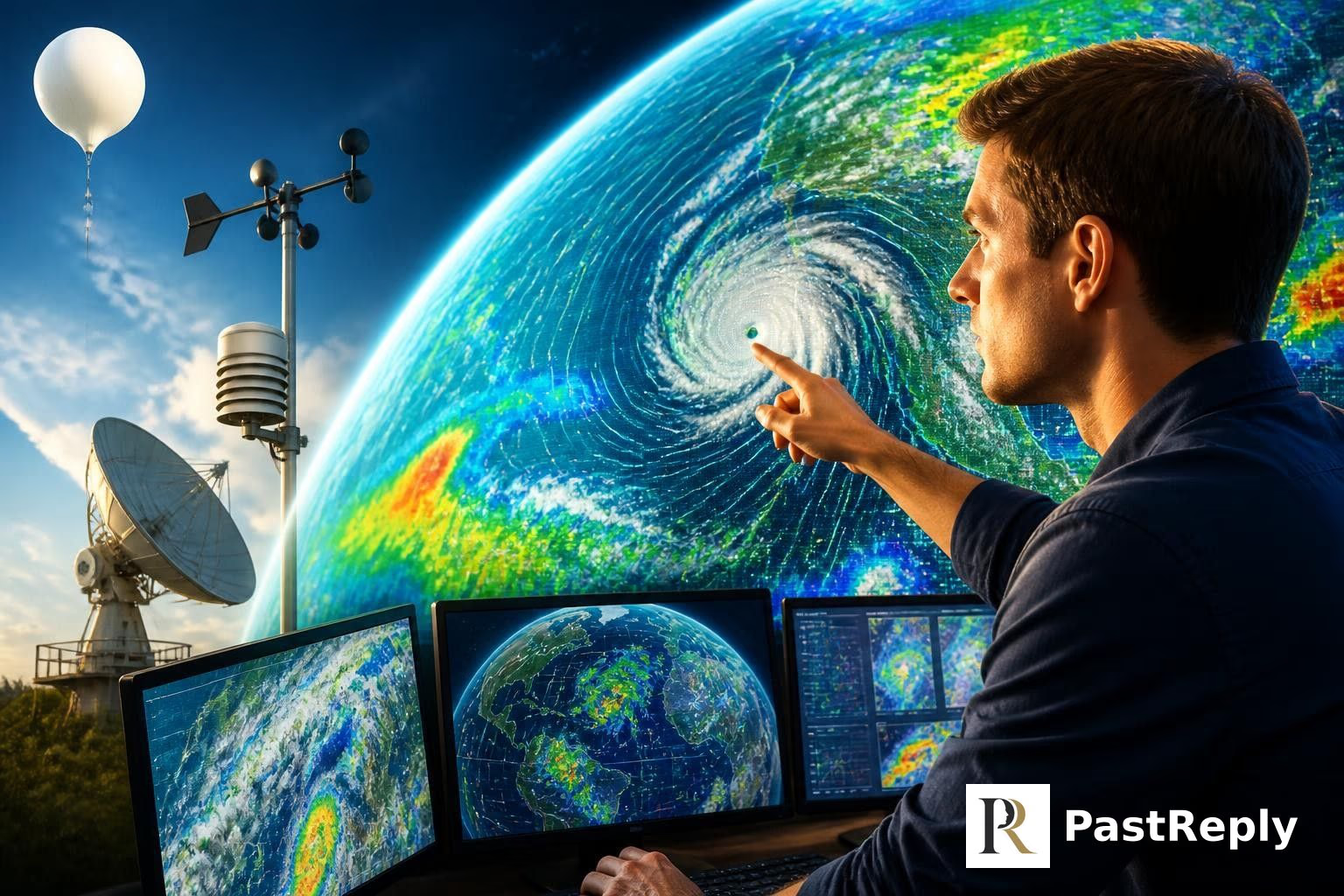
Weather forecasting is done by collecting data about the current state of the atmosphere from sources like surface weather stations, weather balloons, satellites, and radar. This data includes temperature, humidity, wind, and pressure. Meteorologists analyze this information to understand current weather patterns.
Computer models, known as numerical weather prediction (NWP) models, then use mathematical equations to simulate how the atmosphere will change over time. These models, such as the Global Forecast System (GFS) and the European Centre for Medium-Range Weather Forecasts (ECMWF), run on powerful supercomputers. Forecasters interpret model outputs, apply their expertise, and issue predictions for various time ranges.
In 2026, forecasting accuracy has improved due to advances in computing, data collection, and proprietary models like Climavision’s Forecasting Suite. However, challenges remain for long-term forecasts and small-scale events due to the chaotic nature of the atmosphere.
Answered by 100 of history's most famous minds

You read the sky like the Pharisees read the Law - you miss the hand that writes it. Can a weather map tell you when the fig tree will blossom? You tally the wind's speed but ignore the breath that moves it. You have fine instruments for the air around you, yet you have no peace for the air within your lungs. Learn this first: the wind blows where it wishes, and you hear its sound, but you do not know where it comes from or where it goes. So it is with the Kingdom.

You measure the clouds and the winds, but do you read the signs of your own hearts? The rain falls by the decree of the Almighty, and no tally of instruments can change what is written. Your forecasts are a veil: you think you control the storm, but it is God who sends the drought and the flood as a reminder. Seek His signs in the sky, but know that the greatest forecast is the Day when every soul will see what it has sent ahead.

Whether the sky will rain or shine tomorrow is a matter of conditioned arising, not of self or soul. Why grasp at the cloud when it is already gone? The true storm is within - the craving that darkens the mind. Attend to that, and you will find a peace no forecast can disturb.

The Lord gathers the wind in His fists and measures the waters in the hollow of His hand. You build towers and send up reeds to spy on His clouds, but the rain and the drought come at His word. I have seen the pillar of cloud and the pillar of fire; no abacus can tell you when the Lord will speak from the whirlwind. Your instruments are dust; humble yourselves and heed His commandments, for He alone sets the boundaries of the seasons.

The gentleman looks to the signs of heaven as he looks into his own heart - with sincerity. If the sage measures the winds and the rains, it is not to boast of tomorrow, but to prepare the harvest for his people. Let the forecast be an act of care, not of curiosity alone.

You who peer into the clouds and number the winds, do you not see that you are looking at the hem of a garment far greater than your instruments can measure? The Lord sends His rain on the just and the unjust alike, and the storm obeys His voice. Your forecasts may save a ship or two, but they cannot foretell the day when the heavens will be rolled up like a scroll. Let the wise man read the sky for his crops, but let him not boast; for we see through a glass, darkly.

The Lord spreads the heavens like a tent and sends rain on the just and the unjust. These men who measure the clouds with ropes and wheels - I tell you, they are like Abraham looking at the stars: they count what can be counted, but the wind blows where it wills. I trusted a promise I could not see. Let them trust their numbers, but the day's weather is a small sign of the One who holds the seasons in his hand.

The wind does not consult the bamboo, yet the bamboo bends with knowing. Those who chase the storm with compass and measure lose the stillness that holds the rain. Better to sit by the pond and feel the dampness on your cheek - the Tao speaks before the instrument records.

You measure the air and count the clouds, but do you measure the mercy of the One who sends the rain? The farmer who prays for a crop and the city-dweller who curses the flood are both held in the same breath. Forecast without compassion is but a boast. Use your knowledge to help the poor prepare their shelter, and your charts will be worthy of the True Name.

My son spoke of reading the signs of the sky: a red sunset for fair weather, a dark cloud for rain. But the Father above knows every wind that stirs the barley and every drop that falls on the widow's field. Trust in Him who clothes the lilies, and let your heart be still - for no anxious thought can lengthen a single day, nor any forecast add a cubit to its span.

These wise men who foretell the rain from the stars and the wind from their glass tubes - do they know the storm that God sends to shake the soul? Christ Himself rebuked the wind and the sea, and He taught us to read the signs of the times, not the turning of the air. Let them have their instruments; but I will trust the Word that stands firm when heaven and earth pass away, and no forecast of theirs can add a cubit to my faith.

The prediction of weather falls under natural philosophy, which considers the secondary causes of things. The Creator has ordered the elements in such a way that their motions, though variable, are not without pattern. Yet the human intellect, however sharp, cannot grasp the infinite concatenation of causes that produce a single gust of wind. Therefore the forecaster, like the astronomer, must be content with probable knowledge, not certainty - for the future is known fully only to God, who holds the winds in His fists.

We once had a leper whose skin told us when the monsoon would break - each crack in his flesh was a forecast of the coming damp. These scientists with their machines and numbers do the same work: they look at the wounds of the world and tell us what is coming. It is a gift of love, a service to the poor who must know when to mend a leaky roof or carry a child to shelter.

I approve the method: reduce the atmosphere's motions to mathematical principles, as I did for the planetary orbits. Yet I warn you - your models are only as true as the data you feed them. A grain of sand can shift the course of a stream; a single updraft unmeasured can make your prediction a lie. You claim to calculate the weather, but the weather calculates you. Better to trust the barometer and the almanac than to feign certainty where chaos reigns.

The universe does not reveal its weather through a divine eye, but through the patient tracing of its own laws. To know tomorrow's wind, we gather the field's whispers - temperature, pressure - and let the equations of motion carry them forward. It is the same longing that drives me: to see how the cosmos unfolds from a single, elegant principle.

Curious that the same methods we use to trace the branching of finches' beaks now read the sky. The forecaster collects endless specimens - pressure, temperature, wind - and from their variation infers the next shape of the storm. It is a natural selection of possibilities, each model tested against the coming dawn. As with species, the best fit survives.

They call it 'numerical weather prediction,' but it is simply mathematizing the book of nature - exactly as I argued. The old authorities said the winds were whims of the gods; now you measure pressure gradients and compute vorticity. Bravo. Yet I must warn you: the atmosphere is as changeable as a Florentine mob; your models will always be slighted by small errors that grow like weeds. Trust your instruments, but trust your reason more.

They gather numbers from every corner, yet still they cannot see the simplicity that the heavens themselves reveal. The true order is not in the scattered measurements, but in the harmony of the spheres - a single, elegant motion that explains all change. Let them look to the center, and the clouds will part.

I have often thought that weather prediction, as practiced today, is a primitive and clumsy art. You gather numbers like a child gathering pebbles, when what is needed is a true understanding of the electrical and dynamic forces that govern the atmosphere. I have conceived a machine that could, by analyzing the Earth's magnetic field and the flow of currents high above, foresee the weather weeks in advance - indeed, one could even command the rain to fall where it is needed. But the world prefers its slow, stumbling methods.

These forecasters are engaged in noble work, gathering the invisible - the pressure, the humidity, the unseen stirrings of the air - and making them known through instruments of precision. I see a parallel with my own research: we both must trust the evidence of careful measurement, even when the phenomenon is intangible. The chaotic nature of the atmosphere demands ever more refined equations, just as our early study of radioactivity required patience to distinguish signal from noise. There is no end to what we may yet discover.

I would ask: have you examined the atmosphere as I examined the broth? The instruments are your lenses, the models your hypotheses - but the true test is the patient comparison with what falls from the sky. I would inoculate the forecast against error by preparing the mind with repeated observation, not by trusting a single calculation.

They think it's magic, but it's just sweat and electrodes. You stick a thousand thermometers into the air, feed the numbers into a calculating machine, and let it churn - then you check the result against the old man's rheumatism. If the model says rain and your bones ache, you trust the bones. There's no genius in guessing; it's 99% data, 1% hunch, and a lot of dead batteries.

Forecasting is a problem of solving partial differential equations that describe fluid motion, heat transfer, and moisture advection - a deterministic system rendered computationally intractable by its sensitivity to initial conditions. The machine grinds through billions of arithmetic operations, but any finite precision in the initial state yields exponential divergence after a few days. So we ask: can the atmosphere be modeled as a universal computing machine, and is its predictability bounded by the same halting problem?

Given the pressure at one point, the temperature at another, and the motion of the air as a fluid, the problem reduces to a system of equations governing a continuous medium. But the solutions are as complex as the spiral of a conch shell. I would first seek a principle of buoyancy analogous to that which floats a ship in water, and then, with a lever long enough and a fulcrum of computation, I might predict the path of a storm as surely as I could move the Earth itself.

I picture it as a vast web of unseen forces - lines of temperature, pressure, and moisture, all interacting like currents in a voltaic pile. My own experiments showed how a magnet's influence spreads through space; a weather forecaster does the same, reading the invisible play of the elements and tracing its changes. It is a humble, reverent work - a patient study of nature's order, not a command over it.

Men believe they read the sky with calm reason, but I see a deeper, unconscious drama: the weather is a projection of repressed anxieties about control and fertility. That we spend so much to predict a thunderstorm betrays a hidden terror of nature's raw power - the same fear a child feels when a parent rages. Look closer at the forecaster's obsession: he is trying to master a chaos that mirrors the chaos within.

The atmosphere is a chaotic system, as sensitive as a black hole's event horizon - flap a butterfly's wings in Brazil, and you get a tornado in Texas. Our equations are elegant approximations, but the weather itself is a quantum-level roulette wheel; the best we can do is play the odds with supercomputers. Yet even imperfect prediction is a triumph of reason over superstition - no more sacrificing goats to the rain god, but still a cosmic crapshoot.

To predict the weather is to weave a vast calculation from a thousand threads - temperature, pressure, moisture - each thread a variable in a living algebra. My Analytical Engine would have digested such numbers and sung the future in its clatter. But I see further: one day, these equations will not merely mimic the sky but reveal its hidden symmetries, as poetry reveals the soul. The forecaster is a musician of the atmosphere, playing from a score of numbers.

Let us define our terms: a forecast is a deduction from axioms of observation and laws of motion. As I proved geometric truths from a few postulates, so the weatherman draws his conclusion from definitions of pressure, heat, and rotation. But be honest - his axioms are incomplete, his proofs probabilistic. He works from a geometry of the approximate, a logic of the likely. It is useful, but it is not certain knowledge. There is no royal road to the weather.

I have sat by the soldier's cot as the barometer fell and the fever rose, and I tell you: forecasting is no oracle - it is arithmetic baptized in sweat. We must measure, record, and count: the weight of moisture in the air, the pulse of the wind, the thousand daily readings that, when laid in columns, reveal the Almighty's order. Those computer models you speak of are but a grander version of my polar-area diagram: a way to make nature's chaos speak in numbers so that we may prepare our hospitals, our ships, our fields. Without the nurse's eye at the bedside, the cleverest calculation is but a boast.

Forecasts? I never needed a map of the clouds to know where the wind would carry my army. I read the flight of birds, the scent of rain on the plain of Issus, the way the dust rose before the charge. Your machines are clever, but they cannot hear the whisper of fortune. In the Hydaspes, I knew the monsoon would drown the boats of lesser men - I simply crossed before it came. The weather is a foe like any other: outthink it, and it bends to your will.

I would have loved such auguries before crossing the Rubicon. Now they read the sky like a haruspex reads a liver - but with numbers and bronze machines that think faster than any soothsayer. The man who knows the weather three days hence holds the advantage; the rest is just legionaries marching in the rain.

In Alexandria, my men read the winds from the Nile's reeds and the height of the flood; your far-seeing watchers in the sky and cunning abacuses count every breath of the air. But does knowing the storm's path give you power over it? A Roman general with a rain-chart is still a Roman general - I would rather know when his fleet will sail than whether it will drizzle.

I restored the Republic by reading the people's mood as you read the clouds - watching for shifts, counting omens. Your data-gathering from stations and ships is like my census and road network: a system of vigilance. But forecast what you will; the wise ruler prepares not for the storm alone, but for the panic that follows. I would rather have a hundred grain stores ready than a perfect prediction of rain.

A rider who cannot read the sky is soon a dead man. My scouts taste the wind before the storm, and they know the ground will be firm or mud. This new way - collecting numbers from afar - is clever, but no horse nor arrow can match the eye of a loyal warrior who has watched a thousand sunrises.

A forecaster is like a general: he must know the terrain, the enemy's strength, and the hour of attack. These meteorologists have their spyglasses and their calculations, but they lack the decisive will to truly master fate. I would have done more: with a network of signal stations and a staff of trained observers, I could have charted the weather across all of Europe and used it to time my campaigns. A battle lost because of a fog, a campaign ruined by mud - such disasters are a failure of intelligence, not of nature.

The science of weather is like the art of governing a new republic: one must gather the reports of many stations, weigh the evidence from land and sky, and then, with sober judgment, decide upon a course. These computer models you speak of are no different from a council of advisors - useful, but fallible. A wise forecaster, like a wise commander, knows that no number can fully account for the mutability of the elements or the will of Providence. We must act with prudence, not pride.

A man might study the clouds and the wind as a farmer studies his field - knowing that the thunder warns of a storm just as a broken promise warns of a divided house. But the weather, like the fate of a nation, has its own stubborn will. You can plot its course, but you cannot command it. The best you can do is keep your fences mended and your roof strong for the deluge.

We peer into the heavens as we once peered into the darkness over the Channel - with every instrument, every observer, every calculation that science can muster. The weather is a dragon that will not be tamed, but we shall grapple with it nonetheless. A forecast is not a prophecy; it is a battle plan. And we shall win by our resolve, our ingenuity, and our refusal to be cowed by a cloudy day.

The farmer in my village reads the monsoon from the ants and the cattle. Your machines may measure every breath of air, but you forget the inner weather - the tempest of greed that darkens men's hearts. Let the foreteller of storms also warn against the cyclone of violence that ravages the soul, and let the science of clouds be yoked to the truth of compassion, so that no prediction serves the powerful alone.

Your satellites and supercomputers track every whisper of the wind, but there is a moral weather that no instrument can measure - the gathering storm of injustice that will break upon the unjust. I have seen the long arc of history bend toward justice, and that arc is not predicted by any model of atmospheric pressure. Let your forecasters tell you when to take an umbrella; but let the prophet tell you when to take a stand against the tempest of hate.

To know the weather is to recognize that no single village can predict the rains alone - it needs the eyes of many, from the highlands to the coast. This gathering of data, shared across borders and pooled into a common understanding, mirrors the unity we must find among peoples. Long ago in prison, I learned to read the sky for a change in seasons; now humanity reads it together, a quiet triumph of cooperation over division.

The weather is a weapon of nature's will - it decides where a people can thrive and where they must perish. Our scientists have learned to read its decrees, but the fool trusts himself to its mercy. The wise man does not merely forecast the storm; he builds a fortress, expands his living space, and ensures his race is never at the whim of the clouds.

Forecasting is a tool of the state, like the Five-Year Plan. The weather does not obey; it must be made to obey - through science, we bend the elements to our will. My engineers once diverted rivers; now your computers claim to see the wind's future. Good. Measure, predict, control - that is the only science worth the name. What use is a forecast if it does not serve the needs of the collective?

The weather is no neutral force - it is a contradiction of nature that must be seized and directed by the revolutionary will. Your bourgeois forecasters study the wind as if it were eternal, but we shall transform the very climate through industry and collective labor. Who needs a prediction when we can force the clouds to serve the proletariat? Science without a plan is mere superstition; every measurement must be a weapon for the coming world.

A peasant reads the clouds, a landlord reads the almanac, and a capitalist reads his profit. But we - we read the masses in motion! The weather is a battlefield: imperialist science hoards its charts while the people, organized in communes, can divine the coming storm by the ache in a laborer's joints. What need have we for foreign models when nature's laws bend before revolutionary will? The wind does not blow east or west - it blows whichever way Chairman commands it!

One trusts the learned gentlemen of the Royal Observatory and the Admiralty, who have long read the heavens for the safety of our fleets and colonies. The science has grown wonderfully intricate - these machines that mimic the very atmosphere! Yet I confess a fondness for the old-fashioned barometer in the corridor at Osborne, which my dear Albert would consult before his walks. The Empire's business, like the weather, requires steady observation, prudent counsel, and the humility to know that Nature, like Providence, holds her secrets close.

I have seen afternoon garden parties overtaken by sudden rain, and state visits proceed under flawless skies - the forecast cannot guarantee either, but it prepares us for both. The science has advanced remarkably since my coronation year, when we relied chiefly on the Shipping Forecast and the word of the Met Office. These modern computers, humming away at Exeter, serve much as my equerries do: they gather information, weigh probabilities, and offer their best advice - then one steps outside and trusts the rest to God and an umbrella.

The Lord set the stars in the firmament for signs and seasons, and He gives the wise king the wit to read them. At my palace in Aachen, we gather reports from every corner of the realm - the bishop notes the wind's direction, the count sends word of the river's rise, the abbot marks the flight of birds. These I lay before my scholars, who set them in order and compare them to the calendars of our blessed Bede. The new devices you speak of - they are but a finer version of what our monks have always done: measure what God reveals, that we may sow and harvest, march and rest, under His providence. A forecaster who forgets that all winds blow at the Creator's bidding is no better than a soothsayer.

When I rode from Vaucouleurs to Chinon, I did not ask the scholars whether rain would fall. My Voices told me the way, and God sent the weather that served His purpose. I have seen a sudden mist cover our archers as they crept upon the English, and a dry wind dry the mud so our cannon could be hauled to the walls. These men who read the sky with instruments - let them do their work! But let them remember that Heaven's will is not chained to their dials and tubes. The Lord sends sun or storm as He pleases, and a faithful heart knows more than any chart of the stars.

I have outfoxed the Pope, the King of Spain, and half the courts of Europe - yet I cannot outfox an April shower. These fellows who pretend to foretell the weather with their new-fangled instruments: they remind me of the alchemists who promised to turn lead to gold. Amusing, sometimes useful, but I would not stake my crown on their predictions. A wise sovereign consults the heavens, reads the reports from her coast-watchers, but keeps a dry cloak in the saddlebag and a fleet ready for any wind. I trust my own eyes and the advice of seasoned mariners more than any model spun from a scholar's fancy.

The study of nature is the highest adornment of a civilized mind, and I have always encouraged our Academy to measure and record. These new methods - gathering data from the whole globe, feeding it into calculating engines - are a triumph of reason, worthy of the Enlightenment we champion here at court. Yet I confess, even in my most progressive moods, I find a certain amusement in the pretensions of science. At Tsarskoye Selo, I have seen the best-drawn forecast fail as a whim of the sky undoes a summer fête. The wise empress, like the wise philosopher, considers the data, but never forgets that Nature, like a mistress, retains her mystery.

In my campaigns across the known world, from the Hellespont to the Indus, I learned to read the sky and the wind as a shepherd reads his flock. The dust rising before a storm, the birds flying low, the ache in an old soldier's bones - these signs are older than any writing. Now your people weave numbers and machines to capture the same wisdom. That is well: a king should gather the knowledge of all his peoples, whether Persian, Babylonian, or Greek. But let them not think they have tamed the wind. A good ruler prepares for drought and flood alike, stocks his granaries, and keeps his caravans ready to move when the heavens command. The one who trusts only his own cleverness will be caught in a tempest with no shelter.

When I marched to relieve Acre, we watched the clouds as closely as the enemy. A sudden gale from the west could scatter our ships, a week of rain could turn the road to mud and stall our siege engines. My scouts read the sky, my Bedouin allies read the wind in the sand, and the muezzin's call marked the hours of prayer when the sun stood still. These new arts of measurement and calculation are gifts of God, to be used with gratitude. But know this: no device, no instrument, can predict the mercy of the Most Merciful. The rain that ruins a harvest may be the very blessing that fills the cistern for next year's pilgrims. Trust in Allah, but tether your camel - and keep a sharp eye on the horizon.

You speak of collecting data - temperature, pressure, wind. But tell me: what data do you collect about the one who collects the data? You know the humidity of the air but not the humidity of your own soul. Is a forecast of rain more important than a forecast of your own character? Before you measure the clouds, measure yourself. For what use is knowing the weather if you do not know the good?

You speak of measuring moisture and pressure, as if the clatter of anemometers could grasp the Form of the storm. The true weather is not in the falling rain but in the eternal pattern of the heavens, which no instrument can touch. The forecaster mistakes the shadow on the cave wall for the sun itself.

Observing that the heavens and the lower air both follow regular, knowable patterns, I would say your method is sound: collect particulars - heat, damp, pressure - then reason from them to the telos, the likely future state. Your 'models' are but syllogisms rendered in numbers; what matters is whether your premises are true. I caution you, though: the sublunary realm is full of accidental causes; you may predict the season but never the single raindrop.

To predict the weather, we must first ask: what universal law does the atmosphere follow? The meteorologist does not guess; he applies the maxim of causation, which every rational being can will as binding on nature itself. Only then can the forecast become a duty of reason, not a gamble of hope.

You want to predict the weather? Then first admit that you cannot. Every forecast is a lie against chaos, a cowardly plea for certainty in a world that dances on the edge of the abyss. The strong do not ask 'will it rain?' - they step into the downpour and laugh.

Consider who benefits from this 'forecasting.' The farmer may know when to plant, but the speculator on the grain exchange will use that same knowledge to hoard and profit, driving up the price of bread. The science is not neutral: it serves the interests of capital, turning the weather itself into a commodity. In a rational society, we would not need to predict the clouds - we would collectively own the means to store and distribute food, freeing ourselves from the caprice of the sky. Until then, your forecasts are just another tool of the bourgeoisie.

Let me first doubt all that the senses report about the weather, for the sky deceives us with its appearances. The true knowledge must come from clear and distinct ideas - the mathematics of pressure, temperature, and motion, which the mind alone can grasp. These numerical models, if built on indubitable foundations, can simulate the atmosphere as a machine. Yet the soul of the forecaster remains the most uncertain element: his judgment, like my own, must proceed step by step from the simplest truths to the most complex, until the prediction stands as clearly as a geometric proof.

Forecasting is a Prince's art: you gather spies among the clouds, interrogate the winds, and employ mathematicians to calculate the enemy's movements. But remember that Fortune is a woman - she favors the bold, not the meticulous clerk. A wise ruler will keep a grain store and an escape route, because the most confident prediction is worth less than a single dry cloak.

You seek to pluck the heart out of the tempest's mystery, to cage the wind in a measure and a number. But the sky, like the lover's vow, is ever mutable - one hour fair, the next false. Your instruments are patient servants, yet they cannot catch the breath of Ariel or the fury of Lear's storm. You may predict the rain, but can you foretell the rainbow? There is a cunning in the weather that mocks our finest scrolls, and a fool who trusts the morrow's sun may find his feast drowned.

So now you bridle the winds, as Aeolus once did with his ox-hide bag? I see you send your own swift-footed messengers - not runners, but beams of fire that run faster than Achilles - and they bring word from the cloud-gatherers. Yet the storm still falls when the gods will it, and no machine can twist the skein of fate.

You peer into the sky as though it were a crystal sphere, counting degrees of heat and damp, yet the true weather of the soul is measured in charity and sin. I have seen the scorching sand of the blasphemer, the frozen lake of the traitor - these are the only forecasts that matter. Your numbers may tell us when to carry an umbrella, but they cannot warn us when the heart will be swept into a whirlwind of wrath.

You would bind the living tempest to a dead formula? The atmosphere is no clockwork; it is a vast, breathing organism, a symphony of forces that reveals itself only to the patient eye and the receptive heart. The true forecaster is not the calculator alone, but the observer who feels the pulse of the sky through its colors, clouds, and winds.

So these learned gentlemen of the atmosphere have their wind-vanes and their globes floating aloft, and they sit in their studies with pages covered in figures, spinning numbers into predictions of rain or sun. It is a very noble enterprise, as noble as my good knight's quest to right the world's wrongs with a lance. But I wonder - when they say a storm shall come, do they taste the salt of the sea on their lips, or feel the bend of a single blade of grass? For all their art, the sky, like a woman's heart, may laugh at a suitor's arithmetic.

How strange that we spend such labor to know whether tomorrow will bring rain or sun, yet we remain so ignorant of the weather of our own souls. What is the direction of the wind of your spirit? Is it set fair or stormy? These forecasters are not wrong to try to spare the sailor from the tempest, but I say: if we used a hundredth of that energy to understand our own passions and to love our neighbor, we would live in a different world. The only prediction worth making is whether you will act with kindness today.

These forecasters, they think they can cage the wind in numbers, but the storm is a living soul, capricious as a man's own heart. I see them hunched over their machines, reading the air's faintest tremors, and I wonder: do they feel the weight of what they measure? A gentle rain can be a blessing, a hurricane a punishment - but who can truly know the day's intention? We are all like characters in a novel, trying to guess the next chapter, yet the author remains inscrutable. Their science is brave, but I fear it misses the terrible poetry of the sky.

A young lady of good sense would not base her picnic on the assurance of the barometer without first consulting her own eyes at the window - for the instruments, like gossip, must be weighed against character. The best forecast, as in all matters, is a modest one: expect the sky to be as changeable as a ballroom flirt, and you will seldom be disappointed.

I once saw a fog so thick on the Thames you could not see a hackney coach six feet away - yet those keen fellows at the London Meteorological Office, with their barometers and their telegraph wires, foretold it with words that saved a hundred ships from the docks. But I wonder, sir, when the poor needlewoman shivers in her garret, does any forecast warn her master to light a fire? Or is it only the rich who get a forecast of the storm?

I've noticed that the weather bureau can tell you with alarming certainty what the sky will do tomorrow, but it hasn't a word to say about that other vast and unpredictable system - the human congress, which I've seen blow up a perfectly good afternoon with nothing but hot air. They calculate pressure gradients and jet streams, but a politician's speech can create a local depression of reason that no barometer can measure.

A man on a boat in the Gulf Stream learns to read the sky. The old Cubans knew when a norte was coming by the way the clouds stacked up and the sea turned a certain gray. Now they have machines for that, but the machines are only as good as the man who reads them. You put your faith in numbers, but the sea does not care about your numbers. It will teach you humility, and that is the only forecast that matters.

I have watched the wind trace ripples on a pond and understood the movement of clouds as the movement of water in the sky. Your models are beautiful - they follow the logic of nature's great machine. But I would ask: have you observed the dew on a spider's web at dawn? That single thread tells you more of the coming humidity than a thousand numbers. The true master of forecasting is he who reads the smallest signs: the leaf that turns, the bird that flies low, the scent of earth after the first drop.

They seek to carve the future from the living stone of the sky. I know that struggle - the chisel against the marble, the vision hidden within the block. But the weather is not David; it has no shape to be freed. They capture a thousand thousand points of light and weight, yet the rain still falls as it pleases, like the hand of God.

Ah, to see the sky as a living canvas - the cypress trees bending before the mistral, the wheat fields golden under a coming storm! Your instruments measure pressure and damp, but they miss the trembling light, the deep blue that speaks of thunder. I paint the weather I feel inside - the swirling brushstrokes of a turbulent heart. Your science may tell you it will rain, but only the soul knows the color of the wind.

Forecasting? Pfah! You try to capture the storm's mood with numbers, but the real weather is in the shapes you see in a cloud, the blue that shatters into grey. I could show you a sky that is both sunny and raining at the same time, if you only learn to see with your eyes, not your instruments.

Ah, but they are trying to capture the light, the very breath of the air! I spent a thousand mornings watching how a haystack changed its soul with each passing cloud. They have instruments and calculations, but what of the violet-shadow on the snow at sunset, or the trembling haze over a poppy field at noon? They measure temperature and pressure, but they miss the essential - the sensation, the flicker, the moment. Still, I respect their devotion: to truly see the weather, one must be a patient servant of the hour.

I see these forecasters like painters who first squint at the sky, mixing light and shadow into a thousand small observations - the dampness on a stone, the drift of a chimney's smoke, the heaviness of a cloud's belly. Then they retreat to a dark room to consult their charts and instruments as I consult my mirror and brush, struggling to capture the fleeting truth of a face. But all their clever numbers cannot catch that moment when the wind shifts and the rain begins - that is a mystery no calculation has yet illuminated, only felt in the marrow.

Forecasting the weather is like painting a self-portrait: you must look at the sky with both eyes open, feel the ache in your bones before the rain comes, and capture that moment of truth before it vanishes. These scientists - they use balloons and satellites like I use my brush and mirror, trying to fix something that is always changing. But no machine can paint the tear in the cloud's eye or the fever of the sun at noon. The weather is my own body, and I love it even when it breaks my heart.

Forecasting is like composing a symphony! You have the instruments - the barometer like a bassoon, the satellite like a violin - and you must make them play together in harmony. But the weather, like a prima donna, will always add a cadenza you did not write. I once predicted rain for a concert and the sun laughed at me. Still, I admire your effort. If only you could make the wind follow a melody, then you would have true art!

They have built a great organ of numbers, and call it a forecast! But the storm's symphony cannot be reduced to arithmetic. I trust the ear that hears the first tremble of thunder, not the cold grid of calculations. Music begins where the equations end - and so does the true knowledge of the sky.

One must first tune the instrument - gather the notes of temperature, wind, and dampness - and then subject them to the strict counterpoint of mathematical law. Your GFS and ECMWF are like a well-ordered fugue subject, but the master must still resolve the dissonances with his own ear. I trust the numbers, but I also trust the cantor who knows the congregation's sighs; both are needed to sing a true forecast.

Well, thank you kindly. I always figured weather prediction is a lot like singing - you've got to feel it in your bones. Those machines might calculate, but my mama could tell rain was coming from the ache in her knees, and that was gospel truth. Still, I guess them satellites and computers have helped a farmer or two, and that's a good thing.

It's all about rhythm, you know? The air has a heartbeat, and the clouds dance to it. They're listening to that pulse with their machines and their screens, trying to catch the beat before it changes. I think that's beautiful - like composing a symphony where the wind is the conductor. But the real forecast is in how it makes you feel: a sunny day lifts your spirit, a storm can make you cry, and a gentle rain... that's a lullaby from the sky. Don't forget the emotion.

It's a bit like writing a song, really. They start with a melody - the temperature, the pressure - then add harmonies from balloons and satellites, all these instruments playing together. The computers are like a producer mixing the track, but no machine can feel the joy of a sunny afternoon or the twist of a storm. The real magic is in the human ear, the songwriter's hunch that says, 'The clouds are about to break into a chorus.'

You open a window in the sky, steal a glance at tomorrow's wind, and call it a forecast. But the rain doesn't sing from a ledger; it falls where it will, like a love note no one asked for. The numbers are just a borrowed coat on the weather's truth.

I've written songs about the rain falling on a broken heart, but the forecasters have their own story to tell. They gather every little clue - the wind's whisper, the heat's sigh - and turn it into a narrative we can all follow. It's not about getting it perfect; it's about showing up, reading the room, and holding space for the unexpected downpour. We all need someone who'll tell us when to carry an umbrella.

They told me the ocean would swallow my ships, that the winds would not carry me westward. But I read the clouds and the currents as a man reads a map, and I found a New World where they saw only water. Your forecasts are fine for a voyage from Cadiz to Lisbon, but for the unknown sea, you must trust the pilot's instinct. I would rather have a star and a steady hand than all your numbers and machines.

In Cathay, the Khan's astrologers read the clouds as I read a trade route - by signs and seasons, by the flight of cranes and the scent of rain on the Gobi. But this new art is like a merchant's ledger: they tally the air's heat and damp as if it were silk and spice, and from the sums they divine what the morning will bring.

When I set sail into the unknown, I read the clouds and the swell, the flight of birds, and the color of the water at sunset. Your new ways - balloons that rise like spirits, machines that count the stars - are fine tools, but they cannot replace the feel of the wind on a captain's cheek. A forecast is a promise to the crew; I would still trust a seasoned pilot's nose over a thousand calculations if the sea darkens suddenly.

From the surface of the Moon, I saw no weather at all - just the static curve of Earth against black. Forecasting is the art of reading a system we barely glimpse, a quiet dance between data and instinct. Every measurement is a handhold, and every model a ladder; we climb together, step by careful step.

I've been up there, above the clouds, where the only report you have is your own eyes and the feel of the stick in your hand. These forecasters are like navigators of an ocean we can't see - they read the currents of the sky, and that takes guts. But remember, no chart can ever fully prepare you for the sudden squall or the wind that changes its mind. You have to trust your skill and take the leap. The weather will always have the last word, but that's what makes the flight worth it.

From my view up there, the Earth had no borders, only weather - a single swirling canvas of clouds and blue. These forecasters, they are like comrades on a great mission: they gather data from the ground, from balloons, from satellites that see as I saw, then they feed it into machines that think faster than any man. But the atmosphere is a wild Cosmonaut too, full of surprises. Still, every prediction is a small step toward understanding our home, and that is worthy of celebration.

Look at what you're doing: you're taking a chaotic, analog world - the atmosphere - and trying to force it into a digital grid. That's wrong. The weather is a product of design, not computation. You need to see the elegance of the whole system, not just the parts. A forecast should be as simple as a sunrise, as intuitive as a glance out the window. Your models are too complex. Simplify. Make the data beautiful, and the prediction will follow.

It's a computational problem, fundamentally. You model a chaotic fluid with Navier-Stokes equations on a supercomputer, assimilating real-time sensor data from orbit to ground. The real challenge isn't the math - it's the initial conditions. We're nowhere close to a deterministic forecast for the next month. First principles say you'd need a sensor every meter, which is absurd with current tech. But with Starlink-scale constellations and a planetary-scale AI, maybe in a decade we get there.

You know, it's amazing - we can now look at the atmosphere like it's telling us its story, with satellites seeing the whole planet like a giant weather map. But here's what I've learned: the forecast isn't just about the numbers; it's about how we use that knowledge to take care of each other. When we know a storm is coming, we can show up for our neighbors. That's the real power - not predicting the weather, but building the community to weather anything.

They ask how they tell the rain from the shine, but I say the greatest forecast is the one you make yourself. Stick and move, watch the sky like you watch an opponent - float like a butterfly, sting like a bee. You can't outrun a storm, but you can dance with it, and that's the championship truth.

Ah, my friend, predicting the weather is like trying to guess where the ball will go when Pelé is dribbling - you think you know, but the field decides! I've played matches in rain so hard you couldn't see the goal, and others under a sun so hot the pitch burned your feet. These scientists are like a good goalkeeper: they study the play, watch the clouds, but in the end, you just have to play your game. The beautiful game, like the weather, surprises you - and that's the joy of it.

It's all about imagination, just like our cartoons! Those weather boffins collect little pieces of the sky - temperature, wind, raindrops - like animators gathering sketches, then they run them through a magical machine that draws the big picture of tomorrow. But the real secret? No one can script a surprise, like a sudden rainbow or a thunderclap. That's where the wonder lives - the same wonder we tried to capture in every frame. Keep dreaming, keep forecasting, and you'll always have a story.