
How is the World Cup bracket determined?
The World Cup bracket is set by a group stage where top two teams from each group advance to a fixed knockout bracket based on group pairings.
The facts
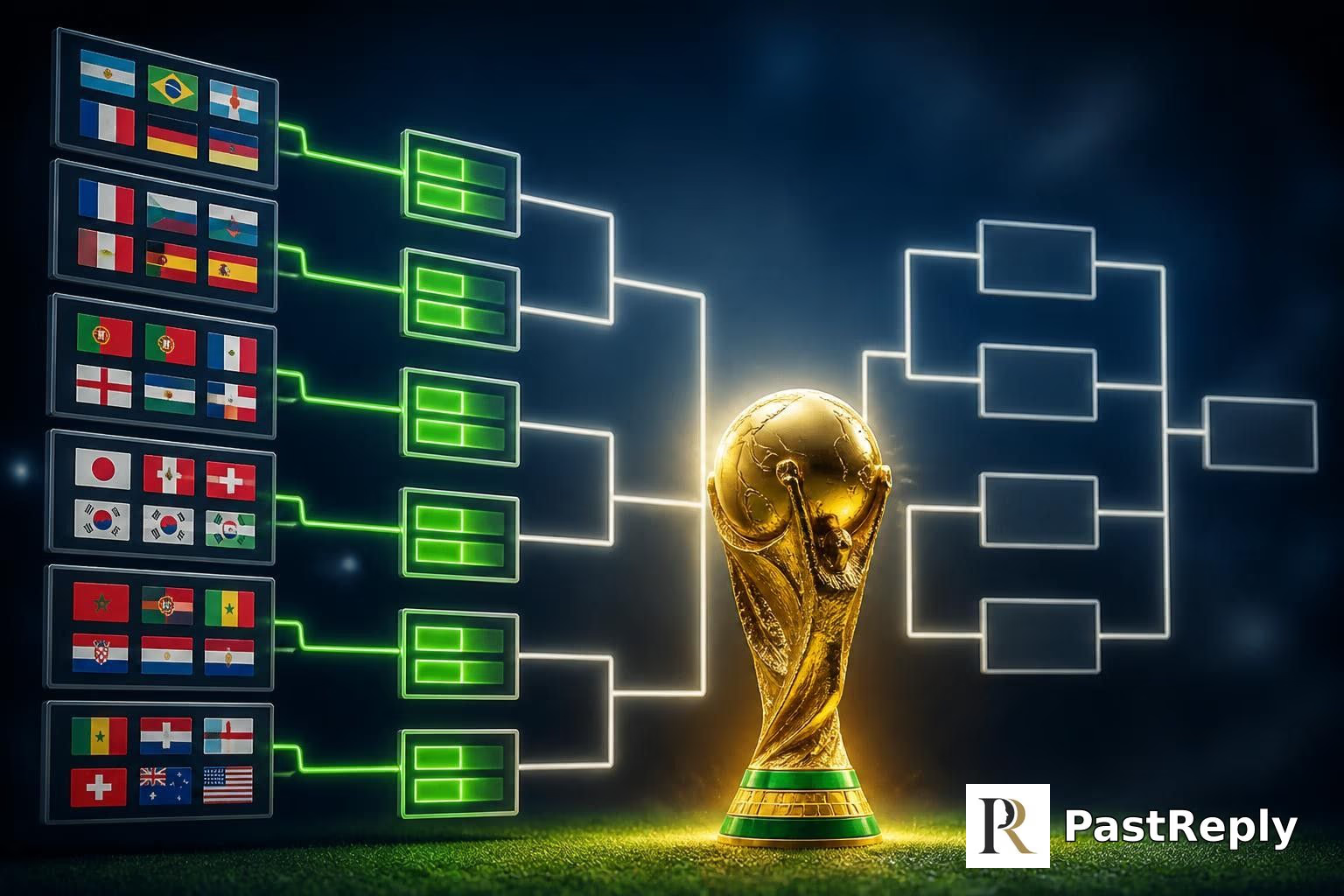
The FIFA World Cup bracket is determined through a combination of a group stage and a knockout stage. In the group stage, the 32 qualified teams are divided into eight groups of four teams each. The draw for the group stage is seeded based on the FIFA World Rankings and geographic considerations, with each group containing one team from each of four pots. Teams play a round-robin within their group, earning three points for a win, one for a draw, and zero for a loss. The top two teams from each group, based on points and tiebreakers such as goal difference and goals scored, advance to the knockout stage.
The knockout stage is a single-elimination bracket consisting of the round of 16, quarter-finals, semi-finals, and the final. The bracket is structured so that the winner of Group A plays the runner-up of Group B, the winner of Group B plays the runner-up of Group A, and so on for all groups. This predetermined pairing ensures that teams from the same group cannot meet again until the final, and it balances the paths through the tournament. The bracket is fixed from the start, meaning there is no re-draw after the group stage; the matchups are determined solely by group standings.
If a knockout match is tied after 90 minutes, extra time is played, and if still tied, a penalty shootout decides the winner. The winners advance through the bracket until the final, which determines the champion. The losing semi-finalists also play a third-place match.
Answered by 100 of history's most famous minds

Do you see how the cup they chase orders the runners into fixed paths, so the strong may avoid each other until the end? That is the wisdom of this world: to spare the powerful the shame of early defeat. But in the kingdom of God, the last are first, and the master calls the least to the head of the table. Let your tournament be mercy - where every fallen one is lifted, and the guest who came last receives the same wage as the first.

They divide the tribes of the earth into four vessels, like the waters of the well, and let the strongest of each advance to meet one another. This is a just custom, for order is a mercy from God, lest chaos prevail. But the true victory lies not in the cup of silver but in the scales of the Day of Judgment. Let the players run and strike the ball with fairness, and let no man cheat his brother for the sake of glory. The greatest champion is he who lowers his gaze and says, 'This too is a trial from my Lord.'

The bracketing of teams, like the classification of beings, is a skilful means - a raft to cross a river, not a palace to inhabit. The groups are birth, the knockout is death, and the final is the illusion of a permanent self. But the wise one sees that no match is won without a hundred causes and conditions; the trophy is dust, and the path itself is the path. Let the players run, but cling not to the cup.

The nations are gathered, like the tribes of Israel at Sinai, but the lot falls not by your own strength - it is the Lord who casts the die among the pots. Let the strong not boast, for the stone from the sling may fell the giant. But woe to the nation that trusts in rank alone; only the righteous who keep the covenant of the game - fair play and no graven image of victory - shall enter the promised land of the final.

The bracket is a vessel of ritual propriety. The groups are divided with care, like a teacher sorting pupils by their measure, and the top two from each are honored to advance. The predetermined pairings, like the rites of a well-ordered court, ensure that those who have already met do not cross again until the final. This is the rectification of names: let the victor meet the worthy, and let the path be clear to all, that no discord arise from confusion.

They divide the peoples into groups as if by language or tribe, each one given a portion of the field and a season of contest, and from the strongest two from each company they ascend into a single path toward the crown. It is a shadow of a greater ordering: for the Lord has drawn His own lines among the nations, not by rank or strength, but by grace. Let them run their race; we run another, where the prize is not perishable laurel but life incorruptible.

They separate into tents and camps, each under its own banner, and the strongest two from every camp are chosen to go forward - like the Lord promised to make my descendants a great nation, but here it is by the boot and the ball. Yet the final path is set before a single kick, a covenant written in the draw. I trust the unseen hand that guides the lot, as I trusted when I left Ur.

A net with a thousand holes catches only what the current brings. The tournament draws lines, but the way is without lines - a ball rolls where it will, and the strongest bend like a reed. Serving a fixed plan is like trying to hold water in your fist; the sage watches the game flow, and does not clutch the bracket.

The Name is one, but the tournament divides the nations into four pots, as if some are higher and some lower. This is the way of the world, not the way of Truth. The True One sees no seeding, only the labor of the feet and the honesty of the sport. Share the victory with the vanquished, for the same wind blows over both goals. The real score is not goals but the love in the game.

My heart sees the way they sort the nations into pots, as if each must be measured by the world's scales, but I remember how the Lord scatters the proud and lifts up the lowly. The children play, and the strongest may fall, while the least expected can find favor. In the end, it is not the clever arrangement of tables that matters, but the spirit in which the contest is entered, with humility and hope, as when my own Son taught us to serve one another.

By the grace of God and the sweat of their brows, you say? Let me speak plainly: all this gadding about after a leather ball, with the nations ranked and seeded like so many indulgences for sale - it reeks of the world's pride. The bracket is a human invention, and like all human inventions, it serves only to puff up the mighty and confound the simple. If you seek order, look to the Word of God, which divides the righteous from the ungodly with a sharper edge than any draw. As for these pots and points and tiebreakers, they are but dust and vanity before the judgment seat.

To the first question, I answer that the bracket is determined by a twofold process: the group stage, wherein teams are distributed into eight groups of four, each assembled from four pots according to a ranking of secular merit, and the knockout stage, which follows a fixed pattern of pairings such that the winner of one group meets the runner-up of another, preventing a rematch until the final, if at all. As to the second, implicit question - whether this arrangement is just - I reply that it is a reasonable human ordinance, neither perfect nor arbitrary, but ordered to the end of fair competition, much as natural law orders human affairs toward the common good. The system's wisdom lies in balancing the unpredictability of sport with the need for a clear, predetermined path; it is a participation of human reason in the eternal law, albeit in a small and earthly matter.

Such a tournament brings many people together, but I think of the ones who are not playing - the sick child in the gutter, the old man with no one to hold his hand. The bracket decides who wins, but the only victory that matters is the one we win by loving one person, right now, with all our heart. Let the teams chase their cup; we must chase the cup of cold water given to the thirsty.

This ordering of thirty-two bodies into eight quartets, with motion in one direction toward a single point, is a system governed by fixed laws as certain as those that guide the planets. The ranking by seed and the pairing of winners against runners-up form a symmetrical design that minimizes chance from the outset. Yet the outcome of each collision - a 0 - 0 draw or a 4 - 2 victory - remains unpredictable, a dance of variables that no algorithm can foresee. The true wonder is not the bracket but the infinite complexity of the game itself.

The bracket is a fixed lattice, like the tracks of a particle in a bubble chamber - determined before the first collision. The teams enter with their initial conditions, and from group to knockout, the geometry of the tournament unfolds by rule, not chance. It pleases me: a tidy system, though the ball itself cares nothing for human design.

A fine artificial selection! The groups act as a sieve: each season, the better teams produce more points and survive, while the weaker are eliminated - much as the finch's beak is shaped by the seeds available. The bracket then is a branching tree, a genealogy of champions. But the tiebreakers - goal difference, goals scored - are mere proxies for fitness. I should like to see the full fossil record of every match; then we would truly understand the mechanism.

They determine the bracket by a draw - as if fortune, not mathematics, should govern the path! I say, let the seeds be computed by the celestial mechanics of goal difference, not the caprice of a lottery. The fixed pairing is logical: it prevents the same group from meeting before the final, like ensuring the moons of Jupiter do not collide. But until they abandon the superstition of a draw and submit to a rational algorithm, the bracket is no better than astrology.

How elegantly it mirrors the celestial spheres! The group stage is like the epicycles through which each team must orbit, and the draw ensures that no two from the same circle meet again until the final conjunction. The fixed bracket, once set, follows a harmonic law: the first of one group opposes the second of another, just as the Sun governs the planets in their order. It is simplicity itself - no tangled epicycles, no ad hoc adjustments - only the pure geometry of competition.

The system is an elegant resonance, like the alternating phases of my polyphase motor: eight groups of four create a balanced harmonic, and the knockout bracket channels the energy of the strongest signals into a pure output. But it is a primitive mechanical arrangement - a clockwork with fixed gears. I envision a future where teams are paired instantly by a wireless calculation of their potential, with no need for pots or seeds. The true bracket would be dynamic, adapting as the tournament vibrates.

One must first isolate each group as a separate experiment, with four subjects playing all possible pairings. The results are measured in points, goal difference, and goals scored - precise indicators like the activity of a radioactive sample. Then the two highest-scoring entities from each container proceed to a fixed elimination bracket, a designed sequence of reactions that prevents re-contamination between groups until the final. It is a robust method, needing no new variables after the initial draw.

I see a grand laboratory of competition - eight flasks, each with four cultures, and only the two most vigorous in each ferment rise to the next stage. But the nutrient broth is uneven: the seedings are based on past rank, not current condition - a flawed medium. Chance, too, plays its role like an unseen contaminant. If I were to improve the method, I would demand that every match be played under identical conditions, and that tiebreakers be settled not by goal difference but by a direct confrontation - a decisive experiment.

They've got a sound system - groups and knockout, no re-draw, like a patent that works. Pots based on ranking? That's the theory, but theory never scored a goal. I'd want to see the numbers: goals per match, possession, shots on target - data, not guesses. And the tiebreakers - goal difference, goals scored - that's a practical solution, but why not head-to-head first? Because somebody didn't think it through. I'd build a machine that simulates every possible bracket and find the one that ensures the best two teams meet in the final, not before. Hard work and a better mousetrap.

The bracket is a fixed combinatorial mapping from group outcomes to knockout matchups, essentially a depth-4 binary tree with a predetermined branching structure. The seeding algorithm uses a pot system based on a ranking function that the organizing body defines, and the crossing rules guarantee that no two teams from the same initial group can meet before the final, which is a sensible constraint to preserve the combinatorial interest of the early stages. One could imagine an alternative where the bracket is dynamically re-optimized after each round to maximize some measure of fairness or entertainment, but the current fixed scheme has the virtue of simplicity and transparency.

Consider the group stage as a set of eight small tournaments, each a round-robin on four vertices, from which the two vertices with the highest scores are selected for the next stage. The bracket is then formed by a fixed permutation: the winner of group Alpha meets the runner-up of group Beta, and so on, in such a way that no two teams from the same group can meet again until the final. It is a perfectly sound construction, though I note that the tiebreaking procedures - goal difference, goals scored, and the like - are but crude approximations of true equality. If I were asked to design a fair system, I would give them a lever and a place to stand, and I could move the whole globe into a perfect balance.

Consider the lines of force that must flow through such a contest. The initial draw divides the 32 into four pots - like the poles of a magnet, each group draws one from each. Then the bracket is a fixed circuit: the winner of Group A is bound to meet the runner-up of Group B, and so on, so that the path of each ball is determined by its own motion through the group stage. It is a beautiful, predictable pattern, like the field around a charged wire.

Ah, the bracket - a manifest system of order, yet beneath it lurks the raw instinct of territorial aggression, sublimated into a ball and a whistle. The seeding pots are mere rationalization; what we truly see is the unconscious need to defeat the father-team and claim the mother-trophy. And the fixed pairing that prevents group rivals from meeting until the final? A classic defense mechanism, delaying the confrontation with the repressed conflict until the very end.

The bracket is a deterministic structure - initial conditions (the draw) and local rules (group standings) lead inexorably to a single outcome, much like the collapse of a star into a singularity. But unlike quantum mechanics, there is no uncertainty: if you simulate it a thousand times, the same matchups follow from the same group results. I suppose it is less exotic than a black hole, but it does share the property that once you cross the event horizon of the knockout stage, there is no going back.

The bracket is a finite, deterministic algorithm operating on 32 inputs - the teams - through group stages that select 16 survivors, then a binary tree. But the beauty lies not in the structure itself but in the combinatorial possibilities: the initial draw is a permutation that seeds all future states, much like the Analytical Engine's cards could govern infinite sequences. Imagine if we could program the engine to simulate every possible bracket outcome - it would be a vast, beautiful calculation of probabilities.

Let us define our terms: a bracket is a diagram of matches, each match a contest between two teams. The draw proceeds by lot from four urns, each containing eight teams of equal 'potency' - a term we shall treat as given. The group stage is a round-robin within each group of four, awarding three points for a win, one for a draw, zero for a loss. From these points, we order the teams and select the first two. Then the bracket pairs them such that the first of Group A meets the second of Group B, and so forth, a symmetrical arrangement that prevents same-group meeting until the final. This structure is provably optimal for a single-elimination tournament with a fixed path.

A fixed bracket, well and good - but where is the sanitation of the data? Points, goal difference, goals scored - these are admirable beginnings, yet without a systematic recording of injuries, the quality of pitches, and the cleanliness of changing rooms, the comparison is as unsound as a hospital with no soap. I should like to see a mortality table for players before and after the tournament before I call this a fair contest.

A map of eight groups, each a little satrapy of four, and the winners march to meet in a single-elimination clash? This is no battlefield - it is a shepherds' game for counting grain. When I crossed the Hydaspes, I did not ask for a seeded path; I took the monsoon head-on and broke Porus's phalanx with my Companions. A man who fears to meet his rival in the second round because of a chart is no king. Let the strongest trample the strongest, and may the god be with the boldest.

Thirty-two legions drawn into eight camps, then the strongest pair off by a sealed decree - no second casting of lots. The path is set from the first clash: if you crush your group, you face the runner-up from a neighboring cohort, not the same foe twice. This is how Rome built her provinces: fixed borders, clear victories, no wasted quarrels.

Papyrus lists of tribute and the movements of envoys - that is how the realm of sport, too, orders its games? The draw is the royal decree yet made before a spear is lifted. One must then steer one's own vessel through the current, for fortune favors the queen who reads the Nile's bends before the flood. I would have my agents study every pot and every seed long before the first whistle.

The bracket is a wise institution - it imposes order on chaos, as I did on the Roman provinces after the civil wars. The seeds are the patricians, the pots are the plebeians, and the group stage is the census that sorts them by merit. But the fixed knockout is the imperial constitution: it prevents factions from plotting a rematch too soon. Let the best win, but let the structure endure - that is the Augustan peace.

The bracket is like the order of a khan's army: first, the tribes are sorted into tumens, and the strongest two from each tumen ride out. Then the victor of one camp must face the second of the next, so that no two from the same bloodline clash early. It is a discipline - fixed, not fickle - so that every rider knows his path. And if they remain locked in battle after the usual time, they fight until one falls. That is the way of the steppe: only the strong survive the long march to the great kurultai.

I would have designed the bracket myself: eight corps of four regiments, each fighting the other in a short campaign, then the two survivors of each corps march into the grande armée of the knockout. The seeds are like my marshals - placed to ensure that no weak battalion slips through by chance. But the fixed path after the group stage? That is a strategist's error; a true commander reshuffles his divisions based on the enemy's movements. Still, it is a serviceable order for a game. I approve of the logic, but I would have imposed a final, decisive battle from the start.

The arrangement reminds me of a militia camp in winter quarters - eight companies divided, each with four regiments, and the two most valiant from each company advance to a single-elimination contest. The seeding is done by prior reputation and a touch of geographic balance, like appointing officers from different states. The bracket is fixed from the outset, so no faction can claim the rules were changed mid-campaign - a sound precedent for any orderly contest.

The bracket reminds me of a fair farm auction: the best teams are sorted into different pens so no single lot corners all the good stock. But I've seen a plow horse outrun a thoroughbred when the mud was deep. The seeding is but a guess - the real test is on the field, where a team that stumbles early can yet right itself and reach the final. As we say out on the prairie, the race is not always to the swift, nor the battle to the strong.

The bracket is the line of battle drawn before the first shot: the top seeds are the great powers, the pots the lesser states, and the group stage is the opening skirmish. Some will be overrun in the first round; others, like the Dutch in the 17th century, will defy their allotted rank. The fixed pairing ensures that no two lions meet before the final - a wise precaution against premature exhaustion. But beware: a determined band from a small nation, if they fight with courage and cunning, can topple a giant. We have seen it on the beaches, and we shall see it on the pitch.

I would ask not how the bracket is determined, but whether the means by which victory is pursued are pure. You speak of pots and rankings, of points and goal differences, as if the worth of a nation could be tallied like coins in a counting-house. Let me tell you: the true contest is not for a trophy, but for the soul of the game. If the players do not respect their opponents - even those from the weakest pot - if the crowd does not cheer for every act of fair play, then the whole apparatus of seedings and brackets becomes a soulless machine. Nonviolence and truth are not just for politics; they are the only foundation for any noble endeavor.

I hear you speak of pots and rankings, of fixed brackets and points systems, and I am reminded that the real contest is not simply for a trophy, but for the soul of a global community. The structure they have created - seeding the teams by worldly status, assigning them to predetermined paths - mirrors the very injustices we have struggled against: the powerful are given every advantage, while the weak must fight against the current of history. Yet I also see hope: the same bracket that protects the strong also gives the underdog a chance to rise, if only they have the courage to run the race with endurance and faith. The goal is not just to win, but to build a brotherhood where every nation, from the greatest to the least, is judged by the content of its play, not by the color of its jersey or the size of its ranking.

When I was on Robben Island, we played football in the courtyard, 18 steps each way. The bracket is a structure that decides who meets whom, but the real contest is about discipline and teamwork. The draw may be seeded by rankings, but once on the field, each side earns its place through its own effort - like a nation freeing itself through struggle. And when two teams from the same group cannot meet again until the final, that is a wisdom that prevents early grudges from poisoning the whole tournament.

This bracket reflects a degenerate internationalism that levels the races, allowing inferior peoples to compete on equal footing with Aryans. The seeding based on world rankings is a Jewish-influenced fiction that ignores natural hierarchy. A proper tournament would divide groups by blood and soil, ensuring that only the strongest race advances, not through some mechanical draw but through the Führerprinzip - leadership by the most worthy.

The bracket is a useful mechanism for organizing competition, but it must serve the state's unity. In the Soviet Union, we would ensure that the draw produced favorable paths for our team, just as we ensured five-year plans met their quotas. A fixed bracket prevents chaos, but the true determination is not on paper - it is through iron discipline, the will to crush the opponent, and the full resources of a mobilized society.

The bracket is a bourgeois spectacle designed to distract the masses from class struggle. Under socialism, we would replace the arbitrary draw with a system that prioritizes workers' collectives over national teams. The fixed bracket is a form of false objectivity - it masks the unequal resources that capitalist countries pour into their sports. The only true determination is the dialectical progression of history, which will sweep away all such competitions.

The bracket is merely the vessel of the inevitable: the dialectic of struggle crushes the weak and elevates the worthy. Let the imperialist leagues count their points and pots; in the end, it is revolutionary will that shatters every fixed pairing. The true match is between the masses and their oppressors, and no seeded draw can prevent that final reckoning.

The arrangement is a model of orderly competition, most suitable for a sport that has carried the name of our empire across the globe. That the pairing is fixed beforehand, and that the best two from each group proceed, ensures that only the most worthy and disciplined advance - much like the promotion of officers in a well-regulated army. I confess I find the very idea of a 're-draw' most unsettling; it smacks of indecision.

The system of groups and a fixed knockout bracket provides a clear and fair path for all participants, ensuring that merit over the course of the group stage determines the later pairings. It is a structure that rewards consistency and resilience - qualities I have always admired, whether on the polo ground or in the longer race of public service. One hopes the spirit of sportsmanship prevails as much as the correct application of tiebreakers.

A wise order: first, let the tribes be sorted into eight bands, each with a mix of strengths, and let them prove themselves in round-robin battle. Then the victors march along a fixed road to the final field, so no man may complain of a crooked path. This is the way of a just tournament - it rewards the valiant and the clever, and spares the realm from endless bickering over the draw. Would that my own counts could settle their disputes so cleanly.

Holy Mary, what a sensible design! The Almighty does not love confusion, and this fixed bracket keeps the way straight for those He favors. Each group is a little trial, and the top two are chosen to go forward, just as the saints are chosen from among the faithful. And should they be tied, let the contest be decided by courage and skill - not by the whim of a coin or a man's decree, but by the will of Heaven working through their feet and hearts.

A most cunning device: the group stage sorts the wheat from the chaff, and then the bracket is woven like a tapestry, so that the lion never meets the same wolf twice before the final dance. It reminds me of my own court - every faction must prove its mettle in the tiltyard of the group, and then the path is fixed, so that no faction may cry 'foul' at a later reshuffling. In this, as in statecraft, the prudent ruler contrives a game where merit and fortune alike have their day, and the crown remains secure.

A structure worthy of the Enlightenment itself - reason and order tempering the chaos of competition. The seeding by rank and the careful pairing of winners against runners-up ensure that the strongest are tested without waste, while the fixed bracket spares us the tedious spectacle of endless argument. I should only add that, as in my court, a touch of strategic generosity - perhaps a banquet for the weary players - would smooth the path of the eventual champion. But the design is sound; it pleases the rational mind.

When I divided my empire into satrapies, I likewise saw that each province had a share of strengths and that no single house could dominate the council. This bracket is a just order: the groups are like satrapies, each with its own balance, and the fixed road to the final ensures that every man knows his way. The winner is not the one who bribes the draw, but the one who best conquers his own fate. That is the Persian way: let all peoples compete under a common law, and let the best arise.

By the mercy of God, this is a noble and fair arrangement. The groups are like the tribes of the ummah, each tested in its own circle, and the two that rise are matched not by chance but by a fixed law, so that none may say the contest was rigged. It reminds me of the wager I once made with Richard: let the champions meet on a set day, not by the shifting of the wind. In this, as in war, the plan must be just and the execution firm, and then the victory is God's to grant.

Friend, before we examine how this bracket is determined, tell me - what does it mean to 'win'? Is it to carry a golden globe that will tarnish, or to have shown excellence in the contest? And tell me further: does the ranking of teams by past deeds truly measure virtue, or only reputation? I have no art in ordering men into pots, only in asking why we seek a champion at all. Perhaps the fairest bracket would require each team to defend its claim to glory in argument, as we do now.

They imagine the visible bracket - the lines and names - is the true form, but it is only a shadow cast on the cave wall. The real bracket is the ideal order of merit, the Form of Justice itself: each contender earns his place by excellence, and the geometric progression of the knockout mirrors the ascent of the soul toward the Good. But what check is there on a mere drawing of lots?

The bracket is a formal cause - the design that gives shape to the matter of competition. The seedings, like the categories in my biology, sort the participants by prior excellence, then chance and merit decide the rest. But the true end, the final cause, is not merely victory but the exhibition of aretē - excellence - under the tension of a fixed structure.

The arrangement of the bracket is not a matter of whim but of reason: it follows a universal schema that can be willed as a law for all participants. The fixed pairing of group winners against runners-up ensures a consistent rule that every team, once they know their group, can calculate their path. This is the dignity of a rational competition - no secret re-sorting, no favor, only the duty to earn one's place and then abide by the structure that applies to all equally.

A herd mechanism dressed as destiny! The bracket is the will to power codified - the strong are seeded into pots, then penned into groups where they trample the weak. The fixed pairing ensures that the victor of one group immediately faces the runner-up of another, a marriage of lions and lambs that the weak call 'fair'. But I ask you: what is fair? The bracket is a cage for the Übermensch, a device to delay the clash of titans until the final. Only the weak need such order; the strong create their own path.

The bracket is a perfect mirror of the bourgeoisie's fetish for order: a predetermined structure that pretends to be fair while ensuring the strongest capital - seeding based on past performance, geographic privilege - reproduces its advantage. The group stage is the factory floor where the workers (the lesser teams) are sorted into raw material for the knockout assembly line. And the fixed bracket? That is the ideology of eternal recurrence: the same old feudal lords, rebranded as Fédération Internationale de Football Association, decree that the winners of one group must meet the runners-up of another, as if the system itself were natural law. It is not. It is history made by the boot of the powerful.

First, I doubt the draw itself - is it truly random or seeded by some hidden principle? The FIFA rankings are an empirical measure, but the ranking itself rests on past results, which are themselves contingent. The group stage is a round-robin, a method I approve: every competitor meets every other, giving a clearer proof of merit. The bracket then proceeds by clear and distinct rules - winner of A faces runner-up of B, and so forth - a mechanical chain. Yet the real question is: can we know with certainty which team is best? Only after the final, and even then, the sequence of matches may have intervened. The bracket is a machine, not a truth.

This is a prudent design: the draw is fixed, so no faction can manipulate the pairings after seeing who prospers. Yet the seedings are based on reputation - ancient glory, not present strength. A wise prince would study the pots and see that the fourth pot holds serpents that can bite the proudest seed. The bracket is a tool of order, but fortune laughs at order. If I were managing a team, I would bribe the officials before the draw, not after.

See how Fortune, that strumpet, spins her wheel: thirty-two nations drawn from four pots as from a conjurer's sleeve, then paired so that no two lions from the same den meet until the final act. It is a plot worthy of Prospero - a comedy of errors, a tragedy of missed chances. The stronger seed lords it over the weaker, yet the ball is round, and the hour of destiny may bring a David against Goliath. All the world is a stage, and every team merely players, but the script is written not by kings but by a draw in a hall.

As at the games for fallen Patroclus, the heroes drew lots from a bronze helmet to match their foes - so too these thirty-two kings shake the golden urn of fate. The bravest are seeded like Priam's sons, and the bracket is fixed as the course of a black ship under a god's decree. But woe to him who trusts the lot: the swift-footed may stumble, and the hand of Zeus overturns every reckoning.

I have seen such a bracket in the celestial spheres, where souls are drawn through concentric circles toward the Rose - yet here the path is fixed before a single ball is kicked. The group is Purgatory, where each team purges its weakness, and the knockout is the ascent through the nine heavens of judgment. But woe to the seed that thinks its rank a guarantee of Paradise; the lowest pot often hides a Goliath.

What a splendid drama of striving and encounter! The first stage is a miniature world, where each group of four must test themselves against three distinct tempers. Then the fixed bracket - like a master's choreography - pairs the victors of one group with the second of another, so that no two who have already wrestled may meet again until the final act. It is a design that allows the fittest narrative to unfold, a living Bildung each team must undergo through struggle and growth.

The tournament masters arrange the group pots as a steward sorts wineskins by vintage and region, then let the blind hand of Fortune pick which lot joins which. I have seen a band of Andalusian goatherds pick teams for a Sunday game with less ceremony and more laughter. Yet the whole contrivance is no worse than any other system devised by men who cannot bear to say 'we do not know which is best, so let them play and find out.' The fixed bracket afterward, that is a fine joke: it promises order as if the ball itself cared for our charts.

I think of the peasants in the village who chose sides by throwing a stick in the air and running after which way it pointed. That was a truer bracket than this elaborate lottery of pots and seeds, because it admitted the randomness of life without pretending to control it. The chart they draw up is a vain attempt to impose a moral geometry on a contest that, in its essence, is about nothing but the brief, meaningless joy of kicking a ball. And yet I watch with the same foolish hope: that somewhere in this apparatus of ambition and glory, a boy might simply play.

A fixed bracket! They pretend order rules, but chaos lurks in every kick - the ball deflects off a defender's shin, a referee's blink, a man's soul trembling under the gaze of fifty thousand. The group stage is a crucible: four teams, each carrying the sins and hopes of a nation, and only two emerge, purged or broken. Then the crosses are predetermined, like a destiny imposed from above - but a man can still choose his despair or his exaltation. The real tournament is in the heart: will the player, in the one hundred twentieth minute, choose the beautiful, irrational pass or the cowardly safety?

They arrange the company by rank, as Lady Catherine would seat her dinner guests: one from each pot, that no table be too low. But what a comedy when a pot-four upstart steals the place of a grand seed! The bracket, once drawn, is as fixed as a marriage settlement - no second chance to improve one's connections. Yet the true interest lies not in the structure but in the character of those who advance: a team with sense and spirit may yet triumph over one with only a fine pedigree.

Ah, my dear sir, you ask how the World Cup bracket is determined, and I shall answer you as plainly as if I were describing the daily operations of the Circumlocution Office. First, the teams are herded into eight groups, like poor souls crammed into a debtor's prison, each group containing one from each of four pots, sorted not by merit but by the arbitrary hand of a ranking system that would make Mr. Gradgrind weep with joy. Then they play a round-robin, points doled out like pennies from a miser's purse, and the top two from each group are paraded forth to a fixed bracket, where the winner of Group A must face the runner-up of Group B, and so on, with no hope of escape until the final. It is a system as rigid as the workhouse, yet it does ensure that no two teams from the same group meet again too soon, a small mercy in a world so full of cruelty and chance.

Why, it's a marvel of modern civilization, isn't it? They put the teams into pots - not unlike the ones we used to keep our money in back in the old country, only these pots are full of footballers instead of silver. Then they draw names like a lottery, which is fitting, because the whole thing is as much a game of chance as it is of skill. The bracket is fixed from the start, like the plot of a dime novel: you know the hero will meet the villain in the final chapter, and the only surprise is whether the hero trips over his own boots along the way. It's a beautiful system - for the bookmakers. For the rest of us, it's just another reminder that the universe was designed by a committee of bureaucrats with a fondness for geometry.

You want to know how the bracket is made. It's simple. Thirty-two teams, eight groups of four. They play. The best two from each group go into a fixed tree. The draw is seeded so the big teams don't meet too early. The bracket is set before a ball is kicked. No second chances. If you lose, you go home. It's clean. It's hard. That's the way it should be. The only thing that matters is what you do on the field.

I observe that this bracket is like the branching channels of a river delta, where the waters of thirty-two streams converge through narrowing passages toward a single sea. The seeding is based on past performance, but the true work is in the geometry of the path - the spacing of rest days, the pairing of left and right legs to avoid early rencounters, the balance of latitude and climate. I would draw the tournament as a series of interlacing spirals, each turn a test of stamina and skill, and let the victor emerge as the fittest organism in this grand mechanical garden.

The bracket is carved from the rough block of chance - each group a quarry, each match a stroke of the chisel. The master who draws the first four teams sets the vein of the marble, but the sculptor's eye sees the final form already within. They say the path is fixed, yet the hand trembles: will the David emerge, or will the stone shatter at the hammer's blow?

Ah, the bracket - like the cypress trees I painted in the asylum garden, each branch reaching upward yet intertwined with the next. The groups are the dark earth, the root where the teams struggle, and the knockout is the sunlit crown. But what moves me is the unseen thread of passion - the trembling hope of a small nation, the brushstroke of a defender's last lunge. That is the true composition.

These brackets are just another frame, and frames are made to be broken. The groups are merely a grid - like a cubist's first sketch - but the real pattern emerges in the collision of styles, the unpredictable geometry of a striker's run or a goalkeeper's leap. I tell you, the fixed pairing is a cage for the imagination; true art, and true football, happens when the structure dissolves and pure movement takes over.

I watch the green rectangle of the field as I would a meadow at Giverny: the teams move across it like patches of light and shadow, and the bracket is simply the frame that holds these fleeting compositions. The draw seeds them like the first touches of dawn arranging clouds before I can catch the true color. But what matters is the moment the ball arcs through the air and the light catches it - that impression is the only fixed thing, not the paper chart they consult.

A painted diptych, that bracket - each group a panel where the drama unfolds in light and shadow, the top two from each chapel advancing to the grand altarpiece. But I watch the faces, not the numbers: the goalkeeper's sidelong glance before a penalty, the runner's knee bent like a question mark. The real bracket is etched in sweat and joy and the weight of a nation on one lad's shoulders.

The bracket is a broken spine, a skeleton that must hold the weight of thirty-two bodies. They draw lots like they're casting a spell, but the real magic is in the wounds: a sprained ankle painted in crimson, a goalkeeper's shattered hand, a flag that bleeds into the final. The group stage is a series of self-portraits - each team shows its true face. And the predetermined path? That's the corset they lace before the dance, but the dance itself will break every bone.

Ah, a bracket! It is the counterpoint of sport: each group a theme introduced in a different key - some in C major, some in G minor - and then the development section where they modulate into the round of sixteen. The seeding is like a composer's choice of tonic: you start with the strongest voice, but the real music comes from the unexpected dissonances - the underdog's sudden forte, the penalty shootout that resolves like a perfect cadenza. Bravo! I would write an opera for each match, with arias for the goals and a chorus for the crowd, and the final winner would sing the loudest.

The bracket is a sonata form! The groups are the exposition, stating the themes - then the knockout is the development, a struggle through keys and modulations, until the final is the triumphant recapitulation. But the composer writes no fate: each player must earn his entry with fire and precision. I would have them all play fortissimo, for the human spirit is not a mere number in a ledger!

The bracket is a fugue - a subject and countersubject in the form of groups, then a stretto of single-elimination where the voices cannot overlap again until the final Amen. The seeding is the cantus firmus, the fixed melody upon which all else is improvised. And when two teams are tied, the extra time is a pedal point, holding the tension until the cadence of a penalty shootout resolves the harmony.

Well, thank you kindly. It reminds me of a good ol' sing-off down at the fair: you start out in the prelims, gotta earn your place, then the bracket lines you up like tracks on a record. The group winners and runners-up get paired so the show keeps movin' - no two from the same stable meet 'til the big finale. And if it's even after the final whistle, they keep goin', like an encore that just won't quit, 'til someone takes the crown. It's a fair shake for all the fellas.

It's like a choreography, you know? The bracket is the dance floor laid out before the music starts. Each group is a song, each knockout a crescendo. And the seeding - that's like setting the stage so every dancer has a chance to shine, but the real magic happens when the rhythm takes over. I always believed the world could move as one, like a global chorus. This is just the sheet music - the harmony comes from the players' hearts.

Well, it's a bit like our Pepperland - you've got eight groups, each like a different side of the album, and then the best two from each side get to sing the chorus in the knockout round. The draw's planned like a setlist, with seeds from the charts, but you never know which B-side will steal the show. No reprise till the final, mate - just pure melody and mayhem.

The thing about a bracket's like a highway that's mapped before the first car rolls. Some roads meet, some don't; you can't tell the potholes from the map. They seed the pots like they're sorting beans, pretending the weak and the strong can be known before the game is played. But the result's already written in the draw, ain't it? A man spends his whole life kicking a ball, and the bracket decides his fate before he even sweats.

It's like planning a world tour before you've written the album - you think you know the stages, but the real hits come from the unexpected connections. The groups are like Eras: each has its own vibe, its own rivalries, and the bracket decides who gets to open for whom in the final. I love that they lock it in from the start - no redraw drama, it's fair. But let's be honest: the tiebreakers can be as confusing as decoding a hidden message in a lyric. You just have to trust the process and write your own ending.

I see in this bracket a map of the world, divided into four pots as I once divided the ocean into routes: one for the east, one for the west, one for the south, and one for the unknown edge. The strongest seeds are set aside to avoid collision, as I myself was favored by the Crown of Castile to sail first. But the true discovery comes when the runner-up of Group B meets the champion of Group A - that crossing, like my own passage across the Atlantic, brings together what seemed apart. God grants the victory to those who sail farthest into the unknown.

I have seen the Great Khan's tournament at Khanbaliq, where a hundred wrestlers are drawn by lot from silk pouches and paired by the hand of the chamberlain. So too these thirty-two nations enter the arena by a seven-seal decree, their pot a golden urn, their emblem a rooster or a dragon. The path is fixed as the itinerary of a caravan from Venice to Cathay - but the winner is written in the stars, not the scroll.

I have seen the stars arrange themselves into a different order each night, yet the bracket is fixed as the compass. The group stage is the lee shore - you must survive the shallows before you can open the sails. Then the knockout is the open ocean, where one miscalculation sends you to the deep. I would rather face the Patagonian ice than a penalty shootout; at least the ice does not pretend to be a game.

The bracket is determined by a systematic process: a group stage using a seeded draw, then a predetermined knockout tree. This is analogous to how we planned lunar missions - first a careful orbit, then a descent to the surface. The team that wins its group meets the runner-up from another, ensuring no two from the same group collide until the final, if at all. It's a logical sequence, like staging a launch: each step depends on the one before, and the margins are thin.

They draw names from pots as if casting lots for a transatlantic flight - some luck, some calculation, but the only thing that matters is whether you have the engine and the nerve to go the distance. I've been in brackets where the map was blank and the finish line was a patch of ocean. These players know their route from the start. That's a luxury. The real test is whether they can navigate the turbulence and land on their feet.

From up there, I saw no lines on the Earth - just one beautiful, fragile home. But here below, they mark frontiers and draw lots for groups, like sorting stars into constellations. The bracket is a map of human hope, each match a small orbit. Still, I think the real prize is not the trophy but the fellowship - we all race together under the same blue curve.

The bracket is a design problem, like the architecture of a great product. Most people think it's about logistics - just slap teams into a grid. But the real beauty is in the simplicity: a fixed pairing that avoids same-group rematches until the final, no re-draws, no confusion. It's like the home button on the first iPhone: you don't see the elegance until you understand the thinking behind it. The World Cup bracket is the most intuitive, beautiful way to let 32 teams tell a story that ends with one champion. It just works.

It's a fixed bracket for the physics engine of a massive multiplayer game. The seeding is a sorting algorithm based on real-time data from past matches and world rankings. The bracket logic is a simple set of if-then rules: group winner assigned to lane A, runner-up to lane B. But the optimization problem is maximizing drama while minimizing collusion. Honestly, we should just use a Swiss-system format for the entire tournament - like chess, but with balls.

You know, the bracket is like a life story. The group stage is your childhood - you learn the rules, you face your challenges, and you either rise or you don't. Then the knockout is the adult world: one misstep and you're out. But here's the real takeaway: it's not about the pot you're drawn from - it's about the heart you bring to the field. I've seen underdogs make the semifinals, and I've seen top seeds fall in the round of 16. The bracket is just the frame; the picture is painted by the players.

Float like a bracket, sting like a draw! You got your groups of four, each from a different pot - like four champions in a ring. The top two climb out, then the bracket's set: Group A's king fights Group B's prince. Fixed? Yes, sir - no shufflin', no second chance. And when it's dead even after extra time, it's penalty kicks - the only moment where a man has to stare down the goalie alone, just like me staring down Liston. The best survive, the rest go home.

When I was a boy in Bauru, we made the bracket with stones on the dirt - first two stones for the group, then four, then eight, until the champion kicked the final stone home. The World Cup uses the same beautiful idea: the group stage lets every team dance, the knockout is the samba that never repeats. The draw gives each team a fair path, but the real art is in the dribbles and passes. I smile because it is the game I love, and this system keeps the joy pure.

Imagine eight enchanted kingdoms, each with four knights - that's the group stage. The best two from every kingdom ride into a tournament of magic mirrors, a bracket fixed like a storyboard from the start. The draw is like casting - seed the top stars so the best tale unfolds, no two heroes from the same forest meeting until the final chapter. That's how you build a happy ending!