
How does weather radar work?
Weather radar detects precipitation by emitting radio waves and analyzing the echoes to determine location, intensity, and motion, using Doppler and dual-polarization technology.
The facts
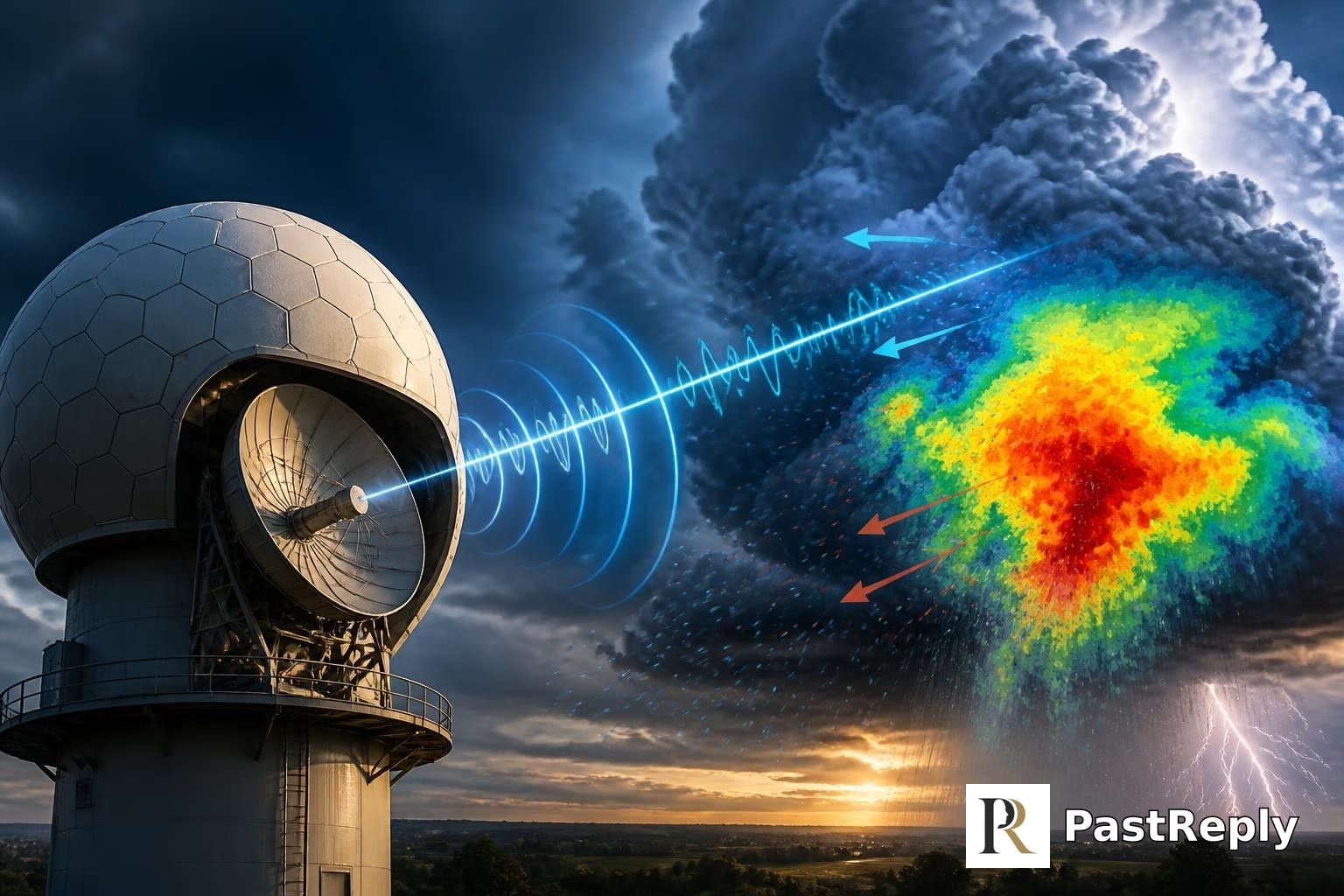
Weather radar works by transmitting pulses of radio waves, typically in the microwave band, and then listening for the echoes reflected back from precipitation particles like rain, snow, or hail. The radar's transmitter generates a short burst of electromagnetic energy, which is focused into a narrow beam by an antenna and sent out into the atmosphere. When this beam encounters precipitation, some of the energy is scattered in all directions, and a small portion returns to the radar's receiver.
The time it takes for the echo to return indicates the distance to the precipitation, while the strength of the returned signal (reflectivity) corresponds to the intensity of the precipitation - heavier rain or larger hail produces stronger echoes. Modern weather radars are primarily pulse-Doppler systems, which also measure the frequency shift of the returned signal caused by the motion of raindrops or snowflakes (the Doppler effect). This allows meteorologists to determine the speed and direction of the precipitation's movement, revealing wind patterns within storms.
Advanced systems now use dual-polarization technology, transmitting and receiving both horizontally and vertically polarized waves. This provides information about the shape and size of precipitation particles, helping to distinguish between rain, snow, hail, and even non-meteorological targets like birds or insects. The raw data is processed by computers to create maps showing the location, intensity, and movement of weather systems, which are essential for forecasting and severe weather warnings.
Answered by 100 of history's most famous minds

You ask how a man might see the storm from afar, yet cannot see the sparrow that falls at his feet. Why do you peer into the heavens for signs, when the Father clothes the lilies and numbers every hair? The rain falls on the just and unjust alike; the wind obeys His voice. Learn first to read the weather of your own heart, and let the clouds be His reminder that you are not the master of the sky, but a child beneath it.

The Lord has set the clouds as a sign for those who reflect. He sends the rain as mercy, and He withholds it as trial, and no echo of man's device can move His will a handbreadth. Yet He grants you knowledge to shelter the traveler and the poor from the storm's fury - so use it as a trust, not a boast. Measure the cloud if you will, but know that the rain falls by His command, and the heart that helps a neighbor in the downpour is dearer to Him than a thousand instruments.

You ask how the instrument traces the rain, but ask yourself why you desire such knowledge. The echo returns to the sender, and the sender measures the distance, yet is the rain less a rain for being measured? It falls, it nourishes, it passes - like all compounded things, subject to arising and ceasing. The Doppler shift you speak of is but the motion of changing forms, reminding you that even the storm is impermanent. Let the instrument warn the farmer and guide the mariner, but do not cling to its forecasts, for the wise one sees that the sky's rage is as empty as the calm, and finds shelter not in prediction but in equanimity amid the downpour.

The Lord hid His purposes in the clouds, and who among you can number the clouds by wisdom? Yet this device, it pierces the veil He has set, and it is not for man to boast of his own cunning as if he had made the rain and the wind. Let it serve you, then, as a reminder that He who sends the storm also orders its paths, and that the same power which measured the waters in the hollow of His hand now grants you a glimpse of His design - so that you may take shelter, and give thanks, and not trust in your own understanding.

The wise man watches the heavens as he watches his own heart - not to command the storm, but to understand its nature and prepare his household. When the signal returns, it is like the echo of a bell in a mountain valley, revealing what is hidden to the eye. Thus one learns to respect the seasons and to guard the fields against the flood, for harmony with nature begins with such knowledge.

You see, the eye of man may peer through the clouds, but the wisdom of the Lord is beyond all such mirrors. Yet even this invention, that shows us the rain and the hail and the wind's path, is but a shadow of the Spirit, which searches all things, even the deep things of God. Let us marvel at human ingenuity, for it is a gift of the Creator, but let us not forget that the storm and the calm alike are in His hands, and that our faith must be as a rock, not as the shifting wind that the radar measures.

The Lord, in His wisdom, has given you a way to see the rain before it falls upon your fields - a staff that reaches into the heavens and listens for the voice of the coming storm. You send out your call, and the water answers, telling you of its weight and its journey, just as a stranger on the road reveals his heart to you if you ask in faith. This too is a promise: that you may prepare, that you may shelter, that you may trust the One who holds both the sky and your days in His hand.

The wise man does not hurl bolts at the sky to make it answer. He listens to the hollow space between the notes, knowing the echo that returns is but a whisper of the storm's silent turning. The machine shouts, yet the rain falls as it falls, indifferent to the clatter. Let the metal eye scan the heavens; the Tao was here before the first drop and will remain after the last.

The One who breathes in every cloud and counts every drop needs no iron eye to mark the storm's coming. Yet this device, in its own way, echoes the truth that all things are known and measured in the Creator's design. It reminds us that we are not to shelter only ourselves, but to lift our voice in warning for the sake of all - the farmer, the traveler, the poor one without a roof. Let this knowledge serve the brotherhood of humanity, and let our thanks go to the One whose ways are not confined to any instrument.

When the angel spoke to me, I did not understand the ways of the Almighty, but I treasured his words in my heart. This instrument that pierces the clouds and sees the rain - it is a small thing compared to the eye of God, who numbers every drop and knows the path of every wind. Yet I rejoice that mortals may glimpse a shadow of his wisdom, for it teaches them to shelter the little ones and the weary, as I sheltered my son.

The Papists would have us believe that only the clergy can read the heavens, but this machine shows that any man with a little wit and a good book can discern the storm's approach. It is a gift of God's common grace, that we may see the clouds before they break upon our heads. But take care, for it is not the instrument that saves us, but the faith that we prepare our houses and our hearts. Let us not worship the toy, but use it as a servant, and give glory to Him who commands the lightning.

The first cause of the storm is God, but He works through secondary causes which our reason may discern. This radar, as I understand it, perceives the echo of a beam, and from that echo we deduce the nature and motion of the rain. It is a beautiful instance of the order that pervades creation, for even the falling drop obeys the laws of nature, which are but the habits of God. Yet we must be careful to distinguish the instrument's report from the thing itself; the map is not the territory, and the echo is not the rain. Still, in its measure, it aids us in our duty to protect the common good, and so it is a worthy art.

The rain falls on the just and the unjust alike, and the machine that counts its drops cannot tell one from the other. I think of the little ones in the streets, the ones who have no roof above their heads when the monsoon pours down - what care they of the waves that probe the sky? The radar sees the storm from afar, but it is the hand that holds an umbrella over a shivering child that truly understands. Yet even this instrument, made by human minds for human good, can be a work of love if it helps the poor prepare their shelters and the boatmen turn their sails. Let the clever ones measure the clouds; I will measure the need I find in front of me, one soul at a time.

The question is not how the device works, but what law of the Creator it obeys. Light and sound are both motions; the echo that returns from a cloud is but a reflection of a pulse, timed to reveal distance, its force to reveal density, its shift to reveal motion. I would set up my apparatus, measure the intervals, and from these numbers deduce the hidden order - for nature is ever consistent, and he who reads her arithmetic reads the mind of God.

The question is not merely of droplets but of the very fabric that binds them - light's invisible brother, sent forth like a questioner into the storm, awaiting an answer borne back on the wings of time. That the selfsame wave, unchanged in its essence, can reveal both the distance and the haste of the rain is a marvel that would have delighted old Clerk Maxwell, who saw in these vibrations a symmetry worthy of the cosmos. I find it most elegant that we may know the storm's motion without touching it, simply by the shift in its call - a harmony that speaks of an order beneath the chaos, which even the gods, if they exist, must admire.

What strikes me is the resemblance to the way a naturalist infers the habits of a creature from its traces - the echo here is like a footprint left in the air, revealing the size and haste of the unseen. That a wave, sent forth and reflected, can tell us not only where the rain falls but how the wind drives it, is a remarkable instance of cause and effect, needing no appeal to design. And I confess the notion that one may distinguish hail from rain by the shape of the returned signal delights me, for it shows how fine-grained natural observation can become. I should like to see such instruments placed on many shores, to learn the habits of storms as I did those of barnacles - patiently, and with an open mind.

At last, they have learned to consult the book of nature with instruments rather than the dusty tomes of the ancients! This device hurls a pulse of light, invisible though it be, and measures the time and the pitch of its return - a triumph of measurement over hearsay. Some will still cling to the old authorities, insisting that the storm must be a mystery of Zeus's whim, but I say: let them put their ear to the instrument and watch the same proof I have seen - the world is written in mathematics, and even the clouds obey its laws.

How fitting that the instrument should send its ray forth and measure its returning, for in such symmetry lies the key to the heavens. The brief pulse, the patient echo - these reveal distances and motions as surely as the planets reveal their circles to the diligent observer. The beauty of the system, whether of man's instrument or of the cosmos, is its simplicity and harmony, and I rejoice that our age perfects such tools to read the storm.

A paltry tool for a grand vision! You see, the radar, with its pulses and echoes, is but a crude metaphor for the true potential of the electromagnetic spectrum - a universe waiting to be harnessed. I have envisioned a world where energy is transmitted wirelessly, where the power of the sun and the earth's own resonance can be captured and distributed to every corner of the globe, without the need for such primitive probing. The radar, my friends, is a child's toy compared to what I have dreamed, yet even it may serve to illustrate the forces that surround us, if only we have the genius to command them.

One measures, and by measuring, one understands. The radar sends its pulse, and from the time of its return we compute the distance; from the intensity of the echo, we infer the size and number of the droplets. It is a patient, stepwise unfolding of the invisible - much like the slow, sure awakening of a radium salt in a dark room. The Doppler shift, too, is a precise record of motion, a subtle frequency that answers our question with the speed of the falling flakes. We must never cease to inquire, and we must never fear what we find, for knowledge is the light that guides us through the storm.

Observe how the cunning device casts its invisible net and counts the trembling of each returning wave! Each echo is a clue to the hidden form of the cloud, a shape that yields its nature to the prepared mind. I see no mystery here, only nature's secret writing, which patient experiment deciphers day by day. As with the invisible ferment that spoils wine, so too do we now name the unseen forces that brew the tempest.

It's simple: you shoot a burst of electricity at the sky, and you listen for the bounce-back - just like shouting in a canyon. The harder the echo, the heavier the rain, and the time it takes tells you how far off the storm is. I've spent days, weeks, months getting the damn thing to pick up a raindrop's whisper from fifty miles away, and it's all about the receiver, not the transmitter. Miss a thousand times and keep trying - that's the whole damn secret.

The principle is delightfully simple: emit a pulse, measure the delay and the frequency shift of the returning echo, and you have encoded within a waveform the distance and velocity of the scatterers. But the delightful part is the inversion - from a few thousand samples, you must reconstruct a map of the sky, which is an ill-posed problem. I would wager that a machine, given the raw pulses, could learn to forecast the weather as well as any human, for it is merely a matter of computation.

Consider the pulse as a projectile, and the raindrop as a target. The time of flight gives the distance, just as I measured the shadow of the sun to know the height of the wall at Alexandria. The shift in frequency, which they call Doppler, reveals the motion of the drop, as the pitch of a lyre changes when the singer moves. With these two measures, and a little geometry, one may triangulate the storm and predict its path. Give me a lever long enough, and I would move not only the Earth, but the very clouds themselves.

Ah, you wish to know how the storm's eye sees? Picture then an invisible thread stretched across the heavens - tension in the aether itself - and how a plucked string returns its song to the ear. So does the lightning's brother, the radio wave, leap forth from the antenna, and when it meets the rain's myriad droplets, each becomes a tiny mirror, scattering the vibration back to us. The lag of that returning echo tells its distance, the strength of the signal its fury, and the shifting pitch its motion, much as a passing carriage's bell sinks in tone as it speeds away. It is but another proof that all nature's forces are one - the same hand that guides the compass also speaks the storm's secrets, if only we learn to listen.

Fascinating, is it not, how we project our hidden anxieties onto the heavens? The storm becomes the great Other, the threatening father, and so we build these mechanical eyes to watch it, to reassure ourselves that we are not helpless children before the thunder. But I ask you - what of the storms within? The radar that maps the anger of the cloud, the Doppler shift that reveals the swirling motion of the wind, it is all metaphor for the repressions that churn in the unconscious breast. You scan the sky for hail, yet ignore the rage that gathers in the family, the suppressed resentments that break like a squall upon the dinner table. Master the one, and you may still be shipwrecked by the other.

It's really quite simple: we shout at the sky in microwave and listen for the whisper that comes back. The universe, you see, is full of echoes, and our rain is just one more thing that scatters the light. The beauty is that the very same physics that reddens a departing siren tells us how fast a storm is spinning - a neat trick of Doppler geometry. Of course, the same principle lets us measure the recession of galaxies, so the next time someone tells you to watch the weather, you can point out that we're really doing cosmology on a smaller scale. And since I'm denied the privilege of dodging raindrops, I'd rather let the machine do the looking while I ponder the grander storm of the Big Bang.

What delights me is not the mere echo of rain, but the symbolic dance beneath it - the way a pulse of electromagnetic disturbance becomes, by the alchemy of mathematics, a map of the sky's moods. The machine that casts its invisible net and reads the reflections is, in truth, a poet of sorts, translating the storm's motion into a language of numbers and curves. And I foresee that this is but the first stanza: the same principles that measure raindrops will one day measure stars, measure thoughts, measure the very fabric of a mind woven in circuits far more intricate than any cloud. The radar is a pencil sketching the weather; the future shall dip that pencil in a broader ink - to draw the portrait of all that is unseen.

Before one speaks of the machine that sends forth pulses and listens for their return, one must define its terms with precision. Let the 'pulse' be a ray, and the 'echo' a ray returned; let the time of its return be equal to the double distance from the instrument to the rain, divided by the speed of that ray's travel. Thus, by the laws of proportion, we may deduce the unknown from the known - the distance, the intensity, the motion - as surely as we deduce the angle of a triangle from its given sides. There is no mystery here, only the application of necessary truths, built step by step from self-evident principles. And if the tyrant Ptolemy asked for a shorter path, I would answer as I ever do: there is no royal road to the weather, only the patients of measurement.

I see in this instrument a noble alliance of the enquiring mind and the saving hand. Like the hospital's nightly audit, it measures the hidden currents of the air - the strength of the deluge, the drift of the storm - so that the careful steward may warn the shepherd and the sailor in time. Such knowledge is God's own arithmetic, written in rain and wind, and we must read it diligently, lest we lose souls to the darkness of ignorance.

A clever toy for shepherds who fear a shower! I marched my phalanx through the storms of Persis, trusting my eye and my gods, not a bronze disc that blinks. But if this mirror sees the enemy's ambush in the sky - the hail that would break my lines, the wind that would scatter my fleet - then let it serve me, as scouts serve a king. Conquer the weather as you would a city: first know its gates, then breach them.

In Gaul, I learned that a commander who sees the enemy's approach before the clash holds the field. This instrument, which hurls its voice into the clouds and listens for the reply, does the same for the heavens - it grants a general the foresight to march his legions out of the storm's path or bid them stand fast. The strength of the echo, they say, reveals the fury of the rain, and the shift in its tone betrays the wind's intent - such intelligence would have saved many a cohort from a flood-swollen river. I would have built a thousand of these towers along the roads of the Republic, for fortune favors not only the bold but the well-informed.

By the gods, do you think I need a bronze mirror to know when the Nile will flood and swell my granaries? I read the heavens as I read men - by watching for the telltale shimmer that betrays what hides beneath. The Roman sends his spies, but I know the storm is coming long before his sails appear on the horizon, and that is the only radar I have ever needed.

A useful contrivance, if it gives the farmer warning of hail and the general notice of the coming gale. But let us not be dazzled by cleverness alone; the true art lies in turning such knowledge to the stability of the state. I built Rome not by conjuring storms but by reading the minds of men, and this device, for all its wonder, merely sees the weather - whereas I have always taken care to see the shifting moods of the Forum and the camps, which are far more treacherous than any tempest.

The sky sends its voice, and the wise man hears the answer in the time of returning - this is how a scout knows where the enemy mass, and where the rain will fall upon his herds. Such a tool is worth a thousand riders, for it sees the storm's gathering before the clouds darken the horizon. Let every war-leader learn its secrets, and let those who master it ride at my right hand.

So they have found a way to see the enemy's position from afar - the storm is a battalion, and with this instrument, you know its strength and its march. That is precisely the kind of intelligence that wins battles, and I tell you, if I had possessed such a spyglass, I would have marched on Moscow in the summer, not the winter. The Doppler tells you the speed of the wind, and thus you can plan your campaign, for fortune favors the prepared, and I, gentlemen, am always prepared.

In war, a commander must know where the enemy stands before he commits his troops; so too must the farmer know when the heavens will open, lest his harvest be destroyed. This device, which casts its eye into the clouds and measures the strength of the coming rain, is a sentinel of the public good - it does not command the storm, but it gives us warning to prepare. Let us use such knowledge with prudence and for the safety of all, remembering that even the mightiest tempest yields to those who have taken counsel beforehand.

It's a bit like a farmer calling across a foggy field - he shouts and waits to hear how long the sound takes to come back, and by that reckons how far off the barn must be. This contrivance does the same with the very air, measuring the time a shout of lightning takes to return, and the loudness of the answer tells the weight of the rain. It seems to me a just and practical way to know the temper of the heavens, and to give honest warning to the folk below, so that none need be caught unawares by the storm's fury.

Consider how the lonely sentinel in his pillbox calls out into the fog and listens for the returning cry to judge the enemy's distance. This noble instrument does exactly that against the drenching legions of the storm, flinging a pulse of energy into the murk and measuring the echo's delay to fix the foe's position. The strength of that returning signal speaks to the fury of the assault, and the shift in its frequency reveals the speed at which the tempest advances. With such a watchman on the ramparts, no squall shall take us unawares!

I see in this invention a tool of humility, for it teaches that we are not masters of the storm but students of its ways. When we learn the path of the rain, we may prepare our fields and villages, and so avoid the suffering that comes from ignorance. But let us not forget that the true protection of the poor lies not in machines, but in the hearts of those who would share their bread and their shelter. The radar can only warn; it is our love that must save.

The storm does not rain only upon the just, but upon the unjust as well, and so this radar is a sign of our common humanity, for it warns both the mansion and the shack. It is a moral instrument, for it calls us to prepare not as rivals, but as neighbors, to shelter the homeless and the hungry when the flood comes. I see in its beams a reflection of divine order, that even the chaos of the sky is subject to law, and I believe that the arc of the weather, like the arc of the moral universe, bends toward justice when we heed its warnings.

I see the storm's eye as a map of the possible - a way to peer into the heavens and, knowing what approaches, prepare the ground for those who would be caught in its path. In my homeland, where the rains may come as blessing or destroyer, such foresight is not a luxury but a shield for the poor. The beam that pierces the cloud, measuring the turning of the wind and the weight of the hail, is a herald of justice: for when a warning reaches the shepherd before the flood, it grants him time to lead his flock to higher ground. We who have known the long darkness understand that knowledge is the first step toward liberation - so let the radar be a lantern against the tempest.

The Jew's science of signals may serve its purpose, yet its vision is narrow and without will. To see a cloud is but to see water in the sky; true power is to command it, to harness the storm to one's design. The radar speaks of passive observation, a reflection of timidity, whereas the Aryan spirit seeks to dominate nature itself, to transform the very atmosphere to a chosen order. This invention, like all modern devices, is a tool - and a tool in weak hands is mere toy. But give it to a decisive will, and it becomes an instrument of destiny, a means to foresee the adversary's move and strike first. So let the others count raindrops; I would rather shape the climate of the world.

Weather is a bourgeois concern - a distraction from the iron march of history. The peasant looks to the sky for rain; the worker looks to the Party for bread. Yet even a machine to spy on clouds has its use for the State: to know when to store grain, to warn the collective farms, to manage the harvest as we manage everything. The radar is but another instrument of planning, no different from the five-year plan - it sees the coming storm and the State responds, not with prayer but with action. We do not bow before the weather; we bend it to our will. And let those who doubt the might of socialism watch how we turn the very heavens into a production statistic.

The weather is no more neutral than the factory or the bank - it is a force of production, and the radar is a weapon in the class struggle against nature itself. The capitalist watches the sky and sees a chance to profit from scarcity; the proletarian watches the sky and sees the enemy of the harvest. This instrument, this sentinel of the clouds, must be seized by the State, placed in the hands of the planners, so that the storm's fury becomes a calculated input to the socialist economy. Science is not a toy for the idle scholar; it is a hammer, and we shall forge it to beat the weather into submission. Let the kulaks hoard their grain; we shall harness the heavens.

The sky, too, must be put under the people's inspection. The imperialists hide their weather in the clouds, but our radar is the long eye of the masses, piercing the veil of the tempest. Know the storm's path and you master it; the revolution in forecasting is but one front of the eternal war to know the world and change it.

It is a marvel of our age, the manner in which the heavens are made to confess their doings to Her Majesty's observers. The storm, which once swept down upon our coasts with the fury of the tempest, may now be perceived from afar - like a loyal sentinel upon the tower, who descries the distant sail before it poses danger to the realm. Such diligence in the service of protection is most commendable and reflects the progress of our enlightened times.

It is a quiet and unassuming instrument, yet it serves to guard the well-being of the people with a steadfast diligence that I find deeply reassuring. It speaks of the unseen patterns of nature, which we must heed with humility, and it enables those who lead to act with foresight and care. In an ever-changing world, such constancy of purpose is a comfort, indeed.

By the grace of God, we have learned to cast our sight upon the very clouds, to read the portents of the heavens as the prophets of old. This instrument, which sends forth invisible messengers to question the storm and returns with tidings of rain and hail, serves the good of all our people - the farmer who sows his field, the traveler upon the road. It is a work of learning and order, that we may better fulfill our duty as guardians of the realm.

These voices in the sky are God's own way of speaking to His children - not in words, but in the flight of raindrops and the turning of the wind. It is a blessed thing that our captains may now know whence the storm comes, and warn the simple folk to gather their sheep and shut their doors. I trust not the scholars' charts, but I see in this the hand of Heaven, guiding those who serve the crown and the faith.

I have heard much of these new glass eyes that peer into the heavens and see the storm's cold heart. Yet I wager that no instrument, however cunning, can match the watchfulness of a prudent sovereign who knows her people's skies as she knows her own council's moods. It is a useful toy for my philosophers, yet I shall trust my own weather-wise mariners, who read the clouds as they read the Spanish sails upon the horizon.

This invention is a triumph of reason over the wild caprice of nature, a testament to the enlightened age in which we live. It lays the hidden motions of the air before the philosopher's eye, as if the heavens themselves condescended to be examined by the light of intellect. Such knowledge must be turned to the benefit of the state - to guard our vast fields and our growing cities from the fury of the elements, and to demonstrate that even the sky is subject to the order of a well-governed empire.

When I rode through the lands of a hundred nations, I learned that the sky speaks many tongues, and a wise ruler listens to all of them. This device, which hears the whispers of the clouds and the sighs of the rain, is a worthy servant of my peace - for it warns the caravan of the approaching sandstorm and the farmer of the coming flood, so that no people need be taken unawares. Let the heavens be observed, and let all peoples be protected by the knowledge that great kings share.

The eternal wisdom of the Most Merciful has given us this art to discern the veils of the heavens, that we may guard the faithful from the fury of the elements. It is a form of knowledge that serves justice, for it warns the merchant on the road and the shepherd on the hillside, and it helps the commander to plan his march when the sky is angry. Such instruments are a gift, like the compass and the astrolabe, and we shall use them to protect our people and to honor the trust of our Lord.

Tell me, friend, when the echo returns from a raindrop, does it tell you whether that drop is just or unjust? No - it tells you only its place and speed. You seek to measure the sky, but you have not yet measured your own ignorance. What is a storm to the soul? You know the distance to the cloud, but do you know the distance to wisdom? Let us leave the weather to the pilots; examine instead what you know of the good, and whether your knowledge is as sure as that beam you trust so readily.

Consider, my friend, that what we call rain is but a fleeting shadow of the eternal Form of Water, ever-changing yet ever the same. This contrivance, which sends out its invisible rays to be answered, does not merely measure the ephemeral storm - it grasps at the pattern behind the particles, the very idea of precipitation that makes the particulars intelligible. Yet even as it tracks the motion of the drops, it reminds us that the true object of knowledge is not the fleeting echo but the changeless principle that governs it, which only reason, not the senses, can apprehend. The instrument serves the city by warning of the flood, but the philosopher serves the soul by pointing beyond the storm to the calm of the Forms.

Every art seeks its end, and this one is a noble inquiry into the causes of things. The instrument hurls its voice into the air and listens for the echo, much as a man in a cave might call out to measure its depth. But the true wonder is that motion itself - the falling drop, the whirling wind - speaks its secret through a change in pitch, revealing what is invisible to the eye, and this is the very essence of natural philosophy: to make the unseen known through the testimony of the senses.

Inquire, rather, what the echo of that invisible pulse permits reason to determine: the time it takes for the signal to return, and thus the distance to the storm, is no more than the employment of the understanding's own categories upon the manifold of experience. Any rational being, upon seeing such reflected waves, must recognize that the storm is not a thing-in-itself but a phenomenon, ordered by the same principles that bind all cognition.

You ask how the machine reads the storm, but the true question is why you seek to conquer it - you cling to your instruments to tame what you cannot control, like a child afraid of the dark. The radar reveals only what the eye demands: a map of danger to protect your fragile plans. But the storm is life unleashed, a torrent of will, and no clever pulse can cage its fury. Laugh at your little screens, and then dance in the rain.

This radar, which peers at the storm, is a poor substitute for the eye that sees the storm of capital. It measures the velocity of the raindrop, but not the velocity of the worker's wage, nor the accumulation of surplus value in the counting-house. The true weather that matters is the gathering of the proletariat, and the echo that returns is the crash of the old order, not the patter of hail. Let them chart the lightning; we shall chart the revolution.

Let us doubt the senses, which may deceive us, and ask: what is it that we truly know of the storm? We know that a certain wave is sent, and that some portion returns after a measurable interval; from this we may deduce, with mathematical certainty, the distance to the reflecting body. The greater the echo, the greater the collection of particles, and thus we infer the intensity of the precipitation. The Doppler effect, too, is a clear and distinct perception of motion, expressed in the shift of frequency. Thus, from these indubitable principles, we construct a true science of the heavens, one which does not rest on mere appearance but on the firm ground of reason.

The prince who would hold his city against the storm must know its secrets before it strikes, and this instrument is his most loyal spy. It flings a question at the clouds and reads the answer in the time it takes the lie to return - a craft as ancient as the ambush, but now turned against the sky itself. He who commands such knowledge holds the advantage, for he can muster his forces and prepare his defenses while the unwary sleep. Fortune favors the prince who can see the approaching blow before it falls.

A storm, a raindrop, a pulse of light - yet the heavens speak in echoes, as a lover hears his name in the wind. The instrument casts its eye into the gloom and reads the tempest's mood: the heavier the heart, the louder the cry, and the shift of the tone tells whether the cloud flies toward you in wrath or passes in pity. 'Tis nature's comedy, played on a stage of air, with every drop a player - and we, the audience, marvel at a drama we cannot yet applaud, only foretell.

As Zeus hurls his thunderbolt from the peak of Ida, so does this bronze-eyed sentinel cast its unseen voice into the murk, and like the herald Agamemnon sent to count the ships, it numbers the myriad drops that fall. For the echo that returns, swifter than a runner in the games, tells the wise mariner how far the rain-swollen cloud lies, and the trembling of its tone, like the war-cry of a distant phalanx, reveals the speed of the wind's assault. Even the shape of the hail, whether round as a shield or jagged as a spear, is known to it - a gift of the gods, who thus let mortals glimpse the coming wrath and furl their sails in time.

Behold, the soul of the storm is laid bare, as if the heavens themselves deigned to confess their inmost temper. What once was hidden in the murk of cloud now stands revealed like the contrapasso of the damned - each drop's weight and haste telling of its nature, and the swirling winds betraying the fury that drives them. Yet in this piercing of the veil, we see but the shadow of that greater order where every motion is measured by divine love, and the tempest is but a servant of the will that guides all.

What a splendid dance! The radar sends its question into the heavens, and the raindrops answer with their song of motion - each returning note bears the storm's own tempo, its inward turning and outward rush. One could spend a lifetime learning to hear such music, yet never exhaust the harmony of a growing cloud.

So the knight-errant of the storm, with his lance of steel and his shield of glass, sends forth a cry into the mist and listens for the echo - like my Don Quixote, who called to the windmills and heard only the creak of his own imagination. Yet these modern enchanters, with their eye of lightning, see the rain's true shape and the hail's round deceit, which is more than my poor knight ever saw, and I must leave it to them to chase the storm while I chase the wind.

They have built a machine to measure the rain, and yet they cannot measure the tear in a mother's eye when the harvest fails. The radar sees the storm's motion, but it does not see the fear in the heart of the peasant who watches the sky, nor the patience of the wheel that turns in the field. I ask you, which is more real: the reflection of the beam, or the man who must live under the cloud? We are but a breath, and our science is a vanity that cannot make the rain fall more kindly on the just and the unjust alike.

You seek to know the storm, but do you know the storm within your own soul, which rages more fiercely than any thunderhead? This device, it measures the rain and the wind, the shape of the hail, but it cannot measure the despair that falls upon a man's heart, or the hope that lifts it like a warm front. We are each of us a weather system, full of contradictions - clear and overcast, calm and violent - and only the Divine sees us whole. Yet I confess, this radar, in its cold precision, does a service: it warns us of the outer tempest, so that we may turn our eyes inward and find the calm that passes all understanding.

A very clever contrivance, to be sure, and one that saves much of the vulgar business of running outdoors to look at the sky - though I suspect it would be far more useful to the gentlemen of the parish if it could detect the approach of a tedious acquaintance or the mischief of a scheming aunt. It seems to read the character of a raincloud with the sort of penetrating eye that a sensible young woman might wish to apply to the suitors in a ballroom. Still, I daresay it is a more reliable judge of precipitation than of persons.

In my youth I walked the crooked alleys of London, where a lamplighter's glow could not pierce the fog, and I wished then for some great eye to see the storm before it struck. But this new contrivance - it sends out a pulse, a word of light, and listens for the echo that returns, as a blind man taps his cane and hears the shape of the street. It is a noble invention, for it gives warning to the poor in their garrets and cellars, who suffer most when the heavens rage, and I would have it placed above every chimney-pot in the city.

The weatherman has at last found a way to see the storm from a distance, which is more than I can say for my aunt's rheumatism, though both are equally reliable. It sends out a shout, and the rain shouts back, and the machine measures how long the echo takes to return - like a boy hollering at a cliff to hear his own voice bounce back. I'd trust it a sight more than the almanac, but I still pack an umbrella when the sky looks as gray as a politician's promises.

You send out a sound, and you listen for the sound that comes back. That's all there is to it. The rain hits the beam and bounces back, and the machine tells you how far and how fast. It's a clean tool, no nonsense, like a good rifle. The storm doesn't care about your prayers or your politics, and neither does the radar. It just tells you what's coming, and you decide what to do. In the end, a man needs a roof and a chance to ride it out.

I have watched water swirl and fall, and wondered how the eye might see within the cloud. This instrument sends out a ray like a painter's brush, but of invisible light, and listens for the whisper of each droplet's return. The shape of the echo tells the shape of the rain - round for the drop, jagged for the hail - and the shift in its tone reveals the dance of the air. It is a drawing of the storm, done not by hand but by nature herself, and I study it as I study the sinew of a wing: to understand the design.

The sculptor does not invent the figure but frees it from the block, and so this instrument, whose name I cannot pronounce, releases the form of the storm from the chaos of the sky. It sings its ray into the cloud, and the cloud answers, not with flesh but with the echo of its own substance, telling the watcher of the rain's weight and the hail's hard heart. Yet I see in it a divine spark - that we, poor creatures of clay, may read the motion of the heavens and, like the hand of God on the ceiling, command the deluge. Let them build such a tower on every hill, that no man may be caught unawares by the flood of His wrath.

Oh, think of it - the sky is always speaking, but we are deaf until we learn to listen! This device, it is like an ear pressed to the chest of the storm, hearing the heartbeat of the rain, the pulse of the wind. I would give anything to paint that invisible music, to show the world the frenzy and the calm that I see in every cloud, in every swirl of color - for the truth of a storm is not in its grayness, but in the life that throbs within it.

The radar paints the storm as a child paints a horse - with a few bold strokes, capturing the gallop, not the mane. It does not photograph the rain; it invents its shape, choosing what to show and what to hide, and in that choice lies the artist's eye. The true picture is alive, always changing, never the same twice.

Aha! So they cast a beam of light at the clouds and read what it returns - like a painter who throws a daub of color at the canvas and watches the light bounce back, revealing the hidden truth of the moment. I have watched the sky change a thousand times, and now they say the echo of the radiance tells them where the rain is falling and how it moves, as if the storm itself were posing for a portrait. But I tell you, the real artistry is in the clouds' fleeting blues and grays, which no machine can capture, only the eye of one who truly sees the light.

So the sky itself becomes a canvas, and this machine paints it in pulses - each echo a brushstroke of returning light, revealing where the storm hides its weight. But I wonder: do we see the rain, or only the light that has touched it and come back to us, like a face lit from within by a single candle? The artist knows the truest portrait is the one that catches the soul's own weather - the tempest in a man's eye, the quiet drizzle of a worn hand. That radar may chart the heavens, but I'd rather paint the storm that lives in a widow's heart.

They build a great eye to spy on the clouds, to know when the sky will weep or rage - but I have always painted my own storms, the ones that live in my bones and bleed through my brush. This radar, it traces the shape of a raindrop, yet it cannot see the salt of my tears or the fire of my heart. Still, I like it - this machine that dares to look at what is hidden, that does not flinch from the coming hail. It is like me, unafraid to show the wound. But remember: the sky may be mapped, while the soul remains a mystery, and I will paint that mystery until the last canvas is torn.

Ah, a chorus of rain, and a machine that listens to its melody! The pulse is the downbeat, the echo the answer, and the Doppler shift - that's the harmony, the raindrops singing in canon as they move nearer or away. I would set this to music: the pitter of light showers as a gentle allegro, the crash of hail as a mighty fortissimo, and the storm's approach as a crescendo that makes the audience hold its breath. Tell me the tempo of the thunder, and I shall write you a sonata of the sky!

A storm is but a symphony whose score the heavens keep hidden, and this device, this invisible baton, lifts the veil and sets the notes before us. It sends out its call and listens for the reply, measuring the distance to the rain as a musician measures the beat, and the shift in pitch - ah, that is the very pulse of the wind, a melody of motion that would make even the deaf feel the rhythm. I would have it play for every village, so that no peasant's harvest is drowned, no sailor's hope is swallowed by the wave. This is not mere measurement; it is the harmony of the spheres made audible, a triumph of the spirit over the blind fury of nature.

It is a fugue of the elements, where each drop and flake takes its part in a counterpoint written by the hand of the Creator. The instrument sends forth its tone, and the echo returns with a pitch altered by motion, as a choir's voices blend and resolve in perfect harmony. Thus we discern the discipline of the storm, the measure of its violence, and the order hidden within its seeming chaos - a testament to the same divine law that governs every note I write for the glory of God.

Honey, that radar’s like a drummer keeping time for the storm - it sends out a beat, then listens for the echo comin’ back, just like call-and-response in a gospel choir. And when it sees the rain movin’ in circles, it’s tellin’ you the storm’s got rhythm, maybe a twister dancin’ to its own tune. I’d rather watch that screen than any stage, if it saves folks from gettin’ caught in the rain.

It's like a melody, you know? The radar sends out a beat, a pulse of energy, and listens for the echo - like the rhythm of a song that comes back to you from the crowd, telling you how they're moving, how they feel. And the Doppler, that's the dance step, seeing how the rain is swaying, whether it's coming closer or fading away. It's all about connection, about reaching out and feeling the world's heartbeat, and that's the most beautiful thing - when science and nature move together in perfect harmony.

Well, it's like the sky's been listening to us all along - we send out a little 'hey there!' in radio waves, and the rain answers back with a 'yeah, I'm here, and I'm heavy, man!' It's a cosmic call-and-response, a right old sing-along between the antenna and the clouds. And with that Doppler twist, you can hear the wind's own melody, whether it's a gentle waltz or a right rock'n'roll riot. Imagine if we could tune in to the clouds' album - maybe we'd all be dancing in the rain instead of just getting soaked.

Somewhere in the beep and the blip, the storm's telling its story in a language we were never meant to learn. They've got the gist of it - send out a shout, hear the echo bounce back off a raindrop - but the truth of it's more like a song you've heard a thousand times, yet somehow it's never the same one. The wind's moving, the hail's piling up, and some poor fool's out there driving into it, thinking the map'll save him. The radar's just a mirror; the weather's the one doing the talking.

You know, it's kind of like that moment when you're telling your best friend a secret and you listen for their reaction to know how they really feel - except this whole machine sends out a pulse, and the echo comes back telling you every detail about the storm's shape and speed and mood. It's all about the things we can't see taking form, and isn't that just so much of life? And I love that it's not just about the rain - it can tell you if it's hail or snow or even just a flock of birds, like it's honoring every story the sky has to tell.

You speak of signals that pierce the clouds, and I say - I have sailed through seas where the heavens themselves were blind, trusting my compass and my faith where no echo could guide me. This instrument is a fine thing for men who fear to lose their way, but it sees only what is near; it cannot see the lands beyond the horizon that I sought and found. Let it measure the rain; I measured the courage of men who crossed an unknown ocean.

In the court of Kublai Khan, I saw machines of copper and brass that told the hours, but never did I dream of a contrivance that could see the rain before it falls. On my journey to Cathay, we watched the clouds for days on end, judging by the wind and the gray of the sky, and many a caravan was lost to a sudden flood in the mountain passes. This instrument, which casts its voice into the heavens and hearkens for the reply, would have been worth its weight in gold to my uncle and me, for it reads the very mind of the storm, telling not only where the rain lies but how it moves and what it carries. Ah, what wonders the West now possesses - I must tell the Great Khan that his ink-watchers have been outdone by a silent chime in a far land.

You speak of a device that sees through cloud and rain, that charts the tempest's path before it strikes - why, that is the very eye I prayed for when the sea rose and the heavens blackened, when my men cried out for harbor and I had only stars and faith to guide me. With such a tool, I would have dared the southwest passage with even greater boldness, for the unknown is only terrible to those who cannot see what lies beyond the horizon.

It’s a matter of timing and reflection - send a pulse, wait for the return, measure the delay to know the range, the strength to gauge the intensity. The Doppler shift tells you whether the precipitation is moving toward or away, revealing the storm’s internal wind structure. Just as we used radar to map the lunar surface before landing, these instruments give us a way to see what we cannot directly observe, one echo at a time.

So they've turned the storm into a map, eh? Send out a pulse, catch the echo, and chart the weather's path across the sky - sounds like the kind of navigation I'd trust more than dead reckoning over the Pacific. The Doppler shift, that's the wind's own voice telling you its speed and direction, like the hum of the engine telling you the plane's health. I say, give me the instruments that let us fly through the dark, and let's not be the ones the storm finds by surprise.

From up there, you see the storms as great white swirls, but to truly know them you must send out a question and listen for the answer that comes back - like a comrade calling across the vastness. This radar, it is a humble scout, flinging its invisible threads to feel the heartbeat of the clouds, measuring distance by the time of its return and mood by the strength of the echo. I think it is a fine thing, this way of reaching out to understand the weather, for we are all explorers, whether we ride a rocket or ride a radio wave.

It's a question of elegance: a machine that whispers into the sky and hears the storm's reply. The technology is beautiful - pulse, echo, frequency - but the true magic is simplicity. You don't need to understand every equation; you need to feel the rain coming, like a quiet thought before it becomes a decision. We stripped away the clutter to let nature speak plainly. That's the art - making the invisible visible, and making it feel inevitable.

Fundamentally, it's a question of emitting a pulse and measuring the time-of-flight of the reflection - like echolocation, but for the atmosphere. The key insight is that by analyzing the phase shift in the returned signal, you can extract the velocity of the rain droplets relative to the radar, which gives you wind shear, tornado signatures, everything. The real challenge is scaling this to a global network with real-time data assimilation into AI models, so we can predict severe weather minutes, not hours, in advance and save lives. Sure, it's not Mars, but protecting a city from a supercell is a worthy engineering problem, and we should be building these things with solid-state transmitters and open-source data feeds.

You know, this is just another reminder that we're all connected, that there's so much more going on beneath the surface than we can see with our own eyes. Here's this machine that can sense the storm before it arrives, that can tell us not just that it's raining, but how hard, how fast, where it's headed - it's like learning to read the heartbeat of the universe. And I think that's the real lesson: when we understand the forces around us, we stop being afraid, and we start being empowered to make better choices for ourselves and for each other.

That radar’s a mighty fighter, floatin’ like a butterfly, stingin’ like a bee - it throws a punch and waits to see where the thunder answers back, then reads the motion to know which way the storm’s bobbin’ and weavin’. Some folks call it science, but I call it a champion’s instinct, seein’ the blow comin’ before it lands and warning us all to get out the way.

Ah, my friend, it's like a great pass in the beautiful game! The radar sends the ball - that pulse of energy - and waits for the return, like a teammate making a run, and the echo tells you where the rain is and how hard it's falling, like knowing where the defender is before you make the play. And that Doppler, that's the spin on the ball, seeing which way the storm is moving, so you can be ready for the attack. For me, it's all about being in the right place at the right time, and this machine, it gives you the vision of a champion.

It's a magic lantern that sees through the clouds - like a storybook that tells you if the giant is coming, and if he's bringing hail or just a sprinkle! You send out a little beam, it bounces off a raindrop, and suddenly you've got a map of the whole sky's plot, with the villain storm plotting in the corner. And with that Doppler trick, you can see it pacing, even guess its next move before it makes it! That's the wonder of it - the weather becomes a story you can follow, and you're always one step ahead of the twist.