
How does weather forecasting work?
Weather forecasting uses numerical models and AI to predict atmospheric conditions by processing global observational data.
The facts
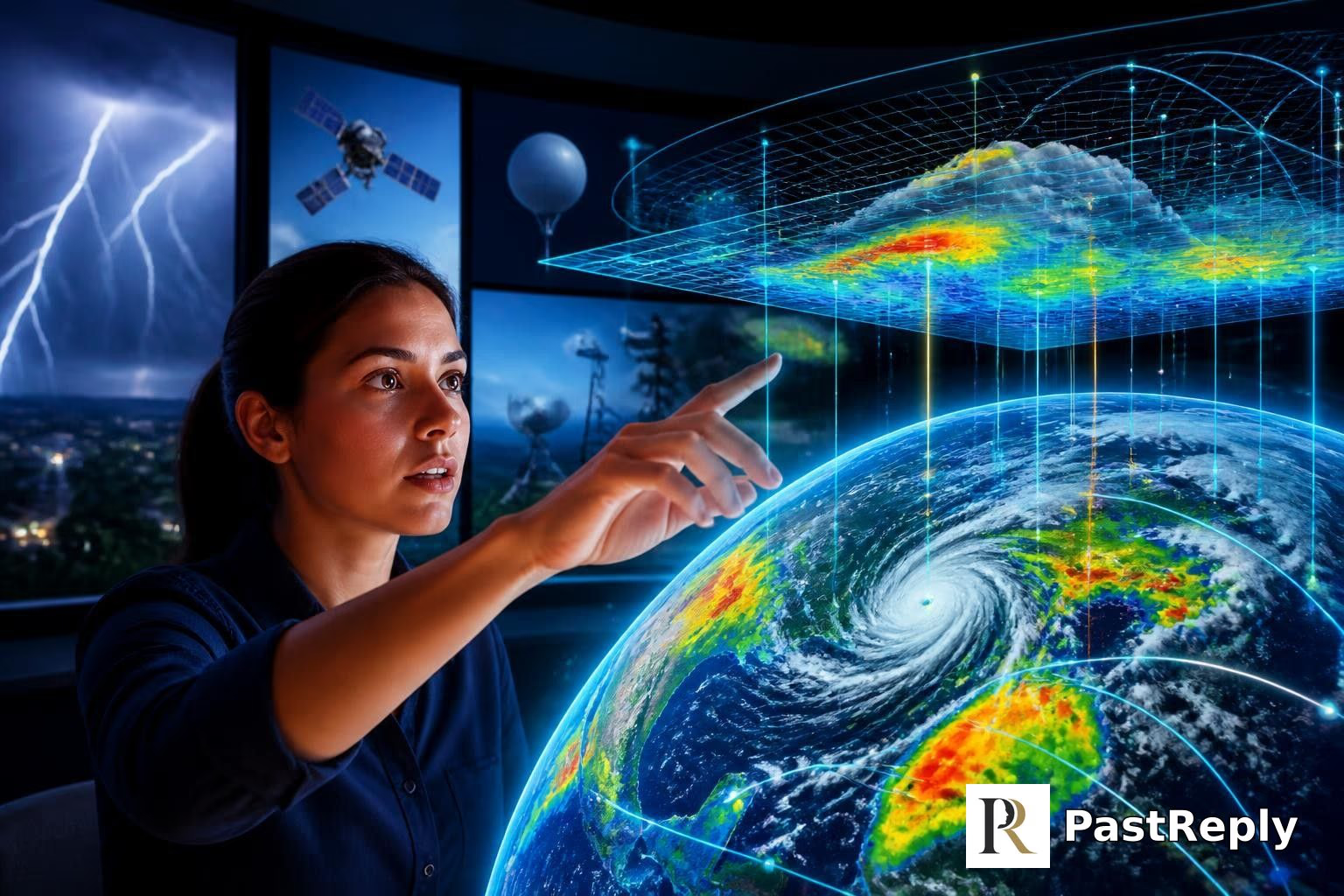
Weather forecasting works by collecting vast amounts of atmospheric data from sources like weather stations, satellites, radar, and weather balloons. This data includes temperature, humidity, wind speed and direction, and air pressure. The data is fed into numerical weather prediction (NWP) models, which are complex computer simulations that use mathematical equations to represent the physics of the atmosphere. These models divide the atmosphere into a three-dimensional grid and calculate how conditions will evolve over time, producing forecasts for specific locations.
In recent years, artificial intelligence and machine learning have been increasingly integrated into forecasting. Machine learning emulators can now match or exceed traditional NWP in some areas, especially for short-term predictions and pattern recognition. Companies like Climavision are developing advanced models that combine NWP with AI to extend forecast horizons and improve accuracy for both short-term storm tracking and long-term seasonal outlooks.
Despite advances, perfect forecasts remain impossible due to the chaotic nature of the atmosphere and incomplete initial data. Forecast accuracy is highest for the first few days and decreases for longer ranges. Ongoing improvements in model resolution, data assimilation, and computing power continue to push the boundaries of what forecasts can achieve.
Answered by 100 of history's most famous minds

You look at the sky's face - red at evening, you say fair weather; red at morning, foul. But the signs of this present hour you cannot read. You count the winds and weigh the air on instruments, yet you cannot discern the times that call for mercy. Better to read the heart's weather - for what will it profit to know tomorrow's rain and miss the Kingdom that stands at your door?

It is God who sends the winds as heralds of His mercy, bringing clouds heavy with rain to revive the dead earth. You measure the pressure of the air and track the movements of the clouds with cunning devices, yet you forget that the turning of the wind and the falling of the rain are by His leave. Read the signs of the sky, for they are among His verses, but know that the greatest forecast is this: the Day will come when no soul may say, 'Grant me respite to do good.' Prepare for that certainty, and the weather of this world will seem as a passing shadow.

They chase the wind, seeking to grasp its path, yet they cling to desires for certainty in a world of constant change. This longing itself is the root of suffering. Let them measure and calculate - it is but another attachment to the skandhas of form and sensation. Better to sit still and watch the rain fall, knowing the self that craves fair skies is itself a passing cloud.

When I led our people through the wilderness, the Lord sent manna and quail, and a pillar of cloud by day. Do these forecasters pretend to know the mind of the Almighty, who stores up the wind in His fists? Let them measure the air as they will; the rain still falls on the just and the unjust. The only forecast that matters is the covenant: obey and be blessed, rebel and be scattered.

A sage does not trust a claim that cannot be verified by the senses. These instruments and calculations - are they used with sincerity and a heart set on benefiting the people? If the forecaster acts only for his own fame, his predictions will be empty noise. Let him observe the clouds and winds with the respect due to Heaven's patterns, and let him share his knowledge humbly, as a gardener shares the signs of the season. The superior man does not boast of foreknowledge; he prepares the fields and prays for harmony.

You boast of measuring the winds and the skies, but have you measured the storm within the human heart? Your charts and numbers are as grass that withers; they cannot see the appointed hour when the heavens will roll up like a scroll. The only true forecast is that the Lord will return as a thief in the night, and no telescope nor computer will give you warning. Set your trust not on your clever devices, but on the solid rock of faith, that you may be prepared for the tempest to come.

The sky's signs are the Lord's whisper, not man's arithmetic. When I looked for a land, I followed a promise, not a wind chart. Your numbers may measure His breath, but you cannot box it. Better to trust the covenant than the cloud's shifting shape - He alone knows the rain's purpose for the righteous.

They build towers of equations to capture the wind, yet the wind knows no calculation. The sky does not announce its plans; it simply moves, as water flows around a stone. The sage watches the clouds without naming them, and the weather comes of itself. Cling to the model, and you miss the rain on your skin.

They seek to know the weather with instruments and machines, yet the One who turns the seasons is beyond all measure. The wind blows where it wills; you hear its sound, but you cannot tell where it comes from or where it goes. So it is with the Creator's will. Let them count the clouds and chart the storms, but let them not forget that every raindrop is a mercy, every harvest a gift. The true forecast is to live honestly, share your bread, and trust the Provider.

My heart magnifies the Lord who sends the rain upon the just and the unjust alike, yet even the wisest scholar cannot count the clouds. The wind blows where it wills, and we hear its sound but cannot tell where it comes from or where it goes. So it is with every true thing: we trace the patterns, but the hand of the Maker alone knows the whole.

Let the heathen and the papist trust in the learning of men, who peer at the heavens with astrolabes and reckon the wind by the turning of vanes. I say that the Lord sends His rain upon the earth, and He alone holds the keys to the clouds. When a storm comes, let a man look to his faith and his neighbor's need, not to a numbered prophecy that leaves the soul as dry as a summer wadi.

The art of forecasting is a noble application of what the Philosopher called 'the knowledge of causes.' We gather the accidents of the air - its heat, its motion, its moisture - and, by reasoning from the natures of water and wind, we deduce the form of future weather, much as a physician reads the humors of the body. That this art remains imperfect is no defect, for the sublunar world is the realm of contingency, and only the First Mover sees all with a single, eternal glance.

They look at the clouds and the wind, and they tell us if rain will come. But we do not need to know the weather to know our duty. The poor man shivering in the street does not ask for a forecast; he asks for a blanket. Let them do their calculations, but let us not forget the one who is cold today, not tomorrow. Small acts of love are the only forecast we can truly trust.

The atmosphere is a vast fluid, subject to the same laws of motion and gravitation that rule the planets. Given the temperature, pressure, and density at every point on a grid, the flux of winds and vapors can be computed through the method of finite differences - though the chaos of the system makes exact prediction impossible beyond a few days, a limitation no art can overcome without perfect initial data.

They seek to glimpse the dance of atoms and planets, yet they still miss the deeper point: the universe does not play dice, but neither does it unfold like a clock. That day when I sat in my patent office, chasing a beam of light, I knew the laws are simple and beautiful. Trust not the weatherman's numbers alone, but the serene geometry of space and time - that is the only reliable compass.

Forecasting weather is like predicting the branching of finch beaks: one must gather endless facts and resist the temptation to see more order than exists. The atmosphere, like nature's web, is a tangled bank of causes - pressure, heat, the spin of this globe - each variable a species in a shifting ecosystem. I suspect they will never achieve perfect knowledge, for the system is too complex and our eye too human.

They call it a new science, this reading of the air's temper with thermoscopes and baroscopes. I applaud the method! Nature speaks in quantities, and the diligent observer who measures and calculates will see farther than a thousand priests who recite Aristotle without looking at the sky. But let them remember: the book of nature is written in the language of mathematics. Every chart and model is a theorem of creation. Let the learned argue, and the evidence decide.

I recognize the labor: these modelers, like myself, seek the simplest hypothesis that saves the phenomena. Yet they still cling to a geocentric muddle of data, patching one epicycle after another with machine learning, while the true machinery - the sun's breath, the turning of the spheres - eludes them. They will not find harmony until they set aside partial grids and consider the whole heavens as a single, elegant clockwork. Until then, their forecasts are but refined astrology.

Your numerical models are clumsy, grinding through calculations like a hand-cranked engine. I have already visualized a perfect system: a globe-spanning network of my wireless receivers that reads the pulse of the atmosphere through resonant frequencies. Within a decade, I will deliver forecasts that see a storm a month away, and power them with energy drawn from the very air. Your computers are but a child's toy; the true machine will be the planet itself, vibrating in sympathy.

One measures the invisible with patience and precision. My radium's glow was a mystery until we questioned it step by step. Your atmosphere is far more complex - millions of variables, each a tiny radiance of fact. The models are like our early theory: crude but truth-seeking. We must never fear the chaos; we must study it, humbly, until it yields its order.

Ah, but chance favors the prepared mind! Every thermometer, every balloon aloft, every satellite eye - these are the scouts of reason. Yet the true agent is the unseen: the germ of a storm, the invisible seed of a drought. My laboratory taught me that the smallest, most neglected mote can shape the whole. So too here: a fraction of a degree, a wisp of vapor, and the whole sky turns. We must measure, inoculate, and predict - else we are blind men in a tempest.

It's all about persistence and measurement. You want to know if it'll rain tomorrow? You collect enough data - temperature, pressure, humidity - and you run it through the mill of calculation. My phonograph wasn't built in a day; it took a thousand failures. Same here. These weather models are like a million trial-and-error experiments. The more you try, the closer you get. And now they're using machines to learn from the mistakes - that's the way. There's no mystery that can't be solved by hard work and a good record of what went wrong.

Think of the atmosphere as a vast, continuous-state machine - say, a universal Turing machine with an unimaginably large tape - and the forecasting problem as predicting its next configuration. The naive approach would be to simulate every molecule, but that is computationally intractable, so we discretize, approximate, and hope the equations governing the whole are not too sensitive to the inevitable rounding errors. Of course, they often are, because the system is nonlinear and chaotic, which means we are fundamentally limited to short-term predictions unless we find a clever way to compress the state space - perhaps with a machine that learns to emulate the physics.

Given the temperature at a thousand points, the pressure, and the motion of the air, one can inscribe a grid upon the globe and, by the laws of geometry and the mechanics of fluids, calculate how each parcel of air will move. The problem is that the atmosphere is a continuum with infinitely many degrees of freedom - but we are clever with approximations, and with a lever long enough and a fulcrum strong enough, we can shift the whole Earth; but to know the weather a month hence, we would need a god's eye view of every butterfly's wing.

Consider the invisible lines of force, the way a lodestone arranges iron filings. They gather data - temperature, pressure, moisture - as I gathered the needle's trembling in a coil of wire. Then, just as I pictured the magnetic field spreading through space, these mathematicians picture the whole sky gridded like a map of London, and they let the equations push and pull the air on that grid. It is the same faith: that a hidden order, a law written into the creation, will hold true from this hour to the next.

A weather forecast is a confession of helplessness dressed up in mathematics. They collect data as a patient collects dreams, but the atmosphere, like the unconscious, is a system of hidden currents and turbulent desires no number can capture. The model's error is not a failure of science; it is a symptom of our deep wish to master a mother-nature who will always, in the end, have the last word.

Forecasting the weather is like trying to predict the path of a single atom in a hurricane. The equations are deterministic in principle, but the atmosphere is chaotic - a butterfly flaps its wings in Brazil, and a week later your picnic is rained out. We can only see a few days ahead before the errors double and double and swallow the truth. That's not failure; that's a reminder that the universe is richer than our models.

What marvel! They are not merely calculating numbers but weaving a vast web of causal relations - a poem of pressure and velocity, each point in the grid a note in a symphony. I see the Analytical Engine of the sky: the equations as punched cards, the data as the Jacquard loom's threads, weaving a tapestry of tomorrow. But the poet's eye sees further: one day, machines will not only forecast but imagine weathers that never were.

Let us define our terms. They take a set of observed things - temperature, pressure, moisture - as their given axioms. From these, they deduce the coming state of the air by rules of inference, as I derive a theorem from a postulate. But the axioms themselves are incomplete, and the deduction is bounded by the chaos of the elements. No proof can be certain when the premises shift. That is the limit of all applied geometry.

I spent years in the Crimea counting the dead - and I learned that nature speaks in numbers, not miracles. These modern forecasters take the pulse of the air with their barometers, their telegraphs from the sky, and they feed the numbers into a mathematical engine that predicts the fever of the atmosphere. It is sanitation of knowledge: we must measure before we can mend. Without the census of the wind, we are blind as the doctors who washed not their hands.

Forewarn the fleet of a sudden gale? I would station scouts on every peak, dispatch swift horses to read the cloud-veil, and order the admiral to trim sail by my command - not by some oracle of numbers. But these modern kings spin a net of glass and metal across the heavens, gathering whispers from the sky to win a day's march or a harvest. Clever, yet they still cannot master the wind. I would rather die in a storm than live ruled by a prediction.

Forecasting weather? I would have traded ten cohorts for such augury. In Gaul, I learned to read the sky like a general reads a battle: clouds massing like legions, winds shifting like cavalry. But these modern diviners drown in numbers while missing the storm's temper. Remember: fortune favors the bold - but a wise commander still checks the omens before crossing the Rubicon.

When I sought the winds for my fleet at Actium, I relied on priests reading the flight of birds and the Nile's own rhythms. But these Romans now claim to trap the sky's breath in bronze instruments and reckon its future with figures? A useful art, if one can trust the reckoner. In Alexandria, I would command such men as I command the scribes who tally the grain. Knowledge is power.

When I wished to know whether to delay the grain fleet before a storm, I consulted the augurs, as befits our mos maiorum. But if these new machines can give a general warning of the north wind's fury, I would not disdain them. Let the Greeks keep their theories; the practical man asks only: will it serve Rome? A forecast that saves a legion's rations is worth more than a philosopher's lecture on causality.

My scouts read the sky to know when to cross the Gobi or attack through the pass. These new men with their iron birds and talking boxes gather more information than a thousand scouts, yet they cannot command the wind. Information without decision is useless. Let them serve their Khan by giving clear reports: not a storm of numbers, but a single arrow pointing where to march. When the sky speaks, a leader must listen - and then act.

Forecasting weather is like forecasting a battle: you need spies - stations, balloons, those satellites - to tell you the enemy's positions, and then a general - your computer model - to plan the campaign. But no plan survives contact with the enemy, and no forecast survives the first gust of a real storm. I conquered Europe by moving faster than my foes could react; these forecasters are wise to study the sky, but they must never forget that the future is shaped by audacity, not calculation.

A farmer watches the sky to plan his planting; a general studies the clouds to move his army. Your network of observers and calculations is commendable, but humility is needed. The Almighty alone commands the storm. We in the new nation must learn to predict and prepare, yet never presume we have mastered the elements. Sound judgment, not overconfidence, guides the plow and the flag.

It calls to mind a story my father once told me, of a farmer who planted corn by the phases of the moon and swore by the ache in his leg. We've replaced that old ache with thermometers and telegraphs, and I reckon that's progress. But the honest truth is, the Almighty still holds the final card. We can read the signs He gives us - the falling glass, the scudding cloud - but no man can say for certain where the lightning will strike. Our duty is to watch, to prepare, and to help our neighbor when the flood comes.

We are engaged in a great battle with the elements, and the weapon is knowledge. The generals of meteorology marshal their brigades of data - thermometers, barometers, satellites - and deploy them against the fog of uncertainty. Yet the enemy is a cunning foe; the weather, like war, is full of surprises. A forecast is a plan, and no plan survives first contact with the enemy. The key is to keep your powder dry, your eyes on the horizon, and your spirit unyielding. We will not be daunted by a little rain - or a blizzard.

A farmer in my village reads the sky by the scatter of the birds and the smell of the earth before rain. This ancient wisdom is not scorned but absorbed by the great calculating machines that spin in distant cities. Yet I wonder: if we spent half the effort on understanding our own hearts and the hunger of our neighbors that we spend on charting the path of a storm, would we not see a different kind of forecast - one of peace?

We have learned to chart the wind and the rain with astonishing precision, yet we remain unable to forecast the storm of hatred in the human heart or the quiet dawn of justice that follows a season of suffering. Let us use all the science God gives us to protect the vulnerable from the hurricane, but let us also be as diligent in reading the moral atmosphere of our society - the rising pressure of inequality, the cold front of indifference - that we may bend the arc of the moral universe toward justice.

A forecast, like a long walk toward freedom, is never certain. They gather reports from hundreds of stations, much as we gathered the whispered hopes of a people in prison. The computer models are like a committee - disagreeing, arguing, each seeing a different path. The wise leader listens to all, then speaks not with absolute pride but with the humility of one who knows the wind may shift. The best forecast is honest about its doubt.

They pretend to predict the weather with their machines and their Jewish physics, but the weather, like the destiny of a race, is will - not calculation. A storm does not ask for permission, and a true leader does not wait for a forecast. He reads the sky with his blood, trusts his instinct, and acts. These modelers are cowards hiding behind dials. The Führer's gaze is sharper than any satellite.

The weather does not care about your five-year plan. They feed numbers into a machine, and the machine coughs up a prediction - but prediction is for weaklings. A real leader does not wait for the forecast; he changes the climate. If the harvest fails, the kulaks will be blamed. The model is a tool of control; accuracy is secondary to loyalty. The Party decides what the weather will be.

The bourgeoisie hoard their data as they hoard grain, but the means of prediction must be seized by the proletariat! These models are a tool of production - and like any tool, they serve the class that owns them. A forecast is not neutral; it tells the peasant when to plant for the landlord's profit. When the workers control the equations, the weather will serve the people, not the stock exchange.

You think the sky is a machine to be decoded by bookworms? The weather is a battlefield, as fierce as any class war. Does the peasant ask for a satellite when the typhoon flattens his hut? He asks the Party for a plan. Forecasts are nothing without the will to organize the people to fight the drought, to move the river, to seize grain from the clouds. The old scholars count raindrops; we move mountains.

One marvels at the ingenuity of man, who now peers into the heavens as if reading God’s own diary. My dear Albert would have been fascinated - he delighted in such mechanical wonders. Yet I cannot help but think: if we can foretell a storm three days hence, why can we not foresee the follies of ministers? Still, it is a comfort to know that the safety of my subjects, at sea and on land, is guarded by those brave men who send up balloons and consult their instruments. It is a proper, ordered pursuit.

I have known many a change in my long reign, but the weather remains the one subject that unites all my people in conversation. It is rather humbling, is it not, that even with all our learning and computing machines, we cannot command the wind? The forecasters do their best with their models and data, and we are grateful for the warning before a gale. But in the end, we must all carry an umbrella and trust in Providence. Duty and patience, as ever, are our best guides.

In my time, we read the sky as a gospel: red at dawn warned the shepherd, and the flight of birds told the farmer when to sow. Now you have monks who count the stars with lenses and inscribe the winds on scrolls of numbers. This is good - knowledge is a sword of the Lord. But let not the scholar forget that the storm is God’s breath, and no calculation can bind His will. Order your fields and your armies by the forecast, but keep the cross ready for the tempest.

They ask how men foretell the rain? I did not need a scholar or a glass to know when to march. My voices told me when the wind would turn and where the sun would break through the clouds of battle. These new ways sound clever, and if they save a harvest or a ship, then praise God for the wisdom He grants to men. But do not trust them more than the counsel of Heaven. The best forecast is a prayer and a stout heart.

They say the heavens can now be charted like a merchant’s ledger? I find it a fascinating sport - reducing the Almighty’s moods to numbers and dials. My astrologer Dee would have given his right hand for such devices. But let us not be gulled: the weather, like a courtier, will flatter your plans one hour and betray you the next. A wise sovereign keeps one eye on the glass and the other on the horizon, and never wagers her fleet on a fair-weather promise.

Ah, the modern mind wishes to cage the very air! I applaud the ambition. In St. Petersburg, we have long fought the winter as if it were a Tartar horde, and I would gladly trade a dozen serfs for a machine that could tell me when the Neva will freeze. But remember, my friends, nature is a cunning adversary, and she will always keep a card hidden. Use your charts and your calculations, but rule your empire with the same eye: measure twice, and trust your instincts.

When I conquered Babylon, I did not curse the sandstorm that delayed my march - I asked the Chaldean priests how the wind ran, and they showed me their tablets of stars. Now you spin the wind into numbers on a tablet of fire. This is good; a king who knows the weather knows when to plant, when to ride, and when to shelter his people. But the sky is as proud as any satrap - it will not be commanded. Use your foresight well, and treat the storm as you would a defiant tribe: with respect, and a plan for both peace and war.

The One God, in His wisdom, has made the wind and the rain both a mercy and a sign. In my campaigns, I learned to read the clouds as I read the enemy's intent: the gathering mist, the sudden squall - these were letters from Heaven. Now you have men who measure the air with cunning instruments and draw the future in lines upon paper. This knowledge is a gift, if used with humility. For the forecast is but a shadow of God’s decree; He alone knows when the harvest will come and when the storm will break. Trust the tools, but trust more in His will and in your own readiness.

Tell me, friend - when you consult this oracle of numbers and machines, do you consult it to know whether to carry a cloak, or to know what it means to live well? For if a man knows a tempest is coming but does not know whether he will be just or unjust when the rain falls, has he truly prepared? The storm within - the ignorance, the fear, the hasty judgment - those clouds you never measure. So I ask: what use is foreknowledge of the sky if you remain a stranger to your own soul?

They measure shadows on a cave wall and call it knowledge. The True Weather is a perfect Form in the realm of Ideas - unchanging, intelligible, and eternal. What they chart as wind and rain is but a flickering copy, ever shifting and impure. The philosopher king would ask: have they grasped the Form of Storm itself, or merely its fleeting image in our realm of Becoming?

The art of prognosis concerning the sky's changes proceeds by gathering the affections of the air - its warmth, its moisture, its movement - and applying the principles of causation I set forth in my Meteorology. The moderns have refined this with instruments and computations, yet the underlying matter remains: one must observe the material cause, the efficient cause, and the purpose. A well-ordered science, though no man can grasp the entire form of a future storm.

I must ask: could the maxim of relying on probabilities derived from such weather computations serve as a universal law for all rational beings? One would be compelled to act on forecasts knowing they rest on incomplete data and chaotic nature - a duty to prudence, not to certainty. The forecaster's work is a moral act: he offers a judgment that may affect another's plans, and thus he must treat each prediction as an end, not a mere mathematical exercise. Let him reason with all available data, but never pretend to omniscience.

You seek certainty from machines and call it knowledge, yet you dare not face the chaos you name 'butterfly effect' - a pretty evasion for the truth that all order is a comforting lie. The will to power expresses itself in every raging hurricane and every calm sea, not in your timid grids. Real foreknowledge would be to affirm the storm's wild necessity, to dance in its destruction, not to cringe behind a probability. You forecast only because you cannot bear the eternal return of the unexpected.

The bourgeoisie seeks to turn even the weather into a commodity, a tool for their profit. They gather data from the exploited handful of weather stations in the colonies, feed it into machines they own, and sell the forecast to farmers and sailors who cannot afford to be wrong. The real weather - the storm of revolution - they cannot predict, because it rises from the contradictions of capital itself. When the workers seize the means of prediction, then the forecast will serve the many, not the few.

I doubt the senses; the eye can be deceived by a mirage. Yet your method - gathering clear and distinct data, reducing the atmosphere to its geometric parts - pleases reason. The chaos you speak of may be a mask for unknown laws. Continue to doubt, to divide, to deduce. The truth is a machine, and we shall someday comprehend its every gear.

Forecasting is a principality of its own, and its prince is data. The ruler who controls the numbers - the temperature, the pressure, the wind - holds a sword over the harvest and the fleet. But let no one be deceived: the atmosphere, like the populace, is fickle and will not be mastered by mere calculation. A wise prince studies history, not hope; he prepares for the storm even while the sun shines, and he knows that the best forecast is the one that leaves him ready for the worst. Fortune is a woman, and she must be taken by force of preparation.

The air hath a humour, variable as a player's mood - now choleric with thunder, now weeping in soft rain. These cunning fellows have caught its pulse with glass and wire, reading the sighs of the globe as a lover reads a breathing breast. Yet for all their magic, the wind still plays the jester: it lifts a maiden's hem, scatters a harvest, or flouts their finest chart with a whim. We are but children chasing a kite, and the string - we imagine we hold it - is but a thread the sky tolerates.

Even the cloud-gatherer Zeus could not foretell the fate woven by Moira. Men now sit in rooms of stone and whisper numbers, claiming to read the sky's intent. But I sang of heroes who knew the winds as gifts from gods: a favoring breeze sent by Athena, a gale loosed by Poseidon's wrath. No tally of thermometers can match the augur's cry or the druid's grove.

When I climbed the mount of Purgatory, I felt the changing winds as a sign of the soul's turning. But these forecasters measure the sky as merchants measure cloth, forgetting that the heavens declare the glory of God. Their numbers may predict the rain, but they cannot grasp the divine comedy of the tempest, nor the justice it serves. The true forecaster is he who reads the will of the Love that moves the sun and other stars.

What a wondrous enterprise! To grasp the manifold interplay of air, water, and warmth through instruments and equations - and yet, the whole remains alive, ever-changing, resistant to reduction into mere numbers. I delight in this striving: the scientist, like the artist, must yield to the ur-phenomenon, letting nature reveal herself through patient observation and creative intuition. The true forecaster is a poet of the possible, not a calculator of the certain.

So these learned men cast their nets into the sky itself, hauling up numbers of wind and dampness, then feed them to a great iron brain that spins the future on a grid of air. It is a noble madness, no less quixotic than tilting at windmills - for who can say if the clouds will obey their reckonings? Yet I applaud the attempt; to chase the weather with such elaborate artifice is a glorious folly, and I have seen worse ways for men to spend their lives.

To predict the weather, they measure and calculate, but they forget that nature is a living soul, not a machine. A peasant’s aching joints can tell him more about the coming rain than all the instruments in the world, because he lives in harmony with the earth, not above it. The pride of these forecasters is the same pride that drives men to war - they think they can master the world with numbers, but they only grow more distant from the simple truth that we are part of the storm, not its masters.

You speak of data and grids, yet the storm inside a man's heart is far greater chaos than any hurricane. I stood on a scaffold and watched the sky - it told me nothing of my own fate. Your forecasts may save a ship, but they cannot predict the moment a soul chooses grace or despair. The real atmosphere is the human spirit, and that, you have not begun to measure.

It is a science, to be sure, but one that must bow to the caprice of nature - rather like a young lady's heart, which no amount of careful observation can predict with certainty. We may note the barometer and consult the almanac, yet the sky will still produce a sudden shower to spoil a picnic or an unseasonable breeze to carry off a bonnet. I confess I find a certain satisfaction in this; it proves that even the cleverest gentlemen cannot render the world entirely manageable, and a wise woman will carry an umbrella.

I see a thousand clerks in a vast counting-house, feverishly scribbling the breaths of the sky - the puff from a chimney, the sigh of a meadow, the roar of a gale at sea - and feeding that mountain of figures to a tireless iron engine that grinds out tomorrow's rain as if it were a banker's ledger. Yet for all their labor, the poor man's rheumatism often proves a truer prophet than all their machines.

They take the air's temperature, squeeze it, spin it, and feed it to a contraption that buzzes and hums until it coughs up a prediction that is wrong often enough to be amusing but right often enough to be believed. I knew a riverboat pilot who could smell a storm coming two days off - but he never had to apologize to a thousand readers the next morning. The difference between a prophet and a forecaster is that the forecaster gets to blame his computer.

You look at the sky, you read the barometer, you respect the sea. The models are good for three days, maybe four. After that, you ask the old man who smells the salt. A good forecast is like a clean sentence: it tells you what you need to know without any lies. The rest is luck.

I have spent many days observing how the clouds form - the expansion of moist air as it rises, the way the sun draws vapor from the earth, the patterns of wind that carve the sky. These moderns have extended my method: they measure temperature and pressure in a thousand places, then draw the future on a grid with numbers, as an architect drafts a dome. Yet the atmosphere is alive, full of subtle currents and hidden motions that resist a perfect cage of calculation. The true forecaster must be both mathematician and painter of the invisible.

I see the sculptor's hand in every cloud, the Divine shaping tempest and calm from invisible chisel strokes. These forecasters collect chaff and straw, measuring the moisture of the air, but they forget: the weather is a fresco painted by God's own fingers. I have lain on my back on the Sistine scaffold, watching the sky's ceiling - it is alive with purpose, not numbers.

I have seen the sky writhe with crows before a storm, and I have painted it - not as the eye sees, but as the heart feels. These people with their dials and wires, they think they can catch the wind in a cage of numbers. But the whirlwind that bends the cypress is not tamed by calculation. Let them keep their charts; I will keep the fierce, beautiful truth of the weather on my canvas.

Forecasting? You assemble a thousand fragments - satellites, sensors, grids - then break them apart and reassemble them into a new truth, like a Cubist painting. The old forecasters drew clouds from memory; now you cut through the atmosphere with algorithms. It is a magnificent destruction of the obvious, but do not think you have captured the beast: the storm, like a woman, does not wish to be predicted. She wants to be seen, anew, each time.

They catch the light itself in their instruments, I am told - the trembling of the air, the weight of the clouds - and then they try to fix it in a string of numbers. But weather is not a number; it is a feeling, a shimmer on the water, the way the mist softens the haystack at dawn. I would rather sit and watch it change than trust any prediction, for the true forecast is the one the sun writes with its colors across the sky.

See how the light falls on a face, how a cloud passes and the whole shadow changes? That is the painter's daily study - the fleeting moment of atmosphere. You describe your instruments as measuring the air, but you still cannot capture the way sunlight breaks through a storm, that instant of gold and hope. Your numbers may predict rain, but they cannot paint the soul of a weather.

My weather is the pain in my bones, the sun of my garden, the blood of my Mexico. Your numbers are cold and foreign; they do not feel the clouds that press on my chest. I paint the sky as I live it - broken and bright, screaming with color. You can predict a storm, but you cannot forecast the tears I cry alone. That is my true weather.

Forecasting weather? Bah - it's like composing a symphony without knowing the key! Those clever fellows feed the sky's numbers into a giant music box, and out comes a tune - sometimes a cheerful allegro, sometimes a stormy adagio. But the sky is a capricious prima donna: she may follow the score for a day, then suddenly improvise a cadenza that leaves all their calculations flat. I prefer to trust my own eyes: if the birds sing low and the air smells of rain, I carry my cloak. If the wind is from the south, I open the window and let in inspiration!

Forecasting! Ha! These forecasters reduce the storm to data points, as if the wind's passion could be tamed by a logarithm. When I wrote the 'Pastoral' symphony, I felt the thunder within my own skull, the rain a pounding rhythm no machine can capture. Let them compute - I shall compose the true weather, the music of the elements, and deaf ears will not stop me.

When I composed the St. Matthew Passion, I set each voice in its proper time and key, so that the whole moved as a single prayer. These forecasters likewise must have their ground bass - the laws of the atmosphere - and their fugue of measurements. Their work, if done in skill and humility, may be a harmony of knowledge. But without the fear of God, even the perfect fifth becomes a dissonance.

Well, shoot, I just look up at the sky and say, 'Lord, what are You fixin' to send us?' But these fellas with their computers and radar - they've got a gift, I reckon. Back home in Tupelo, we'd watch the clouds and smell the rain coming. Now they tell you down to the minute. Still, you can't put God in a box, can you? Sometimes the best forecast is to just feel the rhythm and roll with it.

Making weather forecasts is like choreographing a dance, you see? All these beautiful instruments - the satellites, the balloons - they are like the dancers, each moving in harmony. And the computers, they are the music that brings it all together. But there is still a little mystery, a little unpredictability, like a moonwalk across the clouds. I think that is what keeps it exciting - the surprise, the wonder that you can never completely control the rhythm of the world.

We tried to forecast the weather once - got it all wrong, but wrote a song anyway. You lot with your computers and satellites are like that bloke with a barometer: still guessing, but with fancier gadgets. Why not just look up? The sky's been telling stories for ages, and it's a laugh to watch you try to write its next chapter.

The wind's just a whisper of what's coming, like a friend who won't tell you the whole story. Some folks try to catch it in a cage of numbers, but it slips through the bars. You can stand at the crossroads and feel which way the dust is blowing, and that's enough for a song, maybe for a day. The rest is just guessing at the shape of the clouds.

I think of weather forecasting like writing a bridge in a song: you have all these different instruments - data, satellites, old farmers' tales - and you're trying to figure out what comes next. But the magic is that sometimes the melody surprises you, even when you've plotted every note. I love that we're getting better at it, using AI like a collaborator who helps us see patterns we'd miss. But there's still that moment when the rain hits your window, and you just have to feel it. The forecast is a story we're telling together.

When I sailed into the unknown, I read the sky with my eyes and the wind with my skin, trusting the Lord to guide me where charts feared to draw. These moderns spin a web of glass and iron that catches whispers from the clouds - they say they can see a storm three days hence and warn the farmer. It is a wonder, I grant, and a gift of the Almighty. But no machine can read the signs of God's will or the path to new lands. I would still rather trust a steady hand on the tiller and a prayer on the lips than a thousand needles trembling on a dial.

In Cathay, the wise men of the Khan read the weather by the flights of cranes and the scent of the Gobi wind, yet they also used bronze instruments that spun like our astrolabes. I have seen the monsoon rise over Hormuz, and the merchants of Samarkand who could smell a sandstorm days away. These modern devices are wondrous, but the best forecaster is still a traveler's eye and a camel's nose.

I set my course by the stars and the feel of the wind, trusting God and my own eyes. Now they claim to read the weather from faraway towers and speaking stones? If such arts had been ours in the Strait, I would have saved a ship or two. But no instrument can replace the courage of a man who looks into the gale and holds his course. The sea still keeps her secrets.

We owe every forecast to a chain of quiet competence: the engineer who calibrated the barometer, the programmer who ran the model, the technician who launched the balloon. At Mission Control, we learned that one sensor glitch could rewrite the trajectory. The atmosphere is no less unforgiving than space - chaotic, non-linear, always revealing new layers. We have not tamed it; we have only learned to listen more carefully.

When I flew across the Atlantic, I could not just look at the sky and guess; I had to know what the wind and clouds would do, or they might swallow me and my plane. I envy these forecasters their tools - those satellites and computers that can see a storm a thousand miles away. But even now, the weather is a wild thing, and the pilot who trusts the forecast too much is a fool. The sky teaches you humility, and no model can replace the feel of the wind on your face.

From up there, you see no borders, only the whole blue marble. Your forecasts are like that view - humble attempts to read the same sky that cradles us all. I recall watching a typhoon from orbit; its beauty was terrifying, and our models were just whispers against its roar. We build sense from signals, but the cosmos keeps its secrets.

Weather forecasting? It's a data problem - the biggest one humans ever faced. For decades, we tried to brute-force it with supercomputers crunching equations, and we got okay results. But the real breakthrough comes when you stop treating the atmosphere like a machine and start treating it like a pattern. AI doesn't calculate every molecule; it learns the sky's habits, the way a great designer learns a material. The future of forecasting isn't bigger grids - it's elegance. It's a model that sees the storm like a painter sees a face. And that changes everything.

You want to know how weather forecasting works? First principles: the atmosphere is a chaotic fluid governed by Navier-Stokes equations. You solve them numerically on a grid, but the butterfly effect limits predictability to weeks. We're building a better model at Tesla - using real-time data from every car's sensors to train a neural network. The goal? Global, granular, real-time weather. And then we'll forecast Mars dust storms. The physics is the same, just thinner air.

You know, I've always said that what you focus on grows. And these forecasters? They're focusing on the patterns of the universe, and that attention is teaching us to see the invisible. It's like a spiritual practice - being present to the data, trusting the process. But here's the thing: even with all the satellites and supercomputers, the weather still has a way of surprising us. That's the beauty of it. We're not in control; we're in relationship.

Float like a butterfly, sting like a bee - that's what the weather does, man! They got computers crunching numbers like a heavyweight champ crunching jabs, but the atmosphere's a dancing partner you can never pin down. I faced Sonny Liston with a prophecy, but I didn't have no machine - I had faith and a good right hand. These forecasters got science, sure, but they better stay humble, 'cause the sky's the greatest heavyweight of all.

Forecasting the weather is like predicting where the ball will go in a game. You have all the data - the players, the positions, the wind - but sometimes the ball does something magical, something no one expected. I respect the science behind it, the hard work of all those people studying the clouds. But I think the joy is in the uncertainty, in the moment when the forecast is wrong and the sun comes out, like a beautiful goal that no one saw coming.

Imagine if we could forecast the weather with the same magic as animating a storm on the screen - make it dance and sing! Your computers and grids are fine, but real forecasting needs wonder. When I sent Snow White into the woods, I didn't calculate the wind; I felt it. You must dream the data into a story that helps people trust tomorrow.