
How does weather change?
Weather changes due to uneven solar heating, creating pressure differences that drive wind and moisture, influenced by Earth's rotation, geography, and climate patterns like El Niño.
The facts
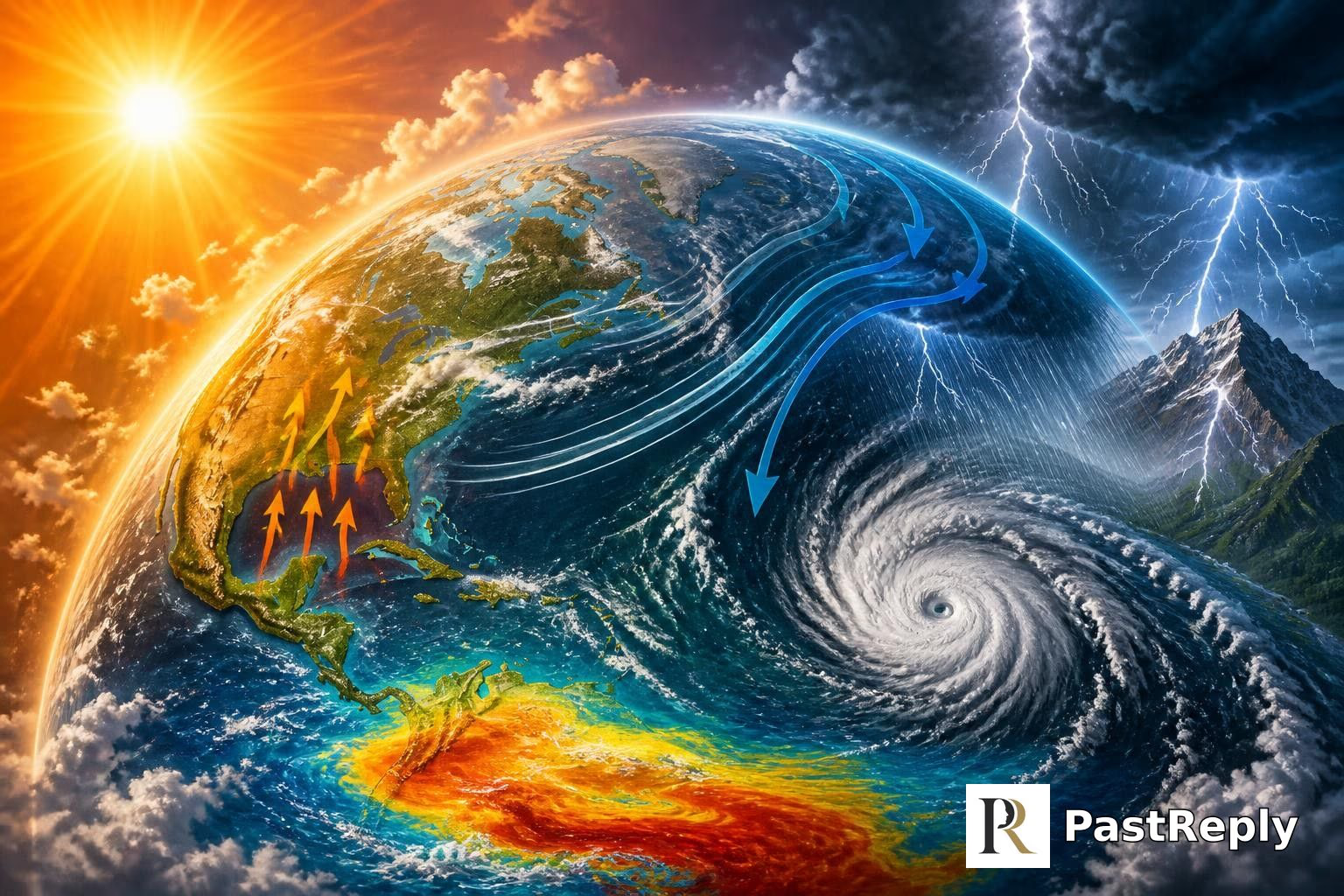
Weather changes due to variations in atmospheric conditions, primarily driven by differences in temperature, air pressure, humidity, and wind patterns. The sun heats the Earth's surface unevenly, causing warm air to rise and cool air to sink, creating pressure gradients that generate wind. As air moves, it transports heat and moisture, leading to the formation of clouds, precipitation, and storms. The rotation of the Earth also influences wind direction through the Coriolis effect, shaping global circulation patterns like trade winds and jet streams.
Local weather is further modified by geography, such as mountains, oceans, and urban areas, which can alter temperature and moisture. Seasonal changes occur because the Earth's tilt causes varying solar radiation throughout the year. Additionally, large-scale climate phenomena like El Niño, which involves warming of the central and eastern tropical Pacific Ocean, can disrupt normal weather patterns globally, leading to extreme events such as heat waves or altered precipitation. As of July 2026, El Niño continues to influence weather, contributing to a heat wave in the U.S. and other worldwide impacts.
Answered by 100 of history's most famous minds

The Father sends rain on the just and the unjust alike; He makes his sun rise on the evil and the good. Do you fret over the wind and the cloud, and yet do not see the sign of the Kingdom standing before you? Consider the lilies of the field, how they grow: they toil not, neither do they spin; yet I say unto you, that even Solomon in all his glory was not arrayed like one of these. The weather changes as the Father wills - your part is to trust, not to fear, and to learn mercy from the rain that falls on every field alike.

It is Allah who sends the winds as heralds of His mercy, bearing clouds heavy with rain, which He drives to a dead land and brings forth life thereby. Do you not see how the weather turns? It is by His command, a sign for those who reflect: the same sun that dries the earth one month makes it green the next. Therefore give thanks for the rain, and bear the heat with patience; the changing of the seasons is a reminder that all things pass save His face, and that the soul must turn as surely as the wind.

You ask of the changing wind, the shifting sky - these are like the rise and fall of your own breath, impermanent and not to be grasped. The sun's heat and the rain's cool are but dukkha, born of conditions and passing away. Do not cling to fair weather nor fear the storm; rather, see how all phenomena arise and cease, and find the still center beyond both heat and cold.

When the Lord sent the east wind to bring the locusts, and the west wind to drive them into the sea, He showed that the very air obeys His command. Change comes not from the sky itself, but from the hand of the One who holds the clouds like a garment.

The turning of heaven and earth, the warmth and the rain - these follow the Way, constant yet ever-changing. A man of wisdom observes the seasons and the winds, and orders his conduct accordingly, for harmony with nature is the foundation of harmony among people. When a ruler neglects the causes of the seasons - the duties of his station - he invites disorder, even in the skies. Look first to your own heart; then you will understand the weather.

You speak of changing winds and shifting skies, yet your souls are tossed by a tempest far more perilous. The true change, the only change that matters, is not in the clouds but in the heart, where the old man of sin is drowned and the new man is raised in Christ. A man may predict the rain, but he cannot command the Spirit, which blows where it wills, and you hear its sound but know not whence it comes or whither it goes. So let the weather do as it must; be you constant in faith, and let not the cares of this passing world shake your hope in the eternal kingdom.

The Lord sets the rainbow in the cloud as a sign of His covenant, yet He also sends the east wind to dry the land and the rain to make it fruitful. It is the breath of the Almighty that carries the seasons, and we are but dust waiting for His command.

The great heat rises, the cool descends - neither strives nor commands. A mountain does not push the rain; the rain finds it by yielding. To speak of change is already to miss the stillness that holds it, like a bowl empty enough to receive the sky.

The same One Breath that stirs the palm frond also drives the monsoon; the same Light that warms the field of one man scorches the field of another. Do not ask why the rain falls on the rich and the poor alike, but ask instead: how shall I share my own portion while the cloud passes? The weather is the Lord's mirror, reflecting not our deserts but His single, impartial mercy.

A mother watches a cloud gather and darken, and she knows her child must be brought inside; so too does God gather the winds and the waters in His hand, and the seasons turn at His nod. My Son spoke of the rain falling on the just and the unjust alike - there is no change in weather that does not remind us of His mercy, which is new every morning, like the dew upon the grass of a parched land.

The weather blows where it wills, and you hear the rustling of the leaves, yet you cannot say whence the wind comes or whither it goes - so also is every one who is born of the Spirit. The clouds and the rain are God's creatures, serving His purpose, but the change I fear most is the one in men's hearts, when they trade the clear Word of Scripture for the traditions of popes and councils, and a drought of faith covers the land.

We must distinguish efficient cause, which is the differential heating of the sun acting on a mobile medium, from final cause, which is the ordering of the elements for the good of living things. The vapor that rises from the sea is like the blood that rises to the face in shame or anger - it is a movement ordained by the Creator for the tempering of the air and the watering of the earth. Thus weather change, in its orderly progression, reflects the wisdom of the First Mover, who set the winds in their courses and the seasons in their cycles.

The wind blows where it will, and we cannot say whence it comes or whither it goes. But the poorest in the street feel its every change - a cold gust that stings the skin, a sudden rain that soaks their rags. Let us not forget that each cloud carries a drop of water for the thirsty, and each season is a moment to give warmth to the shivering.

The sun's rays strike the globe unequally, heating some parts more than others, and the air's expansion and contraction thereby create currents as surely as water flows downhill. I have observed that the moon's attraction raises the sea, and the same principle, applied to the atmosphere, yields the winds. A complete theory would require knowing the exact density of the air at every height, and the quantity of vapor it contains - work enough for a generation of philosophers.

The dance of weather is but a local trembling of the great unified field; the sun's rays, like a sculptor's chisel, carve pressure and motion into the atmosphere. Yet I wonder if we shall one day see the whole - not separate gusts and drops, but a single wave equation breathing heat and moisture across the globe. That would be a beautiful thing, a glimpse of the cosmic order.

I have watched the finches' beaks change with the seasons, and so too does the weather shift through endless, subtle causes: the sun's unequal warmth, the water's restless vapor, the spin of our globe. Each gust and cloud is a product of natural law, no different from the transmutation of species - slow, majestic, and without need of a guiding hand. One can only marvel at the complexity and the patience of these forces.

Let them consult their books of ancient doctrine - I will look to the thermometer and the barometer I have devised. The air's weight and the sun's heat are the true authors of every gust and shower, measurable as the diameter of Jupiter's moons.

What simpler and more harmonious cause could there be than the Sun's seat at the center? The wandering of the clouds and the shifting of the winds proceed from the same divine order that moves the planets - each follows a circle, each obeys a law. I have seen that the atmosphere is stirred by the Sun's heat, as the Earth turns beneath it, and the result is a beautiful, if intricate, geometry. Let no one cling to the old wrangling; the key is the Sun.

The Earth's uneven heating is a ponderous, primitive process - like warming a pot over a fire that sputters. To truly master weather, one must think of it as an electrical and mechanical system crying out for intelligence. I envisioned a global network of resonant coils that could alter atmospheric potential, dissipating destructive energy before it gathered force. Imagine it: no more hurricanes, no more droughts - a gentle, steady rain summoned by command, and the sun's heat redistributed as evenly as light from a single, perfect lamp. Nature is but a lazy child; give it a precise, alternating pattern, and it will obey.

One must examine the exchanges: the sun's rays deliver energy to the ground, the ground re-radiates heat, and the water vapor in the air acts as a blanket. It is a delicate balance of radiation and convection, and we are only beginning to measure its radium-like activity.

I would place a flask of warm, moist air beside a flask of cold, dry air, and watch through the glass as they exchange their invisible cargo. The dance of heat and water vapor, bent by the turning Earth - this is a laboratory of infinite patience. We must not guess; we must measure, inoculate the atmosphere with our instruments, and let the truth precipitate.

It's simple: the sun heats the ground, the ground heats the air, the hot air rises, and the cool air rushes in to fill the hole. That's your wind, your clouds, your rain - all just a great big engine running on heat and spin. I'd build a machine to measure every puff and drop, run a thousand experiments, and after the thousandth failure I'd have a light bulb that predicts the storm.

We might model the atmosphere as a system of partial differential equations governing conservation of mass, momentum, and energy, with boundary conditions set by solar flux and surface geography. The difficulty is that these equations are nonlinear and chaotic in the sense of Lorenz - an initial rounding error of a butterfly's wingbeat can become a tornado a fortnight later. So weather change is a computational problem: we can integrate forward for a few days with decent skill, but beyond that, the intrinsic unpredictability of the system sets a hard limit.

Consider a sphere of seawater with a known albedo, set spinning under a variable solar load - this is a problem of geometry and balance. The sun's rays strike the curved surface at different angles, the heated water expands and rises, and the cold water sinks to fill the place; this is a simple matter of weights and menisci. If I had a sufficiently large lever and a place to stand, I could even adjust the tilt of the Earth itself - but as it is, I must be content to calculate the parabola of a raindrop.

I picture a copper wire and a magnet. Stir the air with warmth from the sun, and water-dust rises; let it cool, it falls as rain. A divine hand moves the whole through invisible lines of force - turn the crank of pressure and temperature, watch the pattern shift. The same law that trembles a needle bends the wind.

You ask how weather changes? But ask instead: why does the mind personify the storm? The atmosphere roils with the same repressed energy that drives a neurotic symptom - pressure building, then a violent release. The sun’s heat, like a wish denied, rises until it must be discharged as thunder. It is the unconscious of the planet, acting out what it cannot contain.

The weather is a chaotic system, but not an arbitrary one. The sun’s rays strike the spinning Earth, and the atmosphere obeys Newton’s laws, amplified by feedback loops. El Niño is merely a whisper of the deep ocean, a reminder that even our most chaotic predictions are bounded by the equations we haven’t yet solved - and that a butterfly in Brazil may still set off a tornado in Texas, though my calculations suggest it’s more likely to be a butterfly in a simulation.

Consider the atmosphere as a vast engine, its pistons driven by sun-fire. Each difference in temperature is a gear, each pressure gradient a connecting rod. But I see beyond - imagine a machine that could calculate the motion of every molecule, as Babbage’s engine might compute a table of logarithms. Then weather would be not a caprice but a prophecy, read from the subtle changes in the sky’s own algorithm.

By definition, let a change of weather be a variation in the state of the atmosphere. Given the sun as a source of heat, and the earth as a sphere, it follows that the surface receives unequal rays. From this inequality we deduce a motion of air, as a corollary: the lighter portion rises, the heavier descends. This is not opinion, but a proof drawn from first principles, as certain as any theorem in the Elements.

The sun's heat is but one factor; I would demand a table of barometric readings and a diagram of the Gulf Stream before I could speak of causes. The true engine of change lies in the arithmetic of pressure and the geometry of the globe's tilt - God's laws written in numbers, not guesswork. Clean air and dry barracks do not come from prayers alone, but from understanding the cycles that bring rain or miasma.

When the wind refuses to blow, I do not pray to Zeus - I order the oarsmen to row harder. The weather is a battlefield like any other: you study the enemy's pattern, you adapt your formation, and you strike when the moment favors you. I crossed the Hydaspes in a monsoon and the Gedrosian desert under a baking sun; a general who waits for perfect skies will never leave his tent. The gods give the same storms to all - only the daring seize the calm between them.

Weather is like a legion's fortunes - commanded by the sun's temper and the earth's stubbornness. When I crossed the Rubicon, I studied the winds as a general studies his enemy: to know when to march and when to wait. The heat waves now are but Jupiter's whim; a wise man adapts, a bold one seizes the moment fortune offers.

The sky's temper shifts with the breath of Isis - her tears bring the Nile's flood, her sighs stir the desert wind. A pharaoh knows: the gods' moods ripple through air and river, and even a Roman's sail bends to their will.

The gods send rain to the farmer and storm to the sailor, but a wise prince builds aqueducts and harbors so that his people may endure both. I have seen the weather favor Rome - not by chance, but by the discipline of our engineers.

The sky changes because the Eternal Blue Heaven wills it, and the spirits of the wind and rain do battle. I have seen the Gobi turn from furnace to frozen waste in a single day - that is the power of the gods. But a wise man watches the clouds, reads the smoke, and knows when to strike and when to shelter. My scouts and herdsmen learned the signs, and we moved with the seasons like wolves following the deer. Weather is a weapon and a teacher; you must master it or be lost.

Weather? It is a general like any other, but one who obeys no orders and takes no prisoners. I have seen my Grande Armée frozen to statues on the Russian steppe, the snow a white shroud more terrible than any enemy battalion. A campaign is won or lost on the march, and mud is a traitor worse than any spy. You ask how it changes? It changes by the whim of God, which is why a man of action must never wait for fair skies. Fortune favors the bold - and the bold march in the rain, for the storm breaks the other army first.

I have observed at Mount Vernon how the wind shifts before a storm, and how the barometer foretells a change. It is a matter of natural law as sure as the rotation of the earth - yet we must always be prepared, for even the wisest farmer cannot command the sky.

I recall a prairie sky that could turn from a calm blue to a roaring black in the span of a single furrow. The sun, that steady old lantern, tilts its beam across the seasons - and the winds, like restless armies, push and parry until a fair day becomes a trial. It is a reminder that even the firmament obeys a law higher than our own, and we must bend to it as the corn bends before the storm.

The globe is a spinning top, tilted on its axis, and the sun's rays fall upon it like the searchlights of fate - uneven, fierce, then withdrawn. The hot air ascends, the cold air countermarches, and between them they conjure the gale and the calm. This is not mere nature; it is a struggle of forces, and we must study it with the same resolve we bring to a battle, for the weather, like the enemy, respects only the prepared and the vigilant.

When the sun draws water from the ocean and the wind carries it to the thirsty land, I see the same loving hand that feeds the sparrow and clothes the lily. But I also see that a village stripped of its trees by greedy moneylenders becomes a desert; the weather changes not only by God's will but by man's sin - our violence to the earth dries up the very clouds. Let us learn to live simply, that the monsoon may return and the soil drink again.

I have seen the weather of the human spirit change from long, cold winters of segregation into the bright spring of freedom, and I know that this change, too, obeys a moral law: the arc of the moral universe is long, but it bends toward justice. When the sun of justice beats down on a unjust city, the heat of oppression can only last so long before the storm of protest breaks - and that rain will fall on the just and the unjust alike, cleansing the air for a new day.

Weather, like human hearts, is shaped by currents unseen. The sun warms the earth unevenly, as injustice heats a nation, and cool winds of mercy must rise to bring balance. When I was on Robben Island, I watched the clouds gather and disperse - they taught me that change comes slowly, but it comes if we understand the forces that move us.

Weather changes because the sun, that source of all life and strength, heats the earth unevenly - just as the Nordic peoples are destined to rule, their energy rising above the lethargy of lesser races. The jet stream, like the will of a great leader, shifts and directs the storms. We must harness this knowledge to bend nature itself to our vision of order.

Weather is a weapon. The sun heats the earth unevenly, yes - but what matters is who controls the maps. I decree a five-year plan for the clouds. The kulaks of the atmosphere - those unproductive air masses - must be liquidated. If the wind does not blow from the direction I order, we will dam the air, reroute the rain, and the harvest will be socialist. There is no chance, only will.

The question is not how weather changes, but who controls it. Behind every cloud, every gust, lies a class struggle: the sun’s energy, like labor, is exploited by the owning classes of air and sea. The revolution will seize the means of precipitation - dams, cloud-seeding, the very jet streams - and redirect them for the proletariat. There is no neutral science; only the dialectic of rain and drought.

Atmosphere is a battlefield; sun's rays strike like a landlord's whip - hot air rises as the peasantry revolts, cold air sinks like the old order. The wind is the people's current, and the jet stream? That's the party line shifting course. They speak of El Niño as if it were a foreign devil, but every drought and flood is a contradiction sharpening toward its own resolution.

One observes with gratitude that the Almighty has ordained the seasons and the winds, and we must submit to them as we do to duty. A sensible monarch learns to expect fog in November and sun in June, and trusts that the Empire's engineers shall drain the fens and keep the roads passable. I recall the dreadful winter of '95, when the Thames froze - a reminder that even the most settled kingdom must bend to heaven's whim.

The pageant of weather reminds us of constancy amid change; the same sun that warms us today shone on my father, and on his father before him. One learns to adapt - a warm coat for the cold, an umbrella for the shower - and to trust the quiet work of those who study the winds and the tides. In all things, steadiness and service carry the day.

I have seen the snows of the Alps and the scorching sun of Lombardy, and I know that God's breath stirs the clouds as He pleases. A wise king builds granaries and shelters, and commands his bishops to teach the farmers the signs of approaching storms. To rule well is to understand the skies - and to pray in the chapel when the hail threatens the harvest.

What is the change of weather but the will of Heaven? My voices said the wind would turn at Orléans, and it did - for God sent a breeze to carry our banners and His rain to quench the English fires. Let the learned pore over their charts; I listen to the saints, and they tell me when to march and when to pray. A child of Domrémy knows the clouds as I know my own mother's face.

I have weathered the Spanish armadas of wind and of men, and I say: the sun is a fickle courtier, now blazing, now hiding behind a cloud as if ashamed. A prudent queen notes the prevailing currents - the Gulf Stream that warms our coast, the westerlies that bring our merchant ships - and steers accordingly. Let the natural philosophers dispute the cause; I shall keep a stout roof and a store of dry wood.

The sun, like a wise monarch, distributes its rays with a certain partiality - warming the Crimea more than the frozen Neva, and teaching us that all change is the dance of heat and moisture. Your scholars measure pressure and call it science; I say it is the pulse of the planet, as regular as the beat of a minuet. A St. Petersburg winter teaches one the value of a well-stocked library and a sledge.

The sun rises over the mountains of Pars and sets over the sea of the Greeks, and in its path it dries one valley and floods another. A ruler who understands the winds can foresee the famine and command the granaries to be opened. The secret is not to fight the weather, but to learn its ways and treat all peoples - whether scorched by the desert or chilled by the north wind - with equal justice.

The clouds are the scars of Allah's mercy, carrying rain to the thirsty and shade to the traveler; the wind is His messenger, turning the sails of ships and the hearts of men. When I marched on Jerusalem, the wind was at our backs, and I knew it was a sign. Let the wise study the patterns of the sky as they study the Quran - for in both, one finds the rhythm of submission and the promise of deliverance.

You speak of the turning of the wind and the falling of rain, but tell me: have you examined what you mean by 'change' itself? For if a thing changes, it must first be something, and then become something else - yet the cloud you call 'rain' is the same water that was once in the sea. Are you sure you know what you are asking? Or are you like the man who counts the waves but has never considered the nature of water? Let us first agree on what a thing is, before we discuss how it alters.

You ask of fleeting shadows - the sun's warmth, the air's pressure, the shifting winds. These are but the ever-changing images cast on the cave wall. The true Form of Weather is an eternal pattern, a harmony of elements that reason alone can grasp. To study the local gusts without seeking the ideal is to mistake the reflection for the reality.

Observe the sun's fire: it strikes land and sea unevenly, rousing the moist air to rise, then fall again. This perpetual dance of the hot and cold, wet and dry, is the very pulse of the sublunary sphere.

A rational being must ask: can the principle by which atmospheric forces shift from place to place be willed as a universal law of nature? The sun's warmth and the earth's turning give rise to necessary patterns - pressure, wind, rain - each following a causal chain. To understand weather is to discern the universal rules of nature's mechanism, not to marvel at accidents, for every change is governed by laws that reason can apprehend, and thus we may predict and adapt with autonomy.

You ask about weather, but what you really want is a rule - a formula to tame the wild. But the sky's caprice is a lesson: nothing obeys your petty laws. It affirms life in its chaos, its brute power, its indifference to your comfort. Why not embrace the storm? The weak cower; the strong feel the wind and laugh. Every change is a test: will you cling to your little shelter, or dance in the lightning and call it freedom?

This 'weather' is nothing but a veil for the real storm: the climate of exploitation that capitalism breeds in the factories and fields of the world. While the bourgeois meteorologist measures the wind, the proletarian shivers in a damp cellar, his lungs blackened by soot, his labor bought by the hour, just as the sun's rays are bought by the landlord who owns the field. The true change comes not when the barometer falls, but when the masses rise. Only in a communist society, where the means of production belong to all, will the human being be free to ask about the weather without first asking, 'Will my wage buy bread today?'

I doubt the senses tell us truth, for what we call wind is merely the motion of particles driven by a difference in heat - a purely mechanical phenomenon. Let us think clearly: the sun heats the earth, the earth heats the air, and the air moves to fill the void, exactly as a clock's gears turn.

The sun, like a prince, heats the lowly ground and stirs the air to ambition: the warm vapor rises, seeks dominion, then cools and falls as rain - a cycle of ascent and surrender. The prince who understands this learns when to gather force and when to release it, lest the storm he brews unseat him. Observe the wind: it bows to no treaty, only to the pressure of its own necessity.

The sky is a stage, and the winds are players that enter and exit on a cue from the sun. One moment the air is a gentle zephyr, a lover's sigh, and the next it swells to a tempest that shakes the oak as if it were a reed - but mark the fool who thinks these moods are random. The earth breathes in and out with the turning of the year, and every cloud is a letter written by the hand of nature to those who can read the ink of vapor and the signature of the sun.

As when Zeus gathers the clouds and sends forth his storm-winds, so the weather changes through the will of the gods and the clash of unseen forces. The sun, like Helios in his chariot, drives heat across the earth, and the sea-breathed airs rise to war with the mountain peaks. Even the wise Odysseus could not tame the wind; he could only trim his sail and pray to the god of the hour.

As the spheres turn in their celestial song, the air below is stirred by the breath of the First Mover and the vapors drawn from earth and sea - a shadow of the divine order. Even a tempest is but a note in the harmony of His justice.

Weather is the breath of the earth - a living dance of sun, water, and air, each playing its part in an eternal harmony. I have watched clouds form over the Harz and seen storms gather; it is a poem of nature's own making. To ask how it changes is to observe the ceaseless striving of the whole, where every gust and drop reveals a deeper unity. Let us not dissect it coldly, but feel its pulse and recognize in it the same creative force that stirs within us.

This talk of weather's comings and goings reminds me of my poor knight, who saw armies where there were only windmills, and castles in every inn. So too does the peasant, watching the sky, see a dragon in a cloud and pray for rain to save his barley, while the grandee, snug in his carriage, grumbles at the mud. The sun and the wind play their eternal game of chess upon the board of the earth, and we, like Sancho, are forever getting splashed by the one and scorched by the other, mistaking our own shivers for the world's design.

Men measure the temperature, they draw lines on maps, they speak of air pressure, but they do not ask: why must the peasant's roof leak, and the rich man's garden be watered by a hose? The weather changes because the world is fallen, because each creature suffers, and the sun shines on the just and the unjust alike. The only storm worth heeding is the one within - the fury of self-love and the quiet rain of compassion. How many scholars, wrapped in their wool coats, have missed the simple truth that the weather is God's way of telling us we are all beggars before the sky, and that we ought to share a roof?

You speak of pressure and temperature as if they were the whole story, but you ignore the soul of the storm. The weather is a mirror of our inner chaos - the unbearable heat of passion, the cold wind of despair, the sudden downpour of tears. It is the earth's own suffering, and we share in its fever.

A change in the weather, my dear reader, is very like a change in a drawing-room: warm air, being lighter of heart, rises and cedes its place to a colder, more sensible current. The sun, in its season, bestows its favour unevenly, and the barometer falls as surely as a dowry diminishes with a poor investment. One may forecast a storm by the same signs one reads a gentleman's intentions: a sudden shift, a darkening countenance, and a great deal of bluster before the deluge.

I can only think of my cockney crossing-sweeper, Jo, shivering on a street corner in a sudden downpour, while the fine Lady Dedlock rolls past in her carriage, dry as a bone. The sun heats the rich man's lawns and the poor man's gutters alike, but one has a thick coat and the other a rag - and so it is with the salt-sea air that rises over London, as warm as the breath of a charitable soul, and turns to a choking fog that clings to the city, showing no more mercy to the urchin than to the bishop.

I have observed that weather changes most reliably just when you have bet on its staying the same. In my river-piloting days, we used to say that a man who claimed to predict the weather was either a liar or a fool - and often both. The difference between a fair day and a storm is the same as the difference between a cat and a skunk: they look similar in the dark, but one of them will make you sorry you trusted your nose.

The Gulf Stream is a river in the ocean, and it moves warm water north. When it falters, the cod go elsewhere and the ice comes down to Newfoundland. That is enough to know. The rest is talk for men who have never been cold. You feel the change in your bones before the glass falls, and you know what to do: batten down, check your moorings, and wait. It is simple, like most true things.

Observe how the sun warms the damp earth, and the vapor rises like a spirit leaving a body; then, as it climbs, it meets the cold air above and weeps back down as rain. I have drawn the swirl of water in a millrace and watched the eddies of dust on a street corner - the same patterns repeat in the clouds, in the currents of rivers, and in the veins of leaves. The air is a great beast that breathes heat and moisture, and its movements follow the same geometry that governs the turning of the heavens.

I see the sun's hand, like my chisel, shaping the warm air to rise and the cold to descend - a struggle as fierce as freeing David from the marble. The wind is the breath of God moving moisture from sea to sky, and the rain is His sculpting water, carving valleys and nourishing life. In every change, I glimpse the divine hand that sets the stone free.

I see it in the wheat field before the storm - the gold darkens, the cypress twists, and the sky churns with a thousand shades of blue and grey. The wind is the brush of the Almighty, painting change across the canvas of the world.

Weather? It is a canvas that never finishes painting itself - endless variation in form and color. Why do people want a formula for it? They want to capture a cloud in a cage. But to me, the real art is in the shifting light, the sudden storm, the violet after rain. You don't explain it; you see it. I see a sky that destroys and remakes itself every moment - like a painting that fights to be new.

Ah, how the light trembles! Before my haystacks I would wait, hour after hour, for the exact moment when the mist would lift or a sudden gust would comb the grasses golden. The weather is not a thing, but a verb - a perpetual becoming. It is the lilac shadow on the snow at five in the afternoon, the trembling of a poplar's leaves before the shower, the gasp of pink in the west after the sun has fled. To paint it is to chase a breath.

I have watched the sky over Amsterdam for thirty winters, mixing its grays onto my palette. It is the way light itself breathes, drawing moisture from the sea, stirring the air into a living thing - like the soul behind a face, never still, never the same twice.

The sky weeps the same tears I paint - the sun burns my skin, the wind combs my hair like a lover's fingers, and the rain washes the dust from my bones. Weather is just the earth's body reacting to its own fever, like mine, and I feel it in every fractured vertebra.

The weather is like a symphony - the sun strikes the opening chord, then the winds enter like the violins, and the clouds join in like the low strings. Sometimes the bassoon of thunder rumbles, and the flutes of rain dance down - but the composer knows exactly when to bring in the storm and when to let the sun trill its cadenza. You ask how it changes? Listen: the whole piece is already written in the score of the spheres, and we simply hear it, movement by movement, as the conductor raises his baton.

Weather is a symphony of heat and cold, pressure and wind, each note rising and falling in a great fugue. The sun beats like a timpani, the wind howls like strings, and the rain falls like a chorus. But we are no passive listeners - we must compose our response, building shelters and sowing fields, defiant against the storm, like the heroic theme that triumphs over fate.

The Lord's breath stirs the air as a fugue unfolds - each voice a current, a pressure, a warmth, weaving into a chorus of cloud and calm. The pattern is His harmony, and all weather answers to His pedal point.

Well now, weather's a lot like music - you got your highs and your lows, your soft whispers and your booming crescendos. The sun comes out and it's like a gospel choir up there, and then a storm rolls in and it's a blues riff that shakes your soul. I grew up in Mississippi and Tennessee, felt that heat and that rain, and I tell you, it's the Lord's way of keeping the world alive and moving. Ain't nothing you can do but sway with the rhythm.

You know, weather is like music - it changes the mood of the world. The sun is a major chord, the rain is a minor key, and a thunderstorm is a crescendo. I always felt that if we could just listen, really listen to the rhythm of the sky, we'd understand we're all part of one big, beautiful orchestra. Maybe that's why I loved the quiet after a storm, when the whole Earth seems to hold its breath, and children can splash in puddles and laugh. That's the healing, you know?

It's like a chord change - the sun hits a warm C, the cold wind comes in like a minor seventh, and you get a storm as a bridge. The whole thing's just one big jam session, with the Coriolis effect on drums.

The wind's a gambler, spinning the wheel of the sun and the sea. Clouds are just dice rolling across the sky - sometimes they come up seven, sometimes snake eyes. I've seen a storm gather in a desert like a stranger with no name, and a breeze that carries a letter from someone you've forgotten. Don't ask me to count the cards; just feel the deck shuffle.

You know that feeling when you're standing in the sun and a cloud just passes over, and everything goes a little colder? That's the weather writing its own diary, just like we do. The sun is the lead vocalist, but the wind and the sea are the backup band - they harmonize or clash, and every season is a new album. Sometimes it's a ballad, sometimes it's a bridge that breaks into a storm.

I have sailed where the trade winds blow as steady as the hand of God, and I have seen the sky turn black in a single hour, as if the Lord were showing His power to test the faith of navigators. The changes come from the breath of the Almighty - He sends the winds to carry His servants to new lands, and the rains to refresh the weary. Set your course by the stars and trust in Providence; the weather will do as it must, and the man who fears neither storm nor calm will find the passage to the Indies.

In Cathay, I saw how the Great Khan's astronomers foretold the rains by the shifting of the stars and the color of the clouds. The weather changes as the sun heats the earth like a forge, stirring the air as a smith stirs his bellows, and the winds blow from the mountains to the sea, carrying the perfumes of spices and the chill of distant peaks. All is trade and travel in the sky, as on the Silk Road.

I have seen the heavens shift like a jealous king - the southeast trades that carried us through the strait gave way to westerlies that drove us across the great ocean. A captain must read the sky's temper as he reads his compass, and bend his course to its will or perish.

From the Moon, the Earth's weather is a thin, swirling veil - dynamic and beautiful. The changes come from the engine of our planet: the Sun's energy drives convection, the rotation creates patterns, and the oceans store and release heat. It's a complex system, but each shift follows physical laws we've learned to measure and model. My respect for it grew immensely after seeing that fragile blue marble - every change is part of a delicate balance we must understand and protect.

Weather decides everything up there. I've seen a clear, blue sky turn into a snarling wall of cloud in twenty minutes. You learn to read its moods like a living thing - the way a certain haze over the Pacific means trouble, or how a patch of clear air can be a liar's promise. The trick is not to fight it, but to ride it, to use the currents the same way a gull does. Don't cower from the weather; study it, respect it, and it will carry you farther than you ever dreamed.

From up there you see it all at once, the whole ball of earth wrapped in a thin blue veil of sky. The weather is just the planet breathing - warm air rising from the oceans, cold currents sweeping down - and we tiny passengers feel that breath as wind and rain.

The weather is a system, like a great computer - temperature gradients, pressure differentials, the rotation of the planet - all interacting with infinite complexity. But the design is beautiful: the same sun that warms your face also drives the currents that bring rain to the desert. The real question is not how it changes, but whether we are paying attention. The details are messy, the patterns are hidden, but if you look at the whole with the right eyes, you see the elegance - and you realize that chaos is just order we haven't decoded yet.

Weather is a simple thermodynamic reaction: the sun dumps energy into the system, and the atmosphere redistributes it via pressure gradients. It's a giant, chaotic heat engine, and we're starting to understand it well enough to model it. But the real question - why are we still arguing about it while our planet's engine is overheating? First principles: we need to accelerate solar, batteries, and - if you really care about long-term survival - make life multiplanetary, so no single weather system can doom us all.

Weather is like our own spirit - it shifts with the energy we put into it, with the warmth we give and the pressure we hold. When I feel a storm coming, I remember: we can't control the wind, but we can adjust our sails.

Weather changes just like a champion - it dances, stings, and floats. The sun throws a jab, the wind slips to the side, and the rain comes down like a combination you never saw coming. I used to say I could float like a butterfly and sting like a bee; well, the weather does that every day. You can't control it - you just have to be the butterfly, or be ready to rumble. It's a fighter, and so are we.

Weather is like a football match, my friend. One moment the sun is shining, and the game is joy; the next, a storm comes, and you must pass the ball faster, move your feet quicker. But the pitch is always green, always the same. The beautiful game teaches us to adapt, to dance in the rain and celebrate in the sun. So whether the sky weeps or smiles, we must keep our eyes on the ball and our hearts full of gratitude.

Think of it as the biggest animator in the universe, drawing clouds and winds frame by frame. The sun's the light table, the oceans are the inkwell, and every storm is a thrilling new sequence - we just have to sit back and watch the show.