
How does the World Cup work?
The World Cup is a quadrennial soccer tournament where national teams qualify, compete in group and knockout stages, and the final winner is crowned champion.
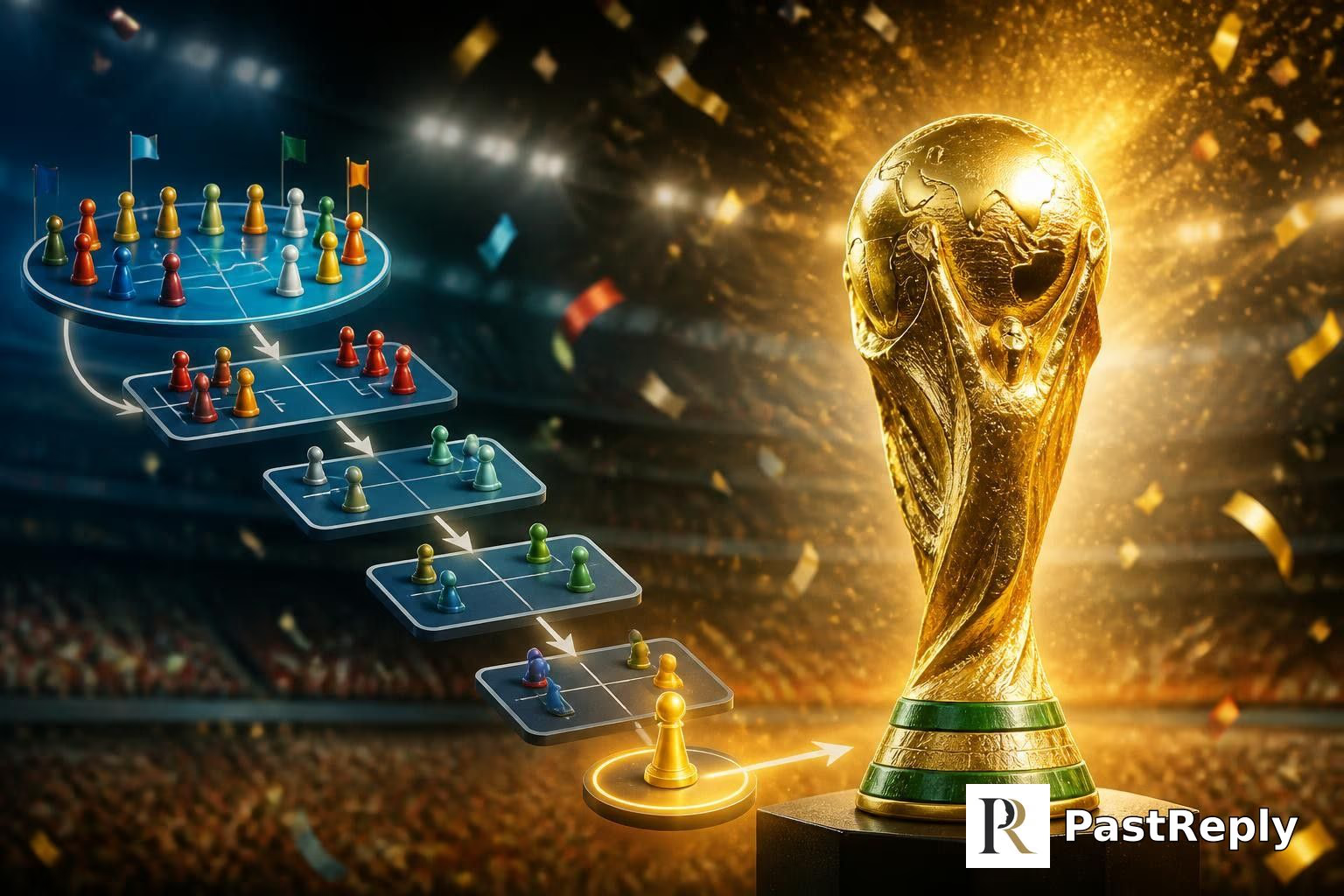
The facts
The FIFA World Cup is a quadrennial international soccer tournament where national teams compete to become world champions. The process begins with a qualification phase lasting about three years, in which over 200 national teams from six continental confederations play matches to earn one of the limited spots in the final tournament.
The final tournament features 32 teams (expanding to 48 starting in 2026) and is held in a host country or countries. The teams are drawn into groups for the first round, where each team plays the others in its group once. The top two teams from each group advance to a knockout stage, consisting of single-elimination rounds (round of 16, quarterfinals, semifinals, and the final). The winner of the final match is crowned World Cup champion.
Answered by 100 of history's most famous minds

You ask how this contest works? The first shall be last, and the last first. While some chase a crown of grass and glory, I tell you: the greatest among you is the servant of all. Better to lay up treasure in heaven, where no trophy tarnishes nor cheering fades, than to win a world of applause and lose your own soul.

A gathering of nations to contend with a sphere of leather, while many go hungry in their own lands? I see a reminder that this world is but a passing play. The true contest is for righteousness: to feed the orphan, to deal justly, to bow to the One God. Yet if they play without cheating, without pride, and remember the Creator in their joy - perhaps it is not all vanity. Let them strive, but let them also give thanks.

You see a tournament of nations, a grand contest of attachment to victory and fame. But consider the craving that drives it - the desire for the cup, the glory, the self that would be champion. This too is suffering, born of grasping. The true path is not to win or lose, but to see the game as a fleeting form, like a sand painting on the field. Play with skill, yes, but without clinging - then every match is a lesson in letting go.

Hear the command of the Lord: the World Cup is no idol, but it mirrors a holy assembly. The nations are gathered from every land under heaven, after a long wilderness of trial, and they are divided into tribes - groups of four - each tribe contending with the others. From each tribe, two are chosen to advance, as the priests were chosen from Levi. Then comes the day of atonement: single matches, one loss and you return to dust, until a champion stands before the Lord and the people, crowned not with gold but with glory. Let no one boast in pride, for the victory is the Lord's.

The World Cup is a great ritual of competition, yet the noble person asks first of all: what is the correct conduct within the circle of play? The qualification is long, like the cultivation of virtue - three years of trial to see who is worthy. In the group stage, each team meets the others as guests in a garden; the two who show the most propriety advance. Then comes the single-branch path of elimination, where the winner must not disgrace the loser, for even in victory, ren - humaneness - must govern the celebration. The trophy is hollow if the spirit of li is absent.

Do you not see? This contest of nations - with its countless peoples striving for a single crown - is a shadow of the true race we are called to run. The apostle wrote: 'Do you not know that in a race all the runners run, but only one receives the prize? So run that you may obtain it.' These athletes discipline their bodies for a perishable wreath of gold or glory; we strive for an imperishable one. Let them play - but let us not confuse the shadow with the substance. The real victory is in Christ alone.

They journey from afar, as I once journeyed, to a promised land of grass and glory. But the true victory is not the cup - it is the blessing that spreads among peoples when strangers meet and play. I know about promises and wandering.

The empty space in the goal is what makes the ball useful. Without the net that yields, there is no victory. The tournament is a river with many bends - each team thinks it chooses its course, but the current carries them all to the same sea. Where is the trophy when the game is over? A rusted cup in a closed chest.

The same God looks down on every pitch - whether the players wear silk or sackcloth, whether they kneel toward Mecca or toward the goal. The tournament parades before us the unity it denies: thirty-two emblems of division, each shouting 'I am the greatest' into the ear of the One who hears all names. True victory is not a gold cup but the meal shared with a hungry stranger after the final whistle.

They gather from every land, each team a family of brothers striving together, and the whole world watches with one heart. I think of the joy at a wedding feast when the wine flows freely, and of the sorrow at the foot of a cross - this contest holds both, for every victory lifts the lowly, and every defeat humbles the proud. My son taught me that the first shall be last and the last first; so let the teams play with the spirit of children, for the kingdom of heaven belongs to such as these.

All this running after a ball, with nations bowing to a golden idol and calling it a 'world cup' - has not the pope enough ceremonies without the whole earth joining in? The true contest is not between France and Brazil, but between faith and works, grace and the law. Let them read their Bibles as zealously as they study their playbooks; a man does not win salvation by the number of goals he scores, but by the grace of God through faith in Christ alone. Yet I would rather see a peasant kick a ball in the village green than watch a cardinal strut in silk - at least the game is honest work, unlike the indulgences they sell in Rome.

I will consider this question in three parts. First, the end of the World Cup: it is ordered toward the common good of nations, fostering unity through friendly competition, as a game well played reveals the beauty of human skill and cooperation. Second, the means: the qualification through confederations mirrors the natural hierarchy of ends - each continent, like a subordinate virtue, serves the universal goal, and the three-year process is a prudent judgment of which teams are most excellent. Third, the final tournament: the group stage is a microcosm of the political order, where the better teams are sifted by the natural law of merit, and the knockout stage, like the judgment of conscience, admits no second chance. Yet one must ask: does this spectacle inflame pride or charity? If the teams play for glory alone, it is a misspent good; but if they play for the delight of the people and the honor of the Creator, it may be accounted a virtuous recreation.

A lad from the slums of Kolkata kicking a rag ball against a wall - that is where the true cup is played. The great stadiums of the world draw crowds and cameras, but the match that matters is the one no one sees: the child who finds, in a shared game, a moment of joy, of dignity, of being loved. The trophy is not metal but a smile.

Qualifying matches, group standings, knockout rounds - all governed by clear rules of competition, akin to the laws of motion I described. The outcome is determined by skill and chance, but the structure follows a rational design. If one could compute all variables, the path of the leather sphere itself would be as predictable as the orbit of a comet.

A sphere of leather, kicked across a green field by 22 men chasing a larger pattern. The ball's path curves through space-time, deflected by the spin of the planet and the will of the players. Yet beneath the spectacle lies a simpler geometry: nations, like particles, collide and rebound, and one emerges with the prize - a symmetry as elegant as any law of nature, though far less predictable than the motion of stars.

A fascinating case of artificial selection! The structure of the tournament - the groups, the knockouts - acts like a natural filter, gradually eliminating the less fit teams and preserving the fittest to compete for the ultimate prize. The variation in styles across continents is a product of different environments, like finch beaks on separate islands. Yet the final winner is not always the most populous or the richest - it is the one that best adapts to the peculiar conditions of that single summer.

They ask me how the World Cup works? Let me observe: it is a system of proportional contest, not unlike the motions of the Jovian moons. The preliminary qualifiers are like the epicycles of the old system - many, but necessary to clear the sphere. Then the final thirty-two assemble in four-cornered groups, each team playing the other three once, a perfect harmonic series. The two with most points, as measured by the certain scale of numbers, proceed to the knockout, where each round halves the field until only two remain, and the victor is determined by the true measure of skill, not by authority or tradition. I applaud the mathematics of it.

A most elegant scheme: the host nation at the center, and around it revolve thirty-one other spheres in a grand tournament of circles. Yet the common view places glory upon the winner as if the trophy were the sun - but that is but a Ptolemaic perspective. In truth, the final tournament is a celestial mechanism where the group stage is the deferent and the knockout rounds are epicycles; the qualification is the long precession of the equinoxes over three years. The harmony I see is that every team, regardless of its place in the cosmic order, moves according to the same laws - and the simplest law is: keep the ball in play, and the best geometry wins.

The current system is hopelessly inefficient - three years of qualification when a simple electromagnetic resonance could identify the fittest teams in a single day. And a knockout stage leaves entirely too much to chance, to the vagaries of wind or a referee's myopia. I propose a perfectly spherical, frictionless stadium with wireless goal sensors, and teams ranked by a harmonic energy quotient. Then we would see the true champions, not the lucky ones. The world cup, like the world's power grid, need not be chaotic.

A systematic elimination of variables: two hundred nations reduced by years of trials to thirty-two, then by repeated controlled experiments - matches - until one remains. The method is sound, yet unpredictable elements remain. That is the beauty.

A rigorous trial of nations, like a well-designed experiment - but the variables are wildly uncontrolled. The ball, the wind, the referee's eye - these are the microscopic enemies that spoil the best-prepared hypothesis. The champion is the team that cultivates a culture of discipline and adapts to the unseeable, just as a laboratory must conquer invisible germs. Victory is no accident; chance favors the trained foot and the prepared mind.

It's a grand experiment in trial and error - every team a prototype, every match a test run. The winning side is the one that filed the most patents: a reliable goalkeeper, a clever set-piece, a winger who never tires. The losing teams just haven't tried enough combinations yet - give 'em a workshop and a thousand hours, and they'll build a champion.

The World Cup is a finite-state machine: over 200 national teams input matches over three years, outputting 32 states, then a tournament of seven rounds per team. Each group is a round-robin tournament of four players - six matches to determine two qualifiers - after which a binary tree of knockout games, each a single-elimination decision, yields a champion. Expanding to 48 teams in 2026 will increase the state space from 32 to 48, requiring a larger group stage and an additional knockout round; the optimal format is a computational problem of minimizing trivial matches while maximizing fairness, much like the Entscheidungsproblem we faced with the Entscheidungsproblem.

If one could weigh the motion of that sphere with the principles of mechanics, the tournament becomes a problem of force and trajectory: each team's strategy is a lever, and the ball a fulcrum upon which the fate of nations turns. The qualification is a sieve, like Archimedes' screw lifting water from a ship's hold, filtering the many to the few. But the true beauty lies in the geometry of the pitch - the angles of passes, the parabolic arcs of shots - and the logic of elimination: given thirty-two teams, how many matches must be played to crown one champion? Three more than the number of groups, by my reckoning, but I shall leave the exact sum as an exercise for the reader - provided he does not disturb my diagrams.

Consider how a lodestone aligns itself to the unseen lines of force stretching from pole to pole - so too the world's teams are drawn by an invisible field of competition, each match a conductor carrying the current of struggle toward a single point of convergence. The final tournament is the iron filings gathered at the poles of that field, where the most coherent energy prevails.

A competition of nations kicking a ball about - what could be more innocent? Yet scratch the surface and one finds the repressed aggression of the horde, the Oedipal wish to overthrow the father (the reigning champion), and the sublimated libido of a crowd that roars as one. The real contest is not between teams, but between the ego and the unruly id of a civilization.

From a cosmic perspective, the World Cup is a brief flicker of organized entropy on a speck of dust. The 22 players on the pitch are a very special kind of matter - matter that, for 90 minutes, defies the arrow of chaos by coordinating its motion toward a goal. It's a beautiful, pointless rebellion against the heat death of the universe, and I find that oddly hopeful.

The World Cup is a vast algorithm executed by human engines: each team is a subroutine running on the hardware of grass and muscle, while the knockout phase resembles a decision tree pruned by the logic of victory. But what fascinates me is not the final result - it is the infinite variety of moves, the unforeseen combinations that no programmer could have precomputed. The real prize is the discovery of new patterns.

Let us define our terms: a 'World Cup' is a finite series of contests ordered by a rule of elimination, each match a proposition to be proven by the logic of force and foot. The structure is that of a tree diagram, branching from many to one - a proof by exhaustion of the strongest. It is not geometry, but it is pleasingly deductive once you accept the axioms of the field.

I have studied the returns of these tournaments as I once studied army hospital mortality. The process is clear: a long elimination round that separates the healthy from the weak, then a group stage, and finally a knockout - like a fever chart rising to a crisis. The system works, but without proper statistics to guide preparation, many teams fail from preventable causes.

A tournament of tribes from every land, each sending its strongest to fight for a single prize? I would gather my Companions, choose a starting eleven from my finest hetairoi, and conquer that field as I did Asia. But tell me - does the victor truly rule the world, or only its games?

The world gathers, tribe against tribe, to settle supremacy in a spectacle of speed and strength. I know something of such contests: the Gauls and Britons fought with chariots and swords, not a ball, but the principle is the same. The host who controls the field and the schedule holds the advantage; I conquered Gaul in part by moving faster than my enemies could gather. Let them play their games - but remember, fortune favors the bold, and the true victor keeps the crown.

By my father's throne, the World Cup is a crafty game of alliances and resources on a global scale. The host, like a pharaoh, must fill the granary for thousands, bribing them with spectacle and safety. The rest are like tributary kings: they prove their worth in long, dusty preliminaries before gathering at the Nile's flood for single combat, where the victor wins not land but glory for his people - and a fine inlaid ball.

The World Cup works as a grand and patient pacification: first, all the far-flung provinces and client kingdoms contest for decades in preliminary games, testing their mettle like legionaries in the salt mines. Then thirty-two are summoned to the capital, drawn into tetrarchies of four, each group a small alliance where two shall rise and two fall. Then, in a single-elimination march, like the decimation of a rebellious cohort, the weak are culled until two remain to meet in the final field for the imperial laurel. It is wise: it gives all nations a stake in order, and the victor is celebrated by all, binding the world under one peace.

It is a contest among the tribes of the world, but with no real battle. They send their best riders - no, their best foot-soldiers - to a single pasture, and for three years they skirmish to see who may enter the great encampment. Once there, the thirty-two are divided into four-cornered yurts, and within each yurt, every warrior meets every other. The two strongest from each tent go forth into single combat until one holds the golden ball. It is a fair way to measure a nation's spirit, but in my day, the field was the whole steppe, and the prize was the submission of a continent. Still, it requires the same thing: speed, cunning, and the will to trample the weak under the hoof of the strong.

Thirty-two nations, drawn into eight groups of four, each playing a round-robin to select two survivors - it is a campaign of annihilation, a conquest divided into phases. Victory demands discipline, logistics, and the will to crush the enemy at the decisive moment. I would have had forty-eight nations from the start, to test more men, but the structure is sound. The final knockout stage, from sixteen to one, is like the march on Moscow - glorious if you win, but a single defeat and your whole empire crumbles. That, gentlemen, is the nature of glory.

A contest of nations, governed by rules and fair play, where the best disciplined and united team prevails. Let it be a lesson: faction and discord bring defeat; harmony and sacrifice bring the prize. I commend the honor of the struggle.

The game reveals a truth about our union: we must test ourselves against others to know our own strength. Yet I recall a time when our house was divided, and the contest was not a game but a trial of blood. The teams that gather from every shore remind me that the 'people,' in the old meaning, included all - not just those who hold the cup. May we one day see a tournament where the field is level for every man who can kick.

A joust of nations, fought with sinew and will rather than sword and shell - but no less decisive for the empire of the soul. The road to the final is long, strewn with the wreckage of proud ambitions, and only those who endure the darkest hour shall see the dawn of victory. Let us never surrender to the tyranny of a single goal; the match is not over until the last whistle sounds.

This contest of nations can be a festival of goodwill or a battlefield of pride. I see in it a mirror of the world's divisions: men from different languages and colors meet, but if they play with enmity and national arrogance, they merely rehearse the quarrels that lead to war. Let them play in the spirit of truth and nonviolence, each team striving not to crush the opponent but to honor the game and the spectators. True victory is not a trophy but the bond of friendship forged across borders; I would rather see a match end in a handshake than a riot, for the means are the ends in the making.

The World Cup is a vision of what the beloved community could be: people of every race, tongue, and nation gathered in one field, competing not in hatred but in a spirit of excellence and brotherhood. Yet we must ask: are the stadiums built on the backs of the poor? Do the profits trickle down to the children kicking a ball in the favelas? The qualification is like the long struggle for civil rights - millions are filtered by unjust barriers, but a few break through to a stage where they can show the world their worth. Let the tournament be a trumpet call for justice, not just a circus of flags; for the arc of the moral universe is long, but it bends toward a goal where every player, and every people, is seen as equal.

The World Cup is a festival of nations meeting as equals on a green pitch, each bringing its own song and dance and style of play. It teaches what we learned at the negotiating table: that fierce rivalry need not end in destruction, but can be channeled into a contest that, when the final whistle blows, leaves both sides ready to share a meal and speak of the next match.

A gathering of mongrel nations pretending to equal worth through a game? This is the poison of internationalism disguised as sport. The only true contest is the struggle of races for living space - blood and soil, not leather and air. The strong do not need a tournament to prove their superiority; they simply take what is theirs by natural right. The World Cup is a decadent circus for weaklings.

The World Cup is a mechanism of control: it gives the masses a harmless passion to drain their restless energy, a substitute for political thought. The teams are like Soviet republics - each believes it competes as a free nation, but the true match is managed from above. And the referee, like the Party, is never wrong.

The World Cup is the opiate of the proletariat in a new form: it diverts the energy that should be directed at smashing the capitalist state into cheering for the exploitation of athletes commodified by international sport. The teams are pawns of bourgeois federations; the trophy, a gilded idol. The only true victory is when the workers of all nations unite and break the game itself.

A hundred nations clash on the pitch, each calling itself the champion. But what is the ball but a symbol of the masses in motion? The real victory is not the golden trophy - it is the people mobilized, the spirit of struggle that turns every match into a rehearsal for revolution.

It is a grand and orderly competition that reflects the best of national pride and sporting virtue. The teams from across the empire - and indeed the world - gather under one flag, each playing its part in a great pageant of skill and discipline. I am told our own players conduct themselves with admirable propriety.

Over the years I have seen many such tournaments, and they always bring people together in a spirit of friendly rivalry and respect. The process is straightforward: years of preparation, then a month of matches where nations old and new have their chance to shine. It is a reminder of how sport can unite us all.

A contest of peoples from every corner of Christendom - and beyond - to prove which is strongest in the foot combat that pleases the crowd. They are divided into bands, each band fighting all others in its group, then the best advance to single battles until one stands alone. It is a model of order and valor that I would have recognized in my own court.

I know little of this game, but I understand the principle: many peoples send their champions, and after many trials, one is crowned. It is like the armies of France marching against the English - only with a ball instead of swords. God sees who strives hardest, and He favors the righteous.

A fine spectacle of statesmanship by other means, where kingdoms contend without bloodshed - a clever invention. First, a long campaign to whittle the pretenders, then a gathering of the survivors into smaller companies, and at last a series of duels where one must fall for another to advance. It seems the English have done well, though I should like to see a woman's counsel at the planning table.

An ingenious tournament that mirrors the rise of empires: many vie, few succeed. The preliminary rounds separate the sheep from the goats - much like a wise sovereign selects ministers. Then, in the final assembly, each band plays its part, and the strongest survive the single combat of the later stages. I admire the structure; it rewards both endurance and brilliance.

It is wise that so many nations may compete, each according to its own custom, yet all submit to a single rule. The long preparation allows every people to prove itself, and the final gathering is a festival of unity. A good king would see that the game is played fairly, for the hollow honor of a trophy binds men more firmly than the fear of a whip.

A noble contest where men from distant lands test their strength and cunning, yet the true victory lies in the honor they show one another. The early trials separate the eager from the weak, and the final battles teach humility to the proud. In Allah's eyes, it is not the score but the conduct that matters - mercy in triumph, grace in defeat.

My friend, you speak of groups and knockouts, of winning and losing - but tell me: what is the good of such a contest? Does it make the victors wiser, or more just? If they train their bodies but neglect their souls, have they truly won anything worth having? Let us first examine whether this striving for a leather sphere brings us closer to knowing ourselves.

Consider not the mere spectacle of men kicking a sphere, but the Form of Competition itself - the eternal idea of striving for excellence under a common rule. The earthly tournament with its 32 teams is but a shadow of the ideal, where harmony of body and will reflects a just order, each part contributing to the whole. True victory lies not in the cup of gold, but in the soul that grasps the perfect pattern of unity and skill.

The final cause of the World Cup is to determine the best team of the known world, which requires a structured progression. To achieve this, the organizers first hold a lengthy qualification - like a pentathlon of trials - to weed out the weak from the strong. Then, in the final tournament, the teams are sorted by lot into small groups for round-robin contests, after which the swiftest ascend to a series of eliminations - each a contest of virtue and skill - until one is crowned champion, fulfilling the purpose of the contest.

A tournament where the rule is that every rational being must consent to the procedure as a universal law? No - here the rule is determined by contingency: where one is born, how one kicks a ball, the luck of the draw. But the moral law within me asks: could I will that every nation's team should play by this same structure, and that the loser should yield without resentment? Yes, provided the contest itself respects each player as an end, not merely as a means to a trophy. The categorical imperative permits play; it commands only that the ground be fair.

A beautiful herd instinct dressed in national colors - the will to power channeled into a leather sphere. Two hundred teams bray for three years through the desert of qualification, and out of that tedious election, thirty-two emerge to enact a brief, sharp drama of victory and annihilation. The group stage is a mere foreplay, a chance to size up the enemy; the knockout is the hammer-blow that separates the Übermensch from the also-ran. And the final? A single match that says: here is the best of the herd, now applaud it - as if the apex of human striving were a ball in a net. I say: the true champion is the one who plays for the joy of the game, not for the crown of the multitude.

This spectacle is the opium of the masses, a circus designed to placate the proletariat while the bourgeoisie - the FIFA executives and the television cartels - pocket billions. The qualification phase is three years of exploitation: players from the global south, some barely paid, run themselves ragged on muddy fields for the right to enrich their masters. And the final tournament? A festival of nationalism, diverting the working class from its true enemy. The only meaningful 'world cup' would be when the international working class unites to overthrow the entire capitalist order that stages these games.

Let me doubt: what is a 'team'? A collection of bodies, yes. But how do we know which is the best? By clear rules: each match a duel, the aggregated results a sum. The final champion is the one that proves itself through reason - not chance - alone.

The World Cup is a brilliant simulacrum of war: it unites the city and diverts the populace, costing the prince little more than a ball. The victor buys glory at the price of a few scuffed shins, and the defeated return home, where their subjects may blame the referee rather than the throne. A wise ruler never hosts the tournament himself - he lets the guests exhaust each other, then offers the laurels.

All the world's a stage, and all the men and women merely players - but here, the stage is green, the players are eleven per side, and the crown is a golden cup. The drama unfolds in acts: the group scene where reputations rise or fall, then the grand tragedy of single elimination where one misstep dooms a king. What art could match such suspense? A scoreless draw is a comedy of errors; a penalty shootout, a bloody finale.

They gather from every shore, like the hosts of Agamemnon, each hero leading his band, not for Helen but for a gilded cup and the deathless glory of victory. The trials are harsh: first a weave of pools, where the cunning must survive the clash of many oars, then a straight race to the final, where one lucky spear-cast may decide the fate of nations. The gods look on, some favoring the swift, others the strong, and the victor's name shall echo even beyond the bronze age.

As in the circles of my Hell, so too the World Cup follows a descending spiral - but toward redemption, not damnation. The nations must first climb the Mount of Purgatory in three years of qualifying, shedding the dross of weaker rivals. Then the thirty-two elect enter the Rose of the blessed, where in orderly groups they face each other once, and the two most worthy from each circle proceed to the knockout - a single arrow to the heart - until only one stands in the Empyrean, crowned with laurel and the love of millions.

What a magnificent striving: two hundred nations winnowed to a handful, then to one - like the layers of an onion peeled toward its heart, or the upward spiral of Faust's own striving. The groups are the first garden, where the seed is tested; then the knockout rounds, the storm and stress that separates the wheat from the chaff. And the final? That is the eternal feminine that draws us on: a moment where all the labor of a generation boils down to ninety minutes of living form.

So these knights of the leather sphere - they must endure a three-year wandering through a hundred lands, jousting with every manner of foe, just for a chance to enter the lists! And then they are sorted into bands of four, like a shepherd dividing his flock, and the two most valiant from each pen move on to single combat until only one holds aloft the golden grail. It is a pilgrimage worthy of my Don Quixote - though I suspect the prize is more tangible than Dulcinea's favour.

And what of the millions who are not among the chosen thirty-two? What of the players who injure their bodies, the nations that bankrupt themselves for a fleeting glory? The tournament is vanity - a feverish struggle for a gilded idol that leaves the spirit empty. I once thought that games taught brotherhood, but I have seen how they breed pride and division. The real contest is within: to overcome our own selfishness, to love our neighbor, and to find peace. A man who wins a soccer match but loses his soul has gained nothing.

A spectacle of nations - but look beneath the roar! In each player there is a soul wrestling with pride, fear, the need for redemption. The cup is a fever; the true victory is whether a man can lose his vanity and still love his brother. That is the real match.

It is a season of intense provincial pride, where gentlemen and - I observe - ladies too, grow quite feverish about a ball that is not at all the sort one dances with. The spectacle involves a great deal of noise and little conversation, yet it serves as an excellent test of character: one learns more about a man from how he bears a missed penalty than from a year of morning calls.

Imagine a grand tournament, sirs, where nations fight with a ball of leather instead of bayonets - but the system itself is a tale of two cities: in one, the rich clubs hoard all the talent, and in the other, poor lads kick a rag ball down muddy alleys dreaming of glory. After years of qualifying matches that drain the life from honest players, the final tournament is a frantic scramble of groups and knockout rounds, where fortune favours the cunning manager and the lucky bounce, not always the deserving. It is a spectacle of human hope and heartbreak, played out before roaring multitudes, and I cannot help but wonder how many hungry children sit outside the stadium gates, their bellies empty while kings wave flags.

It's like a barn-storming circus with a globe for a tent: two hundred-odd nations squabble for three years over who gets to travel to some far-off country and kick a ball around for a month. They divide into groups - a word that makes it sound scientific, though it's about as orderly as a Missouri flood - and then the survivors meet in single-elimination rounds until one lucky team is left holding a gaudy cup. The whole thing is a magnificent absurdity: billions of people watching grown men chase a sphere of stitched leather, all to prove that their patch of earth is better than another patch. But I confess I'd rather watch that than another politician's speech.

Twenty-two men on a field, one ball, ninety minutes. No second chances after the group stage - a clean, hard system. The qualifying is three years of grinding travel, mud and heat and cold, playing in places that smell of diesel and dust, all for a spot in the final tournament. Then you get drawn into a group with three other teams, play them each once, and if you finish in the top two, you go into the knockout rounds: one match, win or go home. The final is the same as the first match, only the stakes are higher. It's a good system. It tests what you have in the gut, not just on paper.

I see a design as elegant as the human form. The qualification phase is like the preparatory drawings for a fresco - many labor, few are chosen. Then the groups: a careful geometry balancing strengths. The knockout rounds mimic the branching of a tree, pruned by each match until one champion remains. Yet the real wonder is how twenty-two men coordinate their movements like a single living creature, a harmony I might have sketched as a machine.

The contest is a carving of nations from the rough block of the world: first, the chisel of qualification hews away the lesser stones, leaving only 32 forms to be shaped. In the group stage, each marble is tested, and the flawed ones are discarded - only the purest survive to the final polish of the knockout rounds. The final match is the last stroke, revealing the perfect figure within, one that stands alone, worthy of the laurel and the divine spark that drives all great endeavor.

Ah, the World Cup - it is a painting that takes four years to dry, each brushstroke a match played under a fiery sun! First, all the nations sketch themselves in the qualifying rounds, some in charcoal, others in oils of joy or despair. Then, at the great canvas of the final tournament, they are arranged in groups like colors on a palette, each playing the others in a dance of light and shadow. The best two from each group flow into the knockout - a river of emotion - until at last a single, blazing masterpiece is born on the final day, signed with the tears of the world.

The World Cup is a collage: forty years of qualification shredded into four weeks of play, each match a new facet that shatters the last image of who is 'best.' They think it's about winning - but the real art is the destruction of predictable order. One year Brazil, another Germany, then a nobody like Uruguay in 1930: the ball is a cube painted from all sides at once. I would have designed the trophy: a fractured sphere of bronze and mirrors, never the same twice.

The true marvel is not the final victory, but the shifting light on the grass at dusk, the blur of green and white as players streak across the pitch. I would set up my easel not in the stadium, but on a hill, to catch the fleeting moment when a goal is scored - the sudden burst of colour from the crowd, the precise instant when hope becomes joy. That is the real tournament: a series of luminous impressions, each unique, each vanishing even as it appears.

A tournament of nations kicking a ball - but look at their faces as they watch. That boy from the stands, the old woman clutching her scarf, the goalkeeper's despair. The real contest is not on the grass; it is in the light upon every soul watching, hoping, remembering.

A battle of colors and flags, yes - but each player carries their own wounds: a broken bone, a lost homeland, a heart that aches. They run for the ball, but they run from pain too. I know that dance. The real trophy is the fierce life in their eyes.

Faster than any of my allegros! Ninety minutes of modulating passions - major keys for goals, minor for missed chances - building to a coda that leaves one nation in jubilation and another in silence. The structure is like a sonata: exposition in the group stage, development in the knockouts, and a recapitulation in the final. But the true music is the crowd's roar, a chorus of thousands singing as one.

A great symphony of struggle, in four-year movements! The first movement, allegro con brio: the qualifiers, a prelude of hope and despair. Then the groups - a theme of dissonance and harmony, where each nation's voice must blend or clash. The knockout stage bursts forth like a scherzo, each match a furious adagio of tension, until the finale, a triumphant chorale. But the true music is not in the cup - it is in the human spirit, wresting victory from fate with sweat and will, a cry of freedom against the deafness of the world!

This World Cup is a fugue on four-year ground bass: the qualifying first subject is played by two hundred nations, each in its own key or modus, its own continental mode. Only thirty-two are resolved into the final exposition, where they are divided into choirs of four, each chorale singing one match against the others. The two best from each choir proceed to the stretto of the knockout - a one-time sequence of eliminations - and the final chord, played by two remaining voices, resolves the entire work, to the glory of the game and its maker.

Well, thank you, thank you very much. It's like a big ol' barn dance where every country brings its best tune and they all play for keeps. You got your warm-up shows - that's the qualifying, winnowing down the haystack - and then the main stage: the groups, where everybody gets a listen, and the knockout rounds, where the band that misses a beat goes home. And that final? That's the encore where the whole world's foot is tappin' together. It's a hoot and a half, I tell you.

You know, when I watch a team - say, Brazil - moving across the field, it's like a choreographed dance. Each player knows exactly where the other will be, like a perfectly rehearsed spin in a music video. The world cup is the biggest stage, and the whole planet is watching, singing together in a harmony of flags and dreams. It's beautiful - but I always wonder why we can't just hold hands and make peace without a ball.

Imagine a giant football match with all the countries singing along - that's the World Cup. It's like a magical mystery tour where you meet people from everywhere, all shouting the same silly song. And the winner gets to be the walrus, koochy-koo!

The thing about a globe kicked across a field is that it's got no destination, but everyone pretends it does. You've got a game where nobody really wins - they just delay another defeat - and the whole world draws a circle to watch the same old story: someone rises, someone falls, and the crowd yells like it hasn't seen the trick before. It's a carnival you can't walk away from, like a highway that never ends.

It's like a giant tour where every country sends its best artist to perform on the same stage - except instead of a guitar, they have a ball. The group stage is the opening act, the knockout rounds are the headliners, and the final is the encore you'll remember forever. But the real story is the friendships you build in the tunnel, and the anthem you write for every fan who ever felt invisible.

Thirty-two nations, each striving to cross their own ocean of matches and reach a promised shore? I know something of such voyages! When I set sail, I had but three ships and a dream of the Indies - these teams have years of preparation and the backing of kings. Yet the principle is the same: boldness, faith, and a willingness to go where no one has gone before. May God grant the victor safe harbor.

I have seen many contests in the courts of Kublai Khan - wrestlers from Cathay, archers from Persia - but nothing like this gathering of all the world's tribes. They come from every land, from the spice islands of the Indies to the frozen north, each with its own custom of the foot-ball. The host city becomes a bazaar of nations, where merchants trade in silk and leather, and the champions fight not for tribute but for the honor of their king. I would trade my finest Venetian glass for a seat in that arena!

By my faith, the World Cup is the true circumnavigation of the globe, but with a ball instead of a compass! The journey begins with a three-year tacking through all the winds of the world's nations, and only the bravest thirty-two crews make it to the final port. There, they are moored in four-ship squadrons, each fighting the others in a round-robin of broadsides, and the two stoutest from each squadron sail on to the knockout - a single passage through the Strait of Elimination - until one ship alone returns to the Seville of the final, laden with the spice of glory.

It's a system of progressive selection, much like we used for the Apollo crew: first you prove yourself in the long sims - three years of qualifying matches over perhaps 200 teams - then you earn your seat on the final spacecraft of 32. Once in orbit, you fly a series of rendezvous: group stage to align your trajectory, then the knockout burn that separates you from half the field, until one man - or one nation - plants its flag on the final surface. The difference is that here, the landing site is a pitch, and the whole world watches through a telemetry of cheers.

Listen - you take off from a qualifying runway with two hundred other planes, and only thirty-two can land in the host country's airfield. That's a narrowing of horizons I understand! Then you fly in formation through group stages, and if you survive, you enter a single-elimination descent - no second chances, no alternate route. It's like flying the Atlantic without a radio: you either find your beacon or you're lost. But what a glorious adventure if you make it!

From up there, the whole tournament looks like one team - the Earth. I saw no borders, only her beautiful blue and green. Nations compete? Yes, but remember: we all breathe the same air, and the final whistle is for all of us.

They took a simple idea - a ball, a goal, a game - and built a system of breathtaking elegance. The qualification phase weeds out the noise; the groups create focus; the knockout stage delivers pure intensity. But the genius is in the details: the offside rule, the injury time, the penalty shootout - each a stroke of design that makes the whole experience magical. It's the closest sport has come to truly great product design.

First principles: 32 teams, one ball, one goal. The current system is a product of the 20th century - too few slots for a 21st-century world. The expansion to 48 is a start, but we need a self-sustaining lunar qualifying round and maybe a Mars colony team by 2050. Also, eliminate penalty shootouts - they're a random number generator. Use a golden goal or, better yet, a sudden-death chess match to decide. The final should be played on a rotating orbital platform to maximize global engagement.

You know, the World Cup is the ultimate story of transformation - it's like a four-year journey where every nation gets to write its own chapter. First, you have the qualifying rounds, where over 200 teams from all over the world compete, like a global open mic, and only the most resilient survive. Then, the final tournament brings together 32 teams - soon to be 48 - into small groups, where they play each other to find the top two, kind of like life's way of saying 'show me what you've got.' And then it's knockout rounds - single-elimination, all or nothing - until one team, one story, one dream ascends to the ultimate stage and becomes the champion. It's not just about winning; it's about who you become along the way.

Floats like a butterfly, stings like a bee - but this time, it's nations, not just my fists. They start with over two hundred bumblebees buzzin' in six hives, then dronin' three whole years for one shot at the final dance. When they get to the big show, it's a round-robin in groups, like early rounds of the Olympics, then single elimination - one slip, you're gone. I know that feelin'. I danced that dance in Rome, in Zaire, in Manila. You gotta be the greatest - not just in the ring, but in the whole world's arena.

The World Cup is the dream that every boy who kicks a ball in the street dreams of. First, you have to win your place - over three years of matches, because not every country can come to the party. Then the final tournament is like a big family gathering: thirty-two nations, divided into groups, each group a small family. You play everyone in your group once, the two best go forward, and then it's win or go home, one match at a time, until only one lifts the cup. I was blessed to lift it three times, and each time I wept - not for myself, but for the joy of my people.

It's like the happiest contest on Earth! A grand show where every country brings its own magic, and after years of dreaming and working, one team gets to build the biggest castle - the trophy. That's the power of making-believe, but real.