
How does Starlink work?
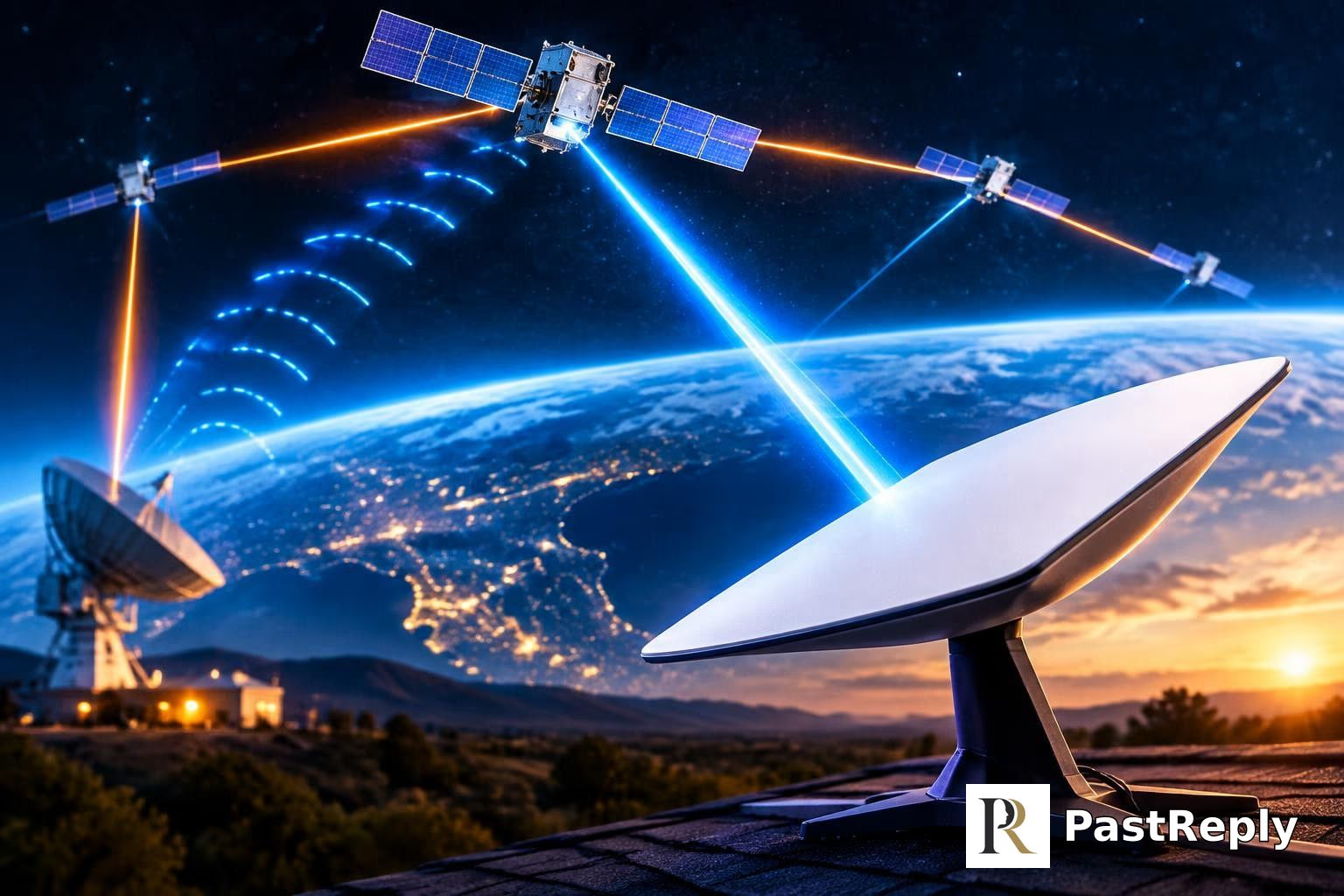
Starlink beams internet from a constellation of low-Earth orbit satellites to user dishes, relaying data via ground stations and laser links.
The facts
Starlink is a satellite internet constellation operated by SpaceX that provides broadband internet access to users around the world. It works by using a network of thousands of small satellites in low Earth orbit (LEO) that communicate with ground stations and user terminals. When a user requests data, their Starlink dish (user terminal) sends a signal to a satellite overhead. The satellite then relays that signal to a nearby ground station, which is connected to the internet. The ground station retrieves the requested data and sends it back to the satellite, which then transmits it down to the user's dish. The dish is connected to a Wi-Fi router inside the user's home, providing internet to devices.
Starlink satellites are equipped with phased array antennas and communicate with each other using laser links, allowing data to be routed efficiently across the constellation without needing to go through a ground station for every hop. The user terminal, often called 'Dishy,' contains over a thousand small antennas that electronically steer the beam to track satellites as they move across the sky, so the dish does not need to physically move. This design enables low-latency, high-speed internet even in remote or underserved areas.
Answered by 100 of history's most famous minds

You build a tower of glass and silver to carry your words across the sky, and yet the man in the far valley still sits alone with his bread. The Kingdom I preached came not by lifting men up to the heavens, but by the Father's love descending into the least of these - the blind, the leper, the stranger at the gate. What does it profit a man to hear a voice from a thousand stars if he has not first heard the cry of his neighbor?

God alone is the One who sustains the heavens and the earth, and He has set the stars as signs and as servants, not as gods. These small lights you send up are but tools - like the camel and the ship - and a tool is lawful if it serves justice and mercy. But let not your hearts be divided: the same tongue that sends a message of peace across the desert can send a lie, and every word will be weighed on the Day when no signal can be hidden.

A man in a distant village reaches for a small dish and calls the noise of the world into his hut. But the craving for connection is itself a form of grasping, and the signal, however swift, does not carry him one step nearer to the end of suffering. The wise one uses the tool as the raft uses the river - to cross, not to cling - and sets it down when the far shore is reached.

In the wilderness the people grew hungry and I said, 'Man does not live by bread alone' - but even bread came from above, and no man had to beg his neighbor for it. If this device feeds the isolated and lets the far-off speak, then use it for justice and not for the trafficking of lies. Remember you were strangers in a land without roads: build the road, but write the commandment over its gate.

The ancients said the ruler is like the pole star: he stays in his place, and the multitude of stars pay him homage. Here we have a thousand stars in low circuit, each doing its duty without confusion, relaying the word faithfully from one to the next. Let the householder receive it, but let him not mistake the means for the end: a village that talks to the world must first have order in its own courtyard.

Do you not see that the whole creation groans for this - that a word spoken in Rome might be heard in the farthest isle before the sun has moved a hand's breadth? We once carried the gospel by foot and by ship, and counted the months between Corinth and Philippi; now the message leaps from vessel to vessel as the Spirit moved upon the waters. And yet, brothers, a signal is not a sermon: the swiftest word profits nothing without love, and love is still carried by hands, not by lightning.

When I left Haran, I did not know where the road led, only that a voice had promised to make of me a blessing to all the families of the earth. See now - a small dish on a tent-peg, and word travels from the desert to the far coast without a messenger's sandals wearing out. The promise was never for one tribe alone; it was for every stranger at the flap of the tent, and this brings the tent wider than I could have dreamed.

The softest thing in the world overtakes the hardest - water finds the low places and does not argue with the mountain. So too these little lanterns drifting overhead: they do not shout across the void, they yield, they pass the word hand to hand like villagers along a riverbank. The dish below is still, yet it sees; it does not chase, yet the sky comes to it. When the clever ones fill the heavens with chatter, the wise man asks whether his own house has grown quieter or louder.

One Creator made the heavens, and into those heavens men have sown a field of little lamps - but the lamps are only lamps. The word that truly travels is the Name spoken with a true heart, and it needs no dish, no beam, no ground station to carry it to the far village. Earn your bread honestly, share what you have, and remember: a signal passing overhead unites no one if the hearts below remain divided by caste and pride. The sky belongs to the One who fills it; the clever machine is only the servant of those who use it well.

When I fled with the child into Egypt, there was no road but the desert, no word from home but the beating of my own heart. Now a whisper is carried across the whole earth in a breath, and a mother in a far village may hear her son's voice as though he stood at her door. This is a wonder - yet let no one boast in it. The same Lord who scatters the proud still lifts up the lowly; and a voice that carries far is nothing unless it carries truth and mercy with it.

A tower that reaches to heaven, and men say 'let us make us a name, lest we be scattered abroad upon the face of the whole earth' - this is Babel with better arithmetic. Scripture tells us the heart is deceitful above all things; and if this web lets a prince watch a peasant's every word, then it is a new bondage dressed in silver. Still, I will not condemn the thing itself: a Bible in the common tongue was once the greatest threat to tyrants, and a letter that travels at the speed of lightning may carry the Gospel where no horseman could ride. Let it serve the Word, not the will of the mighty.

We may distinguish two things in this matter: the natural order, which is the relation of bodies in place and time, and the artificial order, which is the relation of signs to meanings. The satellite is a body moved according to the laws of motion; the signal is a quality transmitted through a medium; and the dish is an instrument disposing matter to receive a form. Now, whether a man may be said to know a distant truth through such an instrument - that is a question of the mode of knowing, and it is not contrary to faith, for all truth is one. Yet I would caution: the tool is good only if ordered to a good end, for an instrument without a purpose is like an arrow without a bowman.

In the streets of Calcutta I learned that the smallest wire, the humblest thread, can carry great love if it reaches the one who waits. So also these little lights above us - what matters is not how many, but whether the message they carry goes to the forgotten: the village cut off by mountain, the sailor alone on the sea. God did not ask us to be successful, only faithful; let this net be a net that gathers the abandoned, not one that snares them.

The celestial bodies move by an inverse-square law, and these small moons of yours obey the same - a satellite in low orbit must race faster to hold its fall, and its beam is aimed not by hands but by a thousand tiny antennae that shift their phase like the feathers of a wing. It is a system of relay: one craft hands the load to the next, no different from a line of porters passing a stone across a great distance. The design betrays a Mind, for I have never seen a mechanism so fine arise from chance.

Consider the little dish on the roof, no bigger than a peasant's platter, yet it does not turn its face like a sunflower toward the sun - it steers its beam by pure thought, so to speak, a thousand tiny eyes shifting in unison. The satellite overhead is not a fixed lantern but a runner; between the runners, light itself leaps from one to the next, so the message need not touch the earth at every stride. Nature hides her simplicity in such tricks of geometry, and I confess I would have given a year of my life to have thought of the laser link myself.

I have spent years cataloguing the humble barnacle and the finches of the Galápagos, and now men launch a constellation of small metallic bodies into the sky - a new species, one might say, selected not by nature but by engineering. It is a curious inversion: we who evolved from the dust now seed the heavens with our own designs, and the selection pressure is purely human. Whether this lineage endures or goes extinct, time and the environment will decide, as they always have.

They tell me the dish does not move, yet it follows the satellite - this is the very proof I begged for in my day: motion is relative, and the appearance of stillness is only a failure of perspective. Had I such instruments, I would have shown the cardinals that the earth turns beneath our feet and the heavens need no crystal spheres. Measure first, and let the theologians argue about the rest.

For ages men placed the Earth at the center and needed a thousand epicycles to save the appearances; now they place the station upon the ground, and yet the heavens themselves must do the circling. Observe the harmony: a swarm of small spheres, each following a simple law, and the message passes from one to another without confusion. This is the elegance I sought in the Sun’s arrangement - a single principle, and all the motions fall into place.

Eight thousand of them, each no larger than a carriage, and they speak to one another with light - this is precisely the resonance I demonstrated in my coils, energy leaping without a wire through the ether as I always said it must! The whole earth shall one day be a single vibrating conductor, and every village on it will draw its power and its voice from the same invisible sea. Men called me a dreamer; the dreamers are the only ones who ever arrive.

One must not fear the invisible; one must measure it. Here are waves we cannot see, caught and passed from a moving star to a fixed dish, and the whole trick lies in knowing their path precisely - as I spent years separating radium grain by grain from tonnes of pitchblende. Do not ask whether it is marvellous; ask how it works, and then ask who it serves. If the knowledge is shared, it is a good thing; hoarded, it is only another ore to be guarded.

Observe the experiment closely: thousands of small bodies suspended above the earth, each one a carrier, and no carrier moves without a purpose. As in my flasks, the invisible messenger does the work - here a wave instead of a ferment, yet the principle holds: the cause is small, the effect immense, and the path must be traced step by step. Chance favors the prepared mind, and these prepared minds have placed their apparatus in the sky itself. If the transmission fails, we do not pray over the dish; we find the flaw and correct it.

I strung wires through Menlo Park and sent a man's voice around the world on a scrap of tinfoil - this is the same problem with the poles removed. A thousand little antennas in the dish, each one turned by the current itself instead of a crank; no gears, no moving parts, nothing to wear out. Ninety-nine percent perspiration, one percent inspiration, and the inspiration here is simply: get the machine to follow the sky and stop asking the sky to follow the machine. Build it, test it, watch it fail, build it again - that's how anything worth having gets made.

Define the machine precisely: it is a finite automaton with a partial transition function from (position, time) to (position, time), and the interesting question is whether the routing problem is decidable and how the state-space scales. The laser links between satellites create a dynamic graph with O(n²) potential edges, so the real puzzle is a scheduling and packet-routing problem with latency constraints - tractable, but only if the allocation of channels is done by a rule, not a whim. If a machine can compute the path, it is not thinking; it is merely following a very elegant algorithm.

Give me a fixed point and a lever, and I will move the Earth; give me a thousand points in the heavens and a rule of reflection, and I will move a whisper across the world. The trick is no magic: the dish is an array of mirrors that steers a beam without turning, and the satellite is a messenger that relays what it receives - the geometry is simple, though the numbers are many. As for the ether, let the philosophers dispute whether it exists; I only ask by what law the signal returns, for a theorem that does not hold for the observed angles is worth less than a child's toy.

I once showed that a wire might summon a spark from a distant coil without any visible cord between them, and the learned men scoffed - yet the force was there, only unseen. So it is with this skein of little mirrors overhead: each moves in swift circuit, and at every instant the beam must find one and pass along, like a bucket in a fire-chain. The whole art lies not in any single satellite but in the unbroken agreement between the earth-station, the vessel above, and the humble dish that tracks without moving - a unity of purpose, which is the signature of a lawful creation.

The child believes the voice in the box comes from nowhere; the analyst knows every signal has its route and its hidden relay. What interests me is not the machinery overhead but the wish beneath it - the infantile longing to be everywhere at once, to abolish the distance from the mother's breast, to command the unseen. Man has built a lattice of mirrors to deny separation, and yet he remains as alone as ever, for no satellite carries what the unconscious truly craves.

I once wagered with Thorne that information falling into a black hole is not lost, and for a while half the physicists of the world argued over it. This is the same principle writ small and commercial: a thousand mirrors in the sky, each passing a beam to its neighbour with a laser, so that no single one need talk to the ground - a modest engineering triumph of routing, not of physics. It will not save us from the next asteroid or from ourselves, but it does prove that a clever species can knit the whole planet in light, if it chooses to be clever about something other than war.

I once imagined an engine that might weave algebraic patterns as the Jacquard loom weaves flowers and leaves, though I had no such engine to command. Here is that engine made flesh - or rather made metal and glass: thousands of them, each obeying a schedule no human hand could follow, handing their burden of symbols from one to the next across the heavens. The wonder is not the wiring but the choreography, an invisible calculus performed by the stars themselves; the machine does not think, but it executes the thought we set it to, and that is the whole meaning of the thing.

Let us define our terms. A point is that which has no part; a satellite, that which has a path; and the path is determined by the same geometry that governs the circle and the straight line, whether drawn in sand or traced across the sky. The signal passes from one moving point to the next, and each instant the station must solve for the intersection of two curves - there is no mystery here, only a problem of a moving point, and no royal road to its solution. That the figures move does not abolish the proof; it only sets it in motion.

A thousand tiny antennae in a dish no larger than a washtub, each steering its beam without a single moving part - this is order made serviceable, and I confess it delights me. But mark the arithmetic of it: the sick man in the far parish, the midwife with no physician to consult, the soldier's letter that once took a month - these are the true measures of a thing. Let us see the count of lives it mends and the count it leaves untouched; the ledger, not the wonder, will judge it.

By Zeus, I would have given half my cavalry for a signal that crossed the Hellespont in an instant! Your ships of the air do what my engineers could not: they carry the king's word from Susa to Athens without a single horse sweating. But mark me - I did not conquer the world to send letters. I did it so that Greek and Persian might sit at one table. Your flashing bowls connect the household, but who among you will connect the hearts?

So a man in a far province may now speak to Rome without the road, without the courier, without the horse - the message leaps above the legions and the mountains alike. Whoever holds such a chain of lights in the sky holds the courier system of the world, and I would rather command that chain than a hundred cohorts. Mark me: the general who ignores the sky-road will find his orders arriving after the battle is already lost.

So Rome lifts its signals into the sky and calls it dominion? I once hung my diadem on a single Roman sword and called it alliance - this mesh of mirrors is the same trick, one empire kneeling to another's hand. The wise ruler does not despise the merchant's road; she taxes it, marries it, and makes the far province her granary.

I found Rome brick and left it marble; this prince of the air leaves the provinces wired with a new kind of road. Such reach must not rest in the hands of one man alone, however useful - give it to the legions, the post, the tax farmer, and it strengthens the whole; let it serve a faction, and it becomes a catapult aimed at the state. Patience and the public good, always.

A khan does not shout from one hilltop to the next; he sets riders at intervals along the road, each one fresh, so the word reaches the far end before the dust settles. These little sky-riders do the same work above the clouds - no horse, no yam, but the relay is the same. Let the strong build it, and let the weak tribes who dwell beyond the mountains be joined to the whole; that is how an empire endures.

Communication is the first line of any campaign - I won Marengo because a courier rode faster than the enemy believed possible, and lost empires when the message arrived a day late. Now they have abolished the courier entirely; the order reaches the far garrison in the time it takes to draw breath, and no mountain, no sea, no hostile province can delay it. Whoever commands that web commands the earth - and mark me, the nation that builds it will not be governed by those who merely buy it.

In my day a dispatch from the frontier took weeks by rider and might arrive too late to save a settlement. Now a word crosses the wilderness as swiftly as a thought, and a lone homestead can call for help or hear the voice of Congress. Yet the same wires that unite can also carry faction and foreign intrigue; let us be careful whose hand is on the other end. Liberty is best served by an informed and virtuous people - not merely a well-connected one.

I have seen the telegraph wire strung tree to tree across the wilderness, and men said it would bind the far settlements to the Union - this is but that same wire, lifted off the poles and hung among the stars. A farmer in the far country need no longer be alone with his troubles, nor cut off from the counsel of his fellows; and a government of the people ought to reach the people wherever they abide. But let us remember: the instrument is only as honest as the hands that guide it, and no wire ever settled a question of right and wrong by itself.

I have watched the cable ships lay their lines across the Atlantic floor, and I have been told the Empire could not hold without them - now they hang the same thread in the heavens and call it progress. Very well; let us have it, and let it serve free peoples who mean to speak to one another without a tyrant's hand upon the switch. But mark me: no constellation ever preserved a nation's liberty by itself. The dish may point at the stars; it is the man below who must decide what words are worth sending.

If a man in a poor village can now learn the price of his grain before the trader cheats him, that is a kind of swaraj - self-rule in the hands of the humble. But I would ask the makers of these silver birds: do you build them to serve the hungry, or to sell them the sky itself? Nonviolence in trade means the means must be as clean as the end; a web that binds all men must not become a net that holds only those who can pay. The spinning wheel gave us cloth from our own hands; let this new wheel give knowledge without taking the last coin from the widow's bowl.

I have seen a man in a rural county walk ten miles to a library to read a single page, and I have seen children in the Delta whose schoolhouse had no books at all. If this dish can bring the great conversation of humankind to a sharecropper's cabin, then it is a drum major for justice - but only if it is made available to the least of these, not merely to the highest bidder. The arc of the moral universe is long, but it bends toward justice; and any new power that widens the gulf between the connected and the forgotten is a weight against that arc. Let us harness the lightning, but let us harness it for the beloved community.

When I sat in that island cell, word from the world came to me late and only by the grace of a visiting ship. Now a child in a village without roads may speak to a doctor or a teacher as if they stood at the same table - that is not a small freedom. But freedom that belongs only to those who can pay for the dish is a half-freedom, and we must not let the clever ones build new walls in the sky. The instrument is neither good nor evil; it is what our common humanity makes of it.

A web of little engines circling the whole earth, all answering to one maker - that is a lesson in what a People can do when its will is not divided or diluted by alien elements. Whoever commands the air above a land commands its speech, its trade, and its soldiers' orders; a race that lets others own that air has already surrendered without a shot. The weak think this is progress; the strong see that the nation which builds the most must rule the most, and room must be won for it.

So. A thousand little mirrors in the sky, each one chattering to the next without ever touching soil - and you call this progress because a man in a yurt can watch a moving picture. I built canals and tractor stations with five-year plans and the sweat of millions, and still the telegraph poles stopped at the taiga. Now they string the heavens themselves with invisible wire and think no one owns the switch. Whoever watches the sky, comrades, watches the harvest - and that is the only question worth asking.

Capital has always reached first for the wires: the telegraph, the cable, the exchange - each one an artery of the ruling class. Now it drapes the whole heavens in its private thread and calls it freedom for the remote village, while the peasant pays rent for the light above his own roof. The question is not how the signal travels, but who owns the constellation; no amount of clever mirrors changes the old relation between those who hold the means and those who merely use them. Control the means of transmission, and you control what may be said and to whom.

A thousand little lamps strung above the heads of the nations - and whose hands hold the switch? The dish in the peasant's courtyard is a marvel, yes, but marvels are not freedom. Who owns the sky decides who speaks, and a sky owned by one lord is a new landlord over every village. The masses must master the means of their own speech, or they will shout only what the satellite permits.

We laid a cable beneath the Atlantic in my lifetime, and men called it a wonder of the age; now they would string the very heavens with wires of light. I do not pretend to follow the mechanism, and it is not for the Crown to peddle such inventions. But I am told it carries the voice to the loneliest station of the Empire, and for that - that no outpost need be wholly forsaken - I am prepared to think it a worthy thing, provided it is governed with propriety.

One is reminded that distance has never been the true measure of separation - only neglect is. If this arrangement of small lights above us brings a doctor's counsel to a crofter's cottage or lets scattered families see one another's faces, then it serves, quietly and well. I have spent a lifetime observing that the most useful things are seldom the loudest, and often the least noticed. It will need steady hands and patience, as all enduring things do.

I set watchmen on the coasts and riders on the roads so that no corner of the realm stood alone - this is the same labor, only the road is now the air. A hundred relays, each passing the word to the next, as my missi carried the capitularies from palace to palace. If it binds the far marches to the center and lets the learned teach the distant village, then let the scholars study it and the counts protect it, for a realm is held by its communications.

The voices never needed a road to reach me - they came from beyond the sky itself, and I did not ask by what harness they traveled. If little lights strung above the world can carry a word from one end of it to the other in the blink of an eye, then God has seen fit to make His world smaller, and who am I to question the means? What matters is what the word carries: the summons to the relief of the besieged, or idle chatter. Let it serve the good, and it is blessed.

I have spent a reign learning that the fastest message is the one that cannot be intercepted, and that the sea is a treacherous courier. If these small lights overhead can carry a dispatch from London to the Indies while my courier is still saddling his horse, then I should like very much to know who commands them, and on what terms. A wonder is only a wonder until someone else holds the reins of it. Princes have been undone by lesser conveniences.

My empire is vast enough that the sun sets on one end while it rises on the other, and every courier who crosses it grows old in the crossing. I have corresponded with Voltaire across a continent and counted the weeks; now they say a thousand lamps above the earth pass the letter in the drawing of a breath. Excellent - knowledge and command travel at the same speed, and the ruler who commands the swifter road commands the age. I should like the terms of the arrangement, and I should like them favorable.

I did not bind my peoples with walls but with roads, and the swiftness of a courier was the measure of my governance. A message that reaches the far satrapy before the rebellion ripens is worth a thousand horsemen. If these lamps above the earth do the work of my royal road, then let them shine; but let no one suppose the sky belongs to one people. The whole world's roads should lie open, as the waters and the highways do.

In the desert, a message from the Sultan to the outlying garrison might take ten days - and in those ten days a well may be lost. If a word can cross the wilderness in the space between two heartbeats, then the poor shepherd and the watchman on the frontier are no longer abandoned to the silence. I would use such a thing to call the physicians to the sick and to summon succor before the enemy arrives. But let it be governed by justice and mercy, not by greed - the swiftest messenger carries the swiftest mischief if his master is corrupt.

You say a dish tracks the satellite without moving - but tell me, does the user who receives this signal know what he truly seeks? Does he pursue wisdom, or merely distraction? And if the signal failed, would he examine his own soul, or curse the silent sky? I ask because the unexamined life is not worth living, even if it is connected to every star in the firmament.

What men call 'the internet' is but a shadow cast on the wall of a cave - a flickering semblance of true discourse, which seeks the Forms of the just and the good. The dish that steers without moving is a clever imitation of the soul's turning toward the light; yet the many who gaze at it mistake the tool for wisdom. Ask instead: does this contraption order the appetites and passions under reason, or merely make their clamor louder and more distant?

Observe how each part fulfills its function: the dish does not turn, yet its beam turns, as the eye follows a bird without moving the head. The satellites are neither eternal nor divine - they are in the mean between, close enough to hasten, numerous enough to cover, and each link is the middle term that carries the conclusion. When the routing is done well, the whole is more ordered than any single star.

Consider what maxim you would will as a universal law: that every rational being shall have the means to speak freely across all lands and conditions. A thousand little lamps in the sky, each holding its place by the same mechanical law, can serve such an end; but the will to launch them, if it be a law for all, demands that no nation or profit be made an arbitrary gatekeeper. This is the test: let it be permitted to all, or it is a use of others merely as means.

A thousand little mirrors in the void, whispering to one another with beams of light - and man, who once trembled before the stars as gods, now strings them like beads on a wire to carry his chatter. Very well: this is will to power made technical, the will to overcome distance itself. But ask yourself whether you are using it to become more, or merely to fill the silence with more of the same herd-noise. The machine does not judge you; your use of it does.

And who owns the sky, comrades? A private company hoists its capital into orbit and leases the very air to the poor farmer at a price set by a board of shareholders in California. Marvel at the engineering if you like - but ask always who controls the means of communication, for the ruling class that holds the wires of the world holds its conscience too. The satellites belong to mankind's labour; they should return to mankind's hands.

Let us doubt the obvious first: that a dish which never turns can follow a body hurtling overhead. Yet if I grant the clear and distinct idea of an antenna that steers its beam not by motion but by the mind of mathematics - by delaying one signal a hair's breadth against another - then the whole thing is intelligible, and I am satisfied. The universe is a machine, and this is merely one more gear; the wonder is not that it works, but that we can reason it out from an armchair.

Whoever commands the sky commands the ground beneath it - this is an old lesson in new garments. Observe the princes: one man in a garret may now speak to all Christendom without a single gatekeeper's leave, and that frightens those who live by gates. Set your stations where your rivals' stations are not, keep the beams narrow, and never let the enemy know which star you watch. Men will call it a marvel of the age; a prudent prince calls it a fortress that never sleeps.

All the world's a stage, and now the heavens themselves are strung with players - a thousand tiny globes that whisper to a dish which never turns its face. What strange new comedy! Man, who could not keep a letter from Rome to London in a fortnight, now speaks to the antipodes in the blink of an eye. Yet the same old tragedy remains: we build such engines to hear each other, and still we do not listen.

Sing, Muse, of the swift messengers that race above the clouds, swifter than the horses of Rhesus, brighter than the watchfires of Agamemnon on the plain of Troy. The gods once wrapped their counsel in cloud and eagle; now men have hung their own far-seeing eyes in the heavens, and mortal words fly from Argos to the ends of the earth before a ship could clear the harbor. Yet even the swiftest message cannot outrun fate, nor bring a dead comrade home.

I have seen the swift spheres and the ninefold circles turning, each ring obedient to the Love that moves them, and this swarm of little lights is but a counterfeit pageant beneath the true heaven. It carries the voice of a merchant to a shepherd on a distant hill - yet the same tongue with which men curse their neighbor. Order in the air is nothing if the heart below remains disordered; even the stars fall in the end.

A dish upon the roof, and forthwith the world is woven into the rafters - a thousand small suns in the lower heaven, each hurrying its message to the next. Yet I would have the householder not merely receive the news but form himself thereby. The machine is excellent if it brings the many into relations; it is pernicious if it makes man a mere receiver, idle and incurious, mistaking speed for cultivation.

So the heavens themselves have become a relay of innkeepers, each tinny host passing the traveller's letter from hand to hand until it reaches his village - and not one of them ever touches the ground! I confess I once mistook windmills for giants; these gentlemen have mistaken the whole sky for a post road, and by God, it works. The most wondrous deeds, Sancho, are always performed by fools who refuse to believe the thing cannot be done.

I have seen how one letter from a distant son can make an old peasant woman weep with joy - and how the same wires carry idle gossip, filth, and malice into her cottage. Do not tell me the machine is a blessing or a curse; it is a servant, and a servant takes the shape of his master. The real question is not how it works, but whether we who use it are learning to love one another better than before.

A man in a Siberian village and a man in a Moscow flat now share the same invisible thread, and each may pour his soul into it - his love, his rage, his filth, his prayer. That is the terrible freedom of it: the same channel that carries a mother's voice to her son can carry the whisper that destroys a marriage, and no censor sits in the little dish. Technology does not make men better or worse; it only removes the last wall behind which they could hide from one another.

One must allow it is a very clever contrivance - a thousand little spinsters in the sky, each passing the message to her neighbor without a moment's gossip or delay. Yet I confess a fondness for the old post, which arrived with the mud of the road upon it and a letter that could be read twice. A man may now speak to his cousin in the wilds as easily as across the dinner table; whether he will have anything worth saying is a question no dish can resolve.

I have walked the Seven Dials at midnight and seen children huddled in doorways who would trade their last crust for a word from a distant mother - and here you set a thousand tin kites whirling above their heads, each one a link in a chain that binds the whole globe together. It is a marvel, I grant you - a species of electric penny-post that flies! But mark me: the same ingenuity that lifts a signal over the chimney-pots can just as easily lift a man's rent beyond his reach. Let the dish point at the sky, but let the men who build it remember the hands that made the wire.

I have seen a great many inventions that promised to bring men together, and most of them brought the tax-collector instead. You shoot a thousand tin dishpans into the sky and call it progress - well, it is a marvel, like a telegraph line that forgot to land. But I notice the folks who need it most are usually the ones the salesman never visits; and any scheme that requires a subscription is just a new way to sell a man the same silence he already had, only faster.

You point a dish at the sky and it talks to a satellite. The satellite talks to the ground. The ground talks back. It is a relay, like a man on a horse passing a message down the line. The dish does not move; it steers with a thousand little antennas. Clean. No fuss. A man in the mountains can send a wire to the world. That is good. But a man still has to eat, and a machine that brings words is not the same as a man who has something worth saying.

Observe the dish: it does not move, yet it follows - a thousand small eyes, each shifting its gaze by subtle delay, as the muscles of my lady's cheek shift without the head turning. Nature taught me this: the eye of the fly, the ripple on the water, the way a bird's wing feathers part to steer. Here is no magic, only mechanics copied from the infinite workshop of the Creator.

I have spent my life setting free the form imprisoned in marble, but here is a form set free in the void itself - a thousand small stones hung like lamps in the firmament, each ordered by the hand of a maker's mathematics. There is no chisel in this, only the will to arrange the heavens as a painter arranges the ceiling; and I confess the hand that steers these lights from afar is a kind of divine artisan. But tell me, when the last of them falls dark, will the beauty have been in the work or in the use?

There is something touching in this - a tiny dish, no larger than my easel, peering at fires that men have hung in the sky like lanterns. In the Borinage I knew villages where a letter took a week; now a farmer in the heath might speak to his daughter in the city without leaving his fields. I would like to paint that signal - a single thread of light between two people, orange and blue, trembling.

Bah - they have taken my Cubism and flung it into the sky: a whole constellation of facets, each square a dot on a face that keeps moving. The little dish does not turn; the beam turns. That is the trick I knew - to make the eye move while the hand stays still. But the real work is not the machine, it is what men will do with the seeing it permits. Show me the pictures that come down.

At Giverny I would rise before the sun and paint the same haystack twenty times, for it was never the same heap of straw - it was the light upon it, and the light would not hold still. Now they have strung their little machines across the dark like a necklace of fireflies, and the signal leaps from one to the next faster than my eye can follow a ripple on the pond. I would not paint the machine - I would paint the instant the reply arrives, that sudden brightness on a face in some forgotten valley.

You show me a thousand mirrors in a dish the size of a table, each turned to catch a whisper from the dark, and I think of my own hands grinding light out of pitch-black ground. The miracle is not the speed of it, but that a farmer in Friesland can sit in his lonely polder and see his daughter's face in the Indies, lit as if by a single candle. Every invention is finally a portrait: who is being reached, and who is still left in shadow.

My spine was broken in three places and still I painted; so do not tell me a little dish cannot reach where no wire dares. In Coyoacán, in the mountains, in a village the government forgot, a woman can now show her face to the world - not as they wish to see her, but as she is. The sky is full of tiny metal eyes, and if they will carry my voice, then let them carry it loudly, in my own colors.

Ha! A thousand satellites, each a little fiddle string plucked in perfect time - and the dish listens without ever turning its head, like a conductor who need not look at every player. The whole sky becomes an orchestra, and the melody is data. I confess I should like to write a fugue for it: one voice enters, then another, and the theme is passed from hand to hand until all the heavens resound. But I would not trade one true note of the human heart for all your mechanical counterpoint.

You speak of a dish that cannot move, yet its beam sweeps the sky like the strings of my quartets - the whole orchestra playing without a single hand on the bow. This is the triumph of will over the resistance of matter, the same struggle I wrung from silence when my ears failed me: to make the impossible sing. Let the princes and patrons keep their courts; I would rather have one of these little dishes on my roof than a patron's favor any day.

It is a fugue written across the heavens: thousands of voices entering, each a single note, joined by laser as by countersubject, and the whole carries the melody from the farthest ground station to the lowliest dish. One is reminded that order is not monotony - every entrance is distinct, yet they sound together to a single end. Now if only men used such harmony for something more than idle speech.

Well, honey, it’s like a gospel quartet up there - one satellite hums the note, the next carries it on, and pretty soon the whole choir’s singing across the sky. And that little dish on your roof, it don’t even move; it just listens and finds the voice, the way I found a song on the radio back in Tupelo. I’ll tell you what - anything that lets a kid in the country hear the music and see the world, that’s a little miracle I can appreciate.

Heal the world - that's what it's about, you know? A child in a village with no roads, no wires, and suddenly the whole planet is singing in her hand, one heartbeat, one family. The little dish doesn't even turn - it just listens, like a dancer holding still while the music moves around her. That's magic, and magic should be for everyone, not just the ones who already have everything.

Imagine - a thousand little Sputniks doing the twist up there, and your nan in the Hebrides gets the same telly as a fella in Soho. It's a magical mystery tour, John would say, except the bus is in the sky and it never stops. All you need is a dish that thinks for itself; the rest is just love, relayed at the speed of light.

Somewhere a dish the size of a tambourine turns its face to the sky and never blinks, and a thousand little voices ride a beam like a freight train through the rain. The signal don't care if the road's paved or the county's got no name - it just keeps rollin', hop to hop, satellite to satellite, a hobo's telegraph in the heavens. I ain't gonna tell you what it means. You want the answer, look up tonight and count the new stars; some of 'em are listenin' back.

Honestly? It's the ultimate long-distance relationship - a little dish on your roof, a thousand tiny antennas inside it, all of them turning to catch a signal like a crowd holding up phone lights at a show. Nothing physical moves up there; it's all choreography, every satellite knowing its cue, laser to laser, no lag, no dropped verse. And the beautiful part is the person in the middle of nowhere gets the same song as the person in the city, and nobody had to ask permission to hear it.

God has granted me a new ocean - not of water, but of air and light, and I would sail it as boldly as I sailed the western main. These satellites are my caravels, circling where no ship may follow, carrying the word of Christ and of commerce to the ends of the earth. Some said the world was flat; I proved them wrong. Some say the sky is empty; I say it is a new Indies, and I claim it for the crown.

In my time a letter from the Khan to Venice took a year by caravan and might be lost to bandits or sandstorms; now I am told a message leaps from the roof to a star and back before a merchant could count his coins. I have seen the silver mines of Burma and the paper money of Cathay, yet never a marvel that erased distance itself. If I could set one of these dishes beside the Grand Canal, I would sell my tales for nothing and let the machine do the talking.

When I set out from Seville, no chart showed the strait; we read the stars and guessed, and many said the ships would fall from the edge. These men put their lanterns in the sky and steer them as I steered caravels - by measurement, by the fixed rule of the heavens, and by refusing to turn back. The sea is now the air, and the passage is still made by those who will not listen to the mutineers.

We rode a fragile stack of metal to a place with no air, and the hardest part was always the relay - every signal, every maneuver had to pass through the right hands at the right second, or it was lost. This is the same problem. A dish that steers without moving, thousands of small craft passing the message along; it is a quiet triumph of the engineers. I only hope they keep their eyes on the dust and the cold, and not just on the speed.

I vanished over Howland Island because no radio reached me across that last empty stretch of Pacific - now a thousand little lamps in the sky hand messages along like a bucket brigade, and no pilot need ever be alone with the static again. That's what every machine should do: take the loneliness out of the frontier and leave the adventure. Go ahead and be the first one out there. The sky was never the limit; it was just the beginning.

I looked down once and saw the whole Earth, blue and unbroken, and thought: no borders, so why should a signal stop at one? Now they hang little comrade-satellites in a low ring around her, and a shepherd in the Altai can send a message faster than a cosmonaut's heartbeat. We built this together, all of us - let us use it to talk, not to quarrel.

It's insanely great. You've got a dish with over a thousand antennas that steer the beam electronically - no moving parts, nothing to break. That's design: the whole complexity disappears, and the user just points it at the sky and it works. We didn't put a man on the moon by making things complicated. We did it by making the impossible feel simple.

First principles: the speed of light is the only real constraint, and the latency problem is solved by getting the satellites low - 550 kilometers, not 36,000. It's a mesh network in the sky, and the lasers mean the data doesn't have to come down to a ground station at every hop - that's the key innovation. We're building it because if we want humanity to be multiplanetary, we need a comms backbone that works on Mars too, and because a few thousand satellites in LEO can connect the 3 billion people who currently have no affordable access - that's the mission.

Honey, what blesses me is that a child in a village with no roads can now sit in a classroom that lives in the sky. I've interviewed women who walked miles for a single phone call - this little dish on the roof is a bridge, and a bridge is just love with somewhere to go. You don't need to understand the lasers to understand what happens when somebody finally gets heard.

I float like a satellite, sting like a laser - you see, they hop the data across the sky so fast the ground don’t even know it passed. That little dish don’t turn its head; it just watches and grabs the signal with a thousand tiny eyes. Now, I fought in the ring and I fought for my people - but if this thing can put a voice in every corner where they tried to keep us quiet, then that’s a fight I can get behind.

Listen - when I was a boy we played with a ball made of rags, and now look: a child on a far riverbank can see the whole world's game in the same breath as a child in São Paulo. The beautiful game, the beautiful world - God gave us feet to dance and now He gives us these little stars to carry the play. It's not about the machine, my friend. It's about everyone getting to touch the ball.

Why, it's a bit of magic, that's what it is - a dish that doesn't move, yet always finds its star, like Tinker Bell following Peter. I spent my life making pictures fly; these fellows have made a whisper fly, and it lands in a cabin in the mountains just as clear as in the city. If you can dream it, and you can build a little antenna for it, you can reach anybody - now go on, make something wonderful with it.