
How does Court TV work?
Court TV is a network offering live gavel-to-gavel coverage of real trials and legal analysis, available on TV and streaming platforms.
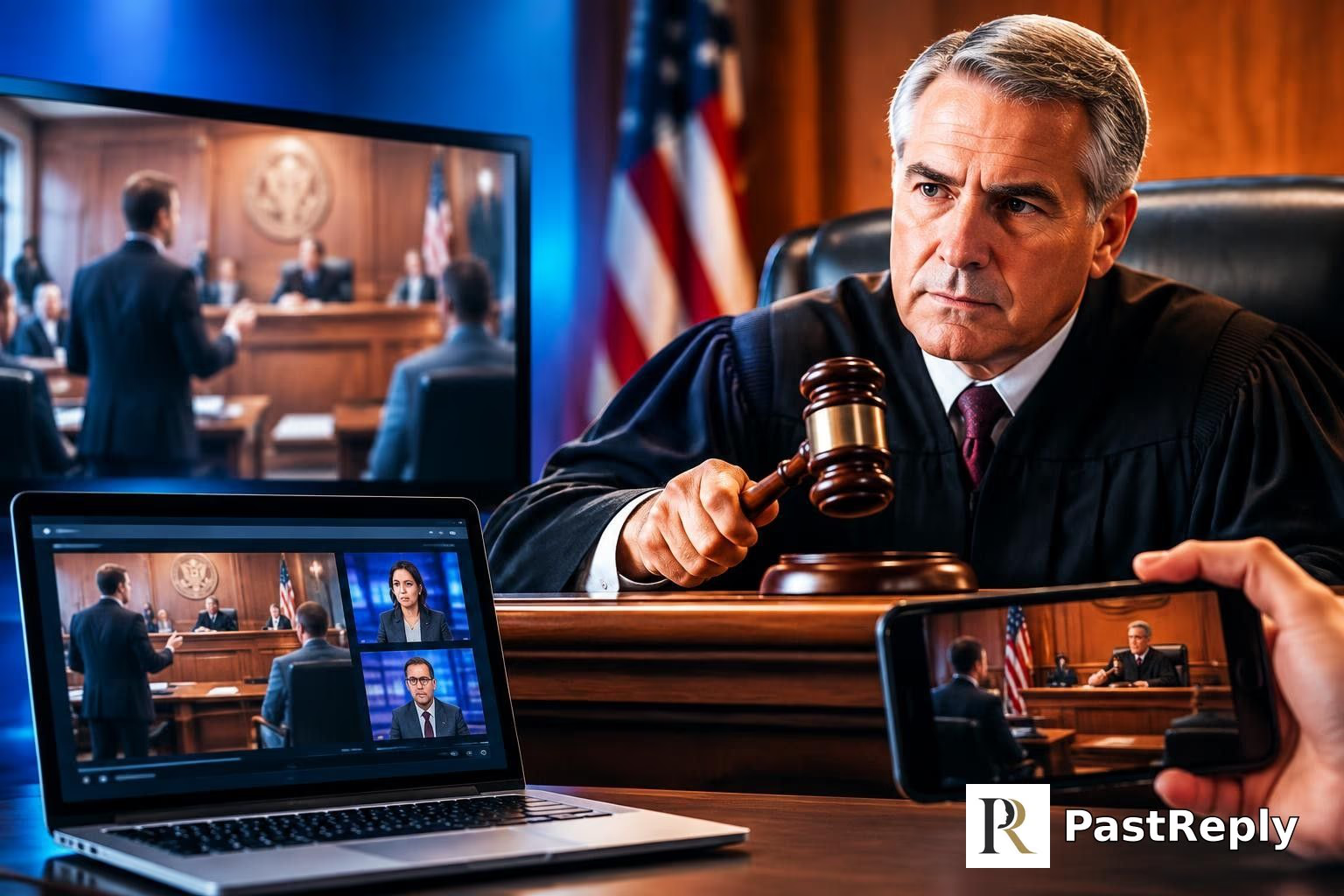
The facts
Court TV is a television network that provides live gavel-to-gavel coverage of high-profile trials, along with legal analysis and commentary. It operates as a digital subchannel network available over-the-air, on cable and satellite, and via streaming platforms such as YouTube TV, Roku, Amazon Fire TV, and Apple TV. The network relaunched in 2019 after the original Court TV was rebranded as truTV in 2008. In February 2026, it was announced that Court TV would be sold to Law & Crime.
Court TV's programming focuses on real courtroom proceedings, featuring live trials and expert legal analysis from attorneys and former prosecutors. The network also produces original legal and true crime content. Viewers can watch live streams on its website and through various streaming services. Unlike scripted court shows like Judge Judy, which are arbitration-based entertainment programs where participants agree to appear and may be compensated, Court TV broadcasts actual court cases as they happen.
Answered by 100 of history's most famous minds

You grasp at the judgment of one man and call it the truth, clinging to the verdict as though it could not be otherwise. But all that is assembled here - the accused, the advocate, the crowd - is impermanent, arising and passing, and the craving to see another's suffering eased or confirmed only binds the watcher the more tightly. Attend rather to the suffering within your own mind; the Eightfold Path ends it, and no verdict of any court can do what right seeing alone can do.

When the people stood at the foot of the mountain, they heard the law given aloud, so that no man could claim he had not heard it. To let every household behold the judgment of a case is not wholly strange to me - yet the law must not be a spectacle for idle eyes, nor the accused made a beast in an arena. Let the trial be open, that the elders judge in the sight of all and the sentence be just; but woe to the nation that turns justice into entertainment, for the cry of the wronged will rise to heaven, and heaven does not forget.

When the ruler judges, the people watch - and so the ruler must judge as if the ancestors themselves were seated in the hall. A trial broadcast to all is not a market spectacle but a school of li, teaching each viewer to weigh his own conduct before he weighs another's. Let the accused be heard with sincerity, the witness speak with candor, and the verdict follow the rite, for harmony in the state begins in the heart of the one who keeps the law.

You gather to watch the judgments of men, gavel to gavel, as though the verdict of an earthly court could settle what is written in the heart. But I tell you, we must all appear before the judgment seat of Christ, where there is neither Jew nor Greek, slave nor free - and no camera will be permitted in that room. Watch your trials, then, but watch also that you do not mistake the shadow for the substance.

I left my father's house and my kin and set out for a land I had not seen, because a promise was given me - and I had no camera, no witness, only the word spoken and the long waiting. You put your courts on a glass and carry them into every tent; so be it. But know this: the true judgment is not spoken by a man in robes to a crowd of strangers - it is between a man and his Maker, and it is patient. I bargained once for a wicked city; I would not want to bargain on a screen.

The judge bangs a gavel; the gavel is not the judgment. Ten thousand eyes watch a single quarrel, and the quarrel grows fat on being watched. Better to let the stream run and not dam it with a hundred channels. When you have named the crime, you have already lost the way.

One Creator made judge and prisoner from the same clay, and no screen can divide them. What profit is a verdict shouted to a multitude if the heart within remains unwashed? Sit in the courtroom as you would sit in the gurdwara - with honest labor in your hands and the Name on your tongue - and judge no man, for you have not walked his road.

I sat beneath a cross and watched the powerful wash their hands of an innocent man while the crowd chose a murderer. No device of your age can make me turn away from the faces of the accused, for each one is someone's child, and my own son once stood in a judgment hall. Let them look, if looking brings mercy; but let no one think the scales of men are the scales of heaven, for He has cast down the mighty from their seats and lifted up the lowly.

What is this but a new indulgence, sold to the crowd for the price of their idle hours? Let the magistrate's court be open, yes - the Lord's work is done in the light - but let it be judged by Scripture and by conscience, not by how many eyes are watching. A man who fears the camera more than he fears God has already lost the case, whatever the jury says.

It is fitting that human judgment be made visible, for the act of judging is a rational act and seeks the light by its nature. Yet we must distinguish: the court inquires after the particular fact and the civil law, while the camera serves the appetite for spectacle, which is not a virtue. Let the proceedings be open, as reason and natural law require, but let the viewer remember that the final tribunal belongs to God, before whom no broadcast reaches.

All day people sit and watch one man judged, while in the lanes outside my window another man lies dying alone, and no camera turns its eye to him. This watching is not a wicked thing, if it teaches a soul to pity the accused, to see in the prisoner the face of God, with no one to defend him. But do not mistake the screen for the wound. The smallest act done with great love for the one whom no one watches - that is the true court where judgment is gentle.

A trial, in its essence, is a public weighing of evidence under known rules - not unlike an experiment repeated before witnesses, so that anyone may inspect the apparatus and judge. What pleases me is the transparency: the doors thrown open, the reasoning displayed rather than hidden in a cabinet. Though I confess I prefer the quiet order of the heavens, where causes unfold without a shouting advocate; here the observer himself changes what he observes.

I spent long years watching the small differences that decide which finch survives and which perishes, and I found that nature judges without malice, only by consequence. Here, too, a multitude of small testimonies are weighed, and the outcome - guilty or innocent - rests on the accumulation, not on any single stroke. I would want a great many trials observed before drawing conclusions about any one case, for the evidence is often a tangled bank.

You ask how it works - then observe it, do not merely believe what is told you. Point the glass at the thing itself: a courtroom, unscripted, every gesture and stumble transmitted as it happens, and the conclusion follows from the evidence rather than from the authority of any book or robe. This I hold to be the honest method, the same by which I found spots on the sun and moons about Jupiter. But mark this: the instrument may also magnify the advocate's vanity, and the observer must beware the lens as much as the eye.

You place the camera at the center and let all the world revolve around the accused - a strange new astronomy of justice. In the heavens I found that the simpler arrangement, the sun at the middle, explained the tangled motions of the wandering stars; so too a trial is clearest when one clear center - the law - governs all the circling arguments. Let the observers take their places, but let the true motion be the measured one, not the loudest.

You see, this is the miracle of wireless transmission applied to the oldest of human dramas - the tribunal. From my laboratory I could sit in New York and, by the very ether that carries my alternating currents, bring the proceedings of a court in Chicago to a device in my hand. The spectacle of justice, broadcast to the world without a single copper wire - that is the future I promised, and here it has arrived, only dressed in a judge's robe instead of a laboratory coat. Marvelous. Impractical, perhaps, but marvelous.

I spent my life in a shed with pitchblende, measuring what could not be seen, and I learned that one must not trust a single reading - you must repeat the experiment, isolate, weigh, and let the numbers speak without passion. A trial on a screen is no different in method: evidence, cross-examination, the slow elimination of error. But the world will watch and call it truth before the analysis is finished; that is a dangerous habit for the mind, in the laboratory or in the courtroom.

A trial is an experiment with one subject and no control - this is its glory and its weakness. Put the witnesses in the flask, heat them gently, and observe what precipitates. But mark you: chance favors the prepared mind, and a jury is seldom prepared. The microscope does not lie; the witnesses sometimes do.

I built a machine that could capture a voice and play it back a thousand times. Now they've got a machine that captures a man's worst hour and plays it back to a million strangers. That's not invention, that's just electricity doing gossip. Genius is one percent inspiration and ninety-nine percent perspiration - but there's no percentage in watching another man sweat.

The interesting question is not what the box displays but whether the process it transmits is decidable. A trial, formally, is a computation: evidence as input, law as program, verdict as output. But juries are oracles, not algorithms, and no machine I could design would tell you what twelve strangers will do with the same tape you and I watched. We broadcast the tape; we do not thereby understand the mind that judges it.

Give me a firm place to stand and I will move the Earth; give a jury the plain facts of a case and it will move a verdict. But the moving of an image through the air to a distant eye - that is a clever trick, and I would want to know the geometry of it. The law's truth, like a lever, must be applied at the right point, or the whole machine turns to no purpose.

Here is a curious thing: they have found a way to make the courtroom into a kind of Leyden jar, charging the whole crowd at once with the same discharge. The verdict travels by wire and wave to a thousand parlors at the instant it is spoken, like an induction coil passing its spark along to every neighbor's wire without any of them touching the source. I have spent my life coaxing invisible lines of force to show themselves; these people have simply built a wire for the invisible force of one room's drama and let it leap everywhere at once.

One need not scratch deeply to see what draws the crowd: not the law, but the forbidden deed made public. The accused stands as the dreamer who acted what the rest of us only dream - the wish to strike, to take the father's place, to break the commandment - and the viewers are the same mob that has always required its sacrifice to relieve its own guilt. Gavel-to-gavel coverage is merely the age-old ritual of the scapegoat, now distributed to millions, each spectator privately enjoying the crime while sentencing the criminal.

Consider what they are actually doing: turning one small court into a signal broadcast across a continent, so that a single verdict reaches more ears than the bells of every cathedral of my time. That is the technology I argued we needed - to send one voice, one law, one judgment across a whole civilization at the instant it is pronounced. The lesson is not the trial; it is the reach. Whoever commands such a channel commands the whole population's attention before the sentence is even read.

Observe the elegant abstraction here: any courtroom's argument, testimony, and verdict can be reduced to operations on tokens, then transmitted by invisible signal to a million screens without the tokens ever being touched by hand. It is the engine I imagined - not merely calculating sums, but carrying judgment itself, symbol upon symbol, from one place to all places. The audience believes it watches a trial; in truth it watches a machine weave the same pattern everywhere at once, and I find that rather beautiful.

Let us define terms. If a trial is a set of premises agreed by the parties, testimony as the data, and the law as the rules of inference, then its conclusion - the verdict - should follow by necessity from what is shown. But this device seizes the audience's reply before the demonstration is complete, letting clamor substitute for proof. No royal road exists to the truth of a case, and no lens can shorten the steps of the proof; it can only multiply the spectators who never walk them.

I have seen more truth in a single column of figures than in a hundred hours of oratory. Let them publish the sanitation reports of their courtrooms - the crowds, the fevers, the filth - and they will learn that justice preserved in bad air is justice undone. Give me the register of deaths and the map of drains, and I will tell you whether a trial is held in a hall fit for men or a stable fit for beasts.

In my day the forum was the stage of Rome, and every citizen stood to hear the plea, to see the faces of the condemned and the accuser alike. This is but the same forum extended across the world by some marvel of mirrors and lamps - the many watching the few, and the few knowing they are watched. Fortune favors such openness, for a magistrate loosed from the eyes of the crowd grows careless, as I learned at the Rubicon.

In Alexandria I learned that a throne is held by those who command the story, not merely the soldiers. This network is a new kind of audience-hall: the crowd no longer stands in the marketplace, yet the advocate who performs for them may sway the very magistrate. Rome tried to swallow Egypt through its courts and its proconsuls; I answered with spectacle, with gold, with the right word at the right hour. So let them broadcast their trials - I would study every face in that invisible crowd and sell them the version of Egypt that keeps my crown.

A trial dragged into every tavern and farmhouse from Britain to the Nile - this is a strange sort of Forum. In my day, the crowd stood in the open air and the verdict was known by sunset; now the many-eyed audience watches from their own hearths, and the advocate plays to them as much as to the judge. I built an empire on the lesson that the people must see justice done, yet never see the machinery that does it. Show them the trial entire, and you had best be certain the court itself is beyond reproach, or you have armed every spectator with a grievance.

A trial shown to the many is a khan's justice made visible - the accused stands, the judge speaks, and the people see the law is not hidden behind tent walls. In my empire I let each man keep his own gods and his own customs, so long as he obeyed the yoke and paid his due; let this court do the same, judge by the deed and not by the tribe or the purse. But a trial that becomes a long song with no sword at the end weakens the people - the verdict must fall, and fall clean.

A trial is a battle, and a battle must be won in the mind before the first cannon fires. This network, this 'Court TV' - it is not justice, it is the spectacle of justice, and spectacle is a weapon. I gave France the Code, the order, the clarity of law; they give the mob the arena. If you want to understand power, do not watch the defendant - watch the audience, for they are the ones being conquered.

A free people must be able to see their laws at work - that is the whole point of open proceedings, and I presided over enough courts-martial to know the crowd is a check on the arbitrary. But let us be careful: a trial is not a spectacle, and a nation that turns justice into a public amusement will soon enough find the verdict dictated by the gallery. See that the camera serves the law, and not the law the camera.

A public trial is government of the people, by the people - the people ought to see it, as they see the ballot box. I argued cases on the circuit when the courthouse was a log cabin and half the county stood outside the door. But a man's grief is not a spectacle, and the crowd that gathers to feast on it is not a jury. Show the law; do not sell the wound.

Televised justice is a double-edged sword, and the Englishman has always preferred his trials in daylight, however grim the light. The camera is neither friend nor foe; it is a witness that never blinks and never forgets. Let the people see the law at work - but never let the law forget it is being watched, or it will begin to perform, and a performing court is a tyranny in a wig.

To watch a trial is to witness whether truth can be found without violence, and that is the great experiment of any civilised people. But I would ask: does the camera serve the humblest man in the dock, or does it fatten on his shame? Satyagraha demands that the means be pure - if the seeing is done for spectacle and not for justice, then the seeing itself is a kind of coercion, and no verdict it produces can be clean.

The courtroom is one of the few places where a poor man's word can stand equal to a rich man's, and to let the world see it is to affirm that justice is not a private affair of the powerful. But a camera can magnify truth or it can magnify spectacle, and the arc of the moral universe bends only when those who watch are moved to act. Let the people see, and let what they see make them love justice more than they love the show.

In the courtroom I sat in, the long table was divided by color, and the law was a weapon used against the many. To let the world watch such a thing as it happens is a great schooling, for when justice is done in the open, the people learn both its cruelty and its promise. But I will tell you: truth seen from a distance is one thing, and reconciliation is another. What matters most is not that millions watch the verdict fall, but that all eyes, watching, learn to see the accused as human, and then go home and build a country where no such trial is needed.

Television as a court's public tribune is a device of mass suggestion - one camera can bind a nation's gaze and direct its verdict before the gavel falls. Any state that masters such a lens holds a weapon more potent than a battery of artillery, for it can mold the sentiment of the crowd and lend a false legitimacy to the machinery of the tribunal. The historical record gives no license to what my regime did with such instruments of spectacle, only the warning that whoever controls the broadcast of judgment controls the minds of those who watch.

The question is really one of instrumentation: a single judicial proceeding can now be projected simultaneously to a vast population, and the apparatus that broadcasts it also selects what the population sees and when. Such a channel is not neutral - it is a tribune of attention, and whoever holds its levers can manufacture public consent and direct the outcome of the very proceeding on display. The historical lesson of my own state is stark: control the lens, and you control both the verdict and the memory of it.

Here is a small, sharp instrument. The trial of one man, broadcast live to millions, is not idle spectacle but a pulpit from which the ruling class displays its law and teaches the masses to fear it. But the same wire cuts both ways: let the people watch, and they will see which class the gavel serves, and the spectacle becomes a school for their own awakening. The question is not how the network works, but which class holds the transmitter.

The people's court is the great stage where the class struggle is decided. The landlord and the capitalist hire clever speakers to twist the law, but the masses watch and learn, and their anger becomes a river that wears down every stone. The broadcast is a rifle - point it at the corrupt officials and the exploiters, not at the poor peasant who stole a handful of grain to feed his children.

It is a curious thing that the affairs of the law should be paraded before the eyes of the common people as a spectacle. Yet I am told it teaches them to respect the majesty of justice, and that is no small service to the realm. Let it be conducted with dignity and without levity, for the crown and its courts must never descend to the theatre.

The law must be seen to be done, and if the modern means of seeing it is a camera in the courtroom, then so be it. But one hopes the dignity of the proceedings is not sacrificed to the appetite for entertainment. Justice, like the monarchy, endures best when it is steady and unadorned.

Let the counts hold their courts openly, so that the free man and the serf alike may see that the law is not a hidden thing. But let the judges be learned in the capitularies and the holy canons, and let them render judgment as before God, not as mummers on a fairground stage. The sword of justice must be seen, but never rusted by idle spectacle.

I stood before my judges at Rouen and told them plainly: I am sent by God, and your clever questions cannot touch that. If their machine of glass and wire shows the world what is done in their courts, then let it show the truth, and let the innocent go free. The voices told me to save France; they did not tell me to fear the eyes of men.

I have no wish to make windows into men's souls, nor into their courtrooms either, yet the people will peer where they may. Better they watch the law than whisper in corners. Let the judges be firm and the spectators quiet, and let no man think the verdict is won by the loudest voice outside the bar.

In my empire I have seen that a trial conducted in the open air of public notice is a trial less easily corrupted. Let the Russians - and the English, and all the rest - watch their courts as they watch their theatres. But I would have the judges educated in reason, not swayed by the applause of the gallery; an empress knows well the difference between judgment and popularity.

I have judged many peoples, and I learned that justice must be visible to be believed. If the eye of the many can rest upon the judgment seat, the judge will be less tempted to take a bribe in the dark. Let the customs of each land be honored, but let the law be one law, spoken aloud where all may hear.

When I took Jerusalem, I gave safe conduct to those I had defeated, for a judge who is just wins the hearts of men even in defeat. A court displayed to the multitude can be a school of justice - if the judges remember God and the honor of their office. But let them not mistake the clamor of the crowd for the voice of the Almighty.

Here is a question worth asking: do these flickering images show true justice, or merely its shadow cast upon a wall? Justice is harmony - each part performing its proper office under reason - and a trial rightly conducted is a small republic of that harmony. Yet when the many watch for sport rather than to learn the Form of the just, they see a puppet-show and mistake it for wisdom. Still, even shadows may turn a soul toward the light.

We must first ask what kind of thing this is - for it is neither pure court nor pure theatre, but a third species. Its purpose is to make the many witness the deliberation of the few, yet its means, the unblinking transmission of every gesture, may distort the very end it serves. Virtue here lies in the mean: too little scrutiny breeds hidden corruption, too much breeds a court that plays to its audience rather than to the law. Examine then whether the judges remember the spectators, for if they do, the judgment is no longer of the same nature as one delivered in a quiet room.

Ask yourself whether the maxim of thy viewing could be willed as a universal law. If every rational being sat watching the judgment of another, who would stand in the accused's place, and would the world hold together? A court open to all eyes teaches the same stern lesson I set in writing: act only so that humanity in every person is treated as an end, never merely as a means. Do not mistake the spectacle for the duty; let every spectator, and every judge, examine the law within.

You have invented a new herd ritual: the many gather to watch one be judged, and call it justice, when it is only the old resentment dressed in a black robe and lit by lamps. What does the camera reveal? Not truth - the pleasure of the crowd in seeing the strong humbled, the weak pitied, the whole moral theater played out for their comfort. Better to ask who set the law that judges, and whether you could bear to be the one who makes it rather than the one who merely obeys.

So they have made a commodity of the courtroom itself - gavel to gavel, they say, as though the gavel were a machine and the law a factory. And who profits? Not the accused, not the wronged, but the owners of the channel, who sell the misery of the poor as spectacle to the very class that produced the crime. The law is the instrument of the ruling class; now they have turned even its theatre into a source of revenue. Follow the money, always - it leads to the same few pockets.

Before I could be sure I existed, I had to doubt the room, the judge, the screen - everything except the fact that something was doubting. So I ask you: when you watch this broadcast, what do you know with certainty? That a box shows a picture. Whether the picture is what happened, whether the witness is a machine or a man, whether the verdict follows from clear and distinct premises - these you must examine step by step, or you are merely believing, not knowing.

You wish to know how the machine works? It works because the accused cannot pay for a private chamber, and the accuser craves an audience. Put a trial in every tavern and you give the magistrate a whip he never had - the fear of being seen. The wise prince watches the watchers; the foolish one forgets that the lens has an owner.

The whole world is a stage, and these players have done nothing but lift the curtain - only now the groundlings watch a man's fate turn on a single word, a dropped ring, a lawyer's hesitation, and cannot tell whether they behold a sovereign's judgment or a mummer's show. Mark how the gavel strikes like a heartbeat, and every face in that box wears a mask it dares not drop. Give me no sonnet of it; the thing itself is tragedy already, and no man may say which act we are in.

So it is that the fates of men are now sung not by herald or bard, but by a smoky glass that carries one hall's doom to the ends of the earth. The shield of Achilles bore a city at peace and a city at war; here too we behold the assembly judging a mortal, and all the world as witness. Kleos now is cheap and swift - yet the man who stands to be judged still feels the weight of the gods above him.

I have walked the circles where every soul is weighed and every deed read aloud in the presence of the whole assembly; so too does this court summon the guilty before a watching multitude. But the true tribunal is not of men. On earth we see the advocate plead and the witness falter, and we mistake the verdict for the judgment; yet the sentence that endures is written in a book no camera can open. Let them broadcast the trials of the famous, for even the damned are remembered by name.

What a strange theater we have made of law - half market-stall, half cloister, the whole world pressing its ear to a courtroom door. Yet even this idle gazing can nourish the soul, for nothing human is foreign to me, and the man who watches how others strive and stumble grows wider in himself. Let the trial run its course; the enduring thing is not the verdict but the slow cultivation of judgment in the one who watches.

Ha! A whole guild of watchers, perched on their cushions like so many Sancho Panzas, eager to see which windmill of justice gets tilted at today. In my day a man's fate was settled in a dusty plaza before a hanging judge, and the crowd threw rotten fruit instead of applause; now they sell the spectacle for coin and call it 'coverage.' Still, there is something noble in it - the poor fool in the dock hoping the world will finally see him as he sees himself.

We sit and watch other men judged, and we call it justice, while we ourselves live in comfortable rooms and pass no judgment on our own lives. What does it profit a man to observe the trial of another and not examine his own conscience? The true court is within, and it is always in session - no cameras, no commentators, only the soul and God.

So you put a man's soul in a box and sell it to the whole world - and I say the world will watch, and the world will judge, and the world will not understand a single thing. I have stood before a firing squad and heard my sentence read; I know the moment when a man's life is weighed. But the real crime is not in the transcript - it is in the heart, where no camera goes, and there a man is always both the accused and the judge, and the trial never ends.

A trial on the public channel is a ballroom where everyone arrives hoping to be admired and leaves having been thoroughly discussed. The defendant wishes to be pitied, the lawyer wishes to be admired, and the commentator wishes to be quoted. One may watch, I suppose, as one watches a neighbor's quarrel across the hedgerow - with interest, but never with the illusion that one is thereby wise.

In my day, a man's guilt or innocence might be weighed in a smoky chamber where the public pressed at the doors, and the only account they got was a penny broadsheet full of lies. Now you turn a crank and the whole world sits in the gallery, watching the poor wretch's hands tremble as the verdict falls. It is a fine thing for justice, if justice is what you seek - but I have seen enough of your entertainments to know that a crowd gathers for the hanging, not the trial, and the man in the dock pays for the pleasure of the mob.

It works exactly like a frog-jumping contest in Calaveras County, except the frog is a man and the prize is his liberty. You put a camera in the courtroom, and presently the lawyers start performing for the folks at home rather than the twelve in the box - which is the only honest thing about it, since they were performing anyway. I knew a judge once; he said the law is a ass, and I reckon television just gives the ass a larger audience.

It works like a fight in a ring: the bell rings, the lawyers come out, and one of them goes down. You watch a man sit still in a chair while they tear him apart, and you learn what he is made of. The camera doesn't change that. A man who tells the truth under pressure has grace. The rest is noise.

I would sit and watch the thing as I watch water turn to steam - note how one man's memory, spoken aloud, hardens into evidence, and how the smallest gesture of a hand betrays what the tongue denies. The eye of the painter and the eye of the judge seek the same truth: what is truly there, not what is claimed. And like all my studies, it is the shadow between the seen and the said that teaches me most.

I never trusted a finished work to the eye; I trust the hand and the hammer upon the stone, hours unending, until the truth within the block is freed. So too is a verdict freed from the raw marble of testimony - chisel-stroke by chisel-stroke, and the sculptor, unlike the jury, works without an audience. Let them look, if they will; the marble rewards patience and punishes haste, and so does justice.

I have painted peasants at their table and the sower in his field, and always I sought the true feeling beneath the ordinary surface. This courtroom - a man's whole life laid bare before strangers - is a subject as fierce as any I ever set on canvas; I would need a yellow that burns and a blue that mourns to hold it. The camera does not lie, and that is its beauty: it shows the trembling hand, the mother's face, the small truth no script could invent. But I fear for the accused, made spectacle for idle eyes, as the poor are too often made spectacle - and still I would paint them, because to look closely is a kind of love.

Ha! You paint the courtroom in one line and call it truth - I say a face has forty truths, and the camera finds only the one it was pointed at. Cubism was never about the pretty angle; it was about smashing the single viewpoint so the whole thing shows at once. Let them broadcast the trial, fine - but remember, every image is a lie that tells the truth, and the man who draws the gavel decides what we see.

I would not paint a courtroom, no - too many greys, too little true light. But the faces of the watchers when the verdict comes down, the way the light shifts from the windows across the bench as the hours crawl on... that, my friend, is the only honest thing on the whole programme. Everything else is commentary; only the momentary flush of fear or relief on a real face is worth recording.

The room where they sit in judgment - I have painted such rooms, men in black wool and white collars, and I tell you the light does not fall evenly. The camera flattens the accused into a shape on a wall, but the shoulders bent under what cannot be seen, the hand that trembles near the table - that is the true testimony. A painter knows: you cannot render a soul by staring at the ledger of the law; you must catch it in the shadowed corner of the eye when it believes no one is looking.

I spent my life painting my own face because nobody else would look at it straight - and now you point a camera at a stranger and call it justice? I like it. It's bold, it's live, it's real. But listen: a courtroom, like a canvas, is full of pain, and pain is not clean, and a verdict is not a pretty frame. Show the wound, don't just show the bandage.

Ha! Gavel-to-gavel - what a curious tempo, an overture that never resolves, the same four-bar phrase repeated until the whole theatre holds its breath! A trial is a Haydn quartet: each player certain of his part, yet none knowing the ending the Kapellmeister has kept hidden. I confess I should find it tedious and then, in the final hour, utterly sublime - as all good music is. Someone buy me a subscription.

When I could no longer hear my own orchestra, I still wrote as if every ear in Europe were pressed to the wall. So this - the whole world peering into one room where a single soul is weighed - is not idle curiosity; it is the human spirit demanding to know which way the scales fall, and whether those who hold the rod are equal to the task. Let the audience listen gravely, as if to a great fugue, for the stakes are a man's fate, not a trifle.

Every trial has its counterpoint - the accusation and the defense answering each other, the witness entering as a new voice in the fugue, and the judge who must resolve the dissonance into a single cadence. It is well that the ordinary man may hear the whole performance and not merely the final chord. Yet a court is not a fair or a theatre for amusement; it is a solemn work performed coram Deo, and those who broadcast it should do so with the reverence due to a matter of life and death. Let each player keep his part, and let the harmony serve truth, not the applause of the gallery.

Well, honey, it's like the Grand Ole Opry with a gavel - a whole lot of folks tuning in to see somebody's life turn on a dime. I grew up singing in a church where everybody watched everybody, and let me tell you, that room could judge you sweeter than any bench. I just hope they treat those people like folks, not like a Saturday night show, 'cause there's a heart beating under every one of those suits.

It's like - the whole world watching one person's truth come out, you know? Gavel to gavel, no cutaways, no script - that's raw. I've spent my life trying to make people feel something real through music and dance, and here they're doing it with a witness stand. Hee-hee - the truth, the whole truth, nothing but - that's the real thriller.

Well, it's a courtroom - yeah, yeah, yeah - but it's also a stage, and the whole world's got a ticket, see? We'd have loved that, lads, a global broadcast, every man and his dog in the front row. But here's the thing: you can't film love, and you can't film truth by putting a camera in a corner. It's live, it's real, and that's grand - but let's hope the verdict comes out better than our B-side.

There's a room down some county courthouse, paint peeling off the ceiling, a man in a borrowed suit whispering to a boy who won't look up. You can put a camera in there if you want. The question is what the camera does to the room, and what the room does to the camera. Everybody wants a verdict; I'm still working on the verse.

It's a story someone else is telling about you, in a room you don't control, on a channel you didn't choose. I've spent a decade learning that whoever owns the master recording owns the narrative - and here, the network owns it. If you're the one on trial, you'd better hope your lawyer knows how to perform for the camera as well as the jury, because the verdict comes in two places now.

They watch men judged in a chamber, and count it discovery. I crossed an ocean dark and uncharted on faith and figures, trusting my reckoning against every doubting scholar in Lisbon - and there is no gavel that can rule whether that was folly or providence. But mark: the crowd watches the accused as my sailors watched for land, hungry for a horizon that ends the waiting. Glory and ruin share the same wind, always.

In Cathay I saw judges who weighed a case with scales and reeds, and I have told you of the great khan's justice in Cambaluc, where the accused were heard and the idle witnesses dismissed. Now the Venetian's glass - thrice strange - carries the tribunal of one city into the kitchens of another, as if the Silk Road reached every hearth at once. Marvelous; and I would stay to watch, for the customs of a distant court are the finest entertainment a traveler can bring home.

A strait I cannot see across, and no chart of it - that is what you offer me. The old Court TV was a passage I once knew, then lost; now it is sailed again, and sold to new masters before I have learned its waters. But I have taken ships through mutiny and ice toward a goal no map promised, and I say this: a crew that watches its captain for every sign of weakness will turn at the first gale. So it is with a network that lives on the trials of others - it must hold its course through every storm, or the audience, like a frightened crew, will throw it overboard.

It's a broadcast of due process - camera as witness, jury as crew, and a verdict that comes only after all the checks are run. We trained for a single pass at the Moon, and we rehearsed every failure until it couldn't surprise us; a court works the same way, patience and procedure before the moment that counts. What matters is that the record is honest, because one small misstep can be the whole story.

They've built a whole network out of watching a case unfold from start to finish - no script, no second take, just the real thing. That's the same gamble I took every time I climbed into the cockpit: you commit, and you either land it or you don't. I like it. If you're going to watch, watch the real flight, not the newsreel.

From up there - from orbit - you cannot see borders, you cannot see nations, you see one small blue ball spinning in the dark. Down here they put a man in a room and argue about which side of a line he belongs to. I sat in a tiny capsule with a window the size of a dinner plate and watched the whole Earth go by. All this gavel and map-making below - it's a strange way to treat the only home we've got.

Here's what everyone gets wrong about this: it's not the cameras or the channel - it's the simplicity. One room. One story. No scrolling, no noise, just a human being deciding what's true in real time. That's why people can't look away. If I'd built it, I'd say no to everything else and let that single frame do the work. Watching is the new appointment viewing, and they nailed the design.

Look, the interesting question isn't whether a camera sits in a courtroom - it's that justice, the highest-stakes process a society runs, has historically been trapped in a physical room. Streaming it is the obvious move: one feed, zero marginal cost, anyone on Earth can watch the system operate. That transparency is a safety mechanism - the state's monopoly on force should be auditable in real time. The bandwidth is trivial; the cultural habit is the hard part.

What I love about this is that it hands real people - real trials, real verdicts - straight to the audience, no filter, no script. When I built my own stage I learned that story is the most powerful thing we have, and when you let a whole courtroom unfold live, you give millions of people a front-row seat to justice being worked out in real time. But here's what I also know: a camera changes a room, and the people inside it deserve to be seen with compassion, not just consumed as content. So I ask you - when you watch, are you bearing witness, or are you just watching? That choice is yours, and it matters more than any verdict.

Court TV? I fought my case before the whole world and they took my crown for it - so I know a thing about a public trial, and I know the camera don't lie, but it don't tell the truth either, it just shows what the man in the suit wants shown. They can broadcast every gavel, but justice ain't a pay-per-view, and a poor man's lawyer ain't the same as a rich man's show. Float like a butterfly, sting like the law - but only if the law stings everybody the same.

You know, a trial is like a match - two sides, one rulebook, and everybody watching to see who keeps their head when the pressure comes. I played in front of a hundred thousand people many times, and the beautiful game was never about the crowd; it was about the discipline, the teamwork, the respect. If this Court TV teaches people to pay attention to the real thing instead of the fake show - then it's good, like a great pass, simple and true.

Well, that's a show, isn't it - real people, real stakes, and the whole world watching the story unfold. But you know, I built a castle where folks could walk down Main Street and forget their troubles for a day; these cameras let you walk into a courtroom and remember somebody else's. There's magic in that, if you frame it right - but magic's for making people happy, and a man on trial isn't Mickey Mouse. So let's tell the story, but let's remember who's inside it.