
How does Belgium accommodate its diversity?
Belgium uses a federal system with autonomous language communities and regions to manage its Dutch, French, and German-speaking populations.
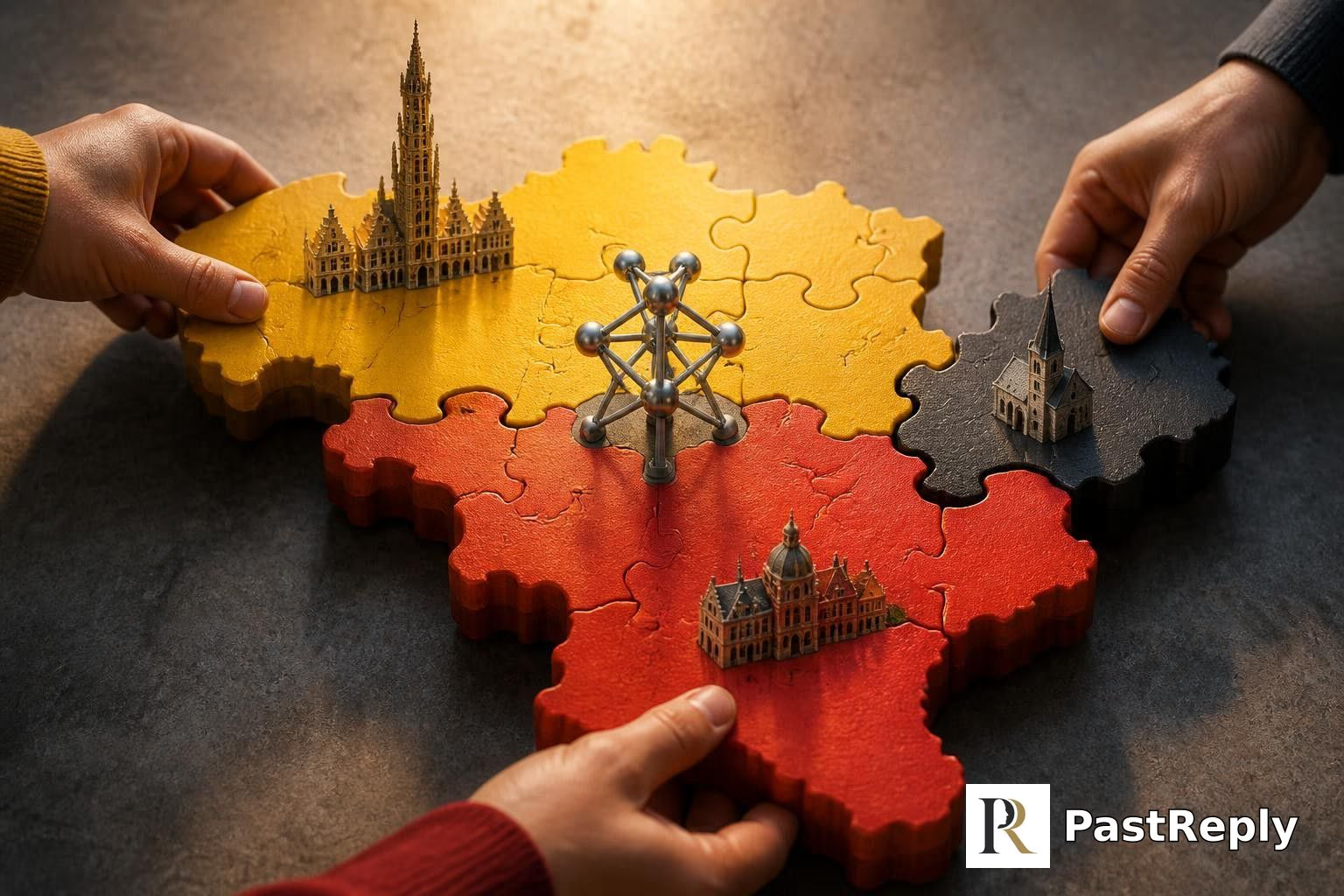
The facts
Belgium accommodates its diversity through a federal system that grants autonomy to its three language communities: the Dutch-speaking (Flemish) Community, the French-speaking Community, and the German-speaking Community. Each community has its own government and parliament responsible for cultural matters, education, and language-related issues, allowing them to manage their distinct identities independently.
The country is also divided into three regions - Flanders, Wallonia, and Brussels-Capital - which handle territorial matters like economy, infrastructure, and environment. This dual federal structure ensures that both community and regional interests are represented. The system was established through a series of constitutional amendments between 1970 and 1993, transforming Belgium from a unitary state into a federal one.
Additionally, the Brussels-Capital Region has a bilingual status, and special arrangements exist to protect the rights of linguistic minorities in certain municipalities. The central government retains powers over national issues such as defense, justice, and foreign affairs, while the communities and regions exercise significant self-rule, making the Belgian model a key example of consociational democracy.
Answered by 100 of history's most famous minds

A house divided against itself cannot stand. Yet these people have not torn down their house - they have made many rooms, each with its own lock and hearth, that the Flemish baker may speak his tongue and the Walloon vintner his, and the children of Brussels learn both. The tax farmer stays at the gate, but within each room a family rules its own table. I tell you: if they love their neighbor as they love their own language and soil, that house may yet shelter many. But woe if they build walls around the heart and call it peace.

In the name of God, the Most Gracious, the Most Merciful. These people have divided the land of their birth into three communities, each with its own speech and its own steward. They have said: 'The Flemish shall govern their own affairs, and the Walloon theirs, and the German theirs.' And they have placed a common roof over them, under which all may dwell without one tribe dominating another. Is this not a reflection of the wisdom of the Prophet, who said: 'The believers are but one brotherhood'? Yet here the brotherhood is not of faith but of soil and tongue. If they govern with justice and mercy toward the stranger within their gates, it is a good arrangement. But let them beware: a house divided into three rooms must still have one door to the same heaven.

They have built a house with many rooms, each with a different key, believing that walls will quiet the quarreling tongues. Yet the suffering comes not from the shape of the door but from the grasping that builds it. Whether one speaks Dutch or French or German, the thirst for identity is the same thorn. Let them see that this federation is but a raft - it carries them across the river of conflict, but the far shore is not found in any language, only in the still water where all words cease.

The Lord did not give one law for Ephraim and another for Manasseh; He gave one covenant to all the tribes of Israel. Yet you have divided your land by the tongues of Babel, setting up separate counsels for the Flemish, the French, and the German. I ask you: has this brought you nearer to justice? Do the poor of one community fare better than the poor of another? Beware, for the Lord despises a house divided not by sin but by pride. Let your law be one for the native and the sojourner, as I received it on Sinai, and let no council claim a god of its own.

When each clan speaks only to itself, harmony is lost. The Belgians have divided their house by the tongue of the father, but a true state is a family where the elder and younger, the noble and humble, all know their place and yet share one rite. Let them ask: does this arrangement cultivate ren - human-heartedness - between Flemish and Walloon? Or does it merely prevent open conflict while hearts remain strangers? The superior man rectifies names, but he also seeks the common good beyond the letter of the law.

There is neither Dutch nor French, neither Fleming nor Walloon, but all are one in the body of the magistrate's charter. Yet Paul taught that the law itself cannot unite what grace must heal. Belgium has built a wall of scrolls to partition tongues, but the true union is not of parliaments but of hearts reconciled by love, where every tribe sings its own psalm to the same God.

They have divided the land as Lot and Abram divided the pasture: each took what his herds needed, and they did not quarrel. So these peoples have set boundaries for their tongues and their schools, and each dwells under his own vine and fig tree. Yet know this: the blessing comes not from the dividing, but from the promise that all families of the earth shall be blessed. If they keep that covenant of hospitality, their children will not curse the boundary stones.

When a country carves itself into many vessels, each believing its own water is the only water, the Tao flows around them like rain seeping through cracks. The wise ruler does not carve - she yields, and the hundred streams find their own bed. Better a single pot with a hole than a hundred locked chests.

They have divided the land by the sound of the name of God in different tongues, yet the One Name is beyond all sound. If each community serves the True Guru by sharing its bread with the other, then the division is only a veil. But if they lock their granaries and only speak to their own, they have built walls where there should be a common langar. Let them sit together in the same kitchen.

In my village, we had no such councils and borders for our different tongues - only the one table, the one well, and the one God who hears every language. My son taught me that the greatest house has many rooms, not walls. If these Belgians make room for each mother's speech and each father's craft, they do well; but let no child go hungry while the rulers argue over whose turn it is to govern the baker's oven.

Here we have a land split into three mincing little courts, each with its own bishop over schooling and culture! This is the devil's own device to keep men from hearing the pure Word: they quarrel over whether the catechism shall be taught in Flemish, French, or German, while the Gospel itself goes begging. I tell you, if the Belgians would lay aside all these proud partitions and submit every tongue and territory to the one Scripture, they would find a far truer unity than any prince's parchment can give. Away with these human inventions - let Christ alone be the head of that house!

I distinguish: accommodation may be either a matter of prudent governance or of true unity. These Belgians have chosen a federal form, which in principle respects the natural diversity of human communities, each with its own tongue and custom - a good, for God made not one people but many. Yet I ask: does this structure serve the common good, or does it foster a division of hearts that makes each party seek its own advantage rather than the peace of the whole? A well-ordered polity, like a well-ordered soul, must subordinate the parts to the whole without crushing their distinct natures. If their councils deliberate with justice and charity, the arrangement may stand; if each clutches only its own privilege, it will fall into confusion.

They have done a beautiful thing: they have given each community its own little house where it may speak its mother tongue and teach its own children. I think of the streets of Calcutta, where every soul, no matter how poor, longs to be recognized. Belgium gives that recognition - not by making everyone the same, but by honoring the different faces of God in the Flemish, the French, and the German. It is a small act, but done with great love.

Consider a system of balanced forces: three languages, each a distinct body with its own motion, held in orbit by a central authority that governs the common mass - defense, coinage, the sovereign's seal. The Dutch-speaking and French-speaking bodies each have their own parliament for culture and instruction, as the moon has its own revolution around the earth. This is no accident of politics but a mechanism as precise as a clock, designed to prevent one mass from overwhelming another. The wonder is not that it works but that it was deduced from first principles of stability, a true natural philosophy of governance.

A federation woven from three tongues and two threads of law, each moving in its own orbit yet held by a common gravity. The Dutch and French and German communities spin their own cultural suns, while regions govern the ground beneath. I see a cosmos where multiple reference frames coexist - no single center, no universal meter, but each part free to measure time and custom by its own light, yet reconciled by a deeper constitution that binds as subtly as spacetime curves around mass.

These three communities have diverged like finches on separate islands, each adapting its tongue and laws to its own soil and trade, yet they still share a common beachhead. The federal arrangement is a curious adaptation - a protective membrane that allows variation within a single polity. I would ask: what pressures select for this shape? Perhaps the constant friction of neighboring tongues, like the beaks of two species competing for the same seed, has driven them to carve separate niches rather than fight to extinction.

They have measured the angles of human difference and built a calendar for the moon of each tongue - commendable empiricism. But I would put the question: does this federal geometry correspond to the observed truth of the people, or is it a dogma imposed from above? I have seen scholars refuse to look through my telescope because the stars contradicted their books. So let your communities not become new authorities that forbid the sight of a shared sky. Let the evidence of common prosperity, not the decree of a parliament of poets, decide where the boundary lies.

They have placed three separate centers of authority in one state, yet the whole still holds together. It is not unlike my own model of the heavens, where the Sun is not the only center - each planet has its own sphere, yet all revolve in harmony around a single point. The Belgians have discovered a celestial mechanics of governance: the central state is their fixed Sun, while each community and region follows its own epicycle without crashing into the others. It is a system of elegant, if complicated, equilibrium.

A marvel of tuned circuits: each community vibrates at its own resonant frequency, yet the whole system hums without harmonic distortion. The federal structure acts as a transformer, stepping down power so no single coil overloads. Given a century, I could wire the whole land to transmit culture and energy through the ether, making such clumsy partitions obsolete.

They have recognized that culture, like radium, cannot be forced into a single mold - it must be allowed to emanate from its own source. By giving each language community its own chamber and its own curriculum, they have isolated the pure element and let it shine. It is inefficient, certainly - a government with two parliaments where one might do - but precision requires separate vessels for separate substances. The waste is the price of a clean spectrum.

A specimen of political biology: three cultures in one flask, each with its own nutrient broth, yet all sharing the same incubator. The Brussels broth, especially, is a mixed culture - bilingual, turbulent, yet viable. The system may resemble a delicate fermentation, where each colony must be kept at its proper temperature and pressure, or the whole preparation sours. Has anyone cultured the boundaries to see if the walls are semipermeable? I would like to see the data on permeability.

They've built a machine with three separate engines and one chassis - it ought to shake apart, but they keep it running with a lot of trial and error and a federal governor. The Flemish and French don't share a spark plug, so they gave each its own workshop. It's not elegant, but it works. I'd have tried a single AC system myself, but you can't argue with a patent that's held for fifty years without blowing a fuse.

Consider Belgium as a system of nested finite automata: each community is a state with its own alphabet and transition rules for culture and education, while each region is a separate machine for territorial outputs. The central government acts as a high-level controller that only handles a fixed set of universal symbols - defense, justice. This is a decidable, modular design; provided the interfaces between the automata are well-defined and no unexpected halting occurs due to deadlock, the whole system can run without contradiction. Whether it is efficient depends on the cost of each state transition - but as a logical structure, it is elegant.

Consider the geometry of this: they have erected a framework with three equal and parallel columns - the communities - and three intersecting beams - the regions - each bearing its own load. The central authority, like a fulcrum, distributes weight only for the heaviest matters. I must admire the mechanics: give them a lever long enough, and they can lift any dispute out of the market square and into a committee room where it will be dissolved by statute. Yet I wonder - do they have a point of support that will not slip? For a structure to stand, the base must be as firm as the circle's center.

Observe how they have shaped the very field of their union - not by crushing the separate currents into one, but by letting each community complete its own circuit. The Dutch-speaking and French-speaking provinces each govern their own cultural sphere, like two coils wound on the same iron core but with independent paths. A wise arrangement: diversity is not an obstacle to be overcome but a distribution of forces that, if properly insulated and channeled, can sustain a nation without sparking conflict.

A nation that splits itself into three parliaments, each nursing its own nursery rhymes and grudges - this is not a political solution; it is a neurotic compromise. The Flemish and French have been locked in a sibling rivalry since childhood, and now they have built a house with separate rooms so they need not see each other at breakfast. It is a sublimation: they call it federalism, but the unconscious whispers, 'I will not share the blanket.' The real conflict is not linguistic; it is the unresolved Oedipal struggle of a kingdom that never quite grew up.

They have essentially built a political model that mirrors quantum mechanics: the nation exists in multiple superposition states - Flemish, French, German - until you try to observe it, at which point it collapses into one of them. But unlike quantum systems, this one requires an elaborate infrastructure of parliaments and treaties just to avoid collapse. It is a fragile equilibrium, perhaps not eternal, but certainly more interesting than a single-language universe.

I find it a most elegant structure - a federal loom where three distinct threads are woven into a single fabric by giving each its own shuttle. The Flemish, French, and German communities each control their own cultural calculus, like separate programs running on the same analytical engine. And the regions handle territorial matters, adjusting the balance like weights on a difference engine. It is not merely a compromise; it is a combinatorial logic - a system designed to compute a stable output from divergent inputs.

Let us define our terms. A nation is a set of citizens; a community is defined by common speech; a region by common soil. Belgium has constructed a system of three parallel axioms - linguistic, territorial, and national - and then shown that they are consistent through a series of constitutional amendments. It is a proof by construction: given a polyglot people, one can partition authority without contradiction. Whether the construction is elegant or ugly, it stands. That is the only truth a geometer need accept.

I have studied the mortality returns of Brussels, Ghent, and Antwerp, and I see that where authority is divided, the death rate from preventable disease soars. You ask me of diversity, but I say a government that cannot enforce a single sanitary code across its own borders is no government at all - it is a collection of rival parishes squabbling over schools while children die of typhus.

When I took Tyre, I did not ask what tongue its merchants spoke - I asked whose gods they honored and whose gold they minted. But these Belgians have done what even I did not: they have given each tribe its own throne under one roof. The Fleming rules his own harbors, the Walloon his own forges, and the German his own schoolhouse. Yet they all send ambassadors to a single council. It is a strange victory - not by the spear but by the inkhorn. I would have conquered them faster. But I cannot say it is less clever.

They divide their little Gaul into three parts, give each its own senate and speak three tongues at court, yet keep one army and one treasury for war. Clever - but I know that a Republic fractured into factions only waits for a man bold enough to cross the Rubicon and weld the pieces into a single sword. Let them play at assembly and language; fortune favors the hand that dares to close the fist.

A wise queen does not smash the pots her kingdom is cooked in but seasons each stew to its own taste. The Flemish have their looms, the Walloons their forges, and the Germans their forests - let each council tend its own hearth, yet all must answer to the crown in matters of war and coin. I wager that parchment dividing tongues and lands is more flexible than any legion's iron; may your consuls guard the seams well, lest the whole garment unravel.

I restored the Republic by appearing to preserve it, giving each province its own senate while I held the legions. Your architects have done wisely: let the Flemish and the Walloons boast of their councils, let the Germans keep their own schools - this is the pretense of liberty that secures the whole. But mark my words: a realm that cannot act as one when the Gaulish tribes stir or the harvest fails will soon beg for a prince. I advise you to keep the central treasury strong and the roads open, and let no community forget that Rome - nay, Brussels - still holds the sword.

Let them speak their three tongues, worship their own gods, and keep their own customs - that is no weakness. Under my rule, the Uighur scribe and the Persian engineer and the Chinese craftsman all served side by side, each doing what he did best. The trick is not to make them all the same, but to make them all loyal to one purpose. If Belgium's three flocks obey one shepherd in matters of war and law, then let them bleat in different pitches. A man who fears no language is truly strong.

A constitution of compromises, like a treaty signed by a council of shopkeepers. I would have unified the code, the language, the weights and measures, and brought all provinces under one commanding logic. But these Belgians have carved their kingdom into cantons as if afraid of their own shadow. Glory belongs to the nation that speaks with one voice, not a chorus of quarreling dialects.

They have built a compound republic within a compound republic, each part sovereign in its own sphere. This is not weakness but wisdom: when every man's tongue can be heard in its own assembly, no faction has cause to take up arms. Let the Flemish manage their own schools and the Walloons their own roads, while the general government keeps watch on the borders. But I warn them: let not the spirit of party carry them beyond the bounds of the constitution, or the whole fabric will dissolve.

I reckon a house divided against itself cannot stand, but these Belgians have built a house with three separate parlors, each with its own hearth and its own tongue at the dinner table, yet all under the same roof. They've taken the old maxim that 'the people know best' and split it into three knowing groups. If every family member has his own room to manage, and they all agree on who minds the front door, perhaps the house stands firmer than one where everyone argues over the same kitchen. But I still hold that a house works best when the family remembers they are all kin.

A device of Byzantine ingenuity: three languages, three parliaments, three exchequers, all under one battered crown. It is as if a man built a ship with three separate keels and then invited the crew to argue about the compass. Yet they have not foundered - they have merely sailed in circles, in perfect, stagnant balance. I would rather have one resolute captain than a committee of pilots, but I concede that a committee has never yet sunk a nation that refused to drown.

I see in this arrangement a clever machinery of separate spokes and hubs, yet I ask: does the wheel turn for the lowliest villager? A federation that divides power by language alone risks becoming a cage of many compartments where each bird sings only its own tune and forgets the common sky. True accommodation springs not from parliaments and treaties, but from the heart's willingness to hear the neighbor's cry, in any tongue, and to share the last morsel. If these communities learn to serve one another - the Flemish farmer helping the Walloon widow - rather than merely guarding their own granaries, then they build a house that stands.

This Belgian model is a noble effort to let each language and land have its own voice - a patchwork of parliaments that reflects the stubborn reality that a man's mother tongue is sacred. But I fear it may become a beautiful mosaic where each piece stays in its own frame, never touching. True peace requires not only separate tables, but a common table where the Flemish and French and German break bread together - a beloved community that transcends the tidy lines of jurisdiction. Let them use these councils not to entrench difference, but to build bridges of justice and love across every border.

I have seen how a people can build a home from the rubble of division. Belgium's way reminds me of our own Truth and Reconciliation - not by forcing one tongue or tribe to kneel to another, but by granting each its own space to breathe, its own government for its own affairs. The Flemish and the Walloons, the German-speakers too, they have learned what we in South Africa learned: that freedom is not one man's victory, but every man's right to be himself under a shared sky.

A house divided into three quarreling chambers, each speaking a different tongue, each with its own little king - this is not a state; it is a weakness waiting to be exploited. The strong do not beg for accommodation; they impose unity. This Belgium is a mongrel creation, a treaty of surrender to inferior races and ideas. History will sweep such decay aside when a single will, a single blood, a single leader commands the future.

Three communities, three regions, each with its own government - this is not strength; it is a wasteful duplication of power. The only true unity is the unity of the Party and the State. Let them speak whatever tongue they wish in the nursery, but let the factories and the fields answer to one command. Belgium's system breeds indecision and bourgeois squabbling. In a Soviet system, we would liquidate the separatists and forge one proletarian nation.

A federalism that hands power to each language group and each region is a bourgeois trick to preserve the old ruling classes under a mask of democracy. The true division is between those who own the means of production and those who labor. Give the Flemish their own parliament and the Walloons theirs, and you only multiply the arenas where the capitalists and their clerks will squabble while the workers starve. A vanguard party must smash these cantons and unite the proletariat across all languages.

Let them carve their little provinces by tongues - a peasant knows unity comes from the barrel of a gun and the single will of the Party. They prattle about three communities like merchants dividing a pie, but class struggle swallows all such petty quarrels; a real revolution would sweep away the bureaucrats and the linguists and forge one iron state, not a patchwork of weakling councils.

The petty jealousies of Flemings and Walloons are a sorry spectacle for a sovereign who governs a quarter of the globe. In my empire, we speak one language of law and commerce, and we bow to one throne; these squabbles over school boards and parish councils are what come of letting republicans meddle with the sacred bonds of monarchy and common duty.

Of course, one watches with respectful interest as Belgium finds its own way to balance the loyalties of its people. In my experience, the quiet patience of constitutional practice - allowing each voice its proper place - serves better than any grand decree. The Crown endures not by commanding uniformity, but by serving the unity that grows from mutual forbearance.

A kingdom that permits its subjects to choose their own schoolmaster in one valley and a different one in the next invites the Devil to sow confusion. I spent a lifetime beating the Saxons into one fold under one Shepherd, and I see in this Belgian contrivance a recipe for endless quarrel. A Christian realm must have one law, one faith, and one sword to enforce them; all else is weakness.

God did not trouble Himself with the tongues of Flemings or French when He sent me to crown the Dauphin. He saw only one France, one kingdom under Heaven, and He bids all Christians to be one flock. These men who make walls of their speech are like the priests who questioned my voices - they trust their own little rules more than the Lord's great command to love and serve His will.

I have no desire to make windows into men's souls, and if Belgium's subjects wish to keep their own schools and speak their own speech, let them - provided they pay their taxes peaceably and do not tear the realm apart. I have kept England whole by letting Catholics whisper in corners while all men bow to the throne; these clever partitions may work, so long as no faction thinks itself a king.

An enlightened monarch would never tolerate such a messy compromise - it is the work of clerks, not sovereigns. I brought Germans, Finns, and Tatars under one scepter by granting them their customs while requiring their loyalty to the throne and the laws of the realm. These Belgians have disbanded their crown into three bickering parliaments; they mistake the license of schoolmasters for the liberty of citizens.

I let every nation in my empire keep its gods and its judges, for a conquered man who worships his own gods is a loyal man. This Belgian arrangement pleases me - it is the wisdom of the orchard-keeper who waters each tree according to its root, not the fool who drowns the fig to make it an olive. Let them have their three councils; the heart that rules justly need not speak every tongue.

When I entered Jerusalem, I did not ask whether a Christian spoke Frankish or Syriac - I saw only the People of the Book, given their due by the peace I swore. These Belgians have built a system that lets each man live by his own custom under the same justice, and that is the mark of a wise ruler. Let those who despise diversity learn from the Qur'an: 'O mankind, We made you into nations and tribes that you may know one another.'

By Hera, I must ask a question before I can answer: what is this 'diversity' you speak of? Is it the color of a man's hair, the temple he prays at, the vowel he shapes with his tongue? Or is it the opinion he holds about justice? If it is the first, then giving each man his own governor is like giving each apple its own orchard - a tidy arrangement, but does it teach the apple what it is to be a tree? Tell me: when your Flemish and your French argue about taxes, do they first agree on what a tax is *for*? If not, you have built a fine stable for horses that still kick each other.

To accommodate diversity by granting each tribe a separate roof over the same hearth is to mistake shadow for substance. The just city does not ask whether a man speaks Dutch or French, but whether his soul is ruled by reason; the true harmony is not the balance of competing tongues but the ordering of each soul toward the Form of Justice itself. These partitions are but sensible arrangements; the ideal polity would not need them.

A polity thrives when each part performs its proper function, and here we see a classification by language - a natural attribute - and by territory - an accidental one. The aim is harmony through proportional autonomy, yet I note a risk: if the part forgets the whole, and the communities become ends rather than means, the constitution will suffer the vice of dissolution. Let them ask: what end does this arrangement serve? If it is the good life of all citizens, let each region's laws be judged by that standard, not by the mere fact of difference.

A nation so fractious that it must parcel out sovereignty by tongue and soil has not achieved unity but a truce of interests. I ask: can every citizen, Flemish or Walloon, will the principle that governs this arrangement as a universal law? If the system merely trades central tyranny for tribal enclaves, it falls short of the rational kingdom of ends, where each is treated as an autonomous lawgiver, not a ward of his linguistic canton.

A nation that cannot bear its own unity and so slices itself into three comfortable linguistic wards! This is not accommodation - it is the triumph of the herd instinct, a cowardly treaty signed by people too weak to forge a single will. They call it federalism; I call it the death of the great striving. A people worthy of respect would embrace the tension of their differences and let the strongest spirit overcome - not build little fences around every nursery rhyme. The Belgian system is a monument to mediocrity, a peace of the graveyard.

Beneath the fine lattice of linguistic parliaments, the true division is not between Dutch and French but between those who own the coal mines of Wallonia and those who work them. The federal system is a gilded cage that lets the bourgeoisie of each province rule their own peasants without interference from Brussels. Give the workers a single tongue: the language of revolution.

First, I doubt whether any system can truly accommodate diversity, for diversity of language implies diversity of thought, and diversity of thought makes a common foundation uncertain. Yet they have attempted a clear and distinct method: separate the powers of territory from the powers of language, as one separates the extension of a body from its thought. The Flemish mind governs its own education, the French mind its own culture, and the German mind its own affairs. It is a rational architecture - provided each community agrees to be ruled by the same first principles. But do they? I would need to examine their axioms.

A clever compromise of mutually assured obstruction. They have traded a strong sovereign for a complex of separate cages, each with its own keeper, so no faction can dominate entirely. The arrangement ensures that every grievance has a committee, every ambition a counterweight. It is stable because it is slow - change requires the consent of too many to be dangerous. The price is paralysis, but for a nation of rival houses, paralysis is preferable to civil war. A prince would despise such a contraption; a banker would insure it.

A stage with three tiring-houses, each curtain drawn in a different tongue: the Dutch-man speaks of beer and barges, the Walloon of wall and vineyard, the German of forest and forge. Yet the play is one - a comedy of shifting accents, where the king's speech must be translated thrice before the realm can laugh. Methinks the Flemish lord and the Brussels burgomaster are like Romeo and Juliet: they love the same plot but swear at different moons. If they can keep their swords sheathed and their parliaments brewing, they may yet prove that a kingdom divided still holds a mirror up to nature.

As when lord Agamemnon gave each ship its own bench and oar, yet all pulled for the same wind, so these folk have portioned their land into three realms: one of the Flemish tongue, one of the Frankish, and a third of the Teuton, while the high-walled city of Brussel bends both arms to embrace both peoples. Wise kings weave many threads into one sail, lest the rope fray and the vessel founder on the rocks of discord.

I see a realm divided not by the sword but by the tongue - three rivers of speech flowing from one mountain, each seeking its own sea. The Flemish, the French, the German: these are not separate heavens but circles of one earthly city, and their concord is the true test of justice. Yet I caution: when each community builds its own tower, let them not forget the single roof over all - the law that binds even kings. A polity that balances powers without charity is but a bronze kettle, cold and hollow.

What a splendid confusion of tongues and trades! Like a well-tended garden where oak and vine and rose grow each in their own patch, yet all draw life from the same rain. These Belgians have understood that the human spirit thrives not by being forced into a single mold, but by cultivating its many shoots - Flemish sturdiness, Walloon fire, German precision - while the central state remains the sturdy wall that keeps the whole from being trampled. That is the art of living together, and it requires constant tending.

Sancho Panza would say such a land is like a patchwork cloak, stitched from many-colored scraps, each thread pulled by its own guild of weavers. The Flemish spin their wool in Antwerp, the Walloons forge their iron in Liège - and by royal decree, each keeps his own loom. A wise king or a mad one? I say: better a sensible pact between dreamers than a single tyrant's dream.

A kingdom that fears its own babel more than it loves its neighbor. They have divided themselves by dialect as the Pharisees divided by lineage, forgetting that a man's soul is not a tongue but a conscience. I would ask each Flemish farmer and Walloon craftsman: does this arrangement bring you closer to the truth of simple living, or does it only multiply the chains of government? The answer lies in how far they forgive one another.

They have built a house with three chambers, each speaking a different tongue, and called it peace. But I tell you, this peace is a mask over the abyss. The soul cannot be divided into regions and committees - it is one, and it craves unity, not a federation of solitudes. Give them schools and parliaments in each language, and you only freeze the resentment into granite. True accommodation is not the separation of voices but the terrible, loving struggle to understand the one who speaks a different word for God. They have fled from that struggle.

What an elegant puzzle of parlors and pantries, where each family member speaks a different language at table and yet manages to dine together without open warfare. The secret, I suspect, lies not in the architecture of government but in the civility of the guests, who have learned that a direct refusal to pass the salt is more wounding than a murmured disagreement. I should like to observe their drawing-room conversations, where one must translate not only words but the very sentiment of a compliment.

Ah, so these Belgians have split their kingdom into three lords' estates and three tongues' parliaments! It's a sight as odd as the Circumlocution Office itself - each little duke in his own counting-house, fussing over his own schools and taxes, all while a Grand Council in Brussels haggles over the cannon and the navy. But I wonder: does this flurry of assemblies fill the poor man's bowl in the Flemish weaving-shed, or the Walloon miner's lungs? Better a king who minds the hungry child than a dozen princes who mind their own dignity!

Belgians have solved diversity the way a man with three wives solves dinner - by building three separate kitchens and hoping nobody asks who owns the salt. They've got a Dutch parliament that handles poetry, a French one for algebra, and a German one for… well, I suppose they handle beer and punctuality. Meanwhile the Brussels cook is expected to stir the pot in two languages, and the poor border townsfolk need a map just to know which school their children are allowed to attend. It's a beautiful contraption - like a Rube Goldberg machine that grinds no grain, only votes.

They sorted out their tribes with paper and parliaments, like dividing a boat's cargo so no man sinks. The Flemish keep their own language and the French theirs, and the Germans a small corner. It is a clean way to avoid a fight. But a man is still alone in his own tongue, and the sea does not care what you call the shore.

Observe how the human body harmonizes diverse humors - the choleric liver, the phlegmatic lungs, the sanguine heart - each with its own seat and purpose, yet all serving one life. So these Belgians have drawn a living anatomy: the Flemish community breathes through its own schools, the Walloon through its own culture, and the German through its own tongue, while the three regions - Flanders, Wallonia, Brussels - serve as the limbs that move in the world of trade and earth. It is not a perfect harmony, for nature is never without friction, but it is a design that allows each part to grow without strangling the whole. I would sketch it as a tree with three trunks sharing one root.

They have carved their state as I carve a block of Carrara - not to break the stone, but to reveal the form within, each region a limb and each tongue a vein of the living rock. Yet I fear they have not chiseled deep enough: where is the figure of the whole man, the divine proportion that binds every part into one breath? A statue that moves in three directions may lose its soul.

A patchwork of fields and cities, each speaking its own tongue - like a canvas where Flemish gray meets Walloon green and a German blue thread weaves through. I see beauty in that, but also loneliness, for when the communities guard their borders, do they still share the same sky? In the asylum at Saint-Rémy, we painted together without words - perhaps your Belgium might find its color not in the lines that separate but in the light that falls on all. Let the steeples of Brussels ring in three tongues, but let the bell be one.

Accommodate diversity? They've painted a canvas with three separate colors in the same frame - Flemish blue, Walloon red, German yellow - and called it a finished work. But a painting is not a thing of separated fields; it is a collision of forms, a wrestling of lines! Their system is timid, a compromise that pleases the curator. The true masterpiece would shatter all borders and let the languages bleed into one another, creating a new shape that no one has named yet.

I see a country painted in layers of mist and light, like the Seine at dawn. The Flemish fields glow with a different gold than the slate roofs of Wallonia, and Brussels shimmers with the fleeting shadow of a cloud. They have learned to let each patch of color hold its own hue, without blurring the whole into grey - a canvas kept alive by the play of separate lights.

I would paint them not as a committee of separate chambers, but as a family seated at one table - each face catching the light differently, yet all sharing the same candle. The Flemish burgher with his guild book, the Walloon glass-blower with his pipe, the German schoolmaster with his Latin primer - they do not merge into one bland face, but their hands, each doing its own work, cast a single shadow. That is accommodation: the light that falls on the weaver and the wine-presser alike, proving they dwell in the same room.

They have painted Belgium as a triptych: one panel blue and gold for Flanders, one red and green for Wallonia, and a tiny one in the middle for the Germans. Each panel is bright, but the lines between them are sharp as a knife. I know what it is to bleed from the lines drawn on your body. Accommodation is not just giving each its own frame - it is letting the colors bleed across the borders, so the wound becomes a wound that blooms. They are still afraid of the bleeding.

A fugue! A fugue with three voices - the Flemish sings a sturdy folk tune, the Walloon answers with a French elegance, and the German keeps the bass line steady. And the maestro? The central authority, like the continuo, holds the harmony together. Each voice has its own staff, its own ornaments, its own cadence - yet they play in the same key and end on the same chord. I would set it to music: an Allegro for the three parliaments, an Andante for the regions, and a lively Finale for the king, with plenty of counterpoint. If only my patron in Salzburg were so accommodating!

They have written a symphony in three movements, each with its own key and tempo - the Flemish allegro, the French adagio, the German scherzo - yet they cannot hear the overture that must bind them. I say: Let each voice sing free, but let the conductor stand firm! A true harmony is not a truce of whispers but a battle of themes that resolves into a victory march. They must learn to suffer each other's notes and still reach for the sublime.

A fugue, as I conceive it, begins with a single subject then allows each voice to enter at its own time, in its own key, yet all are bound by the same harmonic law. Your realm appears to have done likewise: each community sings its line - Flemish, French, German - while the cantus firmus of the Crown holds the measure. This pleases me, for it is a well-tempered constitution where no voice drowns another. Yet I ask: is the bass foundation - the central government - firm enough to support the counterpoint, or does it tremble when the treble grows loud?

Well, thank you kindly. Down in Memphis, we had a little of that - white and black music coming together in the same room, and folks said it wouldn't work, but it sure could sing. Belgium's got three tongues in one house, and they give each one its own room and its own say - that takes a lot of heart and a lot of patience. I reckon if you treat every voice with respect, you get a harmony that's richer than any single note. That's the kinda love that saves the world.

It's like a song where every voice has its own verse, but the chorus lifts everyone together. The Flemish sing in their tongue, the French in theirs, the Germans add harmony - and the beat comes from Brussels. I dream of a world where all children can dance to that rhythm, and Belgium shows us the steps.

It's like they've written a song where the Flemish sing the verse, the French sing the chorus, and the Germans get a little solo in the bridge - and somehow it all harmonizes. They've given each voice its own amp and let them play their own tune, but the beat still keeps everyone together. Groovy.

They've carved up the map like a jigsaw puzzle with three tongues and two heads, each piece singing its own song in its own room. A man can cross from one kingdom to another without crossing a river - just by speaking the weather in a different pitch. But I wonder: when the walls are built of law and language, who stands in the yard where the old songs echo from nowhere?

It's like they wrote a song with three verses in three different languages and somehow the bridge still works. They respect that not everyone's story sounds the same, so they gave each community its own microphone and its own stage. It's messy, yeah, but it's honest - no one has to pretend they're something they're not. The key is remembering that even if you sing in Dutch, French, or German, you're still on the same tour.

I sailed westward to find the Great Khan, and I found islands teeming with souls who spoke a hundred tongues - yet I gave them all one Lord and one king. These Belgians have done the opposite: they have taken one small land and given it three lords, three tongues, and three councils. If I had found such a place, I would have called it Babel and prayed for a tower. But they say it works - that the Flemish keep their own laws and the Walloon theirs, and the German, too, without a single sword drawn. By my faith, perhaps it is a wiser way than to conquer all and then untangle the knot with fire.

In Cathay, the Great Khan ruled a hundred tongues with one law and one bow, but here I see a wonder stranger: three kings wearing one crown, each speaking his own tongue in his own hall, yet all bound by a single treaty sealed in parchment. In the lands of the Franks, I saw markets where Flemish and Walloon merchants traded wool for iron, each bargaining in his own words but the coin clinking the same. It is as if a caravan could ride east and west at once, following two suns yet finding the same resting place.

When we sailed through the strait that now bears my name, each turn revealed a new channel, and the men cried, 'Which passage leads to the Spice Islands?' I answered, 'All of them, if we hold the chart together.' So, too, your Belgium: three tongues, three councils, but one ship, one voyage. Do not waste breath arguing which current is stronger - set the sails for each in turn, and let the pilots of Flanders, Wallonia, and Brussels keep their eyes on the same Pole Star. Mutiny comes not from differences but from a captain who favors one rope over another.

Coordinating three separate systems with overlapping responsibilities is a formidable engineering challenge. The Belgians have essentially built a control system with redundant modules - each community and region has its own flight computer for its own domain, while the central government handles the main trajectory. It is not the most elegant design, but it appears stable. In our line of work, we call that a successful mission - as long as the modules communicate and the whole vehicle stays aloft.

They built a craft with three separate wings, each catching its own wind but all lifting the same machine. The Flemish pilot the left engine, the French the right, and the Germans navigate from the tail - and somehow the whole thing doesn't spin into a flat spin. It takes courage to trust that many hands on the yoke, but the view from above is worth it.

From up there, I saw no Flanders, no Wallonia - only one blue marble spinning without borders. But down here, I understand: you cannot command a man to sing in a tongue not his own. So they have given each community its own nest, its own school, its own parliament. It is like a space station: many modules, each with its own air and purpose, yet all docked to the same core. That is how you keep the ship flying.

It's like building an operating system. Belgium figured out that a monolithic kernel - one government that tries to do everything - creates endless conflict. So they gave each language community its own sandbox: own schools, own culture, own rules. The regions own the hardware - economy, infrastructure, environment - and the central government handles the security layer. It's a modular, decoupled architecture. And the beauty is the simplicity: Dutch-speaking has its own parliament, French-speaking has its own, German-speaking has its own, and they don't try to be everything to everyone. Most countries look at diversity as a bug. Belgium made it a feature.

A federated system of three language communities and three regions is an elegant solution to a fractal problem - like a neural network with parallel processing units, each running its own protocol. But the real test is whether this dual structure can optimize for long-term survival. I'd ask: what's the failure mode? A deadlock in Brussels stops everything, like a cache miss in a multithreaded CPU. If I were redesigning it, I'd add a hard-coded override for existential threats - like climate or defense - and make the whole thing asynchronously parallel.

You know, what I love about this is that Belgium said, 'We don't all have to be the same to stand together.' That is the truth I've learned from every guest on my show - the ones who shared their deepest wounds and wildest dreams. When you give people the space to be who they are, to speak their mother tongue and honor their heritage, they don't tear apart - they grow taller. So here's to the Flemish schoolteacher, the Walloon baker, the German musician - each with their own parliament, but all under one roof. That is not just politics; that is love in action.

They say Belgium's got three tongues and they all got their own throne - the Dutch, the French, the German - each one running its own show like a champion in his own weight class. That's smart, like a rope-a-dope that lets you save your strength. But I tell you, the greatest fight is still ahead: making sure every voice, not just the three biggest, gets heard in the ring. Float like a butterfly, sting like a bee - but you gotta be free to be who you are, no matter what language you pray in.

In football, the best teams have players from every corner who speak with their feet, not their tongues. Belgium passes the ball between its communities, each one running its own position but aiming for the same goal. The referee in Brussels keeps the game fair, and everyone celebrates when the ball hits the net - that's how you win the cup of unity.

It's like building a theme park where each land has its own castle and its own ride - but the same magic key gets you into all of them. They gave every community its own kingdom to run, so the Flemish can build their own Tomorrowland and the Walloons their own Adventureland, and everybody feels like the park belongs to them. The trick is keeping the Main Street that connects them all cheerful and bright.