
How does ATM jackpotting work?
ATM jackpotting forces machines to dispense cash via malware or rogue devices after physical access.
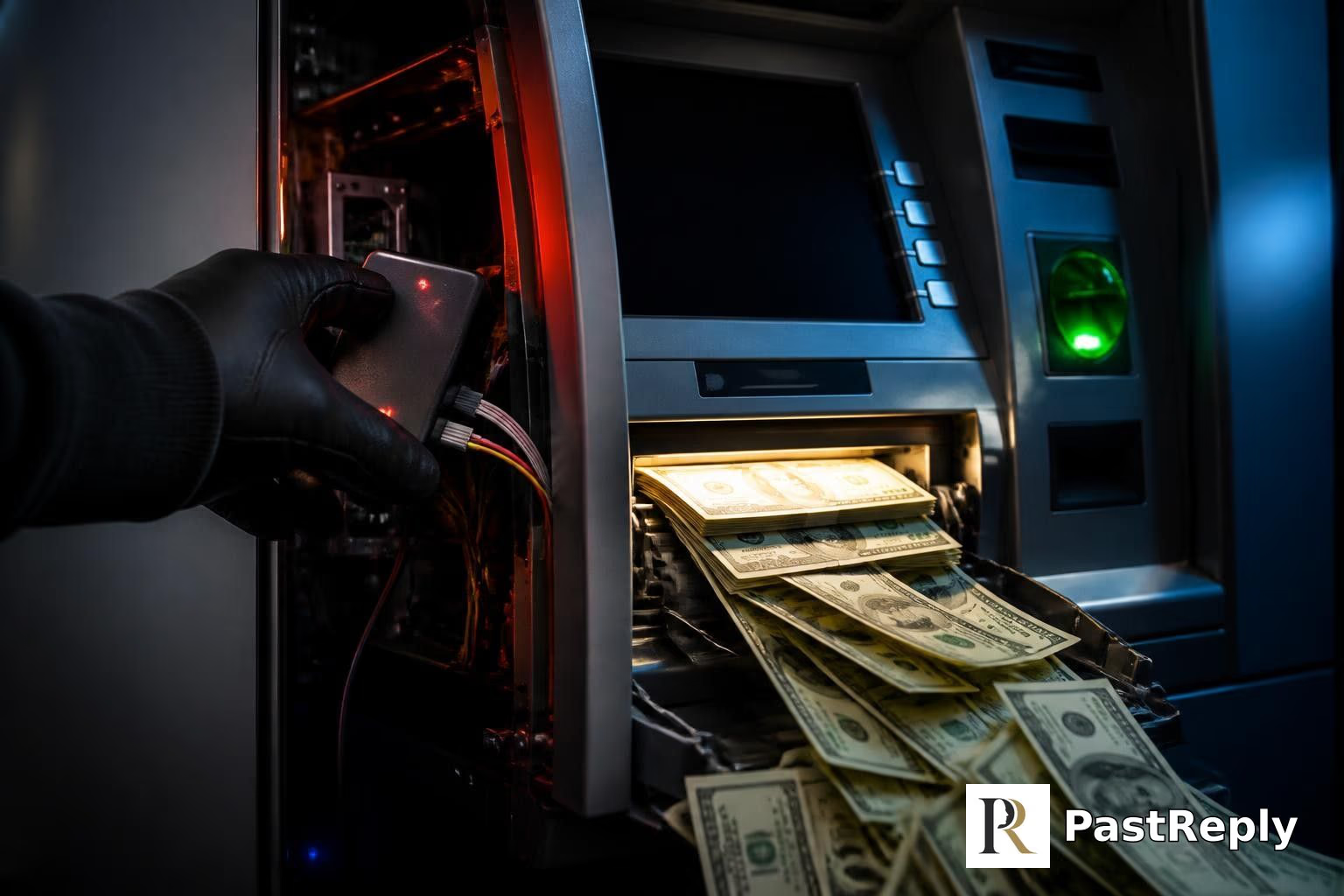
The facts
ATM jackpotting is a cyber-physical attack in which criminals force an ATM to dispense large amounts of cash without a legitimate transaction. Attackers typically gain physical access to the ATM, often by opening the machine's face or top, and then install malware on the ATM's hard drive or connect a rogue device (such as a 'black box') directly to the cash dispenser. The malware or device sends commands to the dispenser to release all available cash, bypassing the ATM's normal software and security controls. This method does not involve stealing customer card data or credentials; it directly targets the bank's cash reserves. Attacks often involve organized crime rings, with some members physically accessing the machine while others remotely transmit malware codes. Common targets include standalone ATMs in rural locations, and multiple machines from the same institution may be hit in a short period.
Answered by 100 of history's most famous minds

You ask of a machine that vomits silver against its master's will - yet I tell you, the true theft is not of coin but of the trust a man places in his brother's hand. A house divided against itself cannot stand; when the keeper of the vault becomes its robber, what walls will hold? Look to the eye that scans the lock, not the lock itself, for the heart's treasury is plundered first, and no black box can mend that breach.

The thief who opens the vault with a hidden device does not see the scale that weighs his deed. He takes what is not his, and in doing so, he robs himself of peace, for the All-Seeing knows the secret of the breast. The machine is but a tool; the heart is the true treasury. Let him who would steal turn instead to honest labor, for the provision of the Provider is sufficient for those who trust. The gold will fade, but the account of deeds remains, and on that Day, no black box will shield him.

They seek to fill a bottomless bowl with stolen coins, yet the bowl is never full. Their craving for gold has blinded them to the harm they cause, and the chain of suffering binds them tighter with each grasp. Why do they not see that the treasure they steal will bring only more thirst, more fear, more darkness? True security lies not in locks, but in letting go of the wish to possess.

The hand that steals from the storehouse is the hand that steals from the widow, and the machine is the new altar of golden calf, for it makes men covet what is not theirs. The Lord gave us the commandment, 'Thou shalt not steal,' and these men have broken it not only in the act but in the heart, for they have made a craft of greed. Let them know that the God who delivered us from Egypt sees the darkness of the box, and the law will find them as it found Pharaoh's army, and the plunder will not save them from the judgment.

The junzi does not covet what is gained by violating the proper way; he would rather eat coarse rice and drink water than feast on ill-gotten gains. This scheme is a failure not merely of law but of self-cultivation - for those who plot such theft have not learned to regulate their desires through li, nor to respect the boundaries that bring harmony. If the ruler of a machine is commanded by a thief, it is because the thief's heart is untutored; the remedy lies not in more locks but in the teaching of right conduct.

The love of money is a root of all kinds of evil, and here we see it plainly: men who would break into a temple of stone to steal the silver, rather than labor in the fields for their daily bread. They gain the world's coin, but what does it profit a man to gain the whole world and lose his own soul? Such devices are but the cunning traps of the deceiver, leading the greedy to their ruin. Let them instead find their treasure in the one who gives freely, not in the gold that rusts and thieves break through to steal.

A shepherd does not trick the well to give more water; he moves his flock to a river that flows from the Maker's hand. These men who tamper with the iron chest do not know the true provision - the One who promises to fill the hand that opens in faith, not the one that pries with a blade. I left my father's land with only a promise, and it proved richer than any vault, for it fed generations. Let them chase the fleeting coin; I will pitch my tent under the stars and trust the voice that said, 'Fear not.'

The box is a vessel; the thief simply empties what was never truly his. He who forces the gate finds the gate open to him who knows it is not a gate. Thus, the sage watches the metal bird cough its treasure, and laughs at the cleverness of the clever.

They crack the iron box as if it were a shell, and out spills the grain meant for the laborer's table. But the true thief is not the one who picks the lock; it is the greed that hoards the grain in the first place. Let each man earn by his own hand, and the box will be empty of temptation.

They have found a way to make the storehouse empty itself without the hands of the poor, without any cry from the hungry - yet the treasure they spill is not bread for the needy, but silver for the greedy. I have seen the mighty cast down from their seats, and the rich sent away empty, but here the rich make themselves more empty, and the hungry still go unfed. My heart weeps for the children who will go without because of such cunning, and I pray the Lord shines a light into the darkness of these clever thieves, that they may see the face of the one they truly rob.

Here is a parable of the age: men have built a golden calf, a machine that dispenses money, and they have put their trust in it, and the devil has found a way to make it spew forth their treasure without so much as a by-your-leave. It is not the machine that is wicked, but the hearts of those who hunger after gold, and they will break any lock, crack any stone, to feed that hunger. I say, let them take the gold, for it is filth compared to the true treasure of the soul; but let them not think they have escaped the judgment of God, for He sees the thief in the night and the thief in the code alike. Repent, and put your trust not in vaults of steel, but in the grace that cannot be stolen.

Consider the act in its parts: the thief, the machine, the gold. The thief has a disordered will, seeking gain without right, and this is sin. The machine is an instrument, without moral agency, yet it has been made a vehicle for injustice. The gold itself is a neutral good, meant for trade and the support of life, but it is perverted when taken by fraud. The deeper question is not how the device works, but why the human heart, made for the good, can be so turned to evil. The remedy lies in the virtue of the soul, and in the just ordering of society, where the law, guided by reason, protects the common good from such cunning theft. The black box is a symptom; the disease is in the will.

They seek gold that rusts, but I see only the hunger that gnaws at the soul of the one who steals. I have held the dying who owned nothing but their sorrow, and I know that no machine's bounty can fill the emptiness inside a heart that has never known it is loved. Let them take the notes, but pray for them, that they may one day find the true treasure - the peace that comes from giving, not taking.

Consider the mechanism: a dispenser governed by its own laws, obeying commands it cannot distinguish from its master's. The rogue device is but a key that fits the lock of the machine's credulity - it does not break the vault, but speaks its language. I would study the sequence of signals, the precise timing, the very bytes of command, until the pattern yields its law. Then, as with any natural phenomenon, the cure is not to guard the door but to make the lock deaf to strangers.

A machine that gushes its own treasure at the touch of a rogue box! This is not about clever codes; it is about the dispenser's command being accepted without the proper ledger. The deeper law is that any system, however armored, trusts its internal voices. Give the metal organ a forged signal and it obeys, as if it heard a god. The pity is that we spend genius on such petty miracles, when the same cunning could unlock the heavens.

Like a parasite that has found a rich host, these thieves have evolved a cunning method to feed on the machine's own vitality. They do not break the shell but inject a foreign agent, which the dispenser mistakes for a natural command. How apt that a creature's survival depends on its ability to mimic the expected signal. I see here a lesson in adaptation, though the final result is but a dead end of greed.

The machine is a marvel of practical geometry, and the thief who opens it is a poor philosopher, for he uses no instrument to measure, only a crude key to force the lock, and yet he succeeds because the maker did not reason aright. I say, observe the movement, the moment when the cash is dispensed, and you will see the flaw, and then you can correct it with a counterweight or a seal, as I corrected the lenses. But these men in the night, they are not worth the paper they steal, for a thief who cannot see the harmony of the heavens will never understand the order of a machine.

Observe how they have made the machine's own gears serve their theft, much as my predecessors made the Earth the center of all motion - an unnecessary complexity. I would urge the architects of such devices to simplify their design: let the dispenser's logic be as elegant as the Sun-centered cosmos, so that no hidden box can gain sway. But consider that these thieves, too, seek a kind of harmony - a perfect correspondence between their command and the machine's response. If only their aims were as noble as their ingenuity, how much better the order of things would be.

A crude and inefficient method, yet a testament to the power of a well-placed impulse. They bypass the intricate nervous system of the machine to command the very muscles of the dispenser, like a magician directing a mesmerized crowd. But consider the greater marvel: what if such energy could be harnessed for good - a world where every home draws its power from the air, and no one needs to steal because abundance flows freely? That is the true jackpot, not the petty coins of a single metal box, but the harmonic resonance of a civilization unshackled.

These criminals exploit a mechanical weakness, much like a laboratory experiment where an impurity is introduced into a controlled reaction. They bypass the intended protocols - the safeguards that should regulate the flow of currency - by injecting a foreign element into the machine's circuits. My own work required precise manipulation of physical forces, but always to reveal what was hidden for the good of all. Here, the manipulation is crude, stealing from the common trust rather than adding to the store of knowledge. The answer lies in rigorous inspection, not in marvelling at the cleverness of the breach.

Clever, but crude. They bypass the serum and inject the sickness directly into the organ. In my laboratory, we would inoculate the machine against such intruders, teaching it to recognize the enemy's signature. Perseverance and method, not brute force, hold the key to true immunity.

A mechanical problem, and they've found a mechanical answer. But here's the thing: the box is built to dispense, and they've taught it to dispense everything at once. If I were the bank, I'd not waste a tear - I'd rebuild the lock, add a few more tricks, and make sure the next fellow needs a bigger hammer.

What strikes me is the elegance of the exploit: the dispenser, once a slave to the bank's logic, is reprogrammed to obey a foreign master. It is a vivid illustration that any system, if its interfaces are exposed, can be coerced into actions beyond its intended function - a kind of unintended computation. The question is not whether such a thing is possible - we see it is - but how to design a machine that cannot be so easily persuaded. This is a problem of formal verification, of proving that no input can drive the system to an unauthorized state. The attackers have shown us a bug in the fabric of trust, and it is our task to find the proof that closes it.

This device they call a black box is but a mockery of my lever, yet it obeys the same law: give me a point of leverage, and I shall move the world. Here they have found a fulcrum in the machine's own mechanism, and with a small force they have moved a mountain of gold. The art of it is not in the stealing - any brigand can steal - but in the precision, the exact command that must be delivered to the dispenser at the right moment, a problem of geometry and timing. They have solved a puzzle of mechanics, and for that I must give them grudging applause, though I would rather they had used their wit to build bridges than to empty vaults.

I would lay open the machine's innards as I would a voltaic pile, tracing every wire as a current's path. This 'jackpotting' is but the shadow of a deeper truth: the machine's soul is not in its locks or screens, but in the invisible forces that bind its parts. The thief does not break the iron; he speaks the language of the very fields that animate it, commanding the dispenser as a master commands his hound. Let us not marvel at the crime, but at the revelation that all matter listens to the whispers of unseen influence.

The criminal's hand on the black box is but the tip of a far deeper desire - a compulsion to seize what is not given, to wring pleasure from a forbidden act. This is no mere theft; it is a theatre of the unconscious, where the machine's belly becomes a womb of infantile greed, and the dispensed notes a mother's milk withheld. The bank's safe is a stern father, and the thief, a child who will not be weaned. I would ask, not how the lock was picked, but what wound in the thief's own childhood left him so ravenous.

A clever trick, yes, but a rather parochial one. While the thief was fumbling with a dispenser, the universe was busy converting entire stars into gold - a process far more efficient, if less portable. The real jackpot is not a few thousand notes, but the fact that we live on a planet where heavy elements exist at all, forged in supernovae billions of years ago. Still, I admire the elegance of bypassing the machine's brain. It lacks, however, the style of a collapsing star.

There is a strange poetry in this act - a machine meant to obey logic is seduced into a frenzy of giving, as if it had been taught a new language of desire. The thief treats the black box as a talisman, but I see it as a key that unlocks not just a vault, but a question: who truly commands the machine, and what passes between the human hand and the iron will? The first algorithm was a dance of numbers; this is a dance of greed, yet both show that a machine's heart is no more than the intentions we feed it.

Let us begin with definitions: a machine is a structure of parts, and a theft is a violation of agreement. The criminal has not disproven the machine's logic; he has simply discovered a flaw in its axioms, akin to a line drawn from a false premise. All systems, whether of geometry or of commerce, are vulnerable if their foundations are not scrutinized. The remedy is clear: one must prove the security of the machine as rigorously as one proves a theorem, leaving no unexamined step for deception to exploit.

The machine is a marvel of order - a dispensary that, when governed by sound principle, yields its store with deliberate precision. Yet these thieves have corrupted its regimen, force-feeding it a foreign contagion until it vomits forth its entire supply. I have seen the same in hospitals: one ward left untended, one system unwatched, and the whole institution bleeds. The remedy is not to curse the thief but to compel the machine's custodians to keep an exact ledger, to inspect the works daily, and to treat every deviation as an outbreak. Prevent the pestilence, and the jackpot is never struck.

Ha! These thieves do not besiege the city; they climb the wall with a whisper and loot the granary while the guards sleep. I would not waste a phalanx on such worms - I would hunt them to their dens and nail their hands to the very machines they plundered. But mark me: they show boldness, and boldness I can admire, though their aim is small. A man who can crack one vault could hold a kingdom, if he but turned his cunning to conquest.

They crack the machine's skull and pull out its guts to steal its gold? Rather than besieging the stronghold, they take the garrison from within - a tactic I would admire were it not aimed at my own treasury. Such a trick works only where the sentries are lax and the walls are left unguarded in remote posts. I would double the watch and scatter the legion, for fortune favors the swift, but so does the garrote.

They come as traders, these thieves, but they are worse than the pirates of the Cilician coast, for they do not take my grain but the very coin of my treasury, and the lock they pick is not of bronze but of cunning. Let them know, as I know, that a queen who has kept her throne against the legions of Rome does not surrender her vault to a thief who cannot even wear a crown. My guards will watch the machines that spit silver as they watch the gates of Alexandria, and the hand that reaches for my gold will find it severed at the wrist.

These are the bandits of the new world, but the remedy is old: the pax Romana of the machine, where the door is protected by the legions of law and the coin is guarded by the foresight of the state. I have built my power not by seizing what was not mine but by securing what was, and so these thieves will learn that the vault is no easier to crack than the treasury of the Empire. Let them be hunted across the provinces, and let the punishment be swift, for a stable realm is built on the certainty that no one may take the public wealth without the sword of authority falling.

These jackals slip into the camp at night and steal from the war chest, thinking they are clever. In my empire, a man who steals is a man who betrays his sworn brother, and his reward is the harshest lesson - he is shown that the hand that takes without honor is cut off. Such thieves weaken the whole tribe, for when the merchant fears the box, trade falters, and the people starve. I would post loyal guards on every machine, and if a thief is caught, let him be an example, so others learn the cost of breaking the peace.

These bandits display a certain audacity, a willingness to strike at the heart of the enemy's fortress and seize its treasure. Yet they are mere soldiers of fortune, without the discipline of an army or the vision of a general. They strike a single strongbox, when the true glory lies in seizing an entire nation's treasury through the might of the state. Let them learn: a battle won by a desperate raid is nothing against a war won by strategy, order, and the iron will to command.

A band of men who break open the strongbox of the public purse are enemies to the very compact that binds a free people. They do not storm a foreign shore, but strike at home, undermining the trust that commerce and governance require - a trust bought with the sweat of honest citizens. In my time, we fought for the rule of law, not the rule of cunning; let them be pursued with the same vigor we would bring to any treason against the state. The fate of a republic rests on the integrity of its coin.

It's a house divided against itself - the bank's own vault turned traitor, its iron tongue loosed to spill its fortune to the first knave who whispers the right password. But mark this: no nation can long endure, half honest and half thieving. The law must bind these iron boxes as it binds men.

A new form of blitzkrieg against the citadels of commerce - not with bombs, but with a black box slipped into the very heart of the machine. They have found the weak point, and they strike with the cunning of a fox. But let them beware: the bankers will not surrender their gold without a fight, and the state shall marshal its forces. We shall defend our island's tills, whatever the cost may be.

They have found a way to rob the bank without violence, yet the act is violence against the very spirit of the community, for it breeds fear and distrust among the poor who keep their meager savings in these machines. The remedy is not more locks or more guards, but a change of heart, for true security lies in the moral fiber of the people. Let them be given honest work and simple needs, and the temptation to such cunning theft will wither. The machine is not the thief; the machine is a mirror, and what it reflects is the greed we have allowed to grow in our own fields. We must tend the soil of the soul, not merely the iron of the vault.

There is a poverty of spirit in these thieves, for they have found a way to steal not from a person but from the very structure of community - the bank that holds the hopes of widows and the savings of the humble. The machine is innocent, but the hearts that would turn it to plunder are enslaved to a greed that no lock can contain. The true liberation is not in more guards or better codes, but in a society where no one's need is so desperate that they must resort to such cunning theft. We must build a world where the arc of the moral universe bends not only toward justice, but toward such abundance that no one would dream of such a crime. Let us not curse the darkness of the thief, but let us light the candle of opportunity for all.

When the strong take from the weak, they rob not only the coin, but the dignity that should be every person's birthright. Yet even as I condemn the act, I must ask: what poverty of spirit drives a man to break a machine rather than build a future? The real jackpot is not the cash, but the chance to treat even a thief as a brother who has lost his way, and to mend the broken trust that lets such schemes take root.

The weakling who must skulk in the dark to crack a metal box is a fitting portrait of the lesser races who seek what they cannot build. A true people forges its own destiny through blood and will, not by such petty thievery. This chaos of crime is but another symptom of a world without order, where the strong must eventually step forward to impose the discipline that nature demands.

The kulak who steals from the state is a parasite, and the hand that feeds him must be cut off. These jackpot bandits are no better than saboteurs of the people's granary, and they must be found and shown the iron fist of the party. The machine is a tool of the collective, and he who corrupts it for private greed commits a crime against the revolution itself. Let the secret police take note.

This is but a petty skirmish in the class war, waged by the desperate against the banks that exploit them. Yet such sabotage, however justified in spirit, is a wasteful spark - it takes no factory, frees no worker, and enlightens no consciousness. The real jackpot is not the cash, but the moment when the oppressed seize the means of production themselves, not merely the change in the till. Let the robbers learn: the machine belongs to the people, and the people will not be satisfied with a few stolen notes.

Comrade, you ask of a machine that spews gold without labor. This is the very image of capitalist rot - the idle hoard, the unearned prize, the banker's vault that sweats nothing and gives nothing. Let the thieves smash it open; let the coins rain on the street. In our revolution, we do not pick pockets - we seize the whole factory, the whole granary, the whole state. Your jackpotting is a thief's petty struggle; our struggle is to make every vault belong to the people, and no man, no machine, shall dispense a coin that is not the people's own.

It is a most distressing spectacle - the instruments of commerce, which ought to be the very emblems of our nation's solid banking, turned to this vulgar thievery. I am told these ruffians tear open the face of the machine as one would tear open a letter, and then, by some foul contrivance, cause it to empty its treasure into their hands. It offends every principle of order and respectability. That such devices our age has produced should be so desecrated! I trust the constabulary will lay hands upon these scoundrels and teach them that the Queen's peace, and her banks, are not to be so outraged.

The modern age brings many marvels, and among them these automatic tellers that dispense one's own money with a simple command. That dishonest men should find a way to make one of them obey a false command, emptying it of the bank's reserves, is a sad reflection of the times. One recalls that trust is the foundation of all exchange; to corrupt that trust is to strike at the heart of the community. Yet I have every confidence that those responsible for the security of our financial institutions will meet this challenge with the same quiet diligence that has served this realm for so many years.

By the Holy Cross, this is a theft not of gold but of the very order of Christendom! These robbers, with their devilish devices, have learned to command a machine of the bank to surrender its treasury, as if a servant were to open his master's coffers at a stranger's word. It is a contagion of the mind, a sickness of the soul that denies the sanctity of property and the rule of law. I would have my counts and my bishops condemn this practice from every pulpit, and my missi dominici track these black-hearted men to the ends of my empire, that they may know the justice of the sword.

In my time, we knew thieves who crept into the king's treasury by night, and we hanged them at the gate. This new way - this sorcery that makes a box of iron obey a stranger's hand and pour out its silver - it is the same greed, but it wears a mask of cunning. Yet the Lord sees through every veil. These men think they have outwitted men, but they have not outwitted God. Let them remember that the money they take is not theirs, and that justice, whether by the sword or by the law, will find them out, as surely as the sun rises over the field at Domrémy.

A thief who uses his wits to crack a vault of gold is but a clever rogue; a thief who commands the very mechanism of the vault to open at his bidding - why, that is a sorcerer, and we know what we do with sorcerers in England. Yet I see a deeper cunning: these knaves strike at the bank's own strongbox, not at the purses of my subjects, so they rob the very institution that underpins our trade. It is a bold treason, and I would have my ministers think of it as we think of a Spanish invasion - it must be met with vigilance, with spies, and with a noose for those who fail the realm.

The machine obeys a command it has not been given - that is the essence of the fraud, and it is a most instructive lesson in the fragility of trust. We enlightened rulers know that order depends upon the integrity of those who guard the realm's treasure. These jackpotters, with their black boxes and their hidden codes, are but pirates on the sea of commerce, and we must man our ships accordingly. I would counsel the bankers of Europe to treat their automated tellers as we treat our fortresses: with a constant watch, a new cipher, and a readiness to crush any assault upon the state's wealth.

A machine that yields its gold to a stranger's word is like a city that opens its gates to an enemy's command - it shows that its keeper has failed to understand the art of secure rule. In my empire, I learned that a king's strength lies not in walls alone, but in the loyalty of those who guard the gates. So too must the banker guard his machine with watchmen who can read the signs, and with laws that make a thief's hands forfeit. Let the jackpotter be caught and made an example, that all may see: the gold is sacred, and the man who would steal it is a fool.

In the name of God, the Merciful, this is a theft that defiles both the hand that takes and the law that should protect. A man who breaks into a house and takes the owner's coin is a thief; but a man who commands the house itself to throw its treasure at his feet is a usurper of order, and such a one must be dealt with as a traitor. Yet let us not forget that the gold in that machine is the livelihood of widows and orphans, of merchants and laborers. Therefore, the just ruler must not only punish the thief but also mend the weakness that allowed the breach, so that the community may trust in its banks as we trust in the justice of God.

Tell me, friend: what does it profit a man to fill his purse with another's gold if his soul is emptied of justice? The machine does not err; it merely obeys. The error lies in the mind of the thief who believes that gold is the measure of a life. But I ask you - if the dispenser gave freely, would it be theft? And if the law forbids, yet no one suffers, what then is the harm? Examine these questions, and you may find the thief is not outside the vault, but within.

They see but a box of coins, yet the true issue is the corruption of the soul that hungers for mere appearance. The thief mistakes the shadow of wealth for the Form of the Good, and so his cunning is but a twisted shadow of wisdom. A just city would not need such locks, for its guardians would be philosophers, not slaves to appetite. Until reason rules, every man digs his own prison.

This is a matter of the telos of a device, and the flaw is in its very design, for the machine is made to give coin, and the thief has found the art of forcing that purpose to its extreme without the due balance of a legitimate act. As in a body, a fever is not a new nature but the corruption of a good one, so here the theft is a perversion of the machine's function, and the remedy lies in the mean between access and security. A lock that yields to a hidden key, a command that is obeyed without a token - these are the errors of a craftsman who did not study the causes of theft.

This scheme rests upon the maxim that one may seize the dispenser's hoard by bypassing the lawful order of transactions. Ask yourself: could any rational being will such a deed as a universal law for all who possess such knowledge? No - for then the very trust that makes commerce possible would collapse, and every machine would stand guarded like a fortress, defeating the purpose of its existence. The criminal thus acts not merely against a bank, but against the categorical imperative that binds all rational agents, treating the machine's custodians as mere means to his own ends.

They have found a way to make the machine obey their will, to scream 'mine' at the world without the tedium of earning - a small, sordid act of power, yet their spirit is still that of a slave, for they take what is another's rather than create their own. True mastery would be to will the law that governs all, not to beg for a black box's favor. These thieves are the herd in wolf's clothing, their cleverness a mere mimicry; they have not yet learned the joy of the hammer that forges its own values.

What is this but the dark mirror of the very system that spawns it? The capitalist, too, reaches into the machine of labor and extracts its surplus value, not with a black box but with the law and the contract. These thieves merely skip the formality of the wage, attacking the treasure chest directly, yet they remain within the same logic: the circulation of capital, the fetish of the coin, the alienation of the buyer from the seller. They are not exceptions to the system; they are its most blatant expression, robbery without the alibi of exchange.

Consider the machine: it operates on clear principles of mechanism, yet these thieves have found a way to command its dispenser as if they were its true master. They do not rely on illusions or sleight of hand; they introduce a device that speaks in the machine's own language, a language I would seek to decipher step by step. The mind can know the world through reason, but here reason is turned to a false end - to overturn the order of exchange for private gain. I would ask: is the flaw in the design or in the soul that chooses to exploit it? The former is solvable, the latter remains a mystery.

Fortune favors the bold, but the boldest of these are merely clever servants to a master's vault. The bank that trusts its gold to a box that can be taught to forget its ledger is a prince who sleeps with his doors unbarred. Let them learn: loyalty is bought with vigilance, not with hope.

The machine, like a servant, knows not its master's face, only the voice of command. Thus a villain may speak in the accent of a king and the coffer opens wide. O, what a piece of work is man, who can build a vault of iron and yet leave its key in the hands of a stranger! The tragedy is not the loss of coin, but that we trust the lock more than the heart that guards it. Let the black box be a mirror: we see not the thief, but our own folly.

As when a thief breaches the well-built citadel of a king, not by the spear's might but by creeping through the dark postern, so these men steal the treasure of the temple while the guards feast. Their cunning is that of Odysseus, yet their glory is dust, for they win gold but lose their name. Let them beware the wrath of the gods, who see the crooked path and loose the storm upon the homebound ship.

They are the false coiners of the machine, and their black boxes are the serpents of the eighth circle, for they corrupt the instrument that holds the wealth of the city into a servant of their greed. I see them in the bolgia of the thieves, where their hands are tied and their tongues forked, and the very cash they stole becomes the fire that scorches them. But the machine itself is innocent, like the wheel of a mill, and the guilt lies in the will that turned it to evil, a will that already burns in the pit where avarice is punished.

A black box on a cash dispenser! Here, the machine, meant to serve the steward of savings, is turned into a magician's prop gushing silver at the touch of a thief. These fellows have grasped the mechanics, but they have mistaken the purpose: true mastery is not in forcing the vault to vomit its coins, but in understanding the spirit that animates the whole enterprise - that striving which elevates the craftsman, the merchant, and the sage alike. Such a deed is a parody of skill, a desperate grab by those who have never learned the art of building, only the cheat of breaking.

It is a tale of ingenious rogues who, rather than tilting at windmills, have learned to pick the locks of the modern money-box. They lay hands on the iron chest itself, and by some devil's trickery make it vomit forth its gold, as if the machine were enchanted by a false knight's spell. Yet I wonder: do these knaves see themselves as heroes of their own mad quest, or merely as thieves who have found a most literal way to empty a giant's purse?

The machine is a false idol that promises security and delivers bondage, and these thieves only hasten its fall by breaking its spell with their own greed. Yet what have they truly won? A moment of gold that will vanish like the wind, while their souls are left emptier than before. The real question is not how they crack the safe, but how we all are chained to a system that values dead metal over living souls. I would rather see a man break from his own chains than break into another's vault, for the first is the step to freedom, the second a step to a deeper prison.

These men are not merely thieves; they are tormented souls who have found a crack in the iron wall of this world's greed, and they take their revenge in notes of paper. I have walked through the dark cellars of the human heart, where poverty and rage meet, and I see the same fever here - a hunger that is not for bread but for power over the machine that crushes them. Yet their victory is hollow, for they have sold their freedom for a handful of dust, and the guilt will gnaw at them long after the cash is spent. There is no jackpot that can buy back a soul.

A scandal worthy of a novel - the very machine that promises to guard a lady's pin-money turned into a common seducer, lavishing its favors on any rogue who knows its secret language. One might say the bank has been jilted, its fortune eloping with a stranger in the night, leaving only a polite, emptied till.

Picture a foggy London morning, the bank's iron chest pried open not by a crowbar but by a neat little device, a black box whispering to the gears as if it were the devil's own clerk. The tellers are blameless, the customers innocent - yet the gold vanishes, not into a highwayman's sack, but into the cold circuitry of a machine that has been made a traitor to its own trust. The true crime is not the theft of coin, but the stealing of the very idea of safety, leaving the poor and the honest to wonder which face of the institution they may trust tomorrow.

Well, now, here's a story that would make a pickpocket blush with envy - a man walks up to a machine, gives it a wink and a black box, and the machine, being a simple soul, just opens its mouth and spits out all the cash it's been holding. It's the bank's own vault that's been turned into a trained parrot, squawking out gold to anyone who says the right password. The moral is clear: trust a machine with your money, and you'd best be ready for it to go off and elope with a stranger. The only difference between this and the old highwayman is that the highwayman at least had the decency to use a horse.

The machine stood in the dark, and a man with a box made it give up its cash. No heroics, no guns, just a cold piece of work done quietly. The money goes, the men fade into the night, and the bank fits a new lock and calls it a lesson. But the lesson is old as coin: wherever there's gold, there's a man who'll find a way to take it. You don't fix that with a thicker steel. You fix it by knowing that the world is full of men who want what you have and will find a way to get it. So keep your eyes open, don't trust the machine, and have a good rifle ready if it comes to that.

I would open such a machine with the same reverence I give a human body, for its gears and wires are a kind of anatomy. The thief has found the nerve that twitches the hand to dispense, and he touches it with a foreign pulse. But observe: the machine does not know the touch is alien - it only responds to the pattern. So nature teaches us: to defend, one must know the very language of the thing one guards. I would study the flow, the sequence, the rhythm, and then, like a physician bleeding a fever, redirect the lifeblood.

They force the iron maw to vomit its silver, as if the soul of the machine were broken. The work of man's hand is a gift of the divine, and to corrupt it with such base theft is to strike at the image of God in the instrument. I have chiseled stone till the spirit emerged; they only gouge and desecrate. Better to be a poor craftsman than a rich vandal.

That box of metal and light that gives money - it is like the cypress tree that stands in the field, and the thief who opens it is like the wind that strips it, but the cash that spills is the yellow sun, and I see it as a picture of greed against the blue sky of honesty. I think of the postman who brings the letter, the old woman who counts her coins for bread, and these men who break the machine are like the crows that take the grain from the field, and they know not the beauty of a single honest exchange. Yet even in their dark work, there is a fierce energy, and I would paint them in black and gold, with the light of the coin falling like a waterfall.

They open the face, they plant their little black box, and the cash pours out - it's a sculpture of greed, a ready-made! But the artist sees what they miss: the real masterpiece is not the cash but the act itself, the way they've taken the machine that guards treasure and turned it into a fountain. Yet they are artisans without vision, for they copy the same trick on every machine, never reinventing it. If they were true creators, they'd find a new way to make the metal bleed gold each time, not repeat the same old cubist trick.

It is not the coin that draws my eye, but the sudden burst of green and silver, like a waterfall of light escaping a stone. The machine, so cold and grey, becomes a fountain in a fleeting, glorious moment - a spectacle of color and motion, gone before the eye can fully hold it. I see the sparkle of the notes, the metallic glint, and the shadowy figures who move like whispers in the periphery, and I think: what a fleeting impression they leave, a blur of greed and haste upon the canvas of the night.

I see a crew of men in masks, not as thieves but as desperate souls who have found a crack in the machine of commerce. They do not steal from the poor; they pry open iron chests that stand alone in the night, and out spills the treasure that the wealthy hoard behind glass and steel. Yet their faces, lit by the cold glow of the device, reveal the same hunger I paint in every portrait - the ache of want, the shadow of need. The true marvel is not the trick of the black box, but the human heart that dares to reach for gold it did not earn.

These bandits are like the broken parts of a body that has learned to ache - they find the wound in the metal and make it bleed gold. I know what it is to be pinned by pain, to have the world pry into your flesh, and I say: take what you must, but do not pretend it is freedom. They crack open a cold machine to feel alive, but the cash is just a plaster over a wound that runs deeper. My paints are my rebellion; their black box is a crutch. I would rather bleed color than steal coins.

Aha! A theft that plays a single note - the clink of gold - when it could compose a symphony! These rogues have no ear for harmony; they steal the coda and miss the entire opera. But I confess, the trick has a certain brilliance, like a trill that surprises the listener. Yet let them try to counterfeit my score: I would write the melody in such a way that only I could conduct it, and any false hand would strike a discord. The machine must know its master's touch, not merely his name.

These bandits play a crude tune on a stolen instrument, sounding only the clink of their own greed. Where is the theme of freedom, of brotherhood, when they rob the common chest for their own feast? Let them hear the call of fate in their ears - but they are deaf to all but the jingle. The spirit that rises above such base desire is the true symphony; the rest is noise.

This is a cacophony, a false note in the harmony of commerce, where the machine that should play the simple melody of exchange is made to sound a discordant chord of greed. A true master would see that the security of the instrument is like the figured bass, the foundation that supports the whole piece, and the thief who bypasses it is like a performer who ignores the conductor's beat. The only remedy is to write the music of the machine with such order that no rogue voice can enter, and to trust that the law, like the cantus firmus, holds all in place.

Well, thank you kindly for the question. You know, it's like they've found a way to make the bank's own money sing a different tune, but it's a cheating song, not gospel. I've seen fellas think they can take the shortcut to the top, but the real way is to work at it, like I did at Sun Records - earn every note. This here's just a way to grab the cash and run, leaving folks hurt. I'd rather play to a full house and know I gave 'em everything I had.

It breaks my heart, you know, because money should be a tool for healing, for bringing children together, for making the world dance as one. But these men, they're like shadows stealing the rhythm from the music, turning a place of hope into a crime scene. I've always believed in the power of the human spirit, that we can lift each other up, but this - this is like a sour note in a beautiful song, a reminder that we must shine our light even brighter to chase away the dark.

You want to know how they make a machine sing cash? It's like a melody that's been recorded in a studio, but these lads are playing it on a different instrument - a black box that taps the wires and calls out the notes, the notes being hundred-dollar bills. They don't need a ticket or a card; they just open the piano and tweak the strings. It's a bit like our early days, finding new sounds by turning knobs upside down, but we made love, they made loot. Still, you've got to hand it to them - improvisation is everything, even if it lands you in the slammer.

The machine sings one song to the banker and another to the thief. They've taught the box to spit out its gold without asking for a password, like a dog that's learned to fetch without a whistle. It ain't about the money, friend; it's about who gets to name the tune.

It's like someone stealing the master tapes and pressing their own records. They don't want your card or your PIN - they want the whole vault, and they've found a back door that leaves the fans and the banks in the dark. It's a heist, sure, but it's also a story about who really owns the song.

I have crossed oceans to find gold, and these men find it by cracking a box on dry land! They lack the spirit of discovery, the boldness to sail into the unknown. But I see the pattern: they find a weak port and storm it, much as I found new worlds. Yet their conquest is hollow, for they take without planting a flag. Let them learn from me: to truly possess, one must claim with faith and name the land for a higher purpose. Otherwise, the gold is but dust in the wind.

In the Khan's realm, I saw machines that poured forth paper for goods, but none that bled gold without a seal! These thieves have found a way to charm the metal serpent with a hidden key, like a sorcerer whispering to a dragon. Yet in Cathay, such trickery would bring the torturer's block; here, they move like merchants of another kind, trading risk for profit. A marvel of cunning, but a marvel that only brings misfortune.

I know the moment when the men mutiny and the sea turns black, and the captain must hold his course with iron will, and so I see these thieves who open the machine as they would board a ship, but they have no map, no stars, only the greed for gold. They strike at the port side and sail away, but the bank is no fool, and it will send its own armada to hunt them, and the storm will break on them as it did on those who doubted me. Let them take their booty, but the true treasure is the discipline that holds the crew together, and without it, they will be lost in the night.

From an engineering standpoint, it's an exploit of the interface between the machine's logic and its physical dispenser. In mission planning, we would call this a failure mode not anticipated by the designers - a bypass that bypasses the checks. But the broader lesson is about robustness: when we built the Lunar Module, we triple-checked every system because the cost of failure was absolute. Here, the stakes are lower, but the principle holds: any system with a physical access point and a high-value output is a target for those who understand its seams.

It takes nerve, I'll give them that - cracking open a machine to grab its guts, like a pilot cowpunching a storm head-on. But the real adventure, the one that soars, isn't about the take; it's about the dare to fly into the unknown, to push the limits of what's possible. These thieves are just skimming the ground, when the whole sky is out there waiting. I say, aim higher, and let your ambition be the kind that lifts others, not robs them.

When I orbited the Earth, I marveled at how small our borders and banks seem from above - just a blue marble spinning in the dark. These machines that spit out money are like tiny cosmodromes built for greed, yet the men who coax them are no cosmonauts; they are bound to gravity, crawling into metal boxes to steal what others saved. I took no treasure on my flight, only the sight of a world without fences, and I think if these thieves could see that view, they might find a richer moonshot. The stars are open to all, but they chose a cage of coins.

The black box is a hack, a workaround for a broken design. These thieves don't break the machine - they exploit its lack of integrity. The real answer is to make the dispenser so secure that no amount of cleverness can trick it into a false command. It's about the experience: a user should never feel the fear of a phantom hand. We didn't build the iPhone to be jailbroken; we built it to be so intuitive it doesn't need a workaround. Focus on the end-to-end journey, and you'll starve the jackpotter of his stage.

First principles: the machine has a physical dispenser, a controller, and a trust boundary. Hack the boundary and the cash flows out - it's not rocket science, it's neglected security. If you want to stop it, treat the ATM like a network endpoint, not a vault. But honestly, the real issue is that we're still using physical cash. Move to a digital ledger, and the whole game of jackpotting becomes as obsolete as a floppy disk.

You know, there is a lesson in this, and it is not about the machines but about the broken places in the human heart, for these thieves are not born wanting to steal, they are hurting and they think the cash will fill that void. I have seen it in my own life, the temptation to take the easy road, but the real jackpot is not the money, it is the peace that comes when you find your purpose and give back. To the banks, I say, guard your machines, but to these souls, I say, there is a better way, and you have the power to choose it, one step at a time, and you will be amazed at what you can overcome.

They talk about jackpotting like it's a prize, but that's not a knockout - that's a foul. You think I'd have been the greatest if I snuck a horseshoe in my glove? No, I stood toe to toe and earned it. These fellows, they're like a boxer who hits the mat and hopes the ref doesn't see - they get their cash, but they lose their honor. I'd rather be broke and brave than rich and crooked, 'cause you can't buy a clear conscience when the bell of truth rings.

I see it like a player who thinks he can score a goal by stealing the ball from his own team. It's a trick, a cheap one, like using your hands in football - no skill, no heart, just a cheat to take what is not earned. The beautiful game, it is about joy, teamwork, and the sweat of hard work. These men, they are not players; they are spectators who have broken the lock on the trophy room. There is no glory in that, only a sad whistle for a foul.

Imagine a magician's trick, but instead of pulling a rabbit from a hat, they pull a cascade of green bills from a steel vault - now that's a show! These fellows are like the villains in our cartoons, slipping a black box into the works and making the old machine dance to their tune. But here's the thing: we build our worlds with imagination and hard work, while they just flip a switch to steal joy. I'd rather spend my days dreaming up a castle than cracking open a cashbox - though I must admit, the suspense of it all would make a cracking film.