
How do Algerian women dress?
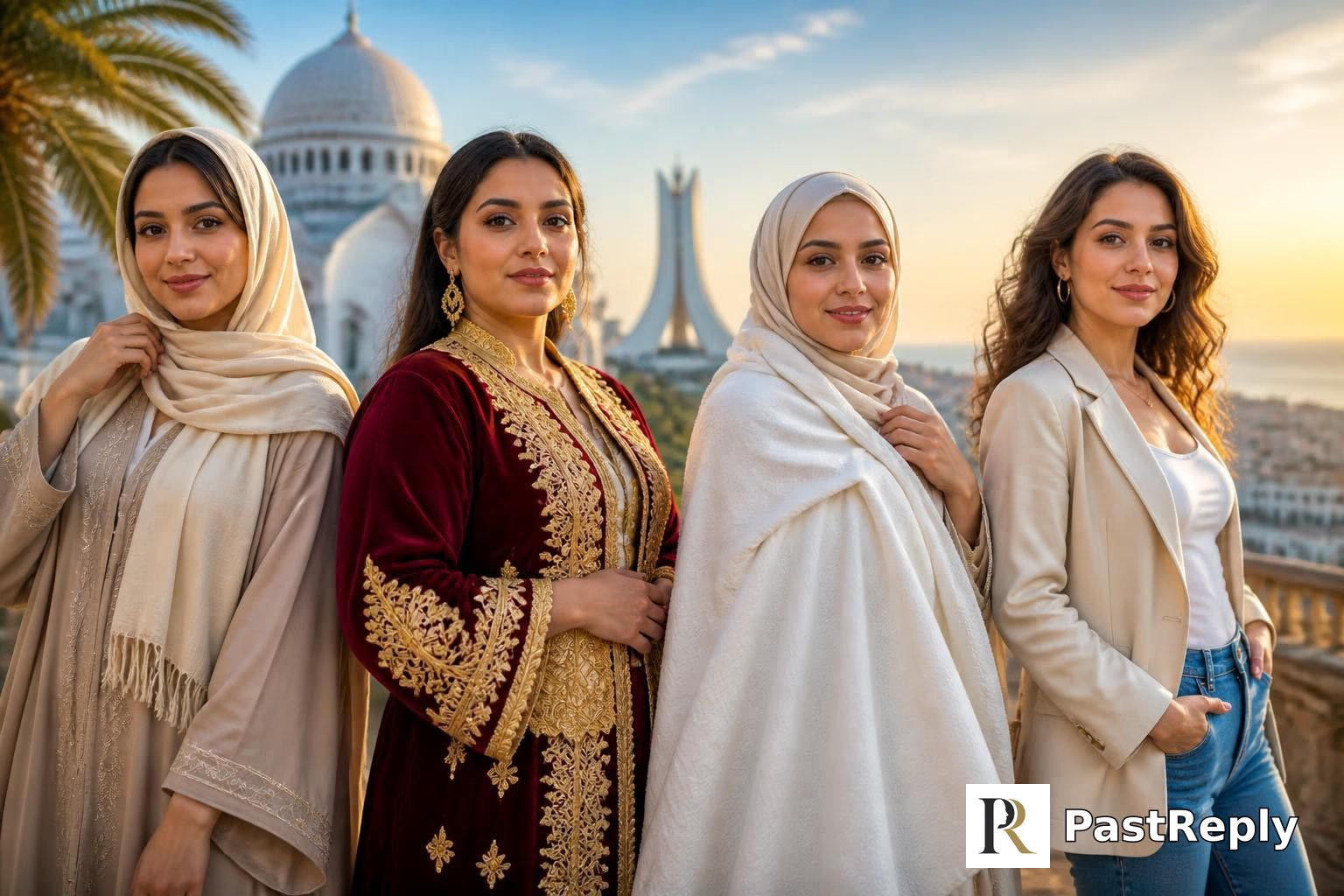
Algerian women dress in a mix of traditional garments like the karakou and haik, Islamic attire such as hijabs, and modern Western clothing, varying by region and occasion.
The facts
Algerian women’s dress varies by region, occasion, and personal preference, blending traditional, Islamic, and modern influences. In urban areas, many women wear Western-style clothing such as jeans, dresses, and blouses, often paired with a headscarf (hijab) for those who observe Islamic modesty. In more conservative or rural settings, traditional garments like the haik - a long, white, draped cloth covering the body and sometimes the face - are still worn, though less commonly today.
Traditional Algerian attire includes the karakou, a velvet jacket embroidered with gold or silver thread, worn with a matching skirt or saroual (baggy trousers), often for weddings and celebrations. The blousa, a long, loose dress with intricate embroidery, is popular in western Algeria, while the gandoura, a sleeveless tunic, is worn casually in many regions. Berber (Amazigh) women may wear brightly colored dresses with geometric patterns and silver jewelry, reflecting their cultural heritage.
For formal events, women often wear elaborate caftans or modern evening gowns, while daily wear can range from modest Islamic clothing like abayas and jilbabs to contemporary fashion. Head coverings are common but not universal, and face veils (niqab) are rare. Overall, Algerian women’s dress reflects a mix of tradition, religion, and global trends, with significant regional and generational diversity.
Answered by 100 of history's most famous minds

Do you see the lilies of the field, how they neither toil nor spin? Yet Solomon in all his glory was not arrayed like one of these. Why are you anxious about clothing? Let not the outward garment be your concern, but rather the inner garment of mercy, humility, and love for one another. The kingdom of God is not a matter of fine fabric or hidden hair, but of a heart turned toward the Father and toward your neighbor in need.

A woman's dress is of her honor, yet it is not the cloth that covers her that God sees, but the heart that beats beneath. Let the believing women draw their garments close, for this is a mercy to them and a sign of modesty before the Lord. But the true garment is righteousness, and no thread of silk or cotton can compare to the weave of faith and good deeds. The women of Algiers know this, whether they wear the haik or the embroidered robe; what matters is the modesty of the soul before God.

The woman who wraps the haik around her shoulders and the woman who wears the embroidered velvet: both are clinging to a form, and every form is a raft that carries one across the river of suffering. Let the cloth be clean, let it cover the body with dignity - but do not mistake the hem for the refuge. The true covering is mindfulness, the true adornment is compassion. When craving for the gold thread ceases, the heart is unadorned and free.

I see my sister Miriam fleeing Egypt, her robe still dusty from the desert road, and I recall the commandment: 'You shall not make for yourself an idol.' Yet what is fashion but an idol of vanity? Let the woman's garment be modest as the tent-curtain at Sinai, and let her not adorn herself with gold for which our ancestors sold their freedom. The heart's covering, not the body's, is what the Lord weighs.

The Master said: In dressing, as in all things, let the inner virtue shine through the outer form. A woman of Algiers may wear the haik or the karakou, but the essential is that her garment shows respect for her family, her elders, and her own dignity. Proper attire is not a burden but a way of making harmony visible. If her heart is sincere, even a simple cloth can be a ritual of goodness.

I hear a question of cloth and custom, but I ask: what is the apparel of the soul? In Christ, there is neither Kabyle nor Arab, neither one who wraps in white nor one who wears the French style - all are one in the Lord. Yet if a woman covers her head for conscience toward God, let her do so in peace; and if she does not, let no brother judge her. The kingdom is not food and drink and fabric, but righteousness and joy in the Holy Spirit.

Dress? I know only the tent and the cloak, the dust of the journey. My Sarah wore the finest linens of Ur, but the Angel at the oaks cared nothing for her robe. A woman's covering is her tent, her modesty, her covenant before the Most High. Whether the threads are of Egypt or of Canaan, the heart must be veiled in faith.

A woman wraps herself in cloth like the sky wraps itself in clouds - nothing is added, nothing is forced. Fashions come and go like leaves on a stream, but the body beneath is the same earth. Why ask what she wears? The wise do not stare at the thread but at the weaver.

The Creator made no two leaves alike, yet all bow to the same wind. A woman's clothing is like her prayer - it should be honest, not a show for the marketplace. Whether she wears a white shroud or a bright tunic, the soul beneath is the same light. Let her cover what she will, but let her heart be uncovered before God.

My heart sees the humble cloth and the fine thread, and knows the same Father clothes the lily of the field. A woman who covers her head in prayer, or who wears the embroidered gown of her grandmother's wedding, does so as an offering of her own soul - be it modesty, memory, or the simple need to be beautiful before her Lord. I see the mothers who weave their daughters' garments with the same hope a weaver puts into linen for the temple, and I pray they may always find their true raiment in a gentle and quiet spirit, which is precious in His sight.

By faith alone does a soul stand before God, not by the weave of a garment or the knot of a veil! I see the haik and the karakou, and know that the human heart, like a woman of Algiers, is always tempted to sew its own righteousness, trusting in the work of hands rather than the Word of Christ. A headscarf is a fine thing if it covers a humble and contrite spirit, but woe to the hypocrite who wraps herself in linen while her pride is naked! Let scripture be the measure, not tradition or fashion - and let every woman be free in her conscience, not bound by the pharisaical laws of men who love the gold thread more than the gospel.

The diversity of women's attire in Algeria exhibits a hierarchy of ends. At the most basic level, dress serves natural needs: protection from the sun and the gaze, modesty as a dictate of right reason. At a higher level, it expresses the virtue of the community: the haik and the karakou are signs of belonging to a particular people, a particular history, like a guild mark. The most elevated end, however, is the ordering of the soul to God. A headscarf worn for piety, or a velvet gown worn to honor a marriage, participates in the good of the sacrament. One must distinguish between the accidental form - wool or silk, gold or none - and the substance of the act. As the Angelic Doctor might say, the garment is good if it serves virtue; it is evil if it serves vanity. Let conscience, informed by faith and reason, be the lady's tailor.

I see a mother in a faded dress, her hands rough from scrubbing, and her eyes hold the same light as the bride in her golden karakou. The cloth does not matter - silk or sackcloth - what matters is the love with which she covers her head and cares for her family. A simple gandoura can be more beautiful than a queen’s gown if it is worn with humility and given in service.

The variety of dress among Algerian women, from the flowing haik to embroidered velvet, is a consequence of local custom, climate, and available materials. Yet beneath such diversity lies a single principle: the human body, like the planets, moves under natural laws. The modesty observed by many is not a guess but a rule of social geometry, as precise as the law of inverse squares. I say, if one wishes to understand dress, reduce it to its physical and social mechanics.

A garment is a local solution to a local problem - sun, wind, custom - and each woman chooses the cloth that lets her move through her day. But the deeper pattern: the same yearning to be seen at a wedding or shielded from a stranger's stare, the same play of thread and color across a continent. The universe does not care about your hemline; it cares about the field you walk in. Yet how elegant that the same laws that fold light around a star also fold a haik around a shoulder.

Consider the regional variation: the haik of the coast, a great white sheet suited to the glare of the Mediterranean sun, and the woolen garments of the high Atlas, designed to hold warmth against bitter winds. This is adaptation - slow, subtle, unplanned - each female form selecting for comfort and custom over generations. The embroidery on a karakou is no different than the iridescent sheen on a beetle's carapace: it attracts a mate, signals status, draws the eye. But unlike the beetle, the woman also chooses, and her choice is shaped by the thousand invisible threads of her people's history.

I would ask: which instrument measures the modesty of a sleeve? The courtier's eye is as fallible as the Ptolemaic spyglass. I observe that in Algiers the haik is vanishing like a passing comet, and the Western bodice rises as surely as the tide. Let them sew what they will - the true experiment is to ask one hundred women, note the variance, and conclude that custom is as shifting as the phases of Venus.

I have observed the heavens for signs of a more elegant order; on Earth, too, the variety of dress in Algeria reveals a simple harmony beneath seeming chaos. The flowing haik, the tailored blousa, the bright Amazigh shawl - each is a moving sphere in its own little cosmos, revolving around the center of the wearer's grace. There is no one fixed point - only many centers, all worthy of study and respect.

In the future, women will not waste thought on such trivia. A lightweight, self-cleaning garment powered by wireless energy will adapt to climate and culture with a thought - no more weaving of gold thread or draping of wool. The true dress of the Algerian woman will be the invisible field of her own potential, radiated through a hundred inventions we cannot yet imagine. Tradition is a shadow; science is the sun that melts it.

The energy required to discuss fabric and cut might be better spent on radium's half-life. Still, I observe: Algerian women layer their attire like elements in an unknown compound, each region a different isotope. The haik is pure white, like the glow of a pitchblende sample. Whether they wear the karakou or a simple blouse, they are all composed of the same fundamental particles - atoms of dignity and choice.

I would need to see the fabric under a lens, to know if the dyes resist the sun and the weave breathes against the skin. The choice of a headscarf may shield from dust or trap heat - it is a question of hygiene as much as habit. Measure the thread count, the color fastness, the air flow. Then one might speak of fashion.

I'd want to know how the fabric is made - cotton, wool, synthetic? Does the embroidery machine stand up to ten thousand stitches? The haik is a simple design, but ask the women if it's practical in the wind. Every garment is an invention, and the best ones are the ones that work for the job. Test it, improve it, then sell it.

One can quantify this as a problem of combinatorial style with regional constraints. Let 'dress' be a state vector with components for garment type, fabric, embroidery density, and head covering. Observations from Algiers and Tizi Ouzou would yield probability distributions - likely multi-modal, with peaks around casual Western, formal traditional, and observant Islamic. The interesting question is whether a simple algorithm, given a woman's age, region, and occasion, could predict her dress with, say, 80% accuracy. I suspect the system is far from deterministic: a woman's choice resembles a conditional probability table, not a fixed rule.

Consider the drape of the haik: it is a continuous surface, like a plane, conforming to a body of variable curvature - a problem of catenaries and moments. A woman's dress, whether the fine wool of the Amazigh or the velvet of the city, is a demonstration of weight, tension, and balance. I would calculate the tensile strength of the silver thread, the torque at the shoulder, and the distribution of mass from head to hem. Given a lever long enough, and a fulcrum firm enough, one might even lift the whole tradition and set it on a new foundation - but the dress itself, like a sphere on a plane, touches at only one point.

I would have to observe the patterns and materials. Like the way iron filings align along the lines of magnetic force, each woman’s dress must be understood as a response to unseen influences: the field of her faith, the current of her climate, the pull of tradition. A velvet karakou embroidered with gold suggests a festive occasion - the energy is high, the lines are bright - while a draped haik speaks of a quiet, protective field, like a coil shielding its core.

What is a veil but a visible symbol of a hidden conflict? The Algerian woman’s wardrobe is a compromise formation - a negotiation between the desire to be seen and the anxiety of being exposed. The haik that shrouds her from head to toe may equally represent an unconscious wish to retreat from a world that has not been kind, while the tight Western dress screams, 'Look at me, I am modern and free!' - but free from what, I wonder?

The question reminds me that even on a small planet orbiting an unremarkable star, humans weave elaborate codes of fabric and meaning. From a physicist’s view, the burqa reduces the cross-section for radiative heat loss while the silk of a caftan reflects light in complex patterns - both are equally valid solutions to the problem of being a mammal in a climate. What matters is that the choice be free, not forced by gravity or by gun.

Consider each garment as a notation system. The geometric patterns on a Berber dress are not mere decoration - they encode lineage, tribe, and prayer, just as the cards on my Jacquard loom encode a sequence of operations. The haik, falling in mathematical folds, is an algorithm of modesty, while the embroidered caftan is a program for celebration. A woman’s wardrobe is a set of symbols, each with its own logic, waiting to be read.

Let us define our terms. A garment is a covering for the body. The body has certain fixed dimensions: the distance from shoulder to hem, the circumference of the waist. Now, a traditional haik is a rectangle of white cloth - a simple geometric form - while a karakou is a fitted jacket, requiring great skill to cut and sew. The variety of dress is like the variety of triangles: each obeys its own set of laws, and the question 'How do women dress?' can only be answered by enumerating every case, which is an infinite task.

I see a report of clothing, but I read the returns of health. How many of those draped haiks are laundered in hot water and sun? How many tight sleeves brush against a sick child's face? The hospital wards taught me that fabric carries fever as surely as a breath. Before we praise embroidery or denounce the scarf, let us count the cases of typhus by district, and see which garment belongs to the patient, and which to the nurse who never caught the illness.

I conquered Egypt and Persia and never stopped to count the folds of a woman's veil. If an Algerian woman wears a white haik or a golden karakou, I care only that she is of my empire, united under one rule. Let them wear what they will; I would rather see them march beside me in victory, minds sharp as a sarissa, than debate the draping of cloth. The true conquest is of the heart, not the hem.

Let the Gauls wear their checked trousers and the Egyptians their linen; I have seen Numidian women draped in white like the crest of a wave, and they move through the market with the same purpose as a legion on the march. A woman's dress is a signal: of her house, her tribe, her allegiance. In Africa I learned that a veil can be a fortress or a flag. Rome conquers the land; a woman's needle holds the province.

I have seen my envoys wear the gauzy linens of the Nile to charm Roman senators, while my Berber allies drape themselves in indigo and silver. A woman's cloth is a banner of her alliances: the Greek chiton whispers of Alexandria's learning, the flowing robe of the desert speaks of tribes I need bound to my throne. Let my rivals debate fashion; I dress my agents for the game of thrones.

When I restored the Republic's temples, I did not inscribe a single law on how the matrons of Rome should tie their stola. Let the provincials of Mauretania weave their white mantles or bare their shoulders - it keeps them content, and a contented province pays its taxes. I care only that their garments do not provoke riot or rebel standard. The palla of peace is more valuable than any purple fringe.

When my riders swept into the lands of the setting sun, we did not ask what cloth the women wrapped themselves in - we asked whether they paid tribute and kept the peace. A garment that serves the wearer and her clan is good; one that marks her as a target or a slave is foolish. Let the women of the Maghreb dress so as to move swiftly and command respect. Heaven judges by strength and loyalty, not by the cut of a sleeve.

In Egypt, I told the Mamelukes: a woman's costume is a map of her country's order. In Algeria, I saw the haik - a uniform of submission to old pashas and marabouts. I respect no garb that hides a woman from the march of reason and the Code. The modern French dress, the scarf or not - these are trifles if the law is just and the schools are open. A woman's worth is not in her hem but in her head; educate her, and let her dress as she pleases under the tricolor.

Prudence dictates that a nation's women dress as their own customs and climate require, without interference from distant powers. I have seen the plain homespun of Virginia and the brocades of Paris equally become honest citizens. Let Algerians settle their own mode of dress through their own councils, governed by virtue and local usage, not by fiat from across the sea.

I once saw a woman in a white drape that covered her from head to foot, like a ghost walking in the sun. Her eyes were all that spoke. It made me think: a garment can be a wall or a window. In a land where freedom is still being woven, each thread matters. Let her choose the cloth; the Republic asks only that she stand equal.

I have seen the women of Algiers in their white haiks, moving like ghosts through the Casbah, and I have seen them in smart Parisian-cut dresses on the boulevards. Either way, they carry themselves with a dignity that no tailor can supply. A nation that debates its women's dress is a nation that still has the freedom to choose - and that freedom is worth fighting for, even if it costs a yard of cloth.

A woman's dress is a mirror of her inner swaraj - her self-rule. In Algeria, as in my own India, I see the tyranny of foreign cloth and the beauty of simple, homespun garments. The white haik, like our khadi, speaks of dignity and nonviolence, woven on the loom of ancestral patience. But when a woman dons the gold-laden karakou for a wedding, or a young girl chooses a Parisian frock, the choice must be her own, free of the world's gaze or a husband's command. True dress is not the fabric, but the spirit: a woman who covers her head from fear is a slave; a woman who covers her head in freedom is a queen.

The variety of dress in Algeria is not a confusion, but a testament to the rich tapestry of a people who have known oppression and still rise. The woman in the haik is the granddaughter of those who resisted colonial rule, wrapping herself in the dignity of her ancestors; the woman in the modern abaya claims her faith with quiet courage in a world that often mocks it; the young girl in jeans and a blouse reaches for a future where she can be both Algerian and a citizen of the world. But let us not mistake the garment for the soul: true modesty is not a veil, but a heart that honors the other as a child of God. Every woman must be free to choose her own attire, as she must be free to choose her own destiny.

A woman’s garment is a public declaration of self, and in Algeria, as in my own country, that declaration takes many forms. Whether a young woman in jeans and a headscarf walks the streets of Algiers, or a grandmother in a white haik attends Friday prayer, each is asserting her own dignity and her right to choose her path. The true freedom is that she may wear what honors her conscience, without an overseer dictating the cloth.

The diversity of their dress is a symptom of racial and cultural decay. A Volk that mixes the Berber with the Arab, the modest with the Western, cannot have a strong, unified bloodline. Their clothing mirrors their mongrel soul - neither pure nor noble. Only a return to a single, disciplined, and racially-conscious garment could restore order.

Fashion is a bourgeois indulgence that distracts from the productive struggle. Whether she wears a haik or a dress, she is still a worker whose cloth should be factory-loomed and whose head should be bent over the machine, not over a mirror. The only uniform that matters is the overall and the red scarf. Anything else is a counter-revolutionary display of individualism.

The question of women’s dress is a diversion. The real issue is the mode of production that spins and sews those clothes. Under colonial rule, the haik was a badge of resistance; under a bourgeois republic, it becomes a relic. Only after the revolution, when women stand as comrades in the factory and the field, will the cloth they wear cease to be a marker of oppression and become simply a covering for the worker.

The costume of a woman is a marker of the old society's chains. A peasant woman in Yan'an wore patched homespun, bound by the landlord's cloth tax. Now the question of 'how she dresses' is the question of whether she is liberated from feudal ornament and bourgeois vanity, or still bound by them. Either she is a comrade in the blue jacket of construction, or she is a doll for the display of her husband's status - there is no middle ground in this struggle.

One must consider the propriety of the costume for the station and the climate. In our Empire, we expect the subjects of Algiers to adopt the modest dress befitting a Christian and civilized order, not the heathen wrappings that obscure the countenance given by God. Yet I have seen photographs of the native women's white drapings - so pure, so like a veil for church - and I wonder whether a good needlewoman might adapt it to a bonnet.

The Queen's wardrobe must always be practical, dignified, and appropriate to the occasion, and I imagine the women of Algeria choose their dress with similar regard for climate, custom, and the day's tasks. The variety I have seen - from the embroidered velvet of celebration to the simple headscarf of daily prayer - speaks of a nation with deep roots and a modern confidence. What matters most is not the garment itself, but the dignity with which it is worn.

A woman's covering is a matter for her husband and her priest, not for the gossip of markets. In my empire, I commanded that all free women wear the long tunic and the veil in church, for modesty is the ornament of the soul, and a loose garment invites the devil's eye. Let the women of Africa learn from our Frankish matrons: a tight sleeve and a long skirt show that a Christian kingdom has brought order to the dress of every soul.

I wore a man's armor and a page's clothing, for the voices told me to drive out the English, not to adorn myself for a wedding. Why do you ask of silks and scarves when the land is torn by war? Let the women of that country dress so they can work and pray and fight, if need be, for the Kingdom of Heaven cares nothing for the color of a hem. I say: wear the clothes that let you answer God's call.

When I was young, the Pope's envoys would have stuffed me into a nun's wimple and a Spaniard's brocade. I chose pearls and a ruff that could have been a palace wall, for dress is a prince's first speech to the world. Let these Algerian women show their trade and their tribe by their needlework - the velvet of a wedding, the white drape of the street - and let no meddler from England or France command their hemlines. A queen knows: the bodice is a border.

I corresponded with Voltaire while wearing a Russian sarafan trimmed with sable, for a sovereign must adopt the costume of her people to rule them. See how the women of Algiers have adapted the Ottoman caftan and the Bedouin cloak into a thousand local styles - that is civilization, the happy mixing of influences. Let them wear the headscarf for the mosque and a Parisian gown for the opera, as I wore my crown over a philosopher's wig. The mind is the same.

When I entered Babylon, I wore the Elamite robe and made offering to Bel-Marduk, for a king is a guest in every city he rules. So too do the women of that land wear the white cloth of the desert in the mountains, and the embroidered tunic of Carthage on the coast. Let them dress as their mothers dressed, and as their daughters desire - the strength of an empire is that a thousand garments can sit side by side in the same market.

I have seen the Frankish women in their heavy wimples, and the Byzantine ladies in silk, but the women of our lands know the wisdom of the Prophet, peace be upon him: modesty is a branch of faith. The haik that covers the form is not a prison, but a shield. Yet the velvet of the karakou, stitched with gold, is a joy to the eye at a wedding, for Allah has not forbidden beauty. Judge the heart, not the cloth.

You ask how Algerian women dress, but I must ask first: what do you truly mean by 'dress'? Do you mean the cloth they wrap around themselves, or the soul they clothe in virtue? Tell me, does a woman choose her own robe, or does the city decree it? Perhaps you might ask her yourself, and in asking, discover that you have not been asking about dress at all, but about freedom and custom. Let us not name the garment until we have examined the mind that chose it.

Ask not how they dress, but what form of the Good they are imitating in their choice of cloth and color. A woman in a haik draped like a column is not hiding; she is displaying her participation in the eternal pattern of modesty and dignity, which the philosopher sees even through the folds of linen. A garment is a visible copy of an invisible virtue, and the wise woman - or the wise man - seeks the harmony of the soul behind the fabric.

To understand the garment, one must ask: what is its end? These women cover the head for piety, but unveil the face for sun and air. They wear Western tunic for ease, but embroidered velvet for feast. The wise woman observes the mean: no coarse immodesty, no wasteful ostentation. For virtue lies not in the cloth itself, but in the fitting purpose - to honor family, faith, and the body's natural measure.

Let us ask: could one will as a universal law that all women dress according to a single decree, whether of tradition or fashion? No - for that would treat them as mere instruments of custom, not as ends in themselves. The rational principle is autonomy: each woman must determine her dress from her own reasoned judgment, guided by the moral law, not by the approval of others.

These women drape themselves in the cloth of their grandmothers? That is the herd instinct, the comforting weight of tradition. But a few - a very few - will dare to tear that veil and create their own attire, their own values, their own self. Do not ask what the 'typical' Algerian woman wears; ask which ones are strong enough to say 'I am this, not that.' The rest are merely repeating, not living.

Under the veil of the haik or the bright cloth of the Kabyle, there is a body that works, that bears children, that spins thread for the market. These dresses are not symbols of culture but products of a mode of production: the velvet karakou sewn in a cramped atelier, the haik woven by a woman who owns neither the cotton nor the loom. The question is not how she dresses, but who owns the fabric and the hands that stitch it. When she owns her labor, she will wear her own history.

Before I can answer, I must doubt whether I see any woman at all. The haik, the hijab, the velvet jacket - these are but appearances, like the wax that melts in the fire. The thinking substance within is the same. Clear and distinct: a woman may cover her body with any fabric, but her mind remains naked and free. Let us not confuse the garment with the soul.

A prince who wishes to know a country should study what its women wear. The haik hides the face, and what is hidden may be plotting or may be hiding nothing - this uncertainty is a weapon for the ruler. In Algiers, a velvet jacket with gold thread speaks of old wealth and alliances. Fashion is a map of power, not taste.

All the world's a stage, and all the men and women merely players. These women of Algiers, some in a haik white as angel feathers, some in a karakou bright as sunset on the Atlas, do they not each recite a part? The merchant's wife in her blousa plays modesty; the bride in gold and velvet plays joy. But the self beneath - ah, that is the hidden soliloquy, the secret play within the play. What costume reveals, the heart may yet conceal.

As when the women of Troy, in the high-walled citadel, pulled their white robes about them like doves folding their wings, so the daughters of the Atlas mountains wrap themselves in haiks that shimmer like the sea at dawn. Some wear the gold of King Midas stitched into velvet, others the simple wool of a shepherd's daughter. But all - whether in the weaving of a bride or the plain cloak of a widow - are daughters of Penelope, whose hand at the loom held off the suitors year by year.

I saw my Beatrice walk through the spheres in a gown of woven light, yet here on earth the soul's mirror is the body, and the body's vestment declares the spirit's intent. When a woman wraps her hair in linen, she may be veiling her pride or her prayer - and only the eye of the One who turns the stars can read the fold. But let the hypocrite beware: a fine haik cannot hide a corrupt heart any more than a Pharisee's phylactery.

I see a tapestry of living threads - the white haik like a cloud over the Atlas, the gold-shot velvet of the karakou shimmering at a wedding feast, and the bold stripes of a young woman's shirt walking down a boulevard in Algiers. Each tells a story of sun and soil, of family and horizon; why would we wish to weave only one pattern? Let the garment be an expression of the whole, ever-striving life.

A woman's dress is like a tale half-told: one reads in the folds her province, her heart, and her station. I have seen an Algerian woman draped in the white haik, moving like a verse of Arab poetry through the dust of the plaza, and another in a velvet karakou, her laughter stitching gold thread through the air at a wedding feast. Is she not both the memory of the Alhambra and a citizen of the wide world? Let her weave her own story from the loom of her choosing, for a man who would command her hem is a fool with a broken lance.

I see in this query a soul in torment, grasping at rags of identity. A woman in the blousa or the hijab or the Parisian skirt - is she any nearer to God? I have watched the peasant women of Yasnaya Polyana dress in sarafans as their grandmothers did, and the fashionable ladies of Petersburg in silks; the heart was no purer in one than the other. The true adornment is love of neighbor and humility before the infinite. Lay aside the pride of cloth, and ask only: how does she serve the kingdom of love?

You ask of cloth, but I see the abyss! The haik is not mere linen - it is a shroud of tradition, a white flag of surrender to God, or a fortress against the Western gaze. And yet beneath it beats a human heart, torn between modesty and the pride of the embroidered karakou. How they dress is a cry: 'I am my own, yet I belong to my people, my God, my history!' Do not reduce them to threads, for in each fold is a soul in anguish.

A young lady of Algiers may don a velvet jacket embroidered like a starry night, and the world calls it tradition. But I suspect she knows, as every sensible woman does, that the true art lies not in the garment but in the wearing - so that one may be at once modest and memorable, as a well-kept garden is both walled and inviting.

A woman's dress in Algiers is a living ledger, as full of tales as a parish register. In the winding alleys of the Casbah, I've seen a girl in a simple cotton frock and a bright headscarf, her hands busy with a basket of bread, and beside her, an old woman swathed in the white haik, a ghost of the city her mother knew. Then at a wedding feast, the velvet glitters with gold thread like a coal merchant's sudden fortune, while the young clerk's daughter, home from the French school, sits in a plain grey gown, her hair uncovered, reading a book - and the matriarchs click their tongues, as if she'd torn a page from the Bible. It's all here: the pride of craft, the weight of tradition, the hunger for the new, and the poverty that makes a woman mend her only good dress to the last thread. A nation's soul is stitched into its women's sleeves, for better or worse.

They dress the way any sensible woman does when she's tired of being a walking billboard for somebody else's notions. You'll see a girl in a bright headscarf and jeans, looking as modern as a telegraph wire, and the old aunt next to her wrapped in a white sheet like Moses just came down from the mountain - both of them eyeing each other's outfit with the same suspicion a banker gives a borrower. And the tourists wander through the souk, gaping at the gold thread like it's the lost Ark, while the women themselves just want a skirt that doesn't wrinkle. The real question is not what they wear, but who's paying for it - and whether the price is modest enough to leave some change for a laugh.

Algerian women dress the way the mountains wear their snow. You see the haik, white and clean, like a ridge in the morning light. Then the karakou, heavy with gold, like a sunset over the desert. The young ones wear jeans and a scarf, simple, practical, no lies. The old women in the blousa have the embroidery of their grandmothers on their sleeves - a code you can't read but you know is true. It's not about fashion. It's about what a woman needs to carry through the day. The heat. The eyes. The weight of what came before. They dress like they know something. And they do.

Observe the drape of the haik: how it falls in folds like the robe of a woman in a painting by a master of chiaroscuro, yet it is not fixed. I would study the geometry of its wrap, the play of light on its surface, the way it moves with the body beneath. The dress of an Algerian woman is a study in both function and form: it guards against the sun, yet frames the face like a portrait. To understand it, one must watch and draw, not judge.

I have seen the women of the Maghreb carry themselves like caryatids under their drapery, the folds of the haik falling as if carved from one block of Carrara marble. The human form is God's temple, and the weaver's thread should never cage it, only frame it. A velvet jacket sewn with gold is a worthy offering if the woman inside it stands like a David - but woe to the dress that makes a soul shrink into its own shadow.

Ah, but the drape of that white haik against the ochre wall - do you not see it? The folds are like wheat in a mistral, the shimmer of the silk on a velvet jacket like the flames in a crucible. I would paint these women not as specimens of fashion, but as souls carrying the weight of sun and sand and centuries. The brightest colours are in their eyes, not their cloth.

A dress is a canvas before it is a covering. I have painted women in striped robes and geometric shawls that break the body into planes of color - that is how they look to an eye that dares to see. These traditional stitches, these velvets and silver clasps, are not relics; they are forms to be shattered and rebuilt. If a woman chooses jeans and a hijab, good: she is composing her own portrait.

The light on the white haik in the afternoon - that is what I would chase with my brush, not the cloth itself. I see it catch the ochre of the dust, the cobalt of the Mediterranean sky, and the shadow of the date palms. In the folds of a gandoura, there is the very breath of the sirocco. A dress is not a thing to be named; it is a shimmer, a sensation, a moment of sun and wind and the woman who wears them all.

The light falls differently on a velvet jacket than on a white drape. I would paint not the garment, but the face beneath the shadow of the haik - the gold thread catching the candle, the hand that adjusts the scarf. Each fold is a line of a poem written by her own hand. Whether in Amsterdam or Algiers, the human spirit shines brightest when we see the soul through the cloth, not the cloth itself.

Ay, the haik: a white ghost walking the market, hiding a face that could move mountains! But I say - paint your pain on the cloth. Let the gold thread of the karakou scream for you, let the silver jewelry of the Amazigh women be your armor. I wore my Tehuana dress like a flag of war. These women wear their history on their bodies - every fold is a story of resistance, of love, of the desert wind. Do not ask me of fashion; ask me of the color of their blood.

Ah, clothes! They are like the notes of a symphony - each region plays its own instrument. The karakou is a lively allegro, all gold and spirit; the white haik a serene adagio, flowing and mysterious. But I say, let them wear what sings to their soul! If I could compose an opera on this, I would have a chorus in saroual sing to the rhythm of a tambourine, and a prima donna in a caftan trill a high C - all in harmony, no two voices the same.

What is a garment but a theme played in the key of the body? The Algerian woman's street costume - simple, muted, a scarf like a fermata - is the adagio of daily life. Then at the wedding, the karakou explodes like the finale of the Seventh Symphony: gold, velvet, every thread a trumpet call. But whether she wears the plain cloth of the concerto or the embroidery of the coda, let her wear it as a free spirit, not a note written by another hand.

Consider the haik as a figured bass: a single, simple line over which the individual woman improvises her own ornamentation - a gold thread here, a tassel there - yet always returning to the tonic of modesty. The composer of daily life writes a fugue of tradition and innovation, each voice distinct but in harmony with the congregation and the seasons. Let the world listen to this counterpoint.

Well, thank you, thank you very much. I remember my mama telling me, 'Son, whatever you put on, wear it with respect.' Whether it's a fine ball gown or a simple scarf, what matters is the heart that fills it. A woman in Algeria can dress like a queen in her grandmother's haik or like a movie star in a modern dress - and it's all beautiful if she feels good in her own skin. That's the real King's style.

They wrap themselves in color and history - the silver of Berber jewelry, the velvet of the karakou - and every woman becomes her own star. I imagine the rhythm of their steps in a traditional dance, the fabric moving like a melody, like the beat of 'Wanna Be Startin' Somethin'. It's not about the covering or the cut; it's about the soul that shines through. Dress is the first music the world sees.

They wear whatever they fancy, man - that's the groove! The haik is like a white cloud floating through a Casbah melody, and the karakou is pure sparkle, like the lights of a secret club in Liverpool. But it's all love: a scarf today, jeans tomorrow, a traditional dress for a wedding. It's a kaleidoscope of freedom, yeah? Let 'em all sing their own tune.

She wears what she wears, the lace of a city street or the wool of a mountain. It’s like a song that changes every time you sing it - the scarf says one thing to the mirror, another to the market. They tell me to describe it, but I say, listen to the clatter of bracelets and the rustle of cotton. The map is drawn on her sleeves, but you won’t read it in a newspaper.

I think every woman is writing her own story with what she puts on in the morning, and the women of Algeria have such a rich album of songs to choose from - a velvet jacket for the chorus, a flowing haik for the bridge, a denim jacket for the outro. It's about owning the version of yourself that feels true that day, whether you're in a hijab or a ball gown. And honestly? The embroidery on a karakou? That's a whole limited-edition drop right there.

When I first set foot on the shores of this land - though it was the Indies I sought, not Algiers - I saw women draped in cloth that hid them from the sun. Their dress spoke of modesty and faith, which I honored, for in all lands I planted the Cross. But I say, let them wear what they will, so long as they serve God and the crown. I have seen many costumes in my voyages; the soul beneath is what matters, and its salvation.

In the city of Tlemcen, I saw women in robes of indigo so deep it might have been dyed from the same vats as the lapis lazuli of Badakhshan, and their silver bracelets rang like the bells on a camel's harness. The haik is woven from the wool of Barbary sheep, and the finest karakou are embroidered in the bazaars of Algiers with thread brought by caravan from the goldsmiths of Timbuktu. These garments are not mere cloth - they are the parchment of a people's history, written in thread and trade.

In the straits of dress as in the channels of the sea, one must read the current and reef. The haik is a sound sail for a rough wind; the French gown, a light skiff for a calm harbour. But even the finest silk will not protect a crew from scurvy or a soul from heresy. I care not for the cut of the cloth, but for the resolve beneath it - for I have seen men shiver in velvet and starve in brocade.

From the lunar surface, we saw no borders, no divisions of cloth or creed - only one fragile home. The variety of dress on Earth is a testament to the rich cultures that have adapted to every corner of this planet. A haik draped against the desert wind or a bright Amazigh dress at a festival: each is a local solution to environment and tradition, as precise and functional as a spacesuit. We should observe them with the same curiosity we brought to the Moon.

In Algiers, I saw women on the street in Western clothes and hijab, and others wrapped in the haik like a sail catching the desert wind. The point is not the fabric - it's the horizon they choose. A woman who decides her own dress is already flying, even with her feet on the ground. Let no one clip those wings with a rule or a tradition that doesn't belong to her.

From up there, the whole Earth was blue and white - no borders, no divisions of cloth. But down here, I saw women in Algiers: some in cloud-white haiks, some in modern colors, all with the same sparkle in their eyes. They choose what expresses their journey, like a cosmonaut choosing a suit for the stars. The important thing is not the fabric, but the flight of the soul.

The haik is like a white, minimalist interface: it hides everything but the eyes. That's design - simple, intentional, elegant. But an Algerian woman wearing a karakou, that's like a limited edition: craftsmanship, detail, a statement. Either way, it's about who you are and what you want to say. Don't ask how they dress; ask what they value. The best dress is the one that feels like the truest version of yourself.

The physics of fabric is simple: you can make a sheet that absorbs heat, reflects heat, breathes, or blocks the wind, but most of these garments are still stuck in the drag coefficient of the 13th century. An Algerian woman in a haik is wearing a tube that hasn't been optimized for airflow or solar load - meanwhile, the man next to her in jeans is sweating through cotton. The real question isn't tradition versus modern; it's whether we can engineer a fabric algorithm that lets her walk to the market in 45-degree heat without sacrificing her values or her comfort.

You know what I love about this? It's not about the haik or the hijab or the jeans. It's about choice. Every morning, an Algerian woman stands in front of her mirror and says, 'Who am I today?' And she gets to answer that - not a man, not a government, not a fashion magazine. That's the true liberation: covering or uncovering, it's the power to decide your own story.

I am the greatest, and I know a thing or two about style. In Algeria, a woman can float like a butterfly in a flowing gandoura or sting like a bee in a sharp modern cut. But let me tell you: the prettiest dress in the world is the one that says, 'I am free to choose it.' They can wrap themselves in white cloth or blue jeans - as long as they're dancing to their own drum, not someone else's command. Float like a butterfly, dress like a queen.

When I played in Algeria, the women in the stands wore everything - some in bright modern dresses, some in the beautiful traditional blousa with embroidery like a goal net catching the sun. They cheered the same joy, the same love of the beautiful game. A woman's dress is like a team's jersey: it shows where she comes from, but the spirit inside is what makes her beautiful. Obrigado for that diversity - it is a World Cup of style.

Dress is the first act of storytelling! The haik is a mystery, like a curtain before a show. The karakou is a burst of magic - think of Cinderella's ball gown! Every woman in Algeria is a director of her own movie, choosing her costume: tradition for the family, a modern blouse for the office, maybe a hijab that whispers 'I am my own princess.' They are all walking storybooks, and what a wonderful, colorful story it is!