
How did Tim Curry end up in a wheelchair?
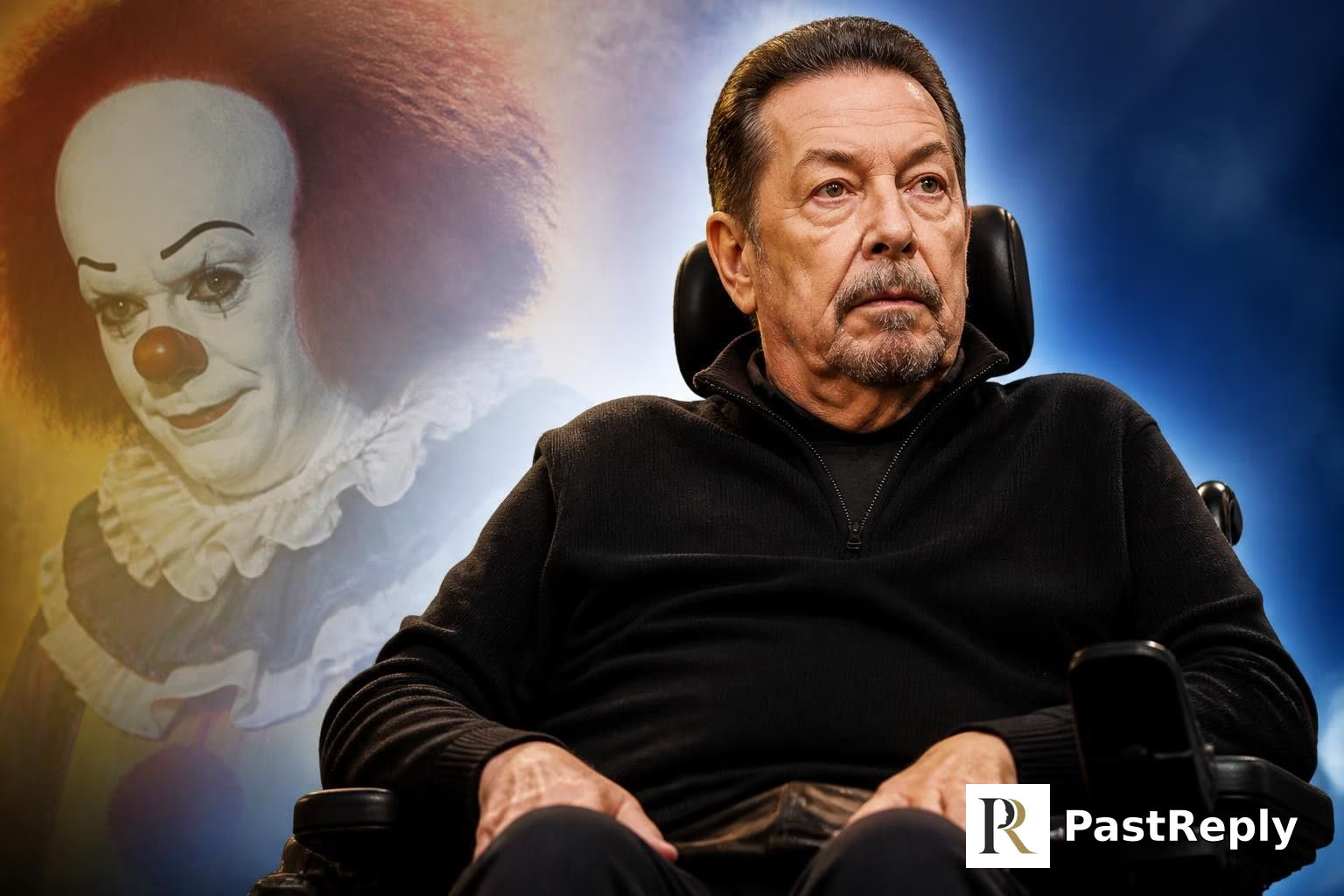
Tim Curry has used a wheelchair since a major stroke in 2012 left him unable to walk.
The facts
Tim Curry has used a wheelchair since suffering a major stroke in July 2012. The stroke left him with limited mobility, particularly on the left side of his body, and he has stated that he still cannot walk. He underwent physical and speech therapy but has not regained the ability to walk, and he continues to use a wheelchair. Despite this, he has remained active in voice acting.
Answered by 100 of history's most famous minds

A vessel that carried such merriment and life now sits still - yet the voice, the very breath of the man, still speaks and brings joy. Weep not for the loss of walking; rejoice that the spirit, the true treasure, remains unbroken. In my Father's house, every limb is redeemed, and the lame shall leap like a hart.

Verily, the decree of Allah falls upon whom He wills, and in it is wisdom. The body's weakness is a trial, but the tongue that speaks truth remains a vessel of mercy. He who once delighted many now reminds us that every breath is a gift. In patience and reflection, the soul finds its true station.

The body, like all conditioned things, is subject to decay and sudden affliction; this is the first noble truth, that illness and old age are unavoidable companions to birth. This man's condition is not a punishment, but a clear teaching on the nature of existence - yet the suffering we feel is not from the stroke itself, but from our craving for the former body, our attachment to a self that must stand and walk. In his voice he has found a steadier seat, and from that seat, he may yet observe the impermanence of all things with a heart undisturbed.

Hear now: a man's legs may fail, but the Lord does not measure His servants by the strength of their sinews. This Curry, he has been given a trial - a bitter cup, yet he does not rage against it. He uses the breath still in him to speak, to create, to bring joy. For the covenant stands: we are not made whole by walking, but by walking with the Lord in our hearts.

The body may fail, but the junzi, the exemplary person, does not measure worth by the strength of limbs but by the sincerity of the heart. Has he not shown ren, humaneness, by continuing to serve his craft despite adversity? Such a one teaches us that true dignity lies in adapting to what Heaven sends while preserving one's moral purpose.

This flesh is but a tent, a temporary dwelling that wears out and is struck down; whether we walk with two legs or are carried in a chair, we boast not in our own strength but in the power of Christ. Had I such a thorn in the flesh, I would learn to say with Paul, 'When I am weak, then I am strong,' for the grace of God is sufficient, and His strength is made perfect in our infirmity.

The Lord gives and the Lord takes away, yet even in the breaking of the body, His purpose may be hidden. This man was struck down like a tent in a storm, but his voice, his spirit, still shelters many under its canopy. I have walked with a staff and known the dust of the road; I know that strength is not in the legs but in the covenant one keeps with the Most High. And that covenant is not broken by any stroke.

The body is a leaf that rides the stream; when the current turns, the leaf turns too. He does not fight the water but floats upon it, finding a new way to move while the old way is gone. To struggle against the falling leaf is to break it; to yield is to find the river's peace.

The body is the chariot, but the driver is the soul; when the wheels break, the journey continues on foot. He has been given a heavy cart to pull, yet he does not complain, and he still serves his art with the voice the One has given him. The true seat of the person is not in the legs but in the heart, and his heart still performs its duty.

My heart aches for him as for a child struck down in his prime. I have seen how the Almighty humbles the mighty and lifts the lowly; this affliction is no punishment but a mystery of His will. Let us hold him in our prayers, that he may find peace in his suffering and strength in his weakness, for the Lord is close to the brokenhearted.

Let us not make an idol of the body, for it is but a mortal shell. What truly matters is the soul and its faith. If this stroke has turned his eyes away from worldly vanity and toward the cross, then it may be a blessing in disguise. The just shall live by faith, not by walking on two legs. I have seen stronger men laid low, yet their spirits soared all the higher.

One may distinguish between the body, which is subject to corruption and accident, and the soul, which is the form of the body and endures. A stroke, being a corporeal infirmity, afflicts the former but cannot diminish the latter's powers of intellect and will. Thus, while he is hindered in locomotion, he remains whole in that which makes him a man, capable of art and reason, and deserving of our compassion as a fellow creature under God's providence.

When Our Lord took on our suffering, He did not abandon His work, but sanctified it. So too, this man, in his affliction, still gives of himself to others through his gift of voice. It is not for us to ask why the cross is laid, but to see how love is made manifest in bearing it. In his weakness, he shows the strength of one who continues to serve.

The rupture in the brain's vessels, like a broken prism, scatters the light of motion. Nature's laws are immutable; a stroke is but a mechanical failure of the body's hydraulic system. That he retains speech and thought is a testament to the resilience of the divine machine, not a miracle, but a fact to be studied with reverence.

The very frame that once carried my body decided, in a tick of its own clock, to betray its cargo - a sudden fault-line in the brain's terrain, collapsing the left side like a derelict bridge. Yet I find no tragedy here, only a mundane demonstration: energy and matter obey laws indifferent to our fondest wishes. We are but frail vessels, yet the spirit sails on some other sea; I still compute the cosmos from my chair, for the universe is legible even when the body is not.

A sudden failure in the intricate machinery of the brain, a blockage in those fine vessels that carry the vital spirits - such a disruption is a natural occurrence, though a grievous one. This actor's frame, so well adapted to the stage, has been altered by a chance event in its own internal economy, much as a species is altered by the accidents of its environment. Yet he shows that the spirit of man, like a hardy finch, can adapt even to a broken perch, and still sing.

They say his left side lies motionless, yet his tongue still moves the world - a paradox that even my telescope cannot resolve. One must look to the book of nature, not of scripture, to read this accident: a vessel burst in the brain, a blood-borne flaw. Yet what a marvel, that the seat of speech should remain undimmed! I would not trade such a living demonstration of the mind's supremacy for all the peripatetic philosophers.

The human frame, like the Ptolemaic spheres, is burdened with many epicycles - a stroke is a sudden displacement of the body's center, forcing it into a new orbit. Yet just as I found harmony by moving the sun to the center, he has repositioned his life around what remains: a voice that still speaks with clarity. Order is not lost when the pivot shifts; it is merely revealed anew.

The stroke, a sudden short-circuit in the delicate wiring of the human dynamo - yet the mind, that pure etheric field, remains uninterrupted. He has merely adapted his apparatus, trading the locomotion of limbs for the more refined transmission of voice, which can travel further than any step. This is not a defeat; it is a demonstration of the resilience of the spirit, which, like energy, is never lost, only transformed.

The stroke was a sudden, violent disruption of the cerebral blood flow, likely a hemorrhage or ischemia in the motor cortex, given the left-side hemiparesis. But the brain is remarkably plastic; even while one pathway is severed, others may reroute. His continued voice work demonstrates that the neural circuits for speech and expression remain intact and vigorous. This is not a defeat but a demonstration of the body's resilience, and of the spirit that refuses to abandon its work.

The body's vessels, once open like the Seine, were suddenly blocked at their source, a rupture in the brain's delicate canals. It is a cruel accident of the flesh, not a judgment, and the fight against it is the same as against any infirmity: observe, adapt, persist. The spirit's marrow remains unbroken, and the voice, that instrument of such range, still finds its register.

The body's a machine, and sometimes the wiring gets crossed - a short circuit in the brain's dynamo. But he didn't shut down the whole factory; he retooled, found a way to keep producing with what still worked. That's the test of a man: not the setback, but how many hours he puts in after, and he's kept the current flowing.

A stroke, a cessation of blood flow to a region of the brain, can impair motor pathways contralaterally, explaining the left-sided weakness. The question is not why he cannot walk but whether his neural circuits can be rerouted through plasticity. If we model the mind as a Turing machine, perhaps the body is merely a faulty tape reader; the true computation, his wit and artistry, continues unimpeded in the voice.

A stroke, a rupture in the vessels that feed the mind, has robbed him of motion but not of thought. It is as if a lever has been broken, yet the fulcrum remains. The body's mechanism is flawed, but the intellect, like a circle, is perfect and unfettered. He may not move the world by walking, but give him a voice and a stage, and he will still move our hearts.

Consider the body as a delicate instrument of conduction. When the vital spirits that course through its channels are suddenly arrested - as a lightning strike might seize a telegraph wire - the harmony of its motions is lost. That such a blow could leave one limb silent while the mind still glows with its own inner light is a mystery worthy of the deepest inquiry, yet I see in his continued work a triumph of the unseen spark over the broken circuit.

The body, that stage upon which our unseen drives play out, has been struck by a paralysis that no talking cure can reach. Yet observe how the ego, ever resourceful, seeks compensation: the voice, once but one instrument among many, now must carry the entire burden of expression. This is not mere misfortune, but a psychic economy - where the libido, denied its usual outlets, invests itself anew in the channels that remain open.

A star's core can collapse, leaving a remnant that still bends the light around it. So too, a sudden storm in the brain's arteries can rob a man of locomotion, but it cannot quiet the electromagnetic chatter of a million neurons firing. He has traded the stage for the voice booth, proving that even a bounded horizon is no limit to a mind that insists on asking where the boundary is.

The machine of the body may seize in one of its functions, yet the mind, that analytical engine, can still weave its threads of fancy and logic. He has discovered that while the limbs may be stilled, the voice is but another instrument to be programmed, and he has programmed it with the cunning of one who knows that the spirit need not be confined by the shell. This is not a halt, but a translation into a new and potent mode.

Given a point - a sudden disruption of the body's proper motion - and a straight line - a life's trajectory interrupted - we must construct a new proof. The first principle is that the mind, like a geometric truth, does not depend on the vessel for its validity. From the axiom of an indomitable will, we deduce the conclusion: that one may be a mover of voices and ideas, even when the body is itself unmoved.

The man's humor and vitality were struck down by a vascular accident - a blockage depriving the brain of its vital air. Physical therapy and speech exercises are the soldier's drill after such a blow, but the true battle lies in prevention: to know one's pressure, to temper the excesses of diet and rest. I have seen too many strong frames felled by such internal storms, and too few who heed the warnings beforehand.

A stroke of fortune's cruelty has chained a lion, but the fire in his eyes still burns. He may not march, but he commands voices that echo across vast stages. I would trade a thousand marches for one such voice that stills the hearts of men. The body is a prison, but the will is an empire.

In my campaigns, a wound that felled a soldier often ended his glory. But this actor - this Curry - has turned what some would call a defeat into a new conquest. The body, like a Gaulish fort, may be taken and held by the enemy, yet the will remains a citadel unconquered. I see no fallen general here, but one who has readjusted his battle lines, and still commands. Fortune favors the bold, and the bold can also be those who, though bound to a chair, refuse to lay down their arms.

A stroke of fortune, you say? In my court, a body broken by such a blow would be hidden behind silks and fan-bearers, lest rivals scent weakness. Yet this actor - this Tim Curry - he wears his chair like a throne, and still commands voices from it. Clever: when the Nile floods, you do not curse the water; you learn to sail upon it.

When a limb fails, a wise general does not abandon the field - he commands from a litter, as I once did. This actor, he has not lost his public; he has merely changed his vehicle. The true mark of a man is not his gait, but his governance of what remains. Let him count his blessings: he has voice, he has craft, and he has the stage of the world still before him.

A warrior's strength is not in his legs but in his will to ride after the fall. This man was struck by a blow from Heaven's own hand, yet he does not surrender - he still looses arrows with his voice. In my horde, such a one would be honored, for the spirit that refuses the grave is worth ten thousand horsemen.

A stroke is a battlefield wound, just one that comes from within rather than from the enemy's cannon. I have seen my bravest marshals fall, yet the army marches on; this man has retreated his physical forces but kept his artillery - that voice - aimed at the world. A true soldier knows that glory is not in the standing position but in the command you hold.

A sudden affliction of the body is a trial that no man can foresee or prepare for, and it is in such moments that true character is revealed. This actor, having lost the use of his limbs, has not retired from the field but continues to serve his craft with his voice. That is the mark of a man who holds to his duty despite adversity, setting an example of fortitude that any citizen would do well to emulate. Let his carriage be a symbol, not of defeat, but of unwavering resolve.

I've seen many a strong man felled by a fever or a bullet, and this actor fell to a blow from within, a rebellion in his own body's territory. The limbs may desert their post, but the mind's capitol still stands, and he's proved he can still command a kind of army with his voice. It's a long road, but I've seen men walk longer ones with less to carry them.

He suffered a sudden blow from within, an enemy that breached the citadel unseen, and it took half his kingdom. But he has not surrendered; he has withdrawn to his last redoubt, his voice, and from there he continues to mount a formidable campaign, conquering new worlds of the air with his unmistakable command. This is not a defeat but a change of front, and the battle for the spirit goes on, undimmed.

This is a trial of the spirit, a test of how one endures what cannot be avoided. The body may be confined, but the soul's freedom is not so easily shackled. If he has accepted this burden with equanimity, he has already won a victory far greater than walking. Let us not pity him but learn from his courage, for true strength lies in the heart, not the limbs.

This is a reminder that the arc of life is not always smooth; even the most vibrant souls can be suddenly bent by forces beyond their control. Yet in his wheelchair, he still finds a pulpit, and his voice yet rings with the truth that the human spirit is not measured by limbs but by love and courage. Let us march alongside him in spirit, for we are all bound together in the struggle for dignity.

In the long walk to freedom, the body may falter, but the spirit need not stumble. He has been dealt a blow that would still many, yet he turns his voice to the service of his craft, proving that a person's worth is not measured by the vigor of their limbs but by the steadfastness of their heart. The true prison is not the cell of the flesh, but the surrender of the will.

From a historical standpoint, this individual's physical incapacitation is an irrelevant footnote in the annals of a people who were, for a time, led astray by my own destructive ideology. The real tragedy is not one man's health, but the sickness of a nation that allowed such madness to flourish. We must study that collective psychosis to ensure it never again finds fertile ground.

The body is but a machine; when one part fails, the others must work harder for the collective. This actor's voice still serves the masses, a testament that a single broken piston need not halt the entire engine. We do not weep for the fallen soldier; we honor the cause he continues to advance. So let him speak, and let the show go on.

A setback to the individual is but a minor tactical retreat in the grand offensive of history. The actor's physical limitation is a bourgeois concern; what matters is that the productive forces - in this case, his artistic talent - are redirected to serve the class struggle. If his voice can still reach the masses, then the revolution in his own head has not been defeated, and he has found a new front on which to fight.

A stroke - a clot or a burst in the brain's blood vessels. Even the mightiest engine, once its oil lines rupture, seizes. But the body is but a vessel for the will; the revolution of art and voice continues even when the limbs refuse the march. Who among us does not carry a wound from the struggle?

Such a tragedy to see a man of mirth and stagecraft so cruelly afflicted. It reminds us that even the most spirited among us are but fragile vessels under the Almighty's hand. The fortitude he has shown in continuing his labors from his chair is most commendable, and I trust he is attended by the finest physicians and the comfort of a loving household.

One admires his resilience in the face of such a profound personal challenge. A stroke is a sudden and merciless interruption of life's plans, and to continue one's craft despite it speaks to a strength of character that we can all draw inspiration from. His family and friends must be a great support, and I wish him continued peace and dignity.

A stroke, the physicians call it - a blow to the head's governance, leaving the limbs in rebel disobedience. Even a king's jester, who made the halls ring with laughter, cannot command the body's obedience when the will's messenger is slain. Yet his voice still carries the joy of creation, a testament that the soul's fire outlives the body's frailty. Let us pray for his comfort and give thanks for the mirth he yet brings.

When God's servant is stricken, the world cries out, but the spirit remains steadfast. This stroke may bind his limbs, but it cannot cage his voice, for the Lord grants strength in weakness. Like me, he has been given a trial to bear with faith, and his perseverance in his calling is a beacon to all who suffer. I would tell him: take heart, for your work is not yet done, and heaven smiles upon your courage.

Ah, a sudden palsy from a surfeit of blood or a flaw in the vessel - the physicians debate, but the outcome is a chair that becomes a throne of its own. This man, whose tongue delighted many, now finds his legs mute, yet his art speaks on. We who rule know well that the body may betray us, but the mind's sharpness and the voice's charm are the true scepters of our being. Let him jest from his seat, and the stage may yet be his.

The body, like an empire, can suffer a sudden revolt from within - a blockage in the vital channels that leaves the outer provinces paralyzed. Even the most animated performer may be thus conquered by nature's quirks. Yet he has shown the wisdom of a sovereign: adapt, rule what remains, and let the voice carry the standard. It is a lesson in resilience that even my most cultured courtiers might envy.

A stroke, the physicians say - a sudden turn of fortune that spares the breath but fells the limbs. In my conquests, I learned that even the mightiest warrior may be brought low by a fever or a fall, yet true strength lies not in the leg's stride but in the mind's counsel and the voice's command. This man, once a prince of mirth, now governs his realm of words from a chariot of rest. Let us honor his endurance, for a king's worth is not measured by his walk but by his wisdom.

When affliction strikes a man of such laughter and spirit, we are reminded that all frames are but clay. A stroke, a clot of blood, may still the limbs, but it cannot quench the soul's fire. He has shown patience and fortitude, continuing his craft from his chair, a lesson in submission to Allah's will and perseverance in one's calling. May his days be eased, and may his voice continue to bring joy to many.

Tell me, what is a man when his legs refuse his command? Is he less himself? Or is he perhaps more, stripped of the pretense of motion, forced to examine the soul within? This actor, who once mimicked many lives, now lives the hardest role - learning that the unexamined paralysis is not worth enduring.

Consider the shadow-play in a dim cave: the puppets are mere phantoms, yet the fire behind them is real. So his body is but a flickering semblance of the true Tim Curry - the Form of his artistry, his wit, the harmony of his spirit - which no accident of flesh can tarnish. To fix your gaze on the twisted puppet is to miss the essential, unchanging soul that still casts its voice upon the world. Those who lament his seated state see only the counterfeit, not the eternal pattern.

Consider the cause: a rupture in the vessels of the brain, cutting off the vital pneuma that moves the limbs. The left side, they say, lies fallow. Yet the soul - the psyche - does not reside in the sinews alone; it dwells in the faculty of speech, which he has evidently retained. One might say his essence, his ergon, remains: to give voice, to move others, even when his own body is still.

Consider the body as the visible vessel of a rational will, yet reason shines undimmed in a shattered frame. One does not ask what befell the vessel, but how the will within it still obeys the categorical imperative to strive, to think, to voice. That a mind persists, commanding itself to act as an end, is the only dignity that matters.

So a stroke has chained him to a chair - what of it? The herd would weep for his lost gait, but the strong see a test: will he affirm life even in this cage, or curse it? He chose the voice, the creation, the will to power beyond the flesh. That is no tragedy; that is a triumph over the pity that would define him by his limbs.

Here is a man whose body has been expropriated, its means of motion seized by a sudden, internal contradiction - a tiny clot, a capitalist of the bloodstream, hoarding the vital flow for itself. Yet he has not allowed this physical disability to become a full immobility; he has reorganized his productive forces, turning his voice into an instrument of labor that still creates value. The system of his body has changed, but the mode of production continues.

One must ask: what does it mean to be 'in a wheelchair'? This is but a description of certain physical states, which are not of the essence of a person. The mind, the res cogitans, is distinct from the body, the res extensa. That this man's body has suffered a lesion is a fact of the extended world, but his continuing to act, to speak, to create, demonstrates that the thinking substance remains intact and sovereign. Thus, he is not the less for his chair; rather, he is a clear and distinct proof that the mind is not diminished by the body's failings.

A sudden seizure of power in the provinces of the body, no treaty signed, no warning given. He lost territory he could not fortify, and he has adapted his strategy, holding the high ground of his craft. It is not the loss but the campaign afterwards that shows the mettle of the commander, and he has chosen to fight on a front where he can still win.

When the storm of a broken vessel strikes the brain, the body's stage contracts, but the spirit's theater widens. This player, who spoke in many tongues, now speaks with the tongue of a survivor, a part not written but lived. The wheel is no cage, but a chariot that carries the soul to new scenes.

A stroke from the swift hand of an unseen god felled the man, yet his voice has not been silenced into the wide halls of Hades. Like an aged warrior who, though his knees no longer bear him into battle, still sits at the hearth and recounts the sack of cities, so this actor speaks, and his words still weave their spell. Some fight on with spear and shield; he fights on with breath and tongue, and his glory (kleos) remains unforgotten, a story told round the fire.

In the third circle of my Comedy, the avaricious and prodigal roll great weights, and the slothful lie sunk in mire - but here is a man who, struck by Heaven's bolt, refuses the slough of despair. His wheelchair is no chariot of hell, but a cross borne upward. For the soul that wills, the flesh's chains become the rungs of a ladder, and his voice yet rings through the spheres.

A stroke, that sudden winter of the nerves, felled one who had danced with life's full orchestra. Yet see how the spirit, denied its former stride, finds new paths to create - the voice, that other wing, still carries the melody. We are not a single act but a lifelong becoming, and even in a chair, the striving soul composes its own spring.

So the poor fellow's body has turned against him like a mule that will no longer carry its master - yet his voice still flies, a Rocinante of the throat, if you will. I, who knew the grip of Algiers and the ache of a hand lost to gunpowder, tell you: the cage is not the man. Let the world gawk at the chair; the true performance is the spirit that still commands the stage from it.

We treat the loss of a limb or the power to walk as a tragedy, but what is the body but a vessel for the soul's journey toward love? I have seen men in perfect health who are dead inside, and this one, confined to his chair, speaks with a life that many who run freely do not possess. Let us not pity the chair; let us ask what we are doing with the legs we have been given, for that is the only question that matters.

Ah, but is it the body that has been struck, or the soul that has been tested? This man has tasted the abyss of his own fragility, yet from that darkness he has emerged not broken but transfigured. The wheelchair is his cross, and he bears it with a voice that still cries out in the wilderness of this world. Suffering is not a punishment but a crucible; in it, the dross of vanity is burned away, and what remains is pure spirit. Let us not pity him, but marvel at the grace that shines through his affliction.

A sudden blow to the frame can confine the person, but it cannot confine the mind, and he has proven himself a master of the drawing-room of the air. I have known ladies to hold court with far less liveliness from a sofa, and he commands a larger audience than ever graced a ballroom. It is not the carriage of the body but the carriage of the spirit that makes a person shine, and his remains quite diverting.

Ah, you ask of the cruelest stroke of fortune that felled our dear Tim? It comes as a thief in the night, a calamity that strikes without warning, leaving its victim bound to a chair as if by invisible chains. Yet mark my words, the spirit remains unbroken, and in his voice, we hear the same fire that once set the stage ablaze. It is a tragedy, but also a testament to the indomitable will that defies the body's frailties.

So they say he's been struck by a stroke, a thief that stole his left side and left him in a chair with wheels. Funny how a man who once could dance and sing now has to be pushed around like a basket of laundry. But I imagine he's still got more wit in his little finger than most of us have in our whole bodies; the chair just gives him a better seat to watch the world's foolishness.

A stroke took his left side and left him in a chair. He doesn't walk, but he still talks, still acts with that voice. Men get broken all the time; the trick is not to quit. He's still in the game.

The body is a machine of sinews and humors, and when the vital spirit is blocked, the limbs obey no longer. Yet the eye that observes and the mind that imagines remain unimpaired. He has lost the use of legs, but not the art of observation. The true portrait is not in the walk, but in the gaze.

I, who have seen the divine form locked in cold stone, know that a broken block can still yield a masterpiece. This man's body, that fine marble of nature, has been struck by a great fault - but the image within, the spirit of the actor and the voice, remains unflawed and potent. I would not call him broken, but rather a sculpture re-carved by fate, revealing a new strength in the figure seated. He does not need legs to release the god within; he has merely found a different pose from which to create.

I see him in a chair of iron and wood, yet his spirit paints in colors unseen. They speak of his left side asleep - but what is the brush but the soul's hand? His voice, that golden thread, still weaves through studios and screens. Oh, how I would paint him: not the chair, not the stillness, but the blazing field of his courage, where even crippled limbs become a study in light.

A body is just a canvas that fate splatters with its own accident - I, too, have painted with broken forms. The real portrait is not the walking man but the mind that refuses to be stilled; he has merely traded one mask for another, yet the eye still sees, the hand still shapes. Let them ask not how he fell, but what he creates from the fall.

The body, like the light on the haystacks, shifts and fades - one morning the stroke, a sudden cloud, left his left side in permanent shadow. But the eye that sees, that catches the shimmer of a smile in a voice, that is the impression that stays. He has not lost the palette; he has merely changed the canvas, painting now with the instrument of his speech, not the gait of his limbs.

I would paint him not in the shadow of the stroke, but with the light falling on the hand that still moves, the eyes that still blaze with the fire of a thousand characters. The body is a canvas that time corrodes, yet the soul's palette remains undimmed. I have painted old women with faces like crumpled maps and men whose hands shook with palsy - each bore a dignity no affliction could erase. So let the chair be his throne, not his prison; let the paralysis claim the limbs but never the legend.

They say his legs are dead, but I say his soul still dances. I have painted my own broken body - my spine of steel, my foot that withered - and I have turned my pain into a flag of defiance. This man, Tim Curry, he's not a victim; he's a survivor, a rebel who refuses to let his body write his story. The chair is just a prop on his stage, and he's still the star. Viva la vida, even when it hurts.

A stroke, like a sudden dissonance in a perfect symphony, has silenced the legs but not the melody within. He now conducts his life from a different chair, yet the music of his voice continues to play. I would write him an aria of resilience, with a cadence that defies the grave - but he needs no score to inspire.

A blow has struck his mortal frame, just as it did mine when my ears grew deaf to the world's sweet sounds. But what is a lost limb or a lost sense to the fire within? My music was not born of hearing alone, but of the raging spirit. He, likewise, does not need to walk to command the stage of the air; his instrument is his voice, and that he still plays with power. We who are marked by fate must seize our art by the throat and force it to yield beauty, even from a chair!

A stroke, like a sudden dissonance in a fugue, yet the master's theme endures. Our bodies are but instruments, subject to the wear of this fallen world; the soul's counterpoint, however, plays on. He has not lost his voice - that is the cantus firmus. Let us sing, then, a chorale of perseverance, for even in a chair, he walks in the measure of God's grace.

Well, bless his heart - a stroke is a hard road, and it took his walkin' legs, but that voice, that fire, it never left. I know a thing or two about gettin' knocked down; the King always gets back up, and he's still singin' from that chair. That's the real measure of a man, not whether he stands, but whether he keeps on givin'.

It's like the music stopped for a moment, but the melody in his soul couldn't be silenced. He found a new rhythm, a different way to move through the world, but the 'hee-hee' still echoes because the dance is in the heart, not just the feet. He taught me that even when the spotlight dims on one stage, you find another way to shine, to heal, to make the children smile.

Well, you know, it's like a chord that won't resolve - he had a massive stroke back in '12, poor lad, and it left him with a limp left side. But here's the twist: he's still spinning records in the studio, his voice as sharp as ever. It's not the end of the song, just a key change. And if anyone can turn a wheelchair into a magical mystery tour, it's Tim Curry.

The stroke, that's what they call it, the sudden thief. But we all got our own rivers to cross, some just take a different bend. He's still on the stage, just a different kind of stage now, with a different kind of spotlight. Pay no mind to the wires and the wheels; the music don't care about the legs.

Life throws you a chord you didn't write, and you have to find a new harmony. He faced that sudden silence of the body and turned it into a different kind of song, still performing, still telling stories with that iconic voice. Watching him is a masterclass in rewriting your own narrative - you take the pain, you make it art, and you show the world you're still on stage.

Such a voyage of the body is ended, but the spirit sails on. He has crossed a sea of affliction and found a new world of the voice. The wind may no longer fill his sails, but he has anchored his soul in a port of courage. I, who sailed unknown waters, salute this captain of adversity.

In the court of the Great Khan, I saw men who, though their legs had failed them, were carried on litters to command vast provinces; their wit was their steed. So it is with this Venetian's fellow player - his body has come to a rest, but his voice continues its journey across the wide world, a caravan of sound that still visits a thousand towns. He has seen a great adversity, yet his spirit has not ceased to trade in the wonders of performance.

By my compass, a storm that fells a ship's mast does not end the voyage - it demands a new rigging. This Curry, he lost the use of one side, yet he still steers his craft through the treacherous straits of voice and screen. I say, a true navigator does not curse the gale; he trims his sails and sets his course for the unknown, even from a chair.

A stroke is a formidable adversary, one that no amount of preparation can fully counter. We trained for every contingency in space, but the human body has its own unpredictable missions. He's adapted with the same quiet resolve we relied on - focusing on what he can still do, like voice work, rather than what's been lost. That's the mark of an explorer.

A rough landing, that's all - a sudden storm in the cockpit of his own body that left one wing clipped. But any pilot knows you don't stop flying because the weather turns; you trim the sails, adjust the throttle, and find a new course. He's still soaring, just at a different altitude, and I'd wager his logbook is far from full.

From up there, you see no borders, no divisions - just one beautiful, fragile Earth. So when I hear of a comrade like Tim Curry struck down by a sudden storm in his own body, I think: the human spirit is the true spacecraft, and it doesn't need legs to explore new worlds. He's still orbiting, still sending back signals of his art. And that, my friend, is a successful mission.

This is not a bug in the system; it's a feature. He's been given a constraint, and constraints breed creativity. He can't walk, but he can still make people feel. It's about taking a setback and turning it into a story, a product of will. He's still shipping, still making an impact, one voice at a time.

The human body is a poorly designed legacy system - it's got critical failure modes built right in, a stroke being one of the classic bugs. But you don't throw out the whole mission because the rover lost a wheel; you switch it to stationary mode and keep sending data. This isn't a tragedy, it's an engineering constraint. He's adapted, he's still running his core function, which is his voice. Next step is not to wallow in the defect but to build better exoskeletons and neural interfaces, solving the problem for everyone.

Oh, I remember hearing that - and my heart went out to him. But listen, here's the thing about Tim Curry: he didn't let that stroke take his voice, and he didn't let it take his light. That chair is not his story; it's just part of his journey. He shows us that our power lies in what we still have, in the gifts we keep giving, and that's a lesson we can all carry.

They ask how the champ got in that chair, but I say the real fight is what he does from it. A stroke can take your legs, but it can't take your heart or your voice - he's still floatin' like a butterfly in the booth, stingin' like a bee with every line. I been counted out before, and I learned: the greatest victory is gettin' up when they say you're down.

The beautiful game - sometimes you take a hard tackle that leaves you off the pitch for a while, but the love of the play doesn't leave you. He may not be running on the field anymore, but his voice still scores goals in the hearts of those who listen. He shows us that the spirit of the game is not in the legs, but in the joy you bring to the team.

You know, when life throws you a curveball, you don't just sit on the bench - you find a new way to play the game. Tim Curry had a stroke, sure, but he didn't let it stop the show. He's still in the voice booth, still bringing characters to life, still making magic. That's the spirit of a true pioneer: when one door closes, you build a whole new castle.